ABSTRACT
FOOTE, KATHLEEN TERESSA. Diffusion, Implementation and Reinvention of a University Physics Reform: The Case of SCALE-UP. (Under the direction of Robert Beichner.)
Educational researchers, including those specifically concerned with improving physics education, have spent a lot of time, effort and resources in developing research-based strategies to improve instruction. Many have documented how their techniques successfully improve various factors from conceptual learning gains to attitudes towards science and more. However, the majority of college science instruction still uses traditional techniques, implying these reformed materials have not achieved a widespread impact.
This dissertation uses SCALE-UP (Student Centered Active Learning Environment with Upside-down Pedagogies) as a case study to examine how research-based reforms spread and is implemented in real-life secondary sites. This reformed pedagogy and
We found interpersonal networks were an important source of information about the reform. More importantly, how implementers receive information and make sense of the reform impacts curriculum development efforts. At the sites studied in Chapter 2,
implementation was an iterative process with instructors constantly making modifications to better fit the reform to their students, teaching style and instructional setting. In Chapter 4, instructors developed a working form of the curricula during their first or second semester teaching the course then avoided making significant changes.
A unique aspect of the SCALE-UP reform is the structural changes required to create a studio-style classroom and class time to integrate lecture, laboratory and recitation sections of a science course. The census revealed the reformed classroom is also associated with higher levels of active learning and study 3 revealed that instructors to radically renovate their curricula to fit the new studio space.
This work has important implications for researchers, curriculum developers and instructors interested in spreading reformed teaching. Utilizing interpersonal networks, including preexisting ones, could aid dissemination efforts. Reforms are modified, which can be positive in many ways, however misunderstandings about the reform can lead to non-productive modifications. Thus, researchers should be aware of how instructors understand the reform so they can anticipate and eliminate any misconceptions that may lead to
nonproductive changes.
This exploratory work opens up many potential avenues for future research. The case studies in Chapters 2 and 4 focuses on relatively successful sites that have achieved
Diffusion, Implementation and Reinvention of a University Physics Reform: The Case of SCALE-UP
by
Kathleen Teressa Foote
A dissertation submitted to the Graduate Faculty of North Carolina State University
in partial fulfillment of the requirements for the degree of
Doctor of Philosophy
Physics
Raleigh, North Carolina 2015
APPROVED BY:
_______________________________ _______________________________
Robert Beichner Albert Young
Committee Chair
_______________________________ _______________________________
BIOGRAPHY
Kathleen Foote was born in Farmington, Connecticut to Lauren and James Foote on June 28, 1988. As the daughter of an engineer and nurse, she has always been interested in math and science but also interested in making the world a better place for the people in it through education and global awareness. From the first day of kindergarten, she knew she wanted to teach. From the first day of high school, she knew she wanted to teach physics.
After graduating high school, Katie attended Providence College with a double major in applied physics and secondary education in physics. She enjoyed her time teaching in high schools around Rhode Island but felt something missing in traditional science classes. A summer research opportunity at the University of Minnesota exposed her to the field of Physics Education Research and it felt like a perfect fit. She wanted to learn more physics and hoped to improve education in a field that she loved but many do not appreciate.
She joined the physics graduate program at NC State with the intention of learning new pedagogical techniques and conducting research in physics education under the direction of Dr. Beichner. In addition to developing research skills, Katie took advantage of
ACKNOWLEDGMENTS
As the crown jewel of academics is nearly in reach, I have spent time reflecting on the past two decades I have spent in school. I never had trouble memorizing facts, applying equations and writing papers and through college, my role models were teachers who could explain things efficiently, taught me long division and made physics “phun”. Graduate school was the first time I was ever asked to do something new and now I am most grateful for all the people who did not tell me the answer.
As with any journey worth undertaking, moving toward a PhD had its ups and downs, its moments of confusion and clarity and its successes and failures. When you start to
specialize for a PhD, your path diverges from all your predecessors and suddenly you seem alone on an isolated island of expertise. At times, I felt like I was swimming in unchartered seas of unfamiliar literature, following ideas down twisted paths of tangentially-related topics, standing in caves devoid of inspiration and I fell down more than once (literally… and broke three bones during my graduate career). Sometimes all I wanted to know was where to go next but no one could (or would) point me in a definitive direction. While the lack of immediate gratification felt frustrating, I knew I had support and encouragement throughout the process. I am infinitely appreciative of the people who stepped back and let me figure these things out for myself because all that I learned about physics and education pales in comparison to what I learned about life.
researchers I admire most: Charles Henderson, Melissa Dancy, my advisor Robert Beichner and post-doc Alexis Knaub. A National Science Foundation fellowship EAPSI OISE-13 funded my summer research in Singapore and part of the data collection for Chapter 2.
Much appreciation goes to my thesis advisor, Robert Beichner and the NC State STEM initiative for connecting me to people and funds for me to pursue my research interests, from Massachusetts Institute of Technology to Japan.
My project involved reaching out to instructors and institutions for data collection and I am infinitely grateful for the faculty members who invited me into their classrooms, took time to talk to me and share classroom resources.
I was fortunate to be surrounded by outstanding graduate students and faculty while conducting my research. Thank you to the committee members who I have not yet
TABLE OF CONTENTS
LIST OF TABLES... viii
LIST OF FIGURES ... ix
CHAPTER 1: Introduction And Literature Review ... I. Motivation ... 1
II. Large Scale Literature Review ... 8
A. Diffusion of Innovations And Communication Channels... 9
B. Dissemination of Innovations in Organizations ... 12
C. Implementing SCALE-UP and Related Instructional Innovations ... 16
III. Useful Theoretical Constructs... 33
A. Sense-making Framework... 34
B. Adoption-Innovation Continuum ... 36
IV. Overview of Dissertation... 39
A. Purpose of Project ... 39
B. Overarching Research Questions: ... 39
C. Overarching Methodological Approach... 40
D. Overview of Dissertation ... 42
CHAPTER 1 REFERENCES ... 45
CHAPTER 2: Factors Underlying the Adoption and Adaption of a University Physics Reform over Three Generations of Implementation ... Abstract... 55
I. Introduction ... 55
II. Literature Review ... 58
A. What is SCALE-UP and why study it?... 58
B. Implementing Active Learning Classrooms in Asia and the United States ... 59
C. Theoretical Framework: Diffusion of Innovations... 61
III. Methods... 63
IV. Research Questions ... 63
V. Data Collection ... 64
A. Interviews... 64
B. Clasroom Observations ... 65
C. Credibility... 68
VI. Results and Discussion ... 68
A. Research Question 1: Initiation (Agenda-setting and matching) ... 68
B. Research Question 2: Redefining/restructuring ... 72
C. Research Question 3: Clarifying/reunitinizing... 75
D. Research Question 4: How do the current implementations compare? ... 79
VII. Limitations... 80
VIII. Conclusions ... 80
IIX. Acknowledgements ... 82
CHAPTER 3: Diffusion of Research-Based Instructional Strategies: The Case of SCALE-UP ...
Abstract... 87
I. Background... 88
A. What is SCALE-UP and why examine it for this study?... 90
II. Literature Review ... 92
A. Innovation Attributes ... 93
B. Communication Channels ... 95
C. Adopter Characteristics ... 96
D. Role of Adaption... 98
E. Research Questions ... 100
III. Methods... 100
A. Survey Design ... 100
B. Survey Implementation ... 102
C. Limitations of the Study... 104
IV. Results and Discussion ... 107
A. Resarch Question 1: To what extent has SCALE-UP spread?... 108
B. Research Question 2: Through what communication channels does word about SCALE-UP spread? ... 113
C. Research Question 3: How do secondary sites adapt pedagogy and structure of SCALE-UP?... 117
V. Conclusions... 125
VI. Summary ... 131
CHAPTER 3 REFERENCES ... 132
CHAPTER 4: Curriculum development in studio-style university physics and implications for dissemination of research-based reforms... Preface to Chapter 4 ... 137
Abstract... 139
I. Introduction and Motivation... 139
II. Literature Review ... 142
A. Sense-making Framework... 144
B. Adoption-Innovation Continuum ... 147
III. Research Questions ... 148
IV. Methods ... 149
A. Data Collection ... 149
V. Analysis ... 152
VI. Results... 153
A. Institution A ... 153
B. Institution B... 155
C. Institution C... 157
IX. Future Work ... 176
CHAPTER 4 REFERENCES ... 177
CHAPTER 5: Conclusions ... I. Summary of Findings... 184
II. Implications ... 188
III. Limitations And Directions for Future Research... 190
LIST OF TABLES CHAPTER 2
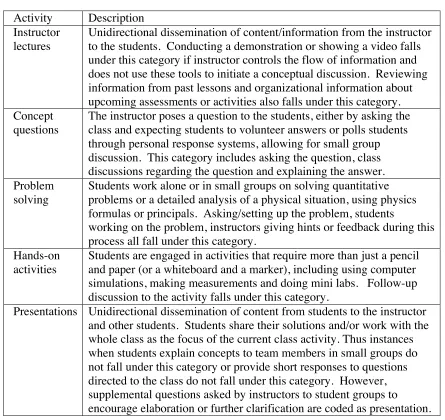
Table 2.1 Description of coding scheme for activities ... 67 CHAPTER 3
Table 3.1 Distribution of departmental affiliation for survey respondents ... 107 CHAPTER 4
LIST OF FIGURES CHAPTER 1
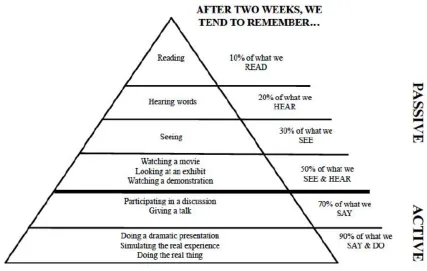
Figure 1.1 Dale’s (1969) Cone of Learning... 22
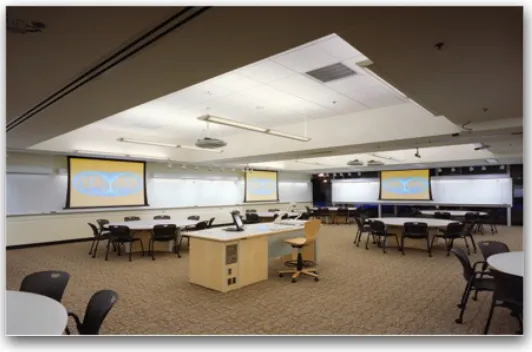
Figure 1.2 SCALE-UP style TEAL classroom at MIT... 25
Figure 1.3 Adoption-Innovation Continuum ... 37
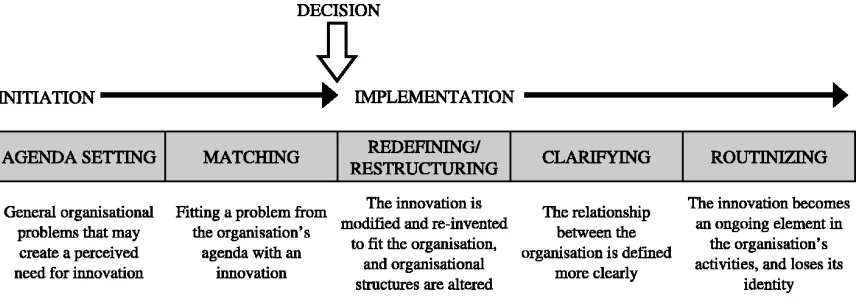
CHAPTER 2 Figure 2.1 Implementation in Organizations (Rogers 2003) ... 63
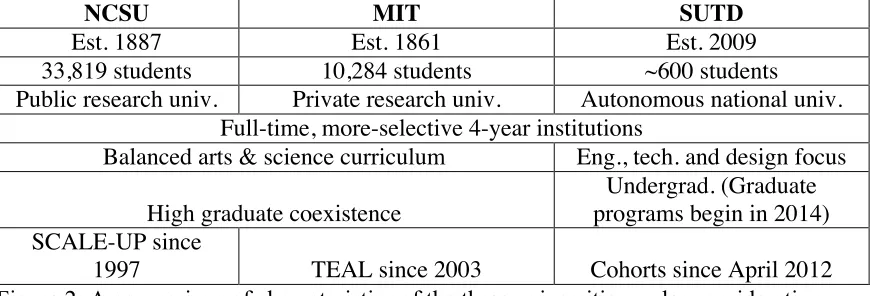
Figure 2.2 Comparison of major characteristics of 3 universities ... 64
Figure 2.3 Percentage of class time in various instructional activities... 78
CHAPTER 3 Figure 3.1 S-shaped adoption curve ... 98
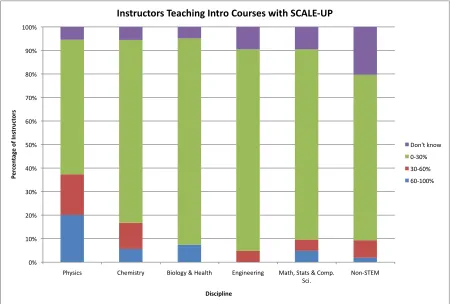
Figure 3.2 Percentage of instructors using SCALE-UP in introductory courses ... 109
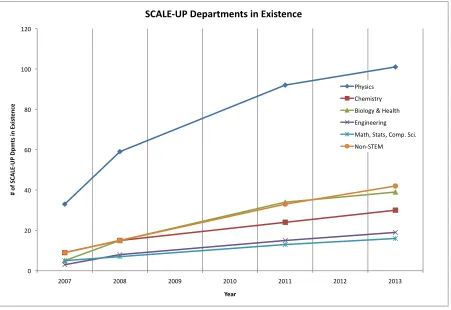
Figure 3.3 SCALE-UP departments in existence by discipline... 110
Figure 3.4 Source of information about SCALE-UP by duration ... 112
Figure 3.5 Active-studio indicators by source of information... 116
Figure 3.6 Active indicator and studio match by self-described user status ... 118
Figure 3.7 Active-studio indicator by discipline ... 120
Figure 3.8 Distribution of active indicator by classroom type ... 121
Figure 3.9 Percentage of departments with specialized classroom equipment ... 122
Figure 3.10 Departmental stance on building a classroom... 124
CHAPTER 4 Figure 4.1 Adoption-innovation continuum ... 147
CHAPTER 1: Introduction And Literature Review
This chapter will provide an overview of the motivation, large-scale literature review and relevant theoretical constructs underlying this study. Then, the second half of this chapter will discuss the structure of the dissertation and contents in more detail.
I. Motivation
Over the past several decades, countless efforts have been made to develop innovative teaching strategies to improve science, technology, engineering, and math (STEM) education for all students. Countless publications reveal that these alternative teaching methods can successfully boost learning gains while improving a host of affective factors (Wieman 2007, Redish 2003, Docktor & Mestre 2011). However, the combined efforts of researchers, federal agencies, private foundations, and internal institutional programs have achieved little overall change in STEM teaching in higher education, especially large research universities (Wieman, Perkins & Gilbert 2010, Dancy and Henderson 2010, Handelsman et. al. 2004, Henderson and Dancy 2009, National Research Council 2003, Redish 2003). After
developing a new innovation, many researchers disseminate their findings primarily through one-way transmission methods, such as publishing a paper or giving a talk at a conference (Khatri, Henderson, Cole & Froyd 2013) but this traditional Development and Dissemination model rarely leads to widespread adoption (Fixsen, Naoom, Blase & Friedman 2005).
members’ pedagogy, particularly when that change conflicted with their beliefs about teaching and learning” (p. 13) and that professors’ “pedagogical discontentment” in their own classes was a far more important factor when considering change (Southerland, Sowell, Blanchard & Granger 2011). Adopters will filter the information and advice they receive to consider, try, adopt and maintain selectively that fits with their perceived needs, priorities and circumstances (Green, Ottoson, Garcia & Hiatt 2009). Thus, it will be important to investigate how instructors understand a reform and what information effectively motivates them to make a change.
Even if instructors attempt to use a reform, the implemented result can deviate from the intended use or take on new forms (Henderson & Dancy 2009, Henderson 2005) and this new model should explicitly account for the implementers’ tendencies to make
modifications. Rarely does a reform fit perfectly into the user environment so, almost inevitably, users modify, alter and refine the reform to fit their local setting (Barley 1986). These adaptations can have mixed results.
On the positive side, faculty are more often open to trying flexible reforms that allow adaptations according to faculty expertise (Henderson & Dancy 2008, Penberthy & Millar 2002, Silverthorn, Thorn & Svinicki 2006). As Cohen and Ball explain, “teachers view themselves as independent, autonomous professionals… Even the most obedient and traditional teachers observed, enacted policies in their own ways and were proud of their contributions” (1990 p. 253).
faculty openness to a reform, reinvention allows users to take ownership of an innovation, improving sustainability. Flexibility in adapting a reform may encourage customization of the innovation to fit local or changing conditions and make the reform more responsive to current and future problems (Rogers 2003).
However, especially with more complex and harder to understand innovations, users can make modifications that compromise effectiveness. Many educational reforms have ended with the innovative instruction gradually fading until it becomes indistinguishable from initial instruction (Hutchinson & Huberman 1994). For example, researchers studying learning gains at a secondary site found improvements after using Interactive Lecture
Demonstrations were “nowhere near” those claimed by developers (Sharma et. al. 2010) and did not know how to achieve promised results at their institution. Thus, more research is needed to understand the role of reinvention so secondary implementers can achieve increased satisfaction and sustainability without sacrificing educational benefits. My dissertation explicitly monitors modifications in all three studies and focuses intensely on how instructors come up with a curriculum to accompany the reform in Chapter 4.
Despite making modifications to adapt to their local situation, many faculty members still discontinue use after trying these instructional strategies (Henderson, Dancy &
Niewiadomska-Bugaj 2012). Since this “show them and they will adopt” does not promote productive, sustained use of reform, the literature calls for a more robust, research-based model of change (Fairweather 2008, Seymour 2002, Henderson, Beach & Finkelstein 2011).
adopters, very few studies examine how secondary sites initiate, implement and use innovative pedagogies. Often, developers do not articulate the underlying organizational support structures needed to ensure outcomes. This can contribute to disappointing results when secondary sites try to use the same reform with different students, instructors and educational settings (Finkelstein & Pollock 2005, Pollock & Finkelstein 2008, Saul & Redish 1997, Sharma et al. 2010). To identify what went wrong, one must investigate the
mysterious “black box” implementation stage (Fullen & Pomfret 1997, Fixsen et. al. 2005. Fixsens et al. (2005) urge researchers to study this process at secondary sites to figure out core intervention components so other implementers know what can be adapted to local settings and what must be preserved. Only by examining the complexities of incorporating innovations into new settings can we generate relevant, believable and actionable advice for future implementers.
“Enacted use” can vary significantly from the developer’s intentions especially since the literature rarely explicitly advises secondary sites on how to overcome challenges and achieve success in different environments. Most of the available literature on innovative pedagogies comes from the “best-case scenario” of development sites that have access to grant funding, a project team, faculty release time and education experts that contribute to published success rates. Similarly, Green et al. (2009) explains that much of the existing innovation literature holds little practical value to secondary implementers since studies have
This thesis is written during an exciting (and intimidating) time for education.
Universities are facing increased competition, greater numbers of non-traditional students, ageing facilities and decreased governmental funding (Douglass 2010, King & Sen 2013, Jones, Ramanau, Cross & Healing 2010). Online universities, Massive Open Online Courses and other freely available course materials put even more pressure on administrators to defend the unique value of a brick-and-mortar education (Martin 2012). Economic pressures, both nationwide and within schools, push instructors to use class time and resources
effectively. Faculty members are increasingly expected to cut failure and withdrawal rates, especially in introductory STEM courses, which are gatekeepers for preparing the
scientifically literate workforce this nation needs. These growing concerns have placed education in the forefront of national conversation and demanded change.
Faced with this rising crisis, many college administrators have begun to search for strategies to improve institutional quality and effectiveness. Fortunately, they have
thousands of research-based reforms to choose from (Docktor & Mestre 2011, Redish 2003) and studies have documented success at development sites. However, for these reforms to facilitate wide-scale educational transformation, the nature of implementing reforms by secondary users must be better understood. Subtle contextual factors, broader institutional structures, social networks and faculty behavior all impact the enacted form of the
educational innovation. Thus, we need to consider all these factors, and the interactions between them, to understand how reforms are put into use at secondary sites.
variety of natural instructional environments as well as relating more detailed findings to a snapshot of nationwide use. Dr. Robert Beichner developed SCALE-UP (“Student Centered Active Learning Environment with Upside-Down Pedagogies”) for large enrollment
university physics courses at North Carolina State University in 1997 (Beichner et al. 2007, Beichner 2008). This fairly open-ended reformed pedagogy and classroom design blends several research-based strategies and has successfully crossed disciplines and continents for use in at least 314 departments at 189 higher education institutions worldwide (see chapter 3). Some of SCALE-UP’s most essential elements include the promotion of social
interactions among students and teachers, the integration of lab and lecture, and a focus on developing conceptual understanding and critical thinking skills.
SCALE-UP is worthy of examination for multiple reasons. When implemented well, Redish (2003) found that radical reforms, like SCALE-UP, lead to higher learning outcomes than more modest reforms. A variety of data sources reveal SCALE-UP effectively
improved students' problem solving ability, conceptual understanding, and attitudes toward science, while promoting success in later courses and reducing attrition rates (Beichner et al. 2007, Beichner, Saul, Allain, Deardorff & Abbott 2000). To spread these benefits amongst a wider population, we must understand how to spread this reform (and others) successfully to secondary sites.
Socratic dialogue, real-world problem solving and technology-rich activities. Reforms that involve structural changes, like SCALE-UP, often require a high up-front investment that we hypothesize will impact the implementation process by involving a commitment by
administration.
The extensive and relatively informal dissemination of this radical course change has led to fairly significant variations in implementation, providing a wide variety of instructional interpretations to investigate. SCALE-UP is not discipline or curriculum specific, which allows us to explore how instructors chose implementation materials. The large number of secondary sites allows us to study implementation in a variety of settings, stages of
implementation and at locations with varying intra-institutional spreads. Additionally, SCALE-UP has been disseminated through a variety of formal and informal means, both by the developer and by advocates at other sites.
Examining how information reaches and transfers into use for SCALE-UP use in
environments fundamentally different than the development site will help reform developers understand how their reforms are used in natural settings. Identifying the reason behind common adaptations will help identify which aspects of reform should remain flexible and where they might need to intervene to dissuade users from making non-productive changes. Understanding how reformers learn about this innovation and try to use it will hopefully have implications for the dissemination of other reforms.
Chapter 2 will follow the SCALE-UP reform through three generations of
results from a large-scale census of current SCALE-UP sites, to quantitatively characterize the stage of diffusion across disciplines as well as identify characteristics of reform users and implementations. Finally, Chapter 4 will examine how reform imitators make sense of the reform and create a curriculum for use at their institution.
II. Large Scale Literature Review Scope of Literature Review
Even though people have been conducting innovation diffusion research for decades, the field still lacks a single, unified, widely accepted theory of implementation. Researchers have approached this issue from a variety of disciplines, including rural sociology,
marketing, health policy, and educational reform, and the literature consists of a mind-bogglingly large collection of non-generalizable theories, each addressing a different aspect of the diffusion process or a different type of innovation. Klein & Sorra (1996) point out,
“Because each implementation case study highlights a different subset of one or more implementation policies and practices, the determinants of implementation
effectiveness may appear to be a blur, a hodge-podge lacking organization and parsimony. If multiple authors, studying multiple organizations, identify differing sources of implementation failure and success, what overarching conclusion is a reader to reach? The implementation literature offers, unfortunately, little guidance” (p. 1059).
Furthermore, although case studies determining conditions for innovation adoption are abundant, innovation scholars have long lamented the lack of research on the implementation stage (Beyer & Trice 1978, Hage 1980, Roberts-Gray & Gray 1983, Tornatzky & Klein 1982) which is acknowledged as a critical period for complex organizations innovations like SCALE-UP (Van de Ven & Rogers 1988).
has come to presenting a comprehensive theory of diffusion” (Surry & Farquhar 1997 p. 3). Then, we will present literature pertinent to understanding the issue at hand, concentrating on the implementation/reinvention process of complex process-based innovations in
organizations, like SCALE-UP. We are particularly interested in implementations where the adopting unit
“is the team, department or organization in which various changes in structures or ways of working will be required. In such circumstances, there is almost always a formal decision-making process, an evaluation phase or phases and planned and sustained efforts at implementation” (Greenhalgh, Robert, Macfarlane, Bate & Kyriakidou 2004 p. 600-601).
In these situations, complicating factors due to the larger adopting unit means much of the literature on simple, product-based innovations adopted by individuals cannot be generalized (Greenhalgh et al. 2004). Therefore, this review will primarily employ literature surrounding the adoption of complex, organizational innovations that require active and coordinated use for adoption.
This section will wrap up with more extensive background on SCALE-UP, its
pedagogical goals, relevant research-based strategies and relevant implementation literature. In order to pick out the “core implementation” features of the reform, it is important to understand what the reform aims to accomplish and how the development site and secondary sites achieve those goals. Relevant implementation literature helps predict which elements may transfer more naturally than others.
A. Diffusion of Innovations And Communication Channels
system, ultimately changing the structure and/or function of this system. Diffusion research, at its simplest, investigates how the features of the innovation itself, the communication channels, members of the social system and a multitude of other factors, interact to facilitate or impede the adoption of a specific product/practice amidst a particular adopter group (Rogers 2003). Since an innovation relies on a social system to spread, much of the
innovation’s success depends on its compatibility with the past experiences of individuals in that system.
Lomas (1993) was one of the first to define a clear distinction between diffusion and dissemination and most researchers who draw a distinction follow her definition. She defines diffusion as a passive concept that is largely unplanned and uncontrolled, so it typically reaches people who are already open to and seeking out the message. She contrasts this with the more active concept of dissemination, which “not only implies a more aggressive flow of information from the source… and a targeting and tailoring the information for the intended audience.” (Lomas 1993, p. 226) Although this definition has been influential in the field, Rogers uses dissemination and diffusion interchangeably to describe the transfer of
information. Thus, I will also not distinguish between the terms in this work.
flow mostly in one direction (Rogers 2003). As will be discussed in the sense-making framework portion of this chapter, the expert-novice knowledge imbalance can lead to misinterpretations of the reform (Spillane, Reiser & Reimer 2002). Futhermore, Mintrom & Vergari (1998) claim that most people considering adoption want practical information from users in similar situations to themselves;
“Rather than rely upon mass-media channels or the outcomes of scientific investigations, most potential adopters base their judgments of an innovation on information from those who have sound knowledge of it and who can explain its advantages and disadvantages” (p. 124).
McLaughlin (1990) urges policy makers to look beyond formal policy structures to spread information and, instead, utilize preexisting professional networks as a vehicle to spread innovations, as these natural, more homophilious networks can lead to more sustainable change. This is also why secondary sites should share their successes and failures since their experiences can be more relatable than the best-case scenario of development.
This information can be used to improve research-based reform efforts at colleges and universities. Traditionally, Principal Investigators and reform developers use one-way
transmission modes for dissemination (publishing a paper or giving a talk at a workshop) but Rogers (2003) recommends researchers need to do more than just spread awareness of a “better” way to do things. Similarly, with regards to physics education, Henderson & Dancy (2007) proved that showing faculty members that lecturing does not work is
active learning so that scientists feel they get their most urgent needs met first” (p. 4-5). For example, demonstrating the reform addresses the problems that faculty members witness in their classes: students are not engaged, motivated and do not do their homework (Wieman et al. 2010). Overall, this theory suggests successful dissemination needs to facilitate practical information sharing that address issues that faculty members perceive to be relevant (Khatri et al. 2013, Mintrom & Vergari 1998) with information exchanged amongst faculty members who share a common understanding, opposed to more formal channels.
B. Dissemination of Innovations in Organizations
Rogers 5-Step Innovations in Organizations Adoption Model
Rogers started thinking about the diffusion of innovations in organizations when he realized that organizational adoption is required before individuals even have the option to adopt certain products. For example, if a district does not provide computers to the schools, then teachers do not have the option of teaching with computers (Rogers 1983). A major turning point in innovation research was when Zaltman, Duncan & Holbek (1973) published Innovations and Organizations that explored this topic in detail and inspired a 5-step
innovation process for organizations (Rogers 2003).
implementation of federally funded projects in the RAND study. Projects started by opportunism related to the availability of funds evidence little local commitment while reform efforts started to solve a problem led to greater changes.
Next, during agenda-matching, an organization matches their goals with an innovation to determine how well they fit before attempting an implementation. Bourdenave (1976) found that “innovation-system fit” between the innovation and its potential context, is generally a more valid and useful construct than the fixed, context-independent “innovation attributes” mentioned in earlier literature (Klein & Sorra 1996).
A satisfactory completion of these two steps leads to the implementation phase when an organization puts the innovation into use. This phase is subdivided into three steps:
redefining/restructuring, clarifying and routinizing.
During redefining/ restructuring, the innovation is re-invented to accommodate the organization’s needs and structure more closely. “Adaption is precipitated by
implementation misalignments— mismatches between the technology and the organization recognized at the time of initial or trial use” (Rogers 2003 p. 255). Usually both the
(Rogers 2003 p. 429, O’Loughlin, Renaud, Richard, Gomez & Paradis 1998). Furthermore, Ives & Olson (1984) demonstrate that user participation in customizing a technology to their needs improves user satisfaction. Other literature confirms this result carries over to
education since faculty members are more open to adaptable reforms that acknowledge their expertise (Henderson & Dancy 2008, Penberthy & Millar 2002, Silverthorn et al. 2006).
Next, clarifying occurs as the organization puts the innovation into more widespread use and its significance gradually becomes clearer to organizational members. When an
organization first introduces a reform, it usually has little meaning. During this stage,
members figure out how an innovation works, how it impacts the organization as a whole and how they are personally influenced. This stage may involve working through
misunderstandings or unwanted side effects, sometimes through the aid of a “champion.” Since probability of opposition is higher in larger adopting units, champions play an important role for organizational innovations. These individuals throw their weight behind an innovation, thus overcoming resistance that the new idea may provoke (Schon 1963, Rogers 2003, Greenhalgh et al. 2004) especially as people try to figure out how an innovation may affect them during the clarifying stage.
one or a few powerful individuals, sustainability is at risk if key figures leave (Rogers 2003). Other factors that influence sustainability is (1) the degree of reinvention (2) the fit between the intervention and the organization and (3) involvement of the local champion (O’Loughlin et al. 1998).
Although this can guide our thinking about stages in the organizational innovation process, several researchers warn against taking this process literally at the organizational level, “the move from considering an innovation to successfully routinizing is generally a nonlinear process characterized by multiple shocks, setbacks and unanticipated events” (Van de Ven et al. 1999). Polley, Garud & Venkataraman (1999) point out that the model holds better in managerial situations when executives make top-down decisions for the whole company but decision making in schools can be more complex (Etzioni 1961, Hage 1999) since each faculty member has more autonomy to respond the ideas, information and other social forces. Thus diffusing the innovation within schools may take more effort (Frank, Zhao & Borman 2004).
from supervisors (Klein, Hall, & Laliberte 1990) and financial incentives for innovation use (Wienman et al. 2010) and more.
C. Implementing SCALE-UP and Related Instructional Innovations
In 1995, at North Carolina State University, Dr. Robert Beichner developed SCALE-UP (originally “Student-Centered Activities for Large Enrollment Undergraduate Programs”) as an alternative to the traditional lecture approach for introductory physics. Before SCALE-UP, instructors who wanted to incorporate active learning into their large enrollment classes typically were limited to implementing interactive lecture activities like Peer Instruction (Mazur 1997) and Interactive Lecture Demonstrations (Sokoloff & Thornton 1997) and then reserving hands-on activities for smaller laboratory or recitation sections. SCALE-UP provided an alternative, allowing instructors of large-enrollment courses to replace a
lecture/recitation/laboratory model with studio instruction, where the same group of students and instructors engaged in activity-based instruction for 4-6 hours per week. Now SCALE-UP has spread to all class sizes and dozens of disciplines (see Chapter 3).
Pedagogical goals of SCALE-UP (which should be common across all implementations) include creating a learning environment in students collaborate with their peers to question, teach one another and present their work to the class. The developer recommends instructors to reduce lecture by replacing it with activities and coach students to answer their own questions.
This section describes relevant research-based materials that influenced or are used in SCALE-UP classes, since they are relevant for understanding how modifications compare to the original reform (especially in Chapters 2 and 4). Some of these research-based materials can be implemented almost as designed by the developer but others may need considerable modification for successful use in the local SCALE-UP setting. SCALE-UP’s flexible approach and lack of specific curriculum encourages instructors to tailor their reform use to their learning objectives, student population, class size and classroom environment. The development website contains instructional materials in introductory physics (designed for 99 students) but lacks systematic suggestions for how resources may be altered for smaller classes or different resources. Chapter 4 explores how instructors at secondary sites create their own curriculum to accompany their implementation of the SCALE-UP pedagogy.
The following literature review describes key components of the pedagogy (cooperative learning and active learning) and learning goals (conceptual understanding and problem solving) of the SCALE-UP approach, including relevant research-based educational
UP at secondary sites. The composite papers do not have space for detailed descriptions of the underlying components of SCALE-UP but they are included here since this is important for understanding how modifications made by secondary users could influence the
implemented reform. 1) Collaborative Learning
Collaborative learning restructures the educational environment so learning is not an individual activity but instead takes place as students work in small groups, defining problems, posing questions, gathering data, interpreting findings and sharing conclusions with team members and classmates. Promoting interdependence encourages collaboration as students work to construct and share knowledge, taking ownership for their participation and contributions to the class (Johnson & Johnson 1978). As the students take a more active role, the teacher facilitates group effort, providing necessary resources to ensure success.
Collaboration helps students understand and master the vocabulary, methodology and the goals of knowledge in a particular discipline.
female or minority students are not alone in the first grouping, since they are often not as influential in team settings as they should be (Heller et. al., 1992).
At the beginning of the semester, training in group functioning and group roles sets expectations for how students are expected to meaningfully contribute to group work (Heller et al., 1992). Group roles can include (a) the manager who plans the approach; (b) the skeptic, who questions the plan and assumptions; and (c) recorder who organizes and reports the results of discussion. Students often spontaneously adopt these roles but instructors are encouraged to assign and rotate these roles. This encourages students to examine problems from a variety of perspectives while decreasing the likelihood of one student dominating group work.
Cooperative Learning (CL) is defined as students working in groups on structured tasks. According to Johnson et al. (1991), there are five critical characteristics to doing this
successfully:
1) Positive interdependence: Team members have to rely upon one another and benefit from working together.
2) Individual accountability: Each member is responsible for mastering the material and contributing equally to the group work.
3) Face-to-face interaction: Most of the group effort must be spent with members working together.
5) Regular self-assessment of group functioning: Groups need to evaluate team functioning and identify ways to improve
SCALE-UP uses group contracts, group evaluations and teamsmanship bonuses on exams and individual quizzes (where students attempt the quiz individually but can consult the group for a small penalty) to promote this kind of collaboration. Formal and informal collaborative learning activities like think-pair-share, cooperative note taking, think aloud group problem-solving and jigsaw activities encourage collaboration within and between groups. For a more complete description of these classroom practices that facilitate these aspects of CL, see Beichner et al. 2000.
The room and classroom equipment were designed to promote collaboration. The 7-foot round tables were empirically optimized for group interaction in large classes (Beichner et al. 2007)- large enough for sufficient workspace during activities but small enough so students can communicate across tables. Sharing key resources, like computers or lab equipment, and writing on white boards also promote group cohesion by creating positive interdependence. The tables seat three groups of three students, and places different groups in close proximity so teams can help each other. The instructor can promote intergroup collaboration by having teams evaluate each other’s work or by creating assignments where three teams work on related problems and share resources.
Two examinations of CL use amongst secondary schoolteachers (Ishler, Johnson, & Johnson 1998, Abrami et al. 2004) may have implications for implementing SCALE-UP, although secondary school teachers have more background with educational underpinnings than a typical physics professor. Both studies found teachers needed to be empowered to believe CL will work in their situation and supportive communities at their institution may help; “it may be useful, but not sufficient, to show teachers how successful others have been with CL techniques... follow-up training for skill refinement and for adaptation of the innovation to a teacher’s particular situation may also be essential” (Abrami et al. 2004 p. 211). As collaborative learning is central to the SCALE-UP pedagogy, these
recommendations may carry over. Proof that collaborative learning works somewhere may not convince faculty to risk trying CL in their classrooms. Adopters may need specific guidance, support and empowerment to convince them it can work in their situation before they decide to adopt.
2) Active Learning
Felder and Brent’s models of student intellectual development (2004a) and implications for the classroom (2004b) recommend students should be presented with a variety of learning tasks to simultaneously challenge and support them in a student-centered learning
Figure 1: Dale's (1969) Cone of Learning
Students are expected to come to class having read about the day’s topic so content coverage remains equivalent to that of lecture sections. The instructor can then minimize lecture during class to 10-15 minute periods to motivate, summarize and outline important points. Just-in-time teaching (JiTT) (Novak 2011) techniques, clicker quizzes at the start of class and/or online quizzes administered through web-based grading systems like WebAssign (Risley 1999) can hold students accountable for mastering the basics of content knowledge prior to coming to class.
lecture in calculus-based physics courses for up to twenty-four students. The technology-rich and inquiry-based curriculum involves students in making observations, doing experiments and using computers to help students build independent investigation skills. Research indicates students prefer the workshop method, demonstrate improved laboratory skills, improved performance on conceptual questions and have equivalent problem solving performance to traditional sections (Laws 1991).
Rensselaer Polytechnic Institute developed an early “studio” classroom called the “Comprehensive Unified Physics Learning Environment” (CUPLE) (Wilson 1994). Here, slightly larger classes of 30-45 students met for two hours two times per week (Cummings, Marx & Kuhl 1999) in a combined lecture and laboratory session that allowed contact hours to be reduced 60% from a traditional model without a reduction in course content. Initial gains on the Force Concept Inventory were disappointing (equivalent to typical gains in traditional courses) but improved when instructors introduced Interactive Learning
Demonstrations and Cooperative Group Problem Solving (Cummings et al. 1999) into the course. Cummings et al. (1999) concluded that without research-based activities, the “use of the studio format alone does not produce improvement in conceptual learning scores as compared to those measured on average in a traditionally structured course” (p. 44).
studios consist of up to 40 students working in teams of 4 on short, concept-oriented “lab demos” and homework problem-solving activities. Although there’s still a front of the classroom, the students have moveable chairs, computer access and can use blackboards for “chalk talks”. New Studio allowed Kansas State engineering classes to achieve gains “on par with those obtained through other styles of interactive instruction “Sorensen et al. 2006, p. 10-11) without requiring extra classroom space or faculty contact hours.
These studio-style predecessors influenced the development of SCALE-UP but Beichner adapted these models to accommodate large enrollment classes (at least for his first SCALE-UP implementation). In addition, SCALE-SCALE-UP added a more purposeful classroom redesign to these predecessors. Students work at round tables with networked computers and access to whiteboards as public thinking spaces. Multiple display screens around the room allow students to showcase and evaluate each other’s work (Beichner et al. 2007, Beichner 2008). SCALE-UP’s intentional studio-space design eliminates the “front” of the room so
instructors are less likely to lecture and instead engage students in activities. Equipment is accessible so students can do laboratory experiments and 10-15 minute hands-on “tangible” activities. These shorter experiments may involve making estimates and order-of-magnitude calculations as students use the predict-observe-explain model to address common
Figure 2: SCALE-UP style TEAL classroom at MIT
The Technology-Enriched Active Learning (TEAL) project at Massachusetts Institute of Technology (Dori et al. 2003, Belcher 2003) uses a SCALE-UP-style classroom and
pedagogy and add two- and three- dimensional tools for visualizing electromagnetic concepts. All introductory physics courses at MIT are now taught in this format. Studies show lower failure rates and higher conceptual gains in TEAL classes (Dori & Belcher 2005) and long-term knowledge retention compared to traditional sections (Dori, Hult, Breslow & Belcher 2007).
3) Conceptual Learning
To address student difficulties with fundamental principles, minds-on “ponderables” are calculations or conceptual questions designed to elicit-confront-resolve student
initially developed Peer Instruction to be used in large lectures. The instructor should stop every 10-15 minutes to present a ConceptTest to the class using the process described below:
(1) Question posed
(2) Students given time to think
(3) Students record or report individual answers (4) Neighboring students discuss their answers (5) Students record or report revised answers (6) Feedback to teacher: Tally of answer (7) Explanation of correct answer
This strategy is especially popular with instructors because it substantially increases
conceptual understanding with minimal additional instructional time (Cummings et al. 1999). Even though this process is usually facilitated through the use of clickers, instructors may use personal response systems for questions in a broader domain than the specific subset of ConcepTests designed to target specific misconceptions.
“large discrepancies in students’ opportunities to engage in formulating and asking questions, evaluating the correctness and completeness of problem solutions, interacting with physicists, identifying themselves as sources of solutions, explanations, or answers, and communicating scientific ideas in a public arena” (2009, p.14).
How instructors implement Peer Instruction and clickers could contribute to the effectiveness of the SCALE-UP reform as a whole.
facilitate the Tutorials (or a modified version) properly in SCALE-UP settings, since that might affect student participation and performance.
Literature on how Tutorials have been specifically adapted to SCALE-UP settings is limited. When piloting these Tutorials in the SCALE-UP classroom, Beichner (2008) suggests breaking these lessons up into 5 to 15 minute segments interspersed with brief, class-wide discussions to ensure students stay on track and allow for instructors to address difficulties before any group gets too far behind. Ithaca College used a modified version of the Tutorials in their 99-student SCALE-UP-style “Performance based physics” (PbP) implementation (Rogers et. al. 2015). When they first introduced the Tutorials into PbP algebra-based classes, students would work uninterrupted for a significant amount of time but later, they broke up tutorial work by elements of lecture or clicker questions. Despite difficulties dealing with a higher student: faculty ratio (40:1 at its lowest) and the initial lack of a dedicated course to prepare undergraduate TAs, PbP courses started to see a slightly higher normalized change on the FCI compared to before the Tutorials were implemented. Now, a one credit weekly course trains undergraduate TAs in pedagogy and how to facilitate the Tutorials.
College’s PbP curriculum as a supplementary research-based strategy to promote conceptual learning.
4) Real-world Problem Solving
SCALE-UP implementations typically include Real World Problem Solving activities, adapted from Cooperative Group Problem Solving techniques. SCALE-UP students at NC State are trained in the GOAL problem solving protocol, inspired by Polya (1957) and encouraged to Gather Information, Organize and plan, perform the Analysis, and Learn from their efforts. Heller, Keith & Anderson (1992) found textbook problems were typically too straightforward to guarantee that students need to work together, using a problem solving protocol. To motivate higher-order problem solving beyond plug-and-chug, NC State SCALE-UP students are provided with challenging, realistic situations modified from Context-Rich Problems (Heller & Hollabaugh 1992), Activity-based Physics Thinking Problems (Redish 2001) or created in house. These problems are designed to read more like a story with a rationale for calculating specific quantities about real objects or events. The problems may not specify the unknown variable, may contain distracting information and/or require students to make assumptions or estimations, if necessary information is missing. These problems encourage students to apply physics concepts and principles instead of just asking, “what formula should we use?” Students are encouraged to work in groups with assigned roles working out their solutions on whiteboards which involves all group members in coming up with a solution and critically evaluating each other’s work.
enrollment introductory physics courses. Students are trained on an explicit five-step problem solving strategy and work together in structured groups of 3-4 students (see section C1) on context-rich problems. In well-functioning groups, students “share conceptual and procedural knowledge and argument roles, and request clarification, justification, and elaboration from one another, so a better solution emerges than could be achieved by individuals working alone” (Heller et al. 1992 p. 635). This study showed that this kind of collaboration did occur, that group solutions were better than that of any single group
member and that problem-solving skills of students of all abilities improved at approximately the same rate. This resulted in more expert-like approaches than students in a traditional course. Training the students in the problem solving protocol and its relation to the goals and structure of the course reduced content coverage slightly. Implementing this effectively also required explicitly training teaching assistants about the protocol, common student misconceptions, how to grade problems and how to maintain well-functioning groups. 5) Special considerations implementing SCALE-UP at secondary sites
In addition to the literature on implementing aspects of SCALE-UP, some research discusses the implementation process at secondary sites. Beichner et al. (2007) outlines steps for starting implementations at secondary sites. First, faculty and departments must be willing to recognize the value of a new way of teaching. As Dori (2007) elaborates,
institutions) or decide to convert the whole department (which can happen in smaller departments). This requires time to restructure courses and for faculty to build skills to be successful in this new format because “coaching student groups through activities and guiding class discussions require different skills than lecturing” (Beichner et al. 2007 p. 30). SCALE-UP instructors need to build skills beyond structuring a good lecture presentation: they must know the activity, anticipate student difficulties, guide students back on the right track and check for understanding. Students may also need guidance to change expectations about their role as a student in this reformed class (Felder & Brent 1999, Gaffney, Gaffney & Beichner 2010, Silverthorn 2006).
Beichner et al. (2007) recommends new instructors should shadow experienced faculty members and/or have weekly instructional meetings on how to teach activities, especially for non-PER (Physics Education Research) faculty who may miss some of the intricacies of research-based materials. Beichner et al. (2007) elaborates, the meetings and classroom observations of more experienced instructors can introduce “new SCALE-UP faculty… to the how and the why of SCALE-UP activities while still having the freedom to tweak them” (p. 31). This paper provides specific examples from University of Central Florida, Rochester Institute of Technology and Massachusetts Institute of Technology to demonstrate different techniques for classroom management and professional development.
Beichner et al. (2007) deemphasizes some of the logistical and administrative challenges of starting and maintaining a SCALE-UP reform but these can cause real problems at
Moelter 2011, Enderle, Southerland & Grooms 2013). For example, California Polytechnic Institute spent years improving their studio physics model, documented learning gains but only had access to one room. When other colleagues wanted to use the room for laboratories and other projects, the Studio effort was disbanded for several years (Hoellwarth & Moelter 2011). The implementation process, including advice on dealing with logistical issues, is discussed in detail for a primarily undergraduate residential college (Rogers et al. 2015) and several large research universities (Florman et al. 2014, Enderle et al. 2013, Breslow 2010).
Ithaca College gradually introduced education research-based materials (Peer Instruction, Washington Tutorials, think-pair-share, open-ended laboratories) into their course over a six-year period and found that conceptual gains did not automatically accompany the renovated room until the pedagogy was changed to match. They claim it took years after making the proposal to see results so they emphasize the importance of buy-in from the department and individuals from multiple parts of an institution to ensure sustained support throughout the process.
Enderle et al. (2013) describe the “kinetics” of a studio physics implementation at Florida State University, exploring personal and contextual factors that facilitate and impede their effort at implementation. They claim sufficient time is the critical fundamental factor for any change effort, consistent with Rogers et al. (2015). They also found motivation levels of individual faculty do not sufficiently explain the implementation effort. Even though a core group of faculty members wanted to change the way introductory physics was taught, the studio program faced challenges from several sources that shifted over time, during the establishment of the studio physics program. The paper enumerates many tensions
“stemming from operational realities of large, research universities” (p. 16) that this reform effort faced. This work confirms an organizational perspective that accounts for some of these situational barriers is required to view the implementation of SCALE-UP.
Furthermore, the two-year study demonstrated how much these organizational conditions change over time, reminding us “the measurement of implementation as a ‘snapshot’ of what users are actually doing with respect to the innovation at one point in time” (Fullan and Pomfet 1977 p. 366) since the nature of innovation use often is constantly renegotiated with the changing circumstances of the institutional community.
III. Useful Theoretical Constructs
A. Sense-making Framework
Spillane et. al. (2000) provides a sense-making framework that explains many reasons implementers make modifications, including personal preference, situational constraints, social influences and how they make sense of the reform. Grounded in individual and situated cognition, this framework describes how the disseminator’s framing of information can affect how an instructor receives information and subsequently perceives the reform
(Spillane 2000). This interpretation can be further affected by the instructor’s preexisting knowledge (Cohen & Weiss 1993), beliefs, experiences and current situation including
organizational and community history (Lin 2000; Yanow 1996) and interaction in formal and informal networks (Coburn 2001).
Since researchers and instructors have different values and backgrounds, this can
complicate knowledge transfer and impede utilization (Henderson & Dancy 2008, Spillane,
Reiser, Reimer 2002, Beyer & Trice 1982). Agents cannot simply communicate the policy and expect immediate understanding. Instructors need time to interpret the reform and clarify implications for their behavior within their existing cognitive structures, their situation and the policy signals.
The first element of the framework applies to how individuals comprehend and make sense of innovation. In a traditional “one-size-fits-all” dissemination model, an
mediated through users' earlier knowledge, with the policy message ‘supplementing’ rather than ‘supplanting’ teachers' earlier practice” (1993, p. 227). The interference of individual cognition can cause people to interpret the same message in different ways, to falsely perceive new ideas as familiar (and eliminate the need for change) or to miss deeper relationships because of superficial features (Spillane et al. 2002). Thus, individual sense making for learning new instructional approaches involves more than simple memorization; it may require restructuring a complex of existing theories about what it means to teach and learn within a discipline. Usually this means that implementers need extended exposure to develop a deep understand of reform; Chapter 4 investigates how initiator’s ideas about the SCALE-UP reform affect their curriculum development efforts.
Implementation practice is not simply a function of an individual agent's ability and skill since the surrounding situation and social interactions can impact implementation (Greeno 1998). Individuals make sense of their world in the context of "thought communities" (such as professions, nations, political parties, religions, and organizations) (Resnick 1991;
Zerubavel 2000) that situate their sense-making. In the second component of our framework, we consider how organizational and historical context, formal and informal communities and communal values and emotions affect sense making. Knowledge is emergent from the interactions of the participants in a given setting as individuals learn from and watch one another (Campione & Brown 1990; Brown, Collins & Duguid 1989), similar to the
The final component of this framework investigates how developers present the policy. Policymakers need to represent ideas about instruction in ways that enable sense making, including concrete examples grounded in underlying theory. In order for implementers to perceive a need for change, policy makers must create a sense of dissonance in which agents see problems with current instruction so they are willing to fundamentally change practice, which is what Southerland et. al. (2011) calls “pedagogical discontentment.” Once agents recognize problems with existing methods, they more willingly restructure existing beliefs to make room for the new idea. Cohen & Hill (2000) found policy is more likely to influence teaching when teachers' opportunities to learn are extended over time, grounded in the pedagogy presented, and are connected to several dimensions of teaching.
B. Adoption-Innovation Continuum
This project seeks to understand the implementation process and enacted use of research-based pedagogies, using SCALE-UP as an example. We want to examine the
implementation process, “what an implementation consists of in practice” (Fullan and Pomfret 1977 p. 336) so the adoption-invention continuum helps us identify which elements of a reform are modified and directly adopted. This is important since current models of diffusion reveal few reforms are implemented as designed. For example, Henderson & Dancy (2008) demonstrate that new users often adapt and reinvent instructional tools to fit their needs, adding new characteristics that distinguish it from its planned or intended use.
When looking at enacted classroom use, one must recognize the role of both the
less as prescribed (Ellsworth 2000, Fullan 2002) since this would blind us to how instructors independently innovate in their classrooms (Henderson 2005). Furthermore, adaption should not be ignored since it can have positive benefits including increasing the chances of
sustained change (Rogers 2003, O’Loughlin et al. 1998). This study plans to take a neutral stance on adaptation, especially since SCALE-UP does not have a specified curriculum and therefore cannot be adopted without input from the instructor.
Henderson and Dancy (2008) propose an adoption-invention continuum to investigate how substantially physics faculty members modify reforms. As seen in Figure 2, the continuum ranges from an adoption pole where the external agent develops all materials to be implemented as is to an invention pole where the instructor controls the development with minimal external influence.
To see where on this continuum most enacted undergraduate physics curricula fell, Henderson and Dancy (2008) asked five faculty members to describe their use of research-based strategies, including what changes they made and why. Even though these faculty members tended to agree with education research on the problem they wanted to solve in their classroom, most (70%) of the changes the instructors made fell on the
reinvention/invention side of the continuum. Instructors often did not implement the complete research-based solution and sometimes made fundamental modifications inconsistent with underlying research. This happened even though these instructors were “likely physics education research users” who wanted to improve their teaching with new techniques.
Henderson and Dancy (2008) also found most faculty members believed educational researchers expected them to use models as prescribed. As a result, they often re-invent the curricula alone without sharing the successes and failures of their modifications amongst other users. Even when the developer of SCALE-UP tried to get implementers to share their resources on the SCALE-UP wiki (http://scaleup.ncsu.edu), instructors were hesitant,
claiming “the resources were not ready” or “would not be helpful for others” (personal communication 3/3/2015). Hiding information from other users deprives other secondary implementers and the research community of valuable information.
reform can transfer and gain recommendations for context-dependent modifications. This continuum helps quantify change.
IV. Overview of Dissertation A. Purpose of Project
This study responds to a call for a close examination of educational change and attempts to describe the highly personal, dynamic and interactive process that unfolds as institutions adopt complex educational innovations in non-trivial, context-dependent situations. The goal is to use case studies and a nationwide census to develop an evidence-based theory of
diffusion that allows for adaptation by examining enacted use of SCALE-UP in natural instructional environments.
We hope we can use this reform, which has achieved more success than others, to guide general implementation efforts. By conducting case studies of relatively successful
secondary sites, we can identify what adaptations sites tend to make, which may have implications for how reform developers should support them. Ideally, this will allow secondary sites to take advantage of flexibility of form without sacrificing function.
Studying how people understand and implement the SCALE-UP reform will have important implications for framing and spreading research-based reforms, for both reform developers and policy-makers.
B. Overarching Research Questions:
3. During use, how do users further modify the reform to fit their local setting? Why do they make changes?
4. How do sites achieve sustained use of the reform?
C. Overarching Methodological Approach
This research project was undertaken to promote successful dissemination of SCALE-UP and other innovations, a goal that requires strong linkage between theory and practice. Interest in the dissemination of educational reforms is still relatively new and existing literature exposes holes in the current research and calls for more evidence-based studies (Fairweather 2008, Seymour 2002, Henderson et al. 2011). To improve our scholarly understanding of the dynamics of diffusion of innovations, using case studies is the only appropriate methodological approach to capture real-life complexity. The internal and external environments of each institution are unavoidably unique in ways that cannot be accounted for by empirical studies that eliminate distinct contextual factors. Case studies and qualitative data are needed to offer insights into complex social processes that quantitative data cannot reveal, especially since the literature lacks unified, viable theory and related empirical evidence.
theoretical framework, these studies fall into the final category. As Eisenhardt and Graebner (2007) explain,
“The central notion is to use cases as the basis from which to develop theory
inductively. The theory is emergent in the sense that it is situated in and developed by recognizing patterns of relationships among constructs within and across cases and their underlying logical arguments” (p. 25). [italics original]
As mentioned in the literature review, an awareness of existing theoretical constructs may illuminate some of our interpretation without constraining the analysis to testing hypothetical relationships.
When done well, the likelihood of validity is high using the theory-building approach because the underlying hypotheses have repeatedly undergone verification and because of the close tie with evidence. Critics of case study research claim theories are limited by the investigator’s pre-conceptions but that can be avoided with a divergent approach to data analysis. By constantly juxtaposing conflicting realities by iteratively comparing cases, the case study process has more potential to unfreeze thinking with less researcher bias than incremental studies (Eisenhardt 1989).
1990). In Chapter 4, we spoke to the same people multiple times over a span of several years to verify previous comments.
Having both qualitative and quantitative data provides a synergy of additional depth and understanding of underlying relationships. Systematic data helps to build foundational relationship but anecdotal data is needed to explain complex relationships, “Theory building seems to require rich description, the richness that comes from anecdote. We uncover all kinds of relationships in our hard data, but it is only through the use of this soft data that we are able to explain them” (Mintzberg 1979 p. 587).
In summary, because of the lack of unified theory surrounding the innovation
implementation process of educational at institutions of higher education, the research aim of this study was to form evidence-based hypotheses by understanding implementation in multiple settings. A review of literature led to the formulation of a tentative theoretical conception of the implementation process in organizations to help identify factors that might affect this process. As will be seen in subsequent chapters, data was collected and analyzed in a way to posit and investigate the relationship between factors. This approach aims to lead to an empirically-grounded innovation dissemination theory that can provide guidance for researchers and policymakers.
More detailed discussions of the methods used for particular studies are described in subsequent chapters.
D. Overview of Dissertation