A Novel Codebook Technique for 3D Face
Recognition
Prof.Kanchan S.Gorde1, Ankita Baoney2
Assistant Professor, Department of Electronics, Terna Engineering College, Navi Mumbai, India.1 M.E Student, Department of Electronics, Terna Engineering College, Navi Mumbai, India.2
ABSTRACT: In this paper we present a novel technique for 3D face recognition base on shape and texture features.
Face Recognition Technology (FRT) is used in several disciplines such as image processing, pattern recognition, computer vision.3D face recognition is used in various area such as law enforcement, criminal identification, and passport and visa verification and so on.3D face recognition has many challenges such as illumination ,pose variation ,aging and facial expression.In our proposed system, shape features are detected by edge detection algorithm. Laplace, Canny and prewitt edge detection algorithm are used here. Texture features are obtained by vector quantization and codebook is generated by using LBG (Linde Buzo Gray) algorithm. Codebook is the feature vector of the entire image and can be generated by using clustering techniques. By taking average of reference codebook threshold value is calculated and comparing it with average value of each image the image is classify to given category. Then Classification rate is calculated for varying codebook size. All the results are tested on 3d Texas database. The proposed system gives the good performance.
KEYWORDS: 3D face recognition, edge detection, shape and texture feature, codebook generation
I. INTRODUCTION
The information age is quickly revolutionizing the way transactions are completed. Everyday actions are increasingly being handled electronically, instead of with pencil and paper or face to face. This growth in electronic transactions has resulted in a greater demand for fast and accurate user identification and authentication. Access codes for buildings, banks accounts and computer systems often use PIN's for identification and security clearance.
Using the proper PIN gains access, but the user of the PIN is not verified. When credit and ATM cards are lost or stolen, an unauthorized user can often come up with the correct personal codes. Despite warning, many people continue to choose easily guessed PIN’s and passwords: birthdays, phone numbers and social security numbers. Recent cases of identity theft have heighten the need for methods to prove that someone is truly who he/she claims to be.
Biometric technology has been used for recognizing the individuals. A biometric is a unique, measurable characteristic of a human being that can be used to automatically recognize an individual or verify an individual’s identity. Biometrics can be classified on basis of physiological and behavioural characteristics. Physiological biometrics include a. Finger-scan b. Facial Recognition c. Iris-scan d. Retina-scan e. Hand-scan
Behavioural biometrics (based on measurements and data derived from an action) include a. Voice-scan b. Signature-scan c. Keystroke-Signature-scan
A “biometric system” refers to the integrated hardware and software used to conduct biometric identification or verification. We are using face for recognizing the individuals. Face is our natural identity. Humans are good in recognizing the faces. Face recognition doesn’t need any physical interaction from user hence it is efficient technology and also it is accurate and very secure. Face recognition is better than any other technologies because of the following reasons: It requires no physical interaction on behalf of the user. It is accurate and allows for high enrolment and verification rates. It does not require an expertto interpret the comparison result. It can use your existing hardware infrastructure, existing cameras and image capture devices will work with no problems It is the only biometric that allow you to perform passive identification in a one to many environments (e.g.: identifying a terrorist in a busy Airport terminal).
a. Capture: A physical or behavioural sample is captured by the system during Enrollment and also in identification or verification process.
b. Extraction: unique data is extracted from the sample and a template is created. c. Comparison: the template is then compared with a new sample.
d. Match/non match: the system decides if the features extracted from the new Samples are a match or a non-match.
Face detection is to identify an object as a “face” and locate it in the input image while face recognition is to decide if this “face” is someone known or unknown depending on the database of faces it uses to validate this input image.
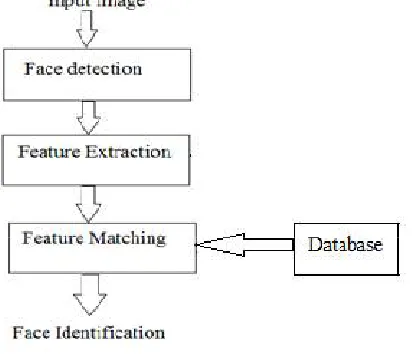
Figure 1 Steps for face recognition
As shown in Figure 1, input image is first detected as a face and then the recognition of the face is done by extracting the features and matching them with database images.
II. RELATED WORK
Typical intensity images of the face were used by many of the face recognition technique. These images are referred as “2D images. “3Dimage” represent the three dimensional shape of the face. The 3D structure of the human face intuitively provides high discriminatory information and is less sensitive to variations in environmental conditions like illumination or viewpoint. For this reason, recent techniques have been proposed employing range images, i.e. 3D data in order to overcome the main challenges of 2D face recognition: Pose and illumination. In face recognition the face images of known persons are stored in database.
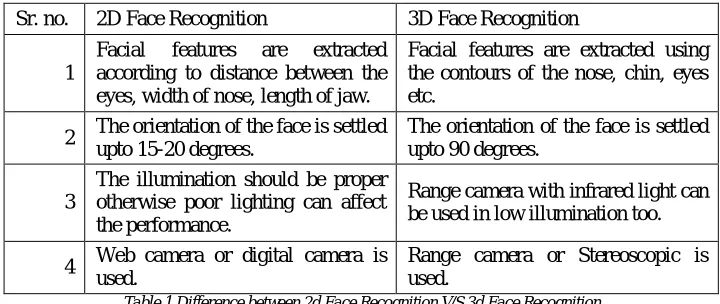
The comparison of 2D face recognition and 3D face recognition is given below and is based on the extraction of features, orientation, illumination factor and capturing device.
Sr. no. 2D Face Recognition 3D Face Recognition 1
Facial features are extracted according to distance between the eyes, width of nose, length of jaw.
Facial features are extracted using the contours of the nose, chin, eyes etc.
2 The orientation of the face is settled upto 15-20 degrees.
The orientation of the face is settled upto 90 degrees.
3
The illumination should be proper otherwise poor lighting can affect the performance.
Range camera with infrared light can be used in low illumination too. 4 Web camera or digital camera is
used.
Range camera or Stereoscopic is used.
Table 1 Difference between 2d Face Recognition V/S 3d Face Recognition
Many well-known face recognition techniques have been developed over the last few decades. Research in automatic face recognition started in 1960‟s with the innovative work of Bledsoe [1]. In 1960s, the first semi -automated system for face recognition was proposed wherein the administrator had to first locate features such as nose, mouth, eyes and ears on the photographs and then calculate the distances and ratios to a common reference point. This distance and ratios were then compared to reference data in the database. Goldstein, Harmon, and Lesk [2] in 1970s introduced the use of 21 specific subjective markers such as hair color, eye lobes, lip thickness, etc. to perform the recognition. But the problem with both these solutions was the manual computation of the measurements and locations.
The below discussion will focus on the most closely related work for 2D and 3D face recognition, current methods for feature detection, and provide an overview of current research in the area of human and object indexing methods and algorithms. We employ two techniques for image comparison: Iterative Closest Point (ICP) algorithm [3], and Principal Component Analysis (PCA) [4].
The ICP algorithm is a 3D technique that uses two point clouds or meshes, the probe and gallery, and iteratively attempts to align the probe to the gallery. To accomplish this task, ICP first finds the closest point in the gallery set for each of the n points in the probe set. When implemented with a k-d tree [5] data structure, nearest neighbor searches can each be accomplished in O(log(n)) time. Beginning with a starting estimate, the algorithm calculates a sequence of rigid transformations Ti until there is no additional improvement in mean square distance between the two meshes. If the initial alignment is poor, ICP may find a local minima that corresponds to an improper registration. For this reason, the probe and gallery centroids are frequently aligned before ICP is performed to ensure an accurate final registration estimate.
The PCA algorithm [4] identifies the maximum amount of variance from a group of data points scattered in a space to obtain a projection along the axis where the variance is maximized. A new coordinate system such that the greatest amount of variance is represented by the first coordinate, the second greatest variance with the second coordinate, etc. is created to represent the data. This process is used to transform correlated variables into uncorrelated variables. This technique can also be used to reduce the dimensionality of a data set for simplified analysis. In face recognition, this technique is used to determine the level of similarity between images. First, a set of 2D gallery images are decomposed into vectors where their values are represented by the grayscale color pixels in the image. These vectors are analyzed and a new coordinate system is created. Next, probe images are decomposed and projected into the new coordinate system. Using a nearest neighbor technique, the gallery image most similar to the probe image will be closest in the new coordinate system.
The vectors are projected into mean-variance space and a Support Vector Machine (SVM) is used to determine the boundary between nose tips and non-nose tips. The authors note that this rule also is challenged by wrinkles, clothing, or other cap-like areas on the face. The authors use three databases to test their algorithm. The largest database, the 3D Pose and Expression Face Models (3DPEF), contains 300 images of 30 subjects with small amounts of changes in pitch, yaw, and roll and a 99.3% nose detection rate is reported.
In [7] author performed a comparative evaluation of five face shape representations, (point clouds, surface normal, facial profiles, PCA, and LDA) using the well-known 3D-RMA data set of 571 images from 106 subjects. These results that ICP and LDA gives the best average performance. Also, various fusion techniques are performed for combining the results from different shape representations to achieve better performance.
In [8] author - used multiple range images per subject with a principal component analysis (PCA) based matcher to allow a greater possibility of matching. Once the sensor acquires the range images and they are normalized, PCA is used to reduce the dimensions of the image representation and facilitate matching. Noise and background information were documented as factors that degraded performance. The authors perform experiments on the FSU 3D face database containing 222 scans of 37 unique subjects containing a total of 6 facial expressions. They report a range of identification percentages based on the size of the training and testing sets. For a training set containing 185 scans and a testing set containing 37 scans, a maximum identification rate of 94% is reported.
In [9] author propose an expression invariant approach to 3D face recognition that reports results on the FRGC v2.0 data set [10]. They perform automatic nose detection by slicing the 3D image horizontally, smoothing uniformly, and filling holes using linear interpolation. A circle centered at the maximum value of the slice is used to find the triangle with the largest area. The three triangle points consist of the circle center and the locations where the circle intersects the slice. A line is fit to the candidate nose tips (which should follow the nose bridge) and the point with the maximum confidence level (based on the triangle altitude) is selected as the final nose tip. Because this method relies heavily on the triangle altitude for nose tip determination, it may perform poorly in the presence of large changes in the pitch or roll of an image.
In [11] created a 3D system that uses multiple regions of the facial surface to improve recognition performance. Their algorithm uses linear discriminant analysis (LDA) to fuse the results from each of the 10 regions and to provide a weighted combination of the similarity scores. The authors found that using a combination of regions outperforms the results when using any single region. In addition, they found that using LDA to determine the fusion weighting parameters provided higher results than the standard sum rule. The authors perform experiments on the FRGC v2.0 data set [10] and report verification rate rates of 90.0% at 0.1% false accept rate on experiment 3, ROC III of the FRGC program.
In [12] author used the ICP algorithm to align 3D meshes containing face geometry. Their algorithm is based on four main steps: feature point detection in the probe images, rough alignment of probe to gallery by moving the probe centroid to match, iterative adjustment based on the closest point matching (ICP), and using known points (i.e. the eyes, tip of the nose and the mouth) to verify the match. Once this process is run, the ICP algorithm reports an average root mean- square distance that represents the separation between the gallery and probe meshes (i.e. the quality of the match). After running this process against their database of images with one gallery image and probe image per subject, they achieved a 95.6% rank one recognition rate with 108 images of 113 participants.
In [13] author created a method for face recognition that uses a combination of 2.5D scans to create a single 3D image for gallery enrollment. They used 598 2.5D probe models of various poses and expression which were matched to 200 3D gallery models collected at the authors’ institution. Using the full 3D image of a subject in the gallery and implementations of ICP and LDA algorithms they were able to achieve a 90% recognition.
III. PROPOSED ALGORITHM
Database used for 3D face recognition is 3D Texas database. Texas 3D Face Recognition consist of 1149 pairs of facial color and range images of 105 subjects of adult human. The images are acquired on very high resolution while acquiring each image the color and range images were captured simultaneously and therefore were perfectly register.
First the image is preprocessed to remove noise and other impurities. After preprocessing the shape features are obtained by applying edge detection algorithms. Here we are using Laplace, canny and prewiit edge detection algorithm for detecting the edges. After detecting the edges vector quantization is applied. Vector Quantization is one of the widely used and efficient techniques for image compression. VQ based image compression technique has three major steps namely (i) Codebook Design, (ii) VQ Encoding Process and (iii) VQ Decoding Process.
For codebook generation we use LBG algorithm. The goal of the codebook design procedure is to design the desired codebook that is to be used in the image encoding/decoding procedures. In the codebook generation process, various images are divided into several k-dimension training vectors. Clusters are form from training vectors then centroid is calculated for the cluster. A set of representative image vectors are called as codewords which can be used to represent all the image blocks. Then by converging all the codewords CB is generated. Each codeword of CB is assigned a unique index value. The representative codebook is generated from these training vectors by the clustering techniques. After generating codebook let's say cb32 we combine the CB values of images of same category and get a single threshold value for a given category.
In the encoding procedure, an original image is divided into several k-dimension vectors and each vector is encoded by the index of codeword by a table lookup method. The encoded results are called an index table. During the decoding procedure, the receiver uses the same codebook to translate the index back to its corresponding codeword for reconstructing the image.
Next process is combination, we get the shape features from which we obtained the texture feature. In combination stage we combine multiple images of same category with different pose variations to obtain a single reference image for that category. It combines the number of images of same person to single reference image. By calculating the average of varying number of images of same person with different angle, pose and expression is indicate by single number.
Finally, for classification we calculate the sum of each image CB value and check with the threshold. Then classify it to a given category. The classification rate i.e the percentage of matching is calculated for Laplace, Canny and Prewitt for varying codebook size
IV. RESULTS
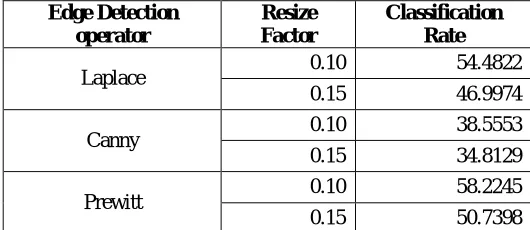
The performance of the proposed 3D face recognition system is discussed in this section. The proposed system is implemented using MATLAB. The performance of the proposed system is analyzed based on the parameters as resize value, classification rate and codebook size.
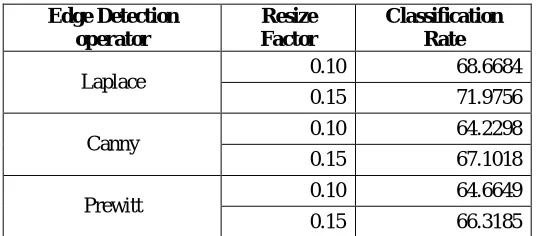
We used the Texas 3D Face Recognition database which contains 1149 pairs of images. Images include various facial expressions and lighting effects. Resize factor of 0.15 means that we resized the image to 15% of its original size. Tables below show results for different codebook sizes with resize factor of 10% and 15%. Different edge detection techniques are applied and classification rate is calculated for them respectively:
Edge Detection operator
Resize Factor
Classification Rate
Laplace 0.10 68.6684 0.15 71.9756 Canny 0.10 64.2298 0.15 67.1018 Prewitt 0.10 64.6649 0.15 66.3185
Edge Detection operator
Resize Factor
Classification Rate
Laplace 0.10 68.6684 0.15 71.9756 Canny 0.10 64.2298 0.15 67.1018 Prewitt 0.10 58.8338 0.15 66.3185
Table 3Classification Rate for Codebook size 64
Edge Detection operator
Resize Factor
Classification Rate
Laplace 0.10 63.8816 0.15 65.9704 Canny 0.10 39.1645 0.15 43.1680 Prewitt 0.10 59.8782 0.15 49.8695
Table 4Classification Rate for Codebook Size 128
Edge Detection operator
Resize Factor
Classification Rate
Laplace 0.10 54.4822 0.15 46.9974 Canny 0.10 38.5553 0.15 34.8129 Prewitt 0.10 58.2245 0.15 50.7398
Table 5Classification Rate for Codebook size 256
From the above result tables it is clear that is result with Laplace edge detection is good. For Laplace with codebook 32 and 15% resize factor we get best result of 71.97% and for 10% resize factor result is 68.6684%. Results are also good for Laplace with codebook size 64. Laplace codebook 64 with 10% resize factor result is 68.6684% and for 15% resize factor is 71.9756%. After that Canny edge detection operator has good results. Canny codebook 32 with 10% resize factor result is 64.2298% and for 15% resize factor 67.1018%. Same results obtained for codebook 64. For prewitt edge detection operator satisfactory results are obtained. Prewitt codebook 32 with 10% resize factor 64.6649% and for 15% resize factor 66.3185%.
V. CONCLUSION AND FUTURE WORK
A paper presented a novel technique for recognition of 3D faces by combination of shape and texture feature and codebook generation by LBG algorithm. The proposed method is tested on 3D Texas database. Canny, Prewitt and Laplace are used for detecting edges from which shape features are obtained. Vector quantization is used to get texture feature. LBG (linde-buzo-gray) algorithm is used for generating codebook. From the experimental results it is observed that in threshold logic, with lower codebook size and Laplace edge detection we get higher classification rate. Hence the proposed system is good and can be used for 3D face recognition.
REFERENCES
1. W. W. Bledsoe, “The model method in facial recognition,” Panoramic Research Inc., Tech. Rep. PRI15, Palo Alto, CA, 1964 2. J. Goldstein, L. D. Harmon, and A. B. Lesk, “Identification of Human Faces,” Proc. IEEE, May 1971, Vol. 59, No. 5, 748-760
3. P. Besl and N. McKay, “A method for registration of 3-D shapes,” IEEE Transactions on Pattern Analysis and Machine Intelligence, vol. 14, pp. 239–256, 1992
4. I. Jolliffe, Principal Component Analysis. Springer-Verlag, 1986
5. J. Bentley, “Multidimensional binary search trees used for associative searching,”Communications of the ACM, vol. 18, pp. 509–517, 1975
6. Xu, T. Tan, Y. Wang, and L. Quan, “Combining local features for robust nose location in 3D facial data,” Pattern Recognition Letters, vol. 27, no. 13, pp. 1487–1494, 2006
7. B. Gokberk and L. Akarun, “Comparative analysis of decision-level fusion algorithms for 3D face recognition,” Proc. 18th International Conference on Pattern Recognition, pp. 20–24, 2006
8. C. Hesher, A. Srivastava, and G. Erlebacher, “A novel technique for face recognition using range images,” Seventh Intl Symposium on Signal Processing and Its Applications, vol. 2, pp. 201–204, 2003
9. A. S. Mian, M. Bennamoun, and R. Owens, “An efficient multimodal 2D- 3D hybrid approach to automatic face recognition,” IEEE Transactions on Pattern Analysis and Machine Intelligence, pp. 1584–1601, 2007
10. P. J. Phillips, P. J. Flynn, T. Scruggs, K. W. Bowyer, J. Chang, K. Hoffman, J. Marques, J. Min, and W. Worek, “Overview of the face recognition grand challenge,” IEEE Conf. on Computer Vision and Pattern Recognition, pp. 947–954, 2005
11. K.-C. Wong, W.-Y. Lin, Y. H. Hu, N. Boston, and X. Zhang, “Optimal linear combination of facial regions for improving identification performance,” IEEE Trans. Systems, Man, and Cybernetics, Part B: Cybernetics, 2007
12. A. Jain, X. Lu, and D. Colbry, “Three-dimensional model based face recognition,”Proc. 17th International Conference on Pattern Recognition, vol. I, pp. 362–366, 2004