Local Directional Number Pattern: An
Efficient Descriptor for Face Analysis
Akhilesh K. Jaunjale1, Vijay B. Baru2
Student, Dept. of E&TC, Sinhgad College of Engineering, Savitribai Phule Pune University, Pune, India1
Associate Professor, Dept. of E&TC, Sinhgad College of Engineering, Savitribai Phule Pune University, Pune, India2
ABSTRACT:A face descriptor is one of the main parameter required for face analysis. Face analysis is always been an area of interest for many researchers. Several methods have been developed for the face analysis making it one of the most successful applications of image analysis and computer vision. A new face descriptor, Local Directional Number Pattern i.e. LDN is proposed for the face analysis. LDN extricates local features of the face composition and encodes it in a six bit compact code. The technique uses a compass mask which gives directional and sign information. A face is divided into different regions to obtain LDN features distribution. All the extricated features are concatenated into a single feature vector. The LDN method performs better than existing methods like Local Binary Pattern (LBP), Local Directional Pattern (LDP)and LocalTernary Pattern (LTP). In this paper different methods of faceanalysis are mentioned with their advantages and disadvantages and how LDN outperforms all other previous methods.
KEYWORDS: Face analysis, Local Directional Number Pattern, feature extraction, feature vectors.
I. INTRODUCTION
The face analysis is widely used application of image processing. Face analysis have gained more attention in the recent years because of the increase in the demand of the automated biometric systems. Biometric systemsuses unique identifiers of a human body such as finderprints, iris pattern, voice waves, face texture etc. The face analysis can be used to achieve automatic Face as well as Facial expression recognition using embedded systems. The automatic face and expression recognition (FER) systems can be an important factor in human-machine interfaces. Face analysis also used in keeping image database used in criminal investigation, video survelliance systems and also for the security purposes. In new electronic generataions mobile cameras are also provided with automatic face detection techniques for auto focus mode.
The main component in face analysis is the face descriptors [1],[2]. These face descriptors uses face features to describe the the face appreance. Two factors can determine the efficiency of the face descriptors. First is the ease of extracting it from the face and secondly its representation. Ideally, a good descriptor is the one which shows high variance between different individual or expressions and very less or no variance for the same individual or expressions at different conditions.
Facial feature extracting can be done in two different ways: Geometric-feature-based and Appearance-based methods. Geometric feature based methods encodes the location and shape of different facial elements, these forms a single feature vector which represents the face. Unfortunately, this method needs precise and reliable feature detection and tracking and to achieve them is a difficult task. The appearancebasedmethods convolves imagefilters, either to create holistic features by applying filters to the complete face or to create local features by concolving the same filters to some specific face region, to extract the changes in appearance of the face image. The appearance based methods performan excellent in controlled environment but the performance degradesif there are chnages in an environment.
More current techniques attempted to defeat the limitations of LBP like Local Ternary Pattern (LTP) and Local Directional Pattern (LDP). In this paper new encoding method Local Directional Number Pattern (LDN) is suggested as novel face descriptor. The comparison of LDN with previous methods is presented.
II. RELATED WORK
Many researchers have shown their interest in local feature descriptors because of its simplicity and these features have ability to outperform the holistic features. Y. Tian et al. utilized Gabor wavelet transforms for facial expression recognition but hese methods are insensitive to small changes in head posture and gives low accuracy rate [3]. T. Ahonen et al. utilized Local Binary Pattern (LBP) for face recognition in 2006 and the same was also utilized by Caifeng Shan et al. for expression recognition using SVM classifier in 2011. The performance of the methods was good under low resolution images and for the same fact it became very popular but unfortunately this method is sensitive to noise an hence limits the accuracy [4],[5].
B. Zhang et al. carried out face recognition using Local Directional Pattern (LDP) and found that it gives better performance and applicable to other object recognition but it miss directional information by treating all the directions equally and is sensitive to illumination changes and noise [6].Xiaoyang Tan and Bill Triggs introduced Lcoal Ternary Pattern (LTP) which is a generalization of the LBP. The LTP descriptor is more discriminant and less sensitive to noise in uniform regions [7]. However it may result in a significant information loss and furthermore it may reside lot of redundant information.
In this paper a new local descriptor i.e. Local Directional Number Pattern (LDN) is proposed that encodes the intensity variations and the structural information of the face’s texture.To overcome the drawbacks of the previous methods, LDN employs the use of kirsch compass mask in order to obtain the edge directions of the face in eight different orientations, a Local Directional Number Pattern, to encode the directional information in an efficient way [8].
III.VARIANTS OF LOCAL PATTERNS
There exists distinctive examples that are utilized to recognize the components of a face includes Local Binary Pattern (LBP), Local Ternary Pattern (LTP) and Local Directional Pattern (LDP).
A. Local Binary Pattern
The LBP is one of the best texture descriptors and it has been utilized as a part of different applications. It has ended up being profoundly discriminative and its key favorable circumstances, to be specific are its computational effectiveness and invariance to monotonic gray level changes make the descriptor appropriate for image analysis assignments in demand.The LBP operator was initially intended for texture description. The operator allocates a 8 bit binary number to every pixel of a image by thresholding the 3x3 neighborhood of each pixel with the center pixel value. The texture descriptor thencan be formed by utilizing a histogram of these labels.
The methodology gives global description by consolidatinglocal descriptions of the face constructed by utilizing the texture descriptors.
The LBP feature vector, can be created in the following manner [4]:
Partition the image under consideration into cells (e.g. 16x16 pixels for each cell). For every pixel in a cell, compare the pixel to each of its eight neighbors.
If the center pixel's value is greater than the neighbor's value, write "0" otherwise, write "1". This gives 8-digit binary number, which can be converted to decimal for convenience.
The histogram is computed, over the cell, of the frequency of each "number" occurring.
The next step is to normalize the histogram and after noramlization histograms of all cells are concatenated. This gives a feature vector for the complete image.
Fig. 1 - Basic LBP operator.
B. Local Ternary Pattern
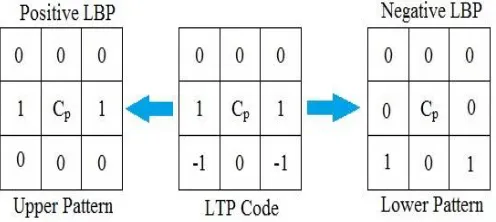
The LTP is an extension of LBP to 3-valued codes. In LTP the threshold of ‘±t’ is assigned to center pixel. The gray level of neighbour pixels in a range of threshold ‘±t’ are quantized to ‘0’, ones above the zone width are quantized to ‘+1’ and ones below the range of threshold are quantized to ‘-1’ [7]. The threshold ‘t’ is user specified parameter. Since the threshold ‘t’ is user specified parameter it may become variant to the gray level transformation. The procedure for LTP encoding is shown in Fig. 2. Here the theshold ‘t’ is set to 1. Hence the tolerance level is [15,17].
Fig. 2 – The basic LTP operator.
For simplicity the ternary codes are again divided into positive and negative parts. These two parts can be considered as as postive and negative parts of LBP or Upper pattern and Lower pattern. Upper pattern can be obtained by replacing the negative values with ‘0’, to obtain the Lower pattern repalce negative values with poistive values and positive values with ‘0’. Fig. 3 gives the idea about these two patterns.
The LTP overcomes the limitation of LBP with repect to sensitivity to noise. However the code may be become sensitive to noise in nearly uniform region which depends on the threshold parameter ‘t’. If the threshold parameter ‘t’ is more the code is less sensitive to noise and vice versa. The splitting of LTP code into positive LBP and negative LBP may also result in the significant information loss. Again the histograms of positive LBP and negative LBP are closely correlated and hence these histograms may contain lot of repeated information.
C. Local Directional Pattern
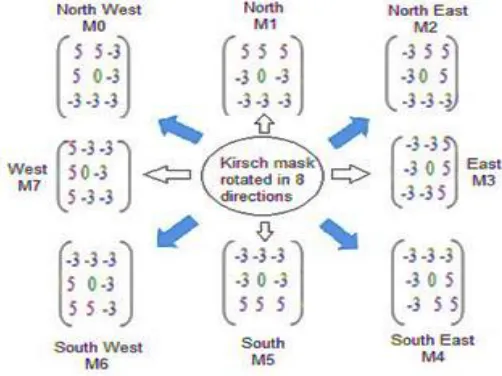
The Local directional pattern was introduced by Taskeed Jabid et al. in 2010. LDP also assigns 8 bit binary code to each pixel as seen in LBP. The relative edge response of a pixel is found out by using derivative masks like Kirsch mask in eight different directions to produce the pattern. These masks in eight different orientations are shown in Fig. 4.
Fig. 4 – Kirsch edge response mask.
After applying these masks in eight different directions we obtain eight edge response values M0 – M7. Each of
which representing the edge relevance in its respective direction. In order to generate LDP‘k’ most prominent directions are found out. The top kvalue of edge response |Mj| are set to 1 and remaining (8-k) bits of LDP code are set
to ‘0’ [9]. The LDP code for k = 3 is shown in Fig. 5. The same original is considered as in case LBP for the purpose of convinience in comparison.
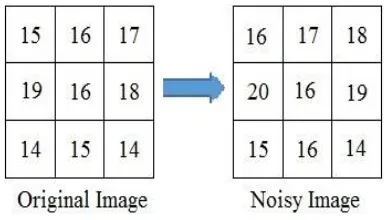
The LDP code is more stable than LBP in presence of noise. The Gaussian white noise is added in the original image with mean ‘0’ and variance ‘0.75’. The image obtained after introducing the gaussian white noise can be given in Fig. 6. The results obtained for both LBP and LDP with the noisy image shows that LDP retains its code where as for the same image with noise LBP gives different code shown in Fig. 7.
The following figure shows the effects of addition of Gaussian white noise in an original image.
Fig. 6 – Conversion of Original image to Noisy image.
The Fig. 7 shows the stability of LDP against LBP.From Fig. 1 and Fig. 5 it can be observed that both the methods LBP and LDP have produced a spcific code respectively, but when a noise is introduced in the same image the response of LBP was changed from ‘10001110’ to ‘10101111’ which can be observed from Fig. 1 and Fig. 7, whereas the reponse of LDP remained unchanged i.e. ‘01010010’ which can be observed from Fig.5 and Fig. 7
Fig. 7 – Stability of LBP vs LDP.
IV.METHODOLOGY
A. Local Directional Number Pattern
utilizing the top directional number obtained from the edge response in eight different directions. These top directional numbers are the most positive and most negative directions of the edge response. In the six bit code for LDN, a fixed position is assigned for top positive direction as the three most significant bits and for top negative direction as three least significant bits.
The code for the LDN can be defined as given in equation 1 [10].
LDN (i, j) = 8mij+ nij (1)
where (i, j) is central pixel of neighboring pixels, mij is directional number of most positive response, and nijis
directional number of most negative response.
These directional numbers can be characterized by the Equation 2 and Equation 3.
mij = arg maxm {Sm( i, j )| 0 ≤ m ≤ 7} (2)
nij = arg minn {Sn( i, j )| 0 ≤ n ≤ 7} (3)
The illustration of LDN method is shown in the following figure:
Fig. 8 – The basic LDN operator.
The LDN image obtained for an image is shown in Fig. 9. The sample image shown here is taken from JAFFE database.
Fig. 9 – The LDN image [10].
In fig. 10 the ‘Image 1’ is considered with some specific intensity levels. Both LDP and LDN operators are applied over the same image independently. Both these methods will encode the structural imformation and the intensity variations available from the image. The response of both the methods is recorded for further consideration.
Fig. 10 – Response of LDP and LDN for Image 1.
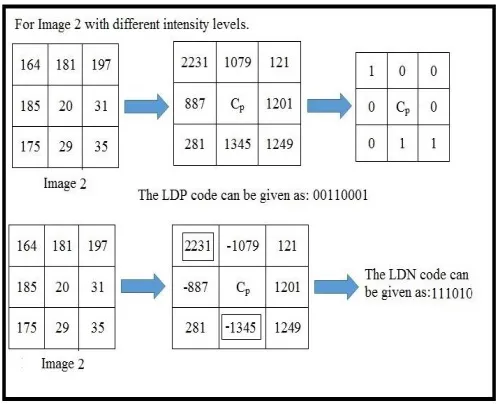
In fig. 11 the intesity transitions of the ‘Image 1’ are changed and the image is converted to ‘Image 2’. Again both LDP and LDN operators are applied over the same image independently. But the response of LDP remains unchanged even if the there are variation in intensities. Whereas the LDN code creates another code for the ‘Image 2’, presenting its ability to detect intensity variations.
Fig. 11 – Response of LDP and LDN for Image 2.
V. DISCUSSIONS
The face descriptors exists before LDN faced many problems like sensitive to noise, intensity variations, head pose variations etc. The first local descriptor described on this paper was LBP which gained lot of popularity because of its simplicity but it is very sensitive to noise. To overcome the limitations of LBP another local face descriptor LTP was considered. LTP is simply an extension of LBP. Though LTP tried to overcome the problem of sensitivity to noise but the method suffered from significant information loss. The next face descriptor came in limelight was LDP and it performed very well in presence of noise but unfortunately LDP was not able to differentiate between the intensity variations. It is found that LDP produced the same code for different intensities.
The new face descriptor proposed in this paper is LDN. The method is is robust against noise and intensity variations and cn be used as an efficient face descriptor.
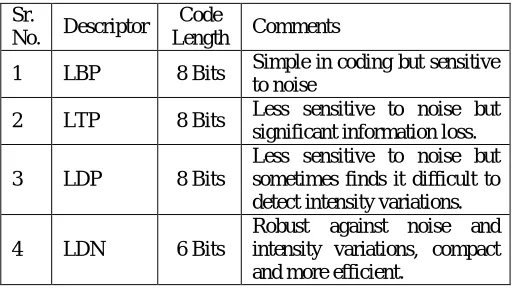
Following table gives a brief idea about different variants of local patterns.
Table 1: Different Variants of Local Pattern. Sr.
No. Descriptor
Code
Length Comments
1 LBP 8 Bits Simple in coding but sensitive to noise
2 LTP 8 Bits Less sensitive to noise but significant information loss.
3 LDP 8 Bits
Less sensitive to noise but sometimes finds it difficult to detect intensity variations.
4 LDN 6 Bits
Robust against noise and intensity variations, compact and more efficient.
VI.CONCLUSION
The In this paper a novel descriptor, LDN is brought into consideration. This descriptor exploits the structure of the face's composition and encodes it in a compact code efficiently. LDN utilizes directional data with the help of Kirsch compass mask and allows it to perceive comparable composition structures with intensity transition. LDN produces steady response against noise than previously available descriptors like LBP, LTP and LDP. The face and expression recognition can be achieved at high recognition rate using LDN.
REFERENCES
1. R. Chellappa, C. Wilson, and S. Sirohey, “Human and machine recognition of faces: A survey”, Proceedings of IEEE, Volume 83, Issue 5, Pages 705–741, May 1995.
2. W. Zhao, R. Chellappa, P. J. Phillips, and A. Rosenfeld, “Face recognition: A literature survey”, ACM Computing Survey, Volume 35, Issue 4, Pages 399–458, December 2003.
3. Ying-li Tian, Takeo Kanade and Jeffrey F. Cohn, “Evaluation of Gabor-Wavelet-Based Facial Action Unit Recognition in Image Sequences of Increasing Complexity”,Proceedings of the Fifth IEEE International Conference on Automatic Face and Gesture Recognition (FGR02), Pages: 229 – 234, May 2002.
4. T. Ahonen, Abdenour Hadid and Matti Pietikainen, “"Face description with local binary patterns: Application to face recognition", IEEE Transactions on Pattern Analysis and Machine Intelligence, Volume 28, Issue 12, Pages 2037-2041, December 2006.
5. Caifeng Shan, Di Huang, Mohsen Ardabilian, Yunhong Wang and Liming Chen, “Local Binary Patterns and Its Application to Facial Image Analysis: A Survey”, IEEE Transactions On Systems, Man, And Cybernetics Applications And Reviews, Volume 41, Issue 6, Pages 765-781, November 2011.
6. Zhang, Y. Gao, S. Zhao and J. Liu, "Local derivative pattern versus local binary pattern: Face recognition with high order local pattern descriptor", IEEE transaction Image Process, Volume 19, Issue 2, Pages 533-544, February 2010.
7. X. Tan and B. Triggs, "Enhanced local texture feature sets for face recognition under difficult lighting conditions", IEEE Transaction, Image Processing, Volume 19, Issue 6, Pages 1635-1650, June 2011.
9. Taskeed Jabid, Md. Hasanul Kabir, and Oksam Chae, “Local Directional Pattern (LDP) for Face Recognition”, 2010 Digest of Technical Papers International Conference on Consumer Electronics (ICCE), Pages 329-330, January 2010.
10. S. Arivazhagan, R. Ahila Priyadharshini, S. Sowmiya, “Face Recognition based on Local Directional Number Pattern and ANFIS Classifier”,IEEE International Conference on Advanced Communication Control and Computing Technologies (ICACCCT), Pages 1627 – 1631, May 2014.
BIOGRAPHY
Akhilesh K. Jaunjale is a student in the Electronics and Telecommunication Department, Sinhgad College of Engineering, Savitribai Phule Pune University. He received Bachelor of Engineering degree in 2013 from SGBAU, Amravati, MS, India. His research interests are Image processing, embedded technology, Signal processing.
![Fig. 9 – The LDN image [10].](https://thumb-us.123doks.com/thumbv2/123dok_us/1444564.1176983/6.595.174.432.395.523/fig-the-ldn-image.webp)