Efficient Privacy Preserving Content Based
Image Retrival from Cloud
Swathi.J.K, Vasu Deva.R
Dept. of CSE, C.Byre Gowda Institute of Technology, Kolar, India
Asst. Professor, Dept. of CSE, C.Byre Gowda Institute of Technology, Kolar, India
ABSTRACT: the need for efficient environmental science has increased along with the rise of the information era and
“encrypted data across all field in society for maintaining integrity. Cloud big data generally refer to huge data which cannot be handled with human analysis, Machine learning approach is an approach used for classification patterns and application of artificial intelligence, etc. In this project we are implementing an effective algorithm for data analysis by extracting features and adapting machine learning approach called SVM. This paper presents a new method, CBIR over encrypted images. SVM applies a hierarchical micro-clustering algorithm that accounts the entire data set only once to provide an SVM with high quality samples that carry the statistical summaries of the data such that the summaries maximize the benefit of learning the SVM. SVM tries to generate the best SVM boundary for encrypted sets given limited amount of resources.
KEYWORDS: CB-SVM, Gabor Features, Big data.
I. INTRODUCTION
Cloud storage is a modeled scenario of enterprise storage systems where information is stored in virtualized segmented pools of storage which are generally maintained by anonymous third party service providers. There are many benefits which cloud can provide customers with ranging from scalability of the services, cost availability, convenience etc. Cloud computing is a new and virtually precise concept of computing technique, by which computer resources are shared dynamically through the Internet thus by appealing considerable and remarkable attention and interest from both institutions and industry.
Cloud computing innovation is generally developed and most associations need to utilize this innovation in their business forms. Be that as it may, then again, the utilization of this innovation is difficult and numerous associations are worried about putting away their touchy information in their server farms as opposed to putting away them in the distributed storage focuses. In the distributed computing environment, trust, as an answer for improve the security, has pulled in the consideration of specialists. Trust is a standout amongst the most imperative approaches to enhance the dependability of distributed computing assets gave in the cloud environment and has a critical part in the business situations.Some people exclusively associate big data with semi-structured and unstructured data of that sort, but consulting firms like Gartner Inc. and Forrester Research Inc. also consider transactions and other structured data to be valid components of big data analytics applications. Data can be analyzed with the software tools commonly used as part of advanced analytics disciplines such as predictive analytics, data mining, text analytics and statistical analysis. Mainstream BI software and data visualization tools can also play a role in the analysis process. But the semi-structured and unstructured data may not fit well in traditional data warehouses based on relational databases.
II. RELATED WORK
Jianqing Fan et.al in his paper [1] discusses statistical methods for estimating complex correlation structure from large pharmacogenomic datasets. We selectively overview several prominent statistical methods for estimating large covariance matrix for understanding correlation structure, inverse covariance matrix for network modeling, large-scale simultaneous tests for selecting significantly differently expressed genes and proteins and genetic markers for complex diseases, and high dimensional variable selection for identify important molecules for understanding molecule mechanisms in pharma cogenomics. Their applications to gene network estimation and biomarker selection are used to illustrate the methodological power. Several new challenges of Big data analysis, including complex data distribution, missing data, measurement error, spurious correlation, endogeneity, and the need for robust statistical methods, are also discussed.
Cloud computing is obviously one of today's most tempting innovation ranges due, in any event to a limited extent, to its cost-effectiveness and adaptability. In any case, notwithstanding the surge in action and enthusiasm, there are noteworthy, industrious worries about distributed computing that are obstructing energy and will in the long run trade off the vision of distributed computing as another IT acquisition model.
IR can likewise cover different sorts of information and data issues past that predetermined in the center definition above. The expression "unstructured information" refers to information which does not have clear, semantically unmistakable, simple for-a-PC structure. It is the inverse of organized information, the sanctioned case of which is a social database, of the sort organizations generally use to keep up item inventories and staff records. Truly, no information is genuinely "unstructured".
This is certainly valid for all content information on the off chance that you tally the inactive etymological structure of human dialects. In any case, not withstanding tolerating that the planned idea of structure is unmistakable structure, most content has structure, for example, headings and sections and commentaries, which is regularly spoken to in archives by express markup, IR is also used to facilitate “semi structured” search such as finding a document where the title contains Java and the body contains threading
As of late, a few truths demonstrate that individuals give careful consideration to the protection of their pictures, and the expanding stress over security might be the key point later on cloud-based picture administrations. For instance, a cell phone application KeepSafe [9] conceals pictures and recordings from unapproved clients by basically scrambling picture organizers with a PIN code, and it possesses 13 million clients and picked up a speculation of 2 millions dollars. Besides, the face look usefulness of Facebook has been relinquished for a long time because of the protection worry from clients and governments [10].
Subsequently, huge picture need effective yet private substance based hunt works earnestly. Existing largescale picture indexing and pursuit frameworks as a rule disregard the security issue and don't bolster security insurance systems. A few frameworks label pictures with watchwords and metadata, and hunt on scrambled catchphrases, e.g., [11]–[14]. In any case, catchphrase based quest strategies can't be embraced for substance based picture seek, since they just inquiry the events of encoded labels in a precise match way and can't gauge the separation between high dimension highlight vectors. In addition, they for the most part uncover the list items to the cloud. To accomplish content-based picture look, we have to quantify the separation between sets of highlight vectors and in addition to ensure the vectors and list items.
Proposed System
Figure 1 shows the block diagram of proposed system. The system used to retrieve similar images based on the query image selected while retrieving the images will be in the form of encrypted manner and while displaying the images will be in the form of De-crypted manner and this process is known as IES-CBIR (Image Encryption Scheme-Content Based Image Retrieval).
Figure1: proposed CBIR cloud architecture
Testing phase is the evaluation phase. Here input data is given for test. Input data involved for pre-processing and feature extraction. After feature vector is extracted from the test data the feature vector is recognized using CB-SVM classifier by using trained knowledge. Finally the test data is categorized based on the classification result.
A. Preprocessing
Input image is applied with image pre-processing steps to enhance the visual appearance of images. Color conversion to gray image and resizing is applied. Pre-processing is followed by feature extraction.
B. Gabor Feature
The Gabor filter is generally utilized as a part of the image features. The Gabor filter wavelet is the type of sine wave adjusted by the Gaussian coefficient. The Gabor filter is helpful for extracting local and global data. The Gabor filter are tunable band pass channel, multistage and multi resolution filter.
Figure 2: Architecture of Proposed System
The Gabor filter eq. (1) is utilized as a part of texture segmentation, image representation. It offers ideal resolution in space and time domain. It gives better visual representation in the involved composition pictures. Be that as it may, the current Gabor parameter requires additional time utilization for feature extraction. The Gabor filter works on the frequency, orientation and Gaussian kernel.
Gabor(x, y,θ,φ) = X. Y (1)
X = exp(−(x + y ) ÷σ ) (2)
The terms x and y (eq. 2 and eq. 3) is the position of the filter relative to the input signal [5]. The angular representation of the filter is represented as ‘θ’. The angular orientation of the filter is represented as ‘∅’.
C. Encryption Process:
Encryption is performed by partitioning the images into several blocks and applying encryption process to each blocks using AES encryption algorithm. For each block of image following steps will be achieved.
Step 1: Setup and create the account on the server for sharing of data. This account is generated by data owner.
Step 2: KeyGen algorithm is used for the generation of public key. The data owner generates a public secrete key to
encrypt the data over cloud. It also creates an aggregate key to access the block of ciphers of limited size.
Step 3: Encrypts the data provided by the data owner by using the secrete key. This encrypted data is then share among the cloud.
Step 4: The aggregate key is used for extracting the particular block of the ciphers from the cipher file. But other encrypted data remains secure.
Step 5: Decrypt: The encrypted data is then decrypted by using the same secrete key which is use for encryption.
D. SVM Classifier
This paper presents a new approach for scalable and reliable SVM classification. The method, called Clustering-Based SVM, is specifically designed for handling very large data sets. When the size of the data set is large, SVMs tend to perform worse with training from the entire data than training from a fine quality of samples of the data set. Selective sampling (or active learning) techniques with SVMs try to sample the training data intelligently to maximize the performance of SVMs, but they normally require many scans of the entire data set.
Our SVM using the similar idea applies a hierarchical micro-clustering algorithm that scans the entire data set only once to provide an SVM with high quality samples that carry the statistical summaries of the data such that the summaries maximize the benefit of learning the SVM. SVM is scalable in terms of the training efficiency while maximizing the performance of SVMs.
The key idea of SVM is to use a hierarchical micro-clustering technique to get finer description closer to the boundary and coarser description farther from the boundary, which can be efficiently processed as follows: SVM first constructs two micro-cluster trees from positive and negative training data respectively. In each tree, a node in a higher level is a summarized representation of its children nodes.
After constructing the two trees, SVM start training an SVM only from the root nodes. Once it generates the “rough” boundary from the root nodes, it selectively decluster only the data summary near to the boundary into lower (or finer) levels using the tree structure. The hierarchical representation of the data summaries is a perfect base structure for SVM to perform the selective de-clustering effectively. SVM repeats this selective de-clustering to the leaf level.
E. Cloud Storage:
Cloud storage stores the encrypted data of data owner. We can categorize the storage parts into several groups.
User module is to retrieve the images from the cloud by giving encrypted query image. The retrieved images
will be decrypted successfully only for the valid users. If user wants the decrypted file means user must have the secret key. If user is valid secrete key automatically retrieved from the user and the image files are decrypted
Admin module is used to add the client to search the file using the file content.
F. User Regestration and User Login Module
When the cloud user wants to get query results from the cloud he must a member in cloud. Therefore, he must be register first. Registration module consists of the fields like username, password, email id and mobile number. User registration process is done by the admin. Without registration can’t perform the other operations so initially user register then go for the login. After entering all fields, user details will be stored in the Cloud.
III. RESULTS AND DISCUSSION
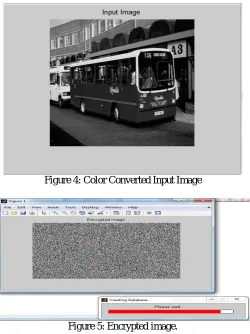
Below Figure 2 shows the input image of testing phase. Input image is applied with pre-processing steps like color conversion as show in figure 3.
Figure 3: Input color image
Image preprocessing is followed by feature extraction, in our proposed system Gabor features of the image is extracted and trained using SVM method.
Figure 4: Color Converted Input Image
Figure 5: Encrypted image.
Figure 6: Retrieved Images
Figure 7: Performance analysis of CBIR process.
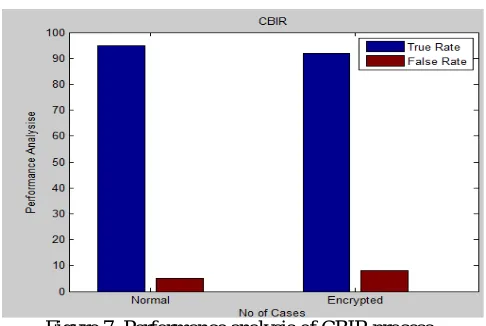
Our proposed system tested more than 100 times. Error rate and true rate is estimated by analyzing accuracy of result in each execution. Comparison is done on both types of inputs such normal images as well as encrypted images. As shown in figure 7.
IV. CONCLUSION
The proposed system integrates scalable encryption method with an SVM classifier which is suitable for image database in cloud. The primitive SVM is not feasible for handling encrypted data set due to complexity in features. SVM gives out the best boundary for encrypted data set. SVM applies a hierarchical micro-clustering algorithm that scans the entire data set only once to provide an SVM with high quality micro-clusters that carry the statistical summaries of the data such that the summaries maximize the benefit of learning the SVM. Also our image encryption algorithm has given proficient result on maintaining security and preserving privacy in cloud environment.
REFERENCES
[1] Jianqing Fan and Han Liu, “Statistical Analysis of Big Data on Pharmacogenomics”, Advanced Drug Delivery Reviews, 2013.
[2] Liran Einav, Jonathan Levin, “The Data Revolution and Economic Analysis”, National Bureau of Economic Research, 2014.
[3] Yuri Demchenko, Paola Grosso, Cees de Laat and Peter Membrey, “Addressing Big Data Issues in Scientific Data Infrastructure”,
Collaboration Technologies and Systems, 2013.
[4] Puneet Singh Duggal and Sanchita Paul, “Big Data Analysis: Challenges and Solutions”, International Conference on Cloud, 2013.
[5] Stephanie E Hampton, Carly A Strasser, Joshua J Tewksbury, Wendy K Gram, Amber E Budden, Archer L Batcheller, Clifford S Duke, and
John H Porter, “Big data and the future of ecology”, The Ecological Society of America, 2013.
[6] Hwanjo yu, jiong yang, jiawei han, xiaolei li. “making svms scalable to large data sets using hierarchical cluster indexing”. submission to data
mining and knowledge discovery: an international journal.
[7] Jia Deng,Alexander C. Berg Stony Brook University Li Fei-Fei, Hierarchical Semantic Indexing for Large Scale Image Retrieval.2014
[8] Ritendra Datta Jia Li James Z. Wang. Content-Based Image Retrieval Approaches and Trends of the New Age.2013.
[10] D. M. Reporter, “Facebook to switch off controversial facial recognition feature following data protection concerns,”
http://www.dailymail.co.uk/news/article-2207098/Facebookswitch- controversial-facial-recognition-feature-following-dataprotection-
concerns.html, Sep. 2012.
[11] D. X. Song, D.Wagner, and A. Perrig, “Practical techniques for searches on encrypted data,” in Security and Privacy. IEEE, 2000, pp. 44–55.
[12] P. Golle, J. Staddon, and B. Waters, “Secure conjunctive keyword search over encrypted data,” in Applied Cryptography and Network Security.
Springer, 2004, pp. 31–45.
[13] Y. Lu and G. Tsudik, “Privacy-preserving cloud database querying,” Journal of Internet Services and Information Security, vol. 1, no. 4, pp. 5–