Design, Implementation & Performance of
Vedic Multiplier for Different Bit Lengths
Vishikha Sharma
1, *Aniket Kumar
2M. Tech Scholar, Department of Electronics Engineering, Shobhit University, Meerut, India1
Assistant Professor, Department of Electronics Engineering, Shobhit University, Meerut, India2
ABSTRACT: This paper describes the design of Vedic Multiplier based on Urdhva Trigbhyam technique of multiplication. It is one of the ancient Vedic sutras for multiplication it means vertical & crosswise. The paper compares the design of Vedic Multiplier for different bit lengths based on Ripple Carry Adder & Kogge Stone Adder. For the highly efficient processor, multiplier plays an important role. It has been found that Kogge Stone Adder is fastest Parallel Prefix Adder, hence the delay in Vedic Multiplier based on Kogge Stone Adder is less as compared to that based on Ripple Carry Adder. The proposed algorithm has been designed using VHDL. Implementation has been done using Xilinx 14.4 with family Spartan6, device as xc6slx45, package csg324 with speed grade of -3.
KEYWORDS: KSA, RCA, Urdhva Trigbhyam, Vedic Multiplier
I. INTRODUCTION
Multipliers play an important role in the arithmetic operation. In microprocessor and most of the digital signal processing algorithm, many instructions perform operations like addition and multiplication, therefore these operations play a vital role in execution time. In present time the demand of computer and signal processing application is increased so the demand of high speed processor is also increased. In order to achieve desired performance in real time applications, the performance of multiplier must be high with low power consumption, delay and area. Vedic multiplier has become more popular technique and it is widely used where high speed and low power are major concern.It is nothing but a sequence of additions carried out on partial products as suggested by Jagadguru Swami [1]. In this paper, the multiplier has been designed using URDHVA TRIGBHYAM sutra one of the 16 Vedic sutras based on ancient Vedic mathematics [2]. The used adders are Ripple Carry Adder and Kogge Stone Adder.
II. RELATED WORK
Urdhva Tiryakbhyam, Multiplication is based on a technique that is called Urdhva Tiryakbhyam (Vertical & Crosswise) of ancient Indian Vedic Mathematics. Urdhva Tiryakbhyam Sutra is a general multiplication formula which is applicable to all types of multiplication. The Sanskrit term means “Vertically and crosswise”. It requires less amount of time for any computation as suggested by M. Poornima [3] than other Vedic sutras like Ekadhikina Purvena, Nikhilam Navatashcara-mam Dashatah etc .It is employed as one of the ancient Vedic multiplication technique [4]. A general method of multiplication is as shown below:-
Step V Step VI Step VII
Fig. 1 Four Bit Vedic Multiplier
In fig.1, this method shown the Vedic multiplication of 4 bits, as the number of bits increases area and gate delay increases at a fader rate in Urdhva multiplication as compared to other techniques, therefore the techniques has been employed here for Vedic multiplication.
III.PROPOSED ALGORITHM
1. Ripple Carry Adder
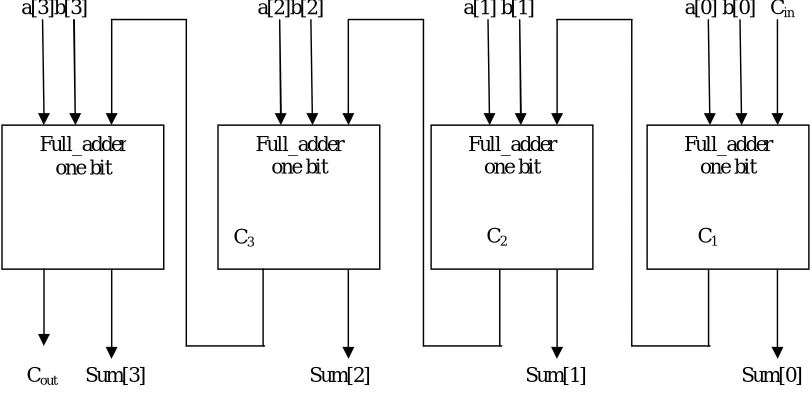
Ripple Carry Adder is one of the digital adder [5, 6] used in many logic circuits. In this adder circuit the carry and sum bits are produced alongside, in which the carry-out of each full adder is the carry in of the following next most significant full adder. It is called a ripple carry adder because each carry bit gets rippled into the next stage. Fig. 2 shows the basic hierarchical block diagram of 4 bit adder using 1 bit adder.
a[3]b[3] a[2]b[2] a[1] b[1] a[0] b[0] Cin
Cout Sum[3] Sum[2] Sum[1] Sum[0]
Fig.2 Four bit Ripple Carry Adder
2. Kogge Stone Adder
It is one of the fastest parallel prefix adder. It generates the carry signals in O (log n) time[ 7-8]. It uses group generate and propagate functions. It uses three stages
i) Pre-processing
ii) Carry look-ahead network
iii) Post-processing
In Pre-processing stage, propagate (p) and generate (g) functions are calculated as
p=a xor b; g=a and b;
In Carry look-ahead network, group propagates and generates functions are calculated as:- cp[i]=p[i] and p[i-1]
cg[i]=g[i] or (g[i-1] and p[i])
In Post-processing network, sum and cout is calculated sum[i]=p[i] xor cg[i-1]
Fig.3 16 bit Kogge Stone Adder Network
3. Vedic multiplier
Multiplication methods that many of processors are using today has inspired by Vedic multiplier introduced in Indian Vedas with different 16 sutras. Vedic multiplier uses bit-wise multiplication with simultaneous product term finding and it’s column-wise addition. It is one of the best benchmark for fast multiplication algorithm.
b[3:2] a[3:2] b[3:2] a[1:0] b[1:0] a[3:2] b[1:0] a[1:0]
{q3[3:0],00} {00,q2[3:0]} q1[3:0] {00,q0[3:2] } q0[3:0]
q5[6] q5[5:0] {0,q4[4:0]}
p[7:2] p[1:0]
Fig.4 4x4 bit Vedic basic element
Firstly the 2 bit Vedic Multiplier has been designed using two half adders [9, 10] & four AND gates. Next the four 2 bit Vedic Multipliers and three Ripple Carry Adders & also by Kogge Stone Adders each of 4 bit, 6 bit, 6 bit are needed for design of 4 bit Vedic Multiplier.
b[7:4] a[7:4] b[7:4] a[3:0] b[3:0] a[7:4] b[3:0] a[3:0]
q0[7:0]
{q3[7:0],0000} {0000,q2[7:0]} q1[7:0] {0000,q0[7:4]}
{000,q4[8:0]}
q5[12] q5[11:0]
p[15:4] p[3:0]
Fig.4 8x8 bit Vedic basic element
The 8 bit Vedic Multiplier has been designed using four 4 bit Vedic Multipliers and three Ripple Carry Adders as well as Kogge Stone Adders each of 8 bit, 12 bit.
2X2 2X2
2X2 2X2
Full_Adder_4bit Full_Adder_6 bit
Full_Adder_6 bit
4X4 4X4
4X4 4X4
Full_Adder_8bit Full_Adder_12 bit
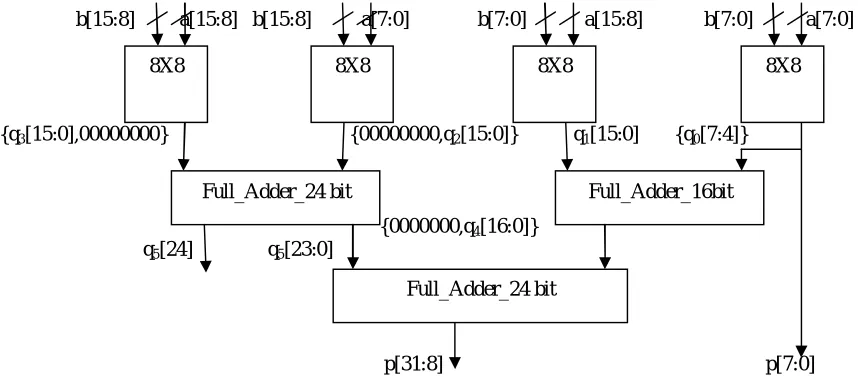
b[15:8] a[15:8] b[15:8] a[7:0] b[7:0] a[15:8] b[7:0] a[7:0]
q0[7:0]
{q3[15:0],00000000} {00000000,q2[15:0]} q1[15:0] {q0[7:4]}
{0000000,q4[16:0]}
q5[24] q5[23:0]
p[31:8] p[7:0]
Fig.4 16x16 bit Vedic basic element
The 16 bit Vedic Multiplier has been designed using four 8 bit Vedic Multipliers and three Ripple Carry Adders as well as Kogge Stone Adders each of 16 bit, 24 bit, 24 bit. It is found that as the number of bits increases in the multiplier the performance of the system increases.
IV.SYNTHESIS&SIMULATION
Fig. 5 Simulation Result of 2-bit Vedic Multiplier
Fig. 6 Simulation Result of 4-bit Vedic Multiplier
8X8 8X8
8X8 8X8
Full_Adder_16bit Full_Adder_24 bit
Fig. 7 Simulation Result of 8-bit Vedic Multiplier
Fig. 8 Simulation Result of 16-bit Vedic Multiplier
V. IMPLEMENTATION
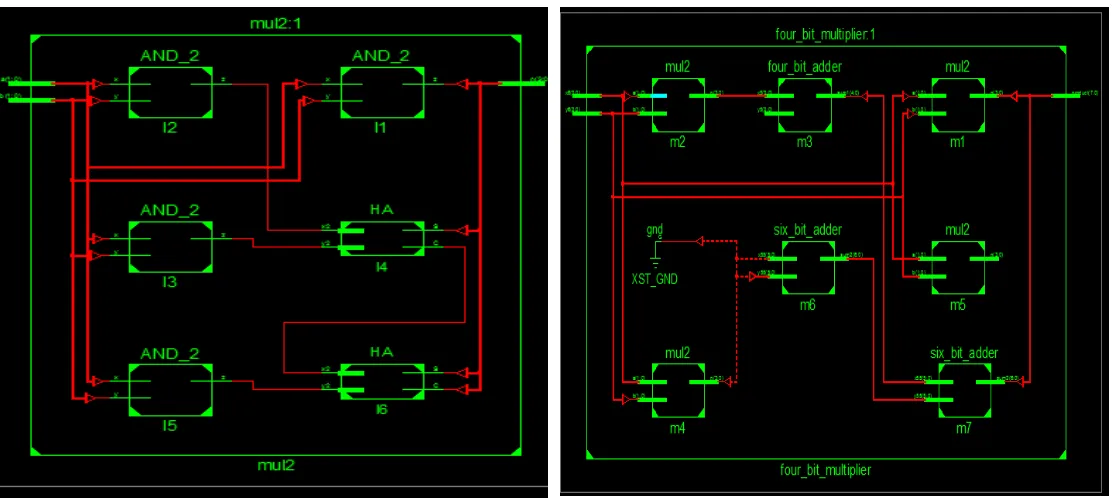
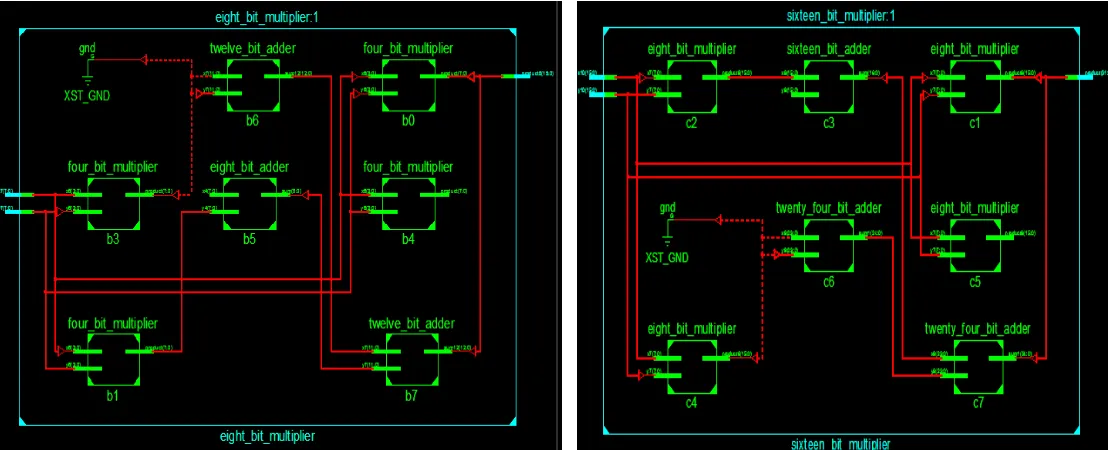
Fig.11RTL Schematic for 8 bit Vedic multiplier Fig.12 RTL Schematic for 16 bit Vedic multiplier
Simulation has been done on Model-Sim Altera Edition 6.6d & Implementation has been done using Xilinx 14.4 with family Spartan6, device as xc6slx45, package csg324 with speed grade of -3. Synthesis report obtained for the above multiplier provides us many parameters such as Delay, Levels of Logic, Memory , No. of slice, no. of LUTs and many more for comparative analysis of vedic multiplier for different bit-lengths.
Table I Comparative Analysis
Device-Spartan6
XC6SLX45-CSG324 Using Ripple carry adder
Vedic Multiplier Delay (ns) Levels of Logics No. of slice LUTs Memory (KB) Fan Out
2-Bit 6.494 4 6 258052 10000
4-Bit 7.942 5 7 255024 500
8-Bit 18.270 15 121 257988 100000
16-Bit 27.278 23 656 259076 100000
VI.CONCLUSION AND FUTURE WORK
From implementation, simulation & comparative results, it is concluded that delay in 16 bit vedic multiplier is 27.278 ns & memory used is 259076 KB. Look-up table (LUTs) is maximum for 16-bit multiplier & hence lowers packaging density, Similar work can be performed for Kogge Stone Adder, Array multiplier, Wallace Tree and Shift & Add Multiplier etc. that would led us to make a conclusion , which multiplier is best ,if speed is critical thing , if Packaging is the concern area & similar conclusions.
REFERENCES
1. Jagadguru Swami Sri Bharti Krishna Tirthaji Maharaja “Vedic Mathematics or Sixteen Simple Mathematicle Formulae from the Veda, Delhi(1965)”, Motilal Banarsidas Varanasi, India.
3. Prabir Saha, Arindham Banerjee, Partha Battacharyya, Anup Dhandapat, “High speed design of complex multiplier using Vedic mathematics”, Proceedings of the 2011 IEEE students technology symposium, IIT Kharagpur, pp. 237- 241, Jan. 2011.
4. Shripad Kulkarni, “Discrete Fourier Transform (DFT) by using Vedic Mathematics”Papers on implementation of DSP algorithms/VLSI structures using Vedic Mathematics, 2006, www.edaindia.com, IC Design portal
5. Laxman S, Darshan Prabhu R, Mahesh S Shetty ,Mrs. Manjula BM, Dr. Chirag Sharma, “FPGA Implementation of Different Multiplier Architectures”, International Journal of Emerging Technology and Advanced Engineering Website: www.ijetae.com (ISSN 2250-2459, Volume 2, Issue 6, June 2012
6. Dr. Ravi Shankar Mishra,Prof. Puran Gour,Braj Bihari Soni, “Design and Implements of Booth and Robertson„s multipliers algorithm on FPGA.” International Journal of Engineering Research and Applications (IJERA) ISSN: 2248-9622.
7. Sunjoo Hong, Taehwan Roh and Hoi-Jun Yoo, “a 145w 8×8 parallel multiplier based on optimized bypassing architecture”, department of electrical engineering, Korea advanced institute of science and technology (KAIST), Daejeon, Republic of Korea, IEEE, pp.1175-1178, 2011.
8. Vadivel Sandeep Shrivastava*, Jaikaran Singh* and Mukesh Tiwari*, “Implementation of Radix-2 Booth Multiplier and
Comparison with Radix-4 Encoder Booth Multiplier,” International Journal on Emerging Technologies 2(1): 14- 16(2011) ISSN : 0975-8364
9. Wen-Chang Yeh and Chein-Wei Jen, “High-speed Booth encoded parallel multiplier design”, IEEE Transaction on Computers, vol. 49, pp. 692-701, July 2000.