Scholarship at UWindsor
Scholarship at UWindsor
Electronic Theses and Dissertations Theses, Dissertations, and Major Papers
2014
Semantic Effects on Metaphor Processing Stages
Semantic Effects on Metaphor Processing Stages
Hamad Al-Azary
University of Windsor
Follow this and additional works at: https://scholar.uwindsor.ca/etd
Recommended Citation Recommended Citation
Al-Azary, Hamad, "Semantic Effects on Metaphor Processing Stages" (2014). Electronic Theses and Dissertations. 5240.
https://scholar.uwindsor.ca/etd/5240
This online database contains the full-text of PhD dissertations and Masters’ theses of University of Windsor students from 1954 forward. These documents are made available for personal study and research purposes only, in accordance with the Canadian Copyright Act and the Creative Commons license—CC BY-NC-ND (Attribution, Non-Commercial, No Derivative Works). Under this license, works must always be attributed to the copyright holder (original author), cannot be used for any commercial purposes, and may not be altered. Any other use would require the permission of the copyright holder. Students may inquire about withdrawing their dissertation and/or thesis from this database. For additional inquiries, please contact the repository administrator via email
Semantic Effects on Metaphor Processing Stages
by
Hamad Al-Azary
A Thesis
Submitted to the Faculty of Graduate Studies through the Department of Biological Sciences
in Partial Fulfilment of the Requirements for the Degree of Master of Science at the
University of Windsor
Windsor, Ontario, Canada
2014
Semantic Effects on Metaphor Processing Stages
by
Hamad Al-Azary
APPROVED BY:
______________________________________________
D. Stanley
Faculty of Education
______________________________________________
D. Mennill
Department of Biological Sciences
______________________________________________
L. Buchanan, Advisor
Department of Psychology
Author’s Declaration of Originality
I hereby certify that I am the sole author of this thesis and that no part of this thesis has been published or submitted for publication.
I certify that, to the best of my knowledge, my thesis does not infringe upon anyone’s copyright nor violate any proprietary rights and that any ideas, techniques, quotations, or any other material from the work of other people included in my thesis, published or otherwise, are fully acknowledged in accordance with the standard referencing practices. Furthermore, to the extent that I have included copyrighted material that surpasses the bounds of fair dealing within the meaning of the Canada Copyright Act, I certify that I have obtained a written permission from the copyright owner(s) to include such material(s) in my thesis and have included copies of such copyright clearances to my appendix.
Abstract
Metaphors can be processed as comparisons or categorizations (Gibbs & Colston,
2012). The quality of metaphor hypothesis suggests that inapt metaphors are processed as
comparisons and apt metaphors are processed categorizations (Glucksberg & Haught,
2006). In two experiments, novel metaphors were manipulated on semantic
neighbourhood density (SND) and topic concreteness and presented to participants at two
reading deadlines that are believed to characterize symmetric (e.g. comparison) and
directional (e.g. categorization) processing stages (e.g., Wolff & Gentner, 2011).
Participants rated the comprehensibility of metaphors. The results suggest that low SND
metaphors are processed as categorizations whereas high SND metaphors are processed
as comparisons. In the case of metaphors made up of high SND, an abstract topic is more
favourable for categorization than a concrete topic. A new model is proposed to explain
Acknowledgements
Dr. Lori Buchanan and Fellow Lab Members: Joining the lab was by far the best
academic decision I have made. It has been a long time since my first lab meeting with all of you. I remember being initially intimidated by your intelligence but you all showed great care for me and my research and were more than willing to help me succeed. Working along-side all of you made me a better student and a more confident researcher. Lori, you have created a tremendous research environment and go to great lengths to support your students. Most importantly, you welcome ideas from your students and show us the value in our research and work. I am very fortunate to have worked with all of you.
My family: I am so grateful for my family. My mother Basma, and father Mohammed, sacrificed so much to secure a good future for me. My brother Hassan, and sister Noor, provide me with so much support and inspiration.
The Biology and Psychology Departments: The faculty and staff from these departments have provided me with a lot of support throughout my years at the university. I am also thankful for Graduate Secretaries Nancy Barkley (Biology) and Barb Zakoor
(Psychology) along with the Psychology Participant Pool and the Research Ethics Board.
Participants: You have all contributed your time and attention and provided valuable data for my thesis. Many of you showed interest in my research. Thank you.
Table of Contents
Author’s Declaration of Originality iii
Abstract iv
Acknowledgements v
List of Tables vii
List of Figures viii
Chapters
I Review of the Literature
Metaphor Processing: Comparison versus Categorization 1
Semantic Variables in Metaphor Comprehension 10
Research Objectives 14
II Design and Methodology
Stimulus Development 18
Participants 19
Procedure 19
III Data Analysis
Experiment 1 Data Cleanup 22
Experiment 1 Statement Comprehension 22
Experiment 1 Discussion 28
Experiment 2 Procedure 30
Experiment 2 Results 30
IV General Discussion 35
Appendices 41
References 46
List of Tables
Table 1 Percentage of responses removed from data analysis for Experiment 1 22
List of Figures
Figure 1Statement by deadline interaction 23
Figure 2 Concreteness by SND interaction 25
Figure 3 Concreteness by deadline interaction 26
Figure 4 SND by deadline interaction 27
Figure 5 Mean Comprehension Score for each of the metaphoric 28
conditions at both processing deadlines
Figure 6 Statement by deadline interaction for Experiment 2 32
Figure 7 Mean comprehension score for each of the metaphoric 34
CHAPTER I
REVIEW OF LITERATURE
Metaphor Processing: Comparison versus Categorization
Metaphors pair two unrelated concepts and as a result, propose a meaningful
relationship between said concepts. The two concepts are commonly referred to as the
topic (first word) and the vehicle (second word). For instance, consider the conventional
metaphor TIME IS MONEY. The topic, TIME and the vehicle, MONEY, are two very
different things; nonetheless, this statement is comprehensible even though it is literally
untrue. Psycholinguists have conducted many experiments to understand how the two
unrelated words in a given metaphor may be related to create meaning (Gibbs & Colston,
2012). Nonetheless, an ongoing debate remains in the literature with respect to the
processing of metaphor; namely, the comparison vs. categorization debate (see Gibbs &
Colston, 2012; Haught, 2013 for reviews). These theories will be briefly described below,
and the more recent hybrid theories, will be described in subsequent sections.
Comparison Theories: Structure-Mapping
There is a number of variants of the comparison theory (see Gentner, 1983;
Ortony, 1979; Tversky, 1977). The most developed comparison model is
structure-mapping, which posits that metaphor is primarily a comparison (mapping) of the
similarities between topic and vehicle domains (Gentner, 1983; Gentner & Bowdle,
2008). In structure-mapping, comparing the topic and vehicle domains uncovers their
shared commonalities. This comparison is presumed to occur in two stages, an alignment
stage and a projection stage. The alignment stage is where topics and vehicles are
projected to the topic. Furthermore, these commonalities can be of two types; attributes
and relations. Attributes refer to one thing (e.g., colourful) whereas relations refer to two
or more things (e.g., eclipse). Structure-mapping holds that metaphor, like analogy, posits
that a relation in one domain (the vehicle) also applies in another (the topic); therefore,
figurative meaning (e.g., metaphor, analogy, and simile) is reached primarily from
relational rather than attributional structures (Gentner, 1983). Wolff and Gentner (2011)
illustrate this with a comparison of two typically unrelated concepts, SOME SUBURBS
ARE PARASITES. Such a comparison would result in the relational mapping of
BENEFITTING FROM AND HARMING HOST; both the suburb and parasite benefit
and harm the host city or host organism respectively. The specific attributes of the
suburbs (e.g., their location) and parasites (e.g., their type) are not the primary structures
important in the interpretation of figurative language, but the relational features are.
The theoretical inferences of structure-mapping have been observed in
experimental settings. For instance, Gentner (1988) found that adults produce more
relational interpretations of metaphors than attributional interpretations, whereas children
rely more on attributional comparisons for comprehension. This developmental
difference suggests that the capacity for comprehending relational structure is acquired
after a preference for attributional structure. Also, Aisenman (1999) found that people
prefer word pairs in the metaphor form (rather than the simile form) when such pairs
share relational features rather than attributional features. Thus, structure-mapping is the
comparison of structures inherent in two unrelated domains, and in metaphors, relational
rather than attributional structures appear to be the primary linkage (see Gentner, 1983,
Categorization
The alternative to the comparison model is the categorization model (Glucksberg,
2008; Glucksberg & Keysar, 1990). Categorization theorists posit that metaphors are
processed as class-inclusion statements much like literal statements. This view holds that
the linguistic form of metaphors, namely, A IS B, resembles the grammatical structure of
literal categorical, or class-inclusion, statements (e.g., A ROBIN IS A BIRD). Therefore,
a figurative statement such as MY JOB IS A JAIL, according to the categorization view,
does not involve a comparison or feature mapping process, such as structure-mapping.
Rather, it involves categorizing the topic, MY JOB, into the superordinate category,
JAIL. This is achieved by dual reference; in this metaphor, the word JAIL can refer to a
literal jail or to an abstract, nonconventional category of which the vehicle belongs (i.e.,
unpleasant situation). This dual reference mechanism is at work in many words (e.g.,
KLEENEX refers to both a brand of facial tissue along with any generic facial tissue)
(Glucksberg, 2003). Furthermore, categorization theorists claim that the grammatical
order of topics and vehicles (i.e., topic is always before the vehicle), is not adequately
considered in comparison theories. That is, MY JOB IS A JAIL, when reversed to MY
JAIL IS A JOB, becomes nonsensical even though their similar features remain the same
(Glucksberg & Keysar, 1990).
In categorization, the topic and vehicle play different roles. The vehicle provides
properties that are attributed to the topic whereas the topic constrains which types of
vehicle properties may be attributed (Glucksberg, McGlone, & Manfredi, 1997). For
example, in the metaphor, MY LAWYER IS A SHARK, the topic, LAWYER, relates to
as physical appearance, thus constraining the types of properties that can be assigned to
it; LAWYER is an example of a high constraint topic, whereas MAN is an example of a
low constraint topic (Glucksberg, McGlone & Manfredi, 1997). The vehicle SHARK is
unambiguous in its reference to predation and viciousness; SHARK is an example of an
unambiguous vehicle whereas ORGANISM is an example of an ambiguous vehicle. Both
high-constraint and unambiguous vehicles are specific whereas low-constraint topics and
ambiguous vehicles are vague. Therefore, a constraining topic paired with an
unambiguous vehicle provides an effective means for property attribution.
Evidence for the categorization model and its position on constraint and property
attribution in metaphor comes from priming studies (e.g., Glucksberg, McGlone &
Manfredi, 1997; McGlone & Manfredi, 2001). Priming is a method in experimental
psychology where an additional, tangential stimulus (the prime) is presented before the
onset of another stimulus, the target stimulus. Doing so can affect the processing of the
target stimulus. For example, seeing the prime DOCTOR allows readers to recognize the
word NURSE faster than they would without seeing the prime (Meyer & Schvaneveldt,
1971). Glucksberg et al. (1997) presented subjects with metaphors composed of
constraining topics (e.g., SOME PLASTIC SURGEONS ARE BUTCHERS),
non-constraining topics (e.g., HIS LIFE IS A SOAP OPERA) unambiguous vehicles (e.g.,
SOME LECTURES ARE SLEEPING PILLS) and ambiguous vehicles (e.g., SOME
DREAMS ARE RIVERS). These metaphors were preceded by priming their respective
topics or vehicles. The researchers found that reading times for metaphors decreased (or,
reading was facilitated) as a result of topic or vehicle primes only for the high-constraint
topic or vehicles of metaphors is only favourable when those primes aid in the property
attribution process. Conversely, the property attribution process can be inhibited;
McGlone & Manfredi (2001) found that priming irrelevant properties of the vehicle
category (e.g., literal properties like SHARKS CAN SWIM) slows down reading time
whereas other primes (topic, and relevant vehicle properties, such as SHARKS ARE
VICIOUS) can speed up reading time. Thus, because the vehicle in the metaphor refers to
a superordinate category and not to the literal shark, priming literal shark properties will
inhibit processing. Gernsbacher, Keysar, Robertson and Werner (2001) explored further
how priming can enhance or suppress the processing of metaphors. Participants were
instructed to determine if sentences presented on the computer monitor made sense or
not. When metaphors (e.g. THAT DEFENSE LAWYER IS A SHARK.) precede target
sentences that reflect the super-ordinate category of sharks (e.g. SHARKS ARE
TENACIOUS), the time participants take to determine if the target sentences make sense
is lower than if the metaphor precedes a target sentence that reflects the literal aspects of
sharks (e.g. SHARKS ARE GOOD SWIMMERS.). The researchers argue that the
metaphors enhance processing superordinate target sentences because both statements
refer to the superordinate representation of SHARK whereas the metaphors suppress
processing literal target statements because the metaphor calls upon the superordinate
representation but the literal target statement calls upon the basic representation of
SHARK, so processing the literal SHARK after reading about the superordinate SHARK
takes extra time.
Hybrid Theories
contemporary theories account for both processes rather than one single process. For
example, Gentner and Wolff (1997) presented subjects with novel metaphors on a
computer screen, which were primed by the topic, the vehicle, both topic and vehicle, or
by neither. The authors predicted that if metaphors were categorizations, then only the
vehicle prime should have a facilitative effect (with lower reading times) because seeing
the vehicle first would induce processing its superordinate category (as predicted by the
categorization model). On the basis of the resulting data these researchers, however,
concluded that only the condition that facilitated reading times happened when both the
topic and vehicle were primed. However, the authors replicated this task with
conventional (frequently used) metaphors and found a processing advantage for vehicle
primes. To account for this, the authors proposed that novel metaphors are processed as
comparisons whereas conventional metaphors can be processed as either comparison or
categorizations. The processing type is determined by the vehicle’s dual reference (i.e.
literal word or superordinate category). If the vehicle refers to the literal word, then
metaphors are processed as comparisons; on the other hand, if the vehicle refers to a
superordinate category then metaphors are processed as categorizations. For Gentner and
her colleagues (Bowdle & Gentner, 2005; Gentner & Bowdle, 2001; Gentner & Wolff,
1997) this finding implies that as metaphors become more familiar, the vehicle acts like a
superordinate category; this view is called the career of metaphor hypothesis.
The career of metaphor hypothesis gained further support from contrasts between
metaphors and similes (Bowdle & Gentner, 2005). Similes differ from metaphors by
including the word like (or sometimes as) in the statement. Both the comparison and
processing, whereas the grammatical form of metaphors invites categorization (Gentner
& Bowdle, 2001; Glucksberg & Keysar, 1990). However, both camps believe that those
invitations are ignored for their favoured processing type (i.e. comparison or
categorization). In other words, comparison theorists hold that even though metaphors are
written like categorizations, they are processed as comparisons (Gentner & Bowdle,
2008; Gentner & Wolff, 1997); similarly, categorization theorists hold that even though
similes are written like comparisons, they are processed as categorizations (Glucksberg,
2008; Glucksberg & Keysar, 1990). Importantly, ignoring the processing demands
inherent in linguistic format adds additional processing effort that translates into
additional time, errors, or change in preference in psycholinguistic tasks.
Based on their understanding of the difference between metaphors and similes,
Bowdle and Gentner (2005) asked participants to rate their preference for novel and
conventional metaphors and their simile counterparts. In experiment 1, participants rated
novel figurative statements higher in comprehension in the simile form (i.e. comparison
form) than the metaphor (i.e. categorization) and conventional figurative statements in
the metaphor form (i.e. categorization form). In experiment 2 subjects read novel
figurative statements faster as similes than as metaphors and conventional figurative
statements faster as metaphors than as similes. In experiment 3, subjects were given pairs
of similes containing the same vehicle (e.g. AN ACROBAT IS LIKE A BUTTERFLY; A
FIGURE SKATER IS LIKE A BUTTERFLY) and a statement with a blank topic (e.g.
__________ IS LIKE A BUTTERFLY) to complete. Participants studied these similes
and provided topics that would result in the completed statements having a similar
statements in simile and metaphor form. They preferred the metaphor form for the
previously studied items rather than the simile form. This implies that comparison
processing of similes gives way to categorization processing after frequent use. In other
words, after becoming familiar with a figurative statement, the participant no longer only
understands the vehicle as a literal word, but now also understands its reference to a
superordinate category (e.g., the superordinate category of BUTTERFLY in this case
may refer to something that moves in an agile, elegant fashion). As such, the career of
metaphor hypothesis suggests that all novel pairings of topics and vehicles, whether
simile or metaphor, are processed as comparisons whereas conventional statements can
be processed as categorizations because the familiar vehicle term has been repeatedly
used and can now refer to a superordinate category. Metaphors begin their “career” as
comparisons and after frequent usage, can become categorizations (Bowdle & Gentner,
2005; Gentner & Bowdle, 2001; Gentner & Wolff, 1997).
Unlike the career of metaphor hypothesis, the quality of metaphor hypothesis
argues that metaphor aptness is the contributing variable that distinguishes comparison
and categorization (Glucksberg & Haught, 2006). Aptness is defined as “the quality of
being appropriate or suitable” (Oxford Dictionaries, n.d.). After controlling for aptness, in
a series of experiments, Haught (2013) showed that novel metaphors (not just
conventional metaphors) are sometimes processed as categorizations. For instance,
subjects were asked to match metaphors (SOME LAWYERS ARE SHARKS) and
similes (SOME LAWYERS ARE LIKE SHARKS) to interpretations which either
referenced properties of a literal vehicle (SOME LAWYERS ARE VICIOUS) or an
GREEDY). In experiment 1, Haught found that subjects matched metaphors to
interpretations containing emergent properties whereas the similes were matched to
interpretations containing literal properties. Moreover, Haught modified conventional
metaphors to become novel by including an adjective that applied to the topic (i.e. SOME
LAWYERS ARE WELL PAID SHARKS); an adjective that applied to the literal vehicle
(i.e. SOME LAWYERS ARE RAZOR TOOTHED SHARKS); an adjective that applied
to both topic and vehicle (i.e. SOME LAWYERS ARE OLD SHARKS); and no adjective
(SOME LAWYERS ARE SHARKS). The prediction was that topic-applicable
statements should be preferred in metaphor form because their adjective (WELL PAID)
is a reference to the metaphorical shark whereas the vehicle-applicable adjective
(RAZORTOOTHED) is a reference to the literal shark. Indeed, subjects rated the topic
modified metaphors higher than similes in aptness (experiment 2) and comprehensibility
(experiment 3) and took less time to read than the topic modified similes (experiment 4).
In another study, Haught (2014) demonstrated that, contrary to the comparison view that
metaphors and similes are interchangeable, people interpret metaphors and similes made
up of the same topic-vehicle combination differently. Participants were provided with
novel metaphors (e.g., THE LAWYER WAS AN OLD SHARK) and their simile
counterparts (e.g., THE LAWYER WAS LIKE AN OLD SHARK) along with
interpretations that reflected the categorization process (e.g., THE LAWYER WAS
SHREWED, EXPERIENCED AND WELL VERSED) and interpretations that reflected
the comparison process (e.g., THE LAWYER WAS WEAK, TIRED, AND LESS
AGGRESSIVE). Participants rated category interpretations higher for metaphors than
metaphors and similes, even with the same topic-vehicle construction, mean different
things. Haught (2014) suggests that, contrary to the career of metaphor hypothesis,
metaphors cannot shift from comparison to categorization as a result of familiarity
without a change in meaning. Importantly, the quality of metaphor hypothesis implies
that categorization processing is indicative of higher quality; that is, a metaphor
processed by comparison will be less apt than a metaphor processed by categorization.
Based on the evidence to date, it appears that metaphors are not processed in a
single predetermined way as was proposed by earlier models (Gentner, 1983; Glucksberg
& Keysar, 1990; Glucksberg et. al, 1997, McGlone & Manfredi, 2001; Ortony, 1979;
Tversky, 1977). What we can take away from the contrasts of earlier models is that the
processes of both categorization and comparison must be considered in metaphor
comprehension research. Another important consideration is the word level properties
upon which these processes occur (Kintsch, 2000). The following section discusses that
aspect of metaphor research.
Semantic Variables in Metaphor Comprehension
Semantic Memory
One major limitation with metaphor processing models is that they do not
describe what topic and vehicle properties are involved in the comprehension of a
metaphor (Gibbs & Colston, 2012; Kintsch, 2000). For example, the categorization view
does not objectively describe what a superordinate category is (Kintsch, 2000). For that
reason, Kintsch (2000, 2008) argues that if metaphor comprehension is a “semantic
problem”, we must consider the general knowledge structure or, semanticmemory, and
Semantic memory can be operationalized in a number ways, but recent models are based
on word co-occurrences. In these models, semantic similarity between words is inferred
from their usage in natural language (see Landauer & Dumais, 1997 for an example of
one of these models).
Kintsch (2000) has found that semantic memory models are an important tool in
metaphor comprehension. His computational model, known as the predication algorithm,
compares the similarity between a metaphor and the words that are thought to be relevant
with the meaning of said metaphor. This model uses Latent Semantic Analysis (LSA) to
compute the similarity in meaning between words. LSA creates a semantic space that is
reflective of how words are used in natural language. Words are represented as vectors
and their arrangement reflects their co-occurrence in natural language, and in turn,
semantic distances between vectors can be calculated as cosines; words that share
meaning are closer to each other than words that do not, and as a result, form semantic
neighbourhoods (Lanauer & Dumais, 1997). The predication model is based on the
categorization view and its property attribution process and determines which properties
are involved in deriving the meaning of a metaphor (Kintsch, 2000). It computes
metaphoric meaning by first selecting semantic neighbours that are related to the vehicle,
and then from this set, selects neighbours that are also related to the topic. The result is a
vector that is the centroid of the topic, vehicle, and the semantic neighbours related to
them. This vector, which represents the meaning of a metaphor in semantic space, can be
compared with the vectors of other words that one would expect to be related to the
metaphor. For example, the vector of the metaphor, MY LAWYER IS A SHARK is
words SHARK and FISH, and is more related to the vector of the word VICIOUS than
the vector of the word LAWYER is. Therefore, the metaphor introduces viciousness to
the concept of lawyer because in the metaphor this word is related to both LAWYER and
SHARK(Kintsch, 2000, 2001). The predication model has also been tested with human
interpretations; and can predict interpretations that participants provide (Kintsch &
Bowles, 2002).
Concreteness
An influential variable in metaphor comprehension is concreteness, or the
capacity for a word to be sensed or visualized. It has been suggested that metaphors are a
necessary component of our conceptual system and that their function is to partially
structure abstract entities in delineated, concrete domains (Lakoff & Johnson, 1980).
Indeed, many metaphors employ a concrete vehicle, and an abstract topic (e.g., Gentner,
1983; Katz, 1989; Kintsch, 2000; Wolff & Gentner, 2011; Xu, 2010, but see Gibb and
Wales (1990) for a non-replicated counter example). Katz (1989) found that when
participants are asked to provide vehicles to topics they chose concrete vehicles that were
of moderate semantic distance from the topic. Xu (2010) found that topic-vehicle word
pairs yield more similarities when the topic is abstract and the vehicle is concrete than if
both terms are concrete. Kintsch reasoned that concrete predicates, or vehicles, may
create more apt metaphors because they are semantically rich; “What strong metaphors
seem to have in common is that the predicate is a concrete term, rich in imagery and
many potential associations…” (Kintsch, 2000, pg. 261).
Although semantic memory and concreteness have been shown to be important in
and Buchanan (2012) examined the effects of semantic memory and concreteness in
novel metaphor comprehension using Windsor Improved Norms of Distance and
Similarity of Representations of Semantics (WINDSORS), a model of semantic memory
similar to LSA. WINDSORS however, arguably captures more nuances of semantic
memory than LSA because it is a measure of semantic neighbourhood density (SND),
which describes how many near semantic neighbours a word has (Durda & Buchanan,
2008). Moreover, WINDSORS controls for word frequency in its calculation of semantic
similarity; that is, some high frequency words may appear near each other by chance
rather than shared meaning; thus, WINDSORS is an updated model of lexical
co-occurence (Durda & Buchanan, 2008).
WINDSORS measure of semantic neighbourhood density has been recently tested
in some psycholinguistic tasks. For instance, Danguecan (2011) found an inhibitory
effect from near neighbours in a lexical decision task; words from dense semantic spaces,
or high SND words, were processed slower than words from sparse semantic spaces, or
low SND words. MacDonald (2013) replicated the inhibitory effect in both young (18 –
25 years old) and older (60 – 80 years old) adults. Lastly, McHugh (2009) found that
WINDSORS semantic distances reflect the dominant and subordinate meanings of
homographic words. In the WINDSORS database, a target word such as DEPRESSION
is more closely related to its dominant meaning, such as SADNESS than its subordinate
meaning such as HOLE. Importantly, priming the dominant meaning (e.g., SADNESS) of
a target word (e.g., DEPRESSION) resulted in faster recognition than priming the
subordinate meaning (e.g., HOLE) of the same target word. In summary, the previous
that the model characterizes semantic density in a way that is consistent with our current
understanding of semantic processing.
In a metaphor comprehension task, participants rated novel metaphors made up of
words with low semantic neighbourhood densities as more comprehensible than high
SND counterparts. Furthermore, metaphors with abstract topics were rated as more
comprehensible than those with concrete topics but only for high SND metaphors. This
interaction demonstrates that the abstract topics employed in many metaphors, and the
abstract advantage reported by Xu (2010) may be limited to high SND metaphors. The
results further suggest that metaphors from semantically sparser neighbourhoods were
more comprehensible. In other words, metaphors with topics and vehicles from
semantically dense neighbourhoods were not rated as highly comprehensible as were
metaphors with words from less dense neighbourhoods. If a dense semantic space
represents the many potential associations that Kintsch is in favour of, then the Al-Azary
and Buchanan (2012) results are at odds with his description of “strong metaphors”.
However, a large but sparse semantic neighbourhood could be what Kintsch had in mind.
Research Objectives
It is unclear why Al-Azary and Buchanan’s (2012) metaphors made up of high
SND words were judged to be less comprehensible than their metaphors made up of low
SND words. However, metaphor processing theories may be able to explain this. Recall
that categorization theory posits that metaphors are processed by including the topic in
the category referenced by the vehicle. Also, Kintsch (2000) has argued that such
superordinate categories can be operationalized as semantic neighbourhoods.
neighbourhood density hypothesis is proposed. This hypothesis is related to Kintsch’s
(2000) Predication Algorithm in that it assumes the semantic neighbourhood of words
affects metaphor comprehension, and is also consistent with the categorization view of
metaphor (Glucksberg & Keysar, 1990; Glucksberg, 2008). However, it differs from the
previous models because it can explain differences in comprehension between high and
low quality metaphors. That is, it can describe why a metaphor is apt or inapt. If a topic is
placed in a semantic neighbourhood, then a dense neighbourhood may have too many
associations and not enough room to assimilate a new word. On the other hand, sparse
semantic spaces would have the room to assimilate a new word. Concreteness would also
play a role; dense semantic spaces would presumably assimilate abstract words better
than concrete words because the former have fewer physical attributes than the latter
(Rosch, Mervis, & Gray, 1976). If concrete words have more attributes than abstract
words, then categorizing concrete words would be more difficult in a dense
neighbourhood because there are many close neighbours that must cohere with the
concrete word and its features. For example, consider two high SND metaphors, A PEN
IS A SWORD and CENSORSHIP IS A FILTER. The latter may be more comprehensible
than the former because the lack of concrete features in CENSORSHIP allows it to
categorize by being assimilated into a dense neighbourhood. On the other hand, PEN has
many concrete features that impede categorizing it in the semantic neighbourhood of
SWORD. In sparse spaces however, concreteness is not such an issue; abstract and
concrete topics should have equal or near equal assimilation. Notice that the semantic
neighbourhood density hypothesis would explain the Al-Azary and Buchanan (2012)
because the semantic space of the vehicle in the former is sparse and can accommodate a
new word. Similarly, high SND metaphors would be less comprehensible than low SND
because the semantic space of the vehicle in the former is dense and cannot accommodate
a new word, but if that new word is abstract, its lack of concrete features can facilitate the
categorization; thus, there is an abstract topic advantage only for high SND metaphors.
The above model sounds plausible, but it must be empirically tested. A recent
study has shown that the online processing, or time course, of metaphors is characterized
in two stages. Wolff and Gentner (2011) provided metaphors (e.g., SOME SUBURBS
ARE PARASITES) as well as reversed metaphors (e.g., SOME PARASITES ARE
SUBURBS) for 600 and 1600 millisecond (ms) deadlines. Participants rated the
statements as comprehensible or non-comprehensible. Metaphors in the reversed form
were just as comprehensible as their forward counterparts at the early deadline which
indicated a symmetrical processing stage. In other words, at 600 ms, people do not have a
preference for the orientation of metaphors; forward (SOME SUBURBS ARE
PARASITES) and backward metaphors (SOME PARASITES ARE SUBURBS) are
equally comprehensible. Conversely, the later deadline showed that forward metaphors
increased in comprehension whereas reversed metaphors decreased in comprehension.
That is, the directionality of metaphors does not occur until after a symmetric stage at 600
ms. Recall that categorization theory holds metaphors are directional, categorical
statements. Wolff and Gentner’s (2011) results, therefore, illustrate that if directional
processing takes place, it occurs sometime after 600 ms and before 1600 ms.
To tease apart the SND by concreteness interaction, the Al-Azary and Buchanan
Wolff and Gentner (2011). This would allow for isolated, symmetrical processing at an
early deadline, and asymmetrical processing at a later deadline. It is predicted that
metaphors will not differ in comprehension rating at the early deadline (600 ms). This is
due to the nature of processing at this period; namely, symmetrical processing, as
discovered by Wolff and Gentner (2011). However, in the later period (1600 ms), it is
expected low SND metaphors will proceed to the second stage of directional processing
and will therefore increase in comprehension. Concrete, high SND metaphors on the
other hand will not reach this directional stage because the dense semantic space of the
vehicle contains no association room for a concrete word. Abstract words will have less
difficulty entering a dense semantic space, so abstract, high SND metaphors will undergo
directional processing as well, but will not be as comprehensible as low SND metaphors.
If the predictions are met, both the semantic neighbourhood density hypothesis and the
quality of the metaphor hypothesis will gain support because only comprehensible
metaphors are processed as directional (categorical) statements whereas less
comprehensible metaphors are not. The crucial assumption in the present study is that
metaphors are processed symmetrically at 600 ms and are later processed as
categorizations at 1600 ms. Comparison and categorization processes can be inferred
from these processing deadlines; if metaphors do not increase in comprehension by the
1600 ms processing deadline then they are comparisons; conversely, if metaphors
increase in comprehension by the 1600 ms processing deadline then they are
CHAPTER II
DESIGN AND METHODOLOGY
Stimulus Development
The items used in this experiment were the same ones used by Al-Azary and
Buchanan (2012). These items were, when possible, taken from other studies such as
Katz et al. (1988) and Xu (2010). Furthermore, metaphors were also inspired from
Danguecan’s (2011) stimulus set of words which were manipulated on concreteness and
SND. The current items varied in the concreteness of the topic and the SND of both
topics and vehicles. Concreteness was operationalized in the same way as Danguecan
(2011) had done, with concrete words referring to physical objects that can be sensually
experienced and abstract words referring to words that cannot be sensually experienced.
For example, pencil is a concrete word, but education is not.
Half of the metaphors were composed of abstract topics whereas half were
composed of concrete topics. SND measures were retrieved from the WINDSORS
database. Words with a SND measure of less than .36 were considered to be low SND
whereas words with a SND measure of more than .36 were considered to be high SND.
This cut off is taken from Danguecan and Buchanan’s (2012) study that showed that the
resulting semantic neighbourhoods produced the effects in psycholinguistic tasks. Half of
the metaphors were made up of high SND words whereas half of the metaphors were
made up low SND words. This resulted in four conditions: abstract topic, concrete
vehicle, high SND (abstract high SND); abstract topic, concrete vehicle, low SND
(abstract low SND); concrete topic, concrete vehicle, high SND (concrete high SND) and
in each condition, which results in 48 metaphors used in the experiment. See Appendix A
for experimental metaphors.
Nonsense fillers were used in order to compare their comprehension relative to
the metaphors. Such statements were matched to the metaphor condition in concreteness
and SND. The only difference is that during their construction, they were intended to be
meaningless. Literal statement fillers were also included. However, their concreteness
was not manipulated as creating an abstract-concrete literal statement proved to be a
difficult task. See Appendix A for filler items. Fifteen practice metaphors along with 15
nonsense statements and 15 literal statements were also employed in a practice sessions.
These were not subject to any statistical analysis. See Appendix B for these items.
The manipulations for this experiment are therefore two levels of concreteness
(abstract topics vs. concrete topics), two levels of SND (high SND vs. low SND), two
levels of processing deadline (early vs. late) and three levels of statement type (nonsense
vs. metaphoric vs. literal), all of which are within-subjects variables. This results in 240
experimental trials.
Participants
Fifty people participated for partial course credit. Recruitment was through the
University of Windsor Psychology Participant Pool. Participants were 18 years of age or
older and had normal or corrected-to normal-vision.
Procedure
After providing informed consent, participants were directed to a Windows XP
computer running Direct RT software (Jarvis, 2006) and a purpose-built 9-button
Participants were provided with instructions on the screen (see Appendix C) and orally
briefed on the experimental task and were informed that they would be quickly judging
the comprehensibility of statements presented on the screen. Instructions were also
presented on the screen. Participants were encouraged to dedicate their left hand for the
button on the left side and their right hand for the button on the right side. The button on
the left was to be pressed if a statement was incomprehensible; conversely, the button on
the right was to be pressed if a statement was comprehensible.
A practice session was initiated to orient the participants to the buttons and their
corresponding representations. This practice session consisted of presenting the words
“comprehensible” and “incomprehensible”. Word presentations were preceded by a 300
millisecond presentation of pound signals which matched the number of letters in each
word. The words were presented on the screen for both, 600 and 1600 millisecond
deadlines. A question mark followed each presentation. In short, the stimulus
presentation schedule was pound signals for 300 milliseconds, replaced by the word for
600 or 1600 milliseconds, replaced by a question mark that remained on the screen until a
response was made. Participants were instructed to make a response at the sight of the
question mark and were told that they only had a limited amount of time to respond. An
error message reading “Please try to respond faster!” appeared after any trial in which a
response was made after the 400 millisecond response duration. In total, this practice
session had 20 trials. Half of the trials had the word “comprehensible” presented at both
presentation durations whereas the other half had the word “incomprehensible” presented
at both presentation durations. The correct response for the “comprehensible” words was
Further, the correct response for the “incomprehensible” words was the left button
pushed within 400 milliseconds of the presentation of the question mark. Participants
were supervised and feedback was provided during this session.
At the conclusion of this practice session, another practice session was initiated.
This practice session was identical in its stimulus presentation schedule; however,
statements (nonsense, metaphor, and literal) were used in place of the single words.
Participants were instructed to press the button on the right if the statement was
comprehensible and the button on the left if the statement was incomprehensible. In total,
this practice session involved 90 trials. See Appendix B for practice items. After this
session, the experimenter left the testing room and the testing session was initiated with
CHAPTER III
ANALYSIS OF RESULTS
Data Cleanup
Following Wolff and Gentner’s (2011) data cleanup procedure,any responses
made after 400 milliseconds were removed from the data analysis. This was to ensure
that all participants remained on task and that they had an equal amount of time to make
their response after the stimuli were presented at their given deadlines. This resulted in
the removal of 17.3% of the trials. See Table 1 for a breakdown of data cleanup for each
condition.
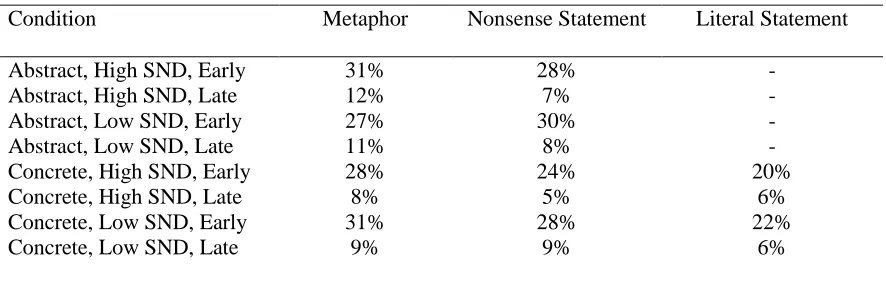
Table 1
Percentage of responses removed from data analysis for Experiment 1
Condition Metaphor Nonsense Statement Literal Statement
Abstract, High SND, Early 31% 28% -
Abstract, High SND, Late 12% 7% -
Abstract, Low SND, Early 27% 30% -
Abstract, Low SND, Late 11% 8% -
Concrete, High SND, Early 28% 24% 20%
Concrete, High SND, Late 8% 5% 6%
Concrete, Low SND, Early 31% 28% 22%
Concrete, Low SND, Late 9% 9% 6%
Statement Comprehension
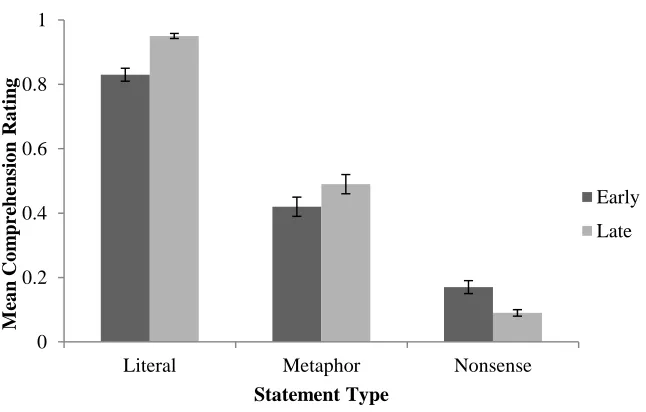
Before the main analysis, the effect of statement type was examined at both
deadlines to ensure that participants were interpreting metaphors as more comprehensible
than nonsense statements and less comprehensible than literal statements. This was
repeated-measures ANOVA. A main effect of statement was obtained, F(2, 98) = 498.12,
p = < .001, 91 as well as a main effect of deadline, F(1, 49) = 15.50, p =
<.001, Pairwise comparisons indicate that metaphors (M = .46, SE = .03) were
more comprehensible than non-sense statements (M = .13, SE = .02) and less
comprehensible than literal statements (M = 0.90, SE = .011). Moreover, a statement by
deadline interaction was obtained, F (2, 98) = 76.48, p = <.001, See figure 1 for
this interaction. Bonferonni adjusted t tests revealed a significant difference between
metaphors and literals at the early deadline, t (49) = 13.21, p = <.001, and the later
deadline, t (49) = 17.78, p = <.001. This was also true for metaphors and nonsense
statements at the early deadline, t (49) = 10.27, p = <.001, and the late deadline, t (49) =
17.22, p = <.001.
Figure 1. Statement by deadline interaction. Error bars represent standard error of the mean.
These results confirm that participants recognized novel metaphors as more
meaningful than nonsense statements but less meaningful than literal statements. Further, 0 0.2 0.4 0.6 0.8 1
Literal Metaphor Nonsense
participants were not simply guessing when making their comprehension judgements
because guessing should result in even comprehension ratings for each statement type at
each processing deadline.
Main Analysis of Metaphors
A concreteness by SND by deadline repeated-measures ANOVA revealed a main
effect of concreteness, F (1, 49) = 7.83, p = .007, = .14. Overall, metaphors made up of
abstract topics (M = .48, SE = .039) were more comprehensible than those made up of
concrete topics (M = .43, SE = .028). A main effect of SND was obtained, F (1, 49) =
52.78, p = < .001, = .52. Metaphors made up of low SND words (M = .50, SE = .02)
were more comprehensible than their high SND counterparts (M = .45, SE = .02). Lastly,
a main effect of deadline was obtained, F = (1, 49) = 16.06, p = .001, = .25. Overall,
metaphors presented at the later processing stage (M = .49, SE = .01) were more
comprehensible than metaphors presented at the early processing stage (M = .46, SE =
.02).
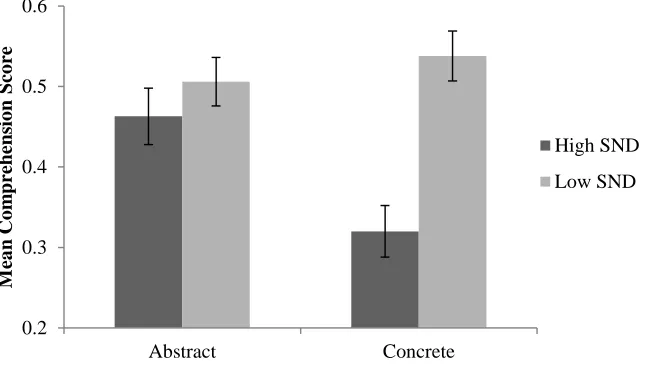
Several interaction effects were revealed, including a concreteness by SND
interaction, F (1, 49) = 39.00, p = < .001, = .44; the effect of SND on comprehension
varied across levels of concreteness. Figure 2 shows that the difference in comprehension
as a result of SND is greater for metaphors that contain a concrete topic than metaphors
Figure 2. Concreteness by SND interaction. Error bars represent standard error of the mean.
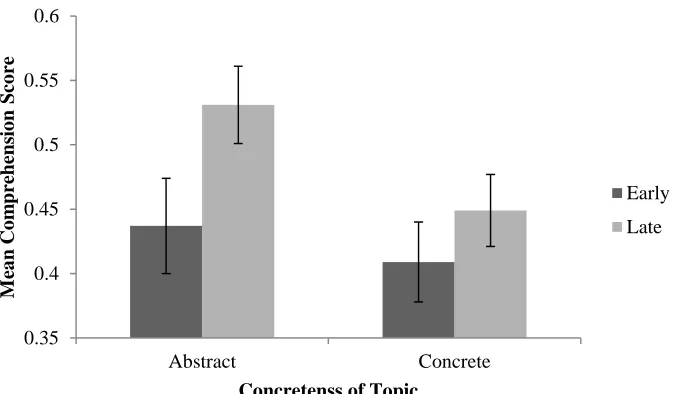
Furthermore, a concreteness by deadline interaction was obtained, F (1, 49) =
5.17, p = .027, = .10; the effects of concreteness on comprehension varied between
early and late deadlines. Figure 3 shows that the difference in comprehension as a result
of deadline was greater for abstract metaphors than it was for concrete metaphors. In
other words abstract metaphors increased in comprehension at the later stage of
processing more than concrete metaphors did. 0.2
0.3 0.4 0.5 0.6
Abstract Concrete
M
ea
n
Co
m
prehens
io
n
Sco
re
Concreteness of Topic
High SND
Figure 3. Concreteness by Deadline Interaction. Error bars represent standard error of the mean.
Lastly, a semantic neighborhood density by deadline interaction was obtained, F
= (1, 49) = 17.55, p = <.001, = .26. The effects of SND on comprehension varied
across levels of deadline. Figure 4 shows that the effects of processing deadline are
greater in metaphors made up of low semantic neighbourhood densities than high SND
counterparts. In other words, low SND metaphors increased in comprehension at the later
processing stage more than high SND metaphors. 0.35
0.4 0.45 0.5 0.55 0.6
Abstract Concrete
M
ea
n
Co
m
prehens
io
n
Sco
re
Concretenss of Topic
Early
Figure 4. SND by Deadline interaction. Error bars represent standard error of the mean.
A three way interaction was non-significant, F(1,49) = 1.17, p = .46, = .01.
Bonferroni adjusted t-tests revealed a non-significant difference between abstract high
SND metaphors at the early and late processing stages t(49) = - 1.68, p = .099 but there
was a difference between abstract low SND and abstract-concrete high SND metaphors at
the late processing stage, t (49) = 3.46, p = 0.001. At the early processing stage, concrete,
high SND metaphors were rated as less comprehensible than abstract, high SND
metaphors, t (49) = 3.099, p = .003. Figure 5 shows each of the condition means at both
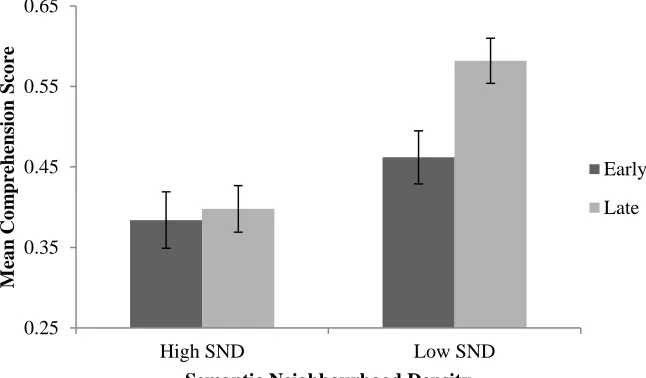
processing deadlines. Metaphors made up of low SND words increase the most from later
processing deadlines. Concrete-high SND metaphors do not increase in comprehension at
the later stage of processing; moreover, the difference between abstract-high SND
metaphors at both deadlines is greater than the difference between concrete-high SND
metaphors at both deadlines. 0.25
0.35 0.45 0.55 0.65
High SND Low SND
M ea n Co m prehens io n Sco re
Semantic Neighbourhood Density
Early
Figure 5. Mean Comprehension Score for each of the metaphoric conditions at both processing deadlines. Error bars represent standard error of the mean.
Discussion
Metaphors were more comprehensible at the later processing stage than the early
processing stage. This is expected considering that the one second difference between the
early and late processing deadlines allows for more processing time and a shift in
processing from symmetrical alignment to directional projection as first demonstrated by
Wolff and Gentner (2011). One striking difference between the current set of results and
Wolff and Gentner’s (2011) is that at the early processing stage, concrete-high SND
metaphors were distinguishable from the other conditions, as shown by their lower
ratings. Recall that Wolff and Gentner (2011) found the early processing stage of 600
milliseconds to be too short for participants to distinguish between forward or reversed
metaphors. The fact that the current stimulus set yields a comprehension difference
testament to the robust effects of SND and concreteness. The obtained interactions
however, were predicted by the proposed semantic neighbourhood density hypothesis. It
seems that metaphors are more meaningful if they are composed of words from sparse
semantic spaces, and this is due to their ability to enter the later stage of directional
processing. When words in metaphors are from dense spaces, an abstract topic can be
more facilitative than a concrete topic when metaphors are composed of words from
sparse semantic spaces; they are more comprehensible than metaphors composed of
words from dense semantic spaces. The processing advantage for low SND metaphors
arises because by the late deadline they increase in comprehension more than high SND
metaphors. Further, the results do not show this processing advantage for concrete high
SND metaphors; such metaphors are as comprehensible in the late stage as they were in
the early stage. Abstract high SND metaphors increase in comprehension more than their
concrete counterparts in the late stage.
There is, however, a potential confound in the experimental design that needs to
be addressed. Recall that this was a repeated measures design so participants were
exposed to each metaphor at both deadlines. Although the re-occurrence of each
metaphor was random, there is, nonetheless, a potential response bias whereby
participants base a proportion of their responses to metaphors presented the second time
in the list on their earlier exposure to them the first time on the list. Experiment 2
eliminates this potential bias by replicating Experiment 1 with deadline as a between
Experiment 2
Procedure
Seventy one people participated for partial course credit. Recruitment was
through the University of Windsor Psychology Participant Pool. Participants were 18
years of age or older and had normal or corrected to normal vision. The experimental
procedures and stimuli were identical to Experiment 1. The only procedural difference
was that in Experiment 1 the participants saw the same metaphors at both the early and
late presentations whereas in Experiment 2 deadline was implemented as a between
participant variable; 37 participants viewed stimuli for 600 ms whereas 34 participants
viewed stimuli for 1600 ms.
Results
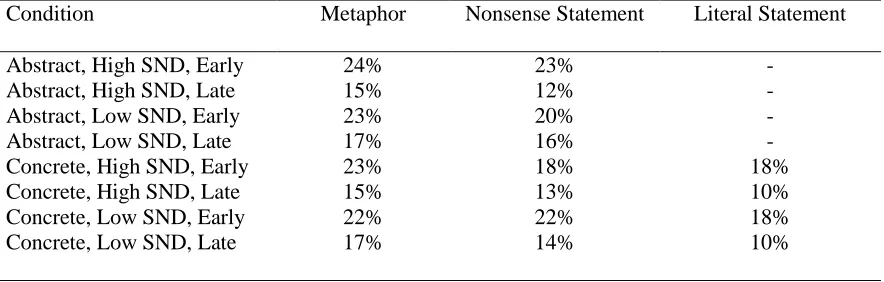
Data removal followed the same procedures as outlined in Experiment 1; this
resulted in the removal of 17.8% of the data. See table 2 for a breakdown of trials
removed by condition. One participant from the 1600 ms condition was removed from
data analysis because they failed to respond within 400 ms in all of the statements of a
given condition. Therefore, data was analyzed from 70 participants; 37 participants
Table 2
Percentage of responses removed from data analysis for Experiment 2
Condition Metaphor Nonsense Statement Literal Statement
Abstract, High SND, Early 24% 23% -
Abstract, High SND, Late 15% 12% -
Abstract, Low SND, Early 23% 20% -
Abstract, Low SND, Late 17% 16% -
Concrete, High SND, Early 23% 18% 18%
Concrete, High SND, Late 15% 13% 10%
Concrete, Low SND, Early 22% 22% 18%
Concrete, Low SND, Late 17% 14% 10%
Statement Comprehension
As in Experiment 1, a statement (nonsense vs metaphoric vs literal) by deadline
(early vs late) mixed design ANOVA was run (with Greenhouse-Geisser correction). A
main effect of statement was again obtained, F(2, 122.77) = 699.35, p = <.001, = .91.
Comparisons revealed that concrete metaphors (M = .48, SE = .02) were less
comprehensible than literal concrete statements (M = .85 SE = .01) but more
comprehensible than nonsense statements (M = .19 SE = .01). A main effect of deadline
approached significance; F (1, 68) = 3.96, p = .051, = .06. A statement by deadline
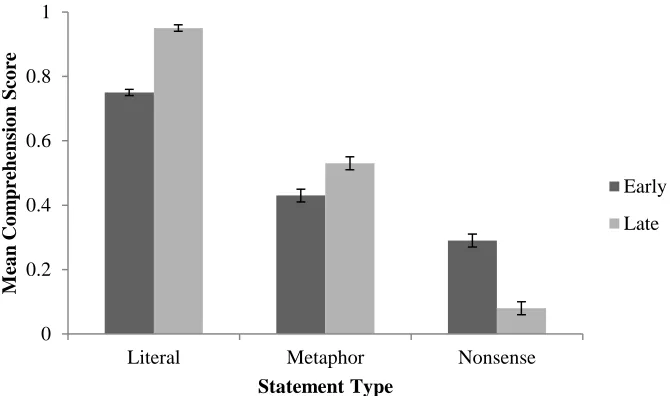
interaction was obtained, F (1.8, 122.77) = 699.35, p = <.001, = .50. See figure 6 for
Figure 6. Statement by deadline interaction. Error bars represent standard error of the mean.
Contrasts revealed that the increase in comprehension by the late deadline was
greater for metaphors than for nonsense statements, F(1, 68) = 77.37, p = <.001, = .53.
Also, the increase in comprehension by the late deadline for literals was greater than for
metaphors, F(1,68) = 7.31, p = .009, = .097.
Main Analysis and Discussion
As in Experiment 1, only the metaphoric statements were subject to further
analysis. A concreteness by SND by deadline mixed design ANOVA revealed a main
effect of concreteness F (1, 68) = 17.32, p = <.001, = .20. Metaphors containing
abstract topics (M = .52, SE = .03) were rated higher than metaphors containing concrete
topics (M = .44, SE = .02), which is consistent with Experiment 1. Moreover, a main
effect of SND was obtained, F (1, 68) = 76.24, p = <.001, = .53, and this is also
consistent with Experiment 1. Metaphors made up of low SND words (M = .56 SE = .02)
were more comprehensible than metaphors made up of high SND words (M = .40 SE =
0 0.2 0.4 0.6 0.8 1
Literal Metaphor Nonsense
.02). A between subjects effect of deadline, was obtained, F (1, 68) = 4.20, p = .044, =
.06. Metaphors presented at the early processing deadline of 600 milliseconds (M = .434,
SE = .031) were less comprehensible than those presented at the later deadline of 1600
milliseconds (M = .53, SE = .03).
The same interaction effects as those found in Experiment 1 were obtained. A
concreteness by deadline interaction was significant, F(1, 68) = 4.81, p = .032, = .07 as
was the SND by deadline interaction, F(1, 68) = 9.86, p = .003, = .13; this interaction
was in the same direction as Experiment 1. Furthermore, a concreteness by SND
interaction was also obtained, F(1,68) = 31.54, p = < .001, = .32. This interaction was
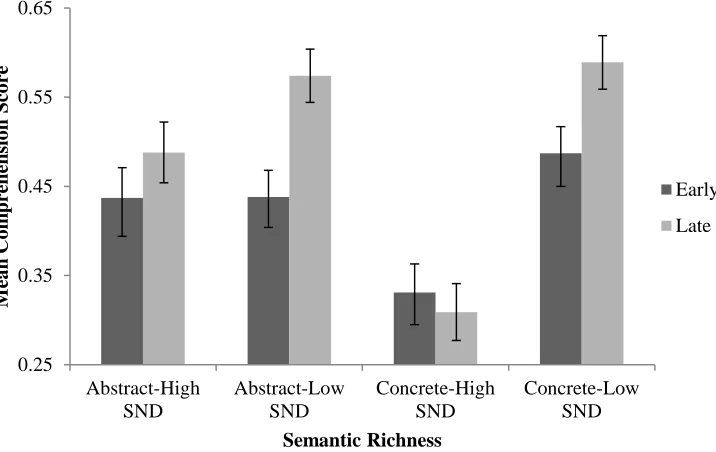
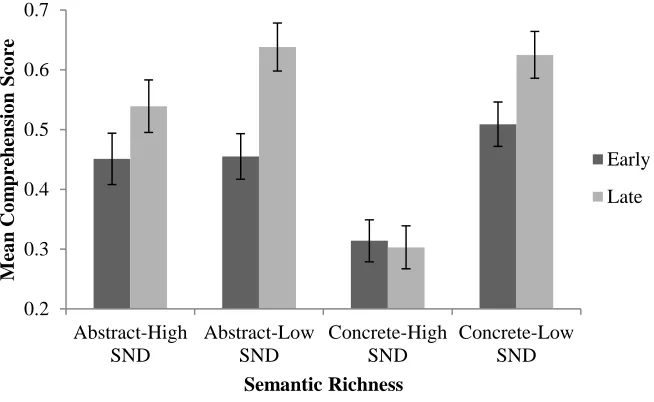
also in the same direction as Experiment 1. Figure 7 shows each of the condition means
at both processing deadlines. As can be seen, metaphors made up of low SND words
appear to benefit from later processing deadlines. Metaphors made up of high SND words
and with concrete topics do not result in increased comprehension ratings as a result of
later processing deadlines. Bonferonni adjusted t tests again reveal a difference between
abstract high SND and concrete high SND metaphors at the early stage; t (36) = 2.92, p =
.006 but this was not true for abstract low SND and concrete low SND metaphors at the
early stage; t (36) = -1.44, p = .160. At the late deadline, abstract low SND metaphors
were more comprehensible than their high SND counterparts, t (32) = -3.03, p = .005. To
summarize, this replication of Experiment 1 resulted in the same pattern of findings and
rules out the possibility that response bias or stimulus familiarity could have produced the
Figure 7.Mean Comprehension Score for each of the metaphoric conditions at both processing deadlines for Experiment 2. Error bars represent standard error of the mean.
0.2 0.3 0.4 0.5 0.6 0.7
Abstract-High SND
Abstract-Low SND
Concrete-High SND
Concrete-Low SND
M
ea
n
Co
m
prehens
io
n
Sco
re
Semantic Richness
Early
Chapter IV
General Discussion
Two processing deadlines thought to reveal symmetrical and directional processes
(Wolff & Gentner, 2011) were used to determine how concreteness and SND interact in
metaphor comprehension. As expected both abstract and concrete, low SND metaphors
increased in comprehension at the later processing stage. Concrete high SND metaphors
did not increase in comprehension at the later processing stage, whereas abstract high
SND metaphors demonstrated a similar pattern to low SND metaphors. At the very least
this data suggests that, contrary to Wolff and Gentner’s (2011) findings, metaphors are
not fundamentally processed by two stages; a symmetric alignment stage and an
asymmetric, directional stage which they showed by comparing comprehension at two
processing deadlines. This was the case for low SND metaphors along with abstract high
SND metaphors, but not so for concrete high SND metaphors. Although the directionality
of metaphors was not directly manipulated, the results may suggest that concrete, high
SND metaphors are not directional metaphors. This is because they did not increase in
comprehension at the 1600 ms processing deadline, and this deadline is associated with
directionality (recall that Wolff and Gentner (2011) only found forward metaphors and
not reversed metaphors to be comprehensible at these processing deadlines). The increase
in comprehension from 600 to 1600 ms seems to suggest that meaningful metaphors
consolidate by the later stage and less meaningful metaphors do not.
Comparison theories, such as the previously discussed structure-mapping theory
(Gentner, 1983; Gentner & Bowdle, 2008; Wolff & Gentner, 2011), to my knowledge,
comprehension by the later processing deadline. Structure-mapping holds that common
features of the topic and vehicle are automatically accessed for comprehension; however,
there is no theoretical reason for why the semantic richness of concrete high SND
metaphors would inhibit the structure-mapping process.
On the other hand, the categorization view can better explain why concrete high
SND metaphors did not increase in comprehension after one second of processing. Recall
that in this model, metaphors categorize the topic in the category that the vehicle belongs
to (Glucksberg, 2008; Glucksberg & Keysar, 1990). In high SND metaphors, this
category is a dense neighbourhood with many near neighbours. It seems that a concrete
topic may have more difficulty penetrating such dense spaces than do their abstract
counterparts. However, even at 600 ms, abstract high SND metaphors were more
comprehensible than their concrete counterparts. Thus, although concrete high SND
metaphors do not increase in comprehension at the later stage of processing, their initial
lack of comprehension was not expected and is not accounted for by categorization
processes alone.
The data is best interpreted through hybrid models (e.g., Bowdle & Gentner,
2005; Glucksberg & Haught, 2006) that account for comparison and categorization
processes, rather than the structure-mapping (Gentner, 1983; Gentner & Bowdle, 2008;
Wolff & Gentner, 2011) or categorization models (Glucksberg, 2008; Glucksberg &
Keysar, 1990; Glucksberg et. al., 1997; McGlone & Manfredi, 2001) that claim singular
processing. Recall that the career of metaphor hypothesis (Bowdle & Gentner, 2005)
states that novel metaphors are comparisons whereas conventional metaphors can be
because all of the stimuli were novel, yet low SND metaphors increased in
comprehension in a way analogous to directional metaphors. Rather, the quality of
metaphor hypothesis (Glucksberg & Haught, 2006) does a better job accommodating the
data; poorer metaphors (as measured by comprehension) were processed as comparisons
whereas richer metaphors reached a directional stage that characterizes categorization.
However, the quality of metaphor hypothesis does not describe why apt metaphors are
processed as categorizations whereas inapt metaphors are processed as comparisons. To
that end, the semantic neighbourhood density hypothesis was proposed. This hypothesis
states that low SND metaphors are more comprehensible than high SND metaphors
because the former are processed as categorizations whereas the latter are processed as
comparisons. Moreover, abstract topics are advantageous for high SND metaphors
because they have no concrete features or attributes to clash with the near neighbours of
the dense semantic space.
The mean comprehension scores at the later deadline replicate the Al-Azary and
Buchanan (2012) results; low SND metaphors were rated as more comprehensible than
high SND metaphors, and abstract-high SND metaphors were rated as more
comprehensible than concrete-high SND metaphors. To examine why these differences
were found, I turned to metaphor processing theories and isolated the processing stages of
metaphors. Based on my understanding of these theories and previous findings I
predicted that SND and concreteness would interact with processing deadlines and
hypothesized that if metaphors are processed by directional, topic-to-vehicle domain
projection, then low SND metaphors would increase in comprehension at this later stage
better than a concrete topic only in high SND metaphors. The proposed semantic
neighbourhood density hypothesis therefore is based on the premise that a novel
metaphor introduces a new semantic neighbour to a semantic neighbourhood. The new
semantic neighbour is the topic, and the semantic neighbourhood is that of the vehicle. If
the semantic neighbourhood of the vehicle is dense, it is difficult to find a meaningful
relationship between it and the topic. Kintsch’s (2000) predication algorithm selects
semantic neighbours of the vehicle in its computation of the metaphor vector. Following
the proposed view the algorithm would have some difficulty in selecting the nearest
neighbours of the vehicle if there are many neighbours (i.e. they form a dense
neighbourhood).
One can make predictions based on the current hypothesis. For example,
concrete-high SND metaphors do not appear to reach directional processing, and this
implies that topics and vehicles are at most, symmetrically aligned. Therefore we can
predict that reversing the topics and vehicles of concrete-high SND metaphors will not
affect their comprehension ratings. Campbell and Katz (2006) provided reversed
metaphors along with a supporting context to participants to rate and read. Participants
rated comprehension for reversed metaphors just as high as forward metaphors when the
former were fitted in a context that supported the reversed metaphor’s meaning
(experiment 1) and read reversed metaphors just as fast as forward metaphors when
provided in a supportive context (experiment 2). Concrete high SND metaphors may be
better than abstract high SND or low SND metaphors for topic-vehicle reversal.
The results obtained in this study encourage many follow up studies. If similes