ISSN(Online): 2320-9801
ISSN (Print): 2320-9798
International Journal of Innovative Research in Computer
and Communication Engineering
(An ISO 3297: 2007 Certified Organization)
Vol. 4, Issue 7, July 2016
Automatic Face Recognition Using IPCA with
DCT Technique
Gurjot Singh, Er. Mandeep Kaur
Department of Computer Applications, Guru Kashi University,Talwandi Sabo, Bathinda(PB), India
Assistant Professor( Computer Applications) Department of Computer Applications ,Guru Kashi University, Talwandi
Sabo, Bathinda(PB), india
ABSTRACT: In general for IPCA based face recognition, the increase in the number of signatures will increase the
recognition rate. Therefore, in our observation it is better to use robust image pre-processing systems, and intensity normalization which increases the recognition rate and simultaneously decreases the number of signatures representing images in the IPCA space. Increase in the number and variety of samples in the covariance matrix increases the recognition rate. These findings can provide useful performance evaluation criteria for optimal design and testing of human face recognition systems.
KEYWORDS: DCT , IPCA, DLA
I. INTRODUCTION
Humans often use faces to recognize individuals and over the past few decades advancement in computing has led to the recognitions automatically using the image acquiring hardware and computing algorithms. The algorithms had been developed through sophisticated mathematical computing and matching process to recognize the face of the individual. The development has propelled various face recognition technologies which add on to the security of the system. This technology can be used for the verification as well as identification. Automatic face recognition system is new concept emerged. This system requires the various features matching of the face by the administrator with a pre defined data. Face recognition technology (FRT) has emerged as an attractive solution to address many contemporary needs for identification and the verification of identity claims. It brings together the promise attempt to tie identity to individually distinctive features of the body, and the more familiar functionality of visual surveillance systems. Face recognition has a large number of application, including security, person verification, Internet communication, and computer entertainment. Although research in automatic face recognition has been conducted since the 1960s, this problem is still largely unsolved. Recent years have seen significant progress in this area owing to advances in face modeling and analysis techniques. Systems have been developed for face detection and tracking, but reliable face recognition still offers a great challenge to computer vision and pattern recognition researchers. There are several reasons for recent increased interest in face recognition, including rising public concern for security, the need for identity verification in the digital world, and the need for face analysis and modeling techniques in multimedia data management and computer entertainment. Recent advances in automated face analysis, pattern recognition, and machine learning have made it possible to develop automatic face recognition systems to address these applications.
ISSN(Online): 2320-9801
ISSN (Print): 2320-9798
International Journal of Innovative Research in Computer
and Communication Engineering
(An ISO 3297: 2007 Certified Organization)
Vol. 4, Issue 7, July 2016
1.2 Steps in Face recognition System
The face recognition process normally has four interrelated phases or steps. The first step is face detection, the second is normalization, the third is feature extraction, and the final cumulative step is face recognition. These steps depend on each other and often use similar techniques. They may also be described as separate components of a typical FRS. Nevertheless, it is useful to keep them conceptually separate for the purposes of clarity. Each of these steps poses very significant challenges to the successful operation of a FRS.
1.2.1 Detecting a face: Detecting a face in a probe image may be a relatively simple task for humans, but it is not for a
computer. The computer has to decide which pixels in the image is part of the face and which are not.
1.2.2 Normalization: Once the face has been detected (separated from its background), the face needs to be
normalized. This means that the image must be standardized in terms of size, pose, illumination, etc., relative to the images in the gallery or reference database. To normalize a probe image, the key facial landmarks must be located accurately.
1.2.3 Feature extraction and recognition: Once the face image has been normalized, the feature extraction and
recognition of the face can take place. In feature extraction, a mathematical representation called a biometric template or biometric reference is generated, which is stored in the database and will form the basis of any recognition task. Face recognition algorithms differ in the way they translate or transform a face image (represented at this point as grayscale pixels) into a simplified mathematical representation (the “features”) in order to perform the recognition task. It is important for successful recognition that maximal information is retained in this transformation process so that the biometric template is sufficiently distinctive.
1.3 Approaches used for face recognition
1.3.1 Feature based approach/Analytic approaches
In feature based approach the local features like nose, eyes are segmented and it can be used as input data in face detection to easier the task of face recognition. For analytic approaches, distances and angles between feature points on the face, shapes of facial features, or local features, e.g. intensity values extracted from facial features or components are usually applied for face recognition. The main advantage of analytic approaches is to allow flexible deformation at the key feature points so that pose changes can be compensated. In both template and geometrical feature based analytic methods are implemented and compared. For template based method, facial regions are matched with templates of eyes, nose and mouth respectively and the similarity scores of each facial feature are simply added into a global score for face recognition. For geometrical feature based methods, eyes, mouth and nose facial features are firstly detected.
A graph structure, called Dynamic Link Architecture (DLA), is proposed by Lades to represent face images. In this system, an elastic graph matching process is used to learn the representing graph of face images. Once faces are represented by appropriate graphs, Gabor features extracted from graph nodes, named Gabor jets, are then used for face recognition.
1.3.2 Holistic approach
In holistic approach the whole face taken as the input in the face detection system to perform face recognition. The
holistic methods used the whole face as input. Principal Component Analysis (PCA), Linear Discriminant Analysis
(LDA) and Independent Component Analysis (ICA) belong to this class of methods. First time PCA algorithm used
for face recognition by Mr. Turk and A. Pentland in 1991 with MIT Media Labs. Applying Principal component analysis (PCA) includes evolution of covariance matrix and computing the eigenvalues for covariance matrix.
Fisherface is one the most successfully widely used method for face recognition. It is based on appearance method.
In1930 R.A Fisher developed linear/fisher Discriminant analysis for face recognition. It shows successful result in the face recognition process.The fisherface method for face recognition described by Belhumeur uses both principal component analysis and linear Discriminant analysis which produce a subspace projection matrix, similar as used in the eigenface method.
ISSN(Online): 2320-9801
ISSN (Print): 2320-9798
International Journal of Innovative Research in Computer
and Communication Engineering
(An ISO 3297: 2007 Certified Organization)
Vol. 4, Issue 7, July 2016
requires a lot of processing time. Besides, due to the need of better classification, the dimension of projection in face space is not as compact as Eigenface, results in larger storage of the face and more processing time in recognition.
1.3.3 Hybrid approach
Hybrid approach is combination of feature based and holistic approach. In this approach both local and whole face is used as the input to face detection system.One of the early works is Pentland’s modular Eigen faces. In this work, the eigenface technique is extended to the description and encoding of facial features, yielding Eigen features such as Eigen eyes, Eigen noses and Eigen mouths. The experimental results show that the Eigen features outperform the eigenface method; the performance was further improved by using the combined representation of Eigen features and Eigen faces.Also, some of the frequency domain methods have been adopted in face recognition such as Discrete
Fourier Transform (DFT), Discrete Cosine Transform (DCT) and Discrete Wavelet Transform (DWT).Here
features are extracted by first transforming images (spatial domain) into frequency domain. Since frequency domain methods are data independent (basis vectors are constant) and also they require only low frequency components which contain the most information to represent the image, these are more efficient than PCA and LDA. Other hybrid methods like PCA and DCT have also shown good results.Two methods PCA and DCT have certain mathematical similarities since that they both aim to reduce the dimensions of data. Initially DCT is useful to compress the input image, then PCA is entered to reduce the dimensions and the final recognition or classification is done using the Euclidian distance formula. It should be noted that it requires less memory what makes its use advantageous with bases of significant size.
II. LITERATURE REVIEW
Samer et.al (2015)paper presents a new approach using one dimensional Discrete HMM as classifier and Principal
component analysis (PCA) coefficients as features for face recognition afterapplying Discrete cosine transform
(DCT).Using seven-states HMM (HIDDEN MARKOV MODELS) to model face configuration. The approach has
been examined on ORL database, gain more speed in training and testing by resized the 112×92 pgm formatted images of database to 50% of its size to be 56×46 pgm formatted images. This method showed recognition rate of 95.211%.In this work the details of theface have been taken as blocks and Discrete Cosine Transform (DCT) is used, applied on face image’s blocks. Thenwithout doing inverse DCT, Principal Component Analysis (PCA) is applied directly for dimensionality reduction thismakes the system very fast.
Kiran et.al (2014) represents accurate face recognition system.This paper describes PCA analysis with DCT and is
useful to increase the efficiency by extracting meaningful features and also increase in recognition rate of system which is easy to implement.
M Sharmila et.al (2014) presents comparative study of three techniques DCT, PCA and DCT-PCA.It has shown that
hybrid technique gives better result than individual methods. It proved that DCT-PCA based technique for face recognition has improved recognition rate than conventional DCT and PCA approaches. The experiments are conducted on standard databases like ORL and UMIST. In DCT-PCA, PCA is applied onto the extracted DCT coefficients of the face images.
Navneet Jindal et.al (2013) paper explains how the faces, having some variations like facial expressions, hairstyles
and viewing conditions w.r.t the original faces reserved in the database, are detected with improved accuracy and success rate.
Ridhi Patel et.al (2013) is recently represents the most recent face recognition techniques listing their advantages and
disadvantages. Some techniques specified here also improve the efficiency of face recognition under various illumination and expression condition of face images.
Ritu et.al (2013) represents elementary techniques like PCA and KPCA broadly used in face extraction and
recognition. She represents benefits of KPCA over PCA. Finally, it finds that it is appropriate technique in face recognition system. Therefore, it will be a possibility to seek a good system using this approach. But this approach is also less efficient than hybrid techniques.
Ajay et.al (2013) presents performance comparison of face recognition using Principal Component Analysis (PCA)
ISSN(Online): 2320-9801
ISSN (Print): 2320-9798
International Journal of Innovative Research in Computer
and Communication Engineering
(An ISO 3297: 2007 Certified Organization)
Vol. 4, Issue 7, July 2016
as the number of training images increases efficiency also increases. The result also shows that N-PCA gives better results than PCA.
M.Parisa et.al (2012) presents review-based comparison and recognition of challenges using holistic and hybrid
appearance based approaches and the recent techniques used for improving recognition accuracy. The accuracy or efficiency of the techniques depends on the situation where the system is used. In addition, several major issues for further research in the area of face recognition are also pointed out for further improvement.
Adeolu et.al (2012) presents an optimized principal component analysis Eigen facial recognition algorithm for black
faces using matlab. A comparative analysis of performance of the optimized principal component analysis (OPCA) and (PCA) principal component analysis is done and it was found out that OPCA performed better than PCA.
Sarala Ramkumar et.al(2011)represents combination of PCA and FDA algorithms and gives better results under
various illumination conditions.S.SAKTHIVELet.al (2010) represents different dimensionality reduction techniques such as principal component analysis (PCA), Kernel Principal component analysis (kernel PCA), Linear Discriminant analysis (LDA), Locality Preserving Projections (LPP),and Neighborhood Preserving embedding (NPE) are selected and applied in order to reduce the loss of classification performance due to changes in facial appearance.
A.Pawan Kumar et.al represents a method of face recognition using weighted Modular principal component analysis
(WMPCA). This method has a better recognition rate than PCA (Principal Component Analysis).In this method face is
divided into different sub-regions like forehead, eyes, nose and mouth then weight of each sub region is calculated by assuming that different regions in a face vary at different rates with expression, pose and illumination. This method shows improvement over principal component analysis but not efficient than hybrid methods.
III. PROBLEM FORMULATION
The problem of automatic face recognition is a composite task that involves detection of faces from a clustered background, facial feature extraction, face identification and face verification. A complete face recognition system has to solve all sub problems, where each one is a separate research problem.
The Problem Formulation can be analyzed on the basis of following parameters
1. Performance: Performance of decreases as number of Test face images increases.
2. Complexity: Previous methods increase the complexity of the system because the density is not normalized
within the principal subspace.
3. Effect of Lighting and Background Conditions: Results saturates under varying lighting and background
conditions.
4. Effect of pose variation: Results saturates under pose variation.
5. Evaluation: Evaluation is limited to frontal and little pose variation faces. Real time evaluations are not
emphasized.
IV. FACE RECOGNITION ALGORITHMS
The early work in face recognition was based on the geometrical relationships between facial landmarks as a means to capture and extract facial features. This method is obviously highly dependent on the detection of these landmarks (which may be very difficult is variations in illumination, especially shadows) as well as the stability of these relationships across pose variation. These problems were and still remain significant stumbling blocks for face detection and recognition. This work was followed by a different approach in which the face was treated as a general pattern with the application of more general pattern recognition approaches, which are based on photometric characteristics of the image. These two starting points: geometry and the photometric approach are still the basic starting points for developers of face recognition algorithms. To implement these approaches a huge variety of algorithms have been developed.
Improved Principal Components Analysis (IPCA)
Roweis S (2002) discussed that for learning the principal components of a dataset, the algorithm does not require computing the sample covariance and has a complexity limited by operations where the number of leading eigenvectors is to be learned.
ISSN(Online): 2320-9801
ISSN (Print): 2320-9798
International Journal of Innovative Research in Computer
and Communication Engineering
(An ISO 3297: 2007 Certified Organization)
Vol. 4, Issue 7, July 2016
be discarded or completed using a variety of ad-hoc interpolation methods. This approach of face recognition involves the following initialization operations:
Step 1: Prepare the data
In this step, the faces constituting the training set should be prepared for processing.
Step 2: Subtract the mean
The average matrix has to be calculated, then subtracted from the original faces and the result stored in the variable
Step 3: Calculate the covariance matrix
In the next step the covariance matrix C is calculated.
Step 4: Calculate the eigenvectors and eigenvalues of the covariance matrix
In this step, the eigenvectors (Eigen faces) and the corresponding eigenvalues should be calculated. The eigenvectors (Eigen faces) must be normalized so that they are unit vectors, i.e. of length 1.
Step 5: Select the principal components
From M eigenvectors (Eigen faces), only M’ should be chosen, which have the highest eigenvalues. The higher the eigenvalues, the more characteristic features of a face does the particular eigenvector describe. Eigen faces with low eigenvalues can be omitted, as they explain only a small part of characteristic features of the faces. After M’ Eigen faces are determined, the “training” phase of the algorithm is finished
V. EXPERIMENTAL RESULTS
From our study it is clear that collecting careful test oracle (Training set) will helps in achieving the required security in various real time applications. Like office entrance, locker entry etc. The customer photo will be picked in real time. Each image will be compared with test set. Now in our cases we have 68% true cases.ie 68% we found good results. But in base paper the true positives are only 57%. Using our technique we fail when the person is having less clear image ie he has covered the face with goggles or with some cloth. But if image is in-front the results will be around 87%.with the improvement in test cases we can further increase the result to 1 or 2 percent.
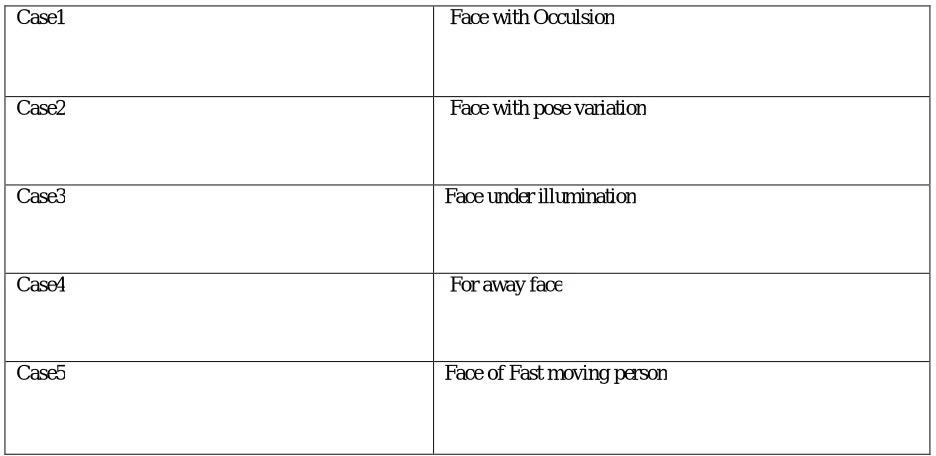
Table 1: Description of different cases Taken for face Recognition
Case1 Face with Occulsion
Case2 Face with pose variation
Case3 Face under illumination
Case4 For away face
ISSN(Online): 2320-9801
ISSN (Print): 2320-9798
International Journal of Innovative Research in Computer
and Communication Engineering
(An ISO 3297: 2007 Certified Organization)
Vol. 4, Issue 7, July 2016
Images Taken for Comparison
Figure 3 Training set Images
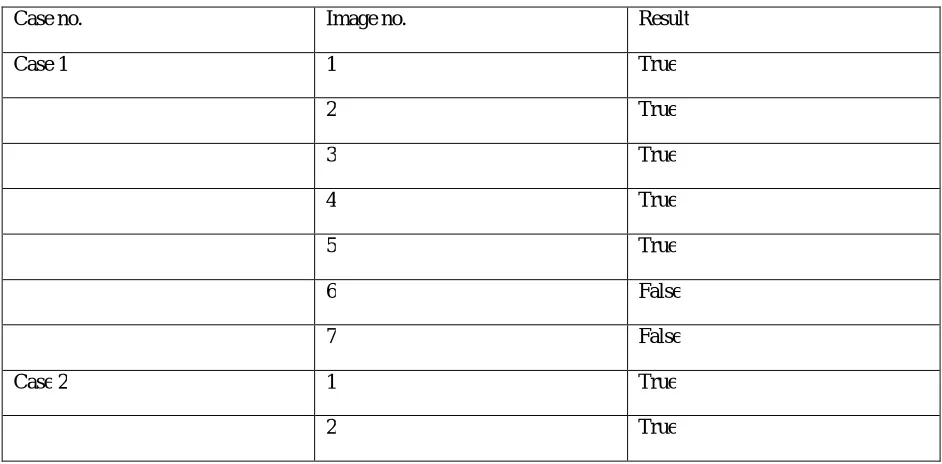
Table 2 :Cases for true positive
Case no. Image no. Result
Case 1 1 True
2 True
3 True
4 True
5 True
6 False
7 False
Case 2 1 True
ISSN(Online): 2320-9801
ISSN (Print): 2320-9798
International Journal of Innovative Research in Computer
and Communication Engineering
(An ISO 3297: 2007 Certified Organization)
Vol. 4, Issue 7, July 2016
3 True
4 True
5 True
6 True
7 False
8 False
Case 3 1 True
2 True
3 True
4 True
5 True
6 False
7 False
Case 4 1 True
2 True
3 False
4 False
5 False
Case 5 1 True
2 True
3 False
4 False
ISSN(Online): 2320-9801
ISSN (Print): 2320-9798
International Journal of Innovative Research in Computer
and Communication Engineering
(An ISO 3297: 2007 Certified Organization)
Vol. 4, Issue 7, July 2016
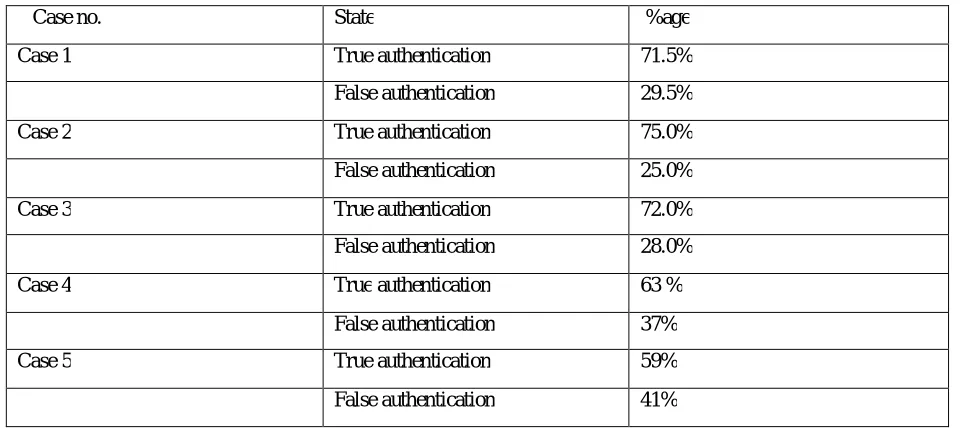
Table 5.3: Percentage Matching
Case no. State %age
Case 1 True authentication 71.5%
False authentication 29.5%
Case 2 True authentication 75.0%
False authentication 25.0%
Case 3 True authentication 72.0%
False authentication 28.0%
Case 4 True authentication 63 %
False authentication 37%
Case 5 True authentication 59%
False authentication 41%
Table 5.4: Average Result of Proposed Method
VI. CONCLUSION
In general for IPCA based face recognition, the increase in the number of signatures will increase the recognition rate. Therefore, in our observation it is better to use robust image pre-processing systems, and intensity normalization which increases the recognition rate and simultaneously decreases the number of signatures representing images in the IPCA space. Increase in the number and variety of samples in the covariance matrix increases the recognition rate. These findings can provide useful performance evaluation criteria for optimal design and testing of human face recognition systems.
In this Dissertation, I have implemented a new rapid method which is the combination of DCT and IPCA.IPCA is considered as a very fast algorithm with a more robustness and DCT is used for time reduction of recognized output images. So finally we can conclude that combination of IPCA and DCT will offers higher rates of recognition .This face recognition method verifies improvement in parameters in comparison to the existing method.
VII. FUTURE WORK
Thesis is limited to image based face recognition. Future work can be enhanced to cope with difficult scenerios, like in video based recognition.
This work can also be applied to the other databases to see the result of proposed method for cross validation. One factor to look out for is the computational complexity involved here. This will be a major issue when trying to
Average true authentication %age Average false authentication %age
ISSN(Online): 2320-9801
ISSN (Print): 2320-9798
International Journal of Innovative Research in Computer
and Communication Engineering
(An ISO 3297: 2007 Certified Organization)
Vol. 4, Issue 7, July 2016
implement the system on real time system. The research will be focused to develop the computational model for face recognition that will be fast, simple and accurate in different environments.
REFERENCES
[1]. J. Lu, K. N. Plataniotis et.al “Face recognition using LDA based algorithms”, IEEE Transactions on Neural Networks 14 (1), pp 195-200, 2003.
[2]. Kiran D. Kadam1 et.al, “Face Recognition using Principal Component Analysis with DCT” International Journal of Engineering Research and General Science Volume 2, Issue 4, June-July, 2014ISSN 2091-2730
[3]. Manal abdullah1 et.al “Optimizing face recognition using PCA” International Journal of Artificial Intelligence & Applications (IJAIA), Vol.3, No.2 2012.
[4]. M. A. Turk et.al, “Eigenfaces for recognition,” J. Cogn. Neurosci. vol. 3, pp. 71–86 1991.
[5]. M. Parisa Beham et.al,“Face Recognition using appearance based Approach: A Literature Survey” International Conference & Workshop on Recent Trends in Technology, (TCET) Proceedings published in International Journal of Computer Applications® (IJCA),2012.
[6]. Miss.Renke Pradnya Sunil,Journal of Electronics and Communication Engineering (IOSR-JECE) ISSN: 2278-2834-, ISBN: 2278-8735, PP: 01-07,2014.
[7]. M Sharmila Kumari et.al, “Discriminative DCT Based Face Recognition: An Efficient and Accurate Approach”International Journal of Innovative Research in Computer and Communication Engineering, Vol. 2, Special Issue.
[8]. Ms. Jaishree Tawaniya et.al, “Image–Based Face Detection and Recognition using MATLAB “International Journal of Core Engineering & Management (IJCEM) Volume 1, Issue 2, 2014.
[9]. Pankaj Chawla et.al, “Performance Evaluation of Face Recognition using PCA and N-PCA” International Journal of Computer Applications (0975 – 8887) Volume 76– No.8, 2014.
[10].Navneet Jindal et.al, “Improved PCA Based Face Recognition System” ISSN: 2278 – 1323 International Journal of Advanced Research in Computer Engineering & Technology (IJARCET) Volume 2, No 6,2013.
[11].Rotimi et.al, “Implementation of an Improved Facial Algorithm in web based Learning System” International Journal of Engineering and Technology Volume 2 No. 11,November, 2012
[12].Ridhi Patel et.al “A Literature Survey on Face Recognition Techniques ”International Journal of Computer Trends and Technology (IJCTT) – volume 5, 2014.
[13].S.SAKTHIVEL “ENHANCING FACE RECOGNITION USING IMPROVED DIMENSIONALITY REDUCTION AND FEATURE EXTRACTION ALGORITHMS –AN EVALUATION WITH ORL DATABASE” International Journal of Engineering Science and Technology Vol. 2(6), 2010, 2288-2295.
[14].Samer et.al, “Face Recognition System Using PCA and DCT in HMM” International Journal of Advanced Research in Computer and Communication Engineering Vol. 4 Issue 1, January2015.