Vol. 5, Issue 12, December 2017
The New Service Brokering Algorithm in
Cloud Computing Based on ACO
Surekha Dixit 1, Nagendra Kumar 2
P.G. Student, Department of CSE, Shri Ram Institute of Science & Technology, Jabalpur, M.P. India1
Assistant Professor, Department of CSE, Shri Ram Institute of Science & Technology, Jabalpur, M.P., India2
ABSTRACT: Cloud Federation is the place where cloud service providers can gather to share their resources and the cloud service consumers can buy those resources. The federation is either handled by one of the cloud service provider or a third party known as cloud service broker. The broker is solely responsible for providing services to the cloud consumers which are leased by cloud service providers. On-demand resource provisioning makes cloud computing a cutting edge technology. All cloud service providers offer computing resources with their own interface type, instance type, and pricing policy, among other service features. A cloud-based service broker provides intermediation to seek appropriate service providers in terms a suitable trade-off between price and performance. On the other hand, load balancing among cloud resources ensures efficient use of a physical infrastructure, and at the same time, minimizes execution time. This makes service brokers and load balancing among the most important issues in cloud computing systems. This paper presents a set of novel market and economics-inspired policies, mechanisms, algorithms, and software designed to address the profit maximization problem of cloud providers.
KEYWORDS: Cloud Computing, Brokering Policy, Resource sharing, Availability, Cloud Analyst, Cloud Service
Broker.
I. INTRODUCTION
Vol. 5, Issue 12, December 2017
The first challenge to be addressed by the research community is to create a framework that could practically exploit a wide range of cloud services. Such frameworks could be based on a toolkit (for example, Optimis), middleware (such as mOSAIC), or even an open source cloud broker (CompatibleOne), and facilitate the use of multiple clouds by users. With the support of such solutions, CSBs can focus on their core business—that is, supporting the relationships between CSPs and DCs [2].
II. RELATED WORK
In the field of resource allocation in cloud computing, there has been a lot of innovation. In our literature survey, we went through some dominant allocation mechanisms and compared them. Also we explained the pricing factors on the basis of which we will further develop our allocation protocol. Hence, it forms a conspicuous part of our research work. Crucially, there will be a great usage of Novel resource provisioning strategies in the field of cloud computing. We evaluate the above mentioned theories and try to propose an appropriate resource provisioning with service broker policy system.
STRATOS [3] is a cloud broker service, which focuses on solving a Resource Acquisition Decision (RAD) problem,
involving the selection of n resources from m cloud providers. STRATOS requires two sets of inputs in order to solve
the RAD problem. The first is the application topology to be deployed on the cloud; this is specified through a Topology Descriptor File (TDF). The second is a set of developer objectives: measurable constraints, requirements and preferences.
OPTIMIS [4] is a multi-cloud toolkit aimed at infrastructure providers, service providers and application developers. It provides a suite of functionalities aimed at optimising IaaS clouds, covering the full lifecycle from service construction, cloud deployment and operation. OPTIMIS focuses on key non-functional concerns, regulatory and legislative constraints. A broker component is contained within the OPTIMIS toolkit, which allows alternative cloud configurations to be directly compared in terms of business efficiency.
Cloud Prophet [5] is a tool focused on application migration to the cloud. CloudProphet traces (records) the workload of the application when running locally, and replays the same workload in the target cloud(s) for prediction. The most mature component focuses on cost prediction, and allows an organisation to model their application requirements over time and predict migration and future costs across multiple cloud providers.
RightScale [6] offers a number of services, which allows users to deploy and manage applications across multiple cloud providers. Basic brokering mechanisms are provided through an alert-action mechanism. VMs managed by RightScale have a number of pre-defined hooks, which send data back to the RightScale console; this allows an alert to trigger an associated action, e.g., a scaling policy [7].
SMICloud [8] is a decision support tool, which allows users to evaluate and rank clouds based on a user’s Quality of Service (QoS) requirements. SMICloud is based upon the Service Measurement Index (SMI) [9] proposed by the Cloud Service Measurement Index Consortium, also used by STRATOS.
CloudHarmony [10] is a commercial product, which provides four core services so that users can compare a large set of commercial cloud providers.
Developing a cloud broker which makes decisions based on application specific characteristics is challenging as it requires not only complete knowledge of both the application’s behaviour and cloud resource performance, but also requires a method, which can find the connection between these two data sets in order to make an accurate prediction. We advocate further research upon application modelling and workload classification, capture and prediction. Furthermore, instead of just maximising performance or minimising the execution cost of an application, a broker must be able to enforce a user-defined QoS property based on the application model and predicted workload.A Cloud federation allows providers to trade their resources through federation regulations. In this paradigm, providers aim to overcome resource limitation in their local infrastructure which may result in rejection of customer requests, by outsourcing requests to other members of the federation.
Vol. 5, Issue 12, December 2017
III.PROPOSED ALGORITHM
To overcome the limitations of existing algorithms we propose a new algorithm that will work with global optimal solutions and will always gives the best results by selecting proper values of CSP.
The global pheromone update rule is give by:
ταi, j (t) = (1- ρ). τi, j + P * τ0 ...(1)
Where τi,j(t)= is the amount of pheromone on the edge (i, j) at time t from one CSP to another CSP; ρ is a parameter
governing pheromone decay such that 0 < ρ < 1; and τ0 is the initial value of pheromone on all edges between CSP. A
higher pheromone values represents a dense route that helps ants to search the next CSP path fastly and lower ones represents weak value that reduces the searching process. The Pseudo code of proposed algorithm is given below:
Input: Number of Cloud Users and List of Virtual Machines (CSP).
Output: Find the nearest virtual machine in the Datacenter (CSP) in that region.
Assumptions: Let us consider the Cloud User (cu) as an Ant and Food source as the Cloud Service Providers (CSP). The goal is to find the CSP with minimum network latency.
Start: Input Cloud users (In form of Tasks) and Cloud Service Providers (In the form of Virtual Machines). User base generates a request (an Internet cloudlet).
Step I: For all Cloud Users cu in CSP assign Task (CSPT) and application id associated with each task. It will specify the application id for the application it is intended and also include the name of the User Base itself as the originator for routing back the responses.
Step II: While k ≤ ants Number do Step III: While CSP[i] list is not empty
Choose CSP which has nearest distance Assign CSP[i] to cu[k]
End Inner while
Record the value of Pheromone User Base to CSP[i] and store the result in concentration matrix. If CSP[i] given service time is not equal to cu[k] taken service time then
Go to Step III.
Step IV: Update the concentration matrix for all paths using equation (1).
Step V: Go to step I.
Step VI: Repeat for next iteration until loop terminates for all paths.
For all other Iterations the concentration matrix will be used to find the next CSP [i] which will reduce the network latency for the all other iterations.
The proposed algorithm aims to show the effectiveness of concentration matrix to select the data center in order to achieve better resource utilization and remove the disadvantages of existing selection method. Once the concentration matrix is updated for complete cycle, it will be used very easily in the next cycle and hence it will reduce the data
transfer time and hence the network latency.
IV.PSEUDO CODE
1. User base generate request to internet cloudlet.
2. Internet cloudlet sends it to service broker via internet.
3. Service broker receives the request. The service broker maintains the list of data center controller, indexed by
region. It also maintains the concentration matrix.
4. Service broker send it to proposed service broker policy which selects the best Cloud Service Provider.
5. Information about datacenter has been selected.
6. Send information to internet cloudlet via internet.
7. The request received at data center will be sent to VM load balancer.
Vol. 5, Issue 12, December 2017
9. Information regarding VMs goes to data center.
10. Response goes to internet cloudlet via internet.
End.
V. SIMULATION RESULTS
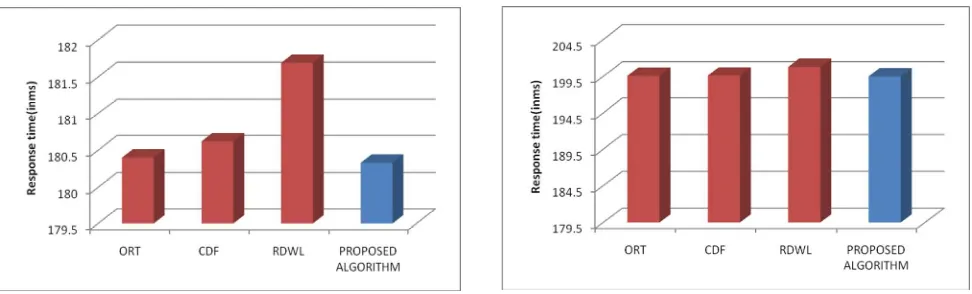
We have conducted several experiments to test the performance of proposed algorithm in terms of response time and this section also shows performance comparison between the proposed algorithm and three existing brokering algorithms named Optimise Response Time, Closest Data Center and Reconfigure Dynamically with Load Balancing There are different sizes virtual machines are used for this evaluation. Table 1 shows the performance comparison between the proposed algorithm, ORT, CDF and RDWL with respect to makespan using different CSP. Figure below shows the graphical representation of the results where CU = 5 and CSP=3.
Number of CU and CSP
ORT CDF RDWL PROPOSED
ALGORITHM
5/1 310.32 310.52 318.60 310.12
5/3 180.40 180.62 181.69 180.33
10/3 199.59 199.62 200.79 199.52
Table 1: Overall Response Time Comparison of Brokering Algorithms.
Result Chart for 5 Cloud users and three Cloud. Result Chart for 10 Cloud users and three Cloud Service providers Service providers
Figure 2: Graph showing result of Proposed Algorithm. Figure 3: Graph showing result of Proposed Algorithm.
VI.CONCLUSION AND FUTURE WORK
Vol. 5, Issue 12, December 2017
research focuses on the development of brokering and multicloud platforms, and on the optimization of the offer presented by the broker to its customers.
In future hybrid Cloud service brokering algorithm can also be developed. Work can be extended for heterogeneous environment also. In future work the effect of precedence between tasks and load balancing will be considered. These methods can also be modeled according to cloud pricing models for providing more benefit to cloud service providers. Separate interface for task scheduling may be provided for cloud controller.
REFERENCES
[1]. Kunal Kishor1, Vivek Thapar2,” An Efficient Service Broker Policy for Cloud Computing Environment”, IJCST- Volume 2 Issue 4, July-Aug 2015.
[2]. Ahmed M. Manasrah, Tariq Smadi, Ammar ALmomani, “A Variable Service Broker Routing Policy for data center selection in cloud analyst”, Journal of King Saud University - Computer and Information Sciences, S1319-1578(16)30019-2, Oct-2015.
[3]. P. Pawluk, B. Simmons, M. Smit, M. Litoiu, and S. Mankovski. Introducing stratos: A cloud broker service. In Cloud Computing (CLOUD),
2012 IEEE 5th International Conference on, pages 891–898, June 2012.
[4]. A. J. Ferrer, F. Hernandez, J. Tordsson, E. Elmroth, A. Ali- Eldin, C. Zsigri, R. Sirvent, J. Guitart, R. M. Badia, K. Djemame, W. Ziegler, T. Dimitrakos, S. K. Nair, G. Kousiouris, K. Konstanteli, T. Varvarigou, B. Hudzia, A. Kipp, S. Wesner, M. Corrales, N. Forg´o, T. Sharif, and C. Sheridan. Optimis: A holistic approach to cloud service provisioning. FutureGeneration Computer Systems, 28(1):66 – 77, 2012.
[5]. A. Li, X. Zong, S. Kandula, X. Yang, and M. Zhang. Cloudprophet: Towards application performance prediction in cloud. SIGCOMM
Comput. Commun. Rev., 41(4):426–427, Aug. 2011.
[6]. A. Li, X. Yang, S. Kandula, and M. Zhang. Cloudcmp: Comparing public cloud providers. In Proceedings of the 10th ACM SIGCOMM
Conference on Internet Measurement, IMC ’10, pages 1–14, New York, NY, USA, 2010. ACM.
[7].N. Grozev and R. Buyya. Inter-cloud architectures and application brokering: taxonomy and survey. Software: Practice and Experience, 44(3):369–390, 2014.
[8]. S. K. Garg, S. Versteeg, and R. Buyya. A framework for ranking of cloud computing services. Future Gener. Comput.Syst., 29(4):1012– 1023, June 2015.