ISSN(Online): 2320-9801
ISSN (Print): 2320-9798
I
nternational
J
ournal of
I
nnovative
R
esearch in
C
omputer
and
C
ommunication
E
ngineering
(An ISO 3297: 2007 Certified Organization)
Vol. 4, Issue 10, October 2016
Retina and Face Recognition Removing Facial
Distortion Using PCA Algorithm
Sumeet Dnyaneshwar Dhumal1, Amit Sunilkumar Bedre2, Sumit Ravindra Sawant3, Ashwin Pandey4, Prof.Jayashree Chaudhari5
Department of Computer Engineering, Dr.D.Y. Patil School of Engineering Pune, SavitribaiPhule Pune University,
India.
ABSTRACT: Biometric recognition technology is fast gaining popularity as means of security measures to reduce cases of fraud and stolen due to its use of physical characteristics and traits for the identification of individuals. The earliest methods of biometric identification included iris eye scan, fingerprint scan, face scan. It focuses on training the system to find an individual unique retina scan and face scan pattern characteristics. We present an implementation of a security system based on Retina and Face recognition as the access control key. This system which is capable of authenticating a person identity by his or her Retina Scan and face scan pattern. In addition system will also remove the distortion of face. The face recognition, face distortion and retina recognition will be done with the Principle Component Analysis(PCA).The PCA is used to reduce multidimensional data to lower dimensions while retaining most of the information. Face recognition can be applied in security measure such as for Passport verification.
KEYWORDS: PCA, Facial Distortion, Face recognition, Retina recognition.
I. INTRODUCTION
In recent year authentication is used in biometric system is been improved in reliability and accuracy. In many of organization still biometric system are using for the authentication of the individuals. Even many of biometric systems are still facing problems &generally suffers from many difficulties such as intra class variability , limited Degree of Freedom , noisy input data & data sets, spoof attack & other related parameters problems which affect the Performance , Reliability & Accuracy of Biometric authentication system.
In word Biometric we can say that Bio means life and metric means measure by this we can say that it is the study of life in which it includes humans, animals and plants. There is simple definition of Biometric technologies is an automated methods of verifying or recognizing the identity of a living person which is based on a physiological or behavioral characteristic.
ISSN(Online): 2320-9801
ISSN (Print): 2320-9798
I
nternational
J
ournal of
I
nnovative
R
esearch in
C
omputer
and
C
ommunication
E
ngineering
(An ISO 3297: 2007 Certified Organization)
Vol. 4, Issue 10, October 2016
II. RELATED WORK
Paper Name Author Name Proposed System For this paper we referred
1. Face Spoof Detection with Image Distortion Analysis
Di Wen, Hu Han, Member,
and Anil K. Jain, Fellow,
The proposed technique is extended to multi-frame face image spoof detection in videos using a voting based scheme. We also collect a face image spoof database, MSU Mobile Face Spoofing Database (MSU MFSD), using two mobile devices (Google Nexus 5 and MacBook Air) with three types of spoof attacks (printed photo, replayed video with iPhone 5S and iPad Air). Experimental results on two public-domain face image spoof databases
(Idiap
REPLAY-ATTACK and CASIA FASD), and the MSU MFSD database show that the proposed approach outperforms state-of-the-art methods in spoof detection in image. Our results also highlight the difficulty in separating genuine and spoof face images, especially in cross-database and cross device scenarios.
Image Distortion technique.
2. A Robust Non-Vascular Retina Recognition System using Structural Features of Retinal Image
Zahra Waheed,
AmnaWaheed, M.
UsmanAkram.
This paper states a simple and fast non-vascular based retina recognition system. It computes similarity measure using novel features based upon structural information of aretina image. It extracts illuminance, contrast and structural features from a color retina image and combines these extracted attributes using an empirically optimized function to generate a similarity score between
ISSN(Online): 2320-9801
ISSN (Print): 2320-9798
I
nternational
J
ournal of
I
nnovative
R
esearch in
C
omputer
and
C
ommunication
E
ngineering
(An ISO 3297: 2007 Certified Organization)
Vol. 4, Issue 10, October 2016
two candidate images. Finally matching decision is obtained on the basis of highest score value. 3. IRIS & Finger Print
Recognition Using PCA for Multi Modal
Biometric System
Piyush G. Kale,
Khandelwal C.S.
In this system we will use two types of
authentication traits of biometric systems i.e. IRIS and Finger print. IRIS images & Finger print images of person we will use in system for authentication ofthem also we will check the reliability and accuracyof the system, so this system can be helpful in privacy also.
In this paper we have studied how to apply authentication of IRIS images and Finger print images of person.
Also, we referred how to keep our system secure.
4.Face and Ear Biometric Recognition using
PCA and LLE Algorithm
GandhimathiAmirthalingam This paper present multimodal face and ear biometric verification system to improvethe recognition rate of image. This paper, a solution based on Principal Component Analysis (PCA) and
Locally Linear Embedding (LLE) algorithms are presented for the face and
ear recognition
respectively.
The Principal Component Analysis (PCA) is one of the most successful techniquesthat have been used to recognize face in images.
In this paper we have referred the PCA algorithm.
5. Image Quality Assessment for Fake Biometric Detection: Application to Face and Fingerprint Recognition
ShrutiGhorpade, DhanashriGund, SwapnadaKadam, Prof.Mr.R.A.Jamadar
In this paper, to develop a system which assurestwo times security against the dissemble biometric scanning of face or fingerprint using two stages for confirmation that the user who gets access to the system is authorized.
Develop a system to enhance the security of biometric recognition framework, by providing a two stage security using finger print and face detection applications.
6. Analysis of various Biometric Techniques
Mr. Sanjay Kumar, Dr. EktaWalia.
This paper presented an overview of the different biometric technique with some advantages and disadvantages. Than we will try to find out which technique is more reliable and secure.
Biometrics technique which refers to identifying an individual based on his or her physiological or behavioral characteristics. In this paper we referred the different biometric technique to secure our system.
ISSN(Online): 2320-9801
ISSN (Print): 2320-9798
I
nternational
J
ournal of
I
nnovative
R
esearch in
C
omputer
and
C
ommunication
E
ngineering
(An ISO 3297: 2007 Certified Organization)
Vol. 4, Issue 10, October 2016
Fingerprint, Face and Iris Biometric Recognition System, Image Quality Assessment and Fake Biometric
Dr.Milind V. Sarode, Prof. Mangesh M. Ghonge
biometric techniques which are face recognition, fingerprint recognition, and iris recognition (Multi Biometric System) and also introduce the attacks on that system and by using Image Quality Assessment For Liveness Detection how to protect the system from fake biometrics. How the multi biometric system is secure than unibiomertic system.
challenging system. It is more secure than unibiometric system. In this paper studied about the three biometric systems.
We have referred the face recognition technique to detect the exact match and also referred how to protect our system from the attacks and fake biometric.
8. PCA Algorithm for Efficient Face Recognition System
ManishaNirania, Mr. Krishan Kumar
In this paper, the PCA algorithm has been proposed and training will be initial points for train the proposed algorithm and this complete work have been chosen for analyze and improve the efficiency of that algorithm.
IRIS & Face Recognition
using Principle
Component Analysis i.e. PCA Algorithm is more suitable and secure. In this paper we have referred the PCA Algorithm to find the best result in image.
9. Intelligent Anti-Theft and Tracking System for Automobiles
Montaser N. Ramadan, Mohammad A. Al-Khedher and Sharaf A. Al-Kheder
The proposed security system in this paper is designed to
track and monitor vehicles that are used by certain party for particular purposes, also to stop the vehicle if stolen and to track it online for retrieval, this presented system is an integration of several modern embedded and communication
technologies.
In this paper we have referred how to track and also monitor the system and also how to protect our system or data to be stolen or hack.
10. Retina Recognition for Biometrics
Ryszard S. Chora. This paper proposed a general framework for image processing of retina images with a particular view on feature extraction. The method uses the set of geometrical and texture features and based on the information of the complex vessel structure of the retina. The feature extraction contains the image preprocessing, locating, segmentation of
ISSN(Online): 2320-9801
ISSN (Print): 2320-9798
I
nternational
J
ournal of
I
nnovative
R
esearch in
C
omputer
and
C
ommunication
E
ngineering
(An ISO 3297: 2007 Certified Organization)
Vol. 4, Issue 10, October 2016
the region of interest (ROI). The image processing of ROI and the feature extraction are proceeded, and then the feature vector is determined for the human recognition.
11. Analysis of Retina
Recognition by
Correlation and
Covariance Matrix
S. N. Kakarwal, Dr. R.R. Deshmukh.
In this paper proposed an automated technique for person recognition based on retina of the human eye. In this paper we compare the performance of retina recognition by calculating correlation and covariance matrix of the retinal images. 20 images are used for the purpose of training and testing. Experimental results on DRIVE database show that these two methods are significantly better.
In this paper we study Retina Recognition system. Recognition system is quite-simple. It requires few components and is effective enough to be integrated within security systems that require an identity check. Retina recognition systems can be used at ATMs, Network access, Internet access, telephone transaction etc.
III. EXISTING SYSTEM APPROACH
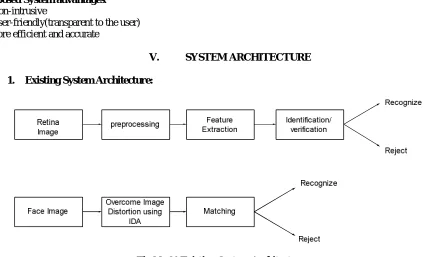
Existing system are created by using different technique and different algorithms to remove distortion of face. This proposed a feature set based on Image Distortion Analysis (IDA) with real-time response (extracted from a single image with efficient computation) and better generalization performance in the cross-database scenario.
To overcome the distorted part on the face using IDA but there is drawbacks in IDA which is shortest algorithm and values are intrinsic in nature.
Compared to the existing methods, the proposed method checks the facial details i.e. Distortion of input image, capture the face image differences and apply PCA algorithm. As a result, experimental results show that the proposed method has better distortion remove ability.
Existing System Disadvantages:
1. The robustness and security level of the system is weak.
2. Existing system uses IDA for distortion which is shortest algorithm and values are intrinsic in nature.
IV. PROPOSED SYSTEM APPROACH
In this paper we present biometric recognition based on the face and retina. Here, we use some face images with facial expressions and retinal images. Here, we use image distortion technique to remove the distortion of image for further processing. After that the given processing image matches to the original image and then finally shows the result. In this system used the PCA algorithm to recognize the image.
ISSN(Online): 2320-9801
ISSN (Print): 2320-9798
I
nternational
J
ournal of
I
nnovative
R
esearch in
C
omputer
and
C
ommunication
E
ngineering
(An ISO 3297: 2007 Certified Organization)
Vol. 4, Issue 10, October 2016
account in a system. Then these data’s are stored in authentication database. Then the system will authenticate with samples stored in authentication database. If the accuracy is 98% with the sample stored in database then it will enter mode.
Proposed System advantages: 1. Non-intrusive
2. User-friendly(transparent to the user) 3.More efficient and accurate
V. SYSTEM ARCHITECTURE
1. Existing System Architecture:
Fig No 01 Existing System Architecture
2. Proposed System Architecture:
ISSN(Online): 2320-9801
ISSN (Print): 2320-9798
I
nternational
J
ournal of
I
nnovative
R
esearch in
C
omputer
and
C
ommunication
E
ngineering
(An ISO 3297: 2007 Certified Organization)
Vol. 4, Issue 10, October 2016
PCA Algorithm: Steps:
1. Let a face image X(x, y) be a two dimensional m x n array of intensity values. An image may also be considering the vector of dimension m n.
Let the training set of images {X1, X2, X3,…, XN}. The average face of the set is defined by
2. Calculate the Covariance matrix to represent thescatter degree of all feature vectors related to theaverage vector.The Covariance matrix C is defined by
3. The Eigenvectors and corresponding eigenvalues arecomputed by using
Where V is the set of eigenvectors associated with itseigenvalue λ.
4. Sort the eigenvector according to their correspondingeigenvalues from high to low.
5. Each of the mean centered image project intoeigenspace using
6. In the testing phase each test image should be meanCentered, now project the test image into the sameeigenspace as defined during the training phase.
7. This projected image is now compared with projectedtraining image in eigenspace. Images are comparedwith similarity measures. The training image that isclosest to the test image will be matched as used toidentify.
VI. CONCLUSION
This is first kind of implementation on RETINA&FACE recognition using PCA for biometric system with this specialized hardware’s & software. This paper presented biometric recognition based on the face and retina. For testing our system, we use some face images with facial expressions and retinal images. The authors apply PCA algorithm for face and retinal biometric system.Experimental results have demonstrated that this approach is promising to improve retina recognition and face recognition for person identification.
REFERENCES
[1] Di Wen, Hu Han, and Anil K. Jain, Fellow, “Face Spoof Detection with Image Distortion Analysis”, IEEE Transactions on Information Forensics and Security, 2015
[2]Zahra Waheed, AmnaWaheed, M. UsmanAkram, “A Robust Non-Vascular Retina Recognition System using Structural Features of Retinal Image”2016 13th International Bhurban Conference on Applied Sciences and Technology (IBCAST).
[3] Piyush G. Kale, Khandelwal C.S,“. IRIS & Finger Print Recognition Using PCA for Multi Modal Biometric System”, International Conference on Global Trends in Engineering, Technology and Management (ICGTETM-2016).
[4] GandhimathiAmirthalingam,“ Face and Ear Biometric Recognition using
PCA and LLE Algorithm”, International Journal of Information Science and Intelligent System, 3(2): 47-54, 2014
[5] ShrutiGhorpade, DhanashriGund, SwapnadaKadam, Prof.Mr.R.A.Jamadar, “Image Quality Assessment for Fake Biometric Detection: Application to Face and Fingerprint Recognition”, International Journal of Emerging Technologies and Engineering (IJETE)
Volume 2 Issue 1, January 2015, ISSN 2348 – 8050.
[6] Mr. Sanjay Kumar1, Dr. EktaWalia, “Analysis of various Biometric Techniques”,Sanjay Kumar et al, / (IJCSIT) International Journal of Computer Science and Information Technologies, Vol. 2 (4) , 2011, 1595-1597.
[7] Pradnya M. Shende, Dr.Milind V. Sarode, Prof. Mangesh M. Ghonge,“A Survey Based on Fingerprint, Face and Iris Biometric Recognition System, Image Quality
ISSN(Online): 2320-9801
ISSN (Print): 2320-9798
I
nternational
J
ournal of
I
nnovative
R
esearch in
C
omputer
and
C
ommunication
E
ngineering
(An ISO 3297: 2007 Certified Organization)
Vol. 4, Issue 10, October 2016
[8] ManishaNirania, Mr. Krishan Kumar,” PCA Algorithm for Efficient Face Recognition” International Journal of Advanced Research in Computer and Communication Engineering
Vol. 4, Issue 8, August 2015
[9] Mohammad A. Al-Khedher, Montaser N. Ramadan,Sharaf A. Al-Kheder, “Intelligent Anti-TheftTracking System for Automobiles”, InternationalJournal on Machine Learning and Computing(IJMLC), Volume 2, No.1, February-2012.
[10]Ryszard S. Chora, “Retina Recognition for Biometrics” Digital Information Management (ICDIM), 2012 Seventh International Conference onYear: 2012.