Student Course Recommendation System
Using Fuzzy C Means and Classification
Algorithms
Yashaswini H P, V Chetan Kumar
M.Tech. Student, Dept. Of C.S.E., P.E.S College of Engineering, Mandya, Karnataka, India
Assistant Professor, Dept. Of C.S., P.E.S College of Engineering, Mandya, Karnataka, India
ABSTRACT: An online web application called Student Advising System has been developed. This system helps students to see the wider picture of carrier planning and understand that this next stage is really a launching pad. This advising system is focused on assuming that students with similar characteristics and behaviours will have similar course preferences. Students are sorted into groups, if a student is determined to be similar to a group, a course preferred by that group might be recommended to the student. The goal is to help students to choose subjects they are good at, interested in, and can see themselves using it in the future then students are more likely to do better in their academics.
KEYWORDS: Course recommendation, Fuzzy C Means algorithm, Classification 4.5 algorithm.
I. INTRODUCTION
In organizations, online scholastic exhorting frameworks can give incite guidance as and when required, and in this manner improve understudy involvement and spare staff time and other institutional assets. Along these lines such frameworks are picking up ubiquity. Look into such frameworks and improvement of such frameworks are in advance. Objectives for scholarly informing incorporate improvement regarding reasonable instructive arrangements, choice of proper courses, understanding of institutional necessities, upgrade of understudy mindfulness about accessible instructive assets, assessment of understudy advance towards set up objectives and improvement of basic leadership abilities with support of understudy self-bearing.
An online smart exhorting framework utilizing shared separating, a method usually utilized as a part of proposal frameworks. This strategy accept that clients with comparable attributes and practices will have comparable inclinations. With this understudy prompting framework, understudies are sorted into gatherings and given exhortation considering the significant elements and furthermore considering their likenesses to particular gatherings. In the event that an understudy has a place with a specific gathering, a course that different understudies in that gathering have favoured, might be prescribed to the understudy.
II. RELATED WORK
InPrevious methods where the institutions uses an instrument such as, student monitoring which keeps up understudy scholastic points of interest, for example: marks, participation, confirmation, charges, sports, arrangement cell, hostel accommodation details and so forth however doesn't gives valuable data where understudy execution will be extemporized.
And some of the frameworks systems where specialists from private coaching classes or training classes gives their feelings, recommendations for the course choice for which students need to pay huge amount. This system also requires time, understanding in the same field.
III.PROPOSED SYSTEM
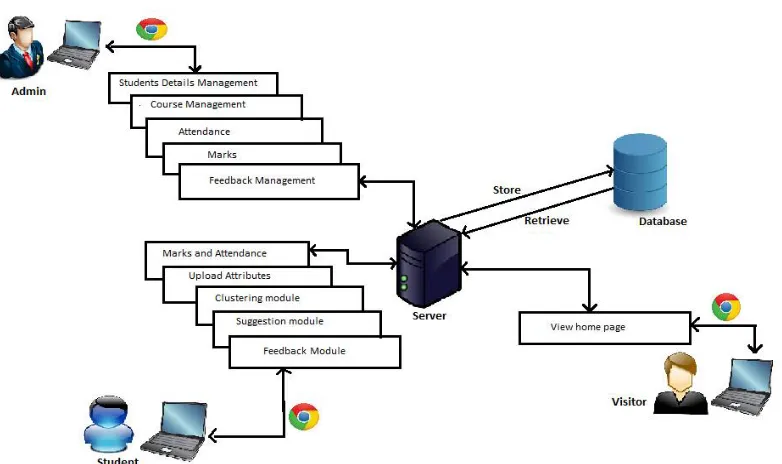
Figure. 1. Block diagram of student course recommendation system
The figure. 1., contains three actors: Admin, Student, visitor and their modules, database, server. The proposed system is a tool for academic advising for an institution. Admin plays a major role in new student registration, course updating, Attendance and marks updating, feedback management, updating old student’s characteristics.
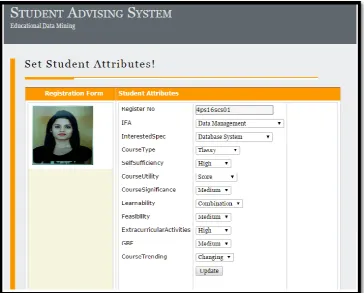
Registered student can access the application using login credentials given by the admin. He can view his attendance of specified month, marks obtained in a specified internals or exam. Initially password is given by admin, later student can change his password using the old password. In order to take a course recommendation from the system he needs to select some characteristics values such as:
Interested Functional Area: business intelligence analyst, data management, designing, developing, gaming and graphics, network management, software architect, system administration, technical support, testing etc. Interested Specialization: computer programming, computer networks, database system, operating system,
software architecture, system architecture, web technology, etc. Course Type: theory, programming, problematic, etc.
Self Sufficiency: high, medium, low. Course Utility: job, score, knowledge. Course Significance: high, medium, low. Learnability: new, know, combination. Feasibility: high, medium, low.
On selecting the characteristics values, the system will cluster the student using the algorithm Fuzzy c means, after identifying the cluster to which student belongs, system recommends the course using the algorithm Classification 4.5.
Students can interact with admin through feedback module. They can post any query and see the response or reply message if admin response to that query.
Finally a Visitor can view the college basic details such as about us, Department, Alumni, Gallery, News and events, Facilities, Contact us, etc. which will give an insight about the institution and how it is functioning towards providing a good education.
IV.PROPOSEDALGORITMS
A. Methodology for Clustering Students:
Proposed framework makes use of "Fuzzy C Means Algorithm" for gathering of understudies in view of comparable qualities. This calculation takes a shot at numbers, so as opposed to taking attributes content esteem we ought to that its number esteem. For instance: the qualities "course drifting" has two values "steady and evolving". We allocate number to its esteem, for example, stable=1 and changing=2. The fuzzy c implies calculation has taking after strides:
Step 1: Randomly initialize the members matrix using this equation ∑ μ ( )=1 i=1,2,..k
Step 2: Calculate the centroid using equation
Cj=∑∑[ ( )][ ( )]
Step 3: Calculate dissimilarly between the data points and centroid using the Euclidean distance.
Di = √(x2-x1) + (y2-y1)2
Step 4: Update the New Membership matrix using the equation,
µ j (xi) =
[ ]
∑ [ ]
Here M is a fuzzification parameter. The range must always [1.25,2]
Step 5: Go back to step 2, unless the centroids are not changing
B. Methodology for Course Recommendation:
Framework makes usage of "Classification 4.5 Rule" for course recommendation, utilizing the bunched dataset of understudies. This algorithm is based on single attribute value. It takes the highest count feature then checks the course taken by that respective students then recommends the highly counted course.
Step 1: Scan the dataset (stockpiling servers)
Step 2: for each trait an, ascertain the pickup [number of occurrences] Step 3: Let a best be the trait of most noteworthy pick up [highest count]
Step 4: Create a choice hub in view of a best – recovery of hubs [student] where the characteristic qualities matches with a best.
Step 5: repeat on the sub-records and compute the results named sub hubs. In light of the most noteworthy number we characterize the new hub.
V. RESULT
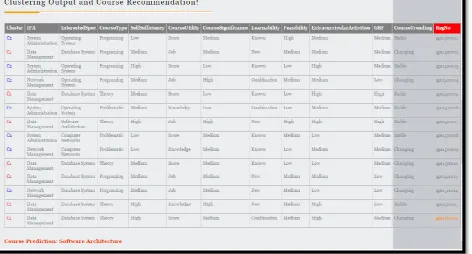
old students data, for this system makes use of Fuzzy C Means Algorithm. System will consider and scan only that particular cluster data set using Classification 4.5 Algorithm, it first identifies the highest count characteristic from the group of characteristics, then identifies the course preferred by those respective students then recommends the highly counted course. Student 4ps16scs01 has beenidentified to cluster c1 and recommended course is Software Architecture based on her characteristic match.
Figure. 3. Analyzed Course Recommendation for Student
VI.CONCLUSION AND FUTURE WORK
The previous methods of advising a student in terms of helping him to choose a right course which will prove beneficial in the future was manual, time consuming, needed experience in the same field. This paper is centred on the development of web application to encourage students identify their abilities, interested specialization, area of interest which they want to select after graduation. This system will also help in educational plans, interpretation of institutional requirements,to select an appropriate course. This in terms will also help the institution to evaluate student progress towards established goals. As students can see themselves usingit in the future they are not only more likely to do better in their academics, they will also achieve higher success in future.To enhance students’ performance a video tutorial module and a question paper module can be included for the recommended course so that students will get more knowledge about the course. In addition to this Parent module can also be included as an actor to the application, such that they can see the progress of their children’s by logging into the application, which will help them to guide their children’s towards academics.
REFERENCES
1. Niall Adams, ‘Statistical Analysis and Data Mining’, The ASA Data Science Journal, Vol.9, Issue 4, pp. 95-104, 2016. 2. Witold Pedrycz, ‘Data Mining and Knowledge Discovery’, Wiley Interdisciplinary Reviews, Vol.6, Issue 5, pp.21-105, 2016.
3. Larry Kerschberg, Zbigniew Ras, ‘ Integrating Artificial Intelligence and Database Technologies’, Journal of Intelligent Information systems(0925-9902, 1573-7675), Vol.42, Issue 2, pp. 179-332, 2014.
BIOGRAPHY
Yashaswini H.P is a final year student of Master of Technology (M.Tech) Pursuing in Computer Science & Engineering, P.E.S college of Engineering, Mandya, Karnataka, India. She received Bachelor of Engineering (BE) from Ghousia College of Engineering, Ramanagaram, Karnataka, India. Her research interests are Big Data and Mining Tools, Algorithms, Data Analytics, web 2.0 etc.