Improved Clustering Approach with Store
and Forward Method for Wireless Sensor
Network
Ch.Radhika Bhavani1, V.Suresh2, P.Bala Murali Krishna3
PG Student, Dept. of ECE, Sri Mittapalli Institute of Technology for Women, Tummalapalem, Guntur, A.P, India1 Asst.Professor, Dept. of ECE, Sri Mittapalli Institute of Technology for Women, Tummalapalem, Guntur, A.P, India2
Professor, Dept. of ECE, Sri Mittapalli Institute of Technology for Women, Tummalapalem, Guntur, A.P, India3
ABSTRACT: In recent times, wireless sensor networks are the most promising and play a vital role in wireless communication. In these networks nodes are generally arranged in the form of clusters and relay nodes which are having more power are used as cluster heads But, as number of sensors increases the speed of transmission could be reduced. The store and forward method may be used to transfer the data from sensors to the base station. In this method, the data might have been failed due to the damage of the storage nodes. In this paper, we propose the hybridization of clustering and store and forward methods to improve the capacity and quality of service of wireless sensor networks. The proposed method improves the network lifetime and consumes less power compared to existing GC, LCD and in MCVC methods.
KEYWORDS: Wireless Sensor Networks, Clusters, Quality of service, Network life time.
I. INTRODUCTION
Nowadays, life is not conceivable without wireless communications. Wireless sensor networks include small nodes which have sensing, calculation and communication abilities. Such networks have limitations in communicating, calculating and consuming energy.
First, sensor nodes have a limited calculating power and a low memory limits the type of the processed algorithms which could be used. Second, the wireless sensors have a little battery and the lifetime of the sensors is a main issue in designing this system.
In the data storage methods, the workload is much on the storage nodes, which have more memory and battery in proportion with the common sensors. So, the life time of the network will increase [4][5][6]. But the problem with these networks is that the storage of the data has been done by several nodes and these nodes are in the network range and fail of a node causes the elimination of the sensed data of a large number of sensors, since this method does not send the sensed data to the base station. In clustering method, data have been sent periodically from sensors to cluster head and from cluster heads to base station [l][2][3]. So data does not remain in the network and transmits periodically to the base station. So, if a node fails, no special data will be deleted.
But in this method, when the number of sensors increases, the clustering of the network will require more calculations, so lifetime will decrease. In our proposed algorithm we tried to ignore the disadvantages of both methods and make use of the advantages of them to create a hybrid method, which in comparison with the other methods have more improved life time and end-to-end delay.
`
II. RELATED WORK
A. Data storage method
In [4],[5],[6],[7] it has been mentioned that the data gathered by sensory could be stored in the sensor networks or transferred to the base station.
When data is stored in the sensor networks, it could bring several problems:
Sensors have a limited memory, so we couldn’t store a large amount of data monthly or annually.
Since the feeding source of sensors is battery when it dies, the stored data in it will be failed.
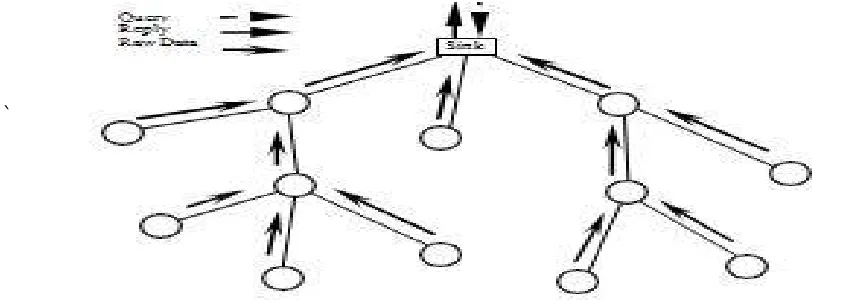
Exploring in the expanded and scattered network will be more difficult. Figure l shows that all sensors have same memory and battery.
It is possible that by increasing the costs, some nodes with much memory capacity and battery power will be used in sensor networks. These sensors make a backup from the neighboring sensors and reply to queries. Since the storage nodes only collect data in neighboring nodes and transmit them physically as shown in Figure 2. This figure shows that some nodes have the stronger memory and battery than other.
The problem with the limited capacity of memory, transmission and battery capacity will be improved partially[5][6].
Storage and forward nodes have been mentioned in [5] as follows:
Storage Nodes: These nodes store all the received data from the other nodes and also their self-generated data and send nothing before receiving Query. According to the definition of Query, they come up with the desired results from Raw Data and transmit the relevant results to the base. The base itself is interpreted as the storage node
Fig. 2: Data Access Model with Storage Nodes
Forwarding Node: These nodes transmit the received data from the other nodes or their self- generated data through the specific pathways to the base again. This transmission continues till the data received at a storage node.
III. CLUSTERING METHOD
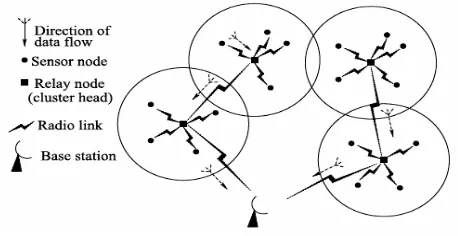
In [l][2][3], it has been mentioned that there is an effective solution to increase the life time of the network is partitioning it to separated clusters by a dynamic node which is called cluster head, as the major node of the cluster. Cluster heads manage the internal network of the cluster as shown in Figure 3. Clusters are formed on the basis of the data loaded up the cluster heads and also the interconnecting space between sensors and cluster heads. Each sensor only pertains to one cluster. Linking to the base station is only possible through the cluster Gate. In the clustering method since the sensed data are transfer to base station by Cluster heads, the data storage carries out in a Safe place. In this method, each Cluster head must send some information about its time schedule and also it’s routing to all the sensors. This is expensive, since there are many sensors in each cluster.
Three clustering methods have been explained below:
A. GC (Greedy clustering method)
In this method, there is just one criterion for clustering the storage nodes:
The storage node must be in the range of the cluster head. The problem with this method is that the storage node might be next to another cluster head.
B. LDC (Least distance clustering method)
Distance is the important criteria in this method and the storage node belongs to a cluster which is next to it. The problem with this method is that several storage nodes might have been near a cluster and different workload will be exerted on the cluster heads and this lack of counterbalance could decrease the lifetime of the network.
C. MCVC (Minimal cardinality variance clustering method)
Counterbalance is the important criteria in this method. First the storage nodes which are only in the range of one cluster head will be located in that cluster. Then for the remaining storage nodes it will be investigated that slightly node is in range of which cluster heads. It chooses among the cluster heads the one which is the most uncrowned one.
IV. THE PROPOSED ALGORITHM
The main purpose of the proposed algorithm is to make use of the positive points of both clustering and data storage methods. It means that we could increase the lifetime of the network and put the work load on the relay nodes by this method. In this method, the sensed data will be transmitted periodically to the base station and this will lead to the placement of the data in a safe place. So, they won’t be failed. In this method, the life time of the network is more than the others.
Storage nodes which are much less than the number of the sensors which make the cluster heads to send information Also data collection is carried out before clustering and clustering processes will be done on the about the time schedule to a few numbers of nodes. Sending information in pipeline form is another characteristic of this method. Sending information in pipeline form is another characteristic of this method.
A. Data storage phase
In this phase, after creating a sensor network and putting the storage nodes and the cluster heads on the network, each forwarding node must select a storage node. The purpose of this phase is to provide a sensor network to send the sensed information to the storage nodes by sensors. In this phase, each sensor must select a storage node for itself to send its information to it, so that the cost of sending data to that storage node will be less than that of the other storage nodes.
The algorithm of this method is so that for each storage node a counter is defined. First, those sensors which are only in the range of one storage node belong to it. Then, for the remaining sensors, each sensor belongs to a storage node which:
Firstly, is at its range and secondly the counter of that storage node is less than the other storage nodes in its range. If there are two or more storage nodes which their counter is equal, sensor will belong to a storage node which has little distance from it. If a sensor is in the range of no storage node, the multi-hop method will be used to send its sensed data to a storage node.
Begin
For each i S do {
It sensor node i can communicate only with storage node j then { = {i}
S = S – {i} C j = C j + l
} }
Else if sensor node i can communicate with more than one storage node then {
{
S = S-{i} = +1
= {i}
}
Else if < , K R and = such that J K and i can communicate with k If distance j < distance l then
{
= {i} S = S-{i} = +1
Else if sensor node i cannot communicate with any storage node then use multi hop routing strategy
S is set of sensors. i is a sensor that want to communicate with a storage node. j and k is name of storage nodes. Sj is set of sensors that communicate whit j and Cj is number of theirs.
B. Clustering phase
The main purpose of this phase is clustering of the network on the storage nodes.
MCVC [8] algorithm is used in this case. Since the storage nodes participate in clustering and each storage node has a lot of information, so observing the counterbalance in clustering could distribute the transmission workload in the equipoise coun ter balance.
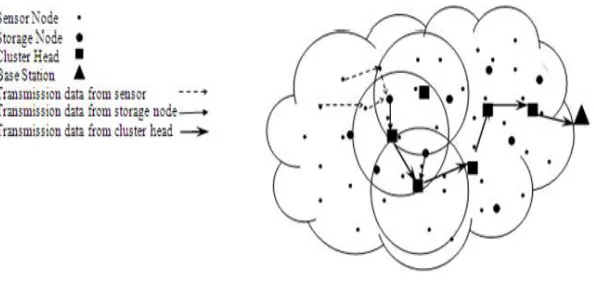
When the sensed data in the data storage phase is transmitted to the storage nodes, in the clustering phase, the data which has been gathered in the storage nodes will be transmitted to the cluster heads, and finally, it will be sent to the base station as shown in Figure 4.
Fi
Fig. 4: The proposed sensor network with storage node and cluster head
Generally, Data transmission is done in the various stages which have been stated below: l. From sensor to sensor and also from sensor to storage node.
2. From storage node to cluster head.
= 0 = 0 R For each i
do {
if storage node i can communicate only with storage node j then {
= {i} S = S-{i} = +1 }
For each i S do
{
Find the storage node R such that { I can communicate with j ,and
<= , K R communicate with k S = S-{i}
= +1 = {i} }
}
So, in a moment, sensors send data to storage node and also cluster heads send data to base station in pipeline form.
V.EXPERIMENTAL RESULTS
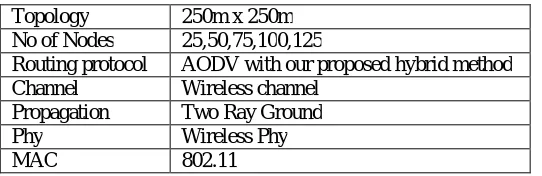
In order to evaluate the performance of proposed Hybrid algorithm, a simulation scenario has been created using NS-2 with an area of 250 m X 250 m. We simulated the environment with varying number of nodes and clusters. The performance of our proposed algorithm is compared with existing GC, LDC, MVCV methods in terms of end-to-end delay, packet delivery ratio, packet drops, residual energy and throughput. Table 1 shows the simulation set up.
Table 1: Simulation Parameters
Topology 250m x 250m No of Nodes 25,50,75,100,125
Routing protocol AODV with our proposed hybrid method Channel Wireless channel
Propagation Two Ray Ground Phy Wireless Phy MAC 802.11
This table presents that the network consists of wireless channel and with two ray ground propagation MAC 802.11. The routing protocols involved in this network are AOVC with our proposed hybrid method because of the features involved in this network make it as a efficient network compared to the present exisiting network.
.
Fig. 5: Average-packet delay comparison
Figure 5 shows the reduced delay in our proposed method as a result of pipelining mechanism that we are using for data transmission. The reduced delay indicates improvement in speed of transmission. As the speed of Transmission is
increased automatically the efficiency of the network is also increased in the proposed hybrid network.
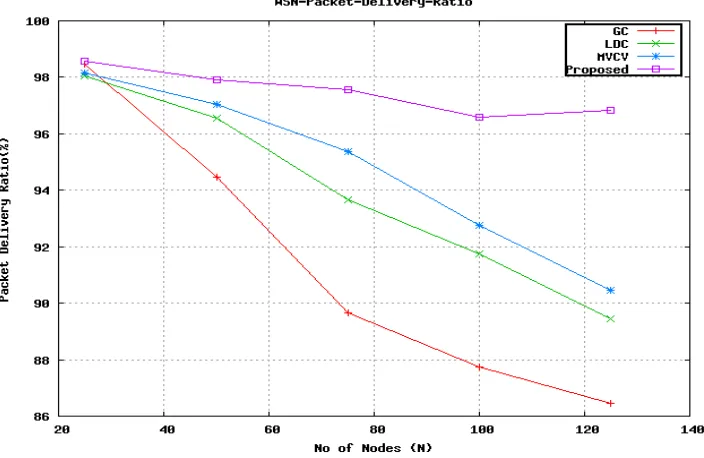
Fig. 6: Packet delivery ratio performance
This graph represents the relation between No.of Nodes and the packet delivery The periodic transmission of sensed data to cluster heads reduces the number of lost packets and improves the packet delivery ratio.The pink line represents the packet delivery ratio performance of the Hybrid method as shown in Fig. 6.
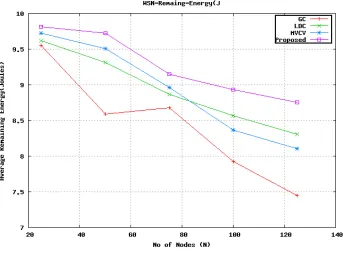
Fig. 7: Remaining energy in the network
The present main requirement of networks is power minization.In this network it is the main advantage that the hybrid method reduces the energy consumption by this graph we can conclude that energy requirement is very less .Because of our efficient hybrid mechanism the energy utilization is less compared to exiting methods as shown in fig.7.
Fig. 8: Packet throughput comparison
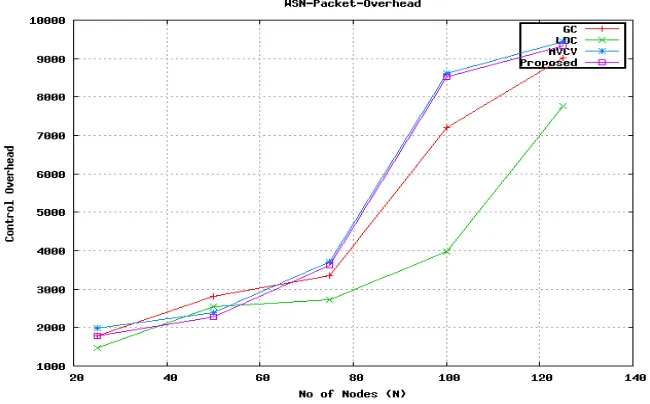
Fig. 9: Packet overhead comparison
Figure 8 and figure 9 are inter related As the number of packet drops is reduced, it will obviously improve the throughput in the network (Figure 8) and reduce the overhead requirement (Figure 9).overhead packets doesn’t contain actual information ,This packets are used to transmit the information safely to the destination. If the packet drops is reduced and then overhead requirement is also reduced Because, of this delay is also reduced in this proposed network.
.
Fig. 10: Network Lifetime Comparison
VI . CONCLUSION
In this work, an efficient clustering method has been proposed in order to improve the quality of service of wireless sensor networks. In this approach, the data transmission takes place in two stages from sensor node to the base station. This method upholds the involvement of the relay nodes in data sending and improves the network lifetime. The results indicate that the proposed method improves the packet delivery ratio, packet throughput and reduces the energy consumption and overhead compared to existing methods.
REFERENCES
[l] K. Akkaya and M.Younis, "A survey on routing protocols for wireless sensor networks," IEEE Transactions on Mobile Computing 3, pp. 325– 349, 2005.
[2] I.F. Akyildiz, W. Su, Y. Sankarasubramaniam, and E. Cayirci, "Wireless sensor networks: a survey," Computer Networks 38, pp.393–422, 2002. [3] A. Bari, A. Jaekel, and S. Bandyopadhyay, "Optimal load balanced clustering in twotiered sensor networks," Proceedings of Third
IEEE/CreateNet International Workshop on Broadband Advanced Sensor Networks (BASENETS), CA, Oct 2OO6,
[4] A. Bari, A. Jaekel, and S. Bandyopadhyay, "Optimal placement and routing strategies for resilient two-tiered sensor networks," Wireless Communications and Mobile Computing, Wiley, 2OO8,
[5] B. Sheng, Q. Li, and W. Mao, "Data Storage Placement in sensor networks," ACM Mobihoc 2OO6, Florence, Italy, May 22-25, 2OO6,
[6] B. Bonfils and P. Bonnet, "Adaptive and Decentralized Operator Placement for In-Network Query Processing," springer verlag, pp. 389-4O9, 2003.
[7] S. Bhattacharya, H. Kim, S. Prabh, and T. Abdelzaher, "Energy- conserving data placement and asynchronous multicast in wireless sensor networks," In Proceedings of the lst international conference on Mobile systems, applications and services, pp. l73–l85, 2003.