PROBABILISTIC COST-BENEFIT ANALYSIS OF INSTALLING EXTENSIVE GREEN ROOF IN MALAYSIA
AMIR MAHDIYAR
A project report submitted in partial fulfilment of the requirements for the award of the degree of Master of Science (Construction Management)
Faculty of Civil Engineering Universiti Teknologi Malaysia
iii
iv
ACKNOWLEDGEMENT
I would like to take this opportunity to express my sincere appreciation to my project report supervisor, Dr. Khairulzan bin Yahya, for his, guidance and critics regarding the processing and editing of this project. Without his continued support and interest, this project report would not have been the same as presented here.
During this work I have collaborated with many people for whom I have great regard, and I wish to extend my warmest thanks to all those who have helped me with my work in the faculty of Civil Engineering in Universiti Teknologi Malaysia.
v
ABSTRACT
vi
ABSTRAK
vii
TABLE OF CONTENTS
CHAPTER TITLE PAGE
DECLARATION ... ii
DEDICATION ... iii
ACKNOWLEDGEMENTS ... iv
ABSTRACT ... v
ABSTRAK ... vi
TABLE OF CONTENTS ... vii
LIST OF TABLES ... xi
LIST OF FIGURES ... xiii
1 INTRODUCTION ... 1
1.1 Sustainable Designing and Development ... 1
1.2 Background of Study ... 2
1.3 Problem Statement ... 3
1.4 Scope of Study ... 4
1.5 Aim and Objectives ... 5
1.6 Significance of Study ... 5
2 LITERATURE REVIEW ... 7
viii
2.2 Construction, and Sustainable Environment ... 8
2.3 A Brief History of Green Roofs ... 9
2.3.1 Novelty ... 9
2.3.2 Cost ... 10
2.4 Major Types of Green Roofs ... 10
2.4.1 Intensive... 10
2.4.2 Extensive ... 11
2.5 Green Roof Benefits and Costs ... 12
2.5.1 Initial Cost ... 13
2.5.2 Property Value ... 15
2.5.3 Tax Reduction... 15
2.5.4 Stormwater Management ... 16
2.5.5 Lower Energy Cost ... 18
2.5.6 Longer Life for the Roof Membrane ... 27
2.5.7 Mitigate of Urban Heat Island Effect ... 29
2.5.8 Operation and Maintenance (O&M) Cost ... 31
2.5.9 Air Pollution vs. Air Quality Improvement ... 32
2.5.10 Carbon Reduction ... 34
2.5.11 Reduction of infrastructure improvement costs ... 35
2.5.12 Reduction of Flood Risk ... 36
2.5.13 Habitat Creation for Urban Wildlife ... 36
2.5.14 Aesthetic, and Provision of Recreational Space ... 37
2.5.15 Land fill and Disposal... 39
2.6 Barriers and Opportunity of Installing Green Roof ... 41
2.7 Retrofitting With Green Roof ... 42
2.8 Performance Evaluation of Plant Selection ... 43
ix
2.9 Economic Analyses ... 45
3 RESEARCH METHODOLOGY ... 52
3.1 Introduction ... 52
3.2 Monte Carlo Analysis ... 52
3.3 Net Present Value (NPV) ... 54
3.4 Payback Period ... 54
3.5 Lifecycle Probabilistic Analysis ... 55
3.5.1 Identifying Factors Affecting Economic Feasibility .. 56
3.5.2 Using Software and Doing the Calculation ... 56
3.6 Research Outline ... 59
4 RESULT AND DISCUSSION ... 60
4.1 Introduction ... 60
4.2 Variables ... 61
4.3 Data Collection ... 61
4.3.1 Personal Cost and Benefits ... 62
4.3.1.7.1 Intensive: ... 68
4.3.1.7.2 Extensive ... 68
4.3.2 Social Costs and Benefits ... 69
4.3.3 Data Collection Summary ... 77
4.4 Net Present Value ... 78
4.4.1 Personal Sector ... 78
4.4.2 Personal and Social Sectors ... 79
4.5 Payback Period ... 81
4.5.1 Personal Sector ... 81
x
4.6 Comparison between Two Scenarios in Terms of NPV and
Payback ... 88
4.7 Sensitivity Analysis ... 89
4.8 Discussion ... 90
5 CONCLUSION AND RECOMMENDATIONS ... 92
5.1 Introduction ... 92
5.2 Evaluation on the Objectives of the Study ... 92
5.2.1 Objective 1 ... 93
5.2.2 Objective 2 ... 93
5.2.3 Objective 3 ... 94
5.3 Limitations of Study ... 94
5.4 Recommendations ... 94
5.4.1 Recommendations Based on Findings ... 95
5.4.2 Recommendations for Further Research Studies... 95
xi
LIST OF TABLES
TABLE NO. TITLE PAGE
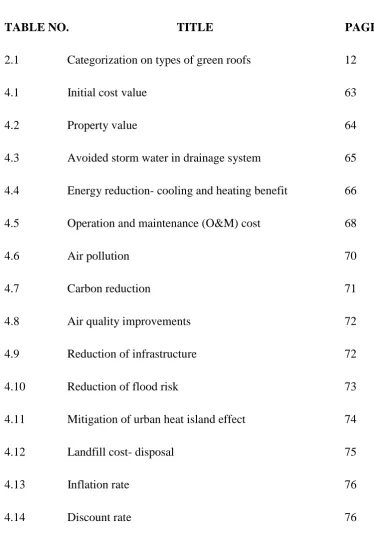
2.1 Categorization on types of green roofs 12
4.1 Initial cost value 63
4.2 Property value 64
4.3 Avoided storm water in drainage system 65
4.4 Energy reduction- cooling and heating benefit 66
4.5 Operation and maintenance (O&M) cost 68
4.6 Air pollution 70
4.7 Carbon reduction 71
4.8 Air quality improvements 72
4.9 Reduction of infrastructure 72
4.10 Reduction of flood risk 73
4.11 Mitigation of urban heat island effect 74
4.12 Landfill cost- disposal 75
4.13 Inflation rate 76
xii
xiii
LIST OF FIGURES
FIGURE NO. TITLE PAGE
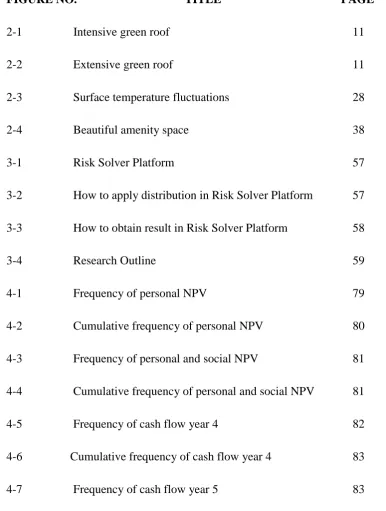
2-1 Intensive green roof 11
2-2 Extensive green roof 11
2-3 Surface temperature fluctuations 28
2-4 Beautiful amenity space 38
3-1 Risk Solver Platform 57
3-2 How to apply distribution in Risk Solver Platform 57
3-3 How to obtain result in Risk Solver Platform 58
3-4 Research Outline 59
4-1 Frequency of personal NPV 79
4-2 Cumulative frequency of personal NPV 80
4-3 Frequency of personal and social NPV 81
4-4 Cumulative frequency of personal and social NPV 81
4-5 Frequency of cash flow year 4 82
4-6 Cumulative frequency of cash flow year 4 83
xiv
4-8 Payback period-year 14 84
4-9 Cumulative frequency of cash flow year 5 84
4-10 Cumulative payback period-year 14 85
4-11 Frequency of cash flow in year 3 86
4-12 Cumulative frequency of Cash flow in year 3 86
4-13 Cumulative frequency of cash flow in year 4 87
4-14 Frequency of cash flow in year 4 87
4-15 Frequency of cash flow in year 9 88
4-16 Cumulative frequency of cash flow in year 9 88
4-17 NPV during lifespan of extensive green roof 89
4-18 Payback of extensive green roof 89
CHAPTER 1
INTRODUCTION
1.1 Sustainable Designing and Development
Nowadays, sustainability is a crucial issue all around the world and governments have found the necessity of energy saving for next generations, as a result, they try to find out some solutions to reduce energy consumption. Indeed, sustainable development, is a review on modernism and tradition and also the interaction between them. Sustainable development has been expressed in Norwegian meeting as “a development to provide our requirements without any reduction for next generation” (D’Orazio, et al., 2012).
2
In contemporary architecture, changes according to climate circumstances and sustainable issues is becoming more popular and it is not just for sustainability of building’s shell, and it could be occurred as an integrated totality for earth and energy sources.
One of the most important parts of a building is roof and many wastages of energy is related to this part. there are many introduced solution due to solve this problem but, we can clearly see the increasing public, industry and government interest in establishing green roofs in many cities due to their demonstrated environmental benefits.
Green roofs can be classified as intensive and extensive roofs based on their purpose and characteristics. Green roofs are built with different layers and variable thicknesses depending on the roof type and/or weather conditions. Basic layers, from bottom to top, of green roof systems usually consists of a root barrier, drainage, filter, growing medium, and vegetation layer.
1.2 Background of Study
3
There are different green roof systems available in the market to supply for different weather conditions and user expectations. Usually, green roofs have, from bottom to top, a root barrier, drainage, filter, growing medium, and vegetation. Manufacturers use worldwide-produced polymers, like low density polyethylene (LDPE) and polypropylene (PP), due to their easy installation, high strength, durability and low production cost. Generally, recycled LDPE is used to manufacture the root barrier, and recycled PP is used to manufacture the water retention and drainage layers.
These plastics improve the performance of green roof systems, reduce cost and overall weight of the system; however, their use as green roof layers has a socio-environmental cost. Green roofs take on average 25 years to balance the pollution released to air due to the production process of polymers. Thereby, reusing waste materials can reduce the green footprint of vegetative roofs. Responsible construction management requires quantitative estimates of costs and benefits of the alternative uses of the environment. (Carter, et al., 2008), and (Clark, et al., 2008) have proven the economic advantages of green roofs. However, a lifecycle benefit-cost value representing a unit of area of a green roof is proven by (Bianchini & Hewage, 2012).
1.3 Problem Statement
Currently, sustainability is a crucial issue all around the world and governments have found the necessity using sustainable approaches for the next generations. Green roofs are accepted as sustainable construction practice and as it can be seen in developed countries like European countries and US, there are ample installed green roofs from all types
(Cantor & Steven , 2008). Although Malaysia has a significant potential of using this
4
It is difficult to find reliable data to estimate and do the cost-benefit analyses. Investigating on cost-related issues is the first step in using a new application and the result of economic-feasibility could play a critical role in decision making about usage or rejecting that application, however, it may have many environmental advantages.
However, myriad of benefits of green roofs are proven in Malaysia (Musa, 2006), clients developers and contractors are not enthusiastic to use of this this alternative as conventional roofs and the most important reason could be the shortage of economic type of researches in two types of green roof; as a result if someone doesn’t know about costs and benefits of using an application, rarely will change his mind to use an alternative instead of a proven construction practice.
1.4 Scope of Study
5
1.5 Aim and Objectives
The aim of this study is to investigate the economic-financial feasibility of installing extensive green roof with probabilistic cost-benefit analysis in Malaysia. To achieve these aims following objectives have determined:
1. To identify both personal and social factors affecting on economic feasibility of extensive green roof in Malaysia.
2. To calculate the NPV investment of extensive green roof considering personal and social costs and benefits.
3. To indicate the payback period of installing an extensive green roof in Malaysia.
1.6 Significance of Study
6
References
Alexandri & Eleftheria, 2008. Temperature decreases in an urban canyon due to green walls and green. building and environment, Volume 43, pp. 480-493.
Ascione, F. et al., 2013. Green roofs in European climates. Are effective solutions for the energy. Applied Energy, Volume 104, pp. 845-859.
Barrio & Del, E. P., 1998. Analysis of the green roofs cooling potential in buildings. energy and buildings, Volume 27, pp. 179-193.
Berndtsson & Czemiel, J., 2010. Green roof performance towards management of runoff water quantity and. Ecological Engineering, Volume 36, pp. 351-360. Bianchini, F. & Hewage, K., 2012. How“green”are the green roofs? Lifecycle analysis
of. elsevier, 48(build environ), pp. 57-65.
Bianchini, F. & Hewage, K., 2012. Probabilistic social cost-benefit analysis for green roofs: A lifecycle approach. elsevier, 58(Building and Environment), pp. 152-162. C.Y, J. & S.W, T., 2011. Ecological energetics of tropical intensive green roof. energy
and buildings, Volume 43, pp. 2696-2704.
Cantor & Steven , L., 2008. Green Roofs in Sustainable Landscape Design. s.l.:W.W.Norton & Company.
Carter, Keeler, A. & Timothy, 2008. Life-cycle cost–benefit analysis of extensive vegetated roof systems. Journal of Environmental Management, Volume 87, pp. 350-363.
Castleton, H., V. Stovin, S.B.M. Beck & J.B. Davison, 2010. Green roofs; building energy savings and the potential for retrofit. energy and buildins, Volume 42, pp. 1582-1591.
97
D’Orazio, M., C. Di Perna & E. Di Giuseppe, 2012. Green roof yearly performance: A case study in a highly insulated building under. energy and buildings, Volume 55, pp. 439-451.
Feng, C., Qinglin Meng & Yufeng Zhang, 2010. Theoretical and experimental analysis of the energy balance of. Energy and Buildings, Volume 42, pp. 959-965.
Fioretti, R., 2010. Green roof energy and water related performance in the Mediterranean climate. building and environment, Volume 45, pp. 1890-1904. GD, G., 2002. Social and environmental benefits of forestry phase 2: landscape, s.l.:
Centre for Research in Environmental Appraisal and Management, University of Newcastle upon Tyne.
Hodo-Abalo, S., Magolmèèna Banna & Belkacem Zeghmati, 2012. Performance analysis of a planted roof as a passive cooling technique. renewable energy, Volume 39, pp. 140-148.
Investopedia, 2013. [Online]
Available at: http://www.investopedia.com/terms/d/discountrate.asp
Jaffal, I., Salah-Eddine Ouldboukhitine & Rafik Belarbi, 2012. A comprehensive study of the impact of green roofs on building. renewable energy, Volume 43, pp. 157-164.
Li, J.-f.et al., 2010. Effect of green roof on ambient CO2 concentration. Building and
Environment, Volume 45, pp. 2644-2651.
MacIvor, J. S. & Jeremy Lundholm, 2011. Performance evaluation of native plants suited to extensive. Ecological Engineering, Volume 37, pp. 407-417.
Mohd Idrus Hj Mohd Masirin, 2008. An Overview Of Landfill Management And Technologies : A Malaysian Case Study At Ampar Tenang.
Musa, S., 2006. Potential Of Storm Water Capacity Using Vegetated Roofs In Malaysia.
N.H. Wong, D. c. H. Y. C. A., 2003. he effects of rooftop garden on energy. elsevier, 35(Environmental and Building), pp. 353-364.
Nagase, A. & Nigel Dunnett, 2010. Drought tolerance in different vegetation types for extensive green roofs:. Landscape and Urban Planning, Volume 97, pp. 318-327. Parizotto, S., 2011. Investigation of green roof thermal performance in temperate
98
Peri, G., Marzia Traverso, Matthias Finkbeiner & Gianfranco Rizzo, 2012. Embedding“substrate”in environmental assessment of green roofs life cycle:. Journal of Cleaner Production, Volume 35, pp. 274-287.
Peri, G., Marzia Traverso, Matthias Finkbeiner & Gianfranco Rizzo, 2012. The cost of green roofs disposal in a life cycle perspective: Covering the gap. Energy, Volume 48, pp. 406-414.
Philip C.H. Yu, W. C., 2007. A discussion on potentials of saving energy use for commercial. elsevier, 32(Energy), pp. 83-94.
Post, 2007. Green-roof study results offer positive surprises, s.l.: s.n. J. K. R, 2007.
Sailor, D., 2008. A green roof model for building energy simulation programs. energy and buildings, Volume 40, pp. 1466-1478.
Susca, T., S.R. Gaffin & G.R. Dell’Osso, 2011. Positive effects of vegetation: Urban heat island and green roofs. Environmental Pollution, Volume 159, pp. 2119-2126.
Takebayashi, H. & Masakazu Moriyama, 2007. Surface heat budget on green roof and high reflection. building and environment , Volume 42, pp. 2971-2979.
Villarreal, E. L. & Lars Bengtsson, 2005. Response of aSedumgreen-roof to individual rain events. Ecological Engineering, Volume 25, pp. 1-7.
Williams, N. S., John P. Rayner & Kirsten J. Raynor, 2010. Green roofs for a wide brown land: Opportunities and barriers for rooftop. Urban Forestry & Urban Greening, Volume 9, pp. 245-251.
Wonga, N. H., 2003. Life cycle cost analysis of rooftop gardens in Singapore. elsevier, 38(building and environment), pp. 499-509.
Wong, N. H. et al., 2003. Life cycle cost analysis of rooftop gardens in Singapore. building and environment, Volume 38, pp. 499-509.
Yang, J., Qian Yu & Peng Gong, 2008. Quantifying air pollution removal by green roofs in Chicago. Atmospheric Environment, Volume 42, pp. 7266-7273.