ISSN(Online): 2320-9801
ISSN (Print): 2320-9798
I
nternational
J
ournal of
I
nnovative
R
esearch in
C
omputer
and
C
ommunication
E
ngineering
(An ISO 3297: 2007 Certified Organization)
Vol. 4, Issue 4, April 2016
An Adaptive Delay Based Road Oriented
Routing Protocol for VANET
Payal B Kamble1, Kamlesh K Kalbande2
M.Tech Student, Dept. of Electronics and Telecommunication, G.H.Raisoni College of Engineering, Maharashtra,
India1
Assistant Professor, Dept. of Electronics and Telecommunication, G.H.Raisoni College of Engineering, Maharashtra,
India2
Assistant Professor, Dept. of I.T., CCIS, King Saud University, Riyadh, Kingdom of Saudi Arabia
ABSTRACT: VANET is the form of MANET that is mobile adhoc network in which the movement of each vehicle (node) is restricted by direction of road and traffic regulation. The geographic routing protocol is developed for efficient vehicle to infrastructure based (V2I) communication and vehicle to vehicle based (V2V) communication. Existing protocol has challenges in geographical environment. To increase the efficiency and to reduce the power of the system the unnecessary rebroadcast must be suppressed with adapting the waiting time concept in existing road oriented routing protocol. This paper proposed an Adaptive Delay Based Road Oriented Routing Protocol (ADRORP) for VANET for the efficient data routing and transmission using two types of transmission method i.e. greedy base forwarding method and the intersection base forwarding method depend upon the position of each client vehicles. The performance of the propose protocol is study on the basic of parameters such as packet delivery ratio and End to End delay etc. Plus the result are compared with the road oriented routing protocol.
KEYWORDS: GR, GF, IF, ADRORP, RORP,E2E, PDR
.
I. INTRODUCTION
In Vehicular Ad Hoc Network (VANET) many routing protocol are develop for efficient vehicle to vehicle and vehicle to infrastructure communication [1]. The purpose of this study is to improve the efficiency of the system. Geographic routing use two types of the transmission method that is greedy base forwarding method and intersection base forwarding method [2]. The sign in geographic area is message forwarding section and the result of the routing depends upon the forwarding method use. In general the geographic routing protocol use two types of the forwarding method that is position based and contention based. Position based routing is depend on sender based in which sender select the next hop send from adjacent vehicle, hop is nothing but the journey between source to destination vehicle. Position based routing is mostly use for direct communication between clients vehicle and server node which contain data in the form of queue. Queue is use for interfacing purpose and the size of the queue is 50 packets. The contention based routing is the receiver based approach in receiver find where should forward the message and this routing are mostly suitable for broadcast protocol.
ISSN(Online): 2320-9801
ISSN (Print): 2320-9798
I
nternational
J
ournal of
I
nnovative
R
esearch in
C
omputer
and
C
ommunication
E
ngineering
(An ISO 3297: 2007 Certified Organization)
Vol. 4, Issue 4, April 2016
II.RELATED WORK
In [2] paper geographic data routing protocol is use for V2V and V2I communication. In this paper main aim is path definition and use two type of routing scheme that is position base routing and contention base routing. Position base routing is sender based approach and use for one to one connection of server and client vehicle that is unicast. In contention base approach is opposite of position base approach in which each client vehicle decide where to forward the message. In [3] paper authors main aim is efficient data circulation to each vehicle and it is use for sending message to number of vehicles. The main disadvantage is reachability is less. In paper [4] authors aim is road traffic safty and sending warning message. And main aim is to reduce latency that is the time between simulation and response of the system. In paper [5] main objective is packet deliver from source to all other node in given geographic region. This paper multiple connections between client vehicle and receiver vehicle is used. And different method of geocast routing is used . In paper [6] that is the i car II main objective is to increase the performance of routing by reduce E2E delay and select the road having high connectivity.
III. DELAY BASED APPROACH
This paper proposed a delay based scheme for geographic and urban environment. All the Vehicles use the two types of forwarding method that is greedy base or intersection base forwarding mode based on the conditions of client vehicle. The Proposed protocol consists of two conditions without applying the waiting time concept and with waiting time concept to reduce the rebroadcast. The main approach of this paper is to reduce unnecessary redundant rebroadcast and maintain the reachability.
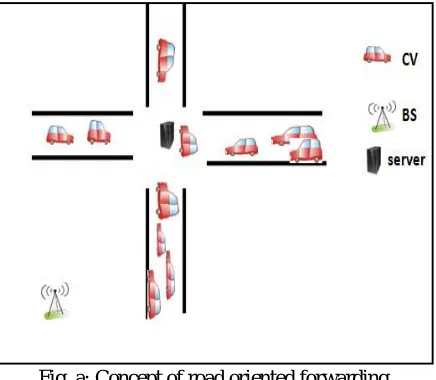
Fig. a: Concept of road oriented forwarding.
The proposed Protocol contains total 300* 300 meter total area in x and y direction and based station is located at the road side. Base station is consist transceiver, multiplexers and antenna mounted on the tower and the height of antenna is 1.5 meter. The server is placed at the middle of the road. Assume that each vehicle consist of GPS device that is global positioning system. The GPS work on both online and the offline mode, if work on offline mode then MMC card is required.
Assumption
ISSN(Online): 2320-9801
ISSN (Print): 2320-9798
I
nternational
J
ournal of
I
nnovative
R
esearch in
C
omputer
and
C
ommunication
E
ngineering
(An ISO 3297: 2007 Certified Organization)
Vol. 4, Issue 4, April 2016
III. PROPOSED METHEDOLOGY A. SENDER: The Fig. b below show the Dispensation of the packet at transmitter.
Fig. b: Dispensation of Packet at Transmitter.
The Fig.b above show Dispensation of the packet at transmitter. All the client vehicles broadcast the request toward base station. Base station calculates the number of traffic on the road and on that basis it selects the road or area which contains the higher traffic. Due to this the traffic of the road is reduced and helps to increase the efficiency of the system. Then it provided the service to the client vehicle on the basic of first come first request. Request from the client vehicle is forward to the server through base station. Then server checks the requested data is available or not if requested data available then it send positive acknowledgement to client vehicle through base station otherwise negative acknowledgement is send to client vehicle. Then base station check is client vehicle is ready to access the data or not if yes then it transmit the data otherwise wait until it become ready.
ISSN(Online): 2320-9801
ISSN (Print): 2320-9798
I
nternational
J
ournal of
I
nnovative
R
esearch in
C
omputer
and
C
ommunication
E
ngineering
(An ISO 3297: 2007 Certified Organization)
Vol. 4, Issue 4, April 2016
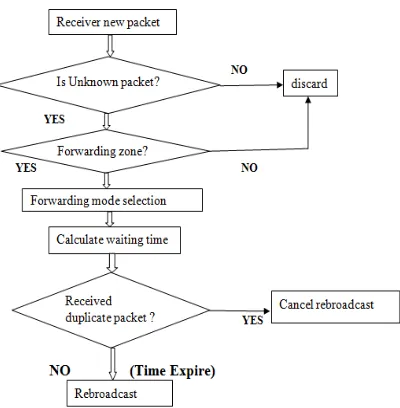
Fig. c: Dispensation of Packet at Receiver
C. Selection of forwarding method
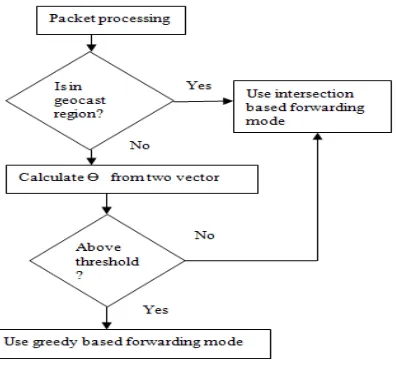
In this paper, selection of forwarding method is very important task and shown in Fig. d The base station check the client vehicle is in geocast region or not. If the client vehicle is in geocast region then it use intersection base forwarding method otherwise it calculate the value of Ө from two vector .If the value of Ө is above threshold then it
use greedy base forwarding method otherwise use intersection base forwarding method. Threshold is nothing but the number of hop that is journey from source to destination.
1)Greedy base forwarding method: The main aim of greedy based forwarding method to exploit transmission achieves at every hop and decrease unnecessary rebroadcast. The waiting time for greedy based forwarding mode is calculate as:
WhereTmax_R is the maximum waiting time for the receiver, R is the range of transmission which is frequent for every vehicle .dpq is the path among vehicle p and q.
In this case the retransmission at vehicle within a range is not required. The main aim of using greedy base transmission method is to reduced rebroadcast. In greedy based forwarding method TGF is delay time of vehicle p received the packet from client vehicle q and calculate from the above formulae. The entire vehicle calculates their waiting time by above equation.
2) Intersection base forwarding method: The main approach of intersection based forwarding method to maximize the chance of vehicles re transmission the packet at intersection. Due to this there is a higher data appearance ratio in packet circulation. Here vehicle at intersection assign a backoff time value. The waiting time is calculated as:
Where, Tmax_I is the max delay time for vehicle at direct data transmission. Tmax_R is the max delay time of remaining vehicle on the road. R is the throughput of transmission which is common for each vehicle .dpq is the distance between two vehicle p and q.
ISSN(Online): 2320-9801
ISSN (Print): 2320-9798
I
nternational
J
ournal of
I
nnovative
R
esearch in
C
omputer
and
C
ommunication
E
ngineering
(An ISO 3297: 2007 Certified Organization)
Vol. 4, Issue 4, April 2016
and calculate from the above formula. In intersection base forwarding method it require high packet arrival ratio because the vehicle at intersection provide less backoff time than the residual vehicle on the road.
Fig. d: Selection of forwarding mode
IV. SIMULATION RESULT
The various scenarios have been design in simulation using Network Simulator (NS-2) with the following simulation parameters:
Simulation Parameter
Simulator NS- 2.34
Simulator Area 300m * 300m
Packet Size 1000bytes
Mac type Mac_8011
Threshold distance 120
Interface queue
Maximum Packet in ifq 50
Packet Interval 0.07 sec
Stop Time nn+3
ISSN(Online): 2320-9801
ISSN (Print): 2320-9798
I
nternational
J
ournal of
I
nnovative
R
esearch in
C
omputer
and
C
ommunication
E
ngineering
(An ISO 3297: 2007 Certified Organization)
Vol. 4, Issue 4, April 2016
In proposed protocol we contain NS-2.34 simulator and consider total area is equal to 300 meter * 300 meter. The total number of packet use is 1000 byte in this project we use queue type of interface with packet size is equal to 50.and here we set two threshold value to evaluate the performance of the system we set threshold is equal to 120 meter and 80 meter. The packet interval is set as 0.07 sec and the simulation end time is equal to the sum of number of nodes and 3.
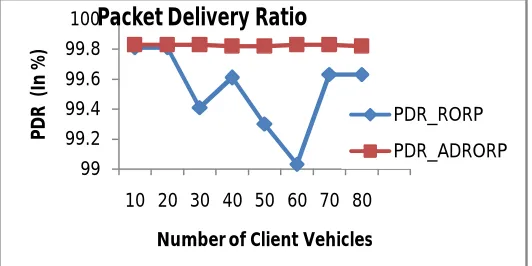
The performance of the system has been evaluated on the base of parameter such as end to end delay and packet delivery ratio as shown below.
1)End to End Delay: fig e shows difference in E2E delay due to the difference of number of client vehicles. E2E delay is nothing but the usual time taken by packets of data to reach the destination. The road oriented routing protocol (RORP) requires more time as compared to proposed adaptive delay based road oriented routing protocol ( ADRORP).
Fig. d: End to End Delay
2)Packet Delivery Ratio: The Fig. e shows difference in PDR due to difference in number of client vehicles. Packet delivery ratio is the ratio of packet size at receiver to the number of packet transmitted. Packet delivery ratio is less in road oriented routing protocol (RORP) as compared to proposed adaptive delay based road oriented routing protocol ( ADRORP). Packet delivery ratio of proposed adaptive delay based routing protocol(ADRORP) is more efficient as it gets constant packets by increase the number of client vehicle while in road oriented routing protocol(RORP) the size of packets are varied by increase the number of client vehicles.
Fig. e: Packet Delivery Ratio
0 0.2 0.4 0.6 0.8 1
10 20 30 40 50 60 70 80
En d t o E n d D e la y( m s)
Number of Client Vehicles
End to End delay
E2E Delay_RORP E2E Delay-ADRORP 99 99.2 99.4 99.6 99.8 100
10 20 30 40 50 60 70 80
P D R ( In % )
Number of Client Vehicles
Packet Delivery Ratio
PDR_RORP
ISSN(Online): 2320-9801
ISSN (Print): 2320-9798
I
nternational
J
ournal of
I
nnovative
R
esearch in
C
omputer
and
C
ommunication
E
ngineering
(An ISO 3297: 2007 Certified Organization)
Vol. 4, Issue 4, April 2016
V. CONCLUSION
An Adaptive Delay Based Road Oriented Routing Protocol for VANET has been design and performance is to be evaluated on the basis of various performance parameters such as end to end delay between client vehicles and packet delivery ratio. The simulation result shows the comparison of performance of two protocols i.e. An Adaptive Delay Based Road Oriented Routing Protocol (ADRORP) and Road Oriented Routing Protocol (RORP). From the simulation result, it is observed that the road oriented routing protocol (RORP) requires more time for transmitting data as compared to proposed adaptive delay based road oriented routing protocol (ADRORP) and packet delivery ratio is less in road oriented routing protocol (RORP) as compared to proposed adaptive delay based road oriented routing protocol ( ADRORP). It means the proposed Adaptive Delay Based Road Oriented Routing Protocol (ADRORP) performs well as compared road oriented routing protocol (RORP).
REFERENCES
[1] W clen R K Guha,T Kown, J Lee a survey and challenges in routing and data dissemination in vehicular adhoc network.
[2] RyosukeAkamastu, KeijiObara, Hiroshi Shigeno” Road-Orinted Geographic Routing Protocol for Urban Vehicular Ad Hoc Networks”IEEE2015 .[3] M. Fogue , P. Garrideo, F. Martinez, J. Cano, C. Calafate, and P. Manzoni,”An Adaptive System Based on Roadmap Profiling to Enhance Warning Message dissemination in VENETSs,” IEEE/ACM Transaction on Networking, vol.21, no. 3,pp .
[4] R. Akamastu, K. Obara, and H. Shigeno,”Geo-Rouuting Protocol Based on RoadNetwork in Vehicular Ad Hoc Network ,” IPSJ Jornel, vol. 56, no. 2, p. 9, February 2015 9to be published).
[5] R. Akamastu , M. Suzuki, Y. Okamato, K. Hara, and H. Shineno,” Adaptive Delay-based Geocast Protocol for Data Dissmination in Urban
VANET,” in Proc. Of 7th International conference on Mobile computing and Ubiquitous Networking (ICMU 2014), 2014 ,pp.141-146.
[6]N. Alsharif, s. Cespedes, and X. Shen, “iCAR: Intersection-based connectivity Aware Routing in V vehicular Ad hoc Network.” in Prac. Of 2013 IEEE International Conference on Communication (ICC 2013), 2013, pp.1736-1741.
[7]T. Li, Y. Li, and J. Liao, “A Contention-Based Routing Protocol for Vehicular Ad Hoc Networks in City Environments,” in Proc. Of29th IEEE
International.