ABSTRACT
TURNER, STEVEN PAUL. The Evolution of Sexually Selected Traits in Dance Flies. (Under the direction of Dr. Brian Wiegmann.)
The Diptera family Empididae is a successful and species rich radiation of the
superfamily Empidoidea. Flies in this family are well documented to engage in a myriad of elaborate courtship displays, which has made them model organisms of choice for behavioral and evolutionary biologists studying the evolution of sexual selection. Chapter 1 of this thesis aims to summarize the variation of courtship strategies of flies in the empidid subfamily, Empidinae. I focus on nuptial gift presentation and variation in types of nuptial gifts. I also briefly discuss the occurrences of sex role reversed mating systems and the reasons why these may have evolved. The evolution of
potential exploitation of female sensory biases by males in systems where males “cheat” concludes the first chapter.
Chapter 2 focuses on how sexual selection drives rapid radiations in nuptial gift giving flies. The focus for this study is Enoplempis a sub genus of Empis.
in macroevolution to recover the ancestral conditions of characters mapped onto the phylogenetic tree and used divergence time estimation to explore the origins of the Enoplempis radiation and the temporal appears of key traits.
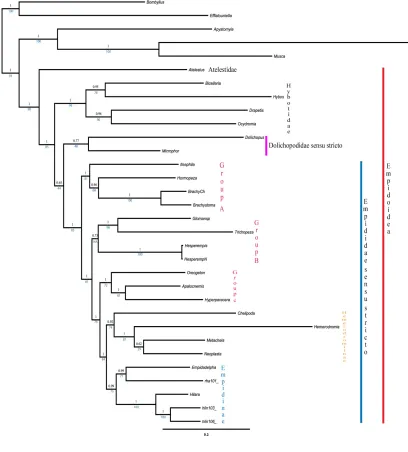
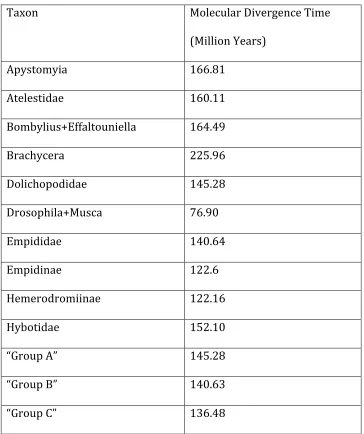
Chapter 3 focuses on the classification and temporal diversification of the subfamilies of the Empididae. This study involved Maximum Likelihood and Bayesian Inference based phylogenetic analyses with the aim of recovering the sister group to Empididae and to resolve the poorly understood subfamily relationships within
Empididae. A key focus of this study was also to establish the closest related subfamily to the highly diverse Empidinae. Divergence time estimations were also done using fossil calibrated molecular clocks in order to identify important events in the evolutionary history of the Empidoidea families and to better understand temporal diversification of empidid subfamilies.
© Copyright 2011 by Steven P. Turner All Rights Reserved
The Evolution of Sexually Selected Traits in Dance Flies
by
Steven P. Turner
A dissertation submitted to the Graduate Faculty of North Carolina State University
in partial fulfillment of the requirements for the Degree of Doctor or Philosophy
Entomology
Raleigh, North Carolina 2012
APPROVED BY:
_________________________ _________________________
Andrew R. Deans Coby Schal
_________________________ _________________________
Brian Wiegmann R. Brian Langerhans
Chair of Advisory Committee
DEDICATION
For my family, and their support over the years, my parents in particular for supporting me in my academic persuits. I also dedicate this to the Wiegmann lab and colleagues at North Carolina State University for their support and valuable input into my research.
BIOGRAPHY
Steven Paul Turner was born in the industrial town of Bradford, West Yorkshire, England. From a young age he took an interest in many subject areas and was torn between pursuing an academic career in Ancient History and Biological Sciences. His passion for biology ultimately won over and in fall 2004 Steven embarked on his undergraduate degree in Ecology which he completed with honors at the University of Derby. It was during this time that he found his passion for invertebrate biology, behavioral ecology and phylogenetics. In 2007, he embarked on his Masters degree in Advanced Methods in Taxonomy and Biodiversity at the Imperial College of Science, Technology and Medicine. During this period, Steven became focused on molecular phylogenetics and the use of phylogenetic comparative methods as an essential tool of evolutionary biology in general. Steven completed his degree with a research project on Molecular Phylogeny and Evolution of Tarantulas. Following his Masters, Steven
applied to work on his PhD with Professor Brian Wiegmann at NCSU. His research has focused on the phylogeny and macroevolution of flies in the family Empididae.
ACKNOWLEDGMENTS
Credit must be given to a number of colleagues and mentors who guided and assisted me during the course of my doctoral research. Thanks to Professor Brian Wiegmann for the opportunity to conduct research in his lab and for his knowledge and experience. Isaac Winkler for guidance and mentoring during the early stages of my PhD and for his vision which led to the project we worked on. Thanks to Brian Cassel for his immense experience and skill in the molecular lab, this continuously proved to be a priceless resource. Thanks to Bradly Sinclair and Jeff Cumming at the Canadian National Collections for their support and collaboration in our project. Finally, thanks to post docs and graduate students of the Wiegmann lab for their support advice and encouragements over the course of my doctoral work.
TABLE OF CONTENTS
LIST OF TABLES ... vii
LIST OF FIGURES ... viii
CHAPTER 1: Mating Systems in Empidinae: A Review ... 1
I. Systems where males display fitness to females. ... 2
II. Examples of sex role reversed systems in Empidinae ... 7
III. Examples of possible exploitation of female sensory biases ... 9
REFERENCES ... 11
CHAPTER 2: A molecular phylogeny of dance flies in the Empis subgenus Enoplempis and the evolutionary origins of mating system associated traits. ... 15
Introduction ... 15
Material and Methods ... 20
Results ... 25
Discussion ... 32
Conclusion ... 40
REFERENCES ... 42
CHAPTER 3: Phylogenetic relationships of flies in the family Empididae (Insecta: Diptera: Empidoidea) ... 48
Introduction ... 48
Material and Methods ... 50
Results ... 56
Conclusions and future directions ... 65
REFERENCES ... 67
Appendix ... 71
Appendix 1 ... 72
Appendix 2 ... 76
LIST OF TABLES CHAPTER 2
Table I. Summary of character states ... 23 CHAPTER 3
Table I. Taxa and additional genes sampled ... 51 Table II. Summary of primer pairs used to amplify additional genes ... 52 Table III. Fossil calibrations and monophyly constraints of included
empidoid families and empidid subfamilies. ... 55 Table IV. Divergence times inferred from molecular data. ... 58
LIST OF FIGURES CHAPTER 2
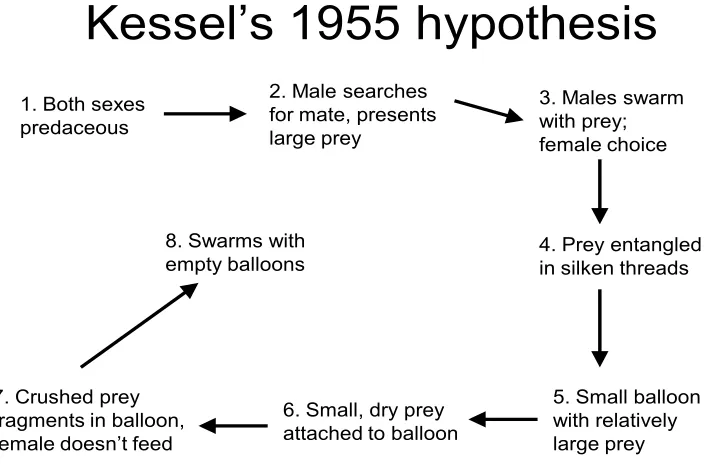
Figure i. Evolutionary sequence of nuptial feeding behaviors hypothesized by Kessel (1955) ... 20 Figure ii. Molecular phylogeny and character mapping of known Enoplempis
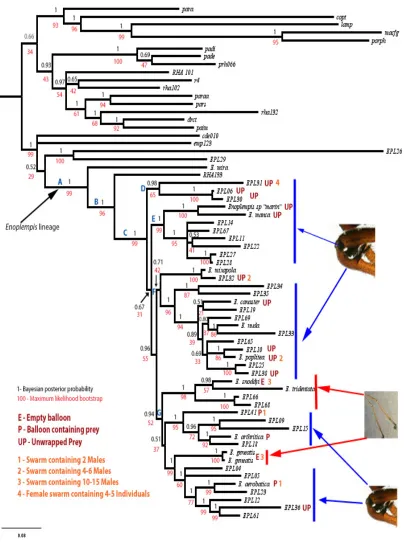
traits. Blue bars cover species with modified legs. Red bars cover species with unmodified legs ... 26 Figure iii. Ancestral nuptial behaviors within Enoplempis. Black states
represent ballooning behaviors; white states represent
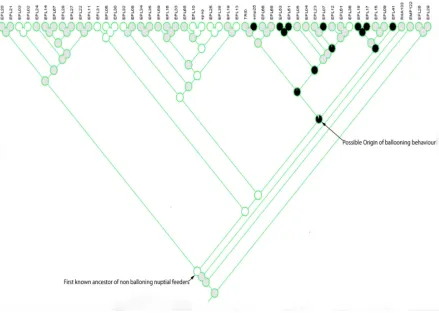
unwrapped prey. Grey represents unknown ... 28 Figure iv. Maximum likelihood reconstruction of ancestral condition of leg
modification ... 29
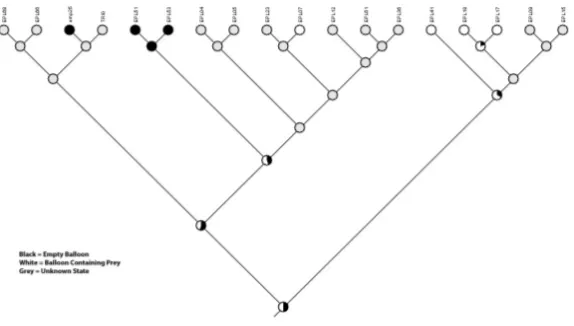
Figure v. Maximum likelihood reconstruction of ancestral ballooning
condition in Enoplempis ... 29
Figure vi. Divergence time tree showing important events in the
evolutionary history of Enoplempis ... 31
CHAPTER 3
CHAPTER 1 Mating Systems in Empidinae: A Review
Mating systems and sexual selection are gaining more attention from researchers in many areas of biology as important mechanisms of diversification (Ritchie 2007). Many groups of vertebrates and invertebrates have been studied to understand how mating preferences might result in advantageous traits. Insects in Mecoptera and Orthoptera and spiders in Salticidae are becoming important model systems for studying the
males (Hamilton and Zuk 1982, McLean et al. 2012), resource and investment shifts that result in sex role reversed mating systems and the evolution of the exploitation of female sensory biases by males which effectively cheat the females (Vahed 1998, 2007, Gwynne 2008, LeBas 2005). The purpose of this review is to briefly summarize what is known about the mating behaviors of the diverse dance fly subfamily Empidinae.
I. Systems where males display fitness to females
reproductive fitness of both the males and females. This system usually revolves around female choice of the male displaying the “best” attributes, which indicates that he has strong genetics. It is thought to have evolved from a mating system where both partners were predatory as adults as seen in the closely related empidoid family Hybotidae (Downes 1968). Basal empidid subfamilies, such as the Clinocerinae also exhibit this groundplan. Both sexes are predaceous in the clinocerine Wiedemannia which uses swarming behavior for both mating and hunting; some species of this fly rely on complex aggregation patterns on rocks whilst grounded to trigger mating behavior (Rogers 1981). Over time selection pressures drove the females to lose prey foraging abilities as adults. This is thought to be an evolved response to the risk faced by foraging females to their own predators. Being the egg producing sex, predation upon females may have became detrimental to the fitness of the species. This resulted in males providing the nutrition required by the females to successfully develop eggs in the form of a nuptial gift.
Across Empidinae there are many examples of nuptial feeding behaviors where males capture prey, typically swarm and then are chosen by a female. Downes (1968)
composed a summary based on primary observations on the nuptial feeding habits of Empididae. This study found that many species of empidids swarm and mate in flight. Males and females of several species of Empis and Rhamphomyia landed to mate, either alighting on trees, bushes or tall grasses and directly on the ground. Downes also suggests that the nuptial gift in empidids is directly associated with female
observed to visit flowers. The typical sequence of nuptial feeding interactions observed by Downes is that males seek out and hunt nuptial prey and take it to a swarming site, usually a landmark of a low lying tree or shrub, or a large rock. The swarming sites are often used continuously by successive generations, but the mechanism which allows newly emerged adults to recognize swarming sites is currently unknown (Sadowski 1999). Males then begin to fly in a specific courtship dance whilst holding on to the prey item. Male competition within these swarms can be very fierce with dominant males of some species chasing sub-‐ordinate males far out of the swarm. Female choice then comes into play as females fly into the swarm and choose the males with the optimal courtship display. This does not necessarily correlate with nuptial gift size and it is thought that empidid females generally choose larger males with intermediate sized gifts (Sadowski et al. 1999). It has been hypothesized that larger nuptial gifts result in inability to perform optimal courtship flight so is selected against by female choice (Sadowski et al. 1999). Pairs of males and females then leave the swarm to mate on foliage or on the ground. In species which mate in the air, pairs of males and females leave the swarm and either fly away from the singles or form mating swarms. This behavior is thought to be a defense against sperm competition by leading females away from potential rival males (Rogers 1981, Evans 1988).
poplitea. Both species occur in overlapping habitats in the Western USA and look
similar in appearance. Both species typically prey on many families of Diptera including smaller empidid species and males of both species are usually found around trees with abundant sources of swarming prey. In E. barbatoides small groups of 5-‐10 males swarm over tree tops and females choose the most attractive males based on the size of the nuptial gift and their flight ability. The pairs of males and females then engage in an erratic mating flight which culminates in a rapid and steep dropping phase. Nuptial prey is transferred from the male to the female during landing. These two phases often result in the splitting of pairs and result in failed courtship. If the landing is successful the pairs will mate until the female has finished feeding on the nuptial gift. In E.poplitea the courtship is similar up to the point following female choice taking place high above the ground within small male swarms. When female choice occurs, instead of erratically dropping and attempting prey transfer on landing, E.poplitea pairs attempt to ascend. Again this often results in pairs breaking up and falling if it is not properly
synchronized. It is hypothesized that these differing copulation strategies are species recognition systems which prevent courtship interactions and saves incompatible males and females of both species resources (Alcock 1970). Slight variations in color between the two species may also be important for conspecific recognition.
(1988) studied the hunting and swarming habits of Rhamphomyia sociablis. The vast diversity of prey items appear to be other types of Diptera, up to 70%, with other Empididae and Empidoidea being relatively common nuptial prey. Conspecifics are never found to be given as nuptial prey, providing more evidence that sexual
cannibalism is not a trait of female empidids. Six other orders of insects comprised the vast majority of the rest of the chosen nuptial prey. Reproductive males of Formicidae were the most common prey item (per family), possibly due to their vulnerability and inability to sting and their highly synchronous phenology.
In many species of hilarine flies and a smaller group of empidines, courtship involves a nuptial gift wrapped in silk or enclosed in frothy bubbles being presented to the female. Courtship interaction observed in these species is similar in sequence to others already discussed, consisting of male swarms of varying size over a specific landmark and culminating with female choice. Mating takes place with the transfer of the balloon in the same way as nuptial prey is transferred. The prey found in these “balloons” is highly variable. In Empis aerobatica, it is usually a complete prey item, usually a dipteran, fully incorporated into the balloon (Aldrich 1899). In an unidentified
is as a sign stimulus which triggers mating (Kessel 1955, Sadowski et al. 1999, Vahed 2007).
II. Examples of sex role reversed systems in Empidinae
In many groups of organisms, particularly insects which engage in costly courtship interactions, role reversed behavior evolve. This is hypothesized to be a result of external ecological pressures on the fitness of foraging males (Ritchie 2007, Vahed 2007, Gwynne 2008). This can be surprisingly common and has been observed in many species of Orthoptera (Vahed 1998) and is also common in the Empidinae, with up to one third of all species engaging in role reversed courtship. There are many examples of swarming females and females with secondary sexual ornamentations in the form of pinnate scales and eversible sacs and decorated wings. (Svennson 1987, Funk and Tallamy 2000, Gwynne and and Bussie`re 2007). Females in these systems still do not hunt and therefore require a nutritional gift as they do in the more common Empidinae mating systems; however, the increased investment from the male shifts the choosy sex from female to male. This is what is thought to have led to the role reversed courtship. In most cases females swarm as males in non-‐reversed systems do in order to attract members of the opposite sex. Males choose the most attractive females and present their nuptial prey to them; the pair then alights near the swarming site and copulates. A newly discovered (undescribed) Californian species of Empis in the subgenus
notice until the females are observed swarming and push out orange eversible sacs. Groups of 4-‐5 females have been observed swarming above a landmark, typically a low lying rock or shrub and evert their ornaments. Males were observed to fly in to the swarms whilst carrying nuptial prey and interact with the females but copulation was not observed (Turner, in prep). The ornamentations seen in Rhamphomyia longicauda and R. pectinata are much more elaborate than the previous example. In R. pectinata, the entire body of the female is covered in pinnate scales, which are vividly coloured on the abdoman and thorax. In R. longicauda, the females have robust eversible sacs which inflate during swarming. They also have heavily scaled legs which are often dangled when swarming. Typically 15-‐20 females swarm over a landmark in both species. Statistical analyses suggest that males usually choose larger females with more robust ornaments (Gwynne and and Bussie`re 2002, Funk and Tallamy 2004). It has been hypothesized that these individuals are more fecund and represent a good choice for the male to maximize his own reproductive fitness.
Female signalling in Empidinae is not restricted to specialized secondary sexual organs on the legs, thorax and abdoman. In Empis borealis, females have broad wings which are shaded with patterns. In this species female swarm size is very flexible with as few as a single individual circling over a landmark to as many as 40 individuals making up a swarm. Svensson et al. (1995) found that males preferred larger females with more visible traits.
of Rhamphomyia longicauda suffered higher levels of mortality due to being trapped more easily in spider webs than males.
III. Examples of possible exploitation of female sensory biases
Most mating systems seen across the tree of life appear to have evolved into complex interactions comprise varying levels of trade offs which directly impact the fitness of each of both sexes. Recent studies focussing on the mating systems of varied organisms have found many examples, obvious or not, where males take advantage of female sensory biases (Thornhill 1978, Ritchie 2007). For example, it has recently been discovered that the large protein capsules produced by some male Orthoptera, the spermatophylax, in some species is largely filled with fluid and offers the female little nutritional benefit but allows the male a prolonged copulation period (Vahed 2007). It is hypothesised that in some mating systems males are evolutionarily taking advantage of female sensory biases and cheating the system by investing less resources in their offspring than they initially appear to be (Gwynne 2008,). Other examples of cheating strategies include in Mecoptera where males will reuse and feed on their own degraded nuptial gifts (Thornhill 1978).
evolved to take advantage of the nuptial feeding system (including the presentation of silk wrapped prey) which was the ancestral condition in Enoplempis, the sub genus to which these species belong. The balloon has evolved to the point where it is simply a sign stimulus to initiate courtship and balloon transfer towards the end of courtship is the stimulus that triggers mating (Ritchie and Vahed 2007). It is not clear whether females evolved an alternate way of acquiring the necessary nutrients to produce eggs and that the relic balloon is now fundamentally an indication of male fitness. In E. snoddyi balloon size is important for female choice so may indicate that male fitness is being assessed through the balloon (Sadowski 1999). The cost or benefit of producing empty balloons has yet to be studied in Empididae.
Another potential courtship system which may involve exploitation of female sensory biases is Empis jaschhoforum which displays extreme polymorphism, including asymmetry of the basitarsi of the forelegs (Daugeron et al. 2011). The three variations of this character are I. Absent, the basitarsi are not enlarged; II. Asymmetrical, one basitarsus is swollen and one is unmodified; III: Both legs have modified basitarsi. The modified basitarsi in this species appear to mimic a nuptial prey item. This species was newly described in 2011 and its courtship behavior has not yet been observed;
basitarsi and it is possible that selection for this trait is currently shaping the evolution of this species (Daugeron et al. 2011, Ritchie and Vahed 2011).
A final example of cheating evolving in a system where nuptial feeding is known to be taking place is Rhamphomyia sulcata (LeBas 2005). Males in this species typically collect nuptial prey and swarm to attract a female. However, some males in this species have been recorded to collect seeds instead of hunting nuptial prey and present this to the female as a nuptial gift. The females are kept occupied attempting to feed on the seeds, as they would a prey item whilst copulation takes place, allowing the male to transfer most of his sperm at no cost at all.
It is unclear why cheating behaviors evolve alongside genuine gift giving. One reason may be that the risks faced by males from their own predators whilst hunting nuptial prey have begun to outweigh the benefit of amplified male reproductive fitness (measured by investment in and number of offspring). The strategies used by males including empty balloons, mimicry ornaments and replacing prey with a worthless object may all be responses to outside selection pressures. Conversely, males may be deceiving females to their benefit as they enjoy reduced exposure to predators and prolonged copulation with females, resulting in reduction in female fitness.
REFERENCES
Alcock, J. 1973. The mating behavior of Empis barbatoides Melander and Empis poplitea Loew (Diptera: Empididae). Journal of Natural History 7(4): 411–420.
Aldrich, J.M. Turley, A. J. 1899. A balloon making fly. American Naturalist 33: 809–812. Bonduriansky, R. 2001. The evolution of male mate choice in insects: a synthesis of
ideas and evidence. Biological Reviews 76: 305–339.
Daugeron, C. Plant, A. Winkler, I. Stark, A. Baylac, M. 2011. Extreme leg polymorphic asymmetry in a new empidine dance fly (Diptera: Empididae). Biology Letters 7: 11–14.
Funk, D., Tallamy, D. 2000. Courtship role-‐reversal and deceptive signals in the long tailed dance fly Rhamphomyia longicauda. Animal Behaviour 59: 411–421. Gwynne D.T. 2008. Sexual conflict over nuptial gifts in insects. Annual Review of
Entomology 53: 83–101.
Gwynne, D.T., Bussie`re, L.F. 2002. Female mating swarms increase predation risk in a ‘role-‐reversed’ dance fly (Diptera: Empididae: Rhamphomyia longicauda Loew). Behavior 139: 1425–1430.
Gwynne, D.T., Bussie`re, L.F., Ivy, T.M. 2007. Female ornaments hinder escape from spider webs in a role-‐reversed swarming dance fly. Animal Behaviour 73: 1077– 1082.
Hamilton, W.D., Zuk M. 1982. Heritable true fitness and bright birds: a role for parasites? Science 22 Vol. 218 no. 4570: 384–387.
California with chemical examination of its balloons. Wassman Journal of Biology 9: 137–146.
Kessel, E.L. 1955. The mating activities of balloon flies. Systematic Zoology 4(3): 97– 104.
LeBas, N.R., Hockham, L.R. 2005. An invasion of cheats: The evolution of worthless nuptial gifts. Current Biology 15: 64–67.
Masta, S.E., Maddison, W.P. 2002. Sexual selection driving diversification in jumping spiders. Proceedings of the National Academy of Sceince 99: 4442–4447. Mclean, M.J., Bishop, P.J., Nakagawa, S. 2012. Male quality, signal reliability and female
choice: assessing the expectations of inter-‐sexual selection. Journal of
Evolutionary Biology 25: 1513–1520. doi: 10.1111/j.1420-‐9101.2012.02533.x Ritchie, M.G. 2007. Sexual selection and speciation. Annual Review of Ecology,
Evolution, and Systematics 38: 79–102.
Ritchie, M.G., Vahed, K. 2011. Sexual selection: Do flies lie with asymmetric legs? Current Biology 21(6): 233–234.
Sadowski, J.A., Moore, A.J., Brodie, E.D. 1999. The evolution of empty nuptial gifts in a dance fly (Diptera: Empididae): bigger isn’t always better. Behaviour, Ecology, and Social Biology 45: 161–166.
Sutherland, T.D., Young, J.H., Sriskantha, A., Weisman, S., Okada, S., Haritos, V.S. 2007. An independently evolved dipteran silk with features common to lepidopteran silks. Insect Biochemistry and Molecular Biology 37(10): 1036–1043.
dimorphism and nuptial gifts in the dance fly, Empis borealis (L.). Annls Zool. Fenn 24: 323–334.
Svennson, B.G., Petersson, E. 1995. Diurnal and seasonal variations in swarming and mating behaviour of the dance fly Empis borealis (Diptera; Empididae). Annual Zoology Fennici 32: 403–409.
Turner, S.P. Novel observations of dance fly nuptial feeding behaviors, in prep.
Vahed, K. 1998. The function of nuptial feeding in insects: a review of empirical studies. Biological Reviews 73: 43–78.
Vahed, K. 2007. All that glisters is not gold: sensory bias, sexual conflict and nuptial feeding in insects and spiders. Ethology 113: 105–127.
Wiegmann, B.M., Trautwein, M.D., Winkler, I.S., Barr, N.B., Kim, J.W., Lambkin, C.,
Bertone, M.A., Cassel, B.K., Bayless, K.M., Heimberg, A.M., Wheeler, B.M., Peterson, K.J., Pape, T., Sinclair, B.J., Skevington, J.H., Blagoderov, V., Caravas, J., Narayanan Kutty, S., Schmidt-‐Ott, U., Kampmeier, G.E., !ompson, F.C., Grimaldi, D.A.,
Beckenbach, A.T., Courtney, G.W., Friedrich, M., Meier, R., Yeates D.K. 2011. Episodic radiations in the fly tree of life. Proceedings of the National Academy of Sciences of the United States of America 108: 5690–5695.
Young, J.H., Merritt, D. J. 2003. The ultrastructure and function of the silk-‐producing basitarsus in the Hilarini (Diptera: Empididae). Arthropod Structure and Development 32: 157–165.
CHAPTER 2
A molecular phylogeny of dance flies in the Empis subgenus Enoplempis and the evolutionary origins of mating system associated traits.
Introduction
Much of the biological diversity seen today has been the result of a number of large species radiations. These radiations are often attributed to specific adaptations or ‘key innovations’ that are associated with specialization in behavioral, ecological and/or physiological traits—and this specialization, in turn, produces differential mating among diverging populations —the primary requirement for speciation (Simpson 1944, Mitter et al. 1988; Winkler and Mitter 2010). Natural selection is often the main driving force behind the evolution and diversification of traits. In many systems, however, Darwin’s theory of sexual selection plays an important a role in evolution within
populations and ultimately across species (Bateman 1948, Trivers 1972, Ritchie 2007). In modern studies, this theory has been further developed with hypotheses such as Zahavi’s (1975) handicap hypothesis and the male brightness hypothesis of Hamilton and Zuk (1982, McLean et al. 2012), where male morphological and colour
ornamentation is perceived as signaling “good genes” to females. The impact of sexual selection appears to have had a profound effect on the evolution of many lineages, being studied in many present-‐day radiations that exhibit a wide variety of secondary sexual ornaments, behaviors and other traits primarily driven by female mate choice.
Examples include observations in stickleback fish (Boughman 2001), reptiles
2009), birds (Moller 1988) and many insect groups (Vahed 1998, Emlen et al. 2005, Gwynne 2008).
When the preference for a variant of the same trait becomes polarized within or between populations, such that individuals with the new trait have differential mating success, this trait can rapidly become fixed within a given population (Ritchie et al. 2007). As mating success remains tied to these trait differences, the result is
reproductive isolation and the evolution of novel species. In this way, sexual selection can lead to the rapid evolution of many species over surprisingly short periods of time (Seehausen 2000, Sauer and Hausdorf 2009).
The use of phylogenetic methods for testing evolutionary hypotheses has become a standard tool for biologists interested in the origin and diversification of traits (Felsenstein 1985, Lajeunesse 2009, Garamszegi and Møller 2010). These
methods track the sequence of trait modifications and place the independent origins of features through time. Phylogenetic methods can reveal macroevolutionary patterns following acquisition of a given trait and provide insight into ancestral conditions that might have shaped present day distributions, biotic interaction, and patterns of
biodiversity. Recently, there has been a surge of studies investigating the impact of sexual selection on the evolution of lineages in a phylogenetic framework; these studies have given more weight to the idea of sexual selection as a common mechanism in species diversification (Basolo 1995, Baker and Wilkinson 2001, Burns 1998, Emlen et al. 2005, Masta and Maddison McLean et al. 2012).
Hyperdiverse groups of insects provide ideal systems to study the evolution of sexually selected traits due to the large amount of variation seen across species and for the larger sample of potential independent origins. For example, the coleopteran superfamily Lamellicornia (the lucanids, scarabs and dynastines) has many
representatives which exhibit wide variation in size dimorphism, secondary sexual ornamentation and courtship interactions. Males of some sublineages display varying strategies for attracting mates, including the evolution of weapons used in fighting for dominance and the evolution of less ornamented sneaker males (Emlen et al. 2005). Sexual dimorphism is also notable in many representatives of Orthoptera (Gwynne 2008, Vahed 2007). These ornamentations serve to demonstrate male fitness and survivorship as many of these traits can make an individual more conspicuous to predators or susceptible to disease and have even been hypothesised to be “honesty mechanisms” (Hamilton and Zuk 1982). Many of these secondary sexual morphologies are driven by female choice (Svennson 1987, Eberhard 1996, LeBas 2004, Vahed 1998, Gwynne 2008).
The necessity for males to advertise their genetic fitness to females has also led to the evolution of nuptial feeding systems. There are many examples of this type of behavior across arthropods, including silk wrapped prey items in the spider Pisaura mirabilis (Stålhandske 2001), the spermatophylax of tettigoniid crickets, the capture of nuptial prey in Mecoptera and the silken pads of hilarine dance flies (Thornhill 1982, Vahed 2007, Young 2003, Sutherland et al. 2007). There have also been many
of ancestral sensory biases in females and present apparently worthless gifts that stimulate female acceptance (LeBas et al. 2005, Vahed 2007). The opposite also occurs in some insect groups where males risk survival to increase their own reproductive fitness to a greater extent than females. The result is sex role reversed systems, where males choose their mates and females evolve elaborate ornamentation to impress the males (Bonduriansky 2001, Gwynne 2008, Vahed 1998).
Sexually selected traits appear to have played a role in at least one of the large species radiations in the insect order Diptera — within the superfamily Empidoidea, a lineage which dates back to the Late Jurassic (155 MYA). The earliest fossils of the monophyletic family Empididae (Moulton and Wiegmann 2007) date back to the Early Cretaceous some 94 million years ago and appear to have a long and rich evolutionary history (Grimaldi and Cumming 1999). The Empididae are well known for their
elaborate mating systems and variation in courtship strategies that have been observed across the group (Alcock 1973, Hamm 1928, Kessel 1947, Kessel 1955, LeBas 2005, Svensson and Petersen 1987, Sadowski 1999, Gwynne 2008, Vahed 2007). The subfamily Empidinae in particular is notable for variation in nuptial gifts provided by the male, usually in the form of a captured prey item. In some species of Empis and
Hilara, balloon like structures are produced by silk glands and possibly anal secretions and used in nuptial gift presentation (Becker 1888, Aldrich and Turley 1899, Melander 1940, Kessel 1955, Cumming 1994, Sutherland et al. 2007).
seen in basal Empidid lineages. Progressive transitions follow with prey presentation from males to females and then to prey wrapped in silk and culminating in empty balloons (Fig i). There have also been studies on male exploitation of female sensory biases, where the males present worthless nuptial gifts, even within species where males usually present a valuable gift to the females (LeBas et al. 2005). Sex role
reversed mating systems occur in a high percentage of empidine species with up to 1/3 of known species having heavily ornamented swarming females such as those of
Rhamphomyia longicauda and Empis borealis (Funk and Tallamy 2000, Svennson 1987). The Empis subgenus Enoplempis includes species with multiple combinations of nuptial feeding traits and thus provides an opportunity to test Kessel’s hypothesis in a
phylogenetic framework. This subgenus has been observed to exhibit many of the secondary sexual characters seen across Empidinae. Males of most Enoplempis species also have femoral-‐trochantal leg modifications which have been observed to be used in courtship interactions in other dipterans (Ingram et al. 2008); however, the use of these ornamentations has not been observed.
In this study, I use nucleotide data to estimate phylogenetic relationships of
Enoplempis and to test the monophyly and constituency of the group. Once clades are established, the evolution of nuptial gift types, swarming behaviors and leg
times to better place the age of the Enoplempis split from the main Empis lineage. A more fully resolved and quantitative analysis of Enoplempis provides new
understanding of the role of mating systems and sexually selected morphologies in species diversification.
Kessel’s 1955 hypothesis
1. Both sexes predaceous
2. Male searches for mate, presents large prey
3. Males swarm with prey; female choice
4. Prey entangled in silken threads
5. Small balloon with relatively large prey 6. Small, dry prey
attached to balloon 7. Crushed prey
fragments in balloon, female doesn’t feed
8. Swarms with empty balloons
Fig i. Evolutionary sequence of nuptial feeding behaviors hypothesized by Kessel (1955).
Material and Methods
Pennsylvania across the Appalachian ranges, Michigan and Ontario were sampled for eastern Enoplempis species in summer 2010. During this sampling event, pinned museum specimens, consisting of both western and eastern Enoplempis species, were borrowed from the Canadian National Collection of Arthropods and Nematodes for DNA extraction. Where possible, swarm composition and nuptial feeding interactions were recorded in the field at collection localities. Additional behavioral information was obtained from previous studies. All field collected specimens were placed directly into 100% ETOH and stored in the -‐20°C freezer. All specimens used in this study, collecting and storage information are summarized in supplementary material I.
Taxon sampling. Twenty empidine outgroup taxa were added to the data matrix in order to root the tree; 45 ingroup Enoplempis species were included in the final datasets giving a total taxon sample of 65 taxa. An additional 21 empidid outgroups were added for divergence time estimation giving a total dataset of 86 taxa in these analyses (supplementary material I).
DNA extraction. Enoplempis species were extracted using the Qiagen DNEasy kit. Abdomens were cut from the specimens and used in the digestion master mix
composed of 180µl ATL buffer and 20 µl proteinase K per specimen. Specimens were left to digest at 55 °C for 36 hours. The extractions were then purified and eluted into the final collection tubes. Two elutions of 30 µl were done per specimen giving a total of 60 µl of template.
genome, and regions I and III of the nuclear protein coding gene CAD were amplified. Weak PCR products from CAD PCR reactions were reamplified using alternate internal primer pairs. Amplified products were quantified on agarose gel and bands of the correct length were cut. Genes were purified using QIAquick PCR purification kit (Qiagen) and sequenced by the Genome Sciences Laboratory at North Carolina State University. Primers are summarized in supplementary material II.
Data processing. Contigs were assembled and base ambiguities edited manually in the program Sequencher Version 5.0 (Gene Codes Corporation). Consensus sequences for all genetic fragments were then exported in FASTA concatenated format and initially aligned using the program MUSCLE (Edgar 2004). The aligned data were then imported into the program Mesquite vers. 2.75 (Maddison and Maddison 2011) and manually adjusted to preserve translated amino acid reading frame for protein coding genes, and positional homology or secondary structure for 16S rDNA. Individual gene matrices were concatenated in Mesquite to assemble the final alignment of 3893 base pairs for the phylogenetic analysis.
Phylogenetic analysis. Maximum Likelihood (ML) analyses were carried out using the program RAxML vers. 7.0.4 (Stamatakis 2006). Each data set was analyzed twice with third codon positions of protein coding regions excluded in the second run. In all ML analyses, 1000 iterations were performed and the tree with the best likelihood score was selected as the optimal topology. Support for evolutionary lineages within
Again, all matrices were analyzed twice, including and excluding third codon positions in protein coding regions. Four simultaneous MCMC chains were set to 20 million generations for all analyses with trees being sampled every 2000 generations. The burn-‐in fraction was set to 0.25, discarding the first 25% of all trees. The remaining trees were summarized into a consensus topology with posterior probabilities being used as a measure of clade support. J model test 0.1.1 (Posada 2008) was used to
determine the optimal model of sequence evolution for all analyses, which was GTR+r+I for all ML and BI analyses.
Character mapping. Three traits associated with nuptial gift behavior were mapped onto the final tree topology to infer the number of origins and phylogenetic position of specific traits. Nuptial feeding states were binary coded, (0) for nuptial prey
presentation and (1) for use of balloons as gifts. Male leg clasper modifications were also mapped on the tree. Femoral-‐trochantal spines were coded as presence or absence character states, with (0) present and (1) absent. Known swarming sizes were also mapped onto the phylogeny but not used for ancestral state reconstruction due to the low number of observations. Table I summarizes character states. Supplementary table III shows full coding with respect to taxa.
Table 1. Summary of character states.
Nuptial feeding Prey Presented (0) Balloon Presented (1) Leg Modification Absent (0) Present (1)
Ancestral state reconstructions. Mesquite vers. 2.75 (Maddison and Maddison 2011) was used to reconstruct ancestral states on the phylogenetic tree estimate using ML and a Brownian motion model of trait evolution where transitions between states are equally likely. This was done to further study the evolutionary sequence of nuptial gift giving strategies. To investigate the ancestral ballooning condition, an analysis was conducted on a smaller subset of species known to balloon. States are summarized in Table I.
Divergence time estimation. BEAST vers 1.7.1 (Drummond and Rambaut 2007) was used with the molecular data to estimate the age divergence of Enoplempis from its nearest
Empis sister lineage and to estimate the time of ancestral origin of ballooning behavior in the subgenus. The divergence times analysis was calibrated using two Cretaceous fossil Empididae: Protoreogeton admirabilis (165 mya) [minimum origin of
Results
Phylogenetic relationships of Enoplempis (Fig II). Both maximum likelihood and
Bayesian analysis yielded trees that agree on the major groupings within Enoplempis.
Enoplempis was strongly supported as monophyletic (pp=1, BS=97). The type species,
Empis mira, was placed as sister to all other members of the subgenus (node A). This group was divided into two well supported monophyletic groups (BandC) (pp=1,BS=96 and pp=1, BS=99, respectively). Four (Nodes D-‐G) subgroups delimited major clades within these groups (pp=0.98, BS=65). Groupings within these lineages were less certain, with low to moderate support for relationships among terminals. Subgroup four (Node G), which contained all known ballooners and had relatively strong support from the Bayesian result, was moderately supported in the maximum likelihood
Character mapping. Mapping nuptial feeding states across the Enoplempis phylogeny revealed that groups one, two and three contain representatives that exhibit full, unwrapped prey presentation behaviors. All five known ballooning species occured within the same strongly supported subgroup despite the variations seen in ballooning behavior. Leg modifications were found in representatives of all groups. Only group four contained representatives that had no leg modifications, and these were nuptial balloon making species (E. snoddyi and E. geneatis, and related taxa with unknown nuptial behavior, EPL66 and EPL68). Swarming behaviors were variable across the phylogeny with no distinct pattern for any given subgroup. The number of individuals comprising swarms was highly variable across the tree, varying widely even in closely related species. For example, EPL41 contained just two swarming males (Turner, in prep) whilst E. snoddyi had up to 15 (Sadowski et al. 1999). Sex role reversal was only found in subgroup one. The distribution of these characters is summarised in Figure ii.
Ancestral state reconstruction. Maximum likelihood based ancestral state reconstruction of nuptial feeding behaviors (Fig. iii) in the subgenus Enoplempis revealed that the ancestral condition is whole prey presentation. This trait appears to be distributed over all Enoplempis subgroups with the exception of the balloon fly-‐making subgroup four. The ballooning condition appears to be a derived nuptial gift presenting condition in
Enoplempis. This result strongly supports the hypothesis that ballooning behaviors arose from a single common ancestor in this sub genus and that the balloon-‐making flies are monophyletic. The reconstruction of the evolution of the leg modification in
all Enoplempis and these were lost independently in both E. snoddyi and E. geneatis. (Fig. iv). Finally, identifying the exact origin of ballooning condition was ambiguous due to missing information on this characteristic for many of the taxa included here (Fig. v).
Fig iv. Maximum likelihood reconstruction of ancestral condition of leg modification.
Fig. v. Maximum likelihood reconstruction of ancestral ballooning condition in
Enoplempis.
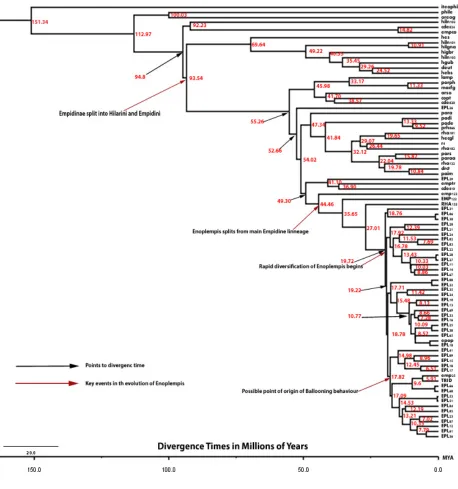
lineage. Tree congruence from these three sources indicates general agreement in support for the current best estimate tree topology. The BEAST analysis showed that the empidid subfamilies began to split from their most recent common ancestor 151.33 million years ago. Within the subfamily Empidinae, the Hilarini and Empidini began to diverge from one another around 95 million years ago. The Enoplempis lineage split from its closest sister taxon 44.46 million years ago. The rapid diversification of
Figure vi. Divergence time tree showing important events in the evolutionary history of
Discussion
Phylogenetic relationships of Enoplempis
Our phylogenetic analyses (Fig ii) show that Enoplempis is a monophyletic lineage (pp=1, BS=99). Based on the current data, the sister lineage to Enoplempis is not certain, but the placement of the group is near the Empis (Xanthempis) lineage or the
Rhamphomyia (Holoclera) flava lineage. The placement of a Rhamphomyia sub lineage close to a strongly supported Empis group reveals the current classification system is comprised of a series of smaller subgroups and two basal lineages. The type species, E. mira, and unidentified taxon RHA133 are basal to the larger radiation of the subgroup. The Bayesian and ML analyses both agree on the common tree shape; however, the ML bootstrap is less well supported than the Bayesian tree, with several nodes being
weakly supported in this framework. Both trees agree that the monophyly of subgroups I-‐IV is strongly supported (PP=1, BS=99). Subgroup 1 is also strongly supported in both analyses (pp=0.98 BS = 65). However, the support values for the leading to the other
disagreement between the two support scores (Zhang et al. 2012, Alfaro et al. 2003). The subgroups all stem from a series of short branches (recovered in both ML and BI analyses), which suggests that a rapid radiation occurred in Enoplempis as the sub lineages within the group became more derived. Sister group relationships between the major groupings within subgroups I-‐IV are mostly well resolved with some ambiguities occurring at the tips of the phylogeny, regarding sister species
relationships. This is most noticeable in subgroup II. In contrast, subgroup IV has good resolution at the tips with the only ambiguous node being the split between the second and third sub sets of ballooning flies (pp=0.51, BS=37). These uncertainties could likely be resolved by the addition of extended taxon sampling and the inclusion of additional nuclear and mitochondrial genes to the current dataset. Overall, the resulting phylogeny has a robust structure against which evolutionary hypotheses on character evolution and splitting of lineages can now be tested.
Evolution and diversification of traits
observed to recognize conspecific swarming patterns (Alcock 1973). This is important as it may function as a barrier to the hybridization of closely related species or
divergent populations. The mapping of known swarming states show that there is considerable variation across Enoplempis. Empis poplitea, E. snoddyi, E.geneatis, E. arthritica, E. aerobatica and new species EPL 41 all have male swarms; however, the number of individuals in the swarm varies considerably from as few as two males in the case of EPL41, to up to 15 in E. snoddyi (Turner, in prep, Sadowski et al. 1999). Species EPL 31 shows another variation to swarming behavior and exhibits sex role reversal, containing swarming females with secondary sexual ornaments. This is the first time this has been observed in Enoplempis (Turner, in prep). The variation in swarming strategy across the phylogeny suggests that preference of this trait and its polarization is a potentially important isolation mechanism and has been observed in other
dipterans, suggesting that swarming cues are important for species recognition in diverse groups of flies (Downes 1969, Diabaté et al. 2011).
answer this question. The single point of origin for all ballooning species is also
supported by the results of the divergence time estimations, which show that group IV (and all known ballooning species) split from the prey presenting Enoplempis lineages 17.81 million years ago, shortly after the initial rapid diversification of the four main subgroups that began 19.72 million years ago. These findings do have some
concordance with Kessel’s 1955 hypothesis in that the ballooning condition is the most derived; however, it is not clear which ballooning behaviors (e.g., with or without included prey) are the most derived based on the data presented here. There is also no observable sequential pattern on the evolution of swarm complexity; however, this may be due to lack of observations. The utilization of silk to produce nuptial gifts has been recorded in several species of hilarine dance flies (Young 2003, Eltringham 1928, Sutherland et al. 2007). This behavior has only been found in Enoplempis in the empidine lineage, suggesting two highly divergent, independent (at least 94 million years since the last common ancestor) origins of this nuptial gift strategy in Empidinae.
The femoral-‐trochantal spines seen in many species of Enoplempis are found across all subgroups. In groups I, II, and III all species sampled show a wide range of species specific modifications. In group IV, most species have these leg modifications, with the exception of two subgroups: 1) Empis snoddyi + E. tridentata + EPL 68 and 69 and 2) Empis geneatis. Both E. snoddyi and E. geneatis produce empty balloons and have no leg modifications. The ancestral state reconstruction of this trait shows that in