ISSN(Online): 2320-9801
ISSN (Print): 2320-9798
I
nternational
J
ournal of
I
nnovative
R
esearch in
C
omputer
and
C
ommunication
E
ngineering
(An ISO 3297: 2007 Certified Organization)
Vol. 4, Issue 9, September 2016
A Survey on Robust Document Image
Binarization Methods
Rinadevi R. Yadav1, Snehal Y. Dhamnekar2, Kirti R. Potekar3, Prof.Y. K. Patil4
B.E Students, Dept. of Computer Engineering, JSPM’S BSIOTR, Wagholi, Pune, Maharashtra, India1,2,3
Asst. Professor, Dept. of Computer Engineering, JSPM’S BSIOTR, Wagholi, Pune, Maharashtra, India4
ABSTRACT: Segmentation Document image binarization is a used pre-processing technique which is analysis segments text from degraded document image. In these studies we proposed a robust document image binarization techniques which is based on adaptive image contrast. Combination of local image and local image gradient is adaptive image contrast which is make liberal to text and by different type of document degradation background variation has been done. In our proposed technique text stroke edge pixel and binarized adaptive contrast map has been detected as using Canny’s Algorithms. For detected text stroke edge pixel within local window the document text will be segmented by local threshold to detect high intensity. The above mentioned process has been rehashed by combining adaptive image contrast with Sobel’s Edge detection technique and Total Variation Edge Detection technique respectively. The comparison between these techniques are made on the basis of Mean square Error Values and Peak signal to noise ratio. These methods have been tested on images suffering from different types of degradations.
KEYWORDS:Adaptive Document image analysis, bimodal pattern, edge detection, segmentation.
I. INTRODUCTION
In Document image binarization is performed in the preprocessing layer for the analyzed documents it was make segments of foreground text extracted from background text. As illustrated in Fig.1 Historical documents suffer from ink has been spread and ink other side seep through the front side.
Fig 1. Degraded document image taken from DIBCO dataset
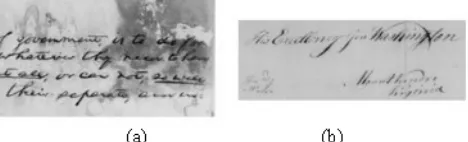
Fig.2 (a) shows a document image having a complex background and Fig 2(b) shows a document having small intensity variation within the document background but large intensity contrast in large stroke.
ISSN(Online): 2320-9801
ISSN (Print): 2320-9798
I
nternational
J
ournal of
I
nnovative
R
esearch in
C
omputer
and
C
ommunication
E
ngineering
(An ISO 3297: 2007 Certified Organization)
Vol. 4, Issue 9, September 2016
Historical documents are degraded by different type of cultural images. This is different type of document normally behave in a particular way to proposed document thresholding error and most of the degraded document image binarization technique is hard to many state of the art techniques. In our proposed system document binarization technique which is extend minimum and maximum methods and In DIBCO these methods are used. The proposed method is simple, robust and capable of handling different types of degraded document images with minimum parameter tuning. In particular, the proposed technique addresses the over-normalization problem of the local maximum minimum algorithm. At the same time, the parameters used in the algorithm can be adaptively estimated. The proposed method is simple, robust and capable of handling different types of degraded document images with minimum parameter Tuning and background variation caused by different type of document degradation. At the same time, the parameters used in the algorithm can be adaptively estimated.
II. LITERATURESURVEY
There Cluster based image threshold used for gray level image to binary image reduction. These methods combine different types of image information and domain knowledge and are often complex. These algorithms try to extract combined text with help of assuming two combined images having two different pixel. It assumes that an image follows a bimodal histogram i.e. it contains foreground and background pixels. Then it will be calculated threshold to extract two images to ensure that two spreading images are minimal. This method gives acceptable results when the pixels in each class are close to each other. Limitation of this system there is images not clear accurately by bimodal pattern. Second limitation is minimization of intra class variance between class scatter [3] Niblack’s algorithm [4] calculates a pixel wise threshold by sliding a rectangular window over the gray level image. The threshold T is computed by using the mean m and standard deviation s, for all the pixels within the window, and this threshold is denoted as:
T = m + k×s
Where k is a constant, which determines how much of the total print object edge is retained, and has a value between 0 and 1. The value of k and the size SW of the sliding window defines the quality of binarization [9].The limitation of Niblack’s method is that the resulting binary image suffers from a great amount of background noise especially in areas without text.[10].Another approach for document images binarization has been adopted by Savona [5] .In this method the page is considered as a collection of subcomponents such as text, background and picture. To define a threshold for each pixel of the background and pictures a soft decision method is used. The neighborhood window should be at least larger than the stroke width in order to contain stroke edge pixels. Pixel of the both sides of the text stroke will be selected as the high contrast pixels. To define a threshold for each pixel of textual and line drawing areas a text binarization method is used. Finally the Results of these algorithms are combined.[5].Although this method solves the problem posed by Niblack’s approach but in many cases the characters become extremely thinned and broken.[10] In Bunsen’s method [6] the local image contrast is defined as follows
: C(i, j ) = Imax(i, j ) − Imin(i, j )
where C(i, j ) denotes the contrast of an image pixel (i, j ), Imax(i, j ) and Imin(i, j ) denote the maximum and minimum intensities within a local neighborhood windows of (i, j ), respectively. If the local contrast C (i, j ) is smaller than a threshold, the pixel is set as background directly. Otherwise it will be classified into text or background by comparing with the mean of Imax (i, j) and I min(i, j ).
ISSN(Online): 2320-9801
ISSN (Print): 2320-9798
I
nternational
J
ournal of
I
nnovative
R
esearch in
C
omputer
and
C
ommunication
E
ngineering
(An ISO 3297: 2007 Certified Organization)
Vol. 4, Issue 9, September 2016
variation. In dark region around the text boundary for the image pixel, denominator is small and accordingly results in a relatively low image contrast. which compensates the small numerator and accordingly results in a relatively high image contrast. [7]. The limitation of this method is that, it cannot handle document images with bright text having bright background properly. To extract only the stroke edges properly, the image gradient needs to be normalized to compensate the image variation within the document background. A weak contrast is calculated for image pixels having bright text stroke edges and which lie within bright regions. A large denominator and as small numerator are produced for documents having bright text stroke edges and which lie within bright regions. Where the power function becomes a linear function therefore, the local image gradient will play the major role. When is large and the local image contrast will play the major role when is denominator small. The setting of parameter will be discussed in shows the contrast map of the sample document images in Fig 2 This problem is known as over normalization problem. The proposed technique overcomes the over normalization problem by assigning weights to image contrast and image gradient.
III.PROPOSEDSYSTEM
The Proposed system consists of four modules:
A. PRE-PROCESSING MODULE: In this module the adaptive image contrast is calculated with the help of equation
The image gradient has been widely used for edge detection and for detect text stroke edge for document images it can be used effectively which is define images background. Another way it will be find out from the degraded document stroke edge and that contain uneven lighting, bleed through and variation. To extract only the stroke edges properly, the image gradient needs to be normalized to compensate the image variation within the document background.
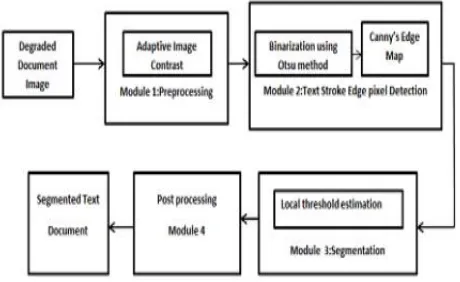
Fig 3. Block diagram of the proposed system
B. TEXT STROKE EDGE DETECTION MODULE: By using OTSU methods and canny Algorithms the text stroke
edge candidate has detected. The purpose of the contrast image construction is to detect the stroke edge pixels of the document text properly.
C. SEGMENTATION MODULE: In this the local threshold has been detected using Local Threshold
Estimation algorithm.
ISSN(Online): 2320-9801
ISSN (Print): 2320-9798
I
nternational
J
ournal of
I
nnovative
R
esearch in
C
omputer
and
C
ommunication
E
ngineering
(An ISO 3297: 2007 Certified Organization)
Vol. 4, Issue 9, September 2016
A. USE OF SOBEL’S EDGE DETECTION METHOD
To test the robustness of the system using Canny’s edge detection method,
Fig 4. Block diagram of proposed system using Canny’s edge detection method
The entire process of document image binarization discussed in the previous sections has been rehashed using Sobel’s edge detection algorithm in place of Canny’s edge detection algorithm in the test stroke edge pixel detection module. Sobel’s edge detection technique is simple and requires fewer computations than Canny’s edge detection method. However it is less accurate and more sensitive to noise than Canny’s edge detection method.
B. USE OF TOTAL VARIATION EDGE DETECTION METHOD:
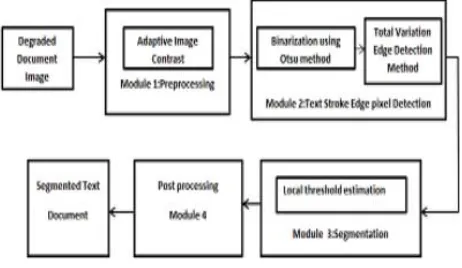
The Sobel’s edge detection technique has been replaced with Total variation edge detection technique.Fig.5 shows the block diagram of the proposed system using total variation edge detection method.
Fig 5. Block diagram of the proposed system using total variation edge detection method
ISSN(Online): 2320-9801
ISSN (Print): 2320-9798
I
nternational
J
ournal of
I
nnovative
R
esearch in
C
omputer
and
C
ommunication
E
ngineering
(An ISO 3297: 2007 Certified Organization)
Vol. 4, Issue 9, September 2016
IV.EXPECTEDOUTPUT
This paper introduces a novel document image binarization technique which will helps to recover the badly degraded documents. The system helps to recover the image which are not exactly bio model. The expected Output as per the base paper is as follow:
V. CONCLUSION
The proposed technique is simple and robust. The proposed technique makes use of the local image contrast that is evaluated based on the local maximum and minimum. Since this method combines the image contrast and the image gradient it can handle all types of degradations in the document images. It overcomes the problem of over -normalization. The adaptive threshold image combined with Canny gives superior performance in terms of Peak - Signal to Noise ratio and Mean Square Error when compared with existing techniques which were proposed by Otsu, Niblack and Sauvola The performance of the proposed system can be compared with existing systems on the basis of misclassification Penalty Metric-Measure and Distortion Reduction Matrix.
REFERENCES
1. B. Gatos, K. Ntirogiannis, and I. Pratikakis, “ICDAR 2009 document image binarization contest (DIBCO 2009),” in Proc. Int. Conf. Document Anal. Recognit., Jul. 2009, pp. 1375–1382.
2. I. Pratikakis, B. Gatos, and K. Ntirogiannis, “ICDAR 2011 document image binarization contest (DIBCO 2011),” in Proc. Int. Conf. Document Anal. Recognit., Sep. 2011, pp. 1506–1510.
3. I. Pratikakis, B. Gatos, and K. Ntirogiannis, “H-DIBCO 2010 handwritten document image binarization competition,” in Proc. Int. Conf. Frontiers Handwrit. Recognit., Nov. 2010, pp. 727–732.
4. S. Lu, B. Su, and C. L. Tan, “Document image binarization using background estimation and stroke edges,” Int. J. Document Anal. Recognit., vol. 13, no. 4, pp. 303–314, Dec. 2010.
ISSN(Online): 2320-9801
ISSN (Print): 2320-9798
I
nternational
J
ournal of
I
nnovative
R
esearch in
C
omputer
and
C
ommunication
E
ngineering
(An ISO 3297: 2007 Certified Organization)
Vol. 4, Issue 9, September 2016
6. G. Leedham, C. Yan, K. Takru, J. Hadi, N. Tan, and L. Mian, “Comparison of some thresholding algorithms for text/background segmentation in difficult document images,” in Proc. Int. Conf. Document Anal. Recognit., vol. 13. 2003, pp. 859–864.
7. M. Sezgin and B. Sankur, “Survey over image thresholding techniques and quantitative performance evaluation,” J. Electron. Imag., vol. 13, no. 1, pp. 146–165, Jan. 2004.
8. O. D. Trier and A. K. Jain, “Goal-directed evaluation of binarization methods,” IEEE Trans. Pattern Anal. Mach. Intell., vol. 17, no. 12, pp. 1191–1201, Dec. 1995.
9. O. D. Trier and T. Taxt, “Evaluation of binarization methods for document images,” IEEE Trans. Pattern Anal. Mach. Intell., vol. 17, no. 3, pp. 312–315, Mar. 1995.