Scholarship at UWindsor
Scholarship at UWindsor
Electronic Theses and Dissertations Theses, Dissertations, and Major Papers
1-1-1967
An analysis of steady state void fraction distribution and steam
An analysis of steady state void fraction distribution and steam
void response to sinusoidal power modulation in a boiling water
void response to sinusoidal power modulation in a boiling water
coolant channel.
coolant channel.
Afamefuna E.A. Egbuniwe University of Windsor
Follow this and additional works at: https://scholar.uwindsor.ca/etd
Recommended Citation Recommended Citation
Egbuniwe, Afamefuna E.A., "An analysis of steady state void fraction distribution and steam void response to sinusoidal power modulation in a boiling water coolant channel." (1967). Electronic Theses and
Dissertations. 6472.
https://scholar.uwindsor.ca/etd/6472
AN ANALYSIS OF STEADY STATE VOID FRACTION DISTRIBUTION AND STEAM VOID RESPONSE TO SINUSOIDAL POWER
MODULATION IN A ROILING WATER COOLANT CHANNEL
A Thesis
Submitted to the Facultylof Graduate Studies through the
Department of Chemical Engineering in Partial Fulfilment
of the Requirements for the Degree of
Master of Applied Science at
University of Windsor
by
Afamefuna E.A.Eghuniwe
Windsor,Ontario
IN F O R M A T IO N T O U S E R S
T h e quality of this reproduction is d ep e n d e n t upon th e quality of th e copy
subm itted. B roken or indistinct print, colored or poor quality illustrations and
photographs, print bleed-through, sub standard m argins, and im proper
alig n m en t can a d versely a ffect reproduction.
In the unlikely e v e n t that the auth o r did not send a co m p lete m anuscript
and th e re are missing pages, th e s e will be noted. Also, if unauthorized
copyright m aterial had to be rem o ved , a note will indicate th e deletion.
UMI
U M I M icroform E C 5 2 6 5 3C opyright 2 0 0 8 by P ro Q u e s t LLC.
All rights reserved . This m icroform edition is protected again st
unauthorized copying u n d er Title 17, United S ta te s C ode.
P ro Q u e s t LLC 7 8 9 E. E ise n h o w e r P arkw ay
4 6 / f 6 7 3 7
APPROVED BY;
In this theoretical analysis,various models and correlations were
-tested for their ability to predict correctly the steady state Gross-
sectional average void fractions in a boiling water channel. A modified
Bowring’s model is proposed and then employed to predict the steam weight
fraction distribution in the subcooled boiling region. This modified model
is used also in the theoretical prediction of steam void, response to small
power perturbation in a boiling water channel.
Bowring’s model (l),was employed to predict the inception of the
subcooled boiling region. In this subcooled boiling region,a parameter
e was introduced to relate the heating component to the evaporative
component of the total heat flux. The parameter e was assumed to vary
linearly throughout the subcooled boiling region. In the bulk boiling
region, ;e equals zero, and the steam weight fraction distribution is calcu
lated from a thermal energy balance.
Various theoretical models and correlations were tested agaist available
experimental data {17,29,36) for their ability to predict accurately the
steam void fraction for both the subcooled boiling region and the bulk
boiling region. Satisfactory agreement was obtained with the majority of
the models over a wide range of channel geometries, heat fluxes, pressure
and inlet flow rates. Neal’s model (7) was found to give the best overall
ag r e e m e n t . The range of operating conditions considered were ;
Pressure ILO-IOOO psia
Flow Area rectangular,annular,
, and circular
Inlet Liquid Velocity above 2 ft/sec.
Subcooling 1.1°F to 21.6°F
Heat Flux 22,800-157,OOOBtu/hr-ft^
In the unsteady state analysis, the equations of change were written
in the one-dimensional macroscopic form, differenced in the height variable
and solved employing a stagewise complex integration procedure. Improved
agreement with experimental data (36) was obtained employing the modified
The author wishes to express sincere thanks to Dr. C.C. St; Pierre for
his help and guidance, to Atomic Energy of Canada, Chalk River, Ontario,
for the use of the CDC-G20 computer, and to Mrs. S. Ouellette of the
Electrical Engineering Department for the use of a typewriter^
The financial assistance from the National Research Council and
■ ■ CONTENTS.
ABSTRACT 111
ACKNOWLEDGEMENTS v '
LIST OF FIGURES vili
CHAPTER I INTRODUCTION 1
CHAPTER II LITERATURE SURVEY
A . Cross-sectional Average Void Fraction A
1. Bulk Boiling Region
2. Subcooled Boiling Region
B. Theoretical Models for the Dynamics of 7
Coolant Channels
C. Power to Void Transfer Function Measurement 9
/ CHAPTER III PRESENT ANALYSIS
A. Bowring’s Model 12
B. Proposed Modification of Bowring’s Model 13
C. Unsteady State Analysis - 15
CHAPTER IV MACROSCOPIC EQUATIONS OF CHANGE FOR A Tim-PHASE
FLOWING SYSTEM
A . Basic Equations 17
1. Macroscopic Mass Balance
2. Macroscopic Momentum Balance
3. Macroscopic Energy Balance
A . Channel Wall Energy Balance
B. Dimensionless form of Equations of Change 19
C. Steady State Equations 21
1. Non-boiling Region
2. Subcooled Boiling Region
3. Bulk Boiling Region
A . Boiling Region Transitions
D. Unsteady State Equations of Change 28
1. Non-boiling Region
2. Subcooled Boiling Region
3. Bulk Boiling Region
CHAPTER V DISCUSSION
NOMENCLATURE
REFERENCES
APPENDIX III
VITA AUCTORIS
Vll
55 59
APPENDIX I 65
APPENDIX II 56
70
APPENDIX IV
LIST OF FIGURES
FIGURES
1 Void Fraction Prediction Using the Modified Powring's 42
Model and Powring's Model with Experimental Data (Ref. 17).
2 Void Fraction Prediction Using the Modified Rowring's 43
Model and Bowring's Model with Experimental Data (Ref. 17).
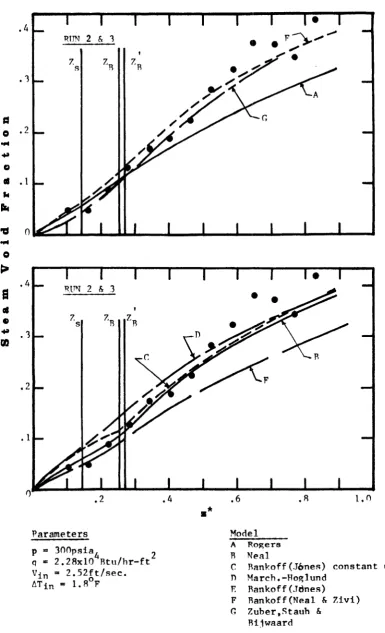
3 Comnarison of Christensen's Experimental Data (Ref. 2D) 44 with Values Predicted by Modified Bowring's Model Run 2 •
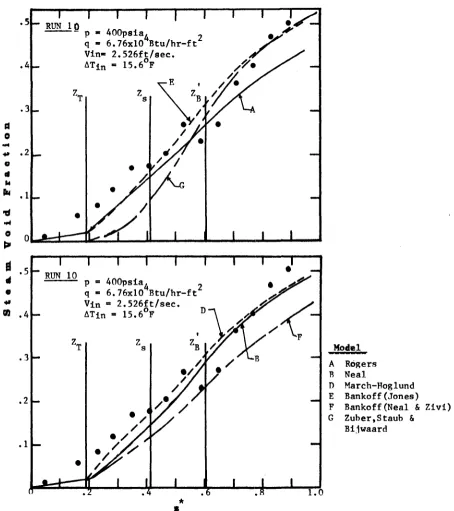
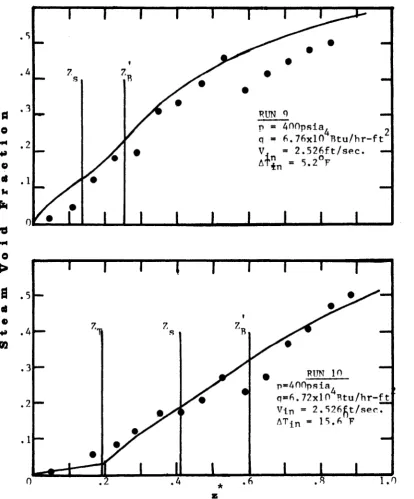
4 Comparison of Christensen's Experimental Data (Ref. 29) 45 with Values Predicted bv Modified Bowring's Model Run IjO.
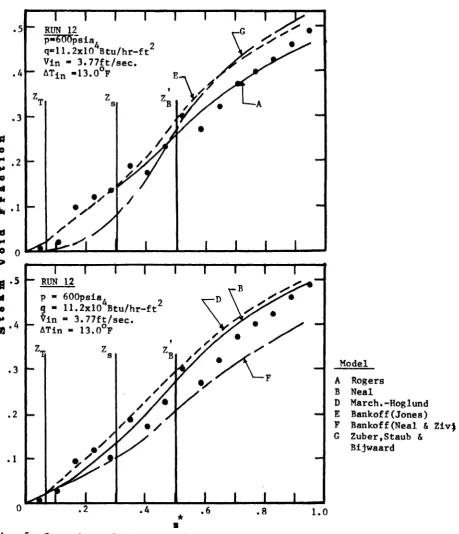
5 Comparison of Christensen's Experimental Data (Ref. 29) 46 with Values D^pdicted by Modified Rowring's Model Run
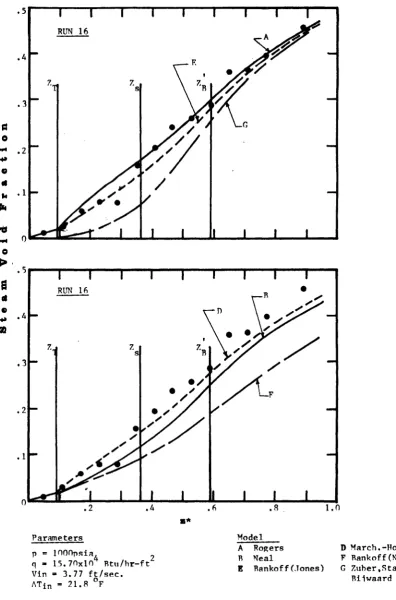
6 Comparison of Christensen's Experimental Data (Ref. 29) 47 with Values Predicted by Modified Bowring's Model Run 16.
7 Comparison of St. Pierre's Experimental Data (Ref.36) with • 48 Values Predicted by Modified Bowring's Model and constant e
Run 12.
8 Comparison of St. Pierre's Experimental Data (Ref.36) with Lg Values Predicted by Modified Bowring's Model and constant
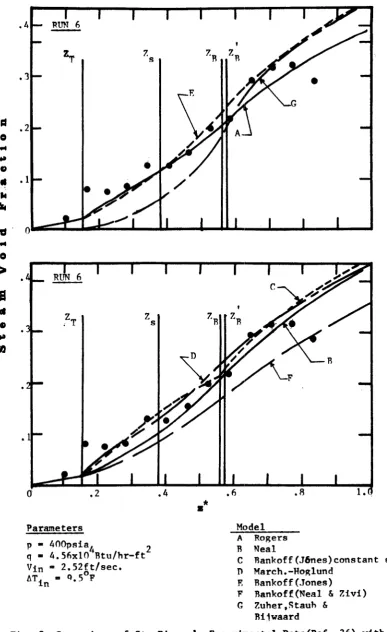
Run _6.
9 Comparison of St. Pierre's Experimental Data (Ref.36) with' 50 Values.Predicted by Modified Bowring's Model and constant je
Run §_•
10 Comparison of St. Pierre's Experimental Data (Ref.36) with 51 Values Predicted by Modified Bowring's Model and constant e
Run 2&3.
11 Comparison of Christensen's Experimental Data (Ref.29
)
with 52 Values Predicted by an assumed Linear Variation of Slip Ratiowith axial distance.in the Subcooled Boiling Region, Run 10.
12 Comparison of Christensen's Experimental Data (Ref.29
)
with 53 Values Predicted by an assumed Linear Variation of Slip Ratiowith axial distance in the Subcooled Boiling Region, Run 12.
13 Comparison of Power-to-void transfer Data(Ref.36) with Values 5^ Predicted by the Modified Bowring's Model and e = 1.3.
In a boiling water reactor, there is an inherent interraction of
reactor power output with the volume void fraction present in the
core. Consequently, a knowledge of the vapour volume distribution along
the channel axial length is of importance for reactor design since
this interraction can result in boiling water reactor instabilities.
Instabilities can arise from reactivity feedback, causing divergent
power oscillations, or from hydrodynamic instability which may occur
in natural circulation boiling systems at constant power.
The steady state behaviour and the dynamic response of a reactor
are strongly dependent on the vapour volume distribution present in
the core. Theoretical predictions of the vapour volume distributions
in a channel are often complicated, due to the presence of three
boiling regions: a non-boêiing region, a subcooled boiling or non-equi
librium region, and a bulk boiling region. In addition, the boundaries
between these regions must be considered.
Several attempts have been made by different authors to formulate
theoretical models or semi-empirical correlations to predict vapour
volume distribution in a boiling water channel. At present there is no
m o d e l o r c o r r e l a t i o n which can be used f o r all of the possible operating
conditions in present day reactors. In general, the semi-empirical
correlations employ dimensionless groups which the authors believe to
predictions employing these correlations cannot be extrapolated with any
degree of confidence beyond the experimental data used to obtain the
correlations.
Authors in deriving the theoretical models have employed many
assumptions because of the complexity of the problem. Often these
assumptions are valid only for specific flow regimes in two phase flow.
In addition, experimental data are normally analysed to obtain values
of semi-empirical constants required for the theoretical models. Once
more extension of the models beyond a particular flow regime or range
of experimental data ^(cannot be done with confidence.
Bowring’s model(1) was one of the first to treat the three distinct
boiling regions. His physical model can be used to predict the inception
of subcooled boiling and the axial quality distribution for the non
equilibrium region. Bowring’s model, with various correlations and
theoretical models relating quality and void fraction, has been used to
predict void fractions at reactor operating conditions(2). However, a
discontinuity in the slope of vapour volume fraction versus steam
quality curve was found to exist at the bulk boiling boundary.
Physically this behaviour is not expected.
The present work is concerned with a modification of Bowring’s
physical model to give a smooth curve of vapour volume fraction versus
quality over the whole channel length. It is hoped that better
agreement .jbetween experimental data and yoid fraction^ predicted
employing the modified Bowring’s model^ill be obtained. In addition,
the ability of several theoretical ' models and correlations to
Finally a study of the dynamic response of a boiling water channel
to power modulation is considered employing this modified Bowring’s
I I LITER ATU R E SURVEY
A. Cross-sectional Average Void Fraction
The majority of the empirical correlations and void fraction models
relating quality and void fraction are valid only in the bulk boiling
region.
1. Bulk Boiling Region
Several of the models employed in predicting the steady
state cross-sectional average void fraction distribution.are summarized
below.,
Sankoff (3) formulated a theoretical model, in which the contribu
tion l o f the local slip effect on the two phase system was neglected.
The two phase mixture was conceived as a single fluid with radial
density dependency. A power law distribution was assumed to hold for
both the liquid phase and the vapour phase. A flow parameter was
derived and its numerical value determined by analyzing available
experimenntal data. In order to eliminate the discontinuity in Bankoffs
expression for the slip velocity ratio, Jones (4) modified the value of
this flow parameter. Later Neal and Zivi (5) claimed a better agree
ment with experimental data, employing a value of the flow parameter
obtained by analyzing Marcheterre's data (6).
Neal (7) derived a theoretical model relating quality and void
fraction by considering two dominant effects on the two phase system.
two phases. The second effect is the radial variation of void fraction
and velocity. Values for the two parameters which account for the local
slip effect and the distributioPâly(radial'variationiof'void fraction
and velocity) effect were obtained by analyzing previous theories and
experimental data for specific flow regimes (8,9,10,11).
Zuber and Findlay (12), formulated a general expression for thé void
fraction claimed to be applicable to any two phase flow regime. Incor
porated in the theoretical model were expressions which accounted for
both the distributional and the local slip effects. These expressions
are dependent on the flow regime.
Marcheterre and Hoglund (13) obtained a semi-empirical correlation
relating quality and void fraction. Dimensional analysis was employed
to correlate vapour volume data using the Froude number, the velocity
ratio of the vapour and liquid phases, and the ratio of the volumetric
flow rates as the significant dimensionless groups.
Primeau and Roger have obtained an empirical correlation (14) which
is a modification of the Collier-Sher correlation (15).
2. Subcooled Boiling Region
Theoretical models to predict axial distribution of void
fractions in the subcooled boiling region are scarce because of the
complexity of the problem.
A physical model for the calculation of void fraction in the sub
cooled boiling region was formulated by Bowring (1). The subcooled boil
ing region was subdivided into a region of high subcooling, in which the
wall voidage is important; and a region of slight subcooling, in which
void fraction in the slightly subcooled region the concept of bubble
detachment was introduced. At low subcooling bubbles growing on the
heated surface detachiand are swept downstream , condensing as they
travel through the subcooled boiling region.
Two new parameters were introduced. The first related the sub
cooling at which a rapid rise in void fraction occured, to the inlet
liquid velocity and the heat flux. The second parameter gave the ratio
of the latent heat flux to the agitative heat flux. Values of both
parameters were obtained by analyzing experimental data.
Zuber, Staub and Bijwaard (16) developed a theoretical model by
considering the effects df velocity, vapour concentration ^chd s temper,
rature profiles, together with the effects of local slip. A'tempera-r .
ture distribution believed to be realistic for.the subcooled boiling
region was assumed. Employing a steady state energy equation in the
Lagrangian form (neglecting kinetic energy and potential energy effects)
an expression was derived for the void fraction distribution. A
distribution parameter whose value is dependent on the flow regime
was introduced. Values of the distribution, parameter were obtained
by analyzing experimental data.
Extensive experimental work has been performed by Rouhani (17) on
void measurements in the region of subcooled boiling. Void fraction
measurements were carried out in an annular test section employing
a gamma radiation technique. These data were used to test the predicts
In order to predict accurately the dynamic performance of a boiling
water reactor (BWR) in the design stage, it is necessary to understand
the transient'behaviour of steam bubbles in the reactor core as the heat
production in the fuel varies. This constitutes the so called power-to-
void transfer function which expresses in a concise manner the dynamic
relationship between a power disturbance and the ensuing steam-void
response. Two main types of approach have been attempted in stability
or dynamic analysis of boiling water reactor coolant channels. The
first employed the three conservation laws'of mass, momentum, dnd
energy in addition to the equation of state. The second (18,19,20,21)
employed the pressure drop versus flow rate curve as the controlling
phenomenon and studied the influence of other parameters of the system
on this relationship.
Homing and Corben (22) employed a one-point model. One different^
ial equation was written for the total steam volume which accounted
for the heat capacity of the fuel. A constant fractional rate
of removal of steam voids was assumed.
Iriarte (23) employed the one point model also but characterized
the power-to-void transfer function, by time constants and a time delay.
Beckford (24), by dividing the fuel plate into several regions,
derived three time constants but omitted any contributions due to the
non-boiling region.
Fleck and Huseby (25), and Fleck (26) obtained solutions based on
linearity of void fraction, water velocity and steam velocity with
coolant was considered also. Akcazu (27) recognized that a perturbation
in the mass flow rate of steam could cause the local void fraction
changes to be less than would be expected, as the perturbation may not
propagate along the boiling section with a velocity equal to the steam
velocity,
Zivi and Wright’s theoretical model (28) considered the effects of
longitudinal displacement of axial void fraction distribution as the
power was modulated. The transient void response was obtained by
accounting for the displacement of the non-boiling length by super
imposing the effects of power,flow and pressure variations on the
steady state void fraction curve. The phase lag was obtained as the sum
of the moving boundary phase lag plus that due to propagation (away from
the boundary) of the void disturbance travelling with the liquid
velocity. The void amplitude was obtained by multiplying the magnitude
of the boundary disturbance and the total derivative of the zero-
frequency void fraction with respect to axial distance.
Christensen (29) in his treatment of the power-to-void transfer
function considered the pressure changes in the channel arising from the
power variations. He derived the power-to-void transfer function,
which fitted his experimental data, employing Laplace transform theory.
Bankoff, Hudson and Atit (30) employed the macroscopic continuity,
energy and momentum balances. These were differenced in the height
variable and then linearized around steady state. Bankoff’s variable
density model (3) was used to relate quality and void fraction.
the transient energy in the fuel element. A modified Bankoff slip ratio
correlation was used and the effects of the moving boundary between
subcooled boiling and bulk boiling regions were considered in addition
to bubble recondensation effects. Solberg (33) and Schjetne (34)
developed and tested respectively the Kjeller model. Conservation
laws were employed in the non-boiling region, subcooled and bulk
boiling regions and an analysis of the subcooled region was based on
Bowring’s work (1).
Bijwaard, Staub and Zuber (35) recently formulated a transformed
continuity equation in terms of kinematic waves describing the transient
behaviour of the vapour concentration in a two-phase flow system.
A complex variable method was used by St. Pierre (36) to solve the
differential equations employing a stage-wise integration procedure.
The transitional boundaries between the subcooled and the bulk boiling
regions were treated in a manner similar to that in the Kjeller model.
Treatment of the bulk boiling region was based upon the. work of Hudson
e£ al. (30)
C. Power to Void Transfer Function Measurement
A detailed account of the early experimental work on boiling water
reactors up to 1958 has been given by Kramer (37). Early experimental
research on the stability of boiling water reactors was done by employ
ing, a harmonically oscillated reactivity input and studying the resul
tant reactor power output. Eriksen (38) measured void volume by their
reactivity worth. This investigation and Daavettilas (39) revealed
10
boiling phenomena.
Deshong and Lipinski (AO) measured the transfer functions of the
reactor at several low powers, employing a rod oscillator technique.
Experimental data were compared with those theoretically predicted
using an analog computer. Transfer functions for higher powers were
then obtained by extrapolation, and these predicted accurately,
instability points at higher power levels.
Zivi and Wright (28) measured transfer functions using an electri
cally heated aluminium channel. For low subcooling tests, the channel
power was modulated about the mean level at a given frequency with
small amplitude (usually 10%). The amplitude and phase of the void
response were obtained over a frequency range of zero to 10 cps. The
void response linearity for â frequency of 1/4 cps. extended up to power
modulation of 20% corresponding to a void amplitude of 17%.
Christensen (29) extended the experimental range of the parameters
employed by Zivi and Wright (28). Power modulation around, a steady state
level was limited to 10% peak-to-peak and measurements of the amplitude
and phase of the void response were made employing a cross correlation
technique. Void response was found to fall off at a much lower frequency
(0.30-0.60 cps) than that predicted by theoretically derived power
-to-void transfer function. A sharp node and an undulation in the
phase measurements occured at the node frequency.
St. Pierre (36) measured power-to-void transfer function using an
electrically heated rectangular test section. Notches at f r e q u e n c i e s
ranging from 1.2 to 3.7 cps were obtained for all the void amplitude
position attaining a maximum value at the inlet. Maximum notch frequ
ency at the centre of the channel was obtained for the transverse measure
ments, The phase measurements had an undulation close to the notch
frequency. The range of linearity of the void response to power
modulation extended to amplitudes of 20% of the average power level for
the runs at 200, 300, and A00 psia. Decreased inlet subcooling increa
sed the zero frequency amplitude and the local void propagation velo
city was found to be a function of the distance from the wall at a fixed
axial position.
Bijwaard, Staub and Zuber (35) measured power-to-void transfer
functions in a vertical, stainless steel tube employing a forced circu
lation loop. Power modulation ranged from 12.5 to 40% of the average
power level. Within the range of frequencies (0.05 to 1) studied, the
void phase lag increased linearly with frequency, and decreased as the
flow rate was increased and with downsream axial distance. The void-
amplitude response decreased at the higher frequencies. Zero frequency';
amplitudes at high flow rates, high heat flux and low inlet subcooling
Ill PRESENT ANALYSIS
The present analysis is concerned first with an accurate prediction
of the steady state cross-sectional average void fractions in a two
phase flowing system. In addition, theoretical predictions of the
dynamic response of vapour volume void fraction in a boiling channel to
small power modulation is considered.
A. Bowring’s Model
Bowring (1) formulated a physical model based, upon'bubble
detachment for calculating steady state cross-sectional average void
fractions in the subcooled boiling region. A parameter e, which is the
ratio of the heating component, , to the evaporative portion, q^, of
the total heat flux was introduced. Experimental data (33) were
analysed to obtain a value of e equal to 1.3, constant in the subcooled
boiling region for the pressure range of 9 to 50 atmospheres, In the
bulk boiling region, q^ is zero and thus the value of e is zero. For
this reason, a step change is obtained in the quality at the bulk
boiling boundary, Z^.
In the slightly subcooled region Bowring divided the total heat
flux, q, into four components:
q = q^ + q* + q^ + q^, (3.1)
Here, q^ represents the evaporative heat flux in the form of the latent
heat content of the bubble; q^ Ts-the convective heat flux arising from
transfer between patches of bubbles and is the heat loss by condensa
tion while the bubble is still attached .to the surface* The terms q^, q^
and q^ were considered by Forster and Greif (41) who showed that q^ was
negligible when compared to q^ at atmospheric pressure. Assuming q^
and q to be negligible at high pressures and heat fluxes Eq. (3.1) sp
reduces to;
q = + 9a (3'2)
A parameter e was introduced by Bowring for the subcooled boiling
region as;
e =?= ^a/ = ( f ' i P p / p X)0 (3.3)'
; **e
where/0 is an effective temperature difference through which an amount
of liquid (equal to the volume of the detached bubble)*is raised as it
is drawn to the heated wall and pushed out again by the bubble. Here 0
is a function of the bulk temperature, the degree of superheat near the
wall and the efficiency with which the bubble circulates the liquid.
B. Proposed Modification of Bowring’s Model
At the onset of subcooled boiling the evaporative heat flux, q^, is
very small and thus e should tend to be large at the transition boundary
Zrj, . At the bulk boiling boundary, Z^, q^ tends to zero and thus e
approaches zero. Consequently, e varies from some large value at the
point of bubble detachment, Z ^ , to zero at the onset of bulk boiling.
The parameter e is a function of the degree of liquid superheat
near the wall, the bulk fluid temperature and the efficiency of
14
approximately constant throughout the subcooled boiling region (42).
The degree of liquid superheat near the wall is reasoned also to vary
slightly throughout the subcooled boiling region. Downstream of tbe
i transition boundary the increased void fraction should tend to increase
the efficiency of circulation. As the circulation increases the'
residence time of the liquid near the wall decreases which would tend
to decrease the effective temperature difference, 0. This increased
bubble circulation would tend to decrease e as the bulk boiling
boundary is approached. In addition the bulk fluid temperature increa
ses approximately linearly through the subcooled boiling region which
would also tend to decrease linearly the value of e as the bulk boiling
boundary is approached.
A linear variation of e with axial distance in the subcooled
boiling region is assumed as a modification of Bowring’s model (1), with
E decreasing linearly from an initial value of 2.6 at the transitional
boundary to zero at the bulk boiling boundary. The constant value of
1.3 for E as used by Bowring is thus taken as an average value over the
subcooled boiling region. This assumed modification should give lower
values of steam quality near the transition boundary and hence smaller
steam voidage values than were predicted with a constant e. As the bulk
boiling region is approached, higher values of steam qualities and
higher steam volume fractions will be obtained than those predicted
employing a constant e. This modified Bowring’s model, which eliminates
the discontinuity at Z is tested employing available steady state void D
C. Unsteady State Analysis
One method which has been employed (36) to solve the linearized
equations of change describing a two phase flowing system uses a stage-
wise integration procedure which employs a complex variable theory.
This procedure which will be used in this present analysis results in a
set of complex difference equations with coefficients • determined from
the steady state values of the problem variables. Consequently,
accurate predictions of the steady state values of void fraction, quali
ty, slip ratio and fluid temperature are of importance in the dynamic
response analysis.
The modified Bowring’s model is employed here in the dynamic
analysis to investigate any possible improvements on predictions (36)
IV MACROSCOPIC EQUATIONS OF CHANGE FOR A TWO-PHASE FLOWING SYSTEM
In this chapter the conservation equations for mass, energy, and
momentum are derived for the flowing two phase fluid mixture. These
equations, with various theoretical models (3,4,5,7) and correlations
(13,14) relating quality and void fraction are employed to calculate
both the steady state cross-sectional average axial void distribution
and the dynamic response of the volume void fraction to power modulation,
Bowring’s modified model is employed in the subcooled boiling region.
The bulk boiling region is treated in a similar manner to that of Hudson
et al (30).
The transition boundaries between the subcooled and the non-boiling
regions, and the bulk boiling and the subcooled boiling regions are
treated in a manner similar to that of St. Pierre (36). For the dynamic
analysis, the effect of the movement of the bulk boiling boundary on the
transient void response is assumed to be distributed over the entire
length of the subcooled boiling region. This assumption eliminated the
discontinuity at the bulk boiling boundary, Z^, in the transient void
amplitude versus axial length curve. The Kjeller model (33,34) had
previously considered this effect to be concentrated at the bulk
boiling boundary, Z^.
The channel length is sectioned into N regions, and linearized
By employing a step-by-step Integration procedure which uses complex
variables, the void response, the temperature response, and the flow
response to power modulation are computed.
A. Basic Equations
The conservation equations are derived in macroscopic form for a
two phase flow by writting a balance (mass, energy, momentum) over a
stationary volume element AAz in a vertical channel. A thermal energy
balance is made relating the heat content of the wall to the heat
transfered to the flowing two phase stream.
1. Macroscopic Mass Balance
A macroscopic mass balance over the stationary volume
element gave :
i | r [ “Pg+ - - I & f "g ) • (4-1)
where
1
A ( + Wg ) . (l-o)PiVi + PgVgO
The term on the left side of Eq. (4.1) represents the time rate of
accumulation of mass within a unit volume element AAz.. The right side
gives the net mass flow rate into the volume element.
2. Macroscopic Momentum Balance
From a macroscopic momentum balance the following equation is
obtained :
A
P.(l-G) p a
18
Ag[ P j^(l-P i) + PgO]4z (4.2)
The left side gives the time rate of accumulation of momentum within
a unit volume element. The four terms on the right side represent respec
tively, the net rate of momentum flux due to the bulk fluid motion; the
pressure differential across the control volume element; the net force
of the solid surfaces on the fluid and the gravitational force on the
total mass of the fluid in the control volume.
3. Macroscopic Energy Balance
The macroscopic energy equation is derived as :
+ z(pgO + (l-a)p%) J +2%2—
P * ( l - a ) PgO
= - a [ w 1 X + W C (T-T ) -f- W.C.(T-T )|
L g g g o ^ ^ oj
- A ( _ J v i s L l
(PgO + ( l - a ) p ^ J 2g^i
W:
-a)2 p^a'
- ^ A(z(W + W.)) + p h(T -T)A:
gg g & c w
where
AjCaXp^
+
a P g C g (T -T ^ ) + (l-a )P j^ C j^ (T -T ^ ^is the total internal energy of the system, U Az
tot’
1
2 - 1
W
I Az
represents the kinetic energy of the system, K tot '
+ z(l-a)pj^j| Az
represents the potential energy of the system,
The first four terms on the right side of Eq. (4.3) are, respecti
vely, the spatial difference of the internal energy, the expansion work
due to pressure variation, the kinetic energy, and the potential
energy. The last expression gives the thermal energy transferred from
the heated surface to the bulk fluid.
4. Channel Wall Energy Balance
An energy balance on the channel wall gave :
- "sen (4.4)
B . Dimensionless form of Equations of Change
Introducing the following dimensionless variables
W w
g W
A,o * *1,0
w.
A gen 2,0
equations (4.1) to (4.4) can be written as •:
(1-Y)
(4.5)■f— (W* + W*) = - T*- ai(la + ay) -Az'
*2
W
*2
1-0 oy
20
St' ay 1
+ a^(T - T^) + agz + 0.535
t ( 1 - a )
Az’
* * . * I " i
3 3 ( 1 - T ) + 33Z + O.Sag
* r * * *
11 + ai+(T - T^) + 332 +
asP
1-a + ay
asP
1-a + ay
] f E * “ ■ ['
]
* I * * *
W, 3 3 ( 1 - T ) + 332 + 0
+ a c ( T - T )
w
*
S w * *
(4.7)
(4.8)
where
ai
"
(t)
36 =
P^hgH"
33 £H_:
37 =
Ap^hH
35 33. . .
31 ’
P C t W. w w w 2,0
38 _'’t V
2g«£c_
In deriving equations (4.5) to (4.8) the following assumptions
have been made : the physical properties of the liquid and vapour
phases are constant in time and space and are referenced to the total
system pressure; at any axial position the bulk fluid and the channel
wall temperatures are uniform and all heat generated enters the coolant;
axial conduction of energy in the channel wall and the bulk fluid
is neglected; the two phase flow is one dimensional and radial variation
velocity may be associated with each phase and both the void fraction
and phase velocities are smooth functions of time and space.
C. Steady State Equations of Change
The equations of mass, momentum, and energy transport are obtained
by setting to zero the time dependent terms in Eqs. (4.1) to (4.8).
In predicting the vapour fraction distribution along the channel axial
length, three distinct regions are considered : the non-boiling region,
where the void fraction is zero; the subcooled boiling region, where
there is a rapid rise in void fraction; and the bulk boiling or thermo
dynamic equilibrium region.
The steady state macroscopic mass and energy balance are obtained
from Eq. (4.5) and Eq. (4.7), respectively :
(4.9)
dz’
- * | * - A . A
Wg|l + ait(T - T_) + 3 3 2 + 0 ! ■
[■
/w* \ i
H t - )
+-A I — A — A. A + W 133(1 - T ) + 332 + 0
_ A — A
+ ae(T^ - T ) = 0 (4.10)
Also, the energy balance on the channel wall gave
( T * T * )
-w a? (4.11)
1. Non-boiling Region
22
Eq. (4.9) simplifies to ;
■ \ , o = 1 : "s
( 4 . 1 2 )
0
.
— * — A
The values of W and W are substituted into the macroscopic energy
2 g
balance, Eq. (4.10) to obtain :
dz' aa(T - T_)
_ A — A. + ac(T - T ) = 0
w (4.13)
In obtaining Eq. (4.13) from Eq. (4.10), the pressure term was neglected
as it was found to be very small compared to the other terms in the
expression.
The expression for (T^ - T ), Eq. (4.11) is substituted into Eq.
(4.13) and the resulting equation integrated with the boundary condition
A — A — A
at z = 0; T = T^, to give :
T* . a&aa,, 2* +
agay o (4.14)
'Eq. (4.14) represents the expression for the bulk fluid temperature
distribution in the non-boiling region.
2. Subcooled Boiling Region
The boundary conditions at the end of the non-boiling region,
g i v e the c o n d i t i o n s at the i n c e p t i o n of th e s u b c o o l e d b o i l i n g region.
— A — A
Thus, at the inception of subcooled boiling, = 1, and = 0 .
(4.15)
■Eq. (4.15) is integrated and the boundary conditions = 1, W = 0;
at the transitional axiàl'position, Z^,'Substituted -to give ;
(4.16)
where
—*
"g ■ < 4 V ’g>/(4Vi„P,) (4.17)
and
\ ■ W,(i-a>P,)/(AV,„pp ( 4 . 1 8 )
The slip ratio is defined as :
V
— S. (4.19)
The expression for V and V from Eqs. (4.17) and (4.18) are substituted
g K »
into Eq. (4.19) to give ;
(4.20)
Also the steam weight fraction or quality, X, is defined as :
A5p V
& .S (4.21)
Combining Eqs. (4.21), (4.20), and (4.16) one obtains
■ t
X 1-5
-X 5 (4.22)
where
Y S5 — S.
-24
A thermal energy balance on an infinitesimal axial length, dz, for
vapour generation gave :
qpPcdz
Eq. (3.2) gives the total heat flux, q, removed from the channel
surface in the subcooled boiling region. Combining Eqs. (3.2) and (3.3)
we obtain :
"a ' r f r '4.24)
% - r t r - (4-24)
* A linear variation of e with dimensionless axial distance, z , is
assumed as a modification of Bowring’s model (1) :
e = a(z* - Z*) + 2 . 6 (4.26)
f
-A'change of variable from z to e is introduced first by employing Eq. (4. 26)
and then Eq. (4.25) is substituted into Eq. (4.23). The resulting
expression is integrated assuming q to be uniform, and applying the
following boundary conditions :
* * — A
for z = Z^, = 0, and e = 2.6, an expression for the Steam
quality ; X^, at an axial position, z, in the subcooled boiling re
gion is thus obtained :
qp (Z* - Z^)H(Log (1+e) - Log^(3.6))
--- '... (4.27)
in ^2
cross-sect-ional average void fraction, a^, at any axial position can be calculated
using Eq. (4.22), if the slip ratio, S, is known.
If the wall voidage, a , is significant, the total void fraction w,
at any axial position, z, is equal to :
« = a + a, (4.28)
w b
An expression for estimating the wall voidage is given in reference (1);
- Pc*
V - i - '4.29)
where 6 is the effective thickness of the vapour film, and in (1), 6 is
the lesser of ;
6 = 0.066R, (4.30)
Q
(Pr)kV,
' 4 - 3 ' )
3. Bulk Boiling Region
In the bulk boiling region, the total heat flux, q, gene
rated from the heated surfaces is converted into the latent heat of eva
poration. Proceeding in the same manner as was done for the subcooled
boiling region, the steam quality at an axial position, z , i n the bulk
boiling region is expressed as :
p_q(z - 2„)
where is the steam quality calculated from Eq. (4.27) by setting e
26
average void fraction at an axial position, z, in the bulk boiling
region can be calculated if the slip ratio, S, is known.
4. Boiling Region Transitions
The transitional axial position, Z^, represents the point at
which steam bubbles begin to detach from the channel wall, and a rapid
rise in the void fraction begins. The axial position Z^, is determined
by the subcooling, 6T^, at the point of bubble detachment,', which was gi
ven in (1) to be the least of :
AT. = Tsat - T, (4.33)
in in
*^scb " h " (4.34)
(4.35)
in
where AT represents the subcooling at the axial position consideredJ .
the subscripts, j r,in,scb, and d are explained in the nomenclature; p is
the subcooled void parameter, and the value was obtained by analyzing
experimental subcooled void fraction data; h is the single phase heat
transfer'co-efficient, and 6 has the value (0.359)e(( 0.196)(p 1))^ (i).
For the pressure range of 11 to 136 atmospheres, n has the value of
(8.62)(14.0 + (0.1)p)10"5, (1).
The value of corresponding to the subcooling AT^ is determined
Z may be calculated from the expression, Eq. (4,14), for the bulk flu- T,
_* _* id temperature profile in the non-boiling region, by setting T =
-A
where is given by ;
T*^ = Tsat - C^6T^/H (4.37)
-At the subcooled boiling region and bulk boiling region boundary,
Zg, the bulk fluid temperature is equal to the saturation temperature.
The steady state macroscopic liquid energy balance is obtained from Eq.
(4.10) :
- f ) + a3Z* +
^ (4.38)
where a% 2 =
The mechanical energy terms (potential and kinetic), and the pressure
term in Eq. (4.38) were found to be small when compared with the sensi
ble heat term. Hence Eq. (4.38) simplifies to :
— A — A
Upon substituting for (T^- T ) from Eq. (4.11) the following is obtain
ed :
— *
Since = 1 - X^, and is approximately equal to unity in the subcooled
28
_* dT dz
+ (î*.
+ E) o dz _ ( 4 . 4 1 )
*
A change of variable from z to e is made, and Eq. (4.46) is
inte-* A
grated by applying the appropriate boundary conditions at Z^, and Z^ to
A obtain an expression for the bulk boundary axial position, Z^:
° b e
where Ap.h.H
■ c T v V •
w w 2,0 w
An approximate temperature distribution in the subcooled boiling
region is obtained by integrating Eq. (4.41), neglecting the last term
in the bracket in Eq. (4.41) :
_ * _ * * a 8P _ H = h ( Z * - Z * ) ( G - 1.4191 - L o g (1 + e))
' .3a , , % _ W .6--- ^
---(4.43)
Alternatively, the bulk fluid temperature at any axial position, z,
is calculated from equation (4.41) by employing Runge Kutta’s method of
integration.
D. Unsteady State Equations of Change
Equations (4.5) to (4.8) will now be solved with the following
assumptions ; a constant pressure drop exists across the coolant chann
el; variations of pressure within the channel are negligible; the sensi
ble heat terms are negligible with respect to the latent heat term; the
inlet bulk fluid temperature and inlet velocity are constant.
non-boiling region,the subcooled non-boiling or non-equilibrium region, and the
bulk boiling region. The superscript * in Eqs. (4.5) to (4.8) will be
dropped from the dimensionless variables, and a very small power modula
tion will be considered. Hence, the spatial derivative in Eqs. (4.5) to
(4.8) will be eliminated by employing the method of central 1 differences
and dividing the channel into N parts over which the stream variables
are assumed to vary linearly. The equations obtained are integrated
over one section employing the trapezoidal rule for evaluation of an
integral.
The transient value of a function F will be defined as :
F = F + f' (4.44)
where F is the steady state value of the function, F, and F is equal to
Re(F^e^^^) and is the deviation of the transient value, F, from the ste
ady state value. Here, F^ is a complex number whose real and imaginary
parts yield the amplitude and the phase lag of F. Since small disturba
nces of the stream variables are considered, the value of a stream vari
able will be calculated employing a Taylor series expansion around the
steady state value of the variable.
iThe unsteady state equations of change are developed in Appendix
(1-3).. The final forms of the equations for the three distinct regions
of the channel are summarized here.
1. N o n - b o i l i n g R e g i o n
In the non-boiling region, there are no free steam bubbles,
and-the-prdftlem variib3:es'ate# the liquid temperature, T(t,z), and the
tempera-ture responses at a given spatial node, are given respectively by :
N+1
= aeQg + a?T%(a7 " iw)/(w2 + a^)
,
1 0.5iw +
Az
- amO.S/ayÇa? - iw)
Lmiki /aj[(a2_2_ W _ A ■as y (a^:+ üj2) j
(ai + to*^)
N
1_ Az
(4.45)
- 0.5io)
^
aioagQ^fa? iw)as(w^ + a p ,
(4.46)
The value of T^ at each spatial node is calculated applying the
appropriate boundary conditions at the inlet to the channel : z = 0,
N = 0, and T^ = 0. From the real and imaginary parts of T^, the ampli
tude and the phase lag of the temperature responses are calculated.
The total temperature response of the bulk fluid at the transition
axial position, Z^, is obtained by summing the temperature response
calculated by a stagewise integration of Eq. (4.46) up to the transition
boundary, Z^, and the bubble detachment effect which is equal to :
zt
Cuis q^ „q; c gen ‘o
(4.47)
2. Subcooled Boiling Region
In the subcooled boiling region, the problem variables are :
the void fraction, a(t,z); the vapour phase velocity, V^(t,z); the liq
uid phase velocity, V^(t,z); the bulk fluid temperature, T(t,z); and the
The dimensionless macroscopic mass, vâpoür energy, and liquid ener
gy balance equations are respectively :
[0.5(1- dt { “n+1 “n} ^g,N+l ^2,N+1 “ \ , N " ^2,N ’
(4.48)
^ N +1/2 dt |“n+1 + °N ^^N+1/2 d t k , N + l \ , N
^^N+l^g,N+l ^ V g , N ^ ™ N +1°1H-1 ^ ^ “n
+ 0.5{(ai3(T^ - T'))^+i + (ai3(T^ - l'))^^ (4.49)
where ai3 =
PcgH^h^
C2W2,o^(l +
^^^+1/2 dt|“N+l “n |" ^ ^ + 1 / 2 dt I'^N+l ^S+1/2 dt{^2,N+l
- 0.5 {(812(1^ - T ))%+! + (ai2(Tw - T ))n} (4.50)
"her* *12 - 0%%,,,X(1 + c)gc '
32
’I’ ’
+ aitCT^ - t') = agQ* (4.51)
where —
w w w 2,0
The quality is related to the void fraction by :
"g.N ■ 4- "n“n (4-52)
where and are obtained from any of the theoretical model or corre
lation relating steady state average cross-sectional void fraction to
steam quality.
From Eqs. (4.48) to (4.52), the void response, the flow response, and
the temperature response are calculated by employing a stagewise inte
gration method, and the appropriate boundary conditions at the transi-i
tion axial position Z^. There are two possible cases of the transition^
position as determined by using Bowring’s criterion (Eqs. (4.33) to
(4.35)). If there is no non-boiling length, phe boundary conditions
I t I
obtained are : for N = 0, z = 0, “^(t) = ^(t) = T^(t) = 0.
If the non-boiling length exists, then the boundary conditions are : I
for N = N^j.» z = and T^^ is the total temperature response of the
bulk fluid at the transition boundary and is discussed in Appendix I.
I I
The void response a (t), and the flow response W. (t) are obtained
Z L A/ J Z t
by calculating the quality change ^ Z.^ due. to the movement of the
transition axial position, Z^, and then employing a quality-void fract^
« » ■ .
ion correlation to calculate, (t) and ^^(t). An expression for f
Z^ is given in Appendix (l), Eq. (A.1.8).
from the movement of the bulk boiling boundary, Z . This contribution
to the -flow and void responses at an axial position, in the sub
cooled boiling region was given in reference (36) :
• / ay\ I
\ , N + 1 " {'dz)S,N+l (4.53)
^B,N+1 " \dTy(^N+l " (4.54)
where j and are obtained from equations (4.23) and (4.41)
' ' ' I I
respectively. In Eq. (4.54), Z^ is taken to be in phase with T^^^.
1 * 1
The temperature responses, T^^^, and T^, are calculated using Eqs. (4.48)
to (4.52). A quality-void fraction correlation is then employed to
calculate the additional component.to the void response arising from the
movement of Z . The total void response is then obtained by summing the
effect of the movement of Z , and that calculated using Eqs. (4.48) to D
(4.52).
3. Bulk Boiling Region
In the bulk boiling region, the bulk fluid temperature is
equal to the saturation temperature. If the pressure variation within
the channel is neglected, the saturation bulk fluid temperature is con
stant through the entire length of the bulk boiling region, and is
referenced to the system operating pressure. Hence, the problem varia
bles reduce to four : the void fraction, • a(t,z); the liquid phase velo
city, V^(t,z); the vapour phase velocity, V^(t,z); and the channel wall
temperature, T (t,z). w
§4
are,,respectively ;
0.5(1 - Y)n+i/2 dt{“N+l “n| ^g,N+l \ ,N+1 " \ , N " ^2,N
(4.55)
I
“ ^N+1^2,N+1 " *N+i“n+1 ^
(4.56)
In the bulk boiling region, the channel wall temperature response
at any spatial node gave :
a s Q ^ ( a7 - iw)
<4.57)
' Employing Eqs. (4.55) to (4.57). and an expression Eqia(4.52)’rèlay
ting quality and void fraction, the flow response, and the void response
at any spatial node can be calculated employing a stagewise integration
procedure, and the boundary conditions at Zg. Since St. Pierre’s .(36)
experimental void amplitude versus axial distance curve was smooth and
continuous, the values of the void and the flow responses calculated at
Zg using-the subcooled boiling region equations, Eqs. (4.48) to (4.52),
constitute the boundary condition for N = 0, for the bulk boiling re
V DISCUSSION
A. Steady State Analysis
For a set of data on heat flux, pressure, inlet subcooling, inlet
water velocity, and channel cross-section, the values of steam quality
in the subcooled hoiling region are calculated using Fq. (4.27). In the
bulkRboiling region, Fq. (4.32) is employed to predict the axial distri
bution of the steam quality.
Bowring's model (1) was employed also'to predict'the axial distri
bution of steam quality for the same reactor operating conditions. Employ
ing the predicted values of steam quality from Eqs. (4.27) and (4.32),
together with one of the theoretical models (4,5,7) or correlations
(13,14) relating quality and void fraction, the steady state cross-
sectional void fractions were predicted.
The modified Bowring's model with c varying linearly with axial dis
tance in the subcooled boiling region, predicted larger values of steam
quality at the bulk boiling boundary than Bowring's model (1). In the
bulk boiling region, this resulted in larger steam qualities, and hence,
greater void fractions than those obtained with Bowring's model.
Comparisons of the predicted cross-sectional average void fractions
and steam qualities in the bulk boiling region with the experimental
void fraction and steam quality data of Rouhani (17) are shown in Figs.
1 and 2. A better agreement between experimental data and the predicted
values was obtained with the modified Bowring's model. Of the
36
tion, Neal's model (7) gave the closest agreement with the experimental data
(see Figs. 1 and 2). The agreement obtained with Rankoff's model (4) and
Marchaterre-Hoglund's correlation (13) was approximately the same.
The heating component , q^, of the total heat flux was used to calculate
the axial position at which the bulk fluid temperature equals the satura
tion temperature. The bulk boiling boundary,,Z^, was located using Eq.(4.42).
This boundary was found to lie downstream of the bulk boiling boundary comp
uted by employing a constant value of c equal to 1.3 in the subcooled boiling
region. This may not be expected since the average value of the variable
e in the subcooled boiling region was 1.3, the same value as was assumed
constant throughout the subcooled boiling region by Bowring. However,
it is thd value of the heating component, q^, and not e, that determines Zp.
The ratio of the average value of q^ in the subcooled boiling region for
the two cases of e equal to 1.3 and e given by Eq. (4.26) was found to be
1.02 : 1 respectively . The bulk boiling boundary computed with Eq. (4.42)
is labelled Z ' in all Figs. 3 to 12, The'boundary denoted as Z , is that
15 D
computed by employing Bowring's model (1) for some available experimental
data (29,36).
Bowring's physical model (1) was employed in the subcooled boiling
region by St. Pierre (2) to compare with available steady state void fract
ion data (2). The predicted void fraction versus axial distance profiles
had a discontinuous change in slope at the bulk boiling boundary,
For the present analysis, the modified Bowring's model employing a linear
variation of c with dimensionless axial distance and e equal to 1.3 in the
subcooled boiling region wereeemp]oyed together with theoretical models and
correlations relating quality and void fraction to compare with the
It Is apparent that the predicted void fraction profiles employing the
modified Bowring’s model are smooth and continuous in contrast to those
predicted with a constant e, which have a discontinuous change in slope at
the hulk hoiling boundary,
All of the theoretical models and correlations were developed for the
bulk boiling or thermodynamic boiling region excepting Ref. 16. However,
these models and correlations were employed to relate quality and void frac
tion in the subcooled boiling region, and the agreement between the predicted
values of void fraction and experimental data was good (see Figs. 3 to 10).
In Figs. (4,5,6,8,9), the subcooled boiling region is appreciable. Here,
the agreement might be considered fortuituous since the theoretical models
and correlations are not strictly valid in the subcooled boiling region.
The use of a constant slip ratio of unitv in the subcooled boiling
region was attempted. This no-slip condition was employed together with
Eq. (4.27) to predict void fraction profiles. A discontinuous change in the
slope of the void profile at the bulk boiling boundary was obtained and for
this reason the void profiles were not included in the figures.
A linear variation of slip with axial distance (in the subcooled boiling
region) was assumed also. An initial value of 0.8 for slip at the transition
boundary, Z.^, was employed based on Gunther's data (43). The value of slip
at the bulk boiling boundary was determined by employing one of the
theoretical models or correlations. Comparisons of the predicted cross-
sectional average void fraction with experimental void data of Christensen
(29) are shoim in Figs. 11 to 12.
Finally, a theoretical model proposed bv Zuber, Staub and Bijwaard (16)
39
fraction profiles were compared with those of the modified model (see Figs.
3 to 10).
R" Unsteady State Analysis
Of all the theoretical models and correlations relating quality and void
fraction employed together with the modified Bowring's model to predict
steady state void fractions, Neal's model (7) and Bankoff's (4) gave the
best agreement with the available experimental void data. Uence, these two
models were employed for the unsteady state analysis to relate quality and
void fraction. The predicted void amplitudes and phase lags employing these
models were approximately the same.
Thp modified model was employed for the stagewise Integration of the
void, flow, and temperature response equations, Eqs. (4.49) to (4.52), in
the subcooled boiling region. The predicted void amplitudes and phase lags
employing the modified model and those obtained using a constant value of
E equal to 1,3 are shown In Fig. 13 together with the experimental
frequency response data of St. Pierre (36).
The resulting effect of the movement of the bulk boiling boundary , ,
on the void response in the subcooled boiling region was accounted for bv
considering the effect to spread out through the subcooled boiling region.
This procedure save a smooth continuous void amplitude versus axial
qualitative considerations of the factors affecting e was assumed to
relate the heating component,q^, to the evaporative component,q^, of the
total heat flux,q. Physically the parameter e should vary from some large
value at the transition boundary, Z j j to zero at the bulk boiling
boundary. Employing this assumed expression of e, it was found that I
1, The predicted void fraction profiles were smooth and conti
nuous,
2, For the steady state analysis, the predicted cross-sectional
average void fractions were in close agreement with the available void
fraction experimental data,
5, Of all the theoretical models and correlations employed to
relate quality and void fraction, Neal's (
7
) and Bankoff’s (4 ) gave the best agreement with the available experimental void data for thesubcooled boiling region and the bulk boiling region,
4 , For the dynamic analysis, the agreement between the predic
ted void amplitude, the phase lag and experimental data was good.
Thus the use of steady state values of void fraction, bulk fluid
temperature and the parameter e in a small perturbation analysis
is satisfactory,
. For all the available reactor conditions tested the theoretical
model proposed by Zuber e^ £l (16) predicted much lower values of
The effect of the inlet subcooling, ATj;^ pn the predicted void fraction
is shown in Figs. 5 and 4. and one can draw the following conclusions I
1. As the inlet subcooling is decreased, the subcooled boiling
length decreases,
2. The steady state vapour generation increases with decrease of
the inlet subcooling.
The effect of the system pressure is shown in Figs, 7 and 8, In Fig; 7
the subcooling.is less than that of Fig, 8, and thus the exit void
fraction should be higher than that of Fig, Q, However, the exit void
fraction in Fig, 8 is higher than that of Fig, 7» This indicates that
as the system pressure increases, the volumetric rate of steam genera
tion decreases.
Concluding, it should be noted that a number of assumptions were
made to simplify both the steady state and the unsteady state analysis.
Some of these assumptions are I
1, The effect of bubble condensation as the bubble is swept down
stream by the subcooled liquid was not included in this present analysis.
For very low inlet liquid flow rate, this effect may be important in
determining the void fraction in the subcooled boiling region and should
be accounted for. The experimental void data tested were obtained for
appreciably high liquid velocities. Consequently, this effect was
assumed negligible,
2. For the dynamic analysis an expression for the single phase
heat transfer coefficient that accounts for the void fraction distribution
must be employed. This variation of the heat transfer coefficient as
Although the agreement between the predicted cross-sectional
average void fractions and the experimental void data was good, it is
apparent that the present expressions employed to account for such
variables as wall voidage, and the slip ratio in the subcooled boiling
region are not satisfactory. The overall result will be much improved
if the exact forms of the wall voidage, the parameter e and the slip
ratio in the subcooled boiling region are known. These require
extensive accurately measured void fraction, quality, liquid phase velo
city and vapour phase velocity data in the subcooled boiling region
42
• ex <1" c • •
4*1 c cr c f l (I ex
p., C" >
CM CO 4J (13 <4-1
cd u P eu e •H U 03 P X P: rP w 03 X-C t'* P •H Pi
I
PC : 03 T ) C pC-c • ui OC
C
03 IP
* 4J C' • ■4-1 C \0
m 4 -1 CM c e *
* <M m O' . Il
P-. c r >
4J P (0 ■p P C o
T-i CC
^ 03
OC P •H
s
(0 *H P P3 > U-si}.j
o
r -fO P 03 (C
^ PC
p (Ci •H
Pf "C (0 03
^ 'H n3 K O
c c;
s _ ^ 4-1
'W M-i tr.
Pj
PC
< PC u COp
ta
0
•*<
e et
u h
P a r a m e t e r s
p s A O b a r ,
q » b . 0 + 0 . 6 x 1 0 R t u / h r - f t
V i n = 3 . A P f t / s e c .
O
>
S
et
4» m
P a r a m e t e r s
p ■ A O b a r
q - 6. 3 ± 0 . 2 x l 0 ‘^ R t u / b r - £ t ‘
V i n ■ ' 3 . A 6 f t / s e c .
J
I
I
I
L
I.
10
M o d e l
A Neal, v a r i a b l e g
R R a n k o f f ( J d n e s ) . c o n s t a n t e C R a n k o f f ( J o n e s ) , v a r i a b l e r
Fi%, 2. V o i d f r a c t i o n P r e d i c t i o n U s i n g t b e M o d i f i e d R o w r l n q ’s M o d e l
uu
q= 6.76x10 Rtu/hr-ft p= AnOpsia
Vjn = 7.526 ft/sec.
ATln = 5.2*T
d
e
o ct h k
R—
■d Rim q
g*= 6.76x10 Btu/hr-ft p« AOOpsla
Vjj, = 2. 526ft/sec. AT, = 5.20R
e
a
«
»
OB
Z
Model A Rogers R Neal
I) March.-Hoglund K Bankoff (.Tones) R Bankoff(Neal & Zlvi) G Zuher.Stauh &
Rliwaard
3. Comparismr C h r i s ^ n ^ ^ s % p e r l m e n t a l DatafRef. 2Q)
- RUN 10
“ p » AOOpsia,
q = 6.76x10 Btu/hr-ft
Vin- 2.526ft/sec. ATin = 15.6°F
0
W
4#
RUN 10
p = AOOpsia,
q = 6.76x10 Btu/hr-ft
Vin = 2.526ft/sec. ATin = 15.6 F
*
Model
A Rogers B Neal
D March-Hoglund E Bankoff(Jones) F Bankoff(Neal & Zivi)
G Zuber,Staub &
Bijwaard
Fig. At. Comparison of C h r i s t e n s e n ’s Experimental Data (Ref. 29)