Autonomy? (Under the direction of Donald Tomaskovic-Devey.)
This paper examines when jobs are autonomous in the labor process and under what kinds of circumstances workers achieve more control of their work process. The degree of skill, technology, and bureaucratization are addressed in previous literatures and are analyzed in this paper as sources of variation in work autonomy. The data employed for this study is the 2002 Australian National Organizations Survey, and the research target is core jobs, defined as jobs directly related to the primary product or service of the organizations. Ordinal Logistic regression is employed for this study and result shows that information based technology increase job autonomy for jobs that require higher education. Also, formalized jobs are likely to have less job autonomy. More generally, findings suggest that job autonomy is contingent on relative power in the labor process and that formalization is primarily a control device at least relative to the labor process.
AFFECT JOB AUTONOMY?
by
SEUNGHEE, CHOI
A thesis submitted to the Graduate Faculty of North Carolina State University
in partial fulfillment of the requirement for the Degree of
Master of Science
SOCIOLOGY
Raleigh 2005
APPROVED BY:
_______________________________ ____________________________ Tom Hoban Michael Schulman
_______________________________
In the middle 1970’s, when Seunghee was born, both of her parents were a little bit disappointed to have another baby girl. They already had three lovely baby girls so they really wanted to have a son as the fourth. It was an import obligation at the time to have a boy to carry the family name to the next generation. But, the first time baby Seunghee smiled to her parents, they loved their fourth baby girl.
Seunghee was raised by a big very warm and happy family with grand parents and four sisters. The memories of her happy childhood and family inspired her to strive to achieve her goals in every stage of her life. Her parents really opened a new world to her by supporting her to studies in Canada and the United States. She traveled to many other
countries throughout world and finally learned that a language barrier is not strong enough to block communication with other people when she is not shy to show her heart.
Achieving a Master’s Degree in Sociology has great meaning to Seunghee. When she was preparing to study sociology at NCSU, the GRE AND TOEFL exams presented a
He offered me great encouragement to finish my thesis. His passionate insight and direction always helped me to find a right track when I was lost. He was very patient and supportive teaching me most of statistics using my research. By sitting and talking to him, I learned more than I had learned from any statistics class. Also, he took his time with me whenever I needed his advice narrowing down my broad ideas. Frankly, I do not feel that I could have done my thesis without his support. Also, I want to thank my other committee members, Michael Schulman and Tomas Hoban, for their time and effort on my research. Specially, Michael Schulman’s comment resulted in better research.
I also thank my cohorts for their kindness and help. Jack often helped me to find good resources, and conversation really made me see ideas I missed. Katrina and Tiffany gave me big emotional support by listening to me. They also shared their statistical skills and knowledge instantly when I asked their advice. Jay taught me to use Excel and Word better, and Delmar kindly shared his books and thesis. For AUSNOS members, I want to thank you, Dustin, Grechan, Greg, and Kendra for your comments on my research. Finally, I really want to thank my best friend, Jess. Without her heart and support, I could not survive in the United States. I specially thank her family’s hospitality to welcome me as one of their family
TABLE OF CONTENTS
Page
List of Tables………. v
List of Figures……… vi
Introduction……….... 1
Literature Review……… 2
Perspectives on Organizational Control Systems……… 2
Skilled Based Autonomy………. 7
Labor Process Theory and Skill Change……….. 9
Contingency Perspectives………. 12
Bureaucratization………. 15
Team Work………. 18
Race and Gender and Work Organization……… 20
Data, Method, and Models……… 22
Data………... 23
Dependent Variable……….. 23
Independent Variables……….. 24
Ordinal Logistic Regression Models……… 30
Results……… 32
Discussion……….. 39
Conclusion……….. 43
References……….. 45
LIST OF TABLES
LIST OF FIGURES
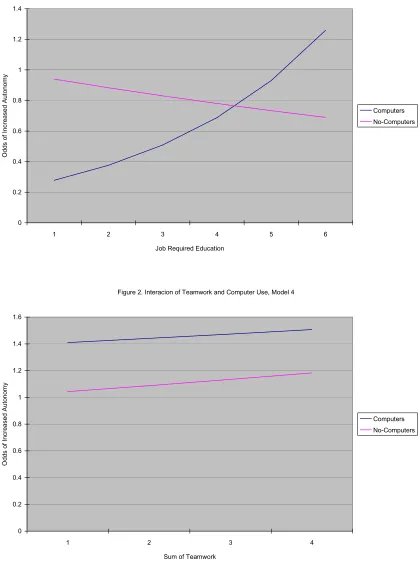
Figure 1: Interaction of Education and Computer, Model 3………. 52
Figure 2: Interaction of Teamwork and Computer, Model 4……… 52
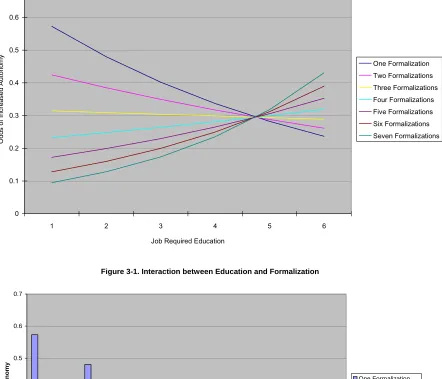
Figure 3: Interaction of Formalization and Education, Model 5……….. 53
APPENDIX
When do workers have control over their labor process? Are skilled workers more likely to control their labor process than deskilled workers? Does the organizational control system influence the degree of autonomy? Finally, does technology influence workers’ autonomy? This paper attempts to answer these questions.
Many researches have explored work autonomy as a fundamental element of skills that workers can own (see review in Kallegerg and Berg, 1987; Spenner, 1983 ). While both traditional theories and recent organizational literature have kindled an interest in skills related to the labor process, how autonomy is affected by technological changes and how it varies across organizational context has not been well addressed.
In previous research work autonomy has primarily been treated as a determinant of individual behaviors at the workplaces or as an occupational characteristic. Autonomy has been found to increase individuals’ job satisfaction (Kohn and Schooler,1983), be a characteristic of good jobs (McGovern, Smeaton, and Hill, 2004) and can define the class character of occupational positions (Wright, Costello, Hachen, and Spague, 1982). Group autonomy has become more salient to researches over the last two decades. Appelbaum and Batt (1994) argue that ‘high-performance’- improvement of efficiency and quality of production- is based on an autonomous group/team work. Organizations allow workers to have group autonomy either in a limited symbolic way or real involvement, even going so as far in some workplaces as managing human resources in order to increase efficiency and to improve production. Workers often know the production process better than their supervisors and so can provide better solutions when troubles occur. While this new trend in
organizational sociology explores work group autonomy, surprisingly individual job autonomy has been rarely studied as an outcome in its own right.
PERSPECTIVES ON ORGANIZATIONAL CONTROL SYSTEMS
Autonomy is a broad and potentially complicated concept. It can be derived from an organizational control structure either directly or indirectly. Edwards (1979, p17) theorizes that: ‘control, as the ability of capitalists and/or managers to obtain desired work behavior from workers, exists in greater or lesser degree, depending upon the relative strength of workers and their bosses.’ He suggests that worker’s autonomy is likely to increase when managerial control relatively decreases. Hence, it is important to understand how the organizational control system functions for both workers and managers and their relative power in the production process.
Direct exploitation and control
Marx provides the foundational perspective on power relations between superiors and the subordinates. It is a conflict relationship. The amount of surplus the capitalists obtain depends upon the degree of exploitation of workers. Workers are willing to sell their labor to earn money, but they do not desire to work hard. This is because laborers do not work for themselves, but for capitalists and the surplus from extra production goes to capitalists. Capitalists try to enforce effort: the emergence of managers is necessary in this circumstance. When workplaces become too large and complex, it is hard for capitalists to directly control workers.
Personal control systems were prevalent in early capitalism. Workforces were small and often directly supervised by a single capitalist. Control of the labor process was
personally because they supervise workers closely. This personal or simple control still functions in small organizations (Edwards, 1979).
Numerical control
Since capitalism expanded, technological development changed organizational control systems. Technical control is an earlier control system affected by technology, which later develop into numerical control. According to Edwards (1979) and Braverman (1974), Marx defines technology as a part of control system. Marx argues that capitalists install machinery in order to take workers power away from the labor process. Technology not only functions to increase productivity but also changes the relation between machine and laborers and the labor process. For instance, traditional craft workers using hand tools could control the labor process with their own skills and knowledge. But, after installing automated machinery, those skills and knowledge are less important to perform tasks. Machinery functions to reduce workers’ control over their working process.
Braverman (1974) discusses numerical control based on more recent technological changes in workplaces. An automatic system of machinery reinforces characteristics of the assembly line, acting as a control device extracting worker’s skill and knowledge from the labor process, and instituting close supervision of workers via machines. With numeric control, manager can concentrate their control over laborers using machines monitoring and pacing workers’ performance. A divided work unit is subjected to the control of the set of machines in the workplaces and so managers can exploit more efficiently deskilled workers. Tasks can be finely subdivided in accordance with the set of machines resulting in workers’ loss of skill and power. The logic of scientific management is completed for Braverman (1974) with numerical control of production.
Rule and Brantly (1992) study 186 for profit organizations with some degree of computerized surveillance. According to their study, computerization of job performance monitoring is prevalent and applied to various jobs. Managers are enabled to deal with more details of workers’ performance through computerization of sales, job tracking, and
inventory control, which makes it easier to control workers. Also, Groth (1999) argues that information based technology facilitates centralization of managers’ power over workers in three ways. Managers access accurate information about workers’ performance in real time regardless of geographical limitation. They also cut off tasks based on machine and control workers by automated machines. Prechel (1994), in a case study of a steel corporation, finds computerization leading a centralization of managerial authority over production and
literatures suggest that computerization and/or automation either directly exploits workers’ effort to perform jobs or enhances the capacity of managers to more closely supervise workers.
Bureaucratic consent and cooperation
In contrast, Weber proposes a potentially cooperative relation between capitalists and workers in his analysis of bureaucratic control. While the intention of the capitalist is still to increase profit or efficiency, it is attained through the legal rational choice of employees based on impersonal and structural rules-what he calls bureaucracy. Bureaucracy arises in organizations with a division of labor where activities or duties are regulated by written rules. Some people have the authority to give commands to others based on positions in a
hierarchical rank order. The bureaucratic control of organization is contingent on the
legitimate decision-making authority attached to the incumbents’ position in the organization. Based on explicit rules and principles, both managers and workers have specified tasks, different type and levels of authority, and resources. Workers perform jobs within their job description and managers evaluate them based on evaluation disciplines. Rewards, either higher wages or promotion, come from following the companies’ rules. Workers are motivated to agree with the rules or disciplines in order to get promotions. Hence, workers are likely to be more cooperative with capitalists’ agenda in Weber’s perspective. Weber also anticipates that bureaucratic control structures are more prevalent in large and complex organizations because bureaucratization makes organization more efficient in order to perform complicated tasks.
management. Subcontractors make decisions and constantly plan the production process in the craft production system because they have knowledge and skill over the work process. The power of workers over the process of production makes it difficult for managers to control them. In order to undermine the relative autonomy of workers, capitalists divide work into deskilled pieces and implement new technology. Through divisions of labor based on scientific management, workers do not need to plan or make decisions over the labor process. They lose their power over their own labor process. For Clawson (1980), bureaucratization is expected to reduce workers’ autonomy in the labor process.
Edwards (1979) argues that organizations often combine control systems. According to him, any control system should comprise three elements: ‘direction of work tasks,
evaluation of work done and rewarding and disciplining of workers’ (1979, p.112). He suggests that in the long term both personal control and numerical control are not successful in controlling workers because those controls do not provide positive motivation to workers. Those two control systems do not promise rewards to workers for cooperative behavior. Following Weber, he argues that formal rules embedded in job hierarchy and possibility of mobility is a better control device to draw workers’ effort and loyalty. Edwards (1979) suggests that bureaucratic control is more likely to be implemented when workers are powerful in skilled white collar jobs and professional jobs. Bureaucratic control is favored for those jobs with significant autonomy in the labor process.
SKILL BASED AUTONOMY
only capitalist, but also laborers can own capital, hence workers try to invest in human capital, such as education and skills, to obtain economic returns. Skillful, knowledgeable workers are attractive to capitalists because they contribute to improved productivity and to commodities’ market value and thus generate more surplus. Hodson and Sullivan (1990, p178-179) state that with the advent of mass-production society which requires technological development, new products and services need workers who own more human capital. For instance, between 1940 and 1987, the average formal education when workers entered the labor market increased from 8.6 years to 12.7 years, and also additional training by either schools or company training programs had increased during this period. Similarly, Wright (1997) identified the importance of “skill rent” in his relational class structure analysis. He theoretically defines that “skills and expertise designate an asset embodied in the labor power of people which enhance their power in labor market and labor processes” (p 23). This is because workers owning high level of skills are scarce in the labor market, which they can take advantage of in reproducing their labor power. It is also relatively difficult to monitor and/or control those high level skilled workers so they can obtain more autonomy or control over their own labor process. Capitalists need to rely on expertise’s loyalty, rather than institute more direct control, in order to get cooperation and effort from them.
While human capital theory contributes to explaining socioeconomic attainment (Blau and Ducan, 1969) and even sex segregation (Tam, 1997), it has limitations. The skills
education description of bureaucratic control and Braverman’s (1974) work on deskilling, we can expect that jobs requiring higher skill will tend to be more autonomous.
Hypothesis 1- Jobs requiring more human capital such as formal education and training are
more likely to allow more job autonomy than those jobs requiring less human capital.
LABOR PROCESS THEORY AND SKILL CHANGE
Traditionally, worker’s skill and knowledge have been considered as the most important factors in maintaining their power over the labor process. Labor process theory examines technical changes and its effect on the labor process, more specifically the degree of skills. In this section, I will explore labor process theory anticipating either upgrading skill or downgrading skill as a result of technological development. How workers gain or lose their control over the labor process is the key question in labor process theory. The implementation of technology has been a main concern of labor process theory. It is important to explore the nature of technology and how technology has been developed, more explicitly how technological changes in the workplace affect worker’s skill. Zuboff (1988) argues that computer-based technology is not neutral: technology embodies essential characteristics that are bound to alter the nature of work within factories and offices, and among workers, professionals, and managers. Also, Edwards (1979) discusses that technology has to be understood as embedded in organizational structure and the labor process.
processes and organizational control structures have increased (Blauner, 1964; Braverman, 1974; Edwards, 1979; Zuboff, 1988).
In the beginning of capitalism, hand tools are rather simple appliances to support individual labor power. Using hand tools does not change the relationship between work and workers and their control over the labor process (Braverman, 1974; Edwards, 1979). This is often referred to as craft technology (Blauner, 1964).
Then, as technology developed, the complexity of tasks or work process became fixed in the technical sequence of operations. At this second stage of machine technology,
machinery comes to support a constant work flow and effort. Much of work discretion is incorporated into machinery, and workers start to lose their control over their labor.
However, machinery in this stage has a limitation itself: it is limited to a specialized task or sequence of operation. External control does not affect the range of operation, although machines can pace its own operation (Braverman, 1974; Edwards, 1979).
In the later stages of automation, machines can interact with incoming information and adjust their own operation. Now, even separate machines can work collectively within the sequence of working process, because machines adjust their operation based on information from other machines. Working process can become more accurate and faster. More
importantly, in this stage, machinery under numerical control could embody scientific
Braverman (1974) argues that workers become deskilled (semi-skilled) in the age of automation technology. It is capitalists who want to employ machines for both increasing productivity and controlling workers by extracting skills from the labor process. Workers lose control over the labor process because machines have been already designed based on skills or knowledge to perform task. Workers only need to follow the pace of work given by machine and need relatively little skills or knowledge to complete tasks. The working process is controlled not by workers but by machinery. Also he argues that managers concentrate on skill and knowledge over the automated production process. Managers break the work into pieces based on the machine’s capacity and assign deskilled tasks to different workers. Workers become alienated from their labor process.
Since workers do not need to have much skill, knowledge, and experience, they become cheap workers and vulnerable to replacement by other workers. Regardless of its cost, employing machines in the line is important to mass production. Therefore, it could be said that industrial capitalist attempted to make workers cheaper and easy to replace by extracting their skill from the labor process.
In contrast, Blauner (1964) exploring continuous-process production compared to automation, argues workers to be more skillful and less alienated. Similarly, Zuboff (1988) argues that this new capacity of information technology can positively change the nature of work and the labor process.
identifies a new characteristic of information technology: engendering knowledge to be distributed to both workers and managers at every level of the organization. This is because the information technology not only translates information into operation, but also registers data about its performance generating new information. For instance, employing scanner machine in the grocery shop, cashiers can check-out goods more accurately and rapidly. Also, the data generated by the scanner machine expands utility for inventory storing, delivery, and marketing strategies. Therefore, information technology generates information beyond its ability to accomplish the primary tasks.
In order to complete tasks with computerized operation, workers often need access to better data. Some of the traditional roles of managers, collecting information and making decision based on the information, are decentralized by information technology. Within this new environment, workers not managers may generate and interpret data and increase their knowledge and control over their own work. In this case, the traditional authority of
managers tends to relatively decrease, as workers’ skill increases. Workers become upskilled. Although information technology has the potential to improve workers’ skill, the choice in improving the skill level of workers is not made by workers (Zuboff, 1988).
Hypothesis 2-Information based technology is likely to affect job autonomy.
Hypothesis2a- Information based technology will tend to reduce job autonomy.
Hypothesis2b- Information based technology will tend to increase job autonomy.
As the previous discussion indicates, the debate about technology and skill content across jobs has been polarized, predicting either upgrading or downgrading. However, Spenner (1983) argues that those antitheses are derived from research designs rather than theory. According to Spenner (1983), new technology is not the only determinant of skill transformation. Often internal work content and the external milieu such as the creation or elimination of jobs requiring a certain level of skill, or the distribution of workers to jobs are reflected in observed skill transformations. Generally, aggregate studies investigating overall skill change in work conclude either that there has been upgrading of skills overtime or no net change. For instance, Cappelli (1993) examines the change in skill requirement for both manufacturing and clerical jobs. He finds that compositional shift to high skilled production in manufacturing jobs contributes to an overall upgrading trajectory, but changes in clerical jobs lead to either upgrading or downgrading of skill. Most case studies pay more attention to the nature of the changes in work content and are more closely tied to the downgrading tradition.
More importantly, Spenner (1983) highlights ‘the mixed effects’ or ‘little-net-change’ results from the organizational studies. According to him, ‘the mixed effects’ or ‘little-net-change’ results suggest that “the effects of technological change and change in the labor process on skill levels are mixed and offsetting” (Spenner; 1983, p 825). Work content (for instance, the level of automation), organizational structures allowing some jobs to be upskilled others deskilled, and external environments all influence change in skill requirement of work.
Vallas (1997)’s case study in AT&T is an example of ‘the mixed effect’ result.
groups. A deskilling trend in clerical occupation was more prevalent than in craft occupations, and two craft occupations experienced opposite skill transformations. Workers (operators) in clerical jobs required relatively less knowledge or skill to perform their tasks due to computer automation. They do not need to know what the codes that they put in to the system actually mean. They also suffer from less autonomy and higher alienation. Many jobs, including inside craft jobs, were effectively eliminated by computer automation of telephone systems. Inside craft workers also experienced downgrading skill over their labor process.
The opposite trend was found in outside craft workers. They installed and maintained the complicated equipment and report that their tasks were more complex after computer
automation. The important finding in this study is that technological changes and their effects on the labor process are contingent on preexisting work context. Technological changes do influence the transformation or reproduction of work but the effect is organizationally and skill contingent.
Hypothesis2c- Information based technology will increase job autonomy of high skill and
high status jobs, but decrease job autonomy for low skill and low status jobs.
BUREAUCRATIZATION
Edwards (1973) argues that bureaucratization is employed as a control device. But, he also suggests that bureaucratization consequently affects the level of job autonomy because it is related to work content. Some sociologists (Clawson, 1980; Perrow, 1986) observe that bureaucratization tends to reduce job autonomy, but others argues that it should increase job autonomy through decentralization of decision making (Blau;1970, Marsden, Cook, and Kilbourne; 1996).
Bureaucratization encourages specialization and standardization. Specialization and standardization tend to be both efficient and unobtrusive (Perrow, 1986). Standardization sets the range of job responsibilities in order to save time and expenses, and specialization of individual activity encourage workers to focus on specific tasks. Perrow (1986) argues that workers can often exercise more delegation of decision-making through standardization and specialization.
Blau (1970) argues that differentiation is necessary in order to coordinate complex tasks as economic scale increases. Specifically, Blau (1970) focuses on structural
homogeneous within subunits, so the number of managers and supervisors decrease and the scope of supervisory activities and administrative intensity lessen. As heterogeneity between subunits tends to increase, problems of coordination with increased size and division of labor occur. The administrative hierarchy tends to increase but at a decelerating rate. Also, the administrative power of local managers tends to increase dealing with different problems in heterogeneous subunits. Thus, net of required skills, higher organizational differentiation should increase worker autonomy.
In accordance with Blau (1970), Marsden, Cook, and Kilbourne (1996) argue that bureaucratization increases job autonomy. Large formal organizations decentralize decision making coping with more complex jobs and in order to reduce coordination costs. The degree of delegation of decision-making responsibilities to individuals tends to increase in large organizations as departmentalization of tasks rises and there is a concomitant decrease in administrative intensity. They also argue that formalization of tasks legitimates the capacity of decision making and reduces direct supervision without a corresponding loss of control. They find that formalization is likely to increase with size but at a decelerating rate. Also, formalization is likely to be higher with taller hierarchical rank order. Finally, they conclude that formalization and decentralization of decision making power can be noticeable different based on contextual factors influencing organization such as making products or providing services and profit organizations or non-profit organizations.
Perrow (1986) also discusses that detailed divisions of labor lead to reduced training time and lower levels of skills, so supervision and evaluation of tasks tends to be simpler and more predictable for managers. Minute divisions of labor result in low-skilled, monotonous, and simplified jobs. Consequently, workers suffer from boredom and dissatisfaction from their labor process and lose control over the labor process. Similarly, Clawson (1980) argues that bureaucratic management in terms of the reorganization of the labor process removes workers’ control from the work process. Capitalists/managers gain more control from the labor process by assigning simplified tasks to workers. Workers do not need to plan and know the whole process of work and lose their skill from the labor process. He also argues that the elaborate rules and orders reinforce the function of detailed divisions of labor as a control device. Managers know how to order tasks and to supervise workers, and to monitor workers effort.
Adler and Borys (1996) argue that formalization could function either to enable workers to master their tasks without close supervision or to enforce workers’ effort leading to a loss of control over tasks. They hypothesize that coercive formalization will be occurred when the power of managers and workers is imbalanced and thus employees in higher position in the hierarchy can and will tend to delimit the responsibility and reduce the
Hypothesis 3a- Departmentalization, because it encourages decentralization of
decision-making power, will lead to increased job autonomy.
Hypothesis 3b-Higher managerial intensity will decrease job autonomy.
Hypothesis 3c- Formalization, because it legitimates and standardizes divisions of labor, will
lead to increase job autonomy.
Hypothesis 3d- Formalization, when it enforces limited responsibility of tasks due to
asymmetric power relationship between managers and workers, will lead to decreased job
autonomy.
Hypothesis 3e- Detailed divisions of labor, because it reduces job power and status, will lead
to decreased job autonomy.
TEAM WORK
The thesis that high performance arise from work group autonomy suggests that self-directed teams allow more training and skills to workers and the autonomous power of team-workers should be higher relative to similarly skilled team-workers (Appelbaum and Batt, 1994). Appelbaum and Batt (1994) find two types of high performance models. A lean model is based on standard organizational human resources practice: investing more training in
workers; delegating more decision power to groups of workers. Work groups tend to increase their control over work flow, for instance solving problems and improving the process of production, but their participation in management remains delimited.
make a decision at every level of the organization, the performance of teams is increased and improved. They observe a lesser rate of default in production and fewer complaints from customers. This type of team-work is treated as a new system of production rather than a collection of individual jobs. Because managers or engineering designers do not actually do production work, workers have more knowledge and group management prerogatives produce improved productivity.
However, the benefits of this new form of work organization are not widespread. Whitfield (2000) argues that workplaces experiencing a high-performance work system are more likely to intensify the skill of a specific group of workers rather than deploy a wide range of training to all workers. The more skilled workers tend to have more opportunities to get in depth training than those with less skilled. Hence, it suggest that high-performance is related to either organizational administrate goals or relative power and status of workers. Task interdependence is treated as one of the most important factors to influence group autonomy in the new organization literature. Van de Ven at al (1976, p325) defines interdependence as “the extent to which unit personnel are dependent upon one and another to perform their individual jobs”. Similarly, Langfred (2002) argues that group autonomy is likely to be dependent upon task interdependence. Group autonomy is likely to increase group performance when group tasks are highly interdependent. Group autonomy is not likely to increase group performance when members in a work group are relatively independent. Although Langfred (2002) focuses on conditions encouraging group
surgery, Zetka (1998) focuses on two different types of team work: a segmented coordination based on face-to-face interaction among members of the group and a congregated
coordination based on advanced technology devices encouraging every member to be more knowledgeable. While the tasks in those two team settings work are based on
interdependence, the team work operating with developing technology tends to obtain higher autonomy based on stronger task interdependence. In this type of team work, the interaction among group workers tends to be more complex and uncertain. Team work becomes more decentralized and more flexible based on each member’s increasing knowledge of the technology.
Hypothesis 4- Team work is likely to increase work autonomy.
Hypothesis 4a- Team work will increase autonomy more strongly for high power and status
workers.
Hypothesis4b-When team work combines informate technology, job level autonomy tends to
increase.
RACE AND GENDER AND WORK ORGANIZATION
that male workers tend to earn more money than female workers: workers in male dominant workplace are likely to earn more money than workers in female dominant workplaces. Cotter, Hermsen, and Vanneman (2003) find that African American women are the most vulnerable group relative to whites, African American, Hispanics, and Asians. They argue that the segregation effect on earning is the highest for this race/gender groups.
Vallas (2003) argues that most sociologists explore racial inequalities distributing jobs, wages, and promotion within organizations rather than address the social process reproducing racial and ethnic inequalities. He provides two general categories explaining racial
inequalities: social relations of production and the labor process and organizational policies and the legal environment. More specifically, spatial dimension of work contributes to reproduce racial inequality: whites are working in the visible front offices while blacks are working in back offices. This spatial segregation hinders minority workers access to the skills and to social ties with the dominant group. Also, minority workers are limited in access to informal relationships that are valuable for acquiring skills and chances for promotion with dominant groups, usually whites. The civil right’s movement contributed to increased minority worker’s wage and to reduced job disparities but often promotion for minorities is merely symbolic to meet governmental laws.
and to perform less complex tasks. Blacks, regardless of the proportion of blacks in their jobs, tend to suffer from lower administrative authority, lower autonomy, and less skilled tasks. Previous studies show that gender and race are directly related to social inequality in work organizations. Often race/ ethnicity and gender contribute to reproduce social inequalities. Women and minority workers tend to be limited in access to tacit knowledge and informal relationships with the dominant group. McGovern, Smeaton, and Hill (2004) indicate that less job autonomy due to lack of skill required is one of characteristics of bad jobs. More importantly, they argue that institutional forces rather than human capital distribute employees at the workplaces, often with much consideration of race and gender. Although there are no previous studies of gender and racial segregations influence on job autonomy, I suspect that race and gender might affect jobs autonomy in the organization. This is because many studies find that women and minority worker’s jobs are usually not high skilled and their chance to access informal relationships is limited. It is also possible that gender and race, like skill, may influence how informate technologies and team work are implement in workplaces.
Hypothesis 5- The gender and race/ethnic composition of jobs is likely to affect job autonomy.
Hypothesis 5a-Male dominant jobs are likely to have more job autonomy than female
dominant jobs.
Hypothesis 5b-Majority ethnicity/race jobs are likely to have more job autonomy than
minority ethnicity/race jobs.
Data
The data used for this study are from the 2002 Australian National Organizations Survey (AUSNOS). The data was collected by telephone from workplaces with at least one employee in 2001-2002 from the population of all workplaces in Australia. The data employed a multiplicity sampling method to select a sample to represent all workplaces including new organizations and small organizations. The list of workplaces came from the 1999 and 2001 Australia National Social Science Survey (ANSSS). Respondents to those surveys were asked to identify a name and a contact point for their employment
establishment. The target respondents for AUSNOS were the chief decision maker in those establishments. 1405 company names were derived from the ANSSS data, and 607
establishments completed the survey. Because of the multiplicity sample, large establishments were over sampled relative to smaller establishments.
AUSNOS contains job level data on workplace autonomy, as well as information about organizational structure, team work, skill requirements, and the use of informate technology. AUSNOS provides information about three job clusters within the organization: managers, core workers, and lower wage workers. Core workers perform jobs directly related to the most important products or services of the organizations. Core jobs are an appropriate target for exploring organizational variation in job autonomy since core workers are likely to have some power over their labor process and to be key targets of managerial control.
Dependent Variable- Autonomy
Job autonomy is measured by the reported degree of personal control of core workers over their tasks. Respondents were questioned “What degree of personal control do
personal control: 2) some personal control: 3) mostly personal control: 4) completely
personal control. 602 chief decision makers provided information on core workers’ personal degree of control over tasks. Thirty nine percent of core workers have no or some control in performing their tasks1. Forty five percent of core workers have mostly control, and sixteen percent of core workers have complete control.
Autonomy is coded 1 for some autonomy, 2 for mostly autonomy, and 3 for
completely autonomy. Ordinal logistic regression is used in this study to estimate increases or decreases in the predicted ordinal level of autonomy by unit changes in the independent variables. Completely autonomy is the outcome category, so the probability of more autonomy is compared to that of less autonomy.
--- Table 1. About Here ---
Independent Variables
Four variables are measured to access the labor process characteristics of core jobs: required education, typical training time, using tools, and using informative technology. Departmentalization, formalization, administrative intensity, and the number of core workers are used to explore the influence of bureaucratization on job autonomy in the organizational structure. While team work is used to explore group autonomy in previous studies, I focus on team work’s relationship with core job autonomy.
Education is a specific form of human capital that an individual can bring to jobs in
1) primary; 2) year 10; 3) year 12; 4) training program; 5) college; and 6) graduate school. Referring to table 2, the average education is 3.89. It indicates that the typical educational background to perform core jobs is likely to require high school and some further training program.
Training time is a measure of the substantive complexity of skill. Substantive
complexity is often referred to as ‘the level, scope, and integration of mental, interpersonal, and manipulative tasks in a job’ (Kalleberg and Berg, 1987.p 175). Spenner (1983) argues that skill is a broad concept which found a different trend in measuring in the social research. Two general trends to measure the skill level of a job are its substantive complexity and the autonomy control. And, skill as substantive complexity has been prevalently operationalized in previous studies relative to those as autonomy-control. This is because empirically
complexity is a core component of the work content of jobs. Training time is measured by asking how many weeks it takes for new core worker to learn to do the job reasonably well. As table 2 shows, on average, 32.7 weeks are needed to learn core jobs in AUSNOS data. However, it is important to notice that the distribution of training time is somewhat skewed. There are some core jobs that take more than a year to acquire the knowledge or skill for performing core jobs. In this case, the median is more reasonable and it is 12 weeks to learn core jobs.
Using computer is an important variable in this study. Labor process theory suggests
core workers use computers to do paper work, to access the internet, and to communicate with other workers or partners. Network based computer seems to be informative technology, but we are not sure from the open ended responses how using networked computer affects their labor process. Another example is nurses and dentists. Top decision makers report that they use various types of medical equipment. Similar to the case of using a network computer, it is not clear in these data how to distinguish levels of informate technology from open-ended responses. It might be assumed that dentists use more technologically sophisticated equipment than nurses, but we do not know the specific labor process related to using those machines from these responses. In this case, the title of an occupation might mislead the coding of information about technology and its effect on labor process.
With this limitation, I chose to measure whether core workers use computer or not rather than a more specific coding of kinds of technology that core workers use or how many machines core workers use2. Core workers using computer are coded 1 while those who use no computer are 0. As table 2 shows, seventy percent of core workers use computer in some fashion to perform core jobs.
Using tool is a potentially important variable too. Some studies suggest that hand tools
do not influence the relations between workers and their labor process and workers using hand tools control their own labor process. Core workers using tool are coded 1 while those
who do not use hand tools are 0. Only fifteen percent of core workers use hand tools to complete core jobs.
Departmentalization is a measure of bureaucratization at the workplace. I measure the
sum of departments in the establishment. For AUSNOS, respondents were asked to say whether there were separate departments taking responsibility for human resources, for equal opportunity, for training, for strategic planning, for public relations, for financing, for
government relations, for information technology, and for research development.
Marsden, Cook, and Kilbourne (1996) operationalized separate departmentalization items to show differentiation of decentralization between large and small organization. As organizational size increases, departmentalization tends to increase as well. Instead of focusing on individual departmental items, I choose to operationalize the total number of departments in the organization3. The total number of departments in the organization is more appropriate than individual departmentalization items for this study. That is, the more departments exist in the organization, the more decision making power and performing of specific tasks would be decentralized to employees in the organization.
I code 1 when respondent replied for each kind of department and when respondents replied no to such a department, I code 0. Then I add all departments coded as 1. For
AUSNOS, there are 6.29 departments on average out of potential 9 total departments. Formalization is also a measure of bureaucratization at the workplace. I measure the
sum of a set of formal documents in the organizations. Informants were asked to say whether there were written rules or disciplines about job descriptions, job performance, work
evaluation, employment contracts, outlining hiring and firing procedures, outlining grievance procedures, and outlining work procedures.
Marsden, Cook, and Kilbourne (1996) find that formalization rises as organization size increase but it decelerates up to the certain point. I see formalization as either an indirect means of maintaining individual decision making rights or a source of control. I
operationalize the total number of formal rules instead of focusing on how each formal rules function to affect autonomy4.
I code 1 when respondent replied for each kind of formal rules and when respondents replied to no to such a rules, I code 0. Referring to table 2, average formalization is 5.59 out of 7 formalization items for AUSNOS. It can be said that organizations in AUSNOS are fairly formalized on labor relations including performance, evaluation, and the working process as a whole.
Teamwork is a measure of team work itself. Task interdependence seems to be an
important aspect determining the degree of group autonomy but it is not specifically
measured in the AUSNOS. Also, the focus of this study examines job level autonomy instead of group autonomy. Hence, the existence of team work seems to be appropriate to predict job autonomy. Respondents were asked to say whether they have established group-forums between core workers and managers for implementing new technology, for quality control, for solving problems, and for other work conditions. I code 1 when respondent replied a
certain kind of team work and then add them up. Average teamwork is 3.16 out of a total 4 team work items5.
Administrative intensity is measured as the ratio of workers to managers. While
specialized subunits tend to increase with larger scale of production, the relative supervisory intensity is likely to be reduced in their homogeneity. Also, heterogeneous subunits tend to require more managers and supervisors (Blau, 1970; Marsden, Cook, and Kilbourne, 1996). In order to operationalize administrative intensity, I divided the total number of managers by the total number of workers. In the statistical models, I use the log of
administrative intensity. On average as shown in table 2, there are 15.5 managers for every one hundred workers in the AUSNOS data.
The number of core workers is another measure of detailed divisions of labor at the
workplaces. While departmentalization measures the delegation of decision making power based on bureaucratic rules, the number of core workers measure increased deskilled workers at the workplace. Braverman (1974) argues that managers who monopolized skill and
knowledge over the automated production process divide the work into narrow and specific tasks in order to control deskilled workers (see also, Wallace and Kallegerg (1982)
discussion about deskilled transformation in the labor process in a time-series analysis of printing industry) Clawson (1980) also argues that capitalists and managers remove control from the labor process by breakdown of the labor process. Different but simplified work is assigned workers so they do not need to have a specific skill to perform their tasks.
5 I measured each team work item and examined its correlation with autonomy. Team works for solving
For AUSNOS, respondents were asked how many people are currently employed as core job. As table 2 shows, the mean of the number of core workers is 105. However, note that the distribution of the number of core workers is skewed. In this case, the median is more reasonable, which is 15 core workers at the workplaces. In the statistical models, I use the log of the number of core workers.
Composition of men and women is measured as the dominance of male and female
workers in core jobs. Many studies have estimated the proportion of female and black in occupations or jobs (e.g. Reskin;1993, Tomaskovic-Devey;1993, and Cotter et al;2003) to compare occupational or job level segregation effects. When the composition of male
workers is 70%, I define the jobs as male dominated. Female dominance means that there are 30% of male workers in the core jobs. 26% of core jobs are male dominant and female dominant workplaces occurs in 36% of core jobs.
Composition of non English and English measures the dominance of English speaking
and non English speaking core workers. Non English speakers are minorities in Australia as racial minorities are in the United States. I define jobs as English dominant when the
composition of English speakers is 70% and above in the core jobs. Non English dominant means there are 30% and fewer English speaking workers in the core jobs. For AUSNOS, 91% of core jobs are English dominant while Non English dominant is rare at 1% of core jobs.
--- Table 2 about here ---
Ordinal Logistic Regression models
Ordinal Logistic regression is a cumulative logit model estimating the effect of
variable. This model assumes that each estimated coefficient is invariant across the level of the dependent variables. Also, in ordinal logistic regression, the effects of the independents variables are subtracted from the marginal odds, hence positive coefficients indicates
increased likelihood of higher scores on the dependent variable (Agresti, 1990). The same as logistic regression, Ordinal Logistic regression provides two ways to interpret the results: the logged odds and odds ratios. Odds ratio refers to a ratio of probability ratios. Namely, while the logit express the probability of both occurrence and nonoccurrence, odds express the likelihood of an nonoccurrence compared to the likelihood of an occurrence (Pampel, 2000). Therefore, odds ratio tends to provide an easier way to interpret the relationship.
In the first model, I introduce education and training time to predict autonomy. Following hypothesis 1, jobs requiring more education and training are likely to increase job autonomy within the labor process. In the same model, I include the measures for using computer and using hand tools. Using computer is related to hypothesis 2. Because of the ambiguousness of technology embedded in using computer, both upgrading and
downgrading predictions are presented in hypothesis 2. Finally, I add the measures for bureaucratization and team work in the first model. Hypothesis 3 suggests that
bureaucratization in the workplaces influence job autonomy. Specifically,
In the second model, I introduce the measures for sex and ethnic composition of core jobs consistent with hypothesis 5. This model is largely exploratory, but the expectation is that female and minority jobs will have less autonomy.
From the third to sixth model, the interaction effects between variables will be explored. The third model includes a two way interaction between education and computer. The fourth model explores an interaction between team work and computer. Both fifth and sixth model will explore the interaction between formalization and education and between computer and education. Three-way interaction was explored but failed to meet conventional levels of statistical significance.
RESULTS
Table 3 displays the results of ordinal logistic regression models predicting the job autonomy of core workers. It presents the standard log odds coefficients and odds ratios model.
As the first model shows, the odds ratios of education is 1.218 which successfully meets the usual .05 significance level. An additional education degree increases the odds of having a one unit increases in autonomy by 1.218 times. Core jobs that require more
education are likely to have higher level of autonomy than those that require less education. The positive coefficient for training time also indicates that more training time increases the probability of higher autonomy. However, training time is statistically insignificant.
Both using tools and computers for performing tasks are associated with lower job autonomy. Net of other variables in the model, the probability of achieving higher autonomy is lower when both types of technology are present. Note, however, that only using tools is statistically significant. This indicates that using tool decreases the odds of having a one unit increase in autonomy by half times. Computer use is not statistically significant. Hence, we cannot confirm the prediction stating in hypothesis 2 whether information based technology tends to affect job autonomy. The prediction of either increased or decreased job autonomy (hypothesis 2a and 2b) is not confirmed in the first model as well.
Both departmentalization and administrative intensity are not statistically significant, so hypothesis 3a and 3b are not supported in the first model. However, notice the positive coefficient for departmentalization. It implies that the more departments in the organization, the probability of obtaining autonomy tends to increase. Also, from negative coefficient for administrative intensity, we note that the fewer supervisors encourage more worker control over the labor process.
The number of core workers is statistically significant and the odds ratios is .804. This indicates that as the number of core workers increases the odds of having a one unit
decreases in autonomy by .804 times. In order words, the more core workers exists at the workplaces the less autonomy that core workers tend to have over the labor process. Therefore, hypothesis 3e is confirmed. It suggests that minute divisions of labor are a controlling device in order to lessen the power of jobs and so reduce work autonomy (Braverman, 1974; Clawson, 1980; Perrow, 1986).
reduces the odds of having increased job autonomy by .902 times. Therefore, hypothesis 3c is rejected, but hypothesis 3d is confirmed. In other words, core workers working at
workplaces setting written rules for tasks, for evaluation, and for the work process are likely to have lower job autonomy. This result does not confirm the argument that decentralized power relations result from bureaucratization (Blau,1970; Marsden, Cook, and Kilbourne, 1996). It suggests, however that formalization is more often a control device, removing autonomy from the labor process (Clawson, 1980; Adler and Borys, 1996).
Team work is statistically insignificant, so we cannot confirm hypothesis 4 in the first model. However, the negative coefficient for team work indicates that the probability of higher autonomy is decreased for core workers in team settings for implementing new technology, for quality control, for solving problems, and for other work conditions. The influence of gender and ethnic composition of core jobs on job autonomy is shown in the second model. Comparing Model fit Chi-square to model 1, Model fit is not significantly improved. Also, male dominant, female dominant, English speaker dominant, and Non English speaker dominant all fail to meet the usual significance level. Hence, we cannot confirm the prediction that the gender and ethnic composition of core jobs influence job autonomy (hypothesis 5). Interestingly, the coefficient for male dominance is positive, which suggests higher job autonomy when male core workers predominantly occupy cores jobs.
time in this model, male dominant, female dominant, English speaker dominant, and Non English speaker dominant all still fail to meet the usual significant level6.
The third model provides a two way interaction between using computers and education of core workers7. Chi square changes relative to model 1 shows significant improvement from model 1, which indicates that model 3 is a preferable to model 1. As the third model shows, the effect of using computer differs by education level. Using computers still has a negative effect on having higher autonomy but becomes
statistically significant (-1.582) while education become statistically insignificant. However, the interaction variable, education times computer is statistically significant and positive. This indicates that both education level of core workers and using computer have nonadditive effects on achieving higher autonomy. In other words, the effects of using computers and education depend on the value of others. The positive coefficient of education times
computer indicates that the effect of education on increased job autonomy is stronger for core
workers using computer (1) than for those who are not using computer (0). As Figure 1 shows, among jobs that require the least education, not using a computer
are associated with 0.6 times (the differences between odds of autonomy) increased odds of higher autonomy than those using computers. On the other hand, among jobs that require higher education, those that use computers are likely to have higher autonomy than jobs that require higher education but do not use computers. There is also a weak trend for core workers not using computers to have lowered job autonomy as education increases. Most importantly, autonomy increases as jobs required education increases, but only for computer
6 I examined three way interactions among education, computer and race and gender composition of core jobs.
users. It confirms the hypothesis 2c stating information based technology increase job autonomy of higher levels of skill and relatively powerful workers.
--- Figure 1 about here---
The fourth model presents interaction between using computer and team work8. Note that comparing Model fit Chi-squares with model 1, Model fit is not significantly improved from model 1. Also, note that when both interactions between computer times team work and computer times education are present, it is not significantly improved from the model 3. However, when both interactions are present in the model, the interaction between team work and using computer is close to meeting the significant level .05. Regardless of its closed significance, I choose the interaction between team work and
computer due to a theoretical reason. Zetka (1998) argues that information based technology influence higher autonomy in members of team work (hypothesis 4b), and the nature of workers status in the team work influence higher autonomy through the transformation of the labor process after new technology. Team work tends to increase autonomy more strongly for high power and status workers (hypothesis 4a).
Both using computer and team work are statistically insignificant. The interaction variable, computer times team work is statistically insignificant, so we cannot confirm hypothesis 4b. This result suggests no effect of using computer on changes in team work. As the figure 2 shows, the effect of using computer on higher autonomy is essentially constant regardless of change in team work. Hence, at least in the data, autonomy does not increase when team work is associated with more developed technologies.
8 I also examined the interaction between team work and education which is statistically insignificant.
---Figure 2 about here---
The fifth model presents the interaction between required education and formalization at the workplaces. Comparing Model fit Chi-squares with model 1, Model fit is significantly improved from model 1 so model 5 is a preferable model to model 1.
I will focus on higher level of formalizations and their effects on education. As figure 2 and 3-1 shows, odds of increased job autonomy are likely to be higher when job required
education is highest at the fully formalized (7 formalizations) workplaces than that of at the average formalized (5 or 6 formalizations). On the other hand, jobs that require on average education level (3.89 out of 6) with 5 or 6 formalizations are likely to have increased odds of higher job autonomy than those at the workplaces with 7 formalizations.
In contrast to Blau (1970) and Marsden, Cook, and Kilbourne (1996), formalization does not encourage delegation of decision making power to workers resulting in increased job autonomy. On the contrary, formalization functions to decrease work autonomy by removing workers’ control over their labor process (Clawson, 1980). Formalization in this study is coercive as Adler and Borys (1996) characterized. However, interestingly, even though the formalization tends to function to decrease job autonomy, job autonomy tends to increase when the level of required education of core jobs increases.
---Figure 3 about here--- ---Figure 3-1 about here---
The final model includes formalization times education and computer times education9. Chi-square changes relative to model 1 shows significant improvement from model 1, which indicates this model is a preferable model to model 1. Also, Chi-square difference from model 3 shows that model 6 is a preferable model because model fit is significantly improved. Formalization times education is statistically significant when
computer times education is presented in the model. Therefore, interactions for formalization
9 I examined three-way interaction among education, computer, and formalization. A comparison Model fit
times education and computer times education (model 6) is more appropriate than interaction model 3 and model 5, but the magnitude of the interactions is nearly identical from model 3 and model 5.
---Table 3 about here----
DISCUSSION
The causes of variation in job autonomy among workers have been rarely addressed in previous organizational literatures. Recently, group autonomy has been focused on as a new feature of organizations with advanced technology or as a new administrative design (Appelbaum and Batt, 1994), yet the individual level of autonomy is still important to understand. The purpose of this paper is to explore how workers obtain autonomy over their labor process and under what kinds of circumstances workers achieve more control of their own work process.
1988). Written rules limit responsibility, and so reduce the autonomy of workers (Clawson, 1980). However, Blau (1970) and Marsden, Cook, and Kilbourne (1996) argue that
bureaucratization at the workplaces encourages increased job autonomy through decentralization of decision making power.
There are two major findings in this paper. First, job autonomy is likely to increase when information based technology is used by workers with high levels of skill. In contrast to labor process theory, using informate technology does not directly affect job level
autonomy. Information based technology influences changes in power relations based on the degree of skill in the job. The finding in this paper supports the expectation that the effect of technology on the labor process is contingent on the reproduction of prior work processes and organizational milieu (Spenner, 1983;Vallas, 1997). In other words, as the power of jobs increase, technological changes are more likely to lead to decreased efforts to control labor (Tomaskovic-Devey and Risman, 1993) and thus increased job autonomy.
Second, formalization tends to control the labor process rather than to encourage delegation of decision making. Core jobs in workplaces with written rules for tasks, for evaluation, and for the work process are likely to display lower job autonomy. This result is in contrast to the cooperative relationship between workers and managers described as bureaucratic control. Edwards (1979) argues that bureaucratic control is based on worker’s consent in order to get social mobility. Decentralization of power through
departmentalization, formalization, and administrative intensity are also predicted to
(1980) would agree that division of labor with detailed rules remove workers’ responsibility and control over the work process resulting in less powerful workers. Also, interestingly, even though formalization tends to function to decrease job autonomy, job autonomy is likely to increase when the level of required education of core jobs increases. This parallels
Edwards (1979) suggestion that bureaucratic control is favored for jobs with significant discretion in the labor process such as in white collar jobs. Also, Adler and Borys (1996) theoretically argue when imbalanced power relationship between workers and managers is prevalent, coercive formalization is likely to occur in lower skilled positions.
to their labor process. In case of a finisher, an unpacking staff, a cook, and a server tend to use mostly hand tools to complete their tasks. Therefore, it would be capricious to conclude that core jobs that require using tools tend to lower job autonomy because first core jobs in AUSNOS data do not represent only using only tools and their effect on the labor process. Also, craft workers using hand tools in earlier capitalism does not parallel that in these days, which labor process theory is originally based on.
Team work does not predict job level autonomy in this paper. However, it would be premature to conclude that team work never influences job autonomy. As the new
organizational literature argues, some forms of team work may encourage group autonomy by enlarging skill level and delegation of decision making and often team work is prevalent in organizations with high technology. Since the focus of this study is job level autonomy, not across groups of jobs, this theory is not well tested. More specifically, task
interdependence is a key aspect of group autonomy and transformation of technology in work process. However, AUSNOS 2002 does not provide information about task interdependence. Further study should pay attention to these relations.
CONCLUSION
I conceptualize that autonomy as a relative concept contingent upon the power relationship between manager and workers (Edwards, 1979). Autonomy is also a complex concept because it is affected by the level of skill as a result of technological changes
(Braverman, 1974) and bureaucratization (Blau,1970; Marsden, Cook, and Kilbourne, 1996) at the workplace. I also use contingent perspectives (Spenner, 1983;Vallas, 1997;
Tomaskovic-Devey and Risman, 1993)based on transformation of prior work processes through technological changes in order to develop the theoretical work.
Core jobs related to the most important products and services of the organization are an appropriate target because core workers tend to have at least some power over their labor process and are a main target of managerial control. In this paper, autonomy of core jobs is obtained when information based technology is used by workers with higher education and skill. Also, core jobs autonomy is likely to decrease in formalized workplaces. Therefore, this paper does not support bureaucratization as a coordination device between workers and managers. Since formalization as a coercive controlling device has been addressed, this result is theoretically plausible.
I think that this paper contributes to the literatures by raising questions about job level autonomy and might be useful for students who are interested in relative power relations in workplaces. Composition of race and gender is still questioned in this paper which is
REFERENCES
Adler, Paul S. and Bryan Borys, 1996. “Two Types of Bureaucracy: Enabling and Coercive.” Administrative Science Quarterly 41:61-89.
Agresti, A. 1990. Categorical Data Analysis. John Wiley & Sons.
Appelbaum Eileen, and Rosemary Batt. 1994. The New American Workplace:
Transforming Work Systems in the United States. New York: ILR Press.
Backer, Gary S. 1957. The Economics of discrimination. The University of Chicago Press.
Baron, James N. and William T. Bielby. 1982. “Workers and Machines: Dimensions and Determinants of Technical Relations in the Workplace.” American Sociological Review 47:175-188.
Blau, Peter M. and Otis D. Duncan. 1967. The American Occupational Structure. New York: John Wiley and Sons, pp. 118-124
Blau, Peter M. 1970. “A Formal Theory of Differentiation in Organizations.” American Sociological Review 35:201-218.
Blauner, Robert. 1964. Alienation and Freedom: The Factory Worker and His Industry.
Chicago and London: The University of Chicago Press.
Bonacich, Edna. 1972. “A Theory of Ethnic Antagonism: The Split Labor Market.” American Sociological Review 37:547-59.
Braverman, Harry. 1974. Labor and Monopoly Capital: The Degradation of Work in the 20th Century. New York and London: Monthly Review Press.
Burris, Beverly H. 1998. “Computerization of Workplace” Annual Review of Sociology 24:141-157.
Beyer Janice M. and Harrison M. Trice. 1979. “A Reexamination of the Relations
Between Size and Various Components of Organizational Complexity.”
Administrative Science Quarterly 24:48-64.
Cappelli, Peter. 1993. “Are skill requirements rising? Evidence From Production and Clerical Jobs.” Industrial and Labor Relations Review 46:515-530.
Clawson, Don. 1980. Bureaucracy and the Labor Process: the Transformation of U.S. Industry , 1860-1920. New York and London: Monthly Review Press.