ISSN(Online): 2320-9801
ISSN (Print): 2320-9798
I
nternational
J
ournal of
I
nnovative
R
esearch in
C
omputer
and
C
ommunication
E
ngineering
(A High Impact Factor, Monthly, Peer Reviewed Journal) Website: www.ijircce.com
Vol. 7, Issue 5, May 2019
Analysis on Energy Efficient Traffic Load
Balancing in Downlink LTE-Advanced
Heterogeneous Network
Alok Kumar Bairwa, Gajendra Sujediya
Research Scholar, RIET Jaipur , Rajasthna, India
Assistant Professor, RIET Jaipur , Rajasthna, India
ABSTRACT: This paper presents a framework to activate and deactivate micro nodes in a heterogeneous multi cell LTE network, based on load and energy efficiency consideration. The framework exploits historical data (i.e., per-macro-cell load curves) to select a set of candidate switch-on/switch-off instants of microcells, assuming a limited number of state changes is allowed in a day. The switching instants are instead determined online, by taking into account the actual traffic as well as the load curves. Moreover, inter cell interference is fully accounted for. Our simulations show that this framework allows a multi cell network to sustain peak-hour load when necessary and to reconfigure to a minimum coverage baseline whenever feasible, thus saving power (up to 25% in our scenarios). Moreover, the framework is robust, meaning that deviations of the actual traffic with respect to the prediction offered by the load curves can easily be handled.
I. INTRODUCTION
The base stations power consumption in Long Term Evolution (LTE) has therefore, become a major challenge for vendors to stay green and profitable in competitive cellular industry. It necessitates novel methods to devise energy efficient communication in LTE. Importance of the topic has attracted huge research interests worldwide. Energy saving (ES) approaches proposed in the literature can be broadly classified in categories of energy efficient resource allocation, load balancing, carrier aggregation and bandwidth expansion. Each of these methods has its own pros and cons leading to a trade-off between ES and other performance metrics resulting into open research questions. This paper discusses various ES techniques for the LTE systems and critically analyses their usability through a comprehensive comparative study. We have seen usage of 1G, 2G, 3G and now4G as the communication standard with each resulting into enhanced performance of cellular systems . Aiming towards the key achievements such as short transmission time, high throughput, low latency and security, these systems generally consist of Base Stations (BS) connected to core network. Each BS has designated cover-age area, called cell and communicates directly with User Equipment (UE) within its coverage . Whenever UE moves from serving cell to neighbor cell, its transfer of control is initiated through handover process.LTE is a 4G technology,
Objectives of LTE and LTE-Advanced
ISSN(Online): 2320-9801
ISSN (Print): 2320-9798
I
nternational
J
ournal of
I
nnovative
R
esearch in
C
omputer
and
C
ommunication
E
ngineering
(A High Impact Factor, Monthly, Peer Reviewed Journal) Website: www.ijircce.com
Vol. 7, Issue 5, May 2019
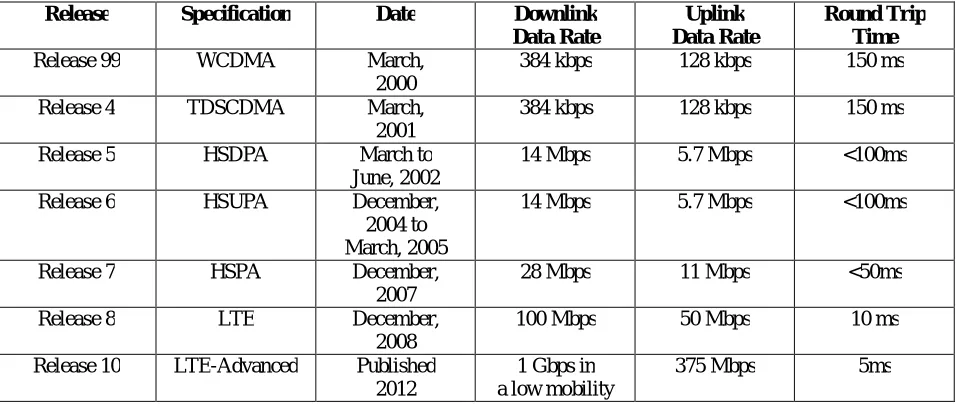
Table 1: Technical specifications published by the 3GPP group
Release Specification Date Downlink Data Rate
Uplink Data Rate
Round Trip Time
Release 99 WCDMA March,
2000
384 kbps 128 kbps 150 ms
Release 4 TDSCDMA March,
2001
384 kbps 128 kbps 150 ms
Release 5 HSDPA March to
June, 2002
14 Mbps 5.7 Mbps <100ms
Release 6 HSUPA December,
2004 to March, 2005
14 Mbps 5.7 Mbps <100ms
Release 7 HSPA December,
2007
28 Mbps 11 Mbps <50ms
Release 8 LTE December,
2008
100 Mbps 50 Mbps 10 ms
Release 10 LTE-Advanced Published
2012
1 Gbps in a low mobility
375 Mbps 5ms
Architecture of LTE
Long Term Evolution (LTE) has been considered to maintain only packet switched service for providing seamless Internet Protocol (IP) connectivity between the packet data network (PDN) and the user equipment (UE), without any interruption to the end users‟ applications during the period of mobility. The term “LTE” covers the advancement of the Universal Mobile Telecommunications System (UMTS) radio access through the Evolved UTRAN (EUTRAN). LTE is accompanied through the non-radio aspects under the term “System Architecture Evolution” (SAE), which includes the Evolved Packet Core (EPC) network. SAE and LTE consist of the Evolved Packet System (EPS). The LTE and SAE architecture decreases operating expenses (OPEX) and capital expenditures (CAPEX).
Figure 1 : High level architecture for 3GPP LTE
ISSN(Online): 2320-9801
ISSN (Print): 2320-9798
I
nternational
J
ournal of
I
nnovative
R
esearch in
C
omputer
and
C
ommunication
E
ngineering
(A High Impact Factor, Monthly, Peer Reviewed Journal) Website: www.ijircce.com
Vol. 7, Issue 5, May 2019
Figure 2 : Architecture of EPS (LTE/SAE) II. PROPOSED METHODOLOGY
LTE PDSCH CHANNEL
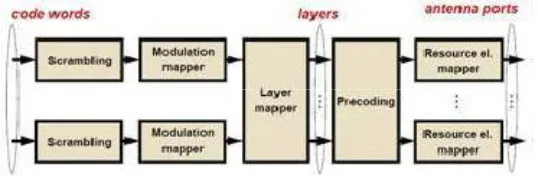
LTE PDSCH is a physical downlink shared channel. It is used to transmit downlink channel (DL-SCH). The DL-SCH is the transport channel for transmitting downlink data. One of the two coded transport blocks (codeword’s) can be transmitted simultaneously on PDSCH depending on pre-coding scheme. The coded DL-SCH codeword’s undergoes scrambling, modulation, layer mapping, resource elements. Scrambled codeword’s undergoes QPSK, 16 QAM or 64 QAM modulations. Choices created flexibility to allow the scheme to maximize the data throughput depending on channel condition.
ISSN(Online): 2320-9801
ISSN (Print): 2320-9798
I
nternational
J
ournal of
I
nnovative
R
esearch in
C
omputer
and
C
ommunication
E
ngineering
(A High Impact Factor, Monthly, Peer Reviewed Journal) Website: www.ijircce.com
Vol. 7, Issue 5, May 2019
Figure 4 PDSCH downlink receiver function
III. SIMULATION RESULTS
ISSN(Online): 2320-9801
ISSN (Print): 2320-9798
I
nternational
J
ournal of
I
nnovative
R
esearch in
C
omputer
and
C
ommunication
E
ngineering
(A High Impact Factor, Monthly, Peer Reviewed Journal) Website: www.ijircce.com
Vol. 7, Issue 5, May 2019
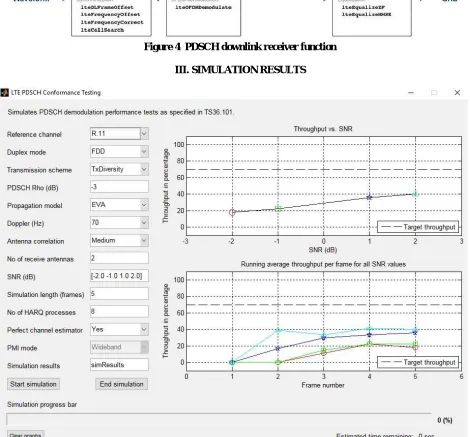
In Fig. 4, throughput vs SNR for EVA with 70 Hz Doppler Effect has been plotted. Here, it has been observed that when the value of SNR is -2dB then the throughput is 17.78%, for -1dB it is 22.22%, for 1dB it crosses the target throughput which is 35.56%. The throughput is 40% for 2dB SNR. In 70Hz doppler values, % of throughput for various SNR values are changing as per the no.of frames transmitted.
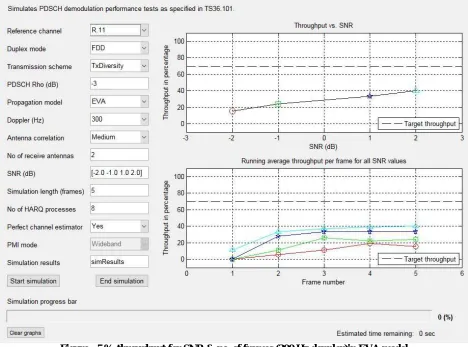
Figure : 5 % throughput for SNR & no. of frames (300 Hz doppler)in EVA model
In Fig. 5, throughput vs SNR for EVA with 300 Hz Doppler Effect has been plotted. Here, it has been observed that when the value of SNR is -2dB then the throughput is 15.56%, for -1dB it is 24.44%, for 1dB it crosses the target throughput which is 33.33%. The throughput is 40% for 2dB SNR. In 300Hz doppler values, % of throughput for various SNR values are changing as per the no.of frames transmitted.
ISSN(Online): 2320-9801
ISSN (Print): 2320-9798
I
nternational
J
ournal of
I
nnovative
R
esearch in
C
omputer
and
C
ommunication
E
ngineering
(A High Impact Factor, Monthly, Peer Reviewed Journal) Website: www.ijircce.com
Vol. 7, Issue 5, May 2019
IV. CONCLUSION
Simulation results show the impact of % throughput depending on SNR & no. of frames transmission for EPA, EVA and ETU model in LTE PDSCH channel. For the different doppler values, % of throughput for various SNR values are changing as per the no.of frames transmitted. Best throughput performance is estimated above the targeted throughput for both cases i.e. SNR & Frame number.In this proposed work, the performances of three propagation models of LTE (EPA, EVA & ETU) have been analyzed. In the analysis, throughputs for various SNR’s value in several Doppler effects have been considered. It has been found that for 5 Hz Doppler Effect, ETU shows the best performance and EVA shows the worst. In case of 70 Hz, ETU is the best and EPA is the worst. But in case of 300 Hz, all the models are identical. It has been also found that increasing the value of SNR increases the value of throughput.
REFERENCES
[1]. Astély, D. et al. (2009) ‘LTE : The Evolution of Mobile Broadband’, (April), pp. 44–51.
[2]. Das, R. N. (2015) ‘Environment’.
[3]. Hosein, P. (2014) ‘Resource Allocation for the LTE Physical Downlink Control Channel’, (July). doi:
10.1109/GLOCOMW.2009.5360730.
[4]. Ikuno, J. C., Wrulich, M. and Rupp, M. (2010) ‘System level simulation of LTE networks’, (June). doi: 10.1109/VETECS.2010.5494007.
[5]. Kadhim, M. (2018) ‘Analysis and Simulation of LTE Downlink : EPA and ETU model’, 2018 International Conference on Advanced
Science and Engineering (ICOASE). IEEE, pp. 185–188.
[6]. Kanwal, K. et al. (2017) ‘Energy Management in LTE Networks’, 5.
[7]. Kaushik, A. and Khurana, S. (2016) ‘International Journal of Advanced Research in Throughput Analysis of LTE PDSCH Channel for
ETU Model’, 6(10), pp. 289–292.
[8]. Mohamed, M. A., Abdel-atty, H. M. and Raslan, W. (2014) ‘Performance Analysis of LTE-Advanced Physical Layer Performance
Analysis of LTE-Advanced Physical Layer’, (January).
[9]. Padaganur, S. K. (2018) ‘Performance Analysis of PDSCH Downlink & Inter-Cell Interferece Parameters in LTE Network .’, 2018 2nd
International Conference on Inventive Systems and Control (ICISC). IEEE, (January), pp. 791–795. doi: 10.1109/ICISC.2018.8398907.
[10]. S, P. A. (2018) ‘PERFORMANCE ANALYSIS OF LTE NETWORK USING RUNTIME PRE- CODING ALGORITHM’, (2581), pp.
220–223.
[11]. Sindal, R. (2018) ‘LTE channel throughput assessment and comparison under different terrain’, (March), pp. 1–9. doi: 10.1002/dac.3586.
[12]. Suarez, M. and Zlydareva, O. (2015) ‘LTE transceiver performance analysis in Uplink under various environmental conditions’, pp. 84–88.
[13]. Toril, M. (2014) ‘Analysis of the impact of PCI planning on downlink throughput performance in LTE’.
[14]. Vlacheas, P. et al. (2011) ‘Autonomic Downlink Inter-Cell Interference Coordination in LTE Self-Organizing Networks’.
[15]. Yahiaoui, C. and Gontrand, C. (2014) ‘Simulating the Long Term Evolution ( LTE ) Downlink Physical Layer’. doi:
10.1109/UKSim.2014.81.
[16]. Ye, S., Wong, S. H. and Worrall, C. (2013) ‘Enhanced Physical Downlink Control Channel in LTE Advanced Release 11’, (February), pp.
82–89.
[17]. Yu, Y. et al. (2010) ‘Performance Analysis of Soft Frequency Reuse for Inter-cell Interference Coordination in LTE Networks’, pp. 504–
509.