Copyright2000 by the Genetics Society of America
The Effects of Hill-Robertson Interference Between Weakly Selected Mutations
on Patterns of Molecular Evolution and Variation
Gilean A. T. McVean and Brian Charlesworth
Institute of Cell, Animal and Population Biology, University of Edinburgh, Edinburgh EH9 3JT, United Kingdom Manuscript received September 28, 1999
Accepted for publication February 17, 2000
ABSTRACT
Associations between selected alleles and the genetic backgrounds on which they are found can reduce the efficacy of selection. We consider the extent to which such interference, known as the Hill-Robertson effect, acting between weakly selected alleles, can restrict molecular adaptation and affect patterns of polymorphism and divergence. In particular, we focus on synonymous-site mutations, considering the fate of novel variants in a two-locus model and the equilibrium effects of interference with multiple loci and reversible mutation. We find that weak selection Hill-Robertson (wsHR) interference can considerably reduce adaptation, e.g., codon bias, and, to a lesser extent, levels of polymorphism, particularly in regions of low recombination. Interference causes the frequency distribution of segregating sites to resemble that expected from more weakly selected mutations and also generates specific patterns of linkage disequilib-rium. While the selection coefficients involved are small, the fitness consequences of wsHR interference across the genome can be considerable. We suggest that wsHR interference is an important force in the evolution of nonrecombining genomes and may explain the unexpected constancy of codon bias across species of very different census population sizes, as well as several unusual features of codon usage in Drosophila.
T
HE efficacy of selection acting simultaneously at This focus on the effects of selection acting on linked neutral variation stems from the assumption that the linked sites can be considerably reduced in regionsmajority of molecular evolution proceeds through of low recombination (Fisher1930;Muller1964;Hill
events of little or no selective importance (Kimura
andRobertson1966). Linkage disequilibrium between
1983). There is, however, considerable reason to doubt alleles at selected loci, generated by the stochastic
na-this view of molecular evolution. In particular, synony-ture of mutation and sampling in finite populations,
mous codon positions (those at which some or all muta-“interferes” with the action of selection at any one locus
tions have no effect on the amino acid encoded) appear (Felsenstein1974). When the rate of recombination
to be under selection acting at the level of translation between selected sites is high, associations between
al-in many bacteria (SharpandLi1986) and eukaryotes, leles are rapidly broken down, but when recombination
including yeast (Sharpet al. 1986), Drosophila (Shields
is rare or absent, interference may have a significant
et al. 1988), Caenorhabditis (Stenicoet al. 1994), and
impact on patterns of evolution.
Arabidopsis (Chiapelloet al. 1998;Duretand
Mouch-While the effects of interference between selected
mu-iroud 1999). In addition, noncoding regulatory se-tations on patterns of molecular evolution at those sites
quences can extend over large genomic regions, and have largely been ignored, the effects of selection acting
there is indirect evidence that transcribed but untrans-at linked loci on puntrans-atterns of neutral evolution and
varia-lated regions of genes can experience stronger selection tion have received considerable attention. Selective
pressures than synonymous sites (Li andGraur1991, sweeps of strongly beneficial mutations (Maynard
p. 73;BauerandAquadro1997).
SmithandHaigh1974) and the rapid elimination of
If the majority of sites in genes, and perhaps in ge-deleterious mutations (Charlesworthet al. 1993) can
nomes as a whole, are not completely neutral but actu-significantly reduce neutral variation in regions of low
ally experience weak selection, then the predictions of recombination. Selection on single weakly selected
mu-the neutral mu-theory are not applicable to mu-the study of tations where the product of the selection coefficient,
DNA sequence evolution. This raises two critical
ques-s, and the effective population size, Ne, is of the order
tions: How does weak selection acting at a single locus of 1, in contrast, has a largely negligible effect on
varia-affect patterns of evolution relative to those expected tion at linked neutral loci (Golding1997;Neuhauser
under neutrality? And how does interference between andKrone1997;Przeworskiet al. 1999).
selected loci affect the dynamics of molecular evolution relative to that expected under independence? The an-swer to the first question can be achieved through the Corresponding author: Gilean McVean, ICAPB, Ashworth
Labora-application of diffusion theory, as for the neutral case
tories, King’s Bldgs., West Mains Rd., Edinburgh EH9 3JT, United
Kingdom. E-mail: [email protected] (Kimura 1983). Simple models that assume
dence between sites can be manipulated to make predic- levels of nucleotide site diversity, and the frequency spec-trum of polymorphic sites.
tions about the extent of codon bias and patterns of
polymorphism and divergence (Bulmer1991;Sawyer We also consider whether interference between weakly selected mutations may explain a number of andHartl1992;McVeanandCharlesworth1999).
Coalescent methods, adapted to incorporate selection observations concerning synonymous codon usage that do not fit the predictions of models that assume inde-(KroneandNeuhauser1997;NeuhauserandKrone
1997), have also been used to investigate genealogies pendence between sites. In particular, we discuss its implications for the remarkable similarity in levels of associated with weakly selected sites (Przeworskiet al.
1999). codon bias observed across species of very different
cen-sus population sizes (Powell and Moriyama 1997), The second problem, that of interference, has
re-ceived much less attention (HillandRobertson1966; interactions between recombination rate, codon bias, and synonymous-site diversity in the genome of
Drosoph-Felsenstein1974;BirkyandWalsh1988;Ottoand
Barton 1997). Strongly beneficial mutations are un- ila melanogaster (Begun and Aquadro 1992; Kliman
andHey1993;Comeronet al. 1999), and the evolution
likely to interfere with each other, as these are probably
rare and spread rapidly through the population. Likewise, of nonrecombining genomes. strongly deleterious mutations at or near
mutation-selec-tion equilibrium will also generate little mutual
interfer-DEFINITIONS AND MODELS
ence as they exist at very low frequencies (though
interfer-ence is an integral feature of the mutation accumulation We first wish to make explicit our definitions of inter-process known as Muller’s ratchet:Felsenstein1974). ference and the Hill-Robertson effect in terms of the In contrast, weakly selected mutations are probably fate of selected alleles at single loci embedded in genetic more numerous and may segregate for sufficient time backgrounds of different fitnesses. Consider the fate of periods, at sufficiently high frequencies, for interfer- an allele with a selective advantage, s, over the wild-type
ence to be important. allele, which is at frequency x in a haploid population.
Interference involving weakly selected sites may be If there is variation in the fitness of individuals due to further broken down into asymmetrical interference in- other loci and the average fitness of the population is volving weakly and strongly selected mutations and in- scaled to 1, then the expected change in frequency of terference simply between weakly selected mutations. the advantageous allele due to selection is
In cases where the selection coefficients are
asymmetri-M␦x⫽sx(1⫺ x)⫹Cov(x, w *), (1) cal, the dynamics of evolution at weakly selected sites
may well be strongly affected, but the reverse is unlikely where Cov(x, w *) is the covariance between the allele to be true. For example, while the effects of recurrent and the fitness of the backgrounds on which it is found deleterious mutation (background selection: Charles- (Price 1970). That is, the expected change in allele worth et al. 1993) on single, weakly selected, linked frequency is the expected change in the absence of any
variants can largely be treated as a simple reduction in interactions, plus the combined effects of other loci. It
Ne, just as for neutral sites (Stephan et al. 1999) there is this second (deterministic) term that we call
interfer-is no detectable effect of the weakly selected site on the ence. The expected change in allele frequency can also dynamics of the strongly selected site, assuming Ns ⱖ be written in a manner more applicable to explicit ge-10 for this site (G. McVean,unpublished results). netic models
The extent to which interference between weakly
se-M␦x⫽sx(1⫺ x)⫹
兺
y
wyDx y, (2) lected mutations alone can affect patterns of molecular
evolution is not known. Previous work (Li1987;
Com-eronet al. 1999) has suggested that such interference where the second term is the sum, over all alleles (y) at other loci, of the linkage disequilibrium (Dx y) between can substantially reduce the expected level of codon
bias in regions of low recombination, but there has the allele of interest and the second allele, times the relative fitness (wy) of the second allele. When there is been no attempt to provide a general description of the
effects of interference on other aspects of molecular no linkage disequilibrium, the dynamics of the selected allele are the same as if there were no variation in ge-evolution, such as patterns of polymorphism and
diver-gence. In this article, we present the results of series of netic background. However, in finite populations, the stochastic nature of sampling and mutation generates simulations that investigate the extent to which
interfer-ence between weakly selected mutations is dependent linkage disequilibrium between the selected allele and genetic backgrounds, which then interferes with selec-on the strength of selectiselec-on, the recombinatiselec-on rate,
and the number of sites under selection. Using a simple tion acting at the single locus (Felsenstein1974). Dis-equilibrium is broken down by recombination (and mu-reversible mutation model (as in the evolution of
synony-mous codon usage:Bulmer 1991) we assess the magni- tation in the genetic background), while selection on genetic backgrounds tends to accentuate associations tude of the effects of interference on the level of molecular
ex-tremes, positive fitness covariance corresponds to hitch- copies. This case has already received some attention (HillandRobertson1966;Barton1995;Ottoand hiking (Maynard SmithandHaigh1974) and negative
fitness covariance corresponds to the elimination of al- Barton1997); however, here we consider weaker selec-tion and a wider range of evoluselec-tionary statistics than leles linked to strongly deleterious mutations (Fisher
1930, p. 136). previously. We then investigate the case of a population
where each chromosome consists of a large number of The Hill-Robertson effect (Hill and Robertson
1966) is a statement about the average effects of interfer- sites, each of which conforms to a two-allele, reversible-mutation model with genic selection. This is the simplest ence. Consider a large collection of identical
popula-tions into which single novel mutapopula-tions are introduced model for the evolution of synonymous codon usage (Li1987;Bulmer1991;McVeanandCharlesworth
at random onto backgrounds with different fitnesses.
Associations made in the first generation are broken 1999), in which the rates of forward and reverse muta-tion are equal.
down by recombination and mutation, but new associa-tions are generated stochastically through sampling and mutation. Thus, in any one generation the effect of
A TWO-LOCUS MODEL OF INTERFERENCE
selection at other loci is to increase the variance in allele
frequency change across populations over that due to First consider the simplest case of two completely linked, biallelic sites with the same selection coefficient gamete sampling. This is equivalent to a reduction in
the (variance) effective population size (Ne) and hence at each. If one of the loci is segregating, and a single
novel mutation occurs at the second site, the fate of this implies a decrease in the efficacy of selection. Under
certain conditions, the long-term fate of neutral alleles new mutation is altered relative to that expected in the absence of interference (Fisher 1930;Barton1995). (e.g., the fixation time) can be predicted by a single,
asymptotic reduction in Ne, where the effects are Variants that arise in association with the beneficial
al-lele will have an increased probability of fixation due to summed over generations and weighted by the fraction
of associations remaining (Robertson1961;Santiago the hitchhiking effect, while those that arise in repulsion will have a reduced chance of becoming established in and Caballero 1995, 1998). Because the efficacy of
selection is determined by the effective population size, the population. We consider the extent to which such events alter the fixation probability, the contribution to the net result of interference is to impede the fixation
of favorable mutations and increase the fixation proba- heterozygosity, and the average time to loss or fixation for both advantageous and deleterious mutations. bility of deleterious alleles (HillandRobertson1966).
This reduction in the efficacy of selection is commonly The fate of single novel mutants (107replicates) in a
population of 100 diploids was followed until absorption termed the Hill-Robertson effect (Felsenstein1974).
One feature of interference as described byHilland (loss or fixation) for different starting frequencies of the favored allele at the linked locus. Linkage is
com-Robertson (1966) is of particular note: a buildup of
negative linkage disequilibrium between selectively ben- plete and selection is genic (i.e., heterozygotes are of intermediate fitness and the differences in fitness be-eficial alleles. When benbe-eficial mutations (or
deleteri-ous ones) are in positive linkage disequilibrium, selec- tween homozygotes is 2s). Selection across loci is also additive. For each replicate, the time to absorption (to-tion is highly efficient and such haplotypes are rapidly
fixed. In contrast, when beneficial mutations are in neg- tal sojourn time) and the contribution to heterozygosity [the sum of 2x(1⫺x) over generations, where x is the
ative linkage disequilibrium, so that they are found in
the same haplotype less frequently than expected from allele frequency] were recorded, as inCharlesworth
et al. (1995). Pseudomultinomial sampling was used to
the product of the allele frequencies, then the efficacy of
selection is weakened. This is because negative linkage select individuals for the next generation (Presset al.
1992). Three cases were examined: 4Nes ⫽ 1, 2, and
disequilibrium reduces fitness variance and hence, by
Fisher’s fundamental theorem (Fisher1930), the rate 4 for both advantageous and deleterious alleles. This analysis differs from that ofBarton(1995) in that al-of adaptation. Such repulsion haplotypes tend to persist
in populations (since they are neutral with respect to leles at both loci are subject to drift.
The results of these simulations are shown in Figure each other), leading to an excess of negative fitness
disequilibrium between selectively favorable alleles. In 1. As previously shown (Hill and Robertson 1966;
Barton1995), interference tends to reduce the average an equilibrium system, this leads to a reduction in mean
population fitness relative to the case of free recombina- fixation probability of beneficial mutations and increase the average fixation probability of deleterious muta-tion.
In this article, we consider two explicit genetic models tions. Conditioning on cosegregation interference is stronger with greater selection coefficients; for example, to assess the impact of Hill-Robertson interference on
patterns of molecular evolution. First, we consider a the maximal reduction in average fixation probability for beneficial alleles with 4Nes ⫽ 1 is ⵑ1% while it is
pair of completely linked loci at which one locus is
segregating for a pair of alleles at some given frequency 15% for beneficial alleles with 4Nes⫽4. This is not to
Figure 1.—The effects of interference on fixation prob-ability (squares), average con-tribution to heterozygosity (dia-monds), and average time to loss or fixation (circles) in the two-locus model.
the fixation probabilities of linked alleles, only that the (unlike fixation probabilities) are little affected by cou-pling or repulsion between selected alleles (Figure 2). average effect is negligible. Figure 2 shows the ratio of
the average values when alleles arise in association with In sum, from the two-locus model of interference we can conclude: (i) The overall effect of interference is the beneficial allele to those when they arise in
repul-sion. Even with 4Nes⫽1 there are strong effects on the to reduce the efficacy of selection at linked loci. (ii) This
results in reduced fixation probabilities for beneficial fixation probabilities of linked alleles, though
interest-ingly this seems to be largely independent of the fre- alleles and higher fixation probabilities for deleterious alleles, the relative effects being stronger for more quency of the currently segregating allele.
In contrast, interference has much less effect on the strongly selected alleles. (iii) Interference decreases the contribution to heterozygosity and time until absorption contribution to heterozygosity of novel mutations and
even less impact on the average total sojourn time. For for beneficial alleles by a small degree and has almost no effect on either property for deleterious mutations. deleterious mutations, interference appears to have
Figure 2.—The odds ratio of the fixation probability (squares), average contribution to heterozygosity (diamonds), and average time to loss or fixa-tion (circles) for single novel mutants arising in association with a selectively favorable allele to that for mutants arising in re-pulsion.
adaptation (including codon bias) to be reduced in the other site is segregating and by the allele frequency distribution in such an event. So, for example, while the regions of low or absent recombination, while the level
of nucleotide diversity (which is proportional to the effects of interference (conditioning on cosegregation) increase with the selection coefficient, the probability heterozygosity contributed by a new mutation) should
be less affected, and the number of segregating sites in of cosegregation decreases with increasing selection co-efficient, and the allele frequency distribution becomes the population (derived from the sojourn time of new
mutations;Ewens1979, p. 238) to be even less so. But skewed toward rare variants that generate little interfer-ence. Second, we may expect that the effects of multiple it is difficult to extrapolate from these simulations to
the equilibrium case with multiple loci. First, to predict loci are not simply the multiplicative effects of all pair-wise interactions (unlike the case of background selec-the effects of interference on equilibrium statistics for
ence between any given pair of sites. For these reasons (1931) model of selection and reversible mutation, as-suming the independent evolution of different sites. we have conducted an extensive series of multiple-locus
simulations.
RESULTS
The effects of interference on the level of molecular A MULTILOCUS MODEL OF INTERFERENCE
adaptation:Interference between weakly selected
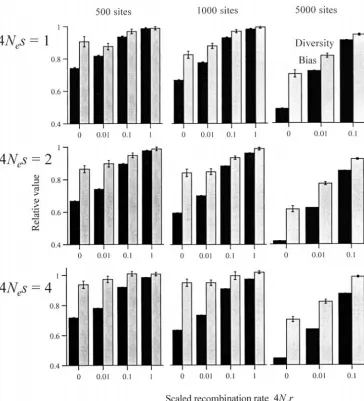
muta-We consider a Wright-Fisher model of a diploid pop- tions can have a considerable effect on the level of ulation of 100 individuals, each of which has a single molecular adaptation, as measured here by the average pair of chromosomes consisting of G selected sites frequency of preferred alleles at each locus among ga-(200ⱕGⱕ5000). Simulations were carried out using metes sampled from the population. In terms of the a modified version of a program written by Richard codon bias model, we measure codon bias as the devia-R. Hudson. Each site represents a biallelic, reversible- tion from equal usage of alleles, or 2x ⫺1, where x is mutation locus modeling the evolution of synonymous the average frequency of preferred alleles over loci. codon usage with equal rates of forward and reverse Relative codon bias is the ratio of the observed bias mutation (Bulmer 1991). Mutations occur at a fre- to that expected from Wright’s distribution of allele quency of per site per generation and can occur at frequencies with selection and reversible mutation, as-sites that are currently segregating. Our results should suming independence between sites.
therefore be compared with the allele-frequency distri- Figure 3 shows how relative codon bias is sensitive to bution under selection and reversible mutation of the selection coefficient acting on codon usage and the
Wright (1931) rather than with those based on the rate of recombination between adjacent sites for 500, infinite-sites assumption (Kimura1971), although this 1000, and 5000 linked sites. Over the range of selection makes little difference for Ne Ⰶ1. As previously, selec- coefficients considered, the impact of interference on
tion at each locus is genic with selection coefficient s. relative codon bias is similar for all values of N
es,
al-Selection across sites is multiplicative and all sites have though the magnitude of change in the frequency of the same selection coefficient. Recombination occurs the preferred codon is greater for stronger selection. with frequency r between adjacent sites per generation For example, with 4N
es⫽4 and 5000 completely linked
with a maximum of one crossover event per chromo- sites, the mean frequency of preferred alleles is reduced some per gamete. Both larger population sizes (500 and to 0.73, compared to a frequency of 0.97 in the absence 1000 individuals) and haploid populations were also of interference, while with 4N
es⫽1, the respective
de-investigated, but no differences were found in any case crease in the frequency of preferred alleles is from 0.71 (i.e., all results appear to depend on the scaled parame- to 0.60.
ters Ne, Nes, and Ner, as expected from diffusion theory; Recombination reduces the effects of weak selection
Ewens1979). Hill-Robertson (wsHR) interference on codon bias
(Fig-Each statistic is the average over at least four runs, ure 3). An increase in codon bias is observed over the each consisting of 50 samples of 25 alleles taken every entire range of recombination rates for all selection 2/generations after an initial period of 2/genera- coefficients and numbers of sites (although the effects tions for the system to reach equilibrium. Such a time are of greater magnitude for sites under stronger selec-period between samples minimizes the risk of evolution- tion). Furthermore, for the numbers of sites considered, ary nonindependence between samples, although each 4Ner⫽1 appears to be sufficient to remove most of the run was checked for autocorrelation and multiple inde- effects of interference.
pendent runs were carried out. In all cases, except where Levels of nucleotide diversity and the frequency dis-stated, the scaled mutation rate per site (both forward tribution of segregating sites: The level of nucleotide-and backward) was 4Ne ⫽ 0.04. While this is larger site diversity (average pairwise difference between
al-than the mean value of 0.013 for synonymous sites in leles) is affected by interference in both quantitatively
D. melanogaster (MoriyamaandPowell1996), we ex- and qualitatively different ways from codon bias (Figure pect the extent of interference to scale with the product 3). Diversity tends to be reduced by interference (but see of G and the scaled mutation rate. We consider scaled below, for the case of stronger selection coefficients). recombination rates between adjacent sites of 4Ner⫽0, However, the proportional decrease in diversity is less
0.01, 0.1, and 1 (though 4Ner⫽1 cannot be considered than the proportional decrease in codon bias. This
im-for the case of 5000 sites due to the limit of 1 crossover plies that the effects of wsHR interference on adaptation per gamete). For comparison with data on synonymous and polymorphism cannot be treated as a single de-codon usage, r corresponds roughly to three times the crease in Ne, since in the absence of mutation bias
single-per nucleotide site recombination rate. Statistics from site models predict that a decrease in Ne causes the
Figure 3.—The effects of wsHR interference on relative codon bias (solid) and nucleo-tide site diversity (shaded); 4Ne ⫽0.04.
ference has little effect on diversity for 1000 or fewer mutation rate, 4Ne (Watterson1975; Tajima 1989;
FuandLi1993). The difference between any two estima-sites, but does decrease diversity for 5000 and more
linked sites. To a large extent, this pattern is repeated tors of 4Ne (scaled by the expected variance in the
difference) describes particular aspects of deviations in the number of sites observed to be segregating in a
sample (data not shown), although the effects are from neutrality. Tajima’s D-statistic compares the esti-mates of 4Nefrom and the number of segregating
weaker than on levels of nucleotide site diversity.
Interference affects the frequency distribution of seg- sites, while Fu and Li’s D*-statistic compares estimates fromand the number of external-branch mutations. regating sites in two ways (Figure 4). First, it generates
high-frequency deleterious mutations such that the dis- Negative values of either statistic indicate an excess of low-frequency variants.
tribution resembles that expected from single-site
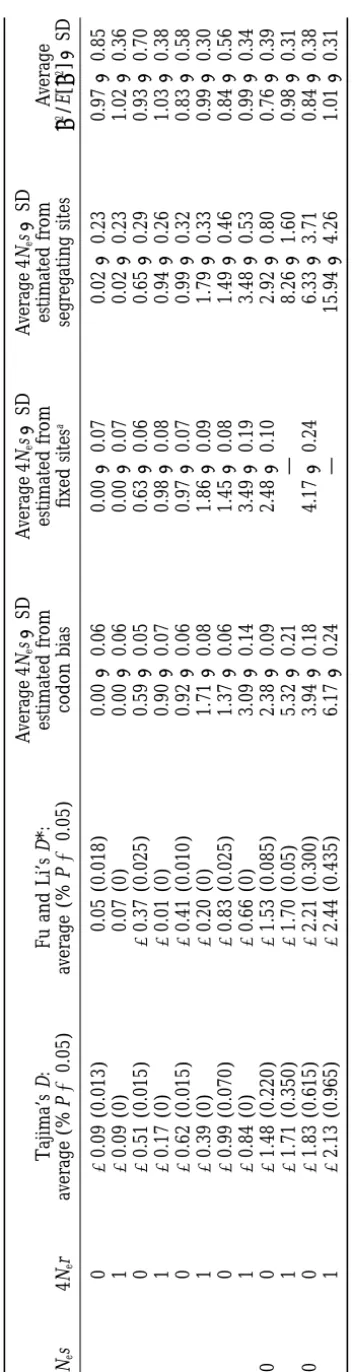
dy-namics with smaller selection coefficients. Second, it Table 1 shows the average value of Tajima’s D and Fu and Li’s D*-test statistics and the proportion of samples increases the proportion of rare variants over that
ex-pected from single-site dynamics. We can assess the sec- showing significant deviation from neutrality for the cases of 1000 linked sites with no recombination and ond effect by considering statistics describing the
devia-tion of the frequency distribudevia-tion from neutral with 4Ner ⫽ 1, 4Ne ⫽ 0.04, a sample size of 25
se-quences, and 4Nes in the range 0–20. For 4Nes ⱕ 4,
expectations, such as those of Tajima (1989) and Fu
andLi(1993). Under the infinite-sites, standard neutral while selection causes a skew toward rare variants, and wsHR interference increases the skew, there is essen-model, the expectations of the statistics(average
pair-wise differences),/an(number of segregating sites in tially no power to detect the action of selection (see also Akashi 1999) or interference. For stronger selection a sample of size n/⌺n⫺1
i⫽1 l/i) ands(the number of
Figure4.—The average fre-quency distribution of segre-gating sites in samples of 25 alleles with no recombination (shaded) and with 4Ner ⫽
1 (solid) for 1000 sites and 4Ne ⫽0.04.
power to detect selection acting on codon usage, but tion to that observed (SawyerandHartl1992;Hartl
et al. 1994) and assuming independence between sites.
interference reduces both the skew toward rare variants
and the proportion of significant test statistics. In short, While the assumption is valid only for the case of free recombination, our interest is in considering the bias there appears to be little power in either of these tests
to detect weak selection, such as that experienced by caused by wsHR interference.
Under the infinite-sites model (which is the limiting synonymous-site mutations, or the action of wsHR
inter-ference. case of the present model as→0) at
mutation-selec-tion-drift equilibrium in a diploid population, the diffu-Estimating the strength of selection on allelic variants:
The bias introduced by wsHR interference into methods sion theory solution for the frequency distribution of preferred alleles at segregating sites in a two-allele of estimating the selection coefficient acting on allelic
variants is of considerable interest. Methods of estimat- model with genic selection and reversible mutation is ing the strength of selection (e.g., that acting on codon
usage) are derived from fits ofWright’s (1931) distri- φ(y)⫽ Ce4Nesy
y(1⫺ y) (4a)
bution of allele frequencies under selection and
revers-ible mutation to various sample statistics, assuming inde- (Wright 1931; McVean and Charlesworth 1999). pendence between sites. For the case of a two-allele The log likelihood of observing a given sample configu-model with no mutation bias, the expected proportion ration (conditioning on segregation and assuming inde-of preferred codons at fixed sites (in the population), pendence) is
at mutation-selection-drift equilibrium, is given by
L(X1, X2, . . . , Xn⫺1)⫽
兺
n⫺1
i⫽1
L(Xi), (4b)
E(x)⫽[1 ⫹e⫺4Nes]⫺1 (3)
(Li1987;Bulmer1991). Hence an approximate value where the likelihood of observing each count is given of 4Nes can be estimated from the relative frequency of by the multinomial (or Poisson) distribution, such that
sites fixed for preferred and unpreferred codons in a sample. Previous work has also shown that this formula
L(Xi)⬀Xiln
冤冢
ni冣
冮
1 0 yi⫺1(1⫺y)n⫺i⫺1e4Nesydy
冮
1 0[1⫺yn⫺(1⫺y)n] e4Nesyy⫺1(1⫺y)⫺1dy
冥
,
accurately predicts the average proportion of preferred codons in a single sequence chosen at random from
(4c) the population (McVean and Charlesworth 1999);
4Nes can thus also be estimated from the average
fre-quency of preferred codons in a sample of sequences. where Xiis the number of segregating sites at which the preferred allele occurs in i of n sequences. Numerical Finally, the value of 4Nes can be estimated from the
frequency distribution of segregating sites by using max- analysis can be used to find the value of 4Nes, which
configura-approach differs from that of Sawyer and Hartl
(1992) andHartlet al. (1994) in that it assumes
revers-ible, as opposed to irreversrevers-ible, mutation and considers only segregating sites. Values of 4Nes estimated by each
method were obtained for each sample taken from the simulations.
Table 1 shows the average estimated values of 4Nes
(⫾one standard deviation). Estimates from average bias are lower than from fixed sites alone, which again are lower than from the frequency distribution (which for 4Ner⫽ 1 are close to the true value). As the selection
coefficient increases, the discrepancy between estimates increases, such that for 4Nes ⱖ 10, estimates based on
the average codon bias are considerable underestimates with 4Ner⫽1. wsHR interference reduces estimates of
the strength of selection by all methods, and for 4Nesⱕ4, the proportion by which estimates are reduced
relative to the case of 4Ner ⫽ 1, is approximately the
same for each method. That is, wsHR interference shifts the frequency distribution of segregating sites toward that expected for more weakly selected alleles, in a man-ner compatible with the reduction in efficacy of selec-tion as estimated from fixed sites or average codon bias. For stronger selection coefficients, 4Nes ⱖ 10, wsHR
interference has a greater effect on estimates of 4Nes
from the frequency distribution of segregating sites than from average codon bias.
These results suggest that while wsHR interference can have a large effect on estimates of the strength of selection, the reduction in efficacy of selection caused by interference is difficult to distinguish from a simple reduction in the selection coefficient, at least for weak selection (4Nesⱕ4).
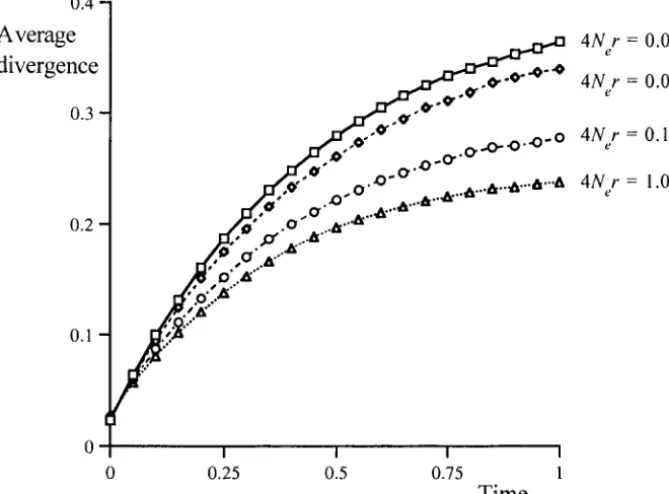
The rate of sequence divergence: In the absence of
mutation bias, the rate of substitution of new mutations is expected to decrease with increasing Nes (Shieldset
al. 1988;Eyre-WalkerandBulmer1995;McVeanand
Charlesworth1999), and so we expect a decrease in the efficacy of selection (Ne) to increase the rate of
substitution. For the case of 1000 sites with 4Nes ⫽ 2,
Figure 5 shows how the amount of sequence divergence between two species decreases with increased recombi-nation. Differences in the extent of sequence diver-gence are only detectable at considerable degrees of divergence and, to a large extent, this is simply the result of different equilibrium levels of codon bias. This is the same problem identified in the previous selection; wsHR can have a large effect on patterns of evolution and variation, but a reduced efficacy of selection is difficult to distinguish from a reduced selection coefficient.
Patterns of linkage disequilibrium:On average,
inter-ference between selected alleles reduces the efficacy of selection and leads to reduced codon bias. While we have demonstrated that interactions between synony-mous-site mutations can have large effects on codon bias, we have also shown that these effects are difficult
TA BL E 1 The effects of interference on sample statistics Average 4 Ne s ⫾ SD Average 4 Ne s ⫾ SD Average 4 Ne s ⫾ SD Tajima’s D : F u a nd Li’s D *: estimated from estimated from estimated from A verage 4 Ne s 4 Ne r average (% P ⬍ 0.05) average (% P ⬍ 0.05) codon bias fixed sites a segregating sites 2/ E [ 2] ⫾ SD 00 ⫺ 0.09 (0.013) 0.05 (0.018) 0.00 ⫾ 0.06 0.00 ⫾ 0.07 0.02 ⫾ 0.23 0.97 ⫾ 0.85 1 ⫺ 0.09 (0) 0.07 (0) 0.00 ⫾ 0.06 0.00 ⫾ 0.07 0.02 ⫾ 0.23 1.02 ⫾ 0.36 10 ⫺ 0.51 (0.015) ⫺ 0.37 (0.025) 0.59 ⫾ 0.05 0.63 ⫾ 0.06 0.65 ⫾ 0.29 0.93 ⫾ 0.70 1 ⫺ 0.17 (0) ⫺ 0.01 (0) 0.90 ⫾ 0.07 0.98 ⫾ 0.08 0.94 ⫾ 0.26 1.03 ⫾ 0.38 20 ⫺ 0.62 (0.015) ⫺ 0.41 (0.010) 0.92 ⫾ 0.06 0.97 ⫾ 0.07 0.99 ⫾ 0.32 0.83 ⫾ 0.58 1 ⫺ 0.39 (0) ⫺ 0.20 (0) 1.71 ⫾ 0.08 1.86 ⫾ 0.09 1.79 ⫾ 0.33 0.99 ⫾ 0.30 40 ⫺ 0.99 (0.070) ⫺ 0.83 (0.025) 1.37 ⫾ 0.06 1.45 ⫾ 0.08 1.49 ⫾ 0.46 0.84 ⫾ 0.56 1 ⫺ 0.84 (0) ⫺ 0.66 (0) 3.09 ⫾ 0.14 3.49 ⫾ 0.19 3.48 ⫾ 0.53 0.99 ⫾ 0.34 10 0 ⫺ 1.48 (0.220) ⫺ 1.53 (0.085) 2.38 ⫾ 0.09 2.48 ⫾ 0.10 2.92 ⫾ 0.80 0.76 ⫾ 0.39 1 ⫺ 1.71 (0.350) ⫺ 1.70 (0.05) 5.32 ⫾ 0.21 — 8.26 ⫾ 1.60 0.98 ⫾ 0.31 20 0 ⫺ 1.83 (0.615) ⫺ 2.21 (0.300) 3.94 ⫾ 0.18 4.17 ⫾ 0.24 6.33 ⫾ 3.71 0.84 ⫾ 0.38 1 ⫺ 2.13 (0.965) ⫺ 2.44 (0.435) 6.17 ⫾ 0.24 — 15.94 ⫾ 4.26 1.01 ⫾ 0.31 All a nalyses are based on simulations with 1000 sites, 4 Ne ⫽ 0.04, a nd a sample size of 25 sequences. aFor the cases of 4 Ne s ⫽ 10 and 2 0 w ith 4 Ne r ⫽ 1, samples rarely contain sites fixed for unpreferred codons.
Figure5.—The effect of interfer-ence on the average amount of se-quence divergence for 1000 selected sites with 4Nes⫽2 and 4Ne ⫽0.04.
Time is measured in terms of the ex-pected number of neutral substitu-tions per site (i.e., 1/generations).
may be other explanations for reduced codon bias in of preferred alleles is less than one. However, the distri-bution of the statistic 2/E[2] has high variance and
regions or genomes with low recombination rates, such
as background selection or hitchhiking (Kliman and is skewed toward high values, such that for neutral sites in the absence of recombination, the ratio is less than
Hey 1993). This raises the question of whether there
are specific properties of interference between weakly one in 67% of samples (although the expectation is one). Hence while this test can be used to detect wsHR selected mutations that can be used to test for its
influ-ence. interference between synonymous sites, it should be
applied with caution. One possibility derives from the observation that
Hill-Robertson interference tends to lead to a buildup of Figure 6 shows the result of the second test. For pairs of segregating sites in close proximity, the average value negative linkage disequilibrium between selectively
fa-of D between preferred alleles is less than zero, while vorable alleles (HillandRobertson1966). We expect
the average absolute value |D| decreases monotonically excess repulsion between preferred codons and a dearth
with distance. For more distant pairs, the average value in variation in fitness relative to that expected from
of D tends to zero as expected. However, the properties the allele frequencies alone. We can therefore test two
of linkage disequilibrium are such that there is little predictions: (i) the observed variance in the number of
power in this test. Furthermore, complications such as beneficial alleles among individuals should be less than
variable selection coefficients across sites will also re-that expected from the sum of the contributions across
duce the power of any test based on linkage disequilib-loci,
rium between putatively “preferred” alleles.
E[2]⫽
兺
i
xi(1⫺xi), (5) Stronger selection coefficients:We can compare the
results obtained here with those known under certain where xi is the frequency of the preferred allele at site limiting cases. With irreversible mutation, strong
selec-i. And, as a direct corollary, (ii) the average value of tion, and an infinite population size, the distribution of pairwise linkage disequilibrium between preferred co- the number of deleterious mutations across individuals dons should be negative for tightly linked sites and tend follows a Poisson distribution and is independent of the to zero as recombination increases. We tested these level of recombination (KimuraandMaruyama1966; predictions with our simulation results for 1000 selected Haigh1978;Maynard Smith1978, p. 35). Hence for sites and 4Nes in the range 0–20. For prediction (ii) we strong selection coefficients we should expect to see
consider only the case of 1000 sites with 4Nes⫽ 4 and fewer effects of interference. Figure 7 shows the
magni-4Ner⫽ 0.01. tude of the effects of interference, as defined by the ratio
In the absence of recombination, wsHR interference of the value of statistics (codon bias, mean population generates an excess of negative linkage disequilibrium fitness, and average diversity) obtained with no recombi-between preferred alleles (Table 1), so that the average nation, to those with 4Ner⫽ 1 (for 1000 sites). For all
Figure 6.—Average linkage disequilib-rium (columns) and average absolute link-age disequilibrium (line) between pre-ferred alleles in a sample of 25 alleles as a function of the distance between segre-gating sites for 1000 sites with 4Nes ⫽ 4,
4Ner⫽0.01, and 4Ne ⫽0.04.
ence at an intermediate selection coefficient; however, will contribute to future generations. For very weakly selected sites, it is the latter effect that dominates, while the value of 4Nes at which the maximum occurs is
depen-dent on the statistic. For codon bias, the relative effects for more strongly selected sites, it is the shift toward neutrality. For completely neutral loci, wsHR interfer-of interference are strongest for 4Nes ⫽ 2, while the
maximal decrease in mean population fitness is at ence acting at linked sites will always reduce variability. The effects on mean population fitness are also of 4Nes⫽10. Interference decreases diversity for low
selec-tion coefficients (with a minimum at 4Nes⫽ 1), while particular note. With 1000 sites and 4Nes⫽10, there is
a maximal 75% reduction in mean fitness relative to diversity is actually increased over that expected from
single-site dynamics for 4Nesⱖ 10. high recombination rates (though for larger Ne and
fixed Nes the reduction would be smaller). With a greater
This last result highlights two important features of
the effects of interference on polymorphism. Linked number of sites the effects are even greater. As has been noted before (Kondrashov 1995), the accumulation heritable variation in fitness shifts the behavior of
se-lected alleles toward that of neutral ones by increasing of weakly deleterious mutations presents a potential par-adox in terms of genetic load. Reduced recombination the variance in reproductive success. This both increases
polymorphism by reducing the efficacy of selection rates can increase the magnitude of this effect consider-ably. Previous analytical work on models of interference (McVean and Charlesworth 1999) and decreases
variation by reducing the fraction of the population that involving a few loci has found only a small advantage
Figure7.—The maximal effects of wsHR
inter-ference on codon bias, nucleotide diversity, and average fitness, as measured by the ratio of the average value observed under no recombination to that observed with 4Ner⫽1 for 1000 sites and
to modifiers that increase recombination rates (Otto 1997). For example, codon bias in Drosophila is, if any-thing, greater than in Escherichia coli (Powelland
Mori-andBarton1997). Our results suggest that in
multiple-locus systems with weak selection such modifiers may yama1997). This is remarkable, given that there is only a very narrow range of values of Nes under which a
provide a much greater advantage.
Multiplicativevs.additive selection:A previous study balance between mutation, selection, and drift is
ex-pected under single-site models (Li 1987; Bulmer
found little difference between multiplicative and
addi-tive selection across loci on the magnitude of interfer- 1991). There are four possible explanations for this paradox: (A) the selective value of alternative codons ence between weakly selected mutations (Li1987).
How-ever, we find that under certain circumstances there differs considerably between species and is negatively correlated with population size; (B) there is some form can be considerable differences in the degree of codon
bias observed under the two models. In particular, when of threshold selection on codon bias that puts an upper limit on the power of selection to increase codon bias; the product of the selection coefficient (s) and the
num-ber of sites under selection (G) is large (Gs≈1), then (C) the effective population sizes of all such species are very similar and within the appropriate range; or (D) additive selection is more efficient at eliminating
delete-rious mutations under low recombination rates (data interference between synonymous codons is sufficiently strong to maintain moderate codon bias over several not shown). This is because the genetic load imposed
by a given number of mutations is greater in the case orders of magnitude of population size.
Explanation A seems highly unlikely, and one might of additive selection across loci (i.e., there is synergistic
epistasis between deleterious mutations), so selection is in fact expect that unicellular organisms under strong replication-rate selection should have stronger transla-more effective for additive selection, leading to higher
codon bias and mean population fitness. The parameter tion-rate-mediated selection than multicellular organ-isms. Neither is there evidence or theoretical reason to values considered byLi(1987) were chosen to minimize
the difference in fitness between multiplicative and suspect strong synergistic fitness effects (such as trunca-tion selectrunca-tion) of unpreferred codons (explanatrunca-tion B). additive selection across loci, i.e., the approximation
(1 ⫺ s)G≈ 1⫺ Gs holds. The product Gs is therefore In contrast, there are many factors that reduce N
e, such
as background selection, hitchhiking, and population critical in determining the importance of the epistatic
nature of selection (Kondrashov 1995), and values subdivision with nonconservative migration (explana-tion C). The problem is to understand why the factor greater than one can lead to considerable differences
in fitness between multiplicative and epistatic interac- by which Neis reduced should be such that Nes remains
within the narrow range (0.1–1.0) required to maintain tions for a given number of deleterious mutations. For
Drosophila it seems likely that Gs exceeds one for synon- a balance between mutation, selection, and drift. Explanation D does not face the same problem, as ymous codon positions (Kondrashov1995); hence
syn-ergistic epistasis between the fitness effects of unpre- selection acting at synonymous sites both generates and limits codon bias. The question is whether realistic pa-ferred codons could place a limit on the extent to which
interference can decrease adaptation. rameters can generate sufficient “selective drag” to
maintain intermediate codon bias over several orders of magnitude in population size. Figure 8 shows how
DISCUSSION
codon bias increases across three orders of magnitude change in haploid population size for a given per-site Previous work has shown that interference between
cosegregating selected alleles can reduce the efficacy mutation rate (forward and backward rates of 2.5 ⫻ 10⫺6per site per generation) and selection coefficient
of selection considerably (HillandRobertson1966;
Felsenstein1974;Li1987;Barton1995;Comeronet (s⫽10⫺3) when there are 104and 105completely linked
sites. As suggested, wsHR interference maintains
inter-al. 1999). This article is the first comprehensive analysis
of the extent to which interactions between weakly se- mediate levels of codon bias when single-site models would predict complete fixation of preferred codons. lected mutations, such as those occurring at
synony-mous sites in many organisms, can affect patterns of For example, with 2Nes ⫽ 20 and 2Ne ⫽ 0.05, the
average frequency of unpreferred codons is expected molecular adaptation, polymorphism, and divergence.
We suggest that wsHR interference may be an important to be 2.5⫻10⫺3(the deterministic equilibrium), while
it is actually ⬎0.3 for 105 sites. These results are for
influence on genome evolution and have proposed ways
of detecting its action. In addition, we wish to consider complete linkage, but as seen from Figure 3, wsHR inter-ference can have a large effect even with moderate re-whether such interference may be important in specific
cases relating to empirical data. combination rates.
One final prediction is worth noting. In bacteria there wsHR interference reduces the sensitivity of levels of
codon bias to population size:One of the most notable is evidence for both selection on synonymous codon
usage (SharpandLi1986) and variation between spe-features of synonymous codon usage is that similar
de-grees of codon bias are observed in species of very differ- cies in the genome-wide level of recombination ( May-nard Smithet al. 1993). If interference (either wsHR
et al. 1999). We have shown that wsHR interference can
also reduce codon bias and synonymous site diversity considerably over a range of recombination rates. The challenge is to identify predictions that distinguish be-tween these explanations.
The major differences between hitchhiking, back-ground selection, and wsHR interference lie in the con-sequences for patterns of polymorphism; wsHR interfer-ence, like background selection (HudsonandKaplan
1994), and unlike hitchhiking (Bravermanet al. 1995),
has little effect on the frequency distribution of segregat-ing sites beyond a shift toward that expected for sites under weaker selection. However, as shown here, it can generate specific patterns of linkage disequilibrium be-tween preferred codons. The problem is that when there is low polymorphism, there is often little power to detect patterns in the frequency distribution of segregating sites.
One important difference between wsHR interfer-ence and background selection is that, for a given
de-Figure8.—The increase in the frequency of preferred
co-crease in equilibrium codon bias, the expected
reduc-dons expected from single-site dynamics and that observed for 104and 105completely linked sites (G) across three orders
tion in nucleotide diversity is less for interference than
of haploid population size for a fixed per-site mutation rate under background selection (McVean and Charles-(2.5⫻10⫺6) and selection coefficient (10⫺3).
worth1999); as yet, there has been no detailed analysis of the effects of hitchhiking on patterns of codon usage. For example, with 4Ns⫽2, 4N ⫽0.04, 5000 sites, and or background selection) is responsible for the con- no recombination, wsHR interference causes a decrease stancy of codon bias across species, then we predict that, in bias of ⵑ60% and a decrease in diversity of 40% on average, species with higher recombination rates (Figure 3). To achieve the same reduction in bias should demonstrate higher levels of codon bias. through background selection, a decrease in diversity
Detecting the influence of wsHR interference on pat- of ⵑ60% is expected (McVean and Charlesworth
terns of codon bias and polymorphism in Drosophila: 1999). For stronger selection coefficients (4Ns ⱖ 10)
While patterns of codon bias in Drosophila demonstrate interference can actually increase diversity relative to clear evidence for selection on synonymous codon usage the case of free recombination, whereas with no muta-mediated at the level of translational efficiency (Shields tion bias, the relationship between recombination rate
et al. 1988;Akashi and Schaeffer 1997; Duret and and diversity is expected to be monotonic under
back-Mouchiroud1999), there are several features that are ground selection (McVeanandCharlesworth1999). not predicted by simple single-site models (Klimanand The extremely low levels of polymorphism observed
Hey1993;Comeronet al. 1999;McVeanandCharles- within regions of essentially no recombination within worth1999). These include the observations that co- the D. melanogaster genome (BegunandAquadro1992; don bias and silent-site diversity are reduced in regions MoriyamaandPowell1996) are therefore more com-of low recombination (BegunandAquadro1992;Kli- patible with background selection or hitchhiking than manand Hey1993) and that codon bias and synony- wsHR interference. In addition, even within regions of mous polymorphism are correlated even when genes in very low recombination (where the per-site recombina-regions of no recombination are excluded (Moriyama tion rate, c, is⬍10⫺9;Comeronet al. 1999) there is still
andPowell1996;Comeronet al. 1999). To what extent considerable variation in codon bias between genes, and
can wsHR interference provide explanations for these this is hard to reconcile with the level of background
phenomena? selection required for little or no diversity. Very low
The inverse relationship between recombination and variation, but nonzero codon bias, suggests recent hitch-codon bias (Kliman and Hey 1993) and diversity hiking events or recent changes in local recombination (BegunandAquadro1992) is typically interpreted in rate (Comeron et al. 1999). Genome rearrangements
terms of the reduced efficacy of natural selection in that change the recombination environment of genes regions of low recombination, resulting from the hitch- will affect levels of diversity more rapidly than levels of hiking effect of beneficial mutations (Maynard Smith bias. However, for regions that have experienced zero andHaigh1974) or from elimination of strongly delete- recombination for the order of 1/years, background rious mutations (background selection; Charles- selection and recurrent hitchhiking models predict nei-ther diversity nor codon bias. It is nei-therefore interesting
bining genomes are subject to the accumulation of dele-terious mutations. Factors such as Muller’s ratchet (Muller1964;Felsenstein1974), hitchhiking ( May-nard SmithandHaigh1974), and the elimination of deleterious mutations (Fisher 1930; Charlesworth
1994) have been invoked to explain patterns of evolu-tion of Y chromosomes (Graves1994;Charlesworth
1996; Rice 1996), organelle genomes (Lynch 1997;
LynchandBlanchard1998), and bacterial endosym-bionts (Moran 1996). To this list we must add wsHR interference as a process that limits the efficacy of selec-tion in the absence of recombinaselec-tion. While interfer-ence is an integral part of Muller’s ratchet (Felsenstein
1974), the difference between the wsHR interference model considered here and Muller’s ratchet is that with back mutation interference causes genomes to reach a lower equilibrium fitness, rather than to decay continu-ously. In addition, the selection coefficients considered here are generally much weaker than those considered in models of Muller’s ratchet, but the cumulative effects on fitness can be considerable. Because a large number
Figure9.—The effect of the number of completely linked of sites in genomes are likely to be under weak selection,
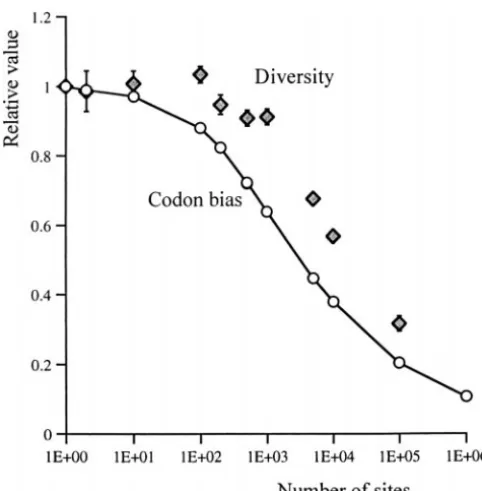
sites on relative codon bias (circles) and diversity (diamonds) we suggest that wsHR interference may be an important for 4Nes⫽4 and 4Ne ⫽0.04. feature of the evolution of nonrecombining genomes.
Figure 9 shows the effects of wsHR interference on equilibrium codon bias and nucleotide diversity for the to note that codon bias on the nonrecombining fourth range of 2 to 106completely linked sites in a haploid
pop-chromosome of D. melanogaster is close to that expected ulation of 1000 individuals with 2N
es ⫽ 4 and 2Ne ⫽
from mutational biases alone (Kliman andHey1993; 0.04. Two features are of note. First, for 105linked sites,
Comeronet al. 1999). Assuming there areⵑ200 genes wsHR interference reduces the efficacy of selection to of average length (500 codons) on this chromosome the extent that codon bias is only 20% of that expected (105 weakly selected sites), wsHR interference predicts
under no interference. Polymorphism is reduced to low but nonzero bias and diversity (see also Figure 9). 30% of that expected with no interference. These results These considerations also identify a possible interac- resemble patterns of synonymous site polymorphism tion between wsHR interference and stronger forces and divergence in the mitochondrial genome of D. mela-such as background selection and hitchhiking. Because nogaster. The ratio of silent-site polymorphism to diver-deleterious mutations tend to persist at very low frequen- gence is about half that expected from patterns in au-cies and beneficial mutations are likely to be rare, back- tosomal genes (data inMoriyama and Powell1996; ground selection and hitchhiking will tend to reduce Nachman 1997), suggesting that there are factors re-the efficacy of selection on codon usage only in regions ducing polymorphism in mitochondria. Likewise, pat-of essentially no recombination. Under such circum- terns of codon usage indicate that selection on synony-stances, wsHR interference will tend to have little effect, mous positions is very weak (Ballard andKreitman as the reduction in diversity caused by other forces re- 1994). Of course, these data may also be explicable by duces the potential for wsHR interference. When back- background selection, Muller’s ratchet, or hitchhiking. ground selection and hitchhiking are less strong, synon- The point is that interference between weakly selected ymous site diversity is expected to increase, which mutations can cause low levels of diversity and the accu-generates wsHR interference. At moderate recombina- mulation of weakly deleterious mutations in nonrecom-tion rates, we expect wsHR interference to become the bining genomes in a manner similar to the effects of major factor limiting selection on codon usage. wsHR much more strongly selected mutations.
interference may therefore provide an explanation for The second point of note is that the reduction in the observed relationship between codon bias and diver- efficacy of selection scales in a much less than multiplica-sity for genes in D. melanogaster in regions of nonzero tive way with the number of sites under selection. The recombination (Moriyama and Powell 1998; Com- ratio Ne/N caused by interference, as inferred from the
eronet al. 1999). level of codon bias, decreases more on the scale of the
The impact of wsHR interference on the evolution log of the number of sites under selection than the
of nonrecombining genomes:There is considerable evi- absolute number. This also holds if the effect is scaled
nonrecom-Hartl, D. L., E. N. MoriyamaandS. A. Sawyer,1994 Selection
the total number of sites. We have no explanation for
intensity for codon bias. Genetics 138: 227–234.
this pattern. Hill, W. G.,andA. Robertson,1966 The effect of linkage on limits
to artificial selection. Genet. Res. 8: 269–294. We thank Philip Awadalla, Nick Barton, Adam Eyre-Walker, Sally
Hudson, R. R.,andN. L. Kaplan,1994 Gene trees with background Otto, and Molly Przeworski for discussion and comments on the
manu-selection, pp. 140–153 in Non-neutral Evolution, edited byB.
Gol-script, and Richard Hudson and Molly Przeworski for the use of their
ding.Chapman and Hall, New York.
simulation program. G.M. is funded by the Natural Environment Kimura, M.,1971 Theoretical foundation of population genetics at Research Council and B.C. is a Royal Society Research Professor. the molecular level. Theor. Popul. Biol. 2: 174–208.
Kimura, M.,1983 The Neutral Theory of Molecular Evolution. Cam-bridge University Press, CamCam-bridge, United Kingdom.
Kimura, M., andT. Maruyama, 1966 The mutational load with epistatic gene interactions in fitness. Genetics 54: 1337–1351. LITERATURE CITED
Kliman, R. M.,andJ. Hey,1993 Reduced natural selection
associ-Akashi, H.,1999 Inferring the fitness effects of DNA mutations ated with low recombination in Drosophila melanogaster. Mol. Biol. from polymorphism and divergence data: statistical power to Evol. 10: 1239–1258.
detect directional selection under stationarity and free recombi- Kondrashov, A.,1995 Contamination of the genome by very slightly nation. Genetics 151: 221–238. deleterious mutations: Why have we not died 100 times over? J.
Akashi, H.,andS. W. Schaeffer,1997 Natural selection and the Theor. Biol. 175: 583–594.
frequency distributions of “silent” DNA polymorphism in Dro- Krone, S. M.,andC. Neuhauser,1997 Ancestral processes with sophila. Genetics 146: 295–307. selection. Theor. Popul. Biol. 51: 210–237.
Ballard, J. W.,andM. Kreitman,1994 Unraveling selection in the Li, W.-H.,1987 Models of nearly neutral mutations with particular mitochondrial genome of Drosophila. Genetics 138: 757–772. implications for nonrandom usage of synonymous codons. J. Mol.
Barton, N. H.,1995 Linkage and the limits to natural selection. Evol. 24: 337–345.
Genetics 140: 821–841. Li, W.-H.,andD. Graur,1991 Fundamentals of Molecular Evolution.
Bauer, V. L.,andC. F. Aquadro, 1997 Rates of DNA sequence Sinauer Associates, Sunderland, MA. evolution are not sex biased in Drosophila melanogaster and D.
Lynch, M.,1997 Mutation accumulation in nuclear, organelle, and simulans. Mol. Biol. Evol. 14: 1252–1257. prokaryotic transfer RNA genes. Mol. Biol. Evol. 14: 914–925.
Begun, D. J.,andC. F. Aquadro,1992 Levels of naturally occurring
Lynch, M.,andJ. L. Blanchard,1998 Deleterious mutation accu-DNA polymorphism correlate with recombination rates in D. mulation in organelle genomes. Genetica 102/103: 29–39. melanogaster. Nature 356: 519–520.
Maynard Smith, J.,1978 The Evolution of Sex. Cambridge University
Birky, C. W.,andJ. B. Walsh,1988 Effects of linkage on rates of Press, Cambridge, United Kingdom. molecular evolution. Proc. Natl. Acad. Sci. USA 85: 6414–6418.
Maynard Smith, J.,andJ. Haigh,1974 The hitchhiking effect of
Braverman, J. M., R. R. Hudson, N. L. Kaplan, C. H. Langleyand
a favourable gene. Genet. Res. 23: 23–35.
W. Stephan,1995 The hitchhiking effect on the site frequency
Maynard Smith, J., N. H. Smith, M. O’RourkeandB. G. Spratt,
spectrum of DNA polymorphism. Genetics 140: 783–796.
1993 How clonal are bacteria? Proc. Natl. Acad. Sci. USA 90:
Bulmer, M. G.,1991 The selection-mutation-drift theory of
synony-4384–4388. mous codon usage. Genetics 129: 897–907.
McVean, G. A. T.,andB. Charlesworth,1999 A population
ge-Charlesworth, B.,1994 The effect of background selection against
netic model for the evolution of synonymous codon usage: pat-deleterious mutations on weakly selected, linked variants. Genet.
terns and predictions. Genet. Res. 74: 145–158. Res. 63: 213–227.
Moran, N.,1996 Accelerated evolution and Muller’s ratchet in
en-Charlesworth, B.,1996 The evolution of chromosomal sex
deter-dosymbiotic bacteria. Proc. Natl. Acad. Sci. USA 93: 2873–2878. mination and dosage compensation. Curr. Biol. 6: 149–162.
Moriyama, E. N.,andJ. R. Powell,1996 Intraspecific nuclear DNA
Charlesworth, B., M. T. MorganandD. Charlesworth,1993
variation in Drosophila. Mol. Biol. Evol. 13: 261–277. The effect of deleterious mutations on neutral molecular
varia-Moriyama, E.,andJ. Powell,1998 Gene length and codon usage tion. Genetics 134: 1289–1303.
bias in Drosophila melanogaster, Saccharomyces cerevisiae and
Esche-Charlesworth, D., B. CharlesworthandM. T. Morgan, 1995
richia coli. Nucleic Acids Res. 26: 3188–3193. The pattern of neutral molecular variation under the background
Muller, H. J.,1964 The relation of recombination to mutational selection model. Genetics 141: 1619–1632.
advance. Mutat. Res. 1: 2–9.
Chiapello, H., F. Lisacek, M. CabocheandA. Henaut,1998
Co-Nachman, M. W.,1997 Deleterious mutations in animal mitochon-don usage and gene function are related in sequences of
Arabi-drial DNA. Genetica 102/103: 61–69. dopsis thaliana. Gene 209: GC1–GC38.
Neuhauser, C.,andS. M. Krone,1997 The genealogy of samples
Comeron, J., M. KreitmanandM. Aguade´,1999 Natural selection
in models with selection. Genetics 145: 519–534. on synonymous sites is correlated with gene length and
recombi-Otto, S. P.,andN. Barton,1997 The evolution of recombination: nation in Drosophila. Genetics 151: 239–249.
removing the limits to natural selection. Genetics 147: 879–906.
Duret, L.,andD. Mouchiroud,1999 Expression pattern and,
sur-Powell, J. R.,andE. N. Moriyama,1997 Evolution of codon usage prisingly, gene length shape codon usage in Caenorhabditis,
Dro-bias in Drosophila. Proc. Natl. Acad. Sci. USA 94: 7784–7790. sophila and Arabidopsis. Proc. Natl. Acad. Sci. USA 96: 4482–4487.
Press, W. H., S. A. Teukolsky, W. T. VetterlingandB. P. Flannery, Ewens, W. J.,1979 Mathematical Population Genetics. Springer-Verlag,
1992 Numerical Recipes in C: The Art of Scientific Computing. Cam-Berlin.
bridge University Press, Cambridge, United Kingdom.
Eyre-Walker, A.,andM. Bulmer,1995 Synonymous substitution
Price, G. R.,1970 Selection and covariance. Nature 227: 520–521. rates in enterobacteria. Genetics 140: 1407–1412.
Przeworski, M., B. CharlesworthandJ. D. Wall,1999
Genealo-Felsenstein, J.,1974 The evolutionary advantage of recombination.
gies and weak purifying selection. Mol. Biol. Evol. 16: 246–252. Genetics 78: 737–756.
Rice, W. R.,1996 Evolution of the Y sex chromosome in animals.
Fisher, R. A.,1930 The Genetical Theory of Natural Selection. Oxford
BioScience 46: 331–343. University Press, Oxford.
Robertson, A.,1961 Inbreeding in artificial selection programmes.
Fu, Y.-X.,andW.-H. Li,1993 Statistical tests of neutrality of
muta-Genet. Res. 2: 189–194. tions. Genetics 133: 693–709.
Santiago, E.,andA. Caballero,1995 Effective size of populations
Golding, G. B.,1997 The effect of purifying selection on
genealo-under selection. Genetics 139: 1013–1030. gies, pp. 271–285 in Progress in Population Genetics and Human
Santiago, E.,andA. Caballero,1998 Effective size and polymor-Evolution, edited byP. DonnellyandS. Tavare.Springer-Verlag,
phism of linked neutral loci in populations under directional New York.
selection. Genetics 149: 2105–2117.
Graves, J. A. M.,1994 Evolution of the mammalian Y-chromosome.
Sawyer, S. A.,andD. L. Hartl,1992 Population genetics of poly-Cytogenet. Cell Genet. 67: 401.
morphism and divergence. Genetics 132: 1161–1176.
Haigh, J.,1978 The accumulation of deleterious genes in a
synonymous codon usage in unicellular organisms. J. Mol. Evol. of background selection at a single locus on weakly selected,
24:28–38. linked variants. Genet. Res. 73: 133–146.
Sharp, P. M., T. M. E. TuohyandK. R. Mosurski,1986 Codon Tajima, F.,1989 Statistical method for testing the neutral mutation usage in yeast—cluster-analysis clearly differentiates highly and hypothesis by DNA polymorphism. Genetics 123: 585–595. lowly expressed genes. Nucleic Acids Res. 14: 5125–5143. Watterson, G. A.,1975 On the number of segregating sites in
Shields, D. C., P. M. Sharp, D. G. HigginsandF. Wright,1988 genetical models without recombination. Theor. Popul. Biol. 7: “Silent” sites in Drosophila genes are not neutral: evidence of 256–276.
selection among synonymous codons. Mol. Biol. Evol. 5: 704–716. Wright, S.,1931 Evolution in Mendelian populations. Genetics 16:
Stenico, M., A. T. LloydandP. M. Sharp,1994 Codon usage in 97–159. Caenorhabditis elegans—delineation of translational selection and