Study of Citrullus Biodiesel Blends on
Emission and Performance Characterization
of IC Engine
Ratnam Ramesh Gujar 1, Rajesh Kale 2, Supriya Baburao Chavan 3
StudentME, Dept. of Mechanical Engineering, Rajiv Gandhi Institute of Technology, Mumbai, Maharashtra India1 Dept. of Mechanical Engineering, Rajiv Gandhi Institute of Technology, Mumbai, Maharashtra India2
Dept. of Chemistry, Bhagwant University, Ajmer, Rajasthan, India3
ABSTRACT: This study explores the emission of different pollutants form by using different blends in IC engine. Biodiesel synthesized from Citrullus colocynthesis schard by applying homogeneous catalyst, sodium methoxide and investigate the synthesized citrullus methyle ester for performance and emission of engine. Further the same biodiesel was preceded for emission analysis on single cylinder IC engine with various blending ratios as well as load. Blends (i.e. mixture of biodiesel + fossil fuel) of B00% (i.e. diesel fuel) and Citrullus methyl esters like TB10%, TB20%, TB30%, TB40%, TB50% were prepared at 400C. The emission parameters like Carbon dioxide (CO2), Carbon
monoxide (CO), Hydrocarbon (HC) etc. and performance parameters like Brake specific fuel consumption (BSFC), and Brake thermal efficiency (BTE) and Brake power were studied and compared with fossil fuel. Result showed that among all methyl ester blends of citrullus, CB20%blend shows lower emissions as well as performance as assimilated with running diesel fuel at all load.
KEYWORDS: Biodiesel, transesterification, engine performance, emissions.
I. INTRODUCTION
In present world fossil fuels are one of the major sources of energy. They have a great utility because of easy usage, availability, cost effectiveness, production of large amount of energy, stability and transportation ease. But due to huge increase in numbers of automobile companies , the demand of fossil fuels also increased. This results into depletion of fossil fuel reservoirs day by day as they are non renewable in nature. We can easily estimate that it will not last after few decades. Also large usage of fossil fuels is not only injurious to health but also hazardous to environment. When they burn they release harmful emissions like carbon dioxide (CO2) , carbon monoxide (CO) , nitrogen oxides (NOx) and
unburned hydrocarbons, greenhouse gases which are the main aspects of global warming. Rise in temperature of earth have resulted in melting of polar ice, rise in sea level and mainly acid rains.
Authors M. Nasarullah , K. Raja Gopal1 investigate the performance and emission characteristics of a direct injection (DI) 4 stroke single cylinder compression ignition engine of 3.7 KW power,1500 RPM when fuelled with methyl ester of jatropha oil.The experimental results show that the maximum brake thermal efficiency was obtained with 20% Etanol-2% THF blended with MEJO when compared with pure MEJO and methyl ester of jatropha oil blends. S.M. Palash, M.A. Kalam, H.H. Masjuki, B.M. Masum, A. Sanjid2 have compared the engine performance and emission results of biodiesel produced from Jatropha oil when applied in different proportions in multi cylinder diesel engine. Results revealed that biodiesel blends produce less CO (up to 52.6%) and lower HC (up to 48%) with an increase in emission of NO (up to 11.82%). Bobade S.N., Kumbhar R.R. and Khyade V.B.3 have done transesterification of jatropha curcas oil which gives 83% of methyl ester and 17% of glycerol using molar ratio 6:1 (methyl alcohol to oil) and 0.5wt % of sodium hydroxide at 65oc for 90 minutes and allowed to settle overnight. Properties of jatropha biodiesel like density, kinematic viscosity, flash point, fire point were calculated as 0.93292gm/cc, 55mm2/s, 180oc, 256oc respectively. Study suggests that the jatropha oils can be used as a source of triglycerides in the manufacture of biodiesel by transesterification reaction. Y.H. Basavarajappa , N.R.Banapurmath4 presents paper which studies the effects of ethanol addition and Exhaust Gas Recirculation (EGR) and on performance, combustion and emissions of compressed natural gas (CNG) dual fuelled with Honge oil methyl esters (HOME) and Jathropha methyl ester (JOME) in a dual-fuel engine. Bobade S.N. and Khyade V.B.5 have studied transesterification of karanja oil which shows have checked the feasibility of Karanja oil for the production of biodiesel optimization of different parameters for high yield /conversion of Karanja oil to biodiesel. Sushma. S, Dr. R. Suresh, Yathish K V6 have observed that a complete substitution of petro diesel by bio fuel is impossible with the use of edible and non edible oil, hence in the present study dairy waste scum oil and karanja oil (in equal quantities) is used to produce hybrid oil biodiesel by transesterification process using sodium hydroxide as catalyst.
Supriya B. Chavan,a Rajendra R. Kumbhar,b D. Madhu,c Bhaskar Singhd and Yogesh C. Sharma c7 have prepared biodiesel from Jatropha curcas oil using waste eggshell. High purity calcium oxide (CaO) was prepared from eggshell and used as a catalyst for the production of biodiesel. Non-edible oil, Jatropha curcas was used as a feedstock for the synthesis of biodiesel. High purity calcium oxide (CaO) was obtained when the eggshell was subjected to calcination at 9000 C for 2.5 h. Pure biodiesel was obtained in high yield by taking into account various parameters such as a proper methanol to oil molar ratio, reaction temperature and reaction time. Reusability of the catalyst was observed and the catalyst worked efficiently up to six times without significant loss of activity. Physical and chemical properties of biodiesel such as density, kinematic viscosity, cloud point, etc. were studied.
Supriya B. Chavan, Rajendra Rayappa Kumbhar, Ashutosh Kumar, and Yogesh C. Sharma8 Studied Biodiesel Blends on Emission and Performance Characterization of a Variable Compression Ratio Engine. They studied the emission of different pollutants using different blends in a variable compression ratio (VCR) engine. Biodiesel synthesized from Jatropha oil using a heterogeneous catalyst was investigated for emission analysis on a single-cylinder VCR engine with various blending ratios as well as load. Blends (biodiesel + diesel) of different concentration were pepared at 400 c. Emission parameters, such as nitrogen oxides (NOx), carbon monoxide (CO), and hydrocarbon (HC), were studied and compared to diesel fuel.
Chavan S.B. , Kumbhar R.R. and Deshmukh R.B.9 have proved that Callophyllum Inophyllum Linn (“honne”) Oil is the best source as a raw material for biodiesel production as it is an evergreen tree and grows along the coastal area. The study is focused on the collection of seeds and oil extraction then production of biodiesel with molar ratio 8:1, KOH were 1.2wt%, tempreture 650 c, reaction time 90minutes and testing of parameters as per ASTM 6751 standards. The physical properties like acid value, density, Calorific value, Flash point, Fire point and Moisture, Viscosity shows of calophyllum methyl esters were calculated. The physico-chemical parameters showed that Calophyllum may works as a sustainable feedstock for biodiesel production that is equivalent to fossile fuel as per ASTM 6751.
biodiesel production with molar ratio 8:1, KOH were 0.75wt%, tempreture 65o c, reaction time 90minutes were used and testing of parameters as per ASTM 6751 standards. The physical properties like acid value, density, Calorific value, Flash point, Fire point and Moisture, Viscosity of Thumba methyl ester (TME ) were calculated.
Chavan Supriya Baburao , R. Rohith Renish , Shinde Chandrakant Anna , Kumbhar Rajendra Rayappa11 have used Ecofriendly Heterogeneous Catalyst (CaO) for Synthesis of Biodiesel and then studied its Characterization on VCR Engine. Waste crab shells after calcination have been used as a nonconventional heterogeneous catalyst for biodiesel synthesis from pongamia oil. Crab shell was calcined in muffle furnace at 1100 °C for 2hrs. The calcined catalyst was characterized on X-ray diffraction (XRD), Fourier transform infrared (FTIR) spectroscopy and Scanning electron microscopy (SEM). The highest yield is obtained. Then blends of different concentration were prepared and it performance and emissions are compared against pure diesel. It is found that an ecofriendly, heterogeneous catalyst made from raw egg shell can be a low cost solution for biodiesel synthesis. Also emissions like CO, CO2 and HC are
lowered as compared with diesel.
Bobade S.N. , Kumbhar R.R. and Khyade V.B.12 have prepared of Methyl Ester (Biodiesel) from Jatropha Curcas Linn Oil. Transesterification of jatropha curcas oil is done, which gives >83% of methyl ester and >17% of glycerol using molar ratio 6:1(methyl alcohol to oil) and 0.5wt % of sodium hydroxide at 650 c for 90 minutes and allowed to settle overnight. As per ASTM 6751(American Standards For Testing and Material) the properties like density, viscosity, flash point, cloud point and pour point have been carried out at Indian Biodiesel Corporation, Baramati for accessing the fuel quality of Jatropha oil methyl ester. Thus this study suggests that the jatropha oils can be used as a source of triglycerides in the manufacture of biodiesel by transesterification reaction. The biodiesel from refined vegetable oils meets the Indian requirements of high speed diesel oil.
Above literature survey encourage us to pursue our work.
The present work investigates the suitability of Thumba biodiesel (Citrullus colocynthis) as an alternative fuel and calculating its performance and emission characterization on IC engine using some catalyst to increase the speed of the process.
II. MATERIAL AND METHODS
1. Fuel Production And Properties
There is a best source as a raw material that is Citrullus Colocynthis (Thumba) oil for biodiesel production. It is a climber and grows wild in western part of Rajasthan. The average yield is about 2500-3500 kg of seeds/ ha. with minimum inputs. Seeds contains 12-20% of golden yellow- brown oil. De oiled cake has a great importance in organic fertilizer industry.
The biodiesel fuel used (methyl ester) is obtained from Thumba oil by transesterification process. It is the process by which fatty acid is converted into its corresponding ester.
sample was then dried by placing it on a hot plate and excess water still in the biodiesel removed. Finally thumba methyl ester is obtained and further blended with diesel fuel to obtain different compositions.
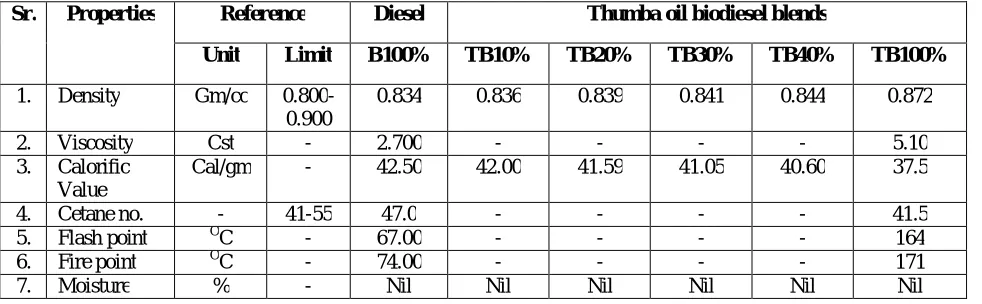
The biodiesel is blended with the diesel fuel in different concentration. Biodiesel is blended with diesel by volume as B10 (10% Thumba biodiesel & 90% diesel fuel), B20 (20% Thumba biodiesel & 80% diesel fuel), B30 (30% Thumba biodiesel & 70% diesel fuel), B 40( 40% tumba biodiesel & 60% diesel fuel) and B100 (100 % thumba biodiesel & 0% diesel fuel) then these samples were proceed for their property testing. Table 1. Shows the properties for each blends and their comparison with diesel fuel. For every blend the value of density and calorific value changes as the concentration of blend changes. The density of thumba biodiesel and diesel fuel is different. When these two blend together the density will slightly increased than the density of diesel fuel. Same way calorific value will also change.
Table. 1 : Analysis of Thumba Biodiesel and its Blends
Sr. Properties Reference Diesel Thumba oil biodiesel blends
Unit Limit B100% TB10% TB20% TB30% TB40% TB100%
1. Density Gm/cc 0.800-0.900
0.834 0.836 0.839 0.841 0.844 0.872
2. Viscosity Cst - 2.700 - - - - 5.10 3. Calorific
Value
Cal/gm - 42.50 42.00 41.59 41.05 40.60 37.5
4. Cetane no. - 41-55 47.0 - - - - 41.5 5. Flash point OC - 67.00 - - - - 164 6. Fire point OC - 74.00 - - - - 171 7. Moisture % - Nil Nil Nil Nil Nil Nil
2. Experimental set-up
(a)
Table 2 : Technical Specification of diesel engine
1. Rated Power Output 5 HP 2. Rated Engine Speed 1500 rpm 3. Stroke Length 95 mm 4. Bore Diameter 87.5 mm 5. Calorific Value of Fuel 43890 KJ/Kg k 6. Density of Fuel 855kg/m3 7. Jacket Cooling Water Flow Rate 12 lit/min 8. Burrete Diameter 12 9. Orifice Diameter 25
Engine performance parameters such as brake power, efficiency, emissions and smoke capacity are quantified. Engine is run at 1500 rpm and data are collected with respect to combustion, emission and performance parameters at various loads of 2, 4, 6, 8.
III. RESULT AND DISCUSSION
Performance characterization :
1. Brake Power :
The main purpose of running an engine is Mechanical Power. Power is defined as the rate of doing work and is equal to the product of force and the linear velocity or the product of torque and the angular velocity. Thus the measurement of power involves the measurement of forces as well as speed. Here we have calculated brake power for each blends and compared with pure diesel fuel. The graphical representation is show in fig. (b)
(b) 2. Mechanical Efficiency (Ƞmech)
Mechanical efficiency measures the effectiveness of a machine. It is defined as the ration of break power to indicated power. We have plotted graph of Mechanical Efficiency for each blends at different loads. And we have observed that as the load increases the mechanical efficiency also increases. Graphical representation of load vs mech efficiency is shown in fig. (c)
(c)
3. Break Thermal Efficiency
Thermal efficiency of an engine is defined as the ratio of the output to that of the chemical energy input in the form of fuel supply. If different fuels are to be compared for the same engine, brake thermal efficiency is the most suitable
0 1 2 3
0 2 4 6 8 10
B
re
ak
P
o
w
e
r
kw
Load kg
Load Vs Break Power
B00
B10
B20
B30
B40
0 20 40 60 80
0 2 4 6
M
ec
h
E
ff
ic
ie
n
cy
Load
Load Vs Mechanical efficiency
B100
B10
B20
B30
B40
parameter instead of specific fuel consumption.Fig. (d)shows the BTE of all biodiesel blends and petroleum diesel under different loading conditions. The maximum brake thermal efficiencies at load 8 for diesel, TB10%, TB20%, TB30%, TB40% and TB100% are calculated as 17.86%, 18.9%, 19.1%, 19.11% etc.
(d)
4. Break Specific Fuel Consumption (BSFC)
Specific fuel consumption is defined as the amount of fuel consumed per unit of power developed per hour. It is a clear indication of efficiency with which the engine develops power from fuel. The variation in Break Specific Fuel Consumption against the load is shown in fig (e) We can observe that the increasing power results in decreasing consumption of fuel.
(e)
0 5 10 15 20 25
0 2 4 6 8 10
B
TE
%
Load kg
Load Vs Break Thermal
Effficiency
B10
B20
B30
B40
0 0.5 1 1.5
0 2 4 6 8 10
B
SF
C
KJ
/k
w
h
r
Load kg
Load Vs BSFC
B10
B20
B30
Emission Characteristics :
1. Unburned Hydrocarbons (UBHC)
Unburned hydrocarbon (UBHC) pollutants are formed when the fuel is not completely burned. UBHC is one of the important parameters for determining the emission behavior of diesel engine. Comparison of UBHC of all the Thumba biodiesel blends and diesel at various load is shown in Fig. (f). It is shown that the variation in UBHC decreases with the influence of Thumba biodiesel percentage in bio-diesel blends. It is also confirmed that thumba biodiesel emission are reduced to much extent of UBHC emissions when compared to base line diesel at full load condition.
(f) 2. Carbon monoxide (CO)
It is the most common type of fatal air poisoning in many countries. It is colorless, odorless and tasteless, but highly toxic gas. Fig. (g) shows the variation in carbon monoxide of all the tested fuels with respect to load. It is learned that the variation in CO emissions for all biodiesel blends and diesel is fairly small. It is also identified that CO concentration of Thumba biodiesel emission is lower than conventional diesel at rated load. This may be due to the oxygen content and less C/H ratio of biodiesel that causes complete combustion. However, it is revealed that the decreasing trend of CO emission does not rely on biodiesel percentage in the blends.
(g) 0 5 10 15 20
0 5 10 15
H yd ro ca rb o n ( p p m H e x) Load(kg)
Load VS HC Emissions
B00% TB05% TB10% TB15% TB20% TB30% 0 0.01 0.02 0.03 0.04 0.05
0 5 10 15
C ar b o n M o n o xi d e (% ) Load (kg)
Load VS CO Emissions
3. CO2 Emission
CO2 causes rise in sea level, reduction of ozone layer, global warming and fatal diseases. Fig. (h) shows the variation
in carbon dioxide of all the tested fuels with respect to load. It is learned that the variation in CO2 emissions for all
biodiesel blends and diesel is fairly small. It is also identified that CO2 concentration of Thumba biodiesel emission is
lower than conventional diesel at rated load.
(h)
IV. CONCLUSION
From above results it is concluded that Thumba Biodiesel has come up with one of the best alternative sources. It can be used in diesel engine as an alternative fuel or by blending it with diesel fuel and is found to give better performance. It has been found that harmful emissions like CO2, CO are reduced while Nitrogen Oxides (NOx) emissionis higher than
that of diesel fuel.
REFERENCES
[1] M. Nasarullah , K. Raja Gopal, “Effect of Ethanol and Tetra Hydro Furan on
a. Performance and Emission Characteristics of CI Engine Fuelled with Methyl esters.
b. Easter of Jatropha” ,International Journal of Engineering Research & Technology (IJERT), March 2014
[2] S.M. Palash, M.A. Kalam, H.H. Masjuki, B.M. Masum, A. Sanjid , “ Impacts of Jatropha biodiesel blends on engine performance and emission of a multi cylinder diesel engine” , International Journal of Advancements in Mechanical and Aeronautical Engineering, Jan 2014
[3] Bobade S.N., Kumbhar R.R., Khyade V.B., “ Preperation of methyl ester (biodiesel) from jatropha curcus linn” RJAFS, 1(2), 12-19, (2013) [4] Y.H.Basavarajappa , N.R.Banapurmath, “Effect of Exhaust Gas Recirculation on the Performance and Emissions of a Dual Fuel Engine
Operated on CNG-Biodiesel-Ethanol Blends” , International Journal of Engineering Research & Technology, Dec 2013
[5] Bobade S.N. and Khyade V.B., “Preparation of Methyl Ester (Biodiesel) from Karanja (Pongamia Pinnata) Oil” , Research Journal of Chemical Sciences, August (2012)
[6] Sushma. S, Dr. R. Suresh, Yathish K V , “Production of Biodiesel From Hybrid Oil (Dairy Waste Scum and Karanja) and Characterization and Study of Its Performance on Diesel Engine” , International Journal of Engineering Research & Technology,
[7] ( July 2014)
[8] Supriya B. Chavan,a Rajendra R. Kumbhar,b D. Madhu,c Bhaskar Singhd and Yogesh C. Sharma c , “Synthesis of biodiesel from Jatropha curcas oil using waste eggshell and study of its fuel properties” ,RSC Adv., 2015, 5, 63596
[9] Supriya B. Chavan, Rajendra Rayappa Kumbhar, Ashutosh Kumar, and Yogesh C. Sharma, “ Study of Biodiesel Blends on Emission and Performance Characterization of a Variable Compression Ratio Engine”, Energy and Fuel (pubs.acs.org/EF)
[10] Chavan S.B. , Kumbhar R.R. and Deshmukh R.B., “ Callophyllum Inophyllum Linn (“honne”) Oil, A source for Biodiesel Production”, Research Journal of Chemical Sciences, November (2013)
[11] Chavan S. B., Kumbhar R. R. and Sharma Y. C, “Transesterification of Citrullus colocynthis (Thumba) oil: Optimization for biodiesel production” , Pelagia Research Library Advances in Applied Science Research, 2014
0.4 0.5 0.6 0.7 0.8 0.9 1
0 5 10 15
C
ar
b
o
n
-d
i-o
xi
d
e
(%
)
Load(kg)
Load VS CO
2Emissions
B00%
TB05%
TB10%
TB15%
TB20%
[12] Chavan Supriya Baburao , R. Rohith Renish , Shinde Chandrakant Anna , Kumbhar Rajendra Rayappa, “Application of an Ecofriendly Heterogeneous Catalyst (CaO) for Synthesis of Biodiesel and its Characterization on VCR Engine” ,International Review of Mechanical Engineering ,May 2015
[13] Bobade S.N. , Kumbhar R.R. and Khyade V.B., “Preperation of Methyl Ester (Biodiesel) from Jatropha Curcas Linn Oil” , Research Journal of Agriculture and Forestry Sciences, March (2013)