Experimental Study on Partial Replacement of
Cement by Sugaracne Bagasse Ash
Amrita Kumari, Prof. Sheo Kumar
M.Tech Student, Dept. of civil Engineering B.I.T Sindri, Dhanbad, Jharkhand, India
Assistant Professor, Dept. of civil Engineering B.I.T Sindri, Dhanbad, Jharkhand, India
ABSTRACT: This experimental study investigates the strength performance of concrete using Portland pozzolana Cement and Sugarcane Bagasse Ash. Initially, bagasse ash samples were collected and its properties were investigated. Normal consistency and setting time of the pastes containing Portland pozzolana cement and sugarcane bagasse ash at 5%, 10%, 15% & 20% replacement were investigated. The compressive strength of mortars containing Portland pozzolana cement with bagasse ash at 5%, 10%, 15% &20% replacements were also investigated. Compressive strength, flexural strength, split tensile strength and density of M25 concrete containing Portland pozzolana cement with sugar cane bagasse ash at 5%, 10%, 15% and 20 % replacements were also investigated at water cement ratio 0.44,0.45,0.46. The result shows that consistency, initial setting time, final setting time increases with increase in percentage of sugarcane bagasse ash where as soundness and compressive strength of mortar decreases with increase in percentage of sugarcane bagasse ash. Compressive strength, flexural strength, split tensile strength and density of concrete containing Portland pozzolana cement with sugarcane bagasse ash decreases with increase in percentage of sugarcane bagasse ash.
KEYWORDS: sugarcane bagasse ash(SBA), Portland pozzolana cement(PPC), flexural strength, compressive strength, split tensile strength.
I. INTRODUCTION
Concrete is a mixture of cement, sand, coarse aggregate and water. Its success lies in its versatility as can be designed to withstand harshest environments while taking on the most inspirational forms. Engineers and scientists are further trying to increase its limits with the help of innovative chemical admixtures and various supplementary cementitious materials. The supplementary cementitious materials can be divided in two categories based on their type of reaction : hydraulic and pozzolanic. Hydraulic materials react directly with water to form cementitious compound like GGBS. Pozzolanic materials do not have any cementitious property but when used with cement or lime react with calcium hydroxide to form products possessing cementitious properities.
Industrialisation in developing countries has resulted in an increase in agricultural out consequent accumulation of unmanageable agro waste. The waste materials that can be used in making concrete are many such as blast furnace slag, waste concrete, pelletised slag like foamed slag, graded wood particles, plastic particles such as polystyrene, sintered pulverized-fuel ash, sugarcane bagasse ash and others. Some of these have been tried with some success whilst others are yet to be tried regarding the feasibility of using them in concrete.
Much of the raw mass of sugarcane becomes waste during the refining process. Since refineries are normally built in locations where commercial power is unavailable, the factories generate their own electricity by burning bagasse to provide steam for back pressure steam turbine generators as well as process heating. The resulting bagasse ash
represents approximately 0.62% of the sugarcane weights. The main composition of bagasse ash is siliceous oxide sio2
that react with free lime from cement hydration .
reaction with the hydration products of the cement and results a reduction of the free lime in the concrete. The silicate content in the ash may vary from ash to ash depending on the burning and other properties of the raw materials like the soil on which the sugar cane is grown . Therefore, this study attempts to make use of the SBA in India as a pozzolanic material to replace PPC Cement.
Justification for the thesis
In production of cement huge amount of CO2 is released to atmosphere which contributes to worldwide concern, which
is global warming. This endangers the sustainability of cement industry and that of concrete. On the other hand cement is the most expensive component of concrete. Hence research are done for replacing cement by supplementary cementitious material. SBA creates waste disposal problem and environmental pollution. Thus this thesis deals with checking the feasibility of the agricultural by-product bagasse ash which is produced as a waste.
II. LITERATURE REVIEW
Sugarcane Baggase Ash
The sugarcane bagasse consists of approximately 50% of cellulose, 25% of hemicellulose and 25% of lignin. Each ton of sugarcane generates approximately 26% of bagasse (at a moisture content of 50%) and 0.62% of residual ash. The
residue after combustion presents a chemical composition dominates by silicon dioxide (SiO2). In spite of being a
material of hard degradation and that presents few nutrients, the ash is used on the farms as a fertilizer in the sugarcane harvests.
Some of experimental work are as follow
Chaysuwan et al. [2003] studied the use of bagasse ash as a replacement for silica in ordinary Portland cement. With a cement to bagasse ash ratio of 70:30 by weight, the sample gave excellent results for both mechanical and physical properties as compared to the control sample. It was also shown from the microstructure that the presence of bagasse ash definitely reduced the porosity of samples. Consequently, the bending strengths were improved for samples replaced with 30% bagasse ash .
Ganesan et al. [2007] studied the effects of bagasse ash content as partial replacement of ordinary Portland cement on physical and mechanical properties of hardened concrete. They found that the bagasse ash was an effective mineral admixture, with 20% as optimal replacement ratio of cement.
Biruk Hailu et al.(2011) studied the application of sugarcane bagasse ash as a partial cement replacement material. OPC and PPC was replaced by sugarcane bagasse at different % ratio for M-35 concrete at w/c 0.55. The test results indicated that up to 10% replacement of OPC cement by bagasse ash results in better or similar concrete properties and further environmental and economical advantages can also be exploited by using bagasse ash as a partial cement replacement material.
Shruthi H R,Dr.H Eramma,Yashwanth M K,Keerthi gowda B S et al.(2013) observed that the experimental result for the 10% replacement of bagasse ash to OPC has increase in strength in comparison with 0% and 5% replacement. Beyond 10% replacement of bagasse ash, the strength was decreased.
III.MATERIALS USED IN EXPERIMENT
I. Cement
Cement is a material that has cohesive and adhesive properties in presence of water. There are different types of cement, out of that the cement used for this project was Portland Pozzolana cement with trade name „LAFARAGE DURAGUARD‟ cement referring to IS code 1489-1-1991(part-1). The physical property of cement is given in
Table no 1: Physical property of cement
S. no. TESTS RESULT
1. Fineness 6%
2. Soundness 5mm
3. Specific gravity 3.057
4. Normal consistency 34%
5. Intial setting time 106min.
6. Final setting time 310min
II. Fine aggregate
The fine aggregate used in the concrete productions is natural sand of Barakar river. The most common constituent of sand is silica, usually in the form of quartz, which is chemical inert and hard. Hence used as a fine aggregate in concrete. In order to investigate its properties for the required application different tests were carried out which include: sieve analysis and fineness modules, specific gravity and absorption capacity, moisture content and unit weight as per specification laid down in IS: 383-1970. The physical property of fine aggregate is tabulated in table no. 2
Table no 2: Physical Properties of Sand
s.no. TESTS PERFORMED RESULT
1. Moisture content 0.22%
2. Water Absorption 0.56%
3. Bulk Density In gm/cm3
Loose condition 1.495
Compacted condition 1.627
4. Specific Gravity 2.675
III. Coarse aggregate
Coarse aggregate is the main constituent of concrete, it provide main body of concrete. Approx 70% volume of concrete is occupied by coarse aggregate. Crushed Stone of maximum size of 20 mm has been used as coarse aggregate. The properties of the coarse aggregates have been obtained from the tests carried out in the concrete laboratory of B.I.T Sindri as per specification laid down in IS: 383-1970.The physical property of course aggregate is tabulated in table no. 3
Table no 3: Physical property of coarse aggregate
s.no. TESTS PERFORMED RESULT
1. Moisture content 0.13%
2. Water Absorption 0.15%
3. Bulk Density In gm/cm3
Loose condition 1.712
Compacted condition 1.845
4. Specific Gravity 2.877
IV. Water
V. Sugarcane bagasse ash
Bagasse is a cellulose fiber remaining after the extraction of the sugar-bearing juice from sugarcane. Bagasse ash is one of the biomass sources and valuable byproducts in sugar milling that often uses bagasse as a primary fuel source to supply all the needs of energy to move the plants. The bagasse ash is about 8-10% of the bagasse and contains unburned matter, silica and alumina.
Bagasse ash has been a problem to the environment due to its disposal. The most significant pollutant emitted from the boilers being a particulate matter, caused by the turbulent movement of combustion gases with respect to the burning bagasse and resulting ash. Sometimes some auxiliary fuels typically fuel or natural gas may be used during startup of the boiler or when the moisture content of the bagasse is too high to support combustion, in such cases the emissions of
SO2 and NO2 will increase. Sugarcane bagasse ash has also been found to have such pozzolanic property, hence it can
be used for partial replacement of cement. For this research sugarcane bagasse was taken from village kutlupur in Gaya district. The physical property are tabulated in table no. 4
Table no 4: Physical property of SBA
S. no. TESTS RESULT
1. Fineness 8%
2. Unit weight 0.89gm/m3
3. Specific gravity 2.4
IV.EXPERIMENTAL PROGRAM
The experimental procedures undertaken in the present study involves several experiments, conducted to obtain various properties. The physical properties tests such as consistency test, setting time test and soundness test of the mixes were determined. The mechanical property such as compressive strength ,split tensile strength, flexure strength and density was obtained.
Properties of (Cement + SBA) Mortar
Following properties are studied for mortar of cement and SBA.
i) Consistency Test
ii) Initial Setting time
iii) Final Setting Time
iv) Soundness Test
v) Compressive Strength
The percentage of SBA was 5%, 10%, 15%,and 20%. The results have been obtained with respect each tests.
Properties of (Cement+SBA) Concrete
Following properties are studied for concrete with different percentage of SBA.
i) Compressive strength
ii) Split tensile strength
iii) Flexural strength
iv) Density
Above given properties of concrete at performed for water cement ratio 0.44,0.45 and 0.46. And at each water cement ratio the percentage of sugarcane was varied 0, 5, 10, 15 and 20%. The results have been obtained with respect each tests.
V.EXPERIMENTAL RESULTS
Consistency, setting time and soundness of different cement SA mixes.
Table no.5 : Consistency, setting time and soundness of different cement SA mixes
Sl.no. %SBA Consistency(%) Initial Setting Time (min.)
Final setting time(min.)
Soundness(mm)
1 0 34 106 312 5
2 5 34.5 117 334 5
3 10 36 131 362 4.5
4 15 37 148 395 4
5 20 38.5 170 412 3
I. Normal consistency
Normal consistency of pastes containing bagasse ashes are shown in Table 4.1. The control paste or the paste without bagasse ash had normal consistency of 34%. All of the pastes Containing bagasse ash showed normal consistency higher than the control paste.
II. Setting time
The results for the setting time in 4.1 indicated that addition of bagasse ash retarded the setting time . The paste without SBA had initial setting time of 106 minute which was increased by 60.03% at 20% replacement. Final setting time at 20% replacement is 412 which is 32.05% of control paste. . Final setting time at 20% replacement is 412 which is 32.05% of control paste.
III. Soundness
The Le-chatelier expansion for mix without SBA is 5.00mm while for mix with 20% SBA is only 3.00%. Hence it is clear from table no. 5 that inclusion of SBA increases the soundness of mixture or decreases the Le-chatelier expansion.
IV. Compressive strength of mortar
The compressive strength of mortar were tested and analyzed. The results of the laboratory tests are given below.
Table no. 6: Compressive strength of mortar
Sl. No. 1 2 3 4 5
SBA% 0 5 10 15 20
Avg. Compressive
strength at 28
days in N/mm2
35.31 34.51 32.70 30.49 27.68
It is clear from table no. 6 that Compressive strength of mortar decreases with increase in percentage of SBA.
Result on concrete
Table no. 7:Characteristic strength of concrete at w/c 0.44 after 28 days
SL. No. SBA% Avg.
Compressive strength
Avg.split tensile strength
Avg. Flexural
strength
Density
1 0 34.11 3.42 7.25 2461
2 5 32.48 3.35 6.99 2432
3 10 30.8 3.23 6.78 2409
4 15 28.53 3.04 6.35 2389
5 20 25.6 2.88 6.00 2372
Table no. 7 shows the avg. Compressive, avg. split tensile strength, avg. Flexural strength and density at w/c ratio 0.44 at 28 days. It is clear from above result that the strength decreases with increase in SBA percentage.
b>Characteristic strength of concrete at w/c 0.45 after 28 days
Table no. 8:Characteristic strength of concrete at w/c 0.45 after 28 days
SL. No. SBA% Avg.
Compressive strength
Avg.split tensile strength
Avg. Flexural
strength
Density
1 0 33.82 3.40 7.10 2460
2 5 32.11 3.33 6.79 2429
3 10 30.46 3.19 6.57 2404
4 15 28.13 3.03 6.21 2383
5 20 25.40 2.83 5.83 2366
Table no. 8 shows the avg. Compressive, avg. split tensile strength, avg. Flexural strength and density at w/c ratio 0.45 at 28 days. It is clear from above result that the strength decreases with increase in SBA percentage.
c>Characteristic strength of concrete at w/c 0.44 after 28 days
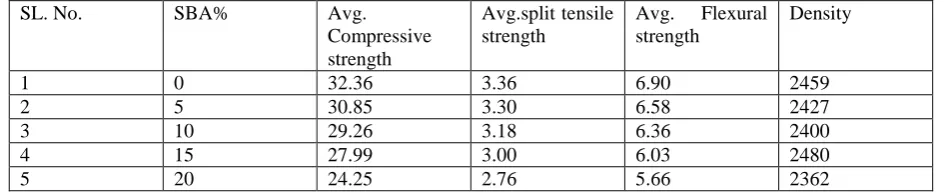
Table no. 9:Characteristic strength of concrete at w/c 0.46 after 28 days
SL. No. SBA% Avg.
Compressive strength
Avg.split tensile strength
Avg. Flexural
strength
Density
1 0 32.36 3.36 6.90 2459
2 5 30.85 3.30 6.58 2427
3 10 29.26 3.18 6.36 2400
4 15 27.99 3.00 6.03 2480
5 20 24.25 2.76 5.66 2362
Comparison of results
Fig. No. 1:Avg. Compressive strength Vs SBA% at different w/c ratio
Fig No. 1 Shows comparison between compressive strength of concrete at w/c 0.44,0.45and 0.46. graph shows that compressive strength decreases with increase in w/c ratio.
Fig. No. 2:Avg. Split tensile strength Vs SBA% at different w/c ratio
Fig. No. 2 Shows comparison between split tensile strength of concrete at w/c 0.44,0.45and 0.46. graph shows that split tensile strength decreases with increase in w/c ratio.
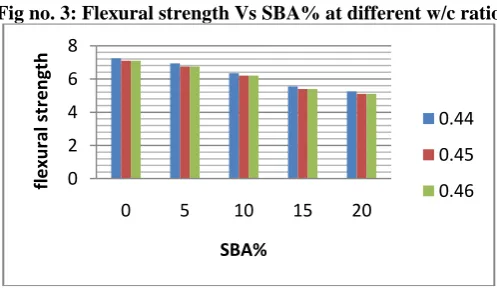
Fig no. 3: Flexural strength Vs SBA% at different w/c ratio
Fig No. 3 Shows comparison between flexural strength of concrete at w/c 0.44,0.45 and 0.46. graph shows that flexural strength decreases with increase in w/c ratio.
0 10 20 30 40
0 5 10 15 20
co m p re ssi ve str e n gth SBA% 0.44 0.45 0.46 0 1 2 3 4
0 5 10 15 20
te n si le str e n gth SBA% 0.44 0.45 0.46 0 2 4 6 8
0 5 10 15 20
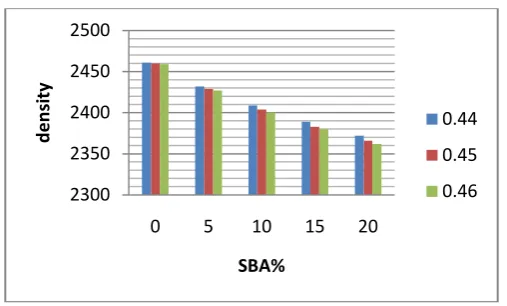
Fig. No. 4:Density Vs SBA% at different w/c ratio
Fig. No. 4 Shows comparison between density of concrete at w/c 0.44, 0.45 and 0.46. graph shows that density decreases with increase in w/c ratio.
VI.CONCLUSIONS
The use of SBA as replacement of cement at different water cement ratio was studied and after research work is done, the following conclusions were done.
1. Normal consistency, initial setting time, final setting time of mix of cement and SBA increases with increase
in percentage of SBA.
2. The workability of concrete containing SBA decreases as the SBA content increases which is due to the higher
water absorption of bagasse ash.
3. The compressive strength of mortar prepared with SBA as partial replacement of cement decreases with
increase in percentage of SBA.
4. The results of concrete work revealed that, the compressive strength, split tensile strength, flexural strength
and density of concrete containing SBA have shown reduction. As the water cement ratio increases, they decreases slightly.
5. Since bagasse ash is a by-product material, its use as a cement replacing material reduces the levels of CO2
emission by the cement industry and also saves a great deal of virgin materials. In addition its use resolves the disposal problems associated with it in the sugar industries.
6. Concrete with partial replacement of cement by sugarcane bagasse ash were economical and have slightly less
density thus can be used at the place at which strength is of less importance and economy and low density concrete density is required.
REFERENCES
1. IS 383 -1970 “Specifications for Coarse and Fine Aggregates from Natural Sources for Concrete”, Bureau of Indian Standards, New Delhi. 2. IS 10262 -1981 “IS Method of Mix Design”, Bureau of Indian Standards, New Delhi.
3. IS 516 -1959 “Methods of Tests for strength of concrete”, Bureau of Indian Standards, New Delhi.
4. . IS 456 -2000 “Code of Practice for Plain and Reinforced Concrete”, Bureau of Indian Standards, New Delhi.
5. Ganesan, K., Rajagopal, K., & Thangavel, K. 2007. Evaluation of bagasse ash as supplementary cementitious material. Cement and Concrete Composites, 29, 515-524.
6. Ajay Goyal and Anwar A.M., Hattori Kunio, Ogata Hidehiko, Properties of Sugarcane bagasse ash and its potential as cement-pozzolana binder, Ain Shams University December 2007.
7. Prashant O Modania and Vyawaharebnology M. R. (2013), Utilization of Bagasse Ash as a Partial Replacement of Fine Aggregate in Concrete, 51: 25 – 29.
8. Siva kumar M. And Mahindra N. (April 2013), Experimental Studies of Strength and Cost Analysis of Concrete Using Bagasse Ash, International Journal of Engineering Research & Technology, 2(4):1-8.
9.
2300 2350 2400 2450 2500
0 5 10 15 20
d
e
n
si
ty
SBA%
0.44
0.45
10. Paya j et al. “Sugarcane bagasse ash (SCBA): studies on its properties for reusing in concrete production”, Journal of Chemical technology and Biotechnology,2002.
11. Sabir BB, Wild S, Bai J. Metakaolin and calcined clays as pozzolans for concrete: a review. Cement Concrete Res 2001;23(2):441– 54. 12. R. Srinivasan, K.Sathiya. “Experimental Study on Bagasse Ash in Concrete”. International Journal for Service learning in Engineering. 2010. 13. Mohamed Eljack Suliman and samah M. Fudl Almola. “The Use of Sugarecane Bagasse Ash as An Alternative Local Pozzolanic material”. A
scientific Journal of COMSATS – Science Vision. January 2011.
14. Cordeiro ,G.C., Toledo Filho, R.D., Tavares, L.M., Fairbairn, E.M.R., 2008. Pozzolanic activity and filler effect of sugar cane bagasse ash in Portland cement and lime mortars. Cement and Concrete Composites 30, 410–418.