Copyright 0 1987 by the Genetics Society of America
Natural Selection and Y-Linked Polymorphism
Andrew
G.
Clark
Department of Biology, Pennsylvania State University, University Park, Pennsylvania 16802 Manuscript received September 8, 1986
Revised copy accepted November 26, 1986
ABSTRACT
Several population genetic models allowing natural selection to act on Y-linked polymorphism are examined. The first incorporates pleiotropic effects of a Y-linked locus, such that viability, segregation distortion, fecundity and sexual selection can all be determined by one locus. It is shown that no set
of selection parameters can maintain a stable Y-linked polymorphism. Interaction with the X chro- mosome is allowed in the next model, with viabilities determined by both X- and Y-linked factors. This model allows four fixation equilibria, two equilibria with X polymorphism and a unique point with both X- and Y-linked polymorphism. Stability analysis shows that the complete polymorphism is
never stable. When X- and Y-linked loci influence meiotic drive, it is possible to have all fixation equilibria simultaneously unstable, and yet there is no stable interior equilibrium. Only when viability and meiotic drive are jointly affected by both X- and Y-linked genes can a Y-linked polymorphism be
maintained. Unusual dynamics, including stable limit cycles, are generated by this model. Numerical simulations show that only a very small portion of the parameter space admits Y polymorphism, a
result that is relevant to the interpretation of levels of Y-DNA sequence variation in natural popula- tions.
ECENT advances in molecular cloning have en-
R
abled investigators to make probes of Y-homol- ogous DNA, and in addition to allowing more direct study of the function and regulation of genes on the Y-chromosome, these probes have been used to begin to ascertain the levels of sequence variation (CASA- NOVA et al. 1985; DARLING et al. 1986; HAREVEN, ZUCKERMAN and LIFSCHYTZ 1986; WILLIAMS et al.1987). These data will yield important insights into the evolution of sex chromosomes, and they raise the challenge of describing the forces that maintain the observed variation. T h e factors that have classically been invoked by population geneticists, including mu- tation, migration, drift, and natural selection, are undoubtedly all at work on Y-linked genetic variation, but there are some important aspects of the transmis- sion of the Y chromosome that make it unique. Be- cause Y chromosomes have unisexual transmission, migration may have quite different effects on the population genetic structure of Y chromosomes when compared to autosomes. HAMILTON (1967) and HEUCH (1 978) suggest that Y-linked meiotic drive can be maintained in a population if there is sufficiently infrequent migration due to recurrent extinction and recolonization of local demes. Genetic drift will affect the structure of variation on the Y chromosomes, but there will be quantitative differences from autosomes, particularly due to the different effective population size (CHARLESWORTH, COYNE and BARTON, 1987). MULLER’S ratchet will apply to the Y chromosome (CHARLESWORTH 1978), and it may be an explanation
for the preponderance
of repetitive heterochromatin
on the Y chromosome (BRUTLAG 1980; JONES and SINGH 1982).T h e theory of natural selection of Y-linked varia- tion is tied inextricably to the theory of sex ratio, and the unusual transmission of the Y can result in popu- lation dynamics unlike those of any other genetic element. HAMILTON (1 967) demonstrated that unbal- anced meiotic drive of the Y chromosome can lead to very rapid population extinction. Since the Y chro- mosome pairs with an X, the segregation properties of the two sex chromosomes must really be considered jointly. There is biological precedent for invoking interactions between the X and the Y, since COYNE (1 985) showed that the fertility of interspecific hybrid males of Drosophila depends on the combination of X and Y chromosomes. T h e observation of rare homol- ogous exchanges between the X and Y chromosome rDNA arrays in Drosophila melanogaster (S. W. WIL- LIAMS, J. A. KENNISON and C. STROBECK, unpublished data), and the obligate crossingover between the sex chromosomes in humans and mice (ROUYER et aZ. 1986) further supports the potential importance of X- Y interaction in evolution. But the bulk of the Y chromosome in most species is genetically isolated by lack of recombination with any other chromosome, giving it clonal transmission properties analogous to
haploids and mitochondria.
T h e objective of this paper is to examine four simple models of natural selection acting on the Y chromo- some. T h e models include Y-autonomous selection,
X-Y variation in viability, X-Y variation in meiotic drive, and a model with pleiotropic effects on the X and Y chromosome in both meiotic drive and viability. The equilibrium characteristics of these models are solved with the intention of gaining insight into the opportunity of natural selection to maintain Y-linked genetic variation.
THE MODELS
Pleiotropic Y-autonomous variation: T h e simplest model for Y chromosome variation allows two Y chro- mosomes, denoted Y and y, and ignores all other genetic variation. In this model and those that follow, the Y chromosome refers to the sex chromosome that is found exclusively in the heterogametic sex, and its genetic effects are assumed to reside in chromosomal regions that do not recombine with the X. In this scheme, there are two male types, XY and Xy, and all of the effects of the Y chromosome variation will be realized in the phenotypes of these two male types. In particular, the males may differ in any of several components of fitness, including differential mating ability (sexual selection), fecundity, viability and meiotic drive (CHRISTIANSEN and FRYDENBERG 1973). All of these components can be determined by pleio- tropic effects of the genes that distinguish Y from y. When the recursion in Y chromosome frequencies is examined, it is readily apparent that there are no conditions on the fitness components that can main- tain an internal polymorphism. This implies that in order to maintain polymorphism in Y chromosomes by natural selection, there must either be intrinsic frequency dependent fitness, demic heterogeneity in fitnesses (GLIDDON and STROBECK 1975), or there must be an interaction with another genetic element. X - and Y-linked viability: Consider the situation with two X chromosomes, denoted X and x, and two Y chromosomes, Y and y. In this system there are three female genotypes and four male genotypes:
Females Males
Genotype XX Xx xx XY Xy xY xy
Frequency U u w a b c d
Viability U1 U2 U 3 U4 U 5 U 6 U7
In the absence of selection, the recurrence system can be written with the normalization U
+
U+
w = 1 and a+
b+
c+
d = 1, where the sex ratio remains 1 : 1. In this case the adult genotype frequencies are obtained from the products of gamete frequencies produced by the two sexes. The genotype frequencies asymptoti- cally converge to HARDY-WEINBERG proportions in females, while the frequencies of the male genotypes at equilibrium are the products of the initial frequen- cies of the respective gametes. Hence there is no statistical association between the X and Y chromo- somes at equilibrium, and the term ad-bc asymptoti-cally decays to zero in a way analogous to linkage disequilibrium. At equilibrium there is no difference in the frequency of the two X chromosomes in the two sexes.
Viability can be added to this model by assigning viability parameters u1 through u7 to the seven respec-
tive genotypes, as shown above. The recursion system is most easily expressed in terms of the frequency of X in females (Xf), the frequency of X in males (Xm), and the frequency of Y(Y). T h e frequency of x in females is 1
-
Xf, and in males it is 1-
X,, while the frequency ofy is 1-
Y. T h e population is censused at the gamete stage, and the frequency of X in eggs is obtained by weighting the frequencies of female genotypes that can produce X eggs by their viabilities and normalizing by the mean viability of females. The complete recur- sion system for viability selection with X and Y varia- tion is:~ 1 x j - X ~
+
0.5~2[Xf(l-
X,)+
Xm(l-
Xf)]x;
=Wf
V&fY
+
Ugxf(1-
Y)Wnl
x;,
=y‘ = V&fY
+
u6( 1-
Xf)Yw,
where,
Wf
= XfX,V,+
[X/( 1-
X,)+
X,( 1-
Xf)]V2+
(1-
Xf)(l - X,)%+
(1-
Xf)(l-
Y ) V 7 .W,
= xfYu4+
xf(1-
Y)vg+
Y(1-
xf)u6This system admits four trivial equilibria, representing fixation for the four possible combinations of sex chromosomes. T h e stability of these “corner” equilib- ria are obtained from the Jacobian of the transfor- mation:
1
ax;/ax,
ax;
lax,
0+
n(1-
Y)12Y(l
-
Y).(u4J7
-
7J5V6) 0 [my [mu+
n(1-
Y)12Y-Linked Polymorphism 57 1
and and, for the other equilibrium:
P =
1When the roots of the characteristic equation of this matrix are positive, real and less than one, then the equilibrium is locally stable. In a similar fashion, the stability conditions are obtained for the other three corner equilibria:
Equilibrium Stability Conditions
A A
Xf =
x,
= Y = 0 V 6<
U7 and V 3 V 7>
0.5A . . ‘vZ(v5
+
v 7 ) X , = X , = 0, Y = 1 v 7c
v6 and>
0.5(4)
A . . OvZ(v4
+
116)Xf = X , = 1, Y = 0 v4 C v 5 andv1v5
>
0.5A A ..A ‘vZ(v5
+
v 7 )‘ v Z ( U 4
+
v 6 )X , = X , = Y = 1 v5
<
v4 and v1v4>
0.5If the leftmost of these stability conditions is violated, then the rare Y chromosome can increase in fre- quency, and if the rightmost stability condition is violated, the rare X chromosome can increase. T h e condition of the X chromosomes is simply that the products of the viabilities of the respective male and female genotypes must exceed the product of the viability of the female heterozygote and the average of the viabilities of the two male genotypes that bear the invading X . If there is a sort of heterozygote advantage, then the corner will be unstable.
In addition to the four corner equilibria, there may exist at most two “edge” equilibria that are fixed for one or the other Y chromosome but maintain poly- morphism on the X chromosomes. The equilibrium frequencies are:
P =
0V 5 i f
v5x;
+
v,(1-
if)
x,
=A V 4 X f
x,
=V$f
+
7 4 1-
if)
T h e characteristic equation of the Jacobian evaluated at these equilibria can be factored as:
( J 3 3
-
X ) [ Y l i-
X)(-X)-
J i z J z i ] = 0,(7)
because dY’/dXf evaluated at these equilibria is 0. From the characteristic equation, the conditions for the stability of the $ = 0 equilibrium are:
V i Y g
<
0.5(v5+
V 7 ) Y z>
U 3 V 7 ,and (8)
v ~ M
+
vGN v5M+
v 7 N < 1where M = v 3 v 7
-
0.5(v5+
v 7 ) v 2 and N = v1v5-
o.5(v5
+
~ 7 ) v Z . Both conditions must be satisfied forthe
?
= 0 equilibrium to be locally stable. T h e stability conditions for thep
= 1 equilibrium are:V1V4
<
0.5(~4+
V6)Vz>
V 3 V 6 ,and (9)
v5S
+
v ~ Tc1
n4s
+
v 6 Twhere S = v 3 v 6
-
o.5(v4+
v 6 ) v Z and T = v1v4-
0.5(v4
+
v6)vz. Analysis of the stability conditions re- veals that it is not possible to have all four corners and the two edges simultaneously unstable. This implies that we cannot guarantee a protected polymorphism of the Y chromosomes. Since protection is a property of local stabilities, it does not guarantee that an inter- nal equilibrium, if it exists, is unstable.T h e recurrence system for viability selection can have an interior equilibrium, and it is found at:
A U7
-
U 6xf
= v4-
U 5-
+
v 7(10)
A
x,
=if(-
X @ 2-
~3+
X ; y 3+
0.5 vg)+
vp)-
0.5 U:,if(V1if
;t
vz-
2
x p 2-
v 32,Xf(V7
-
v5)-
i m v 7+
i f V 5+
X p 3-
y = A
x m x f l u 4
-
v5-
v 6$
v 7 )+
x m ( v 6-
v7) - x f ( v 4-
v5)When the Jacobian is evaluated at this equilibrium, we find that aY‘/dY = 1, and the characteristic equa- tion becomes:
572
Y
0
0 I
*In
FIGURE 1.-Dynamics of the model with viability determined by the X and Y chromosomes. Trajectories from several different initial starting points are plotted on the same phase plane. For all simula- tions the viability parameters were: v l = 0.9, v2 = 1.0, us = 0.4,
v 4 = 0.5, v g = 0.1, v6 = 0.1, U, = 0.8. The unstable interior equilibrium occurs at
if
= 0.63636, is = 0,530562 and Y = 0.488998 ( i n d k t e d by :+”). There is a stable Y = 0 edge equilib- rium and the X I = X, = Y = 1 corner is stable.-
‘ a
I
FIGURE 2.-A perspective view of the additive mean fitness Ga under the viability model. This is a projection with the constraint X, = X,. The viabilities were v1 = 0.5, u2 = 1.7, v3 = 0.3, v4 = 0.7,
v 5 = 1.2, v6 = 0.4 and v , = 1.5. These parameters result in an unstable interior equilibrium.
This equation has three real roots, and the largest root is always greater than one, so the interior equilib- rium is never stable. Because the roots with the largest real part are not complex, the viability model does not show cyclic dynamics (Figure 1 ) .
T h e mean fitness in this model can be calculated as either the additive mean (6, =
Wf
+
Wm) o r as the harmonic mean (& = (W;-5,)0.5). Both of these can decrease over time, since differences in the frequency of the X chromosomes in the two sexes results in a damped oscillation in X chromosome frequencies. But in the immediate vicinity of a locally stable equilib- rium, the mean fitness measured in both ways does increase. T h e mean fitness function can be plotted for a constrained projection of the frequency simplex where X , = X f , and an example appears in Figure 2. A geometric proof that there is no stable interior equilibrium rests on the observation that &u,/dY is independent of Y, so that the surface is composed ofstraight lines running parallel to the Y axis. Such a surface can have no internal maximum.
This completes the analysis of the viability model. T h e model can have seven equilibria, with one unique interior equilibrium. Because the interior equilibrium is never stable, we conclude that viability selection cannot maintain Y-linked polymorphism.
X-
and Y-linked meiotic drive: In this model the only component of selection is the differential pro- duction of gametes by heterozygous females or males. This analysis is closely related to the model presented by MAFFI and JAYAKAR (1981). Zygotes are formed by random union of gametes and there is no variation in fecundity. Let Xx females produce a fractionfof X gametes and ( 1-
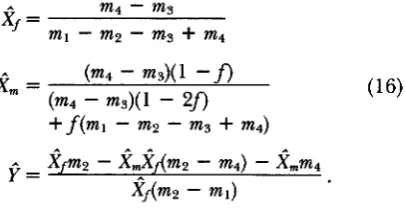
f ) of x gametes. Males with geno- types XY, X y , xY and xy produce X (or x) gametes with frequencies m l , m2, m3, and m4 respectively, and they produce Y (or y) gametes with frequencies ( 1-
m l ) , ( 1-
m),
( 1-
ms), and ( 1-
m4) respectively. T h e recursion equations are constructed by considering the frequencies of the gametes produced by females and males:x;
= X f X ,+
[X,( 1-
X,)+
X f ( 1-
X m ) ] fx;
= Xfyml+
X f ( l-
Y)m2 XfYml+
X f ( 1-
Y)m2 -k ( 1-
X,>Ym3XfY(1
-
m l )+
( 1-
X/)Y(l-
m3) XfY(l-
m l )+
Xf(1-
Y)(1-
m2) ‘+
( 1-
X,)Y(l-
m3)+
( 1-
xf)(1-
Y ) ( 1-
m4) y‘ =T h e Jacobian matrix for this system of equations evaluated at the trivial equilibrium X f A = X , A = Y A = 0 is
.
( 1 3 )1
00
( 1
-
m3)/(1-
m4)f
J =
m 2 h 00
[:
From the characteristic equation of this matrix we get the following two conditions which must both be satisfied for this equilibrium to be stable:
7%
>
m4,and ( 1 4 )
f[l (me/m4)]
<
1 .T h e local stability conditions for the remaining fixa- tion equilibria are:
Equilibrium Stability Conditions
A A A
Xf=
X , = 0 , Y = 1+
( m l h ) ]<
1( 1 5 ) X f = X , = l , Y = O m l > m 2 a n d ( 1
-f)
* [ I
+
(%/me)]<
1X,=X,=Y= 1 m2
>
ml and ( 1-f)
.[1
+
(m3/ml)]<
1 . m4>
m3 and f [ lA A A
Y-Linked Polymorphism 573
All four corner equilibria can be simultaneously un- stable, and when they are there exists an interior equilibrium at
T h e Jacobian matrix evaluated at this equilibrium can be simplified somewhat because d Y ’ / d Y = 1 . T h e characteristic equation is
+
J 1 2 J 2 3 J 3 i-
J 1 2 J 2 1 = 0.This equation yields one negative real root and a pair of conjugate complex roots, but the real part of the imaginary roots is always greater in magnitude than one. This means that the interior equilibrium is always unstable, and that the trajectory of chromosome fre- quencies when perturbed from this equilibrium is an expanding spiral (Figure 3). T h e meiotic drive model can have the unusual property of all fixation points unstable and a unique unstable interior. T h e usual condition for “protected polymorphism” is met, and yet no stable polymorphism exists. T h e actual popu- lation trajectory cycles to frequencies arbitrarily close to fixation, so even though the fixations are unstable, the biologically meaningful interpretation of this model is that it cannot maintain a polymorphism.
X-
and Y-linked meiotic drive and viability: T h e final model to be considered allows pleiotropic effects on the X and Y chromosomes such that both meiotic behavior and viability differ among genotypes. T h e parameterization that will be used is the same as in the previous two models, only now we have both components of selection operating each generation. Recurrence equations can again be expressed in terms of the frequencies of the X and Y chromosomes in male and female gametes. T h e recurrence equations are:XfXmV,
+
[ X m ( l-
X f )+
X f ( 1-
X m ) ] f v *$/
x;
=x:,
= X f Y m l v 4+
X A l-
Y)m2v5G m x
XfY( 1
-
m 1 ) v 4+
( 1-
Xf)Y( 1-
m 3 ) v ~ y’ =W m y
I 0
0
x m
FIGURE 3.-Dynamics of chromosome frequencies under the
pure meiotic drive model. For this simulation, m1 = 0.15, m f = 0.81, ms = 0.13, m4 = 0.07 andf= 0.34. This case has four unstable cfrner equiFbria and an unstable interior equilibrium located at
X, = 0.15,Xf= 0.083333, Y = 0.868182 (indicated by “+”).
where
Wf
= X,X,vl+
[Xm( 1-
X / )+
Xf( 1-
+
( 1-
Xf)(1-
Xm)v3W m , = XfYmlv4
+
Xf( 1-
Y)m2v5+
( 1-
xf)Ym3v6+
( 1-
X f ) ( 1-
Y)m4v7 andW m y = Xfy7.4 1
-
m l )+
x / ( 1-
Y)v5( 1-
m2)+
( 1-
xf)Yv6( 1-
m3)+
( 1-
x/)(
1-
Y)v7( 1-
m4). This recurrence system has the same four trivial equi- libria as the previous two models. T h e Jacobian at the first fixation equilibrium(if
=im
=9
= 0) isO 1
c”
2€
v3 v3
0 m2v5 J =
T h e characteristic equation factors, as in
( 7 ) ,
to( J S I
-
X ) ( X 2-
J i i X-
J 1 2 J 2 1 ) = 0.(20)
Local stability is assured when the largest eigenvalue is less than one, and this occurs when the following
t w o conditions are met:
Equilibrium Stability Conditions
1 1 A
X , = X , = O , Y = 1 2 1 4 1
-
1114)<
-
m3)* A
X , = X m = 1 , Y = O
All four of the fixations can be simultaneously unsta- ble, but when they are the existence of an interior equilibrium is not guaranteed. There can exist aApair
of edge equilibria with
?
= 0 andf
= 1 . Setting Y = 0 and solving the resulting recursion we get:m4u3u7
-
f(m27~5+
m4U7h2i -
-
m2uIu5+
m4u3u7-
(m2u5+
m4u7)u2A (23)
The other edge equilibrium is found at:
Y = 1
(24) m3u3u6
-
f ( m l v 4+
m3u6)~2i -
f - mlulu4
+
m m u 6-
(mlu4+
m m ) u 2There are two conditions that must be satisfied for these equilibria to be stable. The first is that both the numerator and denominator of the respective must be less than zero. This implies that heterozygotes must have the largest harmonic mean fitness (compounding viability and meiotic drive), where the fitness of “het- erozygous” males is the average of the two male types. Note that existence of the equilibria (23) and (24)
requires either this kind of “overdominance” or else “underdominance,” where in the latter both numera- tor and denominator of ?;are greater than zero. T h e second condition that must be met to assure the sta- bility of (23) is:
2fu4(1
-
m l )+
( 1-
gf)u6(1 - m3)<
1 . ifuS(1-
m 2 )+
( 1-
i;)u,(1-
m4>For (24) to be stable, the second condition is the same (25)
as (25) but with the inequality reversed. Condition (25) precludes the invasion of the rare Y chromosome. Whenever an interior equilibrium exists, it is unique, but unlike the pure drive model, it is not necessary that all four corners be unstable in order for the interior to exist. By setting the Yecurrence equation Y’ = Y , we can solve directly for Xf, and this can be used to solve the remaining variables at the interior equilibrium:
X f =
x,
=Y =
u7(1
-
m4) - vS(l-
m3) u4(1-
m l )-
ug(1-
m2)-
US(^-
m3)+
u7(1-
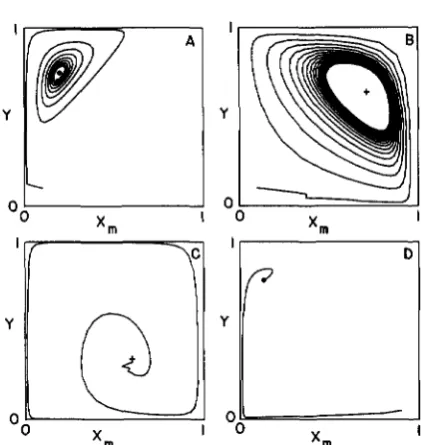
m4)T h e Jacobian of the recurrence system evaluated at this point yields a characteristic equation of the same form as the meiotic drive model, since dY’/dY = 1 . In all cases the characteristic equation will have one negative real root. The other roots may (1) both be real and less than one, giving a stable interior point; (2) both be real and greater than one giving an unsta- ble point; (3) be complex with real part less than one in modulus, giving a stable point with spiral approach; or (4) be complex with real part greater than one, giving an unstable point or a stable limit cycle. Figure
4 illustrates the range of frequency dynamics that are possible under this model.
Y-Linked Polymorphism 575
FIGURE 4.-Examples of the dynamical behavior of the model with joint effects of viability and meiotic drive due to both the X and Y
chromosomes. The parameter values are:
A 0.082 0.448 0.277 0.474 0.636 0.281 0.644 0.850 0.036 0.395 0.895 0.361
B 0.550 0.948 0.933 0.145 0.294 0.334 0.496 0.019 0.996 0.172 0.095 0.484
C 0.790 0.710 0.890 0.320 0.300 0.780 0.370 0.500 0.770 0.850 0.210 0.580
D 0.510 0.950 0.230 0.510 0.880 0.100 0.980 0.380 0.450 0.100 0.930 0.180 Panels A and D have unique stable interior points, B shows a stable cycle, and C has a unique unstable interior point.
TABLE 1
Numerical simulations of models of Y chromosome selection: 100,000 random initial conditions were simulated for each
Meiotic drive Viability Drive and
Result only only viability
Fixation“ 100,000 68,923 68,427
X polymorphism 0 31,077 30,116
X
+
Y polymorphism 0 0 1,114Stable cycle 0 0 343
__
a A chromosome frequency exceeds 0.99999.
The conditions for the maintenance of a stable inte- rior point are rather stringent in the sense that not many random combinations of parameters will satisfy the conditions.
DISCUSSION
T h e four models presented above provide some understanding of the potential for natural selection to maintain polymorphism of the Y chromosome. T h e results provide a compelling argument concerning the maintenance of Y-linked variation: because it is so “difficult” for selection models to maintain Y polymor- phisms, it seems unlikely that such polymorphisms are maintained by balancing selection. A similar argument was also made for the low likelihood of adaptive polymorphism in mtDNA (CLARK 1984). T h e obser-
vation of mtDNA and Y-DNA variation then suggests that if the polymorphisms are maintained by natural selection, it is not through simple constant fitness models. T h e Y-linked color polymorphisms in poeciliid fish (KALLMAN 1970), which have three sex-determin- ing chromosomes, may involve an implicit frequency dependence (ORZACK et al. 1980). T h e fact that the Y-autonomous model can never maintain a polymor- phism suggests that either Y-linked variation is neutral, that it involves frequency dependent fitnesses or geo- graphic structuring, or that it interacts with another chromosome. T h e potential of interaction with the X
chromosome was explicitly explored with the remain- ing three models.
T h e second model allowed segregation of two X
chromosomes and two Y chromosomes, and each re- sulting genotype could have a specified viability. Di- rect solution of the stability of the unique interior equilibrium showed that this model could never main- tain a stable polymorphism of the Y chromosomes. Recombination between a sex-determining locus and a locus that confers differences in viabilities can, how- ever, stabilize internal polymorphisms (A. G. CLARK,
maintain an X polymorphism, and at such a poly- morphic equilibrium, there need not be an excess of female heterozygotes (BENNETT 1957, HALDANE and JAYAKAR 1964, CANNINGS 1967). T h e trajectory of mean fitness can show damped oscillations if there is a difference between Xfand X,, but along the Y = 0 and Y = 1 edges, the harmonic mean fitness is maxi- mized. This analog to the fundamental theorem of natural selection has been described for the X chro- mosome (HARTL 197 1, 1972).
Regulation of the regular meiotic disjunction of sex chromosomes is particularly important because of the influence on sex ratio. Most of the theoretical interest in meiotic drive of sex chromosomes has focused on X-linked factors that modify segregation. An impor- tant result of this work is that modifier alleles that distort segregation can increase in frequency, so that Mendelian segregation of sex chromosomes is unsta- ble with respect to the invasion of such modifier alleles (EDWARDS 196 1 ; THOMSON and FELDMAN 1975). T h e observation of Y-linked meiotic drive in Aedes aegypti (HASTINGS and WOOD 1978) and Y-dependent segre- gation variation in Drosophila melanogaster (CLARK 1987) further motivates the study of Y-linked segre- gation modifiers. MAFFI andJAYAKAR (1 98 1) analyzed a two-locus model with one locus determining sex and the other determining segregation. When there is no recombination between these two loci, their model is the same as our second model except that we allow meiotic drive in heterozygous females. The dynamics of the two models is qualitatively the same: no poly- morphism is possible, but all four fixation equilibria can be simultaneously unstable. When the four cor- ners are unstable, there exists a unique unstable inte- rior equilibrium, and the system shows diverging cy- clical dynamics. KARLIN and LESSARD (1986) show that a stable interior equilibrium is possible in a one- locus multiple allele Y-drive model if the frequency of sib-mating is sufficiently high.
T h e final model allows both viability and meiotic drive to be determined by a pair of alleles at a homol- ogous locus on the X and Y chromosomes. Pleiotropic effects of this type are not unlikely, since many well documented systems of meiotic drive are balanced by deleterious effects on viability. This model can have at most one interior equilibrium, and it is the only model presented that can maintain a stable Y-linked polymorphism. Numerical simulations show however that less than two percent of the parameter space admits such a polymorphism. Experimental data on ribosomal DNA variation on the X and Y chromo- somes of D . melanogaster (WILLIAMS et al. 1987) are broadly consistent with the prediction of the model. There is greater among-continent variation in Y- linked sequences, perhaps due to the more rapid fixation of Y-linked variants, and inability of natural selection to maintain polymorphisms.
Although classical theoretical approaches such as this one are useful in providing a framework for constructing hypotheses about the maintenance of variation, an explanation of Y-linked polymorphism cannot ignore the molecular processes of amplification and gene conversion. There are many additional av- enues to explore the theory of Y chromosome evolu- tion. Most of the interest has centered around the mechanism for generating morphologically distinct sex chromosomes, invoking processes of recombina- tion suppression and gene inactivation on the Y chro- mosome (OHNO 1967; BULL 1983). There is evidence in Drosophila miranda (STEINEMANN 1982) and in snakes (JONES and SINGH 1982) that repetitive DNA “invades” the Y chromosome, although the mechanism is not clear. In a recent review PIMPINELLI et al. (1 986) describe the unusual structure of the D . melanogaster Y chromosome. As in most organisms, it is mostly heterochromatic, but there are six segments that are required for male fertility. These fertility factors are unique among eukaryotic genes in that they span up to 100 kb of DNA. There is clearly a mechanism for homogenizing tandem repeat copies of rDNA, since species differences can be profound, yet there is far greater homogeneity among copies within a species (WILLIAMS, DESALLE and STROBECK 1985). T h e data on sequence organization will have direct impact on the approaches both theoretical and experimental population geneticists take in investigating the evolu- tion of the Y chromosome.
I thank Dr. SCOTT WILLIAMS for discussion and for sharing unpublished data, and Dr. THOMAS RYAN of Minitab, Inc., for donating computer time. This work was supported in part by grants HD-18379 and RCDA HD-00743 from the United State Public Health Service.
LITERATURE CITED
BENNETT, J. H., 1957 Selectively balanced polymorphism at a sex- linked locus. Nature 190: 1363-1364.
BRUTLAG, D. L., 1980 Molecular arrangement and evolution of heterochromatic DNA. Annu. Rev. Genet. 1 4 121-144. BULL, J. J., 1983 Evolution of Sex Determining Mechanisms. Benja-
min-Cummings, Menlo Park, California.
CANNING, C., 1967 Equilibrium, convergence and stability at a sex-linked locus under natural selection. Genetics 5 6 6 13-6 18. CASANOVA, M., P. LEROY, C. BOUCEKKINE, J. WEISSENBACH, C. BISHOP, M. FELLOWS, M. PURRELLO, G. FIORI and M. SINIS- CALCO, 1985 A human Y-linked DNA polymorphism and its potential for estimating genetic and evolutionary distance. Sci- ence 2 3 0 1403-1406.
CHARLESWORTH, B., 1978 Models for evolution of Y chromo- somes and dosage compensation. Proc. Natl. Acad. Sci. USA The relative rates of evolution of sex chromosomes and autosomes. Am. Nat. In press.
Selection com- ponent analysis of natural polymorphisms using population samples including mother-offspring combinations. Theor. Pop. Biol. 4: 425-445.
CLARK, A. G., 1984 Natural selection with nuclear and cyto- 75: 5618-5622.
CHARLESWORTH, B., J. COYNE and N. H. BARTON, 1987
Y-Linked Polymorphism 577
plasmic transmission. I. A deterministic model. Genetics 107:
Variation in Y chromosome segregation in natural populations of Drosophila melanogaster. Genetics 115:
COYNE, J. A., 1985 The genetic basis of Haldane’s rule. Nature DARLING, S. M., G. S. BANTING, B. PYM, J. WOLFE and P. N. GOODFELLOW, 1986 Cloning an expressed gene shared by the human sex chromosomes. Proc. Natl. Acad. Sci. USA 83: 135- 139.
The population genetics of “sex-ratio” in Drosophila pseudoobscura. Heredity 16: 291-304.
Necessary and suficient conditions for multiple-niche polymorphism in haploids. Am. Nat. 109 233-235.
HALDANE, J. B. S. and S. D. JAYAKAR, 1964 Equilibria under natural selection at a sex-linked locus. J. Genet. 5 9 29-36.
HAMILTON, W. D., 1967 Extraordinary sex ratios. Science 156:
HAREVEN, D., M. ZUCKERMAN and E. LIFSCHYTZ, 1986 Origin and evolution of the transcribed repeated sequences of the Y
chromosome lampbrush loops of Drosophila hydei. Proc. Natl. Acad. Sci. USA 83: 125-129.
Some aspects of natural selection in arrhen- otokous populations. Am. Zool. 11: 309-325.
A fundamental theorem of natural selection for sex linkage or arrhenotoky. Am. Nat. 106 5 16-524.
Meiotic drive at the D(MD) locus and fertility in the mosquito Aedes aegypti. Genetica 49:
Maintenance of butterfly populations with all- female broods under recurrent extinction and recolonization. J. Theor. Biol. 75: 115-122.
Conserved sex-associated re- peated DNA sequences in vertebrates. pp. 135-1 54. In: Genome Evolution, Edited by G . A. DOVER and R. B. FLAVELL. Academic Press, New York.
Sex determination and the restriction of
679-701.
CLARK, A. G., 1987 143-1 5 1 . 314 736-738.
EDWARDS, A. W. F., 1961
GLIDDON, C. and C. STROBECK, 1975
477-488.
HARTL, D. L., 1971
HARTL, D. L., 1972
HASTINGS, R. J. and R. J. WOOD, 1978 159-1 63.
HEUCH, I., 1978
JONES, K. W. and L. SINGH, 1982
KALLMAN, K. D., 1970
sex-linked pigment patterns to the X and Y chromosomes in populations of poeciliid fish, Xiphophorus maculatus, from the Belize and Sibun rivers of British Honduras. Zoologica 5 5 1- 16.
Theoretical Studies on Sex Ratio Evolution, pp. 186-188. Princeton University Press, Princeton, New Jersey.
A two-locus model for poly- morphism for sex-linked meiotic drive modifiers with possible applications to Aedes aegypti. Theor. Pop. Biol. 19: 19-36.
OHNO, S., 1967 Sex Chromosomes and Sex Linked Genes. Springer, New York.
ORZACK, S. H., J. J. SOHN, K. D. KALLMAN, S. A. LEVIN, AND R. JOHNSON, 1980 Maintenance of the three sex chromosome polymorphism in the platyfish, Xiphophorus maculatus. Evolu- tion 34: 663-672.
PIMPINELLI, S., S. BONACCORSI, M. G ~ r n and L. SANDLER,
1986 The peculiar genetic organization of Drosophila heter- ochromatin. Trends Genet. 2: 17-20.
ROUYER, F., M. SIMMLER, C. JOHNSON, G. VERGNAUD, H. J. COOKE and J. WEISSENBACH, 1986 A gradient of sex linkage in the pseudoautosomal region of the human sex chromosomes. Na- ture 3 1 9 291-295.
Multiple sex chromosomes in Drosophila miranda: a system to study the degeneration of a chromosome. Chromosoma 86: 59-76.
Population genetics of modifiers of meiotic drive. IV. On the evolution of sex-ratio distortion. Theor. Pop. Biol. 8: 202-2 1 1.
WILLIAMS, S. M., R. DESALLE and C. STROBECK, 1985
Homogenization of geographical variants at the nontranscribed spacer of rDNA in Drosophila mercatorum. Mol. Biol. Evol. 2:
WILLIAMS, S. M., G. FURNIER, E. Fuoc and C. STROBECK,
1987 Evolution of the ribosomal spacers of Drosophila melan- ogaster: different patterns of variation on X and Ychromosomes. Genetics. In press.
KARLIN, S. and S. LESSARD, 1986
MAFFI, G. and S. D. JAYAKAR, 1981
STEINEMANN, M. 1982
THOMSON, G. J. and M. W. FELDMAN, 1975
338-346.