Copyright 0 1995 by the Genetics Society of America
Analysis
of
the Multiple Roles
of
gld-I
in
Germline Development: Interactions
With the Sex Determination Cascade
and
the glP-1 Signaling Pathway
Ross
Francis,
*
EleanorMaine
and
Tim
Schedl*
*Department o Genetics, Washington University School of Medicine, St. Louis Missouri 631 I O , and [Department of Biology, Syracuse University, Syracuse, New York 13244
Manuscript received September 19, 1994 Accepted for publication October 20, 1994
ABSTRACT
The Caenorhabditis elegansgene gld-l is essential for oocyte development; in gld-I (null) hermaphrodites, a tumor forms where oogenesis would normally occur. We use genetic epistasis analysis to demonstrate that tumor formation is dependent on the sexual fate of the germline. When the germline sex determina- tion pathway is set in the female mode (terminal fem/’og genes inactive), gld-1 (null) germ cells exit meiotic prophase and proliferate to form a tumor, but when the pathway is set in the male mode, they develop into sperm. We conclude that the gld-l (null) phenotype is cell-type specific and that gld-l (
+
)acts at the end of the cascade to direct oogenesis. We also use cell ablation and epistasis analysis to examine the dependence of tumor formation on the glp-I signaling pathway. Although glp-1 activity promotes tumor growth, it is not essential for tumor formation by gld-I (null) germ cells. These data also reveal that gld-I (
+
) plays a nonessential (and sex nonspecific) role in regulating germ cell prolifera- tion before their entry into meiosis. Thus gld-l (+
) may negatively regulate proliferation at two distinct points in germ cell development: before entry into meiotic prophase in both sexes (nonessential premei- otic gld-1 function) and during meiotic prophase when the sex determination pathway is set in the female mode (essential meiotic gld-I function).0
OGENESIS in multicellular animals represents acomplex developmental program in which the meiotic nuclear cycle and gametogenesis are coordi- nated to produce a functional oocyte. In the preceding paper, we describe the Caenorhabditis ekgans gene gld- I (FRANCIS et al. 1995). The genetic and phenotypic properties of gld-I argue that it is a tumor suppressor gene that regulates oocyte development. Mutations that eliminate gld-I function abolish oogenesis in the her- maphrodite and result in the formation of a germline tumor. Germ cells that give rise to the tumor complete the early stages of meiotic prophase but then exit pachy- tene and return to a mitotic cycle. These cells subse- quently undergo repeated rounds of ectopic prolifera- tion, giving rise to a tumor that fills much of the germline. Tumor formation is a sex-specific phenotype, as gld-1 (null) males show no abnormalities in germline development. Further, gld-I has no essential function in the soma.
The sex specificity of the gld-I tumorous phenotype has led to the proposal that gld-I (
+
) may act as an important regulator of oocyte development (FRANCIS et al. 1995). Tumor formation would then result from afailure of oocyte determination and/or female meiotic prophase progression that allows germ cells to return to mitosis. Data available at present, however, do not
Corresponding author: Tim Schedl, Department of Genetics, Wash- 631 10.
ington University School of Medicine, 4566 Scott Ave., St. Louis, MO
Genetics 139: 607-630 (February, 1995)
exclude the possibility that tumors result from an in- tersexual mode of differentiation. Ovarian tumors in certain Drosophila mutants are comprised of germ cells with intersexual traits ( BAE et al. 1994;
J.
HORABIN, per- sonal communication). In this report, we investigate the basis of the sex-specific tumorous phenotype using genetic epistasis analysis. By constructing mutant com- binations with gld-I {null) and the sex determination genes, we ask whether tumor formation is specifically correlated with the female sexual fate in the germline. The cumulative results suggest that gld-l(+
) acts down- stream of all known sex determination genes to either specify the oocyte fate or direct oocyte differentiation. We also use genetic epistasis to investigate a second previously inferred role of gld-1 in germline develop- ment ( FRANCIS et al. 1995). Although gld-I has no essen- tial role in male germline development, it acts to pro- mote spermatogenesis in the hermaphrodite germline. For several reasons, we are unable to investigate this aspect of gld-1 function using a null gld-l allele. There- fore epistasis tests are done with two classes of gain-of- function alleles that cause transformations in sexual fate in the hermaphrodite germline. The data obtained are consistent with the proposal that gld-I (+
) promotes spermatogenesis by assisting a set of sex determination loci that specify the male fate.tion depends on the gene g&-1, which encodes a transmembrane protein belonging to the lin-l%/Notch family of receptor molecules (AUSTIN and KIMBLE 1987, 1989; YOCHEM and GREENWALD 1989). glp-1 protein acts as the likely receptor for a somatically derived signal that induces germ cell proliferation (AUSTIN and KIM- BLE 1987; CRITTENDEN et d . 1994). we examine the dependence of germ cell proliferation in gld-1 (null) mutants on the glp-1-mediated signaling pathway in two types of experiments: by ablating certain sets of somatic cells to eliminate the somatic signals and by analysis of
gld-1 (nul1);glp-I
(y)
mutant combinations to eliminate the germline receptor. These experiments confirm the meiotic prophase origin of the tumorous phenotype and indicate that gld-I (+
) has an additional, nonessen- tial and/
or redundant function in negatively regulating proliferation of germ cells before their entry into the meiotic pathway.MATERIALS AND METHODS
Nematode culture and strains
General methods for C. ekguns culture and genetic manipu- lation were as described ( BRENNER 1974; SULSTON and HODG KIN 1988). Experiments were done at 20” unless otherwise noted. C. elegans nomenclature follows HORVITZ et ul. ( 1979) .
Zf
is used for loss-of-function, 0 is used for a null allele that has been shown to fail to produce a gene product, g f is used for gain-of-function, gld-1 (Turn) is used to identify alleles with a tumorous XXgermline (Tum) phenotype, gld-1 (Fog) is used to identify alleles with a feminization of the germline (Fog) phenotype and gZd-1 ( M o g ) is used to identify alleles with a masculinization of the germline (Mog) phenotype. Maternal and zygotic genotypes are indicated using the notation m ( -or
+
) and z ( - or+
) , where m represents the maternal genotype and z the zygotic genotype. All nematode strains used in this work are derived from the wild-type C. elegansvur. Bristol isolate N2. The following genes and mutations, described in HODGKIN et al. (1988), the C. ekguns genetic map (J. HODGKIN, R. DURBIN and M. O’CAI.LAGHAN, personal communication) or the cited references, were used:
LGZ fog-1 (q180 and q187) (BARTON and KIMBCE 1990), unc- 11 (e47), dpyy-5(e6I), dpy-l4(el88), unc-l3(e51 and e1091), gld-1 (all alleles) (FRANCIS et al. 1995), fog-j(q443) (ELLIS and KIMBLE 1995).
LGII dpy-lO(e128), tru-2(e1095), tra-2(q122gf) (SCHEDI. and KIMBLE 1988) , unc-4 (e120).
LGZZZ fm-2(e2105), rnog-1 (q370) (GRAHAM ~ ~ ~ K I M B L E 1993),
unc-69(e587), tra-1 (e1834) and tra-1 (e1575gf) (HODGKIN 1987), unc-32(e189), glpl [see text and Table 4, all de- scribed in AUSTIN and KIMBLE (1987) and/or KODOWNI et al. (1992)].
LGN: dpy-13 (e458sd), fun-1 ( e l 991, e2003ts), unc-5 (e53), unc- 24(e138), fern-3(e1996), fern-3(q20gf and q95gf) (BARTON
et al. 1987), dpy-20(e1282), tra-3(el107), tra-3(bn75) (E. CAPOWSKI, B. BRENDZA and S. STROME, personal communi- cation).
LGV: her-1 (ylOlhvl), unc-42(e270), fog-Z(q71). LGX lon-2(e678).
Rearrangements: hT2(Z) [ bli-41; hTZ(ZZZ) [ dB-181 ( M C I M et al. 1992), nDp4(l;V) ( MCKIM et ul. 1992).
Construction of double mutants between gld-1 alleles and mutations in the sex determination pathway
Tables 1 and 2 describe the phenotypes of double or triple mutants made between gld-l (Turn, Fog or Mog) alleles and mutations in the major sex determination loci. Except where noted below, all doubles requiring a gld-1 (Turn) allele were made both with the null allele q485 and with the strong
Zf
allele q268; identical phenotypes were observed in double mutants containing these gld-l(Turn) alleles. In many con- structions, gld-1 alleles were marked with unc-13, which lies -0.2 map units to the left of gld-1 (FRANCIS et al. 1995). In cases where the progeny segregating from a balanced strain were analyzed, the genotype of the balanced strain was veri- fied by complementation tests. For mutations in the sex deter- mination genes, we use Zfto indicate that the allele is putative null or strong loss-of-function. Other types of alleles are indi- cated. At least 50 animals of the appropriate genotype were examined for each double or triple mutant constructed.fog-1 (If) gld-1 (Turn or Mog): Double mutants of fog-l (Zf)
allele q180 were made using each of three gld-1 (Turn) alleles
( q268, q365 and q485), as well as each of three gld-1 (Mog)
alleles ( ozl0, 0230 and q9?)
.
To make recombinant fog-1 unc- 13 gld-1 chromosomes, we picked female Unc-13 nonDpy-5 recombinants segregating from fog-1 (q180) d@-5 unc-l3/unc- 13 gld-1 (Turn or Mog) hermaphrodites. The resulting fog-1 unc-13 gld-1 chromosomes were maintained balanced overhT2. Double mutants between a second fog-1 allele (q187)
and two gld-1 (Turn) alleles ( q268 and q365) and the Mog allele q93 were constructed by picking nonUnc-11 female progeny segregating from fog-1 unc-11 /unc-l3 gld-l hermaph- rodites; the recombinant chromosome was balanced over
hT2. fog-1 unc-13 gld-1 X0 males were generated by crossing fog-1 unc-13 gld-l/hT2 or
+
males to fog-1 unc-l? gld-I/hT2hermaphrodites.
gld-1 (Turn or Mog) fog-3(If): Double mutants with fog-j(Zf)
were constructed using fog-3(q443) and the gld-l tumorous allele 9485 and the Mog allele q93. Recombinant unc-13 gld- 1 fog-3 chromosomes were generated by picking recombinant nonUnc nonDpy females segregating from unc-13 gld-l /dpy- 14 fog-3 hermaphrodites. Balanced unc-13 gld-1 fog-?/hT2
strains were used as the source of homozygous unc-13 gld-1 fog-3 animals. Males of the same genotype were generated by
crosses.
fog-1 (If) gld-1 (Turn) fog”3(If): A balanced triply mutant strain of the genotype fog-1 (q180) unc-13 gld-1 (q485) fog- ?(q443)/hT2 was constructed as follows. Self-progeny of het- erozygous fog-1 dpy-5/unc-l? gld-l fog-3 hermaphrodites were screened for female recombinants that were nonDpy-5 and nonUnc-13. To identify recombinant females of the desired genotype (fog-1 unc-13 gld-1 fog-3/fog-l dpy-5, resulting from recombination in the fog-l dpy-5 interval), single females were crossed with unc-l3/hT2 males. Only animals heterozygous for a recombinant fog-1 unc-13 gld-1 fog-3 chromosome pro- duced X0 Unc-13 male progeny (genotype fog-1 unr-13 gld-1 fog-?/unc-13) that display the semidominant fog-1
/+
male germline phenotype (production of sperm and then oocytes) (BARTON and KIMBLE 1990). For three females that segre- gated such males, single XX L4 cross-progeny were picked onto individual plates to identify candidate fog-1 gld-1 unc-13 fog-3/hT2 strains. Genotypes of these balanced strains were confirmed by using complementation tests to show that each was heterozygous for fog-1 (Zf), gld-1 (Turn) and fog-j(Zf).fog-1 (If) fog-3(If): XXanimals of the genotype fog-1 (q180) unc-13 fog-j(q443) were obtained from a balanced fog-1 unc-
13 fog-?/hTZ hermaphrodite strain constructed as follows. NonUnc nonDpy female recombinants segregating from fog-
Multiple gld-1 Functions 609
the desired genotype (fog-1 unc-I? fog-3/fog-l dpy-5) were identified based on their segregation of X 0 Unc-13 male cross-progeny (genotype fog-I unc-I? fog-?/unc-13) that dis- play the semidominant fog-I
/+
male phenotype (production of sperm and then oocytes). From such crosses, single non- Unc-13 XXcross-progeny were picked onto separate plates to identify candidate fog-I unc-I? fog-3/hT2 animals. The geno- types of three independently isolated strains were then con- firmed by showing that each carried mutations that fail to complement fog-I and fog-3 mutations. Like fog-1 and fog-3single mutants, XX and X 0 fog-I unc-I? fog-? animals have germlines that make only oocytes and show no obvious defects in proliferation or meiotic development.
gld-1 (Tum or M o g ) ; f a - 1 (I f ) : fern-I ( e l 991), an amber al- lele ( DONIAGH and HODGKIN 1984), was used for the con- struction of double mutants with gld-I (Tum) alleles ( 9485 and
q268) and with gld-1 (q93). Approximately 25% of the Unc- 24 self-progeny of gld-1 (Tum)
/+;
fern-I unc-24/+ hermaphro- dites were Tum, indicating gld-l (Turn) is epistatic to fern-I.Construction of unc-I3 gld-1 (Mog);fern-I unc-24 animals was facilitated by the property that fern-1 XX animals produced by fern-1
/+
mothers are often self-fertile hermaphrodites owing to maternal rescue. Therefore, Unc-24 hermaphrodites segre- gating from unc-I? gld-I (Mog)/+;fem-1 unc-24/+ mothers were picked onto separate plates. Some hermaphrodites seg- regated broods consisting of three fourths female Unc-24 and one fourth sterile Unc-13 animals (unc-I3 is epistatic to unc- 24) of the genotype unc-13gld-1 (q9?); fm - I unc-24. Heterozy- gosity for gld-I (q93) appears to increase the fraction of XXfern-1 (If) [ m (
+
/ - ) z ( - / - ) ] animals that make sperm, butthis effect was not quantitated.
gkl-1 (Tum or M o g ) ; f a - 2 ( I f ) : gld-l (q485) or gld-I (q93); fern-2 double mutants were constructed at 25” using fem-
2(e2105), a strong fern-2(q) allele that is maternally rescued
( HODCKIN 1986). Hermaphrodites segregating from unc-l? gld-I (Turn or Mog)
/+;
fem-2/+ mothers were picked onto sep- arate plates. Maternally rescued unc-13 gld-I/+; f m - 2 her- maphrodites segregated a 3:l ratio of nonUnc females and sterile Unc-13 progeny of the genotype unc-13 gld-1 (Turn orMog) ;fem-2.
gld-1 (Tum);fm-jr(If): Doubles of gld-I (q268or q485) with
fern-? ( I f ) were made using e l 996, afem-3 ochre nonsense allele
( HODCKIN 1986; AHRINCER et al. 1992). Approximately one fourth of the Unc-24 progeny of gld-1 (Turn)/+;unc-24 fern-3
XX animals had a Tum germline.
To generate X 0 gld-I (Turn); fern-3(If) animals, single gld-
I (q485)/+;unc-24 fern-3(el996)/+ XUmales were mated with
gld-1 (q485)/+;unc-24 fern-J(e1996);lon-2 XX females. These crosses yielded Unc-24 Lon-2 XU hermaphrodites. About one half of these had a Tum germline.
$1 (Turn);Em-2(~);fa-jr(If): XXanimals of the genotype
gld-1 (q485);dfiIO tra-2(e1095);unc-24 fern-?(el996) were iden- tified among the self-progeny of gld-1 (Tum) /+;dpy-10 tra-2,’ +;unc-24 fern-?/+ hermaphrodites. Approximately one fourth of the Dpy-10 Unc-24 self-progeny were tumorous, showing that the gld-I (Tum) phenotype is expressed in a tra-2( If); fern- ?(If) background.
gEd-1 (Mog);fem-3(If): Double mutants of fern-J(e1996)
were constructed with gld-1 (Mog) alleles representing each
gld-l (Mog) subclass ( C l , q9?; C2, 0~30; C3, o z l U )
.
In construc- tions with the C 3 allele ozZU, it was initially found that o z l 0can suppress the XX Fog phenotype of fern-3(@ [ m(
+/
- )z ( - / - ) ] animals [ X X fern-3 ( I f ) is not normally rescued by
maternal fern-3(
+
) activity (HODGJSIN 1986)1 .
Thus gld-1 (ozIO);unc-24 fern-?(el996) dpy-20/+ mothers segregated many self-fertile Unc-24 Dpy-20 progeny that were subse- quently shown to be homozygous for both ozlOand f m - 3 ( I f ) .
Homozygosity
for fern-3
( I f ) was indicated by their segregationof only female progeny and homozygosity for 0210 was deter- mined by testing females for failure to complement gld- I (q268). These results indicate that o z l 0 can restore sperma- togenesis in fern-?(If) [ m ( + / - ) z (
- / - - ) I
but not fern-3 [ m ( - / - ) z ( - / - ) ] animals. Suppression by 0210 was-40% penetrant. The C1 and C2 gld-1 (Mog) alleles q93 and oz30were also found to sometimes restore spermatogenesis in
fim-3 [ m (
+
/ - ) z ( - / - ) ] XX animals. However, althoughsperm are often made in C1 or C2 XXgld-1 (Mog);unc-24fern-
? ( e l 996) dpy-20 animals produced by heterozygous mothers, these animals are always sterile because oocytes are never made (see RESULTS). The C1 allele, q9?, restored spermato- genesisin56%of&rn-?(If) [ m ( + / - ) z ( - / - ) I gonadarms and the C2 allele restored spermatogenesis in 44% of gonad arms.
To generate gld-1 (q93 or oz3O);fem-?(If) animals that lack maternal fern-? activity, we crossed unc-I? gld-I (Mog)
/+;
fern- 3(If) dpy-20/+ males with unc-13 gld-l(Mog)/+;unc-24 fern- 3 ( @ dpy-2Ofemales. From these crosses > 100 Unc-13 Dpy-20 progeny were picked and their germline phenotype scored. Almost all ( > 9 7 % ) animals failed to make sperm and had germlines that contained only undifferentiated germ cells. The remaining animals made excess sperm in both gonad arms, indicating they were gld-I (Mog);unc-24 fern-? dpy-20/dpy-20 recombinants.
gEd-1 (Tum);her-1 ( I f ) : Double mutants with her-I were con- structed using her-1 ( y l o l h v l ) , a deletion allele that removes most of the her-1 coding region (TRENT et al. 1991). To generate XX gld-1 (q485);her-I (If) animals, heterozygous
gld-l (Turn)
/+;
her-1 (lf) unc-42/+ hermaphrodites were made and allowed to self. Approximately one fourth of the Unc-42 self-progeny had a Tum germline. To make XU gld-1 (q485);her-I (If) hermaphrodites, XOmales of the genotype
gld-I (Turn)/+; her-1 (If) unc-42/+ were crossed to @-I (Turn) /
+;dpy-ll hm-I (If) unc-42;lon-2 hermaphrodites. nonDpy-11 Unc-42 Lon-2 animals, which must be X 0 cross-progeny, were picked en masse and their germline phenotype scored. About one fourth of the Unc-42 Lon-2 animals were Tum.
gld-1 (Tum);tra-1 ( I f ) : tra-1 (e18?4), a deletion allele that re- moves most of the tra-1 coding region ( ZARKOWER and HODG KIN 1992), was used to construct a gld-1 (q485);tra-l ( I f )
double mutant. unc-I? gld-I (Turn) /+;tra-1 (If)/+ XX hetero- zygotes were constructed and their Unc-I3 self-progeny with a male soma [of the genotype unc-13 gld-1 (Tum);tra-1 ( I f ) ]
were examined. Like the tra-l(e1834) single mutant, these animals have a completely male nongonadal soma and a go- nadal soma that is sometimes male and sometimes morpho- logically abnormal. Germline phenotypes were scored only in animals whose somatic gonad showed no obvious morphologi- cal abnormalities.
gld-1 (Tum);tra-1 (gf): The tra-l (gf) allele e1575gf trans- forms both XX and XU tra-l (@/+ animals into females
( HODCKIN 1987). However, whereas XX tra-l
(d)
/+
animals are morphologically normal females, X 0 tra-1 (gf)/+ females have an abnormal, truncated tail. Therefore XXand X0 tra-1 (gf)
/+
females can be distinguished by tail morphology. To generate double mutants, unc-13gld-I (q485or q268)/+
males were crossed with single unc-I? gld-l(q485 or q268)/+;tra-1
(&/+
XX females. All Unc-13 cross-progeny were somatic females and had a Tum germline. The Tum animals included X 0 somatic females with a truncated tail [ XU unc-13 gld-1; tra- 1 (gf)/+ ] and XX somatic females with a normal tail [ 50%unc-I3 gld-I; tra-l (gf)/+ and 50% unc-13 gld-I]
.
ined XXUnc-13 pseudomales, 100% of which should be unc-
I? gld-1 (Tum) ; tru-2 ( I f ) in genotype.
gld-1 (Tum);tmS (sf): The tru-2(gf) allele q122g f domi- nantly eliminates spermatogenesis in X X but not X 0 animals
( SCHEDL and KIMBLE 1988). To generate XXgld-1 (q485);tru- 2(gf) animals, single gld-1 (Tum)/+;tru-2(gf) unc-4/+ males were crossed with single females of the same genotype. From crosses that gave nonUnc tumorous progeny, Unc-4 cross progeny were scored. Of the X X unc-4 tru-2(gf) cross-progeny with a female soma, one fourth had a Tum germline. In con- trast, all X 0 unc-4 tru-2(gf) animals with a male soma had a normal male germline.
gld-1 (Turn);tmd(If): Double mutants of gld-1 (q485) were constructed with two tru-? alleles, e1107and bn75. e1107is an amber allele that transforms X X tru-? [ m ( - / - ) z ( - / - ) ]
animals grown at 25" into pseudomales that have a partially masculinized soma and germline ( HODGKIN 1980). bn75 is an unusual temperature-sensitive tru-? allele; it has no major effect on the XXfemale soma but masculinizes the germline more strongly than do tru-? amber alleles (E. CAPOWSKI, B. B R E N D Z A ~ ~ ~ S. STROME, personal communication) . The phe- notype of double mutants with both tru-? alleles were analyzed at 25". We first generated X X unc-13 gld-l(q485)/+;tru-3 [ m(
+
/ - ) z ( - / - ) ] animals that, owing to maternal rescueby tru-? (
+
) activity, are self-fertile hermaphrodites. These segregated one fourth Unc-13 animals that are genotypicallyunc-l? gld-I (Tum);tru-3.
gld-1 (Turn) ; rnog-1 ( I f ) : The X X gld-1 (q485) ; mog-1 (q3 7 0 )
double mutant was examined at 25", the temperature at which the mog-1 ( I f ) phenotype is strongest (GRAHAM and KIMBLE 1993). Startingwith gld-1 (Tum)/+;mog-1 unc-69/+ hermaph- rodites, we scored all XXmog-1 unc-69 self-progeny, one fourth of which should be homozygous for gld-I (Tum). For the data in Table 1, the percentage of total mog-I unc-69 animals that showed ectopic germline proliferation was multiplied by four to obtain an estimate ( 7 % ) of the fraction of gld-1 (Tum);mog- 1 unc-69 animals with ectopic proliferation. This number was subtracted from 100 to estimate the percentage gld- 1 (Tum);mog-I unc-69 animals with a Mog phenotype like that of the mog-1 single mutant ( i e . , excess sperm, no ectopic proliferation )
.
gld-1 (Turn);fm4(gf): The fem-3(gf) alleles q2Ogf and
q95g f confer a temperature-sensitive Mog phenotype in which animals grown at 25" produce only sperm, whereas animals grown at 15" usually ( q20gf) or sometimes ( q95gj) make both sperm and oocytes (BARTON et ul. 1987). Double mutants of fm-3(q2Ogf and qY5gf) with gld-l(q485 and q?65) were obtained from strains of the genotype unc-13 gld-1 (Tum);fem- ?(gf);nDp4/+ that were maintained at 15". These strains were made by first constructing unc-I? gld-I (Tum) /+;fern-? (gf) /
dpy-2O;nDp4/+ heterozygotes at 15". Starting with these het- erozygotes, we first identified unc-13gld-I (Tum);nDp4/+ her- maphrodites based on their segregation of -55% Tum ani- mals. Animals homozygous for fern-?(@) were identified by following elimination of dpy-20. For the data in Figure 1 and Table 1 , unc-I? gld-1 (Turn); fern-? (gf) X X animals were picked as newly hatched L1 larvae and grown for 58 hr at 25".
Dominant suppression of fog-2 ( I f ) and &a-2 (sf) mutations by a gZd-1 (Mog) allele
The gld-1 (Mog) allele q93was shown to dominantly suppress the female self-sterile phenotypes of X X fog-2(q71) and X X tru-2(q122gf) animals. For fog-2(If), X X unc-13 gld-1 (q93)/ +;fog-2(@ rol-9 are hermaphrodite in contrast to fog-2(q71)
animals, which are always female. However, X X unc-13 gld-
1 (9?); fog-2 rol-9 homozygotes have a Mog phenotype like that of XXgld-1 (q9?) animals, showing that gld-l (qY?) is epistatic
to fog"2(If). Therefore gld-I (q9?) cannot masculinize the X X
germline by acting through fog-2 (
+
) .Dominant suppression of tru-2(gf) by gld-1 (q9?) was dem- onstrated by showing that X X unc-l? gld-I (q9?)/+;tru-2(gf)
animals are self-fertile hermaphrodites instead of females. These hermaphrodites segregate sterile unc-l? gld-1 (Mog); tru- 2(&) progeny that first make sperm and then undifferenti- ated germ cells.
Double mutants with the gZd-1 fog allele q126
X X double mutants of the genotypes gld-1 (q126);tru- 1 (e18?2) and gld-1 (q126);tru-2(e1095) were obtained as X X
self-progeny from unc-I? gld-1 (q126)/+;tru-l/+ or gld- 1 (q126)/+;tru-2/+ hermaphrodites. X X Unc-13 Tra-2 pseu- domales and X X Unc-13 Tra-1 males were picked and their germline and somatic phenotypes examined. The double mu- tant unc-13 gld-1 (q126);tru-?(e1107) was examined at 25". Unc-13 pseudomales segregating from unc-13 gld-1 (q126)/
+;tru-? [m( - / + ) z ( - / - ) ] mothers were examined for germline and somatic abnormalities. gld-1 (q126) has no obvi- ous effect on the male somatic phenotypes of X X tru-1, tru-2
or tru-3 mutants. Finally, a homozygous gld-1 (q126);unc-24 fem-?(q20gf) dpy-20 hermaphrodite strain was constructed by virtue of the ability of gld-1 (q126) to suppress the sterile Mog phenotype of fem-?(q2Ogf) animals grown at 25". Specifically,
X X gld-I(q126)/+;unc-24 fem-?(q20g;f) dpy-20/+ heterozy- gotes grown at 25" segregated many self-fertile Unc-24 Dpy- 20 hermaphrodites. Several of these hermaphrodites were shown to contain both gld-1 (q126) and fern-?(@) by the inde- pendent segregation of both types of mutations after outcross- ing with wild-type males.
Construction of strains mutant for gld-1 and g&-1
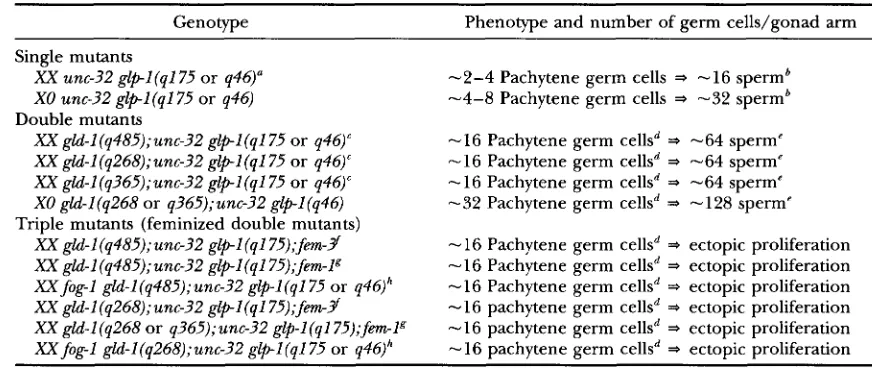
gld-1 (Turn);gZp-1 double mutants: Table 4 and Figure 8 de- scribe the different gld-l (Tum) ;glpl ( 0 or I f ) genotypes exam- ined in this work. For each, we constructed balanced heterozy- gous strains of the general genotype gld-I (Tum)/hT2(Z);unc- ?2glpl/hT2(ZII). Owing to hT2(I)[bli-4];hT2(IZI) [dpy-18]-
induced pseudolinkage, these heterozygotes segregate Unc- 32 self progeny that are essentially always of the genotype gld- 1 (Tum);unc-32 glpl. The gld-I (
+
) ; glpl (+
) control animals used for comparison in all experiments were the Unc-32 self- progeny of unc-32/hT2 hermaphrodites. During passaging, the hT2 chromosome JZII pseudolinkage was found to occa- sionally break down: if a single nonUnc tumorous animal or a nonDpy Bli4 animal was observed, the plate was discarded. To construct balanced strains heterozygous for gld-1 (Tum)and g l p l alleles, gld-l/hT2 males were crossed with unc-32 glp-1 / h T 2 hermaphrodites. Of the resulting male progeny, one half were heterozygous for hT2, whereas one quarter had the desired genotype of gld-I /+;unc-32 glp-I/+ . Single males were crossed with hT2 [ bli-4;d@-18] hermaphrodites; sires that produced no Dpy-18 ( h T 2 ) male cross-progeny were identified as being gld-l /+;unc-?2 g l p l / + . From these crosses, 25 or more L4 X X cross-progeny were picked onto separate plates and their self-progeny inspected in the follow- ing generation. In most cases, balanced gld-1 (Tum)/hTZ;unc- 32 glpl (O)/hT2 strains were easily identified because their
Multiple gld-I Functions 61 1
primers that bracket the 260 bp of glpl sequence that is deleted by q172 ( KODOYIANNI et nl. 1992). The glpl DNA fragment amplified from gld-I (Tum);unc-?2 glp-1 (ql72) ho- mozygotes showed the expected size reduction (compared with gld-I(Tum);unc-?2 control animals), confirming that these animals were homozygous for ql72.
gZd-1 (Tum);glp-I ( 0 or
y)
males and masculinized X X ani- mals: Several balanced gld-I (q485)/hT2;unc-?2 glp-l(0 or lf) /hT2 strains were maintained as X 0 male / X X hermaphro- dite strains to provide a source of X 0 double mutants. The male germline phenotypes of different gld-I (q485);glp-I (Uor lf) double mutants varied depending on the allele, ranging from a Glp phenotype [ for the glp-I ( 0 ) alleles q46 and ql75and the strong If allele q224] to essentially wild type [for the strong lfallele q1721. In addition, we examined X X g l d -
1 (q485);glp-I ( q I 72 or q224) animals that were homozygous for fem-3(q2Og-f), a mutation that masculinizes the X X germ- line ( BARTON et al. 1987). To construct these strains, gld-
I (q485) /hT2;unc-?2 glpl ( q I 72 or q224) /hT2 males were crossed with hT2;fern-? (q2Og-f) hermaphrodites at 15". Single nonDpy-18 (non-hT2) cross-progeny were picked onto sepa- rate plates and the fem-?(gf) chromosome was made homozy- gous by testing different lines grown at 25" for expression of the fern-?(@) Mog phenotype (BARTON et al. 1987). The glp-
1 alleles q172 and q224 behaved differently in the X X gld-
I (Tum);unc-?2 glp-l;fern-3(@) triple mutants; the triple mu- tant with q172 had a Mog phenotype (see RESULTS), whereas that with q224 had a G l p l phenotype.
gld-1 (Tum);glp-1 ( 0 ) triple mutants bearing
If
mutations infog-1, fern-I or fern-3: Table 4 lists the triple mutants that were constructed using a gld-I (Tum) allele, a g l p l ( 0 ) allele (q175
or q46) and one of the following
lf
mutations: fog-I (q180), f a - 1 (e2003ts) or fern-3(el996). In all cases, triple mutants were obtained from balanced heterozygous strains. To make triple mutants carrying f o g - l ( l f ) , we first constructed a bal- anced fog-l gld-l /hT2;unc-32/hT2 strain (as described above for the construction for gld-I /hT2; unc-?2 glp-1 /hT2). A cross of fog-I gld-I /hT2;unc-32/hT2 hermaphrodites with unc-32 g l p l ( 0 ) /hT2 males was then used to generate hermaphro- dites of the genotype fog-I gld-I (Tum) /+;unc-32glp-1(0) /unc- 32. These were then crossed with hT2/unc-?2 males, and wild- type hermaphrodite cross-progeny were picked onto individ- ual plates. Hermaphrodites that were fog-I gld-I /hT2; unc-32 glp-1 /hT2 were initially identified based on the unique germ- line phenotype offog-I gld-I (Turn);unc-?2 glp-I ( 0 ) segregants (see RESULTS). These strains were outcrossed to confirm they carried both gld-I (Turn) and glp-1 ( 0 ) .Triple mutants containing fern-1 (e2003ts) were obtained from a balanced strain of the genotype gld-I (Tum)/hT2;unc- 32 glpl (O)/hT2;fern-I /dpy-I?(e45Xsd) unc-5. Heterozygous
gld-I (Tum)/hT2;unc-?2 glp-l(0)/hT2 males were first crossed to hl'2;dpy-l3 unc-5 hermaphrodites to generate males that were gld-1 (Tum)/hT2;unc-?2 glpl(O)/hT2;dpy-I? unc-5/+.
These males were then crossed to hT2;fem-1 females. Cross- progeny that were partially Dpy-13, and hence dpy-13 unc-5/ fern-1 in chromosome Wgenotype, were picked onto separate plates. Self-progeny were inspected in the following genera- tion to ensure segregation of all phenotypes expected for the balanced strain. Triply mutant gld-I (Tum);unc-?2 glp- I(0);fem-l animals were identified as Unc-32 animals that failed to show the semidominant dpy-I? phenotype.
Triple mutants bearing fem-?(el996) were obtained as se- gregants from a balanced strain with the genotype gld-
1 (Tum)/hTZ;unc-32 glpl (O)/hT2;fem-?(e1996)/unc-24 fern- ?(q2Od) dpy-20. These strains were constructed by a method analogous to that used for construction of a balanced triple mutant containing ,fern-1. Approximately one third of Unc-
32 nonUnc-24 nonDpy-20 segregants are homozygous for fm-
3 ( e l 996)
.
Characterization of gld-I ( Tum) ;glp-I double mutants and feminized triple mutants
Quantitation of germline proliferation: For assays of germ- line proliferation, the above described balanced strains were used as a source of hermaphrodites with the general genotype
gld-I (q485);unc-?2 glp-I (+ or 0 or
8 .
The feminized triple mutants fog-1 (lf) gld-I (Tum);glpl(O) and gld-1 (Turn);unc-32 glpl(0);fem-1 were also examined (see Figure 6 ) . To obtain tightly staged animals, newly hatched L1 larvae were picked as described (FRANCIS et al. 1995 ) and grown to the L4 stage or adulthood. At the times indicated in Figures 6 and 8, ani- mals were fixed and stained with diamidinophenolindole (DAE'I) (FRANCIS et al. 1995). For each timepoint, the num- ber of germ cells per gonad arm was counted twice in 2 1 0gonad arms, and the mean number of germ cells per gonad arm was determined. In experiments with nonconditional glp-
1 alleles (Figures 6 and 8 A ) , animals were grown at 20". Experiments with temperature-sensitive glpl alleles ( q224, bn18, q415) were done using animals grown from hatching at 25".
Determination of when germ cells fist enter meiotic pro- phase during larval growth: Data presented in the accompa- nying paper (FRANCIS et al. 1995) showed that gld-l(q485)
does not affect the timing with which germ cells first enter meiotic prophase in a glp-I (
+
) background. For the present work, it was important to determine when gld-I(Tum) germ cells in various fog-I (+ or 9;glp-I (0 or LJ backgrounds first reach pachytene of meiotic prophase. This was done as de- scribed ( FRANCIS et al. 1995) by examining DAPI-stained prep- arations of tightly staged larvae for the presence or absence of pachytene-stage meiotic germ cells. For each genotype, the mean age (in hours after hatching) at which pachytene nuclei were first observed was determined using 10 animals. Results were as follows: unc-32 glpl(0) ( 2 3 hr, L2 stage), fog-1;unc-32 g l p I ( 0 ) ( 2 3 h r ) ; gld-I;unc-32 glp-I ( 0 ) (31 hr, L 3 ) ; fog-I gld-l;unc-32 glp-I ( 0 ) (32 hr, L3) ; unc-32 [ 46 hr, L4 (wild- type control) ] ; fog-I (lf);unc-?2 ( 4 7 h r ) ; gld-I (Tum);unc-?2
(46 h r ) ; fog-1 gld-l;unc-?2 (46 hr) and gld-I;unc-?Z glp- I(q172) ( 4 6 h r )
.
Entry into meiotic prophase in fog-I(+
or lf) gld-1 (Tum);unc-?2 glpl(0) animals is delayed relative to aglp-1 ( 0 ) single mutant because germ cells undergo two addi- tional rounds of cell division before entering meiosis. Note that f o g 1 (lf) has no effect on premeiotic proliferation by gld-
I (Tum) germ cells nor does it increase the rate of tumor growth in gld-I (Tum) animals ( FKANCIS et al. 1995) (data not shown )
Ablation of somatic gonad cells: Ablations of specific cells of the hermaphrodite somatic gonad were performed using a nitrogen pulse laser (Laser Sciences Inc.) set u p as de- scribed by AVERY and HORVITZ ( 1987). The laser was coupled to a Zeiss Axioplan microscope and beam intensity was ad- justed by the use of neutral density filters. Somatic cells in L1 and L2 gonad primordia were identified by their position and morphology (KIMBLE and HIRSH 1979) and ablated using 30- 80 pulses from the laser. Operated animals were reexamined within 2 hr to confirm killing of the target cell ( s ) and to assess collateral damage.
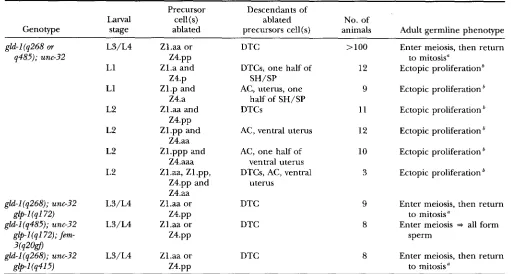
Previous results have shown that ablation of the distal tip cell (DTC) precursors (Z1.a and Z4.p) does not produce a perfect phenocopy of the g l p I ( 0 ) phenotype. In the ablated animals, all germ cells enter meiotic prophase at the normal time ( KIMBLE and WHITE 1981). By contrast, germ cells in
unc-32glp-I (O), gld-I (Tum);unc-32glp-I ( 0 ) and the feminized
phase prematurely (see previous section) (AUSTIN and KIM- BLE 1987). Furthermore, although ablation of the DTC pre- cursors has no effect on sex determination (KIMBLE and WHITE 1981), glp-1 (@-induced premature entry into meiotic prophase can cause masculinization of the germline in ge- netic backgrounds that are partially feminized, For example,
f m - 2 ( t s ) mutants make only oocytes, whereas f m - 2 ( t s ) glp-
1
(y)
mutants make sperm at the restrictive temperature (E. MAINE and J. KIMBLE, unpublished observations). These dif- ferences may, at least in part, explain why DTC precursor ablations in gld-1 (null) animals and gld-1 (nul1);glp-1(q)
mu- tant combinations result in nonidentical phenotypes (see RE-A time-course study to evaluate the effects on killing the somatic DTC in gld-1 (Tum) hermaphrodites was done as fol- lows. unc-32 and gld-1 (Tum);unc-?2 X X larvae were grown to the late L3 or young L4 stage and the DTC was killed in one or both gonad arms. Operated animals were grown for a further 24-40 hr and then prepared for dissection, fixation and staining with DAF'I (FRANCIS et al. 1995). At least 12 operated animals were examined for each 2-hr interval be- tween 24 and 40 hr after ablation of the DTC. Distal germ cells at the pachytene stage of meiotic prophase were generally first observed in the 28- and 32-hr intervals. Distal mitotic figures were first observed at -32 hr after DTC ablation but were more common 34-38 hr after ablation.
Morphological evaluation of germline phenotypes: Observ- ations of living animals by Nomarski differential interference contrast (DIC) microscopy were made as described ( SULSTON and HODGKIN 1988). Generally, worms were picked as L4 larvae and examined as adults between 18 and 48 hr later. For staining with DAPI and antibodies, males and hermaphrodites were dissected, fixed and stained as described (FRANCIS et al. 1995). The monoclonal antibody SP56, which is directed against an epitope expressed only by sperm and primary spermatocytes (WARD et al. 1986), was used at a 1 2 0 dilution of culture supernatant.
SULTS).
RESULTS
In the first half of this section we describe experi- ments designed to investigate the sex specificity of the gld-1 tumorous phenotype and the role of gld-1 in pro- moting spermatogenesis in the hermaphrodite germ- line. As background for these experiments, we briefly review germline sex determination in C. ekguns.
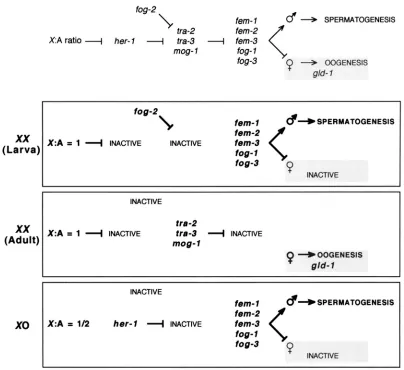
In C. eZeguns there are two sexes: XXhermaphrodites, which are considered to have a female soma and a her- maphrodite germline that makes first sperm and then oocytes, and X0 males, which have a male soma and germline. Sexual identity in the germline is specified by a regulatory pathway of 2 1 4 genes whose activity is set in response to the ratio of X chromosomes to au- tosomes (refer to Figure 9 ) (reviewed by KWABARA and KIMBLE 1992; CLIFFORD et al. 1994). The known terminal regulators of the pathway are a group of five genes (fern-1, -2 and -? and fog-1 and -3) that act to- gether to specify the male identity in both XXand X0 germ cells. In the X 0 male germline, activation of these terminal fern/fog genes is achieved indirectly via the her-
1 gene. her-1, which is active only in X 0 animals, nega- tively regulates the genes tru-2 and tru-3, whose normal function is to negatively regulate one or more of the
terminal fm/fog genes. As a result, the terminal fern/
foggenes are active continuously in males, and XOgerm cells form sperm throughout adulthood. In the her- maphrodite, the production of first sperm and then oocytes is achieved through a different mechanism. In place of her-1, which is not active in XXanimals (TRENT et al. 1991), the fog"2gene (SCHEDL and KIMBLE 1988) may transiently repress tru-2 a n d / o r tru-? and thereby free the terminal fern/foggenes to direct a brief period of spermatogenesis. Later, increased tru-2 activity (DO- NIACH 1986; SCHEDL and KIMBLE 1988; GOODWIN et ul.
1993) a n d / o r activation of the rnog-1 gene (GRAHAM
and KIMBLE 1993) leads to negative regulation of one or more terminal fern/fog genes, and the germline switches to oogenesis.
Mutations in the sex determination genes allow the manipulation of germline and somatic sex independent of each other and of chromosomal sex. Therefore we have used epistasis analysis with gld-1 (Turn) alleles and sex determination gene mutations to examine the ef- fects of chromosomal, somatic and germline sex on tumor formation and to infer the relationship between
the gld-l( + ) function that directs oogenesis and the
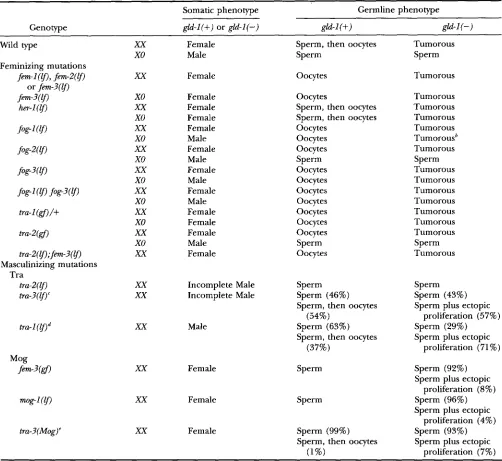
sex determination pathway. These data are summarized in Table 1 and detailed below. All experiments were done with the null gld-1 (Turn) allele 9485, and many were also performed with q268. Identical results were obtained with both alleles.
The gld-1 tumorous phenotype depends on gennline
sexual identity
Tumor formation in X X g e d i e s is independent of the male fate: Tumor formation in XXhermaphrodites that lack gld-1 activity might result from a failure to specify the female germ cell fate or a defect in an early step in oocyte differentiation (FRANCIS et ul. 1995). A prediction of either hypothesis is that inactivation of any of the five genes required for spermatogenesis (fm-
I,
-2
and -3 and fog-1 and -?) should have no effect ontumor formation in X X gld-1 (Turn) germlines. Analysis of XXdouble mutants (Table 1 ) shows that tumors still form when any one of the terminal fm/fog genes is inactivated by a null or strong Zfallele or when both fog- 1 and fog-? are inactivated in the same animal. Further, quantitation of germline proliferation in a fog-1 (Zf) gld-
1 (Turn) double mutant indicates that fog-l (Zf) has no effect on tumor growth (FRANCIS et ul. 1995) (see be- low) . These results are consistent with gld-l being essen- tial for oogenesis and also argue that tumor formation does not result from an intersexual mode of develop ment that is dependent on the terminal fm/fog genes. We also examined whether gld-1 (Turn) is similarly epistatic to several other mutations that eliminate her- maphrodite spermatogenesis. These included ( 1 ) a fog-
Multiple gld-I Functions 613
TABLE 1
Effect of sexual fate on the tumorous phenotype"
Somatic phenotype Germline phenotype
gld-I(+) or gld-I(-)
Genotype g"1(--)
Tumorous Sperm Wild type
Feminizing mutations
fern-l(If, j m " w
fern-?(lf)
or fern-?(@
her-1 (lf,
xx
x 0
Female Male
Sperm, then oocytes Sperm
Oocytes
xx
Female Tumorousx 0
xx
x 0
xx
x0
xx
x 0xx
x 0xx
x 0
xx
x0
xx
x 0
xx
Female Female Female Female Male Female Male Female Male Female Male Female Female Female Male Female
Oocytes
Sperm, then oocytes Sperm, then oocytes Oocytes
Oocytes Oocytes Sperm Oocytes Oocytes Oocytes Oocytes Oocytes Oocytes Oocytes Sperm Oocytes
Tumorous Tumorous Tumorous Tumorous Tumorousb Tumorous Sperm Tumorous Tumorous Tumorous Tumorous Tumorous Tumorous Tumorous Sperm Tumorous
fog-1
tra-2(lf); fern-?(@
Masculinizing mutations Tra
tra-2(lf) tra-3(@)'
xx
xx
Incomplete Male Incomplete MaleSperm Sperm (46%) Sperm, then oocytes
Sperm (63%) Sperm, then oocytes
(54%)
(37%)
Sperm Sperm (43%) Sperm plus ectopic
Sperm (29%) Sperm plus ectopic
proliferation (57%)
proliferation (71 %)
Sperm (92%) Sperm plus ectopic
Sperm (96%) Sperm plus ectopic
Sperm (93%) Sperm plus ectopic
proliferation (8%)
proliferation (4%)
proliferation (7%)
tra-I
(Rd
xx
Malexx
Female Spermxx
Female Spermxx
Female Sperm (99%)Sperm, then oocytes (1%)
a See MATERIALS AND METHODS for details. The phenotype is completely penetrant unless indicated. The genotypes of fern-I,
For fog-l(ql80) gld-I(q485), 80% of tumorous germ lines make some sperm (see text). The percent of XOmales making sperm
"The amber allele e1107 was used as the putative tra-? null mutation. Only animals with a normal male somatic gonad were
Only animals with a normal male somatic gonad were scored. Not included were the -50% of total tra-l(e1834) animals with
tra-?(h75) was used. h 7 5 has a Mog phenotype at 25°C (E. WOWSKI, B. BRENDZA and S. STROME, personal communication).
fern-2, fern-? and tra-? were m(-/-) z(-/-) to eliminate maternal rescue effects associated with these genes.
was not quantitated for fog-l(@ gld-I(Tum) double mutants using different alleles.
scored. Not included were the -20% of animals with abnormal/intersexual somatic gonads.
abnormal gonads (HODGKIN 1987; SCHEDL et al. 1989).
1
(d)
allele that results in constitutive tru-1 activity the XXgermline ( DONIACH 1986; SCHEDL and KIMBLE ( HODGKIN 1987). None of these mutations have any 1988; GOODWIN et ul. 1993). The role ( s ) of tru-l in obvious effect on tumor formation in XX gEd-1 (Turn) germline sex determination are uncertain ( HODGKIN germlines. This result was expected for tru-2(gf) and 1987; SCHEDL et ul. 1989).fog-2(V) because these mutations may lead to increased Tumor formation is independent of the
X
chromo-614 E.
velopment in XXhermaphrodites but not in X0 males. To determine whether sex specificity is correlated with either the sexual phenotype of the animal or its Xchro- mosome dosage, we examined XX and X 0 gld-1 (Turn) animals whose sexual phenotype had been reversed by a mutation in the sex determination pathway. For this purpose her-1 ( I f )
,
fern-3 ( If) and tru-1(gf)
mutations were each used to transform X0 animals into either her- maphrodites [ her-I (If)] or females [ fern-3(If) and tru- I (gf)/+
].
When also homozygous for a gld-1 (Turn) al- lele, these X 0 somatic females develop germline tumors identical to those of XXgld-I (Turn) animals (Table 1 ).
Thus tumor formation is not dependent on Xchromo- some dosage but is instead correlated with a female sexual phenotype. [Although not tested, we presume that similar results would be obtained using fern-I ( I f ) and fern-2(If) mutations.] Because of these results, we have not examined mutant combinations with the up- stream genes that regulate both sex determination anddosage compensation (VILLENEUVE and MEYER 1990).
The complementary experiments in which XX ani- mals are transformed into phenotypic males were done using mutant alleles of tru-1, tru-2 and tru-3. Null and strong Ifmutations in each of the tru genes cause mascu- linization of both the soma and germline of XXanimals. However, none of these mutations completely masculin- ize all XX tissues (Table 1 )
.
For example, although tru- 2(If) XX animals make only sperm, the soma is incom- pletely male. For tru-1(If),
the soma is fully male, but the germline often makes oocytes. Nonetheless, muta- tions in each of the tru genes were found to be fully [ tru-2(If)] or partially [ tru-1 ( I f ) and tru-?(If)] epistatic to gld-1 (Turn) alleles (Table 1 ) . In the case of tru-2, both tru-2(If)
and gld-I (Turn); tru-2 (If)
X X animals have a male germline that never forms a tumor. As XX tru- 2 ( I f ) animals have a completely normal male germline and somatic gonad, this result is consistent with the observation that gld-1 (null) X 0 males are unaffected (FRANCIS et ul. 1995). Because the normal function of tru-2 is to negatively regulate the fern genes, the suppres- sion of the gld-I (Turn) phenotype in a tru-2(If) back- ground should be dependent on fern gene activity. This expectation was confirmed by constructing a XX gld-1 ( Turn) ; tru-2 ( I f ) ; fern-3 { If) triple mutant. X X animals of this genotype have a female soma and a tumorous germ- line, showing that fern-3 activity is required for suppres- sion of tumor formation in a tru-2(If) background.
Although tru-1
(If)
and tru-3(If) alleles can also sup- press tumor formation in X X g l d - I {Turn) animals, these mutations are only partially epistatic to a gld-1 (Turn) allele. A male germline is found in 43% of gld-I(Turn);tru-3(If)andin29%ofgld-l(Turn);tru-l(If)XX
animals. The remaining animals make sperm but also have ectopically proliferating germ cells (Table 1 ) .
This phenotype most likely reflects the fact that tru-1 ( I f )
and tru-?(V) do not completely eliminate oogenesis in the XX germline ( HODGKIN 1987; SCHEDL et ul. 1989).
Because of this, some gld-1 (Turn); tru-1 ( I f ) or tru-3(If) germ cells may fail to adopt the male fate and so prolif- erate ectopically.
Suppression of tumor formation by germline mascu- linizing mutations: The above described results show that tumor formation is correlated with female develop- ment but do not address whether it is germline or so-
matic sex that is important. We therefore examined whether certain mutations that masculinize only the germline (Mog phenotype ) are epistatic to gld-1 (Turn) alleles. The Mog mutations used (Table 1 ) were ( 1 ) a
fern-3(&) allele that makes germline fern-3 activity insen-
sitive to negative regulation (BARTON et ul. 1987; AH-
RINGER and KIMBLE 1991) ;
( 2 )
a Ifmutation in rnog-1, a gene that may function in repressing the terminal fern/fog genes(GRAHAM
and KIMBLE 1993) and ( 3 ) a germline-specific tru-3(If) allele 6n75 [designated tru- 3 ( M o g ) ] (B. CAPOWSKI, B. BRENDZA and S. STROME, personal communication).
The corresponding double mutants with gld-l (Turn) display a masculinized germ- line phenotype [ shown for gld-I (Turn); fern-3(gf) in Fig- ure l a ] similar to that of each Mog single mutant. The germline makes excess sperm and usually displays no evidence of ectopic proliferation. Thus gld-1 (Turn) X X germ cells that are forced to adopt the male identity differentiate as sperm rather than forming tumors. The tumorous phenotype is therefore correlated with germ- line but not somatic sex. For all three double mutants, however, a small fraction of gonad arms ( < l o % ) have ectopically proliferating germ cells in the most proxi- mal region of the germline. As gld-I (Turn) alleles cause a partial feminization of the XX germline (FRANCIS et al. 1995), we believe that the ectopic proliferation that sometimes occurs in these double mutants arises be- cause some fern-?(@), rnog-l(If)
and tru-3(Mog) germ cells fail to adopt a male fate in a gld-I (Turn) back- ground. Consistent with this idea, we found that gld-1 (q485 or q365) can dominantly suppress the Mog phe-
notype of fern-3(gf). In particular, unlike fern-3(@) ani- mals, which make only sperm at 25", some gZd-I (Turn)
/
+;
fern-3(gf) XX animals make both sperm and oocytes and are self-fertile (data not shown) . Partial suppres- sion of fern-?(@ in gld-I (Turn) homozygotes may ac- count for why some germ cells in a low percentage of animals proliferate instead of differentiate as sperm.Tumor formation is independent of somatic sexual environment: As a final test of the sex and tissue speci- ficity of tumor formation, we asked whether tumors form in X 0 animals that have a female germline and a male soma. Mutations in the genes fog-I and fog-3 femi- nize only the germline (BARTON and KIMBLE 1990; EL LIS and KIMBLE 1995)
.
As a result, fog-I (If) and fog-3(If) X0 animals have a normal male soma but possess a germline that only makes oocytes. As described above, fog-1(If)
gld-I (null), gld-I (null) fog-3 ( I f ) and fog-1 ( I f )Multiplr g/&/ Functions (i I .5
I I ( , I I:I '1.- . ~ ~ / ~ ~ , ~ - / ~ / / ) , ~ / / / - / ~ ~ ~ ~ / ~ S ~ ) ~ ~ ~ ; ~ l c ~ ~ o ~ t ~ ~ ~ t i ~ ~ ~ ~ ~ ~ ~ ~ t ~ ~ k c
s p w n . T h r proximal rctgion of ;I S
(),PI,<-/
f q / S O ) ,q/d-/ ( q 4 S S )nlalc gon;d is sho\\m suinctl w i l l 1 l).-\l'l ( : I ) ;lnd \\.it11 S P X ( I , ) . a n antiIx)dy tlirc*ctrtl ;Ig;linst ;I sp(~rn1-spccilic ;mtigcn. S1wrm w e itlcntilictl 1):. their sn~;tll nllclciu size ( i n the I q i o n
ol'cunxd m ~ o w i n ; I ) i t n t l positive staining li)r SI'X ;tntigrn ( i n I ) ) . X l m r ~ t X O V o l ' : ~ d u l ~ . Y O / i ~ , y - / f q / N ) ) g/d-/(./'uw) m;llt.s m;~kc some sperm. 1 x 1 1 the n11n11x-r (11' sperm made is highlv
variable. \lctapl~asc i l n t l tclo1)hasc figures ~ r c intlic;~tctl
( o p ' n arrows) . These ;we mitotic. I . ; I I ~ I ( T than nwiotic 1ig:urcs.
;IS nmlc germ cells undergoing nwiotic divisions stain w i t h SP.5(i.
and triple mutants h ; n ~ ;I m;dc soma, b u t these animals also t l c v c l o p gcrrnlinc ttlmors [Table 1, and shown in
Figure I f o t . , / i ) , g - / ( I f ) g / d - / ( T / r t n ) S O Inalcs]
.
I k m i n a - tion ofl)~-\l'l-st;~incd anim;ds indicates t h a t trlmors form i n t l 1 c . w Inales h y the silmc mc*cll;~nisnl a s i t 1 ,Y,Y g/d- I ( ' I ' r o j r ) g c ~ m l i ~ ~ c s . 111 a l l c;~scs, germ cells i n meiotic prophase arc first ol,scne.tl proximally i n the 1.3 stagc:thcsc cells t h r n ;\ppc;w 1 0 exit mciotic prophase a n d r e t t ~ r n t o mitotic proliferation. I n ;1d111ts, more distal
germ cells c o n t i n w t o c v t e r m r i o t i c pl-oph;tsc ;Ind may FI(;I.KI.: I . - T t t t n o r li)tml;~liolI is c o t ~ c l ; ~ t c t l t v i t l l 111c Iimalc~
germlinc lilte. I<tch p;tncl shows :I tlissc.ctcd gon;ltl stainrtl with DAPI t o visu;dizr g c ~ m ccll nuclei. :\n open circlc intli-
C ~ I C S the. prosin1;tl end o f rach gonid. ( a ) The gc*rnlline from an ?(?i ,y/d-1 ( q 4 S i ) ; , / i . ~ ~ t - 3 ( q 9 j x / ) ;tninl;ll. like the S'S jiwt-
3t.q) singlc nwtant. this clo111A- n1tItant ust~ally has ;I mlscu- linizetl gcmnlinc- 111a1 nl;tkcs o n l v spwm (snl;lll nllclci i n thr regions intlic;ltcd 11). clmwl xrrows). T h r distal 11;df' o f r h r gcrmlinc contains prolifhxtil1g gc*rm cc-lls ( o p c n arro\v points
t o a Initotic cell) , li)llowcd by erlls i n mc*iotic prophasr. ( I , and c ) Cornprison o f grlmlinc tlcvc~lopnlcnt i n gonad arms dissected l i o n 1 SO males o f ' the grnolypcs ,y/d-/ (q4X5) ( I ) ) ancl.fi)x-l(!/) g/d-/(q4A'S) ( e ) . The g / d - / ( q 4 X j ) m;de gcrmlinc appears normal i n a l l rcspccts: tlistid mitotic gc-rm cells (opcw arrow) arc followrtl first b y g c ~ n t cc*lls i n meiotic proph;w (short arrows) ; u n d t h r n b y prin1;ll-y spclm1atocytcs ( tri;mglc*s) and sperm ( c w w d ;~rrows) , 111,/i~,y-/ (//) g / & I ( q 4 R 5 ) . thc orga- nization o f rhc distal 11x11. o f the germline appears nolm;d, hut ;I tumor o f nlitotically ;tctivc* cc~lls liwms prosinlally ( i n
the rcgion int1ic;ltcd by 1;u-g~ arro\vs) . Scale 1 ) ; ~ s . I O pnl.
contrilmte t o tutnorgrowth 11y later rctrlt.ning t o mitotic
proliferation. Simi1;u- germlinc phenotypes ~vcrc ob-
s c ~ ~ c c l
b y
EI.I.IS a n d K I \ I I < I I ( I W i ) for,YO
fijg-1 g/d-I
( 7 ' r r v l ) and g/d-1 (Tuvt)/i1g-3(//j doul~lc mutants. Based on these results, wc conclutlc that tumor f o r m a t i o n oc- C I I ~ S intlcpcntlcntly o f somatic scstli1l environment a slong a s the germline sex clctel.min;~tion pat11way is set
i n the fec.ln;llc m o c k .
I n t h c courw o f t h c w cxpcrin~cnts, w e o l ) s c ~ ~ c t l ;I surprising rcwllt: ji)<r-I(/f) , q / d - I ( T / r ) t ~ ) X 0 nl;~lcs wmally make some sperm. ,As shown i n Figtlre 2, these males have a tulnorotls gcrnllinr containing spcrm t h a t c;u1 be recognized by t h c i r compact ntlclci ant1 their cxprcs- sion o f ' a spct-111-specific ;untigcn ( W A R D r / crl. 19%)
.
This is n o t an allclc-specific interaction, ;IS spcrmato-
genesis w a s o h s c n w l i n mutant comI>in;~tions o f t w o
616 R. Francis, E. Maine and Schedl
alleles (q485, q268 or q365) (see MATERIALS AND METH-
ODS). Although the two fog-1 alleles examined are not
known to be null, both are strong Zjmutations (BARTON
and KIMBLE 1990; ELLIS and KIMBLE 1995). Therefore
it appears that in the absence of gld-1 function, X 0
germ cells can develop as sperm by a pathway that re-
quires little or no fog-1 activity. In contrast, sperm were
never observed in XX fog-1 (Zj) gld-1 (Turn) worms or
in gld-1 (Turn) fog-J(Zj) and fog-1 (lf, gld-1 (Turn) fog-J{Zj) animals of either chromosomal sex.
Summary of interactions between the sex detennina-
tion genes and @-1 (Turn) mutations: These experi-
ments demonstrate that the gld-1 (null) tumorous phe-
notype is dependent on germline sexual identity but is not dependent on the chromosomal sex of the animal or on somatic sexual identity. For the germline, the ultimate effect of the sex determination gene mutations
is to alter the activity of the terminal f m / f o g genes.
Because the gld-1 (null) tumorous phenotype is repon-
sive to the activity state of the terminal f m / f o g genes,
then gld-l(
+
) must act downstream of these genes onthe branch that directs oogenesis (see DISCUSSION and
Figure 9 )
.
Investigation of the role of @-1 in promoting hermaphrodite spermatogenesis using two types of @-1
gf
mutationsThe existence of a g l d - I ( + ) activity that promotes
hermaphrodite spermatogenesis was previously in-
ferred from a gld-1 haplo-insufficiency phenotype: X X
gld-1 (null)/+ and
D
f(gld-1)/+
germlines make fewersperm than normal (FRANCIS et al. 1995). This gld-1
function may also account for the existence of two
classes of gld-1
(gf)
alleles that cause transformations ingermline sexual fates. Alleles of the first type, the gld- 1 (Fog) mutations, feminize the germline of both sexes,
so that X X animals usually make only oocytes and X 0
males make both sperm and oocytes. Alleles of the sec-
ond type, the gld-1 (Mog) mutations, masculinize the X X
germline, so that hermaphrodites make an excess of
sperm. To learn how these g f alleles affect the sex deter-
mination pathway, we constructed double mutants be-
tween gld-l (Fog) or gld-l (Mog) and mutations in the
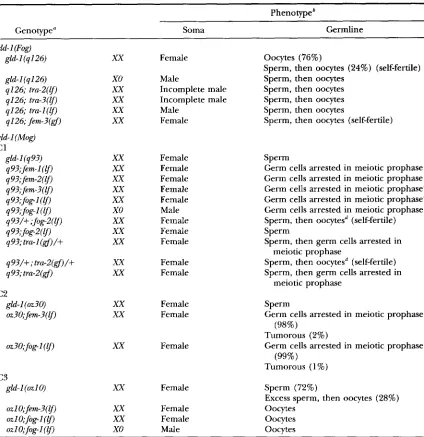
major sex determination loci (results summarized in Table 2 )
.
gZd-1 (Fog) alleles suppress germline masculinizing
mutations: Genetic criteria indicate the gld-1 (Fog) al-
lele 9126 produces a poisonous gld-l product that acts
to partially feminize both X X and X 0 germlines. Be-
cause gld-l (null) males are unaffected, the q126mutant
product must interfere with another gene product in-
volved in germline sex determination (FRANCIS et al.
1995)
.
As indicated in Table 2, 9126 is able to partiallysuppress the masculinized germline phenotypes con-
ferred by a fern-3(@) allele or by lfalleles of each of the
tra genes. Whereas each of these mutants makes only
sperm [or some animals make sperm and then oocytes
in the case of tru-1 (Zj) and tru-3(Zj) mutants] , all X X
double mutants with q126 make sperm and then oo-
cytes. The suppression of tra-2 (Zj) and tra-3 (Zj) indicates
that the 9126 product cannot feminize the germline by
affecting tra-2( + ) and tra-3(
+
) activity. Instead gld-1 (q126) is likely to interfere with a gene product that
acts downstream or independently of tra-2 and tra-3.
gld-1 (q126);fm-3(&) X X animals are always self-fer-
tile hermaphrodites, demonstrating that gld-l(q126)
and fm-3(&) mutually suppress one another. Mutual
suppression has previously been reported for other combi-
nations of g f mutations that affect germline sex determi-
nation and most likely represents a balance between the opposite effects of masculinizing and feminizing muta-
tions (BARTON et al. 1987; SCHEDL and KIMBLE 1988)
.
Effects of @-1 (Mog) alleles on sex detennina-
tion: gld-1 (Mog) alleles that fall into three subclasses ( C l , C2 and C3) were originally isolated as dominant
suppressors of certain mutations that feminize the X X
germline (FRANCIS et al. 1995). The C3 allele, 0.~10,
retains gld-1 functions that are required for oogenesis.
Homozygous o z l 0 X X animals make excess sperm but
also can make oocytes late in adulthood and become
self-fertile. In contrast, C1 and C2 gld-1 (Mog) homozy-
gotes never make oocytes and, as indicated by comple-
mentation data, these alleles disrupt gld-1 functions re-
quired for oogenesis ( FRANCIS et al. 1995)
.
To determine whether gld-1 (Mog) alleles can bypass
the need for the fern genes or fog-1 and -3 in directing
spermatogenesis, we constructed the X X double mu-
tants described in Table 2. XXanimals homozygous for
the C3 allele o z l 0 and either a fm-3(Zj) or fog-1 (Zj)
mutation only make oocytes; fm-3(Zj) and fog-1 (Zj) are
thus epistatic to o z l 0 with regard to germline sex deter-
mination. Similarly, no sperm are made in double mu-
tants between C1 or C2 gld-1 (Mog) and mutations in
the terminal fern/foggenes. Thus, like o z l 0 , the C1 and
C2 alleles do not bypass the need for the terminal fern/
fog genes in directing spermatogenesis. However, un-
like ozl0, X X double mutants containing a C1 or C2
allele show no cytological signs of oogenesis. Instead,
the proximal germline of each of the C1 and C2 gld-
1 (Mog) double mutants described in Table 2 fills with undifferentiated germ cells that have a nuclear mor- phology characteristic of germ cells at the pachytene
stage of meiotic prophase (Figure 3 )
.
In all the doublemutants analyzed, germ cells in adult animals usually
remain arrested in meiotic prophase. In double mu-
tants of certain genotypes, however, the germline occa- sionally becomes tumorous, probably because germ cells exit meiotic prophase and return to mitotic prolif-
eration. These phenotypes are similar to the undifferen-
tiated pachytene arrest phenotype conferred by class B gld-1 alleles (FRANCIS et al. 1995 )
.
The absence of spermatogenesis in C1 and C2 double


![FIGURE fog-1 (q180) glpl ( + ) activity is fog-1 (q180) gld- represents the mean number 1 (q485) [using 1 1 (q485);glpl(O) (e2003)], feminized gld- a the feminized minimum data point glpl Each germ cells counted in and of standard deviation of gl](https://thumb-us.123doks.com/thumbv2/123dok_us/1701721.1215812/16.590.48.323.78.351/figure-activity-represents-feminized-feminized-minimum-standard-deviation.webp)