ISSN(Online): 2319 - 8753
ISSN (Print) :2347 - 6710
I
nternational
J
ournal of
I
nnovative
R
esearch in
S
cience,
E
ngineering and
T
echnology
(An ISO 3297: 2007 Certified Organization)
Vol. 4, Issue 1, January 2015
Experimental Study of Recycled Aggregate
Concrete with Partial Replacement of Cement
by Fly Ash
K.Sathish Kumar
1,S.Dilli Babu*
21Assistant Professor, Department of Civil Engineering, Bharath University, Chennai, India
2* Assistant Professor, Department of Civil Engineering, Bharath University, Chennai, India
ABSTRACT: This paper consists of an overview over the development of recycling of concrete and the use of concrete with recycled materials. The trend of the utilization of recycled aggregates for the developing infrastructures is the solution to the problem of an excess of waste material, not forgetting the parallel trend of improvement of final product quality. The utilization of waste construction materials has to be related to the application of quality guarantee systems in order to achieve suitable product properties. Therefore the complete understanding of the characteristic if new materials becomes so important in order to point out its real possibilities. The studies on the use of recycled aggregates have been going on for 50 years. In fact, none of the results showed that recycled aggregates are unsuitable for structural use. Only having inadequate number of studies in durability aspects, made recycled aggregates to be preferred just as stuffing material for road construction. In the present study, an experimental investigation was conducted to study the properties of concrete, when the Natural Coarse Aggregate (NCA) is replaced with Recycled Coarse Aggregate (RCA). Specimens are prepared with natural, recycled coarse aggregates and to be tested after a curing periods of 7 and 28 days. The use of recycled aggregates in concrete opens a whole new range of possibilities in the reuse of materials in the building industry.
KEYWORDS: Recycled concrete, Fly ash, Recycling, Reuse
I.INTRODUCTION
Demolition of old and deteriorated buildings and traffic infrastructure, and their substitution with new ones, is a frequent phenomenon today in a large part of the world. The main reasons for this situation are changes of purpose, structural deterioration, rearrangement of a city, expansion of traffic directions and increasing traffic load, natural
disasters (earthquake, fire and flood), etc. For example, about 850 millions tones of construction and demolition waste
ISSN(Online): 2319 - 8753
ISSN (Print) :2347 - 6710
I
nternational
J
ournal of
I
nnovative
R
esearch in
S
cience,
E
ngineering and
T
echnology
(An ISO 3297: 2007 Certified Organization)
Vol. 4, Issue 1, January 2015
screening and removal of contaminants such as reinforcement, paper, wood, plastics and gypsum. Concrete made with such recycled concrete aggregate is called recycled aggregate concrete (RAC). The main purpose of this work is to determine the basic properties of RAC depending on the coarse recycled aggregate content, and to compare them to the properties of concrete made with natural aggregate (NAC)—control concrete [4].
Recycling of aggregate material from construction and demolition waste may reduce the demand – supply gap in both these sectors. While retrievable items such as bricks, wood, metal, tiles are recycled, the concrete and masonry waste, accounting for more than 50% of the waste from construction and demolition activities, are not being currently recycled in India. Recycling of concrete and masonry waste is, however, being done abroad in countries like U.K., USA, France, Denmark, Germany and Japan [5]. The successful recovery and recycling of construction waste should be conducted, in order to satisfy future expectations, without assuming unnecessary risks and using the adequate processes available.
The ideal process should be as follows ―to construct for demolishing, to demolish for recycling, to recycle for constructing‖. If this process was strictly complied with residues would not be a future problem as their dimensions would be controlled and limited [11].
II.FLY ASH
Fly ash is the waste obtain from burning of coal and the main source of fly ash is from thermal plant and steel plants etc., Improper disposal of fly ash will result in causing pollutions to the environment [7]. Fly ash compresses of minute particles which when mix with the atmosphere cause pollution problems. Fly ash can be used as a cement replacement material in concrete and the research work on this concluded mechanical properties of concrete increases with the fly ash in concrete as cement replacement material or admixtures [12], [18].
III.RECYCLED AGGREGATE (RA) CONCRETE
A thorough understanding of the basic engineering properties of 14/10 mm RC aggregate allows its full utilization and correct application as the coarse aggregate in concrete [15]. RA Concrete samples were prepared and used in the investigation of various properties including; compressive strength, volume of permeable voids, micro structural development, porosity, and sound absorption [9].
IV.OPPORTUNITIES FOR RECYCLING
In order to meet the challenges of recycling, it is necessary that all opportunities, barriers and obstacles are detected and considered [10]. The opportunities must be exploited, which can for example involve the recycling of concrete and masonry into aggregate, substituting natural materials:
Aggregate bound in concrete
Unbound sub-base and base materials
The opportunities for the production of concrete from recycled concrete are generally described in the ACI 555 report [6]. The recycling of concrete waste in a global perspective is described by Torben C. Hansen and Erik K. Lauritzen [8], Mats Torring [16] and Mats Torring and Erik K. Lauritzen [17]. The overcoming of these barriers and obstacles must be planned and carried out through a long-term action plan combined with adequate research and development. Implementation of the necessary legal, economic and technical instruments requires that initiatives involving legislation and regulations be taken.
ISSN(Online): 2319 - 8753
ISSN (Print) :2347 - 6710
I
nternational
J
ournal of
I
nnovative
R
esearch in
S
cience,
E
ngineering and
T
echnology
(An ISO 3297: 2007 Certified Organization)
Vol. 4, Issue 1, January 2015
VI.TEST RESULTS
Compressive Strength of Cube
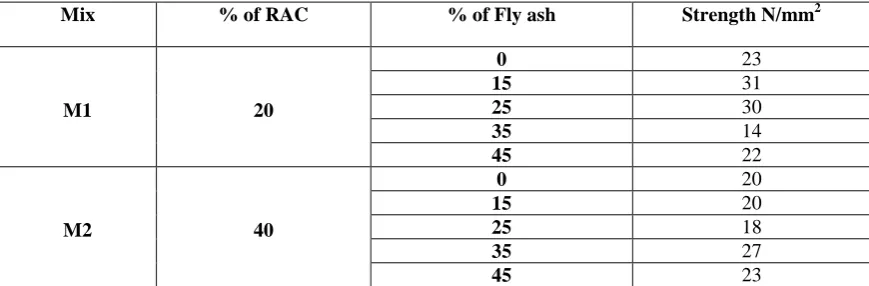
The specimens 100 x 100 x 100 mm were used to determine the compressive strength. Tests are carried out at the end of 7 and 28 days using Compressive Testing Machine of 2000 KN capacity. The test results are shown in Table - 1 and Table – 2.
Table – 1 Compressive Strength at 7 Days
Mix % of RAC % of Fly ash Strength N/mm2
M1 20
0 23
15 31
25 30
35 14
45 22
M2 40
0 20
15 20
25 18
35 27
45 23
ISSN(Online): 2319 - 8753
ISSN (Print) :2347 - 6710
I
nternational
J
ournal of
I
nnovative
R
esearch in
S
cience,
E
ngineering and
T
echnology
(An ISO 3297: 2007 Certified Organization)
Vol. 4, Issue 1, January 2015
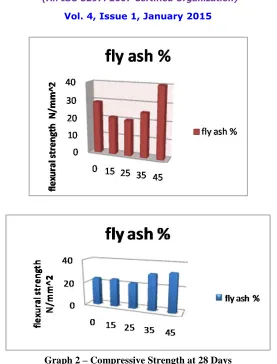
Graph 1 – Compressive Strength at 7 Days
Table – 2 Compressive Strength at 28 Days
Mix % of RAC
% of Fly ash
Strength N/mm2
M1 20
0 29
15 21
25 20
35 25
45 40
M2 40
0 24
15 24
25 22
35 31
ISSN(Online): 2319 - 8753
ISSN (Print) :2347 - 6710
I
nternational
J
ournal of
I
nnovative
R
esearch in
S
cience,
E
ngineering and
T
echnology
(An ISO 3297: 2007 Certified Organization)
Vol. 4, Issue 1, January 2015
Graph 2 – Compressive Strength at 28 Days
Flexural Strength
The beam specimens of size 100 x 100 x 500 mm were used to determine the Flexural strength. Test was carried out at the end of 28 days using Universal Testing Machine (UTM). The test results are shown in Table 3.
Table – 3 Flexural Strength at 28 Days
Mix % of RAC
% of Fly ash
Strength N/mm2
M1 20
0 4.65
15 5.01
25 4.23
35 3.31
ISSN(Online): 2319 - 8753
ISSN (Print) :2347 - 6710
I
nternational
J
ournal of
I
nnovative
R
esearch in
S
cience,
E
ngineering and
T
echnology
(An ISO 3297: 2007 Certified Organization)
Vol. 4, Issue 1, January 2015
Mix
% of RAC
% of Fly ash
Strength N/mm2
M2 40
0 3.43
15 5.17
25 3.25
35 4.08
ISSN(Online): 2319 - 8753
ISSN (Print) :2347 - 6710
I
nternational
J
ournal of
I
nnovative
R
esearch in
S
cience,
E
ngineering and
T
echnology
(An ISO 3297: 2007 Certified Organization)
Vol. 4, Issue 1, January 2015
VII.CONCLUSIONS
The investigation into RAC (Recycled Aggregate Concrete) concrete of Characteristic compressive strength of 20 MPa made from selected 20 mm RC (Recycled Concrete) aggregate fulfilled its aim of the characterization of basic engineering properties. The general conclusion derived from the investigation is that RAC concrete has different characteristics than those of concrete made from comparable natural aggregate with the same amount of cementitious binder.
Based on experimental results conducted on Recycled aggregate concrete, the following observations can be made:
Optimum percentage of Compressive Strength of Cubes was found for the concrete produced from 20% and 40% replacement of Natural aggregate with 15% fly ash.
It is concluded that based on Strength Characteristics the optimum percentage of recycled coarse aggregate is 20% beyond 20% replacement of natural coarse aggregate strength increases.
REFERENCES
1. Fisher, C.; Werge, M. EU as a Recycling Society; ETC/SCP Working Paper 2/2009; Available online: http://scp.eionet.europa.eu.int (accessed on 14 August 2009).
2. Transportation Applications of Recycled Concrete Aggregate—FHWA State of the Practice National Review 2004; U.S. Department of Transportation Federal Highway Administration: Washington, DC, USA, 2004; pp. 1-47.
3. Anbuselvi S., Chellaram C., Jonesh S., Jayanthi L., Edward J.K.P., "Bioactive potential of coral associated gastropod, Trochus tentorium of Gulf of Mannar, Southeastern India", Journal of Medical Sciences, ISSN : 1682-4474, 9(5) (2009) pp. 240-244.
4. RohiM.Salem, Edwin.G. Burdette and N.Mike Jackson, ―Resistance to freezing and Thawing of Recycled Aggregate Concrete‖ Materials Journal, Volume 100, Issue 3, May 1, 2003, Pages 216 – 221,.
5. Ahmad Shayan and AiminXu, ―Performance and properties of Structural Concrete made with Recycled Concrete Aggregate‖ Materials Journal, Volume 102, Issue 4, September 1, 2003, Pages 224 – 230.
6. Arumugam, S., Ramareddy, S., "Simulation comparison of class D/ Class E inverter fed induction heating", Journal of Electrical Engineering, ISSN : 1335-3632, 12(2) (2012) pp. 71-76.
7. Yong-Huang Lin, Yaw-YauanTyan, Ta-Peng Chang and Ching-Yun Chang, Cement and Concrete Research, Volume 34, Issue 8, August 2004, Pages 1373 – 1380.
8. Caroline M.L., Sankar R., Indirani R.M., Vasudevan S., "Growth, optical, thermal and dielectric studies of an amino acid organic nonlinear optical material: l-Alanine", Materials Chemistry and Physics, ISSN : 0254-0584, 114(1) (2009) pp. 490-494.
9. Salomon M. Levy and Paulo Helene, Cement and Concrete Research, Volume 34, Issue 11, November 2004, Pages 1975 – 1980.
10. Nuno Almeida, Fernando Branco, Jorge de Brito and Jose Roberto Santos, Cement and Concrete Research, Volume 37, Issue 2, February 2007, Pages 210 – 220.
11. M. Etxeberria, E. Vazquez, A. Mari and M. Barra, Cement and Concrete Research, Volume 37, Issue 5, May 2007, Pages 735 – 742.
12. Das J., Paul Das M., Velusamy P., "Sesbania grandiflora leaf extract mediated green synthesis of antibacterial silver nanoparticles against selected human pathogens", Spectrochimica Acta - Part A: Molecular and Biomolecular Spectroscopy, ISSN : 1386-1425, 104(), (2013) pp.265-270. 13. C.S. Poon, Z.H. Shui and L. Lam, Advances in Building Technology, 2002, Pages 1407 – 1414.
14. Jianzhuang Xiao and H. Falkner, Construction and Building Materials, Volume 21, Issue 2, February 2007, Pages 395 – 401 15. Seung Bum Park, DaeSeukSeo and Jun Lee, Cement and Concrete Research, Volume 35, Issue
16. S. T. Lee, H. Y. Moon, R. N. Swamy, S. S. Kim, and J. P. Kim, ―Sulphate Attack of Mortars Containing Recycled Fine Aggregates‖ Materials journal, volume 100, Issue 3, Pages 224 – 230, July 1, 2005.
17. Harish B.N., Menezes G.A., "Antimicrobial resistance in typhoidal salmonellae", Indian Journal of Medical Microbiology, ISSN : 0255-0857, 29(3) (2011) pp. 223-229.
18. MostafaTavakoli and ParvizSoroushian ―Strengths of Recycled Aggregate Concrete Made Using Field – Demolished Concrete as Aggregate‖ Materials journal, volume 93, Issue 2, March 1 , 1996, Pages 178 – 181.
19. AR.Arunachalam, Imperceptible Digital Image Watermarking, International Journal of Innovative Research in Computer and Communication Engineering, ISSN(Online): 2320-9801, pp 1321-1326, Volume 1, Issue 6, August 2013.
20. AR.Arunachalam, Spectrum Reuse in Multiple Primary User
ISSN(Online): 2319 - 8753
ISSN (Print) :2347 - 6710
I
nternational
J
ournal of
I
nnovative
R
esearch in
S
cience,
E
ngineering and
T
echnology
(An ISO 3297: 2007 Certified Organization)
Vol. 4, Issue 1, January 2015
21. B.Sundar Raj, A Third Generation Automated Teller Machine
Using Universal Subscriber Module with Iris
Recognition, International Journal of Innovative Research in Computer and Communication Engineering, ISSN (Online): 2320 – 9801,pp 565-571, Vol. 1, Issue 3, May 2013
22. B.Sundar Raj, The Efficiency of the Scalable Architecture for
Revealing and Observing the Environment
using Wireless Sensor, International Journal of Innovative Research in Computer and Communication Engineering, ISSN (Online): 2320 – 9801,pp 63-67, Vol. 1, Issue 1, March 2013