ABSTRACT
ASBECK, STEPHANIE ANN. The Relationship of Inattention and
Hyperactivity/Impulsivity to Basic Early Literacy Skills. (Under the direction of Ann Schulte.)
This study examined the relationship of inattention and hyperactivity/impulsivity to phonemic awareness and mastery of the alphabetic principle in kindergarten children. Teacher rating scales were used to evaluate symptoms of inattention and
hyperactivity/impulsivity and two subtests of the Dynamic Indicators of Basic Early Literacy Skills were used to assess children’s fluency in two basic literacy domains, phonemic
THE RELATIONSHIP OF INATTENTION AND HYPERACTIVITY/IMPULSIVITY TO BASIC EARLY LITERACY SKILLS.
by
STEPHANIE ANN ASBECK
A thesis submitted to the Graduate Faculty of North Carolina State University
in partial fulfillment of the requirements for the Degree of
Master of Science
SCHOOL PSYCHOLOGY
Raleigh 2006
APPROVED BY:
_____________________________________ Chair of Advisory Committee
BIOGRAPHY
Stephanie Ann Asbeck was born in San Juan, Puerto Rico on September 27, 1978, the second child born to John and Magdalena Asbeck. She has an older brother, John Richard; a sister-in-law, Karen; and a 4-year-old nephew, Athan. Given her father’s employment, she had the opportunity to live in Puerto Rico and Mexico.
ACKNOWLEDGEMENTS
There are many people I would like to thank for enabling me to complete this master’s thesis. First is my advisor Dr. Ann C. Schulte, who offered continuous support, guidance, and
motivation throughout the completion of this thesis. Without her patience and humor, this process would’ve been difficult. Likewise, the other committee members, Dr. Patricia Collins and Dr. Mary Haskett, have been a source of encouragement. I thank my committee for all of their support. They are extraordinary professional women who have helped me in many different ways through this learning process.
I would like to thank those in the School Psychology program as well as other graduate students in other fields of psychology at North Carolina State University. I am grateful for their unending encouragement. I would like to thank Melinda Rupard, Anna Datta, Kendrea Hart, Athena Franks, Justin Parker, Andrea McPherson, Lisa Ahern, Caryn Ward, and Jeff Smith for sharing their knowledge, experience, and optimism. Specifically, I’d like to thank Cristina Andreassi for her unconditional support and most importantly, for her love and friendship. Her phone calls, emails, and camaraderie have helped me through these years of study.
TABLE OF CONTENTS
Page
List of Tables………. v
Ch. 1 Introduction………. 01
Ch. 2 Literature Review……… 05
ADHD………. 05
Prevalence……… 05
Primary Symptoms………...… 06
Controversies surrounding ADHD’s primary symptoms……….…… 07
DSM-IV diagnostic criteria and subtypes………...…. 09
Developmental course of ADHD………... 11
Associated problems………..………. 13
Reading Disability………..……… 15
Prevalence………...……….… 15
Primary Symptoms………..……… 16
RD diagnostic criteria………..………… 17
Developmental course of RD………...… 20
Associated problems………...………. 22
ADHD and RD: Comorbidity and Causal pathways…………...……… 23
Factors important in investigating comorbidity……..…….………… 24
Comorbidity estimates……….. 28
Page
Longitudinal studies………..……….. 34
Big Ideas in Beginning Reading………..………..………. 48
Phonemic awareness………..………. 49
Alphabetic principle.………...…..……….…. 50
Accuracy and fluency………..……… 51
Vocabulary………...……… 51
Comprehension………. 52
Ch. 3 Research Aims……… 54
Statement of the problem………...……….… 54
Research questions and hypotheses………..……….…. 56
Question 1. Are teacher ratings of classroom behavior symptomatic of ADHD related to early literacy skills?... 56
Question 2. When controlling for verbal ability, are teacher ratings of children’s classroom behavior symptomatic of ADHD related to children’s early literacy skills?... 57
Question 3. Are symptoms of inattention and hyperactivity/impulsivity differentially related to early literacy skills?... 58
Ch. 4 Method……….... 60
Participants………...………... 60
Page
DIBELS………...………... 61
ADHD-SV………..………. 64
EOWPVT………...……….. 66
Procedure………. 67
Ch. 5 Results………. 69
Results and Descriptive Analyses……….….. 69
Score distributions and outliers………..……….… 69
Demographic differences………...……….. 72
Correlations among primary variables………...……….. 73
Results for Questions and Related Hypotheses………..…… 74
Results for Question 1: Are teacher ratings of classroom behavior symptomatic of ADHD related to early literacy skills?... 74
Results for Question 2. When controlling for verbal ability, are teacher ratings of children’s classroom behavior symptomatic of ADHD related to children’s early literacy skills?... 77
Results for Question 3. Are symptoms of inattention and hyperactivity/impulsivity differentially related to early literacy skills?... 79
Ch. 6 Discussion……….……….. 81
Inattention, Hyperactivity/Impulsivity, and Early Literacy……… 82
Page
Hyperactivity and the alphabetic principle………...… 84
Inattention, hyperactivity/impulsivity, and phonemic awareness..…. 86
Classroom effects on early literacy skills: An explanation for conflicting findings?... 88
Study Limitations………...………. 91
Implications for Practice………..……….. 93
Future Directions for Research………...……… 94
LIST OF TABLES
Page
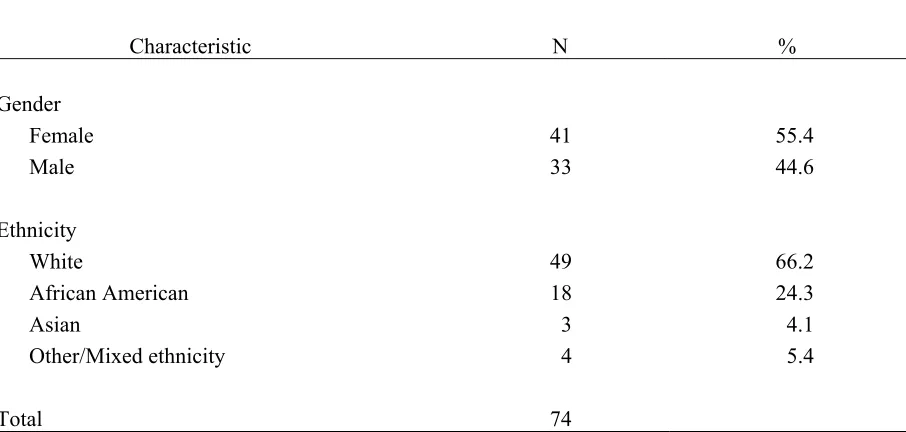
Table 1 Behavioral Characteristics Used in the Diagnosis of Attention Deficit Hyperactivity Disorder (American Psychiatric Association, 1994)……….. 10 Table 2 Characteristics Used in the Diagnosis of Reading Disorder
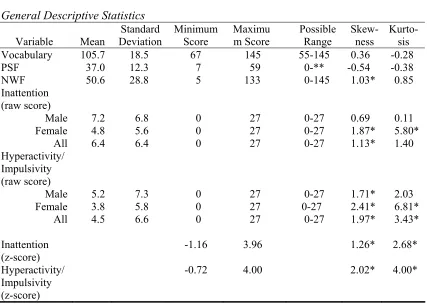
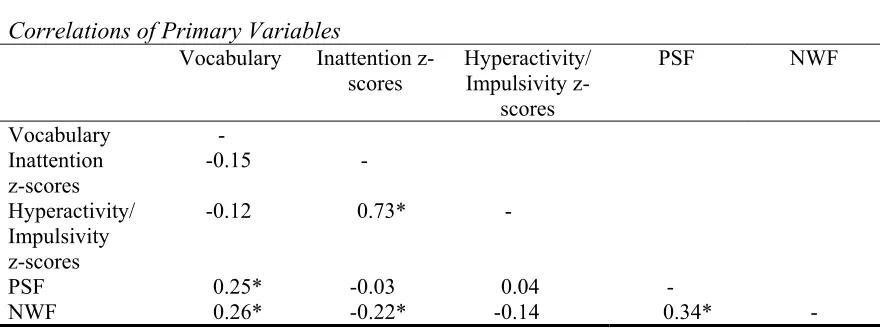
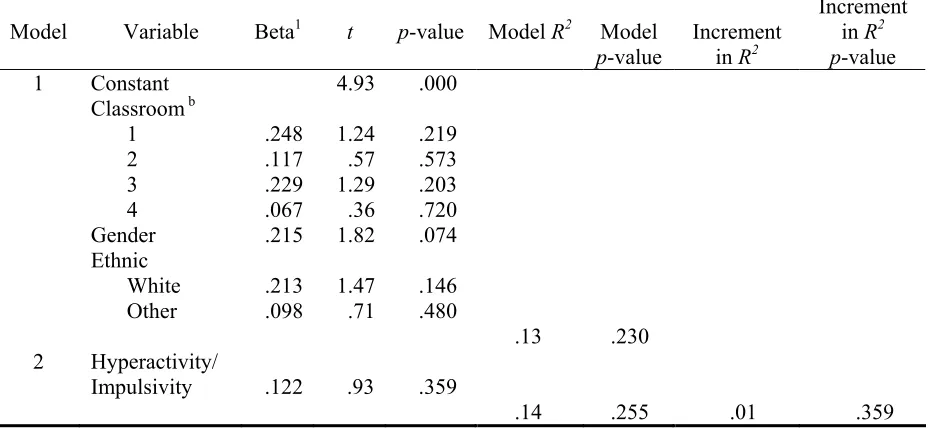
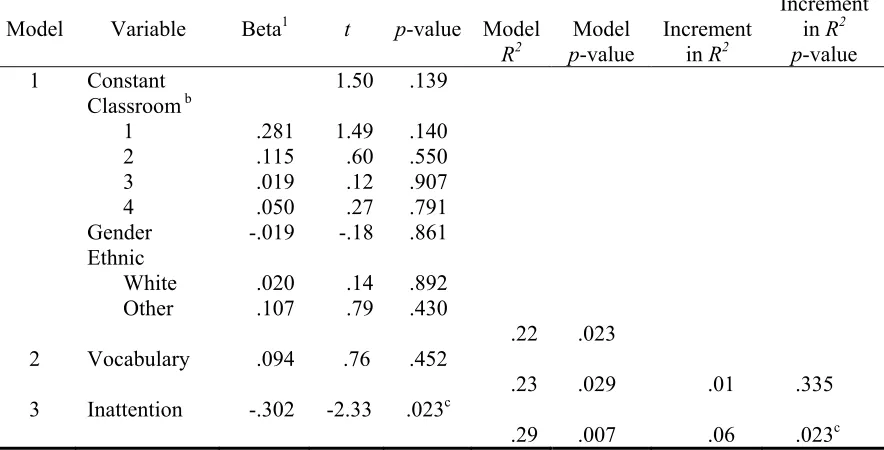
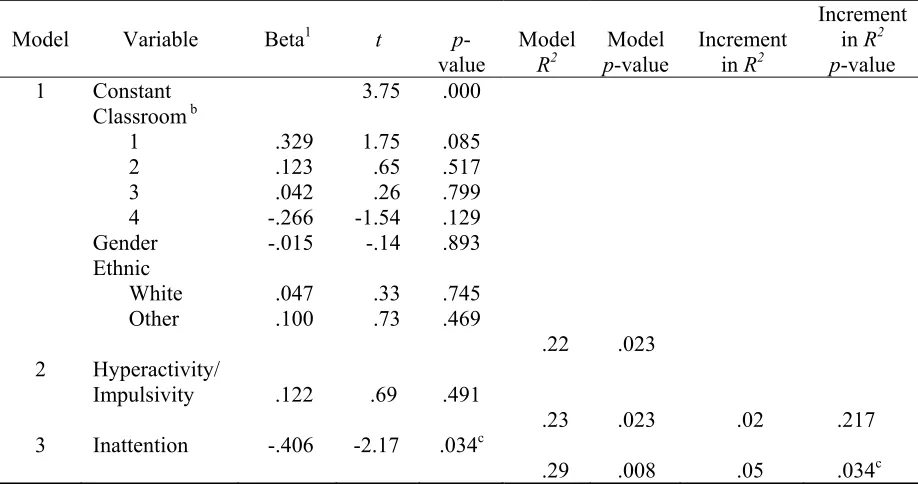
(American Psychological Association, 1994)………... 18 Table 3 ADHD and RD Comorbidity Estimates………..………. 31 Table 4 Demographic Characteristics of the Sample…………..………….. 61 Table 5 General Descriptive Statistics…...……… 70 Table 6 Correlations of Primary Variables………. 73 Table 7 Prediction of PSF by Inattention (Hypothesis 1)………...…... 75 Table 8 Prediction of PSF by Hyperactivity/Impulsivity (Hypothesis 2)….. 75 Table 9 Prediction of NWF by Inattention (Hypothesis 3)…………..…….. 76 Table 10 Prediction of NWF by Hyperactivity/Impulsivity (Hypothesis 4)… 76 Table 11 Prediction of NWF by Inattention when Vocabulary is controlled
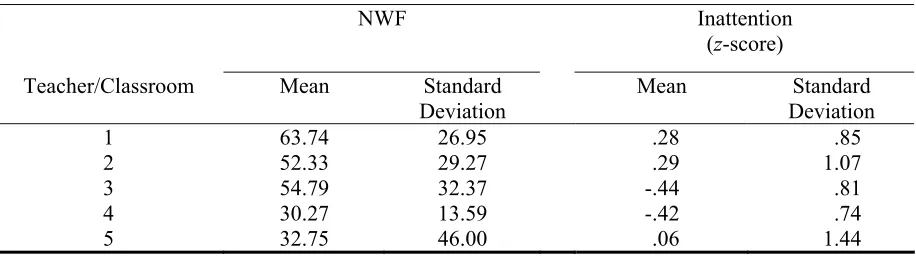
for (Hypothesis 7)………. 78 Table 12 Increase in Prediction of NWF with Inattention (Hypothesis 10)…. 80 Table 13 Mean NWF Scores and Ratings of Inattention by
Reading disabilities and attention disorders are among the most frequent disorders in
school-age children. Prevalence estimates for attention deficit hyperactivity disorder (ADHD)
in the school-age population range from 3% to 5% (American Psychiatric Association, 1994),
while prevalence estimates for reading disabilities (RD) range from 5% to 10% (American
Psychiatric Association, 1994).
Both disorders have serious consequences. Children with ADHD are less successful
in school, more likely to drop out of school, and more likely to engage in criminal behavior
(Ferguson & Horwood, 1995; Flanagan, Bierman, Kam, & Conduct Problems Prevention
Research Group [CPPRG], 2003; Mash & Barkley, 1996; National Institute of Mental Health,
1996). Reading disabilities are related to poor scholastic attainment, grade retention, school
drop out, and difficulty finding steady employment.
Although generally thought to reflect deficits in different cognitive processes
(Pennington, 1993; Torgesen & Wagner, 1998), RD and ADHD co-occur more frequently than would be expected by chance alone (Hinshaw, 1992; Purvis & Tannock, 2000).
Comorbidity estimates vary depending on the stringency of diagnostic criteria for both
disorders, whether an epidemiological or clinic sample is examined, and whether rates of
ADHD in children with RD or rates of RD in children with ADHD are examined. Typical
rates of comorbidity reported in the literature range from 8% to 45% (Lyon, 1996, as cited in
Moats, 1998; Purvis & Tannock, 2000; Schulte, Conners, & Osborne, 1999;
Semrud-Clikeman et al., 1992, as cited in Aaron, Joshi, Palmer, Smith, & Kirby, 2002).
In efforts to understand how ADHD and RD are related, a number of investigators
(Hinshaw, 1992; McGee, Williams, Share, & Silva, 1986; Rowe & Rowe, 1992; Vellutino,
Fletcher, Snowling, & Scanlon, 2004). In general, researchers have found that behaviors
reflective of inattentive rather than hyperactivity dimensions of ADHD are more closely
associated with reading difficulties (McGee, Williams, & Silva, 1985; Rabiner, Coie, &
Conduct Problems Prevention Research Group, 2000). For reading, some researchers have
found that comprehension difficulties are more characteristic of children with ADHD and RD
(Shaywitz, Fletcher, & Shaywitz, 1994). Others have found that word identification
difficulties are characteristic of children with both disorders (Aaron et al., 2002).
Explanations of the higher than expected overlap between the two disorders fall into
four logical categories: (a) RD contributes to the development of ADHD, (b) ADHD
contributes to the development of RD, (c) both disorders predispose children to develop the
other disorder, and (d) a third variable is related to the development of both disorders
(Hinshaw, 1992). To date, there is some research evidence for each of these propositions
(e.g., Hinshaw, 1992; McGee, Williams, & Silva, 1984b; McGee et al., 1985; Halperin,
Gittelman, Klein & Rudel, 1984). However, investigations often have been limited by the
use of measures of ADHD that do not discriminate between the inattention and hyperactivity
dimensions of the disorder, and reading measures that do not discriminate between
component skills of reading. In addition, most research has been conducted with children
who have already learned to read (e.g., McGee et al., 1984; McGee et al., 1985; Halperin et
al., 1984). Only a few studies have assessed children’s attentional problems and preliteracy
skills before exposure to reading instruction (Fantuzzo, Bulotsky, McDermott, Mosca, &
Noone Lutz, 2003; Hinshaw, Morrison, Carte, & Cornsweet, 1987; Jorm, Share, Maclean,
Sullivan, 1985). Early literacy studies are important because demonstrating a relationship
between poor early literacy skills and attention problems would lend support to a
comorbidity explanation that focuses on the role of attention in developing reading skills, or
on the presence of a third variable that leads to early difficulties in both areas, eventually
resulting in the development of both disorders.
The present study used a recently developed early literacy measure, the Dynamic
Indicators of Basic Early Literacy Skills (DIBELS), to examine kindergarten children’s
prereading skills and their relationship to the inattention and hyperactivity dimensions of
ADHD. The inattention and hyperactivity dimensions of ADHD were assessed with a
standardized, norm-referenced teacher checklist (DuPaul, Power, Anastopoulos, & Reid,
1998) whose content focuses on behaviors characteristic of ADHD in the classroom. Rather
than assessing ADHD and early reading difficulties as categorical variables, both were
treated as continuous variables. With this design, the relationships between the two
constructs, ADHD and early reading, could be examined in a broad sample of
kindergarteners. It was predicted that higher teacher ratings on behaviors related to ADHD
would be associated with lower early literacy skills, and that inattention would be more
strongly related to poor early literacy skills than hyperactivity. Results of the study may have
implications for models of the relationship between the two disorders, as well as for early
intervention efforts related to both disorders.
Prior to describing the present study in detail, Chapter 2 provides a review of research
relevant to the study. First, the disorders of ADHD and RD are briefly described. Second,
studies of the comorbidity between the two disorders are summarized, including studies that
the background for the present study. Third, new research regarding the processes
underlying early literacy and skilled reading is summarized. Chapter 3 provides a statement
of the problem and hypotheses for the current study. Chapter 4 provides a detailed
description of the present study and data analyses procedures and Chapter 5 summarizes
results of the analyses. The study concludes with a discussion of results in terms of their
implications for explanations of the ADHD and reading disability comorbidity, limitations of
the study, implications for the practice of psychology, and future research on the topic of the
CHAPTER TWO: LITERATURE REVIEW
Attention-Deficit/Hyperactivity Disorder
It is common for children, especially young preschool children, to be active, energetic,
and to shift from one activity to another. In addition, they easily get bored or off-task,
demonstrate poor self-control, and act without much planning (Barkley, 1996). Although
these behaviors are common in young children, when they are persistent and appear at levels
that are not age-appropriate, they may be indicative of the behavior disorder, Attention
Deficit Hyperactivity Disorder (ADHD). The purpose of this section is to provide an
overview of ADHD by describing its prevalence, primary symptoms, developmental course
and common comorbidities.
Prevalence
ADHD, once referred to as hyperkinesis or minimal brain dysfunction, is one of the
most common mental disorders among school age children (Gaub & Carlson, 1997; National
Institute of Mental Health, 1996). The prevalence of ADHD has been estimated to be
between 3% and 5% of the population (American Psychiatric Association, 1994), affecting as
many as 2 million American children (National Institute of Mental Health, 1996). Estimates
of male: female ratios range from 4:1 to 9:1 (American Psychiatric Association, 1994).
Individuals with ADHD are usually depicted as having problems with hyperactivity,
impulsivity, and inattention. These three primary symptoms are sometimes depicted as the
Primary Symptoms
Hyperactivity-impulsivity
Current diagnostic formulations of ADHD treat hyperactivity and impulsiveness as a
single dimension. However, in order to more fully describe each construct, they will be
separated here.
Hyperactivity. In early formulations of ADHD, hyperactivity, or excessive motor or
vocal output, was viewed as the primary symptom of the disorder (Barkley, 1998). Although
recent conceptualizations of ADHD have focused more on developmental difficulty
inhibiting responses (Barkley, 1998), overactivity still remains a primary symptom of ADHD
(Kendall, 2000), and part of the diagnostic criteria for the disorder (American Psychiatric
Association, 1994). Many children with ADHD seem restless and carry out pointless body
movements (American Academy of Pediatrics, 2001). Compared to their same age peers, they may have difficulty staying seated when required, may run and climb in situations were
it is not appropriate, talk excessively, and distract others by humming and/or making noises
(Barkley, 1996).
Impulsiveness or behavioral disinhibition. Impulsivity refers to difficulty in
restraining behavior, hindering a response, or delaying gratification. It is often viewed as
incapacity to hold back overriding reactions or prepotent responses. Children with ADHD
generally respond hastily to situations or events without waiting for directions to be
completed or adequately taking notice of what is required in the situation (Barkley, 1998).
Because of this impulsivity, children with ADHD often make careless errors. In addition,
these children may fail to think through all possible consequences prior to acting upon a
behaviors, which is why many of them experience injuries and accidents (Barkley, 1996).
Children with ADHD may carelessly damage others’ property and have difficulty waiting for
their turn. When working on tasks deemed as boring or aversive, children with ADHD
generally take shortcuts, using the least amount of effort and performing in ways that take the
least amount of time (National Institute of Mental Health, 1996). These children often interrupt others and blurt out comments or responses without thinking prior to verbalizing.
Sharing, cooperating, and working in groups is many times problematic.
Inattention
The third and final primary symptom of ADHD is inattention. In comparison to other
children their own age, children with ADHD frequently exhibit difficulties sustaining
attention or staying on task, both in play activities or academic tasks. In free-play activities,
this is evidenced by shorter periods of play with a specific toy and frequent shifts among
various play activities (Barkley, 1998). In classrooms, children with ADHD are more likely
to be off-task, and less likely to complete work than non-ADHD classmates (American
Academy of Pediatrics, 2001). They may be described by teachers as daydreaming, failing to
listen, and unable to work without frequent monitoring and redirection (Association of
American Pediatrics, 2001; Barkley, 1998). Parents may complain that they do not complete
chores, are disorganized, and frequently lose things (Association of American Pediatrics,
2001; Barkley, 1998).
Controversies Surrounding ADHD’s Primary Symptoms
How the three primary symptoms of ADHD are related, and the specific behaviors
that fall within each of the primary symptom areas remain points of controversy within the
1994), summarized in Table One, hyperactivity and impulsivity are grouped together as one
dimension of ADHD, and inattention is viewed as a separate dimension of ADHD.
In earlier conceptualizations of ADHD, hyperactivity and impulsivity were viewed as
separate dimensions of ADHD, but were grouped together when factor analyses of ADHD
symptoms were unsuccessful in distinguishing impulsivity and hyperactivity as distinct
dimensions (Achenbach & Edelbrook, 1983; DuPaul et al., 1998; DuPaul et al., 1997; Milich
& Kramer, 1985, as cited in Barkley, 1998). In other words, hyperactive children are also
impulsive and impulsive children are also hyperactive. This core dimension of ADHD is
often depicted as reflecting poor sustained inhibition of responding, poor delay of
gratification, and an inability to adhere to guidelines to control and restrain behavior in social
settings (Barkley, 1998).
Inattention is the second core dimension of ADHD in the present diagnostic
conceptualization of ADHD (American Psychological Association, 1994) and children may
be diagnosed with ADHD if they display markedly elevated levels of
hyperactivity/impulsivity, inattention, or both. However, debate continues about whether
children showing problems only in the area of inattention are truly ADHD, or whether they
have a separate disorder. For example, in previous versions of the Diagnostic and Statistical
Manual (American Psychiatric Association, 1968, 1980, 1987), Attention Deficit Disorder
was classified as a distinct disorder, separate from ADHD, and Barkley (1996) suggested that
more weight should be given to the impulsive and hyperactive characteristics of the disorder
than to inattention when conceptualizing ADHD.
There is some evidence that inattention is associated with a different
differentially related to particular types of school difficulties (Gaub & Carlson, 1977; Merrell
& Tymms, 2001). Because a focus of the present study is the differential relationship of inattention and hyperactivity-impulsivity to reading difficulties, research related to this topic
will be discussed in a separate section of the literature review.
DSM-IV ADHD Diagnostic Criteria and Subtypes
Table 1 lists the specific behaviors that must be evidenced under each of the three
primary symptom areas for a diagnosis of ADHD in the current diagnostic formulation,
Diagnostic and Statistical Manual, 4th edition (APA, 1994). A diagnosis of ADHD (APA,
1994) requires that six or more of the symptoms of inattention and/or
hyperactivity-impulsivity be present for at least six months, to a degree that is maladaptive and inconsistent
with the individual’s developmental level. In addition, it is essential that the
hyperactive-impulsive or inattentive symptoms that have caused impairment be present before 7 years of
age and that some impairment from the symptoms is present in two or more settings (e.g., at
school [or work] and at home). There also must be clear indications of significant
impairment in social, academic, or professional functioning. It is critical that the symptoms
of inattention and/or hyperactivity-impulsivity do not occur exclusively during the course of
a Pervasive Developmental Disorder, Schizophrenia, or other Psychotic Disorder and are not
better accounted for by another mental disorder (e.g., Mood Disorder, Anxiety Disorder,
Table 1.
Behavioral Characteristics Used in the Diagnosis of Attention Deficit Hyperactivity Disorder (American Psychiatric Association, 1994)
I. Inattention
1. often fails to give close attention to details or makes careless mistakes in schoolwork, work, or other activities
2. often has difficulty sustaining attention in tasks or play activities 3. often does not seem to listen when spoken to directly
4. often does not follow through on instructions and fails to finish
schoolwork, chores, or duties in the workplace (not due to oppositional behavior or failure to understand instructions)
5. often has difficulty organizing tasks and activities
6. often avoids, dislikes, or is reluctant to engage in tasks that require sustained mental effort (such as schoolwork or homework)
7. often loses things necessary for tasks or activities (e.g., toys, school assignments, pencils, books, or tools)
8. is often easily distracted by extraneous stimuli 9. is often forgetful in daily activities
II. Hyperactivity-Impulsivity
A. Hyperactivity
1. often fidgets with hands or feet or squirms in seat
2. often leaves seat in classroom or in other situations in which remaining seated is expected
3. often runs about or climbs excessively in situations in which it is inappropriate (in adolescents or adults, may be limited to subjective feelings of restlessness)
4. often has difficulty playing or engaging in leisure activities quietly 5. is often “on the go” or often acts as if “driven by a motor”
6. often talks excessively
B. Impulsivity
7. often blurts out answers before questions have been completed 8. often has difficulty awaiting turn
As noted earlier, in the present conceptualization of ADHD in the DSM- IV, there are
three specific subtypes of ADHD. The first subtype, Attention-Deficit/Hyperactivity
Disorder, Combined Type (ADHD-C), is diagnosed if six or more behavioral symptoms of
inattention and six or more symptoms of hyperactivity-impulsivity have been present for the
past 6 months (and other diagnostic criteria have been met). The second subtype,
Attention-Deficit/Hyperactivity Disorder, Predominantly Inattentive Type (ADHD-PI), is diagnosed if
six or more symptoms of inattention have persisted over the past 6 months, but fewer than six
symptoms of hyperactivity-impulsivity are present. The third subtype,
Attention-Deficit/Hyperactivity Disorder, Predominantly Hyperactive-Impulsive Type (ADHD-PHI) is
diagnosed when six or more symptoms of hyperactivity-impulsivity are present, but fewer
than six symptoms of inattention have persisted for at least the past 6 months.
Developmental Course of ADHD
The problematic behavioral symptoms of ADHD are believed to arise early, before
the age of seven, and in most cases are persistent throughout the child’s development
(Mantzicopoulos & Morrison, 1994; Merrell & Tymms, 2001). Research indicates that
difficulties with disinhibition and hyperactivity arise first (between three and four years of
age) with inattention characteristics emerging later (between five and seven years of age), or
by entry into formal schooling or middle elementary school grades if inattention is the
primary difficulty in the individual (Merrell & Tymms, 2001).
Preschool children with ADHD are often disruptive, aggressive, and have difficulties
being controlled and guided by pre-school personnel (Barkley, 1998; Mantzicopoulos &
Entering elementary school, students with ADHD may not have appropriate levels of
school readiness skills in academic areas such as pre-reading skills, simple mathematical
concepts, and fine motor abilities (Barkley, 1998). The symptoms of ADHD make it difficult
for children to sit still for a period of time, listen attentively, follow directions, stay on-task,
complete assignments, be organized, interact appropriately with peers, and control impulsive
behaviors (Association of American Pediatrics, 2001; Barkley, 1998). These symptoms may
result in gaps in knowledge, difficulty finishing tasks, and poor grades, and lower than
expected achievement scores, and intelligence scores (Barkley, 1998). If the child with
ADHD has a co-occurring learning disability, it is not unusual for it to go unnoticed for some
years, until academic tasks become more demanding (Barkley, 1998). Teachers and parents
often find themselves monitoring, supervising, redirecting children with ADHD and assisting
them with tasks.
In addition to the academic challenges children with ADHD may face, many are also
disruptive, impulsive, and aggressive in school and playground settings, leading to conflict
with peers, teachers, and other school staff. As a result, they are at risk for social rejection
and isolation within the classroom and other settings (Ferguson & Horwood, 1995; Flanagan,
Bierman, Kam, & Conduct Problems Prevention Research Group [CPPRG], 2003).
Entering adolescence, the academic outcomes of adolescents with ADHD vary
greatly from those adolescents without the disorder. Low academic achievement, grade
retentions, suspensions, and expulsions are more common in adolescents with ADHD.
Approximately 29.3% of adolescents with ADHD fail a grade, 46.3% are suspended, 10.6%
are expelled (Barkley, 1998), and 10% quit school (Barkley, Fischer, et al. 1991; as cited in
adolescents with ADHD are more prone to be involved in automobile accidents, smoking,
substance use and abuse, pregnancy, antisocial activities, and criminal behavior (Barkley,
1996; Ferguson & Horwood, 1995; Flanagan et al., 2003; National Institute of Mental Health,
1996).
As adults, individuals with ADHD on the average have a lower level of educational
attainment and socio-economic status than non-ADHD adults (Ferguson & Horwood, 1995).
They may experience work and marital difficulties as impulsivity, difficulty with
organization, and lack of follow through affect their functioning in employment and home
settings (Ferguson & Horwood, 1995).
In sum, the influence of ADHD on an individual’s life and education is pervasive.
Children, adolescents, and adults with ADHD are at risk for a broad range of impairments
that negatively impact every facet of their lives (Barkley, 1996).
Associated Problems
ADHD is frequently comorbid with other psychological disorders. Comorbidity
refers to the co-occurrence of two or more conditions in the same individual (Hallahan &
Kauffman, 2000).
ADHD is comorbid with a number of externalizing disorders, including oppositional
defiant disorder (ODD), conduct disorder (CD), antisocial personality disorder (ASP), and
Tourette’s syndrome at higher levels than expected by chance (Barkley, 1996).
Approximately 35% to 60% of clinic-referred children diagnosed with ADHD will have
concurrent ODD by 7 years of age or later (Barkley, 1996) and 30% to 50% of these children
will eventually meet the diagnostic criteria for conduct disorder (CD) (Barkley, 1996). A
disorder (ASP) in adulthood (Barkley, 1996). Externalizing disorders are more likely to
co-occur in children that have primarily hyperactive/impulsive and combination types of ADHD
(American Academy of Pediatrics, 2001) rather than the primarily inattentive subtype.
In addition to externalizing disorders, ADHD co-occurs beyond levels expected by
chance with several internalizing disorders such as anxiety and depression. Anxiety disorders
affect about 25 to 40 % of children with ADHD (Barkley, 1996). About 40 to 50% of
individuals with ADHD will eventually develop a mood disorder (Barkley, 1996) and
approximately 18% of children with ADHD suffer from depression (American Academy of
Pediatrics, 2001). A familial risk for one disorder increases the chances of developing the
other disorder. Coexisting mood disorders may put children at higher risk for committing
suicide, particularly during adolescence. Internalizing disorders are more common among
children with the inattentive and combined type of ADHD (Barkley, 1998).
It is not surprising that the symptoms of ADHD can often result in difficulties with
educational endeavors, the learning process, and overall school performance (Frick et al.,
1991; Mantzicopoulos & Morrison, 1994). Approximately two thirds of adolescents with
ADHD fall behind in basic academic subjects due to the lack of practice needed to develop
academic proficiency (Faraone, Biederman, & Kiely, 1996), with 19 to 26% diagnosed with
at least one type of learning disability (Barkley, 1996). Of children with ADHD,
approximately 8 – 45% are expected to have a reading disability, 12 – 30% a math disability,
and 12 – 27% a spelling disorder (Barkley, 1998). Of particular interest in the present study
is the relatively high rate of reading disabilities in children with ADHD. In the next section,
Reading Disability
Reading is a critical skill whose mastery is key to academic success. Despite its
importance, many children struggle to learn to read (American Federation of Teachers, 1999).
When these difficulties are prolonged and significant, the child may meet the criteria for a
reading disorder. The purpose of this section is to provide an overview of reading disabilities
by describing the disorder’s prevalence, primary symptoms, developmental course, and
associated problems.
Prevalence
Reading disability definitions vary and these variations affect estimates of the
prevalence of reading disabilities in the general population. Under a stringent definition of
RD, the prevalence ranges from 5% to 10% (American Psychiatric Association, 1994;
Barkley, 1990). However, under more lenient diagnostic criteria, the prevalence rises to
approximately 20% (Lyon, 1996).
The gender ratio, in addition to overall prevalence rate of RD, has also been the
source of much debate. The male-to-female ratio also depends on the defining criteria of RD
and the population studied. Male students are more likely to be referred to clinical facilities
and be identified with a reading disability than females because of a higher incidence of
co-occurring externalizing behaviors (Badian, 1999; Duane, 1991; Lyon, 1996; Schulte et al.,
1999). Thus, although clinics may report a high male-to-female ratio, longitudinal and
epidemiological studies indicate that there are no significant gender differences in reading
disabilities (Badian, 1999; Duane, 1991; Lyon, 1996). In Shaywitz, Shaywitz, Fletcher, &
Escobar (1990) epidemiological study of reading disability, for example, the male-to-female
Primary Symptoms
Reading is often characterized as consisting of two primary skill areas, word
recognition and reading comprehension. Word recognition skills include the use of
knowledge of sound/symbol relationships to decode unknown words, and the ability to
rapidly and effortlessly translate written words into their spoken equivalents (Moats, 1998).
Reading comprehension refers to the ability to use prior knowledge and linguistic knowledge
to decipher the message expressed in print (Moats, 1998).
A considerable body of research has indicated that the proximal cause of most
reading problems is word identification and mastery of the sound-symbol relationships that
underlie word identification (Torgesen & Wagner, 1998). In turn, poor word identification
interferes with reading comprehension. As the child grows older, deficits appear in a wider
range of areas of intellectual and academic functioning, because difficulty with reading leads
to less exposure to advanced vocabulary, complex syntactic structures, and general
information (Stanovich, 1986). The range of areas that difficulty with word identification
affects accounts for the early difficulties identifying the core deficit in reading disability
(Stanovich, 1986). Until recently, the presence of a wide range of deficits in older readers
resulted in considerable debate about the primary deficits underlying poor reading (Fletcher
et al., 1998; Torgesen & Wagner, 1998).
The difficulty in identifying words that is thought to underlie most cases of RD
(Torgesen & Wagner, 1998) arises generally due to deficiencies in the ability to process the
phonological features of oral and written language (Jenkins & Bowen, 1994; Purvis &
Tannock, 2000; Torgesen & Wagner, 1998; Vellutino et al., 2004). These deficiencies
of access or rapid automatic naming (Torgesen & Wagner, 1998). A variety of studies (e.g.,
Purvis & Tannock, 2000; Torgesen & Wagner, 1998) suggest that phonological processing
deficits are the core etiological factor for most reading disabilities (Lyon, 1996; Mody, 2003;
Torgesen et al., 1999). The influence of phonological processing deficits in RD will be
discussed in more detail in a later section.
Reading Disorder Diagnostic Criteria
Reading disabilities fall within the domain of both mental health professionals,
because their presumed underlying cause is often a cognitive deficit, and educators, because
the remediation of reading problems falls within the role definition of educators. Therefore,
both groups provide diagnostic criteria for the diagnosis of reading disabilities (APA, 1994;
United States Office of Education [USOE], 1997). In the past, diagnostic criteria developed
within both professional groups have relied heavily on the notion of a discrepancy between
expected achievement in reading, based on a child’s intellectual functioning, and actual
achievement, for defining a reading disorder or disability (APA, 1994; Lyon et al., 2001;
USOE, 1997;). However, recent research has called this diagnostic criterion, an
ability/achievement discrepancy in reading, into question. In this section, the current
diagnostic criteria for diagnosing reading disorder contained in the DSM IV (APA, 1994)
will be summarized. This section will be followed by a brief summary of the controversy
surrounding the ability/achievement discrepancy contained in this and most other definitions
of RD.
DSM-IV Reading Disability Diagnostic Criteria
Table 2 lists the specific criteria that must be evidenced for a diagnosis of Reading
(APA, 1994). A diagnosis of RD (APA, 1994) requires that there is a substantial discrepancy
between the student’s achievement in reading and the student’s ability given their age,
measured intelligence, and age-appropriate education (APA, 1994). This condition requires
the presence of below average reading ability, while having average or above average
intelligence. Table Two provides more specific information on the DSM-IV diagnostic
criteria for RD.
Table 2.
Characteristics Used in the Diagnosis of Reading Disorder (American Psychiatric Association, 1994)
I. Reading achievement, as assessed through individually administered standardized tests of reading, is considerably below that which would be expected given the individual’s age, intelligence, and age-appropriate education.
II. A difficulty in Criterion I has to significantly interfere with academic achievement and activities that demand reading skills
III. Reading deficits create additional difficulties if sensory deficits are already present.
Controversies Surrounding the Discrepancy Criterion for RD
General intelligence and language ability are both related to reading (Stanovich,
1986). As a result, most definitions of reading disability have required that the child
evidence poor reading skills that could not be accounted for by low intelligence (Lyon, 1996).
This requirement was intended to prevent overidentification of children with reading skills
that were normal, but in the low range due to individual differences in intelligence. It was
assumed that the cause of reading difficulties in children with average and above average
However, research indicating that difficulties processing the phonological features of words
underlie most children’s reading difficulties (Mody, 2003; Torgesen et al., 1999), have lead
researchers and policy makers to question the validity of the discrepancy between ability and
achievement as a diagnostic criterion for reading disability (Fletcher et al., 1998; Lyon et al.,
1996; Torgesen & Wagner, 1998). Critics of the discrepancy criterion argue that: (a) the
proximal cause of poor reading is the same in both groups (Fletcher et al., 1998), (b) lowered
intelligence and language skills are largely the result of poor reading skills not the cause, and
(c) when more domain-specific skills are used to predict reading skills, the association
between intelligence and reading is diminished considerably, particularly in younger children
(Fletcher, et al., 1998). As a result, many researchers (Lyon, 1996; Lyon et al., 2001) have
suggested that in the early grades reading disability simply be defined by low reading
achievement (e.g., reading achievement below the 25th percentile).
This rethinking of the diagnostic criterion for reading disability has important
implications for understanding the relationship between ADHD and reading disability. First,
it calls into question many existing studies of the comorbidity of ADHD and reading
disability because these studies have often used an ability/achievement discrepancy criterion
to define reading disability. Second, it complicates an understanding of how the two
disorders are related, because lower intelligence is associated with both ADHD and reading
problems. When using an ability/achievement discrepancy definition of reading disability in
ADHD and reading disability comorbidity studies, the contribution of low intelligence to the
overlap between the two disorders was at least partially eliminated because reading had to be
lower than expected given a child’s level of intellectual functioning. Without controlling for
must be controlled for some other way rather than using a discrepancy definition of reading
disability. Third, the new understanding of the proximal cause of reading disability suggests
that exploring the relationship between ADHD and early phonological processing skills may
be a promising direction for ADHD and reading disability comorbidity research.
Developmental Course of Reading Difficulties
Reading difficulties tend to be persistent, typically following individuals through the
school-age years and into adulthood (Joseph, 2002). Although reading difficulties cannot be
diagnosed until children learn to read, early manifestations of possible future reading
difficulties may include delays in saying first words and/or first sentences, atypical speech
patterns, or difficulty comprehending speech (Duane, 1991). During the preschool years,
children with reading difficulties generally lag behind peers in letter naming and rhyming
ability (Duane, 1991).
During the preschool years and at school entry, children are expected to develop skills
fundamental to reading. These skills include phonemic awareness, or the knowledge that
words are made up of sounds, and an understanding of the alphabetic principle, the concept
that sounds are represented by letters and that letters make up words. Children who do not
develop these skills early on will struggle trying to decode words and will have difficulty
developing automaticity in reading. Without automaticity, children cannot develop accuracy
and fluency in reading which is closely tied to comprehension. Due to limited memory
storage, if children cannot read quickly and accurately, it is difficult for children to
understand the meaning of what they read (Stanovich, 1986).
During childhood, reading difficulties may interfere with overall cognitive
the lack of exposure to print may lead to further difficulties with reading and listening
comprehension (Badian, 1999). The more difficult reading becomes, the less motivated and
interested the children are in reading. School-age children that do not read fluently enough to
appreciate and take pleasure in reading do not engage in independent reading (American
Federation of Teachers, 1999). This, in turn, hinders the development of reading as well. In
addition, difficulty reading can lead to difficulties in various academic domains (American
Federation of Teachers, 1999). This cycle is known as the “Matthew effect” (Stanovich,
1986).
During adolescence, poor readers are nearly 25% more likely to drop out of school.
Reading difficulties not only lead to persistent poor academic achievement, but also to a
reduction in subsequent IQ and in language ability (McGee, Prior, Williams, Smart, &
Sanson, 2002). In addition, facing academic hardships due to reading problems can also lead
to low self-esteem, embarrassment, anxiety, and frustration.
In adulthood, individuals’ with reading difficulties are inefficient spellers and slow
readers. Many evidence the same phonological decoding deficits that were present in
childhood (Wood & Felton, 1994). Individuals struggling with reading will more than likely
have difficulty finding a secure employment and attaining personal autonomy (American
Federation of Teachers, 1999; McGee et al., 2002). Current estimates are that twenty percent
of the adult population in the nation is functionally illiterate (reading below the fourth-grade
level) and a larger proportion of the population do not have sufficient literacy skills to
perform in the workplace (U.S. Office of Technology Assessment, 1993 as cited in Moats,
In sum, the effects of reading difficulties are long-lasting and are often triggered by
poor phonological skills. The following section will present information on problems
associated with reading difficulties.
Associated Problems
Reading disorders are often associated with other conditions, such as externalizing
disorders, internalizing disorders, other learning disabilities and language disabilities
(American Psychiatric Association, 1994).
Students with reading problems frequently evidence externalizing behaviors or
disorders. The relationship between reading difficulties and externalizing conditions
becomes more evident during the school years (Williams & McGee, 1996). It is believed
that students with academic difficulties may try to compensate for feelings of inadequacy by
being hostile, aggressive, and delinquent (Richek, Schudt, Caldwell, Holt Jennings, & Lerner,
2002; Williams & McGee, 1996). In addition to aggressive behaviors, reading disabilities
often co-occur with attentional difficulties (Hinshaw, 1992). Children with reading
disabilities are more likely to lose interest and motivation in reading and become inattentive
or act out. The presence of reading difficulties and attentional disorders are common and
often intertwined. This makes it difficult to establish the causal relationship between these
two conditions (Hinshaw, 1992).
It is also not uncommon for individuals with reading difficulties to have internalizing
problems such as a low self-esteem, to be socially isolated, anxious, depressed, and
experience frustration (Hinshaw, 1992; Lyon, 1996; Richek et al., 2002). Children with
reading disabilities are often perceived by their classmates as shy, help-seeking, and bullied
Children with other learning disabilities (mathematics and written expression) often
have a reading disability as well (American Psychiatric Association, 1994). In addition,
many students with reading difficulties have underlying language difficulties in written
language, expressive and receptive language, and speech problems (Richek et al., 2002).
Reading difficulties are associated with a variety of behavioral, social-emotional, and
learning disorders. Many of these conditions are viewed as secondary or underlying factors
of RD. Having a better understanding of how these conditions evolve concurrently is
important. The following section will focus on the co-occurrence of attentional difficulties
and reading difficulties and its causal pathways.
Attention Deficit Hyperactivity Disorder and Reading Disability:
Comorbidity and Causal Pathways
Using a somewhat liberal prevalence rate of 10% per disorder, the expected overlap
between ADHD and reading disability by chance alone would be 1% (calculated by
multiplying the probabilities of each disorder occurring independently together). However,
even the most conservative estimates of comorbidity are several times this figure (8% to 45%)
(Faraone et al., 1996; Purvis & Tannock, 2000; Schulte, et al., 1999; Semrud-Clikeman et al.,
1992, as cited in Aaron et al., 2002; Lyon, 1996, as cited in Moats, 1998). This section will
discuss ADHD and RD comorbidity rates reported in the literature and research relevant to
the possible causal pathways between the two disorders. Much of this summary will draw
from Hinshaw’s (1992) seminal review of the relationship between externalizing and
Factors Important in Investigating Comorbidity
Before discussing comorbidity estimates, a number of methodological issues that
affect findings related to comorbidity will be discussed. These issues are important in
understanding why ADHD/RD comorbidity rates differ markedly, but also are important in
evaluating the conclusions that can be drawn from research studies about the likely pathways
between the two disorders.
Epidemiological Versus Clinical Samples
Comorbidity estimates generally draw from two different types of samples,
epidemiological and clinical. In epidemiological studies, a sample is drawn from the
population at large (e.g., all children in a specified geographic area). In clinical studies,
children who have been identified with a particular disorder, often at a university clinic or in
a school system, are assessed to determine whether they also can be diagnosed with a second
disorder. Comorbidity estimates based on the two different types of samples often differ
greatly. In general, estimates based on clinical samples are much higher because children
who exhibit two disorders are much more likely to be brought into clinics or referred for
school services. Estimates based on epidemiological samples are more likely to represent the
true rate of overlap between two disorders (Hinshaw, 1992).
Population Considered
Comorbidity rates between two disorders differ depending on what clinical
population is of interest. For example, the prevalence of bipolar disorders in children with
ADHD is relatively low (6-20%), but the prevalence of ADHD in children with bipolar
disorder is quite high (98%, Mash & Barkley 1998). Studies tend to analyze overlaps among
greater than the overlap of disorder “y” with disorder “x”. Thus, it is important to know the
direction of the relationship on which a prevalence estimate is based. In the case of the
overlap between ADHD and reading disability, findings generally indicate that the
prevalence of a reading disability in children with ADHD, for example, is higher than the
prevalence of ADHD in children with a reading disability (Shaywitz et al., 1994).
Measures Used
Inattention and hyperactivity/impulsivity can be measured by behavioral
observations, task performance, or information gathered from teacher and/or parental rating
scales. The type of instrument used, the psychometric characteristics of the instrument, and
the informant if rating scales are used, can affect the accuracy of the results. Similarly, the
measures used to assess a child’s reading ability will affect the accuracy of the evaluation as
well.
Stringency of Cut Offs
ADHD and reading disability are thought to be the extremes of traits that are
normally distributed (Fergusson & Horwood, 1992). Therefore, for each particular disorder,
the choice of where to set the cut-off score that defines the disorder is somewhat arbitrary.
For example, some researchers have classified all children scoring below the 25th percentile
as reading disabled (Fletcher et al., 1998) while others have classified all children scoring
below the 10th percentile (Shaywitz et al., 1992, as cited in Beitchman & Young, 1997).
Likewise, definitions of ADHD for prevalence studies often employ behavior rating scales
and set cut-offs scores of 1.5 or 2 standard deviations above the mean on ratings of
The stringency of the criteria for defining each disorder will affect the prevalence of
the disorder. This, in turn, will affect the extent of overlap between the two disorders. For
example, two disorders with prevalence rates of 25% will have an expected overlap
considerably higher than the expected overlap of two disorders with 10% prevalence (6.25%
versus 1%). Therefore, in examining comorbidity prevalence rates, the base rate of each
disorder in a particular study must be considered.
Variations in Diagnostic Criteria.
Asreflected in summaries of the diagnostic criteria for ADHD and reading disability
presented earlier, the criteria used to diagnose each disorder have shifted over time. In
addition, researchers have varied in the precision with which they have measured each
domain, as well as the instruments that have been used.
For example, in assessing ADHD and its overlap with reading disability, some studies
have categorized children as having ADHD, without making distinctions among children
with predominantly attention difficulties, children with predominantly hyperactive/impulsive
difficulties, or children with both (e.g., McGee, et al., 1986; Palfrey, Levine, Walker,
Sullivan, 1985; Richman, Stevenson, & Graham, 1982). Other studies have been even less
precise (e.g., Kellam, Branch, Agrawal, & Ensminger, 1975), grouping together defiance,
impulsivity, hyperactivity, inattention, disruptiveness, aggression, and antisocial behaviors,
labeling them as undercontrolled or externalizing behaviors, and reporting overlap between
externalizing behaviors and reading disability (Hinshaw, 1992). As noted earlier, the more
inclusive the criteria, the higher the overlap expected by chance alone, a fact that may
explain some of the higher comorbidity rates reported in the literature (Schulte et al., 1999).
with inattention than with hyperactivity (Lonigan, et al., 1999; McGee, et al, 1985; Rabiner,
et al., 2000). Thus, it would be important to classify children by ADHD subtypes when
evaluating comorbidity rates.
In terms of variations in the diagnostic criteria for reading, comorbidity studies have
varied on two important dimensions: (a) whether a low achievement or ability/achievement
discrepancy definition of reading disability was used, and (b) how reading was measured.
With regard to use of a low achievement or an ability/achievement discrepancy, use of an
ability/achievement discrepancy in the diagnostic criteria for reading disability is used in
order to exclude students with reading difficulties related to low intelligence. Given that
lower intelligence is related to both ADHD and reading disability, the choice between these
two definitions of reading disability affects comorbidity estimates. This issue will be
discussed more extensively in the next section.
In terms of how reading is measured, as noted earlier, there is evidence that problems
with word identification due to poor underlying phonological processing skills may be the
core deficit in reading disability (Mody, 2003; Torgesen et al., 1999) and that readers with
problems in both word identification and comprehension may be different than readers with
only poor comprehension (Stanovich, 1986). Although most researchers have used measures
of reading that did not assess word identification and reading comprehension skills separately
(Rabiner et al. 2000; Rowe & Rowe, 1992), there is some evidence that these two subskills
may be differentially related to ADHD (Shaywitz et al., 1994).
Intelligence
Students with ADHD score, on the average, approximately seven to fifteen points
intelligence (Stanovich, 1986). Thus, without controlling for intelligence, the association
between ADHD and reading disability may be due to the relationship of both disorders to
intelligence. When using an ability/achievement discrepancy definition of reading disability,
the relationship of both disorders to intelligence is controlled for. Thus, when
ability/achievement discrepancy definitions of reading disability are used, comorbidity
estimates are lower. If low achievement definitions of reading disability are used, another
means of controlling for intelligence must be employed or comorbidity estimates will be
higher.
Comorbidity Estimates
The previous sections have detailed the many factors that affect RD/ADHD
comorbidity estimates. As one group of researchers pointed out, there are so many possible
factors on which studies can vary that no two studies have employed the same methodology
(Fletcher et al., 1998) in calculating RD/ADHD comorbidity rates. This variability may
explain the wide range of comorbidity rates found in the literature. As noted earlier typical
comorbidity estimates range from 8% to 45% (Faraone et al., 1996; Lyon, 1996, as cited in
Moats, 1998; Purvis & Tannock, 2000; Schulte et al., 1999; Semrud-Clikeman et al., 1992, as
cited in Aaron et al., 2002), but some researchers here reported comorbidity estimates up to
92% (Silver, 1980; as cited in Conte, 1998).
Given that clinical samples overestimate the true rate of comorbidity, in this section
only epidemiological studies will be reviewed. Furthermore, only studies that separated
attentional problems from other externalizing problems will be considered.
When these two criteria are applied, comorbidity estimates are available from only
Zealand (Anderson, Williams, McGee, and Silva, 1989; McGee et al., 1984), and the
Connecticut Longitudinal Study (Shaywitz, et al., 1994; Shaywitz et al., 1988; Shaywitz &
Shaywitz, 1990). Results from these studies are presented in Table 3.
McGee et al. (1984) reported on the overlap between ADHD and reading disability in
children included in the Dunedin Multidisciplinary Child Development Study. This sample
consisted of 792 children who entered the study at 3 years of age and were monitored every
other year until they reached adolescence. Children were assessed using the Wechsler
Intelligence Scale for Children- Revised (WISC-R, 1974), a measure of word identification,
and the Rutter Child Scale A for parents and B for teachers, as well as other measures. The
Rutter scales listed a variety of problems and the respondent rated how much each statement
applied to the child in question. The hyperactivity measure on the parent and teacher scales
consisted of items measuring restlessness, squirminess, and poor concentration/difficulty
settling. Using cut-off scores from the Rutter Child Scale for teachers, 8.6% of the children
were classified as ADHD, and 9.6% were classified as reading disabled. The authors
reported that 28.6% of children with ADHD had RD. The prevalence of ADHD in the
reading disabled group was not reported. In another publication reporting on the same
sample at 11 years of age, Anderson et al. (1989) reported that 3.8% of the children were
classified as ADHD and 62% of these children were reading two years below their peers.
Although different definitions of RD were used in the two publications, one an
IQ/achievement discrepancy and one a non-IQ discrepant low achievement definition, the
results suggest that the rate of RD in children with ADHD is more than that expected by
McGee, Williams, and Silva (1984) publication to the Anderson et al. (1989) publication may
be due to age or the different definitions of reading disability.
In another epidemiologic study, the Connecticut Longitudinal Study, a sample of 445
kindergarten children was followed longitudinally into adulthood. In elementary, children
were classified as reading disabled if they had a significant discrepancy between intelligence
and reading achievement or a reading standard score below 90 (Shaywitz et al., 1994;
Shaywitz et al., 1988). Inattention and activity (mostly hyperactive/impulsive behaviors),
along with other behaviors, were measured by teacher ratings on the Multigrade Inventory
for Teachers (MIT). The researchers found a 7 % prevalence of inattention and a 17.5%
prevalence of RD in the sample in the early elementary grades (grade was not stated, but the
sample appeared to be in second and third grade). Approximately 36.4% of children with
inattention were also classified as RD and 15% of children classified as RD were also
inattentive. Rates of overlap among the disorders, similar to those in the Dunedin Study were
more than what would be predicted by chance alone.
The RD/ADHD comorbidity rates from the Dunedin Study and the Connecticut
Longitudinal Study are based on different ways of defining reading disability and ADHD.
However, the findings from the studies suggest that the overlap between reading disability
and attention disorders is higher than would occur by chance alone. It also appears that the
prevalence of ADHD in the RD population is greater than expected, yet less than the rate of
RD in the ADHD population. Also, although ADHD and reading disabilities are associated
with lower intelligence, even after controlling for intelligence, the association between RD
Table 3
ADHD and RD Comorbidity Estimates
Reference Type Age Population
Considered ADHD Dx Criteria Criteria RD Dx Intelligence controlled? Base Rates Comorbidity Prevalence Dunedin Study
(McGee et al., 1984)
Epidemiologic 7 years
of age RD in ADHD Teacher & parent ratings of attention and hyperactivity (not separated)
PIQ/word identification discrepancy
Yes ADHD: 8.6%
RD: 9.6%
28.6% RD in ADHD rate
Dunedin Study (Anderson et al., 1989)
Epidemiologic 11 years
of age
RD in ADHD Teacher & parent ratings of attention & hyperactivity (not separated) Word identification 2 yrs behind peers
No ADHD: 3.8%
RD: unreported
62% RD in ADHD rate Connecticut Longitudinal Study (Shaywitz et al., 1994; Shaywitz et al., 1988; Shaywitz et al., 1990)
Epidemiologic
Unspe-cified RD in ADHD & ADHD in RD
Teacher ratings of attention & hyperactivity FSIQ/WJ-Reading cluster discrepancy and low reading achievement
No ADHD: 7%
RD: 17.5%
36.5% RD in ADHD rate
The variability in ADHD and RD comorbidity rates found in the studies described above, as
well as those found in studies using clinic samples points to the need for precise description
of samples and measures, and further research in this area. Furthermore, the results from the
Dunedin sample (Anderson, et al., 1989; McGee et al., 1984) indicate that the extent of
overlap between the two disorders is likely to vary with age, suggesting that longitudinal
studies of the overlap between ADHD and RD are important and might provide more
understanding of what contributes to the overlap between the disorders.
In the next two sections four hypothetical causal models for the association between
ADHD and RD are summarized. The subsequent section briefly describes results from
longitudinal studies that have examined the relationship between ADHD and RD across the
early school years.
Causal Models
In discussing the relationship between attention disorders and reading difficulties,
Hinshaw (1992) presented four hypothetical causal pathways that might explain the
association between the two disorders: (a) reading difficulties lead to attention disorders, (b)
attention disorders lead to reading difficulties, (c) reading difficulties and attention disorders
lead to each other (bidirectional model), and (d) a third variable (or set of variables) may
result in difficulties with reading and attention. These four models are briefly described
below.
With regard to the first model, that reading difficulties lead to attention disorders,
some researchers have suggested that children with RD may become inattentive and
overactive when they are unable to function successfully in school (McGee et al., 1986;
present before attentional problems develop. If attention disorders are present at the same
time that a RD is diagnosed, then it is uncertain which disorder emerged first and causality
cannot be established.
Other researchers (Fergusson & Horwood, 1992; Segalowitz, Wagner, & Menna,
1992, as cited in Schulte et al., 1999) have suggested that the symptoms associated with
attentional disorders limit the opportunities and practice required for students to become
good readers. This second model requires that attention disorders predict subsequent reading
difficulties, and that early attention problems be unrelated to poor readiness skills (Hinshaw,
1992).
With the third model, both disorders are thought to influence each other
simultaneously. That is, attention disorders increase the difficulty in a child’s acquisition of
reading skills, and poor reading skills increase a child’s difficulty attending, primarily in a
school setting. This possibility has been suggested by Rowe and Rowe (1992). In this case,
children showing either disorder early in their school careers would be at risk for developing
the second disorder, and the overlap between domains would increase with age (Rowe &
Rowe, 1992).
Finally, a fourth model is that a factor or set of factors, gives rise to both attention and
reading disorders. The underlying factors could be intraindividual, such as temperament,
intelligence, and language difficulties, or environmental, such as large family size and
problematic homes. Because the third variable(s) needs to precede the relationship, both
attention disorders and reading difficulties would be expected to become evident early in a
Although there is some evidence supporting each of these four causal models (Schulte
et al., 1999), in a comprehensive review of the research related to the relationship between
externalizing disorders and academic underachievement, Hinshaw (1992) reported that
studies consistently found that attention and reading difficulties overlapped early in a child’s
schooling. He suggested that longitudinal studies examining children’s behavior and skills
before reading instruction begins, and then following the children as they progressed through
school, were key to understanding how the relationship between the two disorders arises. In
addition, he stressed the need for such longitudinal studies to assess antecedent variables that
might contribute to the association between the ADHD and academic difficulties. Among
the antecedent variables suggested by Hinshaw were parental involvement, IQ, verbal ability,
and neurodevelopmental delay.
In his review, Hinshaw (1992) presented a number of longitudinal studies that
examined the link between externalizing disorders and academic difficulties, with a primary
focus on reading. Although Hinshaw concluded that the link between externalizing disorders
and poor reading was most often specific to inattention and hyperactivity (versus other
externalizing disorders), only a small number of the studies he reviewed looked specifically
at this relationship. The next section summarizes longitudinal studies examining early
reading and its relationship with ADHD or problems with inattention and hyperactivity.
Longitudinal Studies
As noted in an earlier section, even the seemingly simple task of assessing the extent
to which ADHD and RD co-occur presents a number of complex methodological issues. Not
surprisingly, assessing how the two disorders develop and interrelate over time presents even
hyperactivity are assessed separately or together, and the extent to which the disorders’
association can be explained by each one’s association with lower cognitive ability emerge as
important methodological issues. Complicating longitudinal studies of how the two disorders
develop and interrelate is the fact that possible antecedents of the two disorders are also
related to the development of intelligence, such as parental involvement and language skills
(Hinshaw, 1992). As such, controlling for IQ in studies, without first assessing and
controlling for possible antecedents may mask pathways between the environmental
conditions and the development of the two disorders, because these environmental conditions
also result in lowered general cognitive ability or deficient language skills.
The next two subsections summarize several longitudinal studies that assessed
children before exposure to formal reading instruction and also assessed reading and
inattention/hyperactivity. The first subsection describes studies that Hinshaw (1992)
included in his review. This subsection is followed by a summary and discussion of studies
published after his review.
Studies Included in Hinshaw’s (1992) Review
Hinshaw (1992) summarized many longitudinal studies concerned with externalizing
disorders and achievement (primarily reading achievement). However, only two of these
studies separated hyperactivity and inattention from other externalizing disorders and
distinguished between reading disabilities identified on the basis of low achievement (non-IQ
discrepant poor readers) and on the basis of reading achievement lower than expected based
on one’s intellectual functioning (IQ discrepant poor readers). Both were large scale studies,
one conducted in Australia (Jorm, Share, Maclean et al., 1986; Jorm, Share, Matthews et al.,