Copyright1998 by the Genetics Society of America
Different Forces Drive the Evolution of the Acp26Aa and Acp26Ab Accessory
Gland Genes in the Drosophila melanogaster Species Complex
Montserrat Aguade´
Departament de Gene`tica, Facultat de Biologia, Universitat de Barcelona, 08071 Barcelona, Spain Manuscript received February 4, 1998
Accepted for publication June 16, 1998
ABSTRACT
The Acp26Aa and Acp26Ab genes that code for male accessory gland proteins are tandemly arranged in the species of the Drosophila melanogaster complex. Anz1.6-kb region encompassing both genes has been sequenced in 10, 24, and 18 lines from Spain, Ivory Coast, and Malawi, respectively; the previously studied 10 lines from North Carolina have also been included in the analyses. A total of 110 nucleotide and 4 length polymorphisms were detected. Silent variation for the whole Acp26A region was slightly higher in African than in non-African populations, while for both genes nonsynonymous variation was similar in all populations studied. Based on Fst estimates no major genetic differentiation was detected
between East and West Africa, while in general non-African populations were strongly differentiated from both African populations. Comparison of polymorphism and divergence at synonymous and nonsynony-mous sites revealed that directional selection acting on amino acid replacement changes has driven the evolution of the Acp26Aa protein in the last 2.5 myr.
I
N sexually reproducing organisms both external and of nonsynonymous polymorphism in that same region in at least one of the species analyzed.internal fertilization require the interaction between
proteins synthesized exclusively in the male or the fe- In Drosophila the seminal fluid contains many pro-teins that are synthesized in the male reproductive tis-male reproductive organs. In the case of external
fertil-ization there is a relatively reduced number of gamete sues, primarily in the accessory glands [male Ac cessory gland proteins (Acps)], which are transferred to the surface proteins that mediate species-specific gamete
recognition (Palumbi1994). The situation is more com- female during copulation. Some of these proteins, like
Acp36DE, remain in the female’s genital tract and seem plex in organisms with internal fertilization as, in
addi-tion to fertilizaaddi-tion, mating often triggers in the female to participate in sperm storage (Bertram et al. 1996; Wolfner1997). Other Acps (e.g., Acp70A, Acp26Aa)
a series of physiological and behavioral responses; also,
in the case of multiple matings there may be sperm move to the hemolymph and thereafter they interact with still unidentified female receptors and induce be-competition mediated by male-specific proteins. In both
cases there is an ample field for natural selection to havioral and physiological changes in the female. It has been also shown that variation in some of these genes shape variation within and between species in the genes
coding for these proteins. can account for differences in sperm competition (Clark et al. 1995). In that study one of the regions
The study of nucleotide variation in the genes coding
for sperm lysin in abalone (Lee andVacquier 1995) that revealed a positive correlation between nucleotide
variation and the ability to defend sperm displacement and sperm bindin in sea urchins (Metz andPalumbi
1996) has revealed the action of positive Darwinian se- was the Acp26A region, which contains the Acp26Aa and Acp26Ab genes arranged in tandem (Monsma and
lection in shaping their protein evolution. In the case
Wolfner1988). However, in a later experiment using
of sperm lysin the ratio between nonsynonymous and
males with a null mutation of Acp26Aa that produced synonymous divergence was significantly higher than
no Acp26Aa protein (HerndornandWolfner1995),
one, but no polymorphism was detected in the small
the absence of Acp26Aa in these males had no effect sample of individuals analyzed from a particular species.
on sperm competition. One of the well-established On the other hand, an excess of nonsynonymous
substi-functions of Acp26Aa in Drosophila melanogaster is to stim-tutions between species was detected in a 40-codon
do-ulate egg laying for a period of 24 hr after mating (
Hern-main region of sperm bindin; there was also a high level
dornandWolfner1995). Given that the sex-peptide
or Acp70A also induces egg laying but for a longer period of up to 7 days (Kubli1996), it has been
pro-Address for correspondence: Departament de Gene`tica, Facultat de
posed that Acp26Aa would increase egg deposition as
Biologia, Universitat de Barcelona, Diagonal 645, 08071 Barcelona,
Spain. E-mail address: [email protected] opposed to Acp70A, which would stimulate the
tional units was PCR-amplified using primers 23 nucleotides
tion of eggs by the ovary (Kubli1996;Wolfner1997).
long (Aguade´ et al. 1992). The conditions for amplification On the other hand, little is known about the function
were 948for denaturing, 458for annealing, and 658for
exten-of the Acp26Ab gene product. sion over 30 cycles. Sequencing primers were spaced on aver-Nucleotide variation in the Acp26A region has been age 250 nucleotides. PCR products were made single-stranded
with the lambda exonuclease procedure (Higuchiand Och-surveyed in a North American population of D.
melano-man 1989) and sequenced using Sequenase (United States gaster and also in one allele of the sibling species
Biochemical, Cleveland, OH). Alternatively, they were puri-D. simulans, puri-D. mauritiana, and puri-D. sechellia (Aguade´ et
fied with Qiaquick columns (QIAGEN Inc., Chatsworth, CA) al. 1992). For the Acp26Aa gene this study revealed a and sequenced using the Dye Terminator chemistry (Perkin high degree of amino acid replacement variation both Elmer, Norwalk, CT) according to the manufacturer’s
direc-tions with slight modificadirec-tions; the products were separated
within and between species. In fact, estimates of
poly-with an ABI 377 automated DNA sequencer (Perkin Elmer).
morphism and divergence at nonsynonymous sites were
All lines were sequenced on both strands. The sequences of
rather high, and of the same order as the corresponding
D. simulans, D. mauritiana, and D. sechellia used in the analyses
estimates (polymorphism and divergence) at synony- are those reported inAguade´ et al. (1992). The sequences mous sites. Variation was not randomly distributed newly reported in this article have been deposited in the EMBL
sequence database library under accession numbers AJ231350–
along the coding region, but there was an excess of
AJ231401.
both nonsynonymous and synonymous divergence in
Sequence analysis:Sequences were edited for further
analy-the 39half of the gene. The second exon of the Acp26Aa
ses using the MacClade version 3.0.6 program (Maddison gene was later compared between D. melanogaster and and Maddison 1992). The DnaSP version 2.80 program D. simulans, and the more distantly related species of (RozasandRozas1997) was used for most intraspecific and
some interspecific analyses.
the melanogaster group, D. yakuba and D. teissieri (Tsaur
and Wu 1997). In the different comparisons the
esti-mates of Kawere generally higher than the
correspond-RESULTS
ing estimates of Ks, pointing again to positive selection
as a major force in the evolution of this gene. On the Nucleotide variation: Figure 1 and Table 1 give a summary of nucleotide sequence variation in the four other hand, the Acp26Ab gene did not show the elevated
nonsynonymous variation observed in the Acp26Aa populations surveyed. A total of 110 nucleotide and 4 length polymorphisms were detected in the 1614-nucle-gene.
However, variation at these two genes has been studied otide region studied (excluding alignment gaps). Five nucleotide polymorphisms segregated for three variants only in a sample from North America. To obtain a better
insight into the role played by selection in the evolution resulting in a total of 115 mutations segregating in the sampled populations. Only 1 length polymorphism (an of these genes, nucleotide variation at the Acp26Aa and
Acp26Ab genes has been surveyed in three other popula- 8-bp deletion from nucleotide 1575 to 1582) segregated in three populations (two African and one non-African), tions: a European population (Montblanc, Spain) as a
second representative of non-African populations, and while the other three deletions were singletons. Nucleo-tide polymorphism at position 1578 was not considered two populations from equatorial Africa (Ivory Coast and
Malawi in West and East Africa, respectively). in further analyses as some of the lines segregated for a deletion spanning this position.
Unlike the samples from Montblanc and North
Caro-MATERIALS AND METHODS lina, the African samples segregated for the In(2L)t
in-version. The region studied is located on band 26A Drosophila stocks:Ten isofemale lines collected in 1993 in
and therefore is included in the region affected by the
Montblanc (Spain) were isogenized for the second
chromo-some by the corresponding series of crosses with a balancer inversion, which extends between bands 22D3-E1 and
stock. Twenty-four lines from Lamto (Ivory Coast) and 18 lines 34A8-9. Only 1 of the 18 lines studied from Malawi from Malawi, kindly provided by M. Veuille and V. Be´nassi presented the inversion, while 9 of the 24 lines studied
(see Be´ nassi et al. 1993;Be´ nassiand Veuille 1995), were
from the Ivory Coast did (M. Veuille,personal
commu-used in this study. African lines were either isogenic for the
nication). The 2 sets of lines of this latter population
second chromosome or maintained as heterozygotes over a
balancer chromosome. The African isogenic lines were used were considered together for further analyses as they
directly. On the other hand, one male from each of the African were not genetically differentiated for the Acp26A re-lines maintained as heterozygotes was crossed with females gion when using the permutation test proposed by
Hud-carrying the deficiency Df(2L)Gdh-A,dpL, which covers
cytolog-sonet al. (1992a) and Ks*as the test statistic.
ical positions 25D7 to 26A8-9; individuals heterozygous for
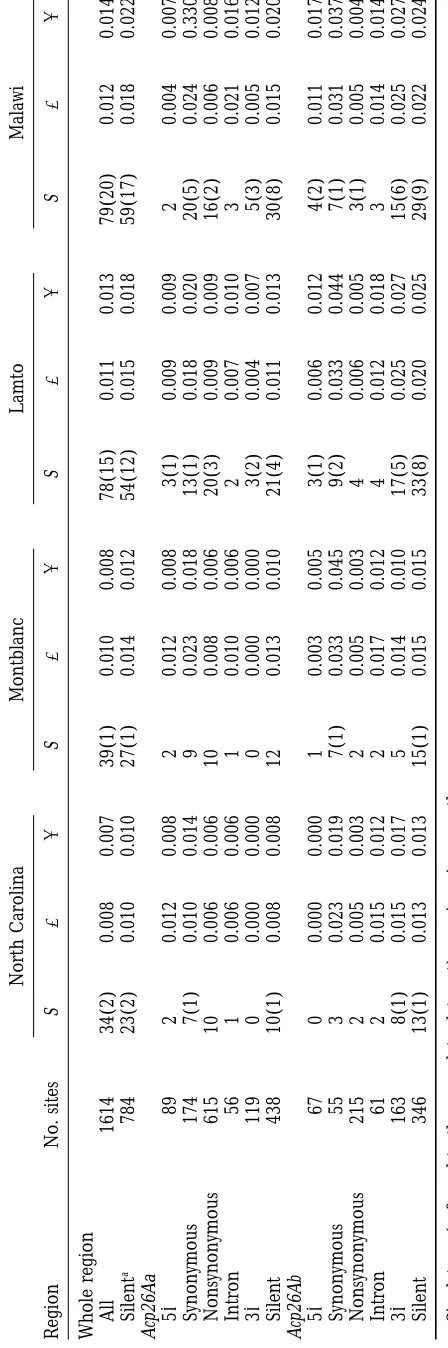
Nucleotide variation for the whole region studied was
the deficiency and, therefore, hemizygous for the wild Acp26A
locus were selected from the progeny. Ten lines from North estimated separately for each population (Table 1). The
Carolina, previously studied inAguade´et al. (1992), were also level of both total and silent polymorphism was slightly
included in the analyses. higher for the two African populations, especially when
DNA extraction, PCR amplification, and sequencing:DNA
compared to the North American sample. The level of
was extracted from 10 adult flies by a modification of protocol
synonymous variation in the exons was higher than that
48 in Ashburner(1989). For each of the lines an z1.7-kb
1081 Evolution of the Acp26A Region
between the two genes, which includes regulatory se- of comparisons that presented a significant association (using thex2 test and without considering the Bonfer-quences of both genes, showed the lowest level of silent
polymorphism. roni correction for multiple comparisons), and the
portion of significant comparisons. In all cases this pro-As in the original study of this region (Aguade´ et al.
1992), the level of nonsynonymous variation of both portion was higher in the non-African than in the African samples. Also in the African samples the propor-the Acp26Aa and Acp26Ab genes was rapropor-ther high as
com-pared to other regions of the genome; the ratio of non- tion was in all cases higher for the Acp26Ab transcription unit. For the two larger samples from Africa and for the synomymous to synonymous polymorphism was higher
for the Acp26Aa gene. Figure 2 shows the amino acid pooled African sample, Table 3 also shows the number of significant comparisons when the Bonferroni correc-variation of the two proteins in the populations sampled.
The mean number of amino acid differences between tion was applied. In the pooled African sample, 8 of the 15 significant associations in the Acp26Ab transcription lines varied between 4 and 5 for Acp26Aa and was
ap-proximately equal to 1 for Acp26Ab. Only the sample unit were in the trailer between polymorphisms 1490 and 1572; in this smaller region this represented 22% from Lamto presented one not-in-frame 3-bp deletion
in exon 2 of the Acp26Aa gene that resulted in one of significant associations (8 out of 36 comparisons). The trailer presented in fact three major haplotypes amino acid change in addition to one amino acid
dele-tion. Polymorphisms at adjacent residues 24 and 25 (represented by lines La32, La36, and La108) in the African samples. These major haplotypes were also pres-involved the same 2 amino acids (Gln/Lys), and also
those at nearby residues 76 and 79 (Asp/Asn). Residue ent in the non-African samples, although only two segre-gated in each population. However, even in this small 90 of the Acp26Ab protein segregated for 2 amino acid
variants (Ala/Glu) at intermediate frequencies in the region (between sites 1490 and 1572) five recombina-tion events could be inferred in the history of the African African populations, while it was monomorphic for Ala
in the non-African samples. No amino acid polymor- pooled sample using the four-gamete test (Hudsonand Kaplan1985), while none was in the non-African samples.
phism was detected in any of the five putative
glycosyla-tion sites (MonsmaandWolfner1988) and in any of Tests of neutrality:Tests of neutrality based on
poly-morphism data were applied to the whole region and the three peptidase sites (Park and Wolfner 1995)
of Acp26Aa; also the 11-amino-acid residues conserved also to the two transcription units separately. In the samples studied neither the Tajima test (Tajima1989)
relative to the Aplysia Egg Laying Hormone (ELH;
Monsma and Wolfner1988) were monomorphic in nor the Fu and Li test (Fu andLi1993) detected any
departure from neutral expectations. all the samples studied.
Genetic differentiation between populations: Table Tests of neutrality based on polymorphism and
diver-gence data were also applied. The direct relationship 2 summarizes the analysis of population differentiation.
The Fst parameter, which measures the proportion of between levels of polymorphism and divergence in a given region, predicted by the neutral theory of molecu-nucleotide diversity attributable to variation between
populations, was estimated from the average number lar evolution, constitutes the common null hypothesis of these tests. Table 4 summarizes the results of the of differences between alleles according toHudsonet
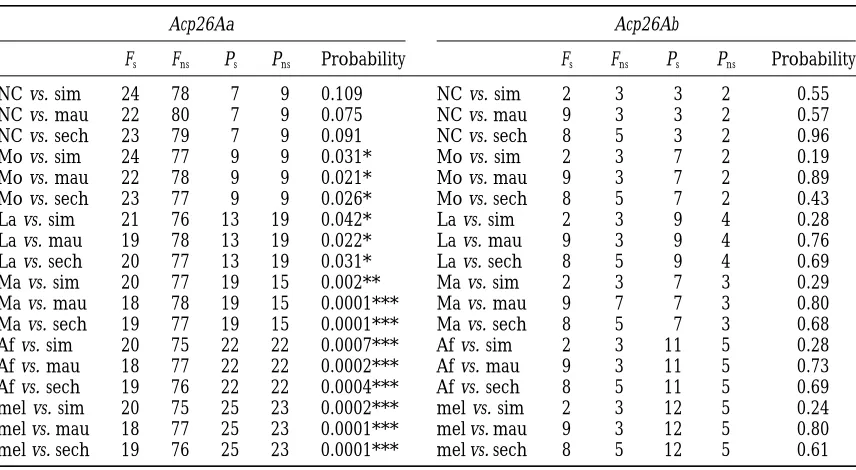
al. (1992b). Population differentiation was assessed by McDonald and Kreitman (MK) test (McDonald and Kreitman1991). This test, which compares
nonsynony-the permutation test (Hudsonet al. 1992a) using Ks*as
the test statistic. The analysis was performed for the mous and synonymous changes in a coding region, was applied separately to the Acp26Aa and Acp26Ab genes. whole region studied considering either all variation or
only silent variation, and also separately for the Acp26Aa In the Acp26Aa gene there was in all cases an excess of nonsynonymous differences fixed between species; this and Acp26Ab transcription units. In all cases the
compar-ison between the two African populations presented the excess was significant in comparisons involving the Montblanc, Lamto, and Malawi populations, and only lowest Fstestimates. These populations did not show any
significant differentiation for the Acp26Ab transcription marginally significant in the North Carolina compari-son. On the other hand, the MK test did not detect unit, while for the Acp26Aa transcription unit, and for
the whole region, they were either marginally (0.05, any departure from neutral expectations in the much shorter Acp26Ab coding region. The Hudson, Kreitman, P,0.10) or slightly (P50.04) differentiated. The
non-African populations showed a significant differentiation and Aguade´ (HKA) test (Hudson et al. 1987) was
ap-plied both for all changes and for silent changes (analy-in all cases from the Malawi population and (analy-in most
cases from the Ivory Coast population. sis not shown); in this test the regions compared were the two transcription units included in the fragment
Linkage disequilibrium:In light of the results of
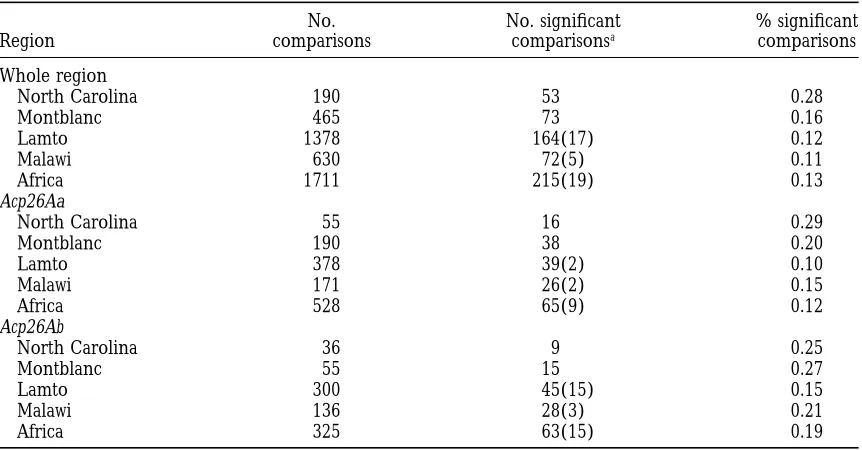
ge-netic differentiation between populations, linkage dis- studied (Acp26Aa and Acp26Ab). When all changes were considered, most of the comparisons revealed a signifi-equilibrium or pairwise gametic association was
esti-mated separately for each population and also for the cant departure from the neutral expectations, while no departure was detected when only silent variation was pooled African sample. Table 3 shows the total number
1083 Evolution of the Acp26A Region
Figure1.—Continued.
applications of the HKA test is consistent with the excess non-African populations, the estimated nucleotide vari-ation (measured as p or u) was much higher in the of nonsynonymous divergence in the Acp26Aa gene
al-ready detected using the MK test. African populations, while the level of linkage disequi-librium was higher in the non-African samples (Begun
andAquadro1993, 1995). The analysis of silent (and
DISCUSSION
presumably neutral) variation within the AdhSallele in
samples from both East and West Africa and in
non-Afri-Pattern of nucleotide variation:In the few studies that
TABLE 2 genes presented similar levels of nonsynonymous var-iation in African and non-African populations. As in Population differentiation
previous nuclear DNA studies comparing African and non-African populations, polymorphisms in the North
Whole region Acp26Aa Acp26Ab
American and European samples were a subset of those
Fst P Fst P Fst P present in the two African populations. However, in
All sites contrast to previous studies (BegunandAquadro1993,
NC-Mo 0.09 0.031 0.12 0.057 0.03 0.099 1995) most of the nonrare polymorphisms segregating
NC-La 0.14 0.001 0.08 0.023 0.20 0.000 in the African samples were also segregating in the
non-NC-Ma 0.19 0.000 0.17 0.000 0.21 0.001
African samples. Also the two African samples shared
Mo-La 0.14 0.000 0.17 0.000 0.09 0.009
most nonunique polymorphisms.
Mo-Ma 0.19 0.000 0.23 0.000 0.14 0.002
Unlike the study of the Adh region (Be´ nassi and
La-Ma 0.02 0.066 0.02 0.071 0.01 0.147
Silent sites Veuille1995), no major differentiation for the Acp26A
NC-Mo 0.11 0.029 0.16 0.111 0.05 0.127 region was detected between West and East Africa. Fst
NC-La 0.17 0.012 0.09 0.112 0.22 0.000 estimates were rather low both for the Acp26Aa (0.02–
NC-Ma 0.18 0.001 0.18 0.000 0.19 0.002
0.03) and Acp26Ab (0.01) transcription units. In the
Mo-La 0.14 0.000 0.25 0.002 0.07 0.029
case of the Acp26Aa region the two populations were
Mo-Ma 0.17 0.000 0.24 0.000 0.08 0.028
marginally or slightly differentiated, while in the case
La-Ma 0.02 0.085 0.03 0.040 0.01 0.179
of the Acp26Ab region they did not show any
differentia-NC, North Carolina; Mo, Montblanc; La, Lamto; Ma,
Ma-tion. In contrast to silent variation within AdhS, variation lawi; P, probability.
at the Acp26Aa and Acp26Ab regions might be governed by selection (see below). Also non-African populations showed in general a strong differentiation from both African and West African populations relative to East
East and West Africa; this differentiation could be, as African samples (Be´ nassiandVeuille1995).
for other genes, both a result of drift during the out-In this study variation both at the Acp26Aa and
Acp-of-Africa expansion and of selection acting differentially 26Ab genes was surveyed in two non-African samples
during that process. and in a subsample of the same two African populations
Nonsynonymous variation at the Acp26Aa gene is gov-studied byBe´ nassiandVeuille(1995). As in previous
erned by directional selection: When the whole gene
studies the level of variation was higher in African than
was considered, Kaand Ksestimates between D. melano-in non-African populations, although the differences
were not very conspicuous (Table 1). In addition, both gaster and the closely related species D. simulans, D.
mau-TABLE 3
Linkage disequilibrium
No. No. significant % significant
Region comparisons comparisonsa comparisons
Whole region
North Carolina 190 53 0.28
Montblanc 465 73 0.16
Lamto 1378 164(17) 0.12
Malawi 630 72(5) 0.11
Africa 1711 215(19) 0.13
Acp26Aa
North Carolina 55 16 0.29
Montblanc 190 38 0.20
Lamto 378 39(2) 0.10
Malawi 171 26(2) 0.15
Africa 528 65(9) 0.12
Acp26Ab
North Carolina 36 9 0.25
Montblanc 55 15 0.27
Lamto 300 45(15) 0.15
Malawi 136 28(3) 0.21
Africa 325 63(15) 0.19
aNumber of significant comparisons using thex2test without and with (in parentheses) the Bonferroni
1087 Evolution of the Acp26A Region
TABLE 4
McDonald and Kreitman tests
Acp26Aa Acp26Ab
Fs Fns Ps Pns Probability Fs Fns Ps Pns Probability
NC vs. sim 24 78 7 9 0.109 NC vs. sim 2 3 3 2 0.55
NC vs. mau 22 80 7 9 0.075 NC vs. mau 9 3 3 2 0.57
NC vs. sech 23 79 7 9 0.091 NC vs. sech 8 5 3 2 0.96
Mo vs. sim 24 77 9 9 0.031* Mo vs. sim 2 3 7 2 0.19
Mo vs. mau 22 78 9 9 0.021* Mo vs. mau 9 3 7 2 0.89
Mo vs. sech 23 77 9 9 0.026* Mo vs. sech 8 5 7 2 0.43
La vs. sim 21 76 13 19 0.042* La vs. sim 2 3 9 4 0.28
La vs. mau 19 78 13 19 0.022* La vs. mau 9 3 9 4 0.76
La vs. sech 20 77 13 19 0.031* La vs. sech 8 5 9 4 0.69
Ma vs. sim 20 77 19 15 0.002** Ma vs. sim 2 3 7 3 0.29
Ma vs. mau 18 78 19 15 0.0001*** Ma vs. mau 9 7 7 3 0.80
Ma vs. sech 19 77 19 15 0.0001*** Ma vs. sech 8 5 7 3 0.68
Af vs. sim 20 75 22 22 0.0007*** Af vs. sim 2 3 11 5 0.28
Af vs. mau 18 77 22 22 0.0002*** Af vs. mau 9 3 11 5 0.73
Af vs. sech 19 76 22 22 0.0004*** Af vs. sech 8 5 11 5 0.69
mel vs. sim 20 75 25 23 0.0002*** mel vs. sim 2 3 12 5 0.24
mel vs. mau 18 77 25 23 0.0001*** mel vs. mau 9 3 12 5 0.80
mel vs. sech 19 76 25 23 0.0001*** mel vs. sech 8 5 12 5 0.61
Fs, number of synonymous fixed differences between species; Fns, number of nonsynonymous fixed differences
between species; Ps, number of synonymous segregating sites; Pns, number of nonsynonymous segregating sites.
NC, North Carolina; Mo, Montblanc; La, Lamto; Ma, Malawi; Af, Africa; mel, all D. melanogaster lines; sim, D. simulans; mau, D. mauritiana; sech, D. sechellia. Probability established with a G -test with Williams’ correction for continuity. *0.01,P,0.05; **0.001,P,0.01; ***P,0.001.
ritiana, and D. sechellia were rather similar, and no sig- after mating; the protein is cleaved three times after residues 48, 68, and 115 or 117, generating four peptides nificant excess of replacement changes could be
detected (Aguade´ et al. 1992). However, when the re- (ParkandWolfner1995). Only the processed protein
is active, and secretions from the male accessory gland gion corresponding to the second exon of the gene was
compared between both D. melanogaster and D. simulans, main cells are needed for the processing. As one of the known functions of Acp26Aa is the stimulation of egg and the more distantly related species D. yakuba and
D. teissieri (TsaurandWu1997), the average Ka/Ksratio laying in the mated female, the last peptide would be
the candidate for that function as it contains the region for the four comparisons wasz1.5; only the Ka/Ksratio
for the branch separating both species pairs was signifi- of similarity to the ELH in the four species of the melano-gaster complex. To test whether positive selection has cantly.1, which constituted unambigous evidence that
at least in the past the evolution of Acp26Aa had been driven the evolution of the different parts of the protein, the Acp26Aa coding region was first divided in two frag-driven by positive selection.
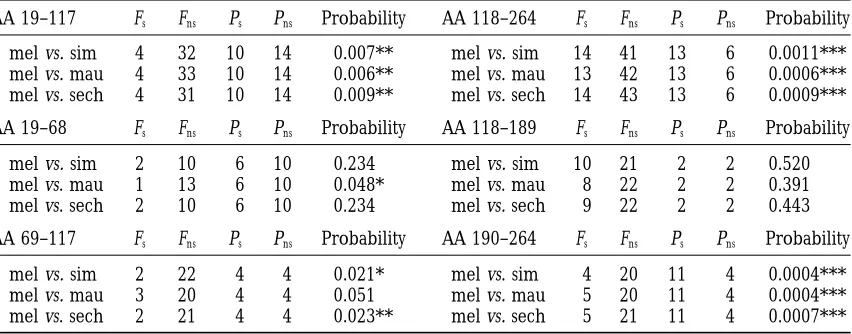
In this study another three populations of D. melano- ments that included the first three peptides and the last peptide, respectively. Application of the MK test gaster were sampled. Application of the MK test to the
different populations surveyed (and to the complete revealed an excess of fixed nonsynonymous differences in both fragments, although significance was higher in D. melanogaster sample) revealed a significant excess of
nonsynonymous fixed differences between D. melanogas- the second fragment (Table 5). To further explore the distribution of fixed and polymorphic changes, both ter and each of the three sibling species (Table 4). This
excess of nonsynonymous divergence was also revealed fragments were subdivided, despite the fact that subdivi-sion could lower the statistical power of the MK test; by the results of the HKA tests performed comparing
all variation (most tests significant) and only silent varia- the first fragment was divided in two, corresponding to the regions coding for the first two peptides and for tion (all tests nonsignificant) between the Acp26Aa and
Acp26Ab regions (analysis not shown). We can now assert the third peptide, and the second was in two equally sized fragments (Table 5). Although the contribution of that directional selection not only drove the evolution
of Acp26Aa in the distant past (between the D. melano- the different peptides to the function(s) of the Acp26Aa protein is not known, this analysis indicates that direc-gaster-D. simulans split, 2.5 mya, and the D.
TABLE 5
McDonald and Kreitman tests along the Acp26Aa gene
AA 19–117 Fs Fns Ps Pns Probability AA 118–264 Fs Fns Ps Pns Probability
mel vs. sim 4 32 10 14 0.007** mel vs. sim 14 41 13 6 0.0011***
mel vs. mau 4 33 10 14 0.006** mel vs. mau 13 42 13 6 0.0006***
mel vs. sech 4 31 10 14 0.009** mel vs. sech 14 43 13 6 0.0009***
AA 19–68 Fs Fns Ps Pns Probability AA 118–189 Fs Fns Ps Pns Probability
mel vs. sim 2 10 6 10 0.234 mel vs. sim 10 21 2 2 0.520
mel vs. mau 1 13 6 10 0.048* mel vs. mau 8 22 2 2 0.391
mel vs. sech 2 10 6 10 0.234 mel vs. sech 9 22 2 2 0.443
AA 69–117 Fs Fns Ps Pns Probability AA 190–264 Fs Fns Ps Pns Probability
mel vs. sim 2 22 4 4 0.021* mel vs. sim 4 20 11 4 0.0004***
mel vs. mau 3 20 4 4 0.051 mel vs. mau 5 20 11 4 0.0004***
mel vs. sech 2 21 4 4 0.023** mel vs. sech 5 21 11 4 0.0007***
AAx–y, region coding for amino acid residues x through y. Fs, number of synonymous fixed differences
between species; Fns, number of nonsynonymous fixed differences between species; Ps, number of synonymous
segregating sites; Pns, number of nonsynonymous segregating sites. mel, all D. melanogaster lines; sim, D. simulans;
mau, D. mauritiana; sech, D. sechellia. Probability established with a G -test with Williams’ correction for continuity. *0.01,P,0.05; **0.001,P,0.01; ***P,0.001.
complex; it also indicates that selection might be acting gaster and simulans lineages (Eaneset al. 1996).
There-fore, only selective sweeps occurring in the last differentially along the fourth peptide.
Directional selection is, however, expected to cause z600,000 years would have any effect on extant poly-morphism in D. melanogaster.
a reduction of polymorphism in the region closely
linked to the favored variant. Although all D. melanogas- The Acp26Aa and Acp26Ab genes have different evolu-tionary histories as expected in a high recombination ter populations harbored an important amount of
non-synonymous and non-synonymous polymorphisms at the Acp- region like the Acp26A region. The function of the Ac-p26Ab protein after its transfer to the female is not 26Aa region, some regions showed a very low level of
polymorphism without the corresponding reduction in known; there is no evidence of selection either driving its evolution or maintaining the different protein vari-the levels of fixed differences. In fact, in vari-the sample from
North Carolina the region extending from polymorphic ants. Unlike the Acp26Aa gene, the level of nonsynony-mous variation in the Acp26Ab coding region is, both site 417 to the end of the Acp26Aa transcription unit
(Figure 1) presented 5 singletons out of 6 polymor- within and between species, roughly an order of magni-tude lower than that of synonymous variation (Aguade´
phisms; also in the sample from Malawi the region
span-ning polymorphic sites 270 to 693 presented 10 single- et al. 1992), indicating a certain degree of functional constraint at the protein level.
tons out of 11 polymorphisms. Nevertheless, it could be
argued that the sample from North Carolina is not at I thank Michel Veuille and Ve´ronique Be´nassi for the African lines equilibrium, and that the observed distribution of poly- and for sharing unpublished information on the chromosomal poly-morphism of these lines. I also thank the Umea˚ Stock Center for the
morphism is still reflecting its rather recent origin; this
Df(2L)Gdh-A,dpL/SM1 line, Serveis Cientı´fico-Te`cnics from
Universi-argument would generally not be made for the East
tat de Barcelona for automated sequencing facilities, and Julio Rozas,
African sample. Also the extent of the fragment with
Carmen Segarra, and Griselda Ribo´ for comments on the manuscript.
reduced polymorphism in Malawi (z400 bp) would be Special thanks are given to David Salguero for his excellent technical consistent with the region expected to be affected by a assistance. This work was supported by grants PB94-0923 from Direc-cio´n General de InvestigaDirec-cio´n Cientı´fica y Te´cnica, Spain, and
selective sweep in a region of high recombination like
1995SGR-577 from Comissio´ Interdepartamental de Recerca i
Tecno-the Acp26Aa region. On Tecno-the oTecno-ther hand, as Tecno-the
coales-logia, Generalitat de Catalunya.
cence time of any given sample of sequences is 4N gener-ations, selective sweeps that occurred before that time would have no effect on the observed polymorphism.
LITERATURE CITED
Under the assumption of mutation-drift equilibrium
this time can be estimated from the ratio between u Aguade´ , M., N. MiyashitaandC. H. Langley,1992 Polymorphism
and divergence in the Mst26A male accessory gland gene region
(4Nm) and divergence (2tm). Using restriction map
poly-in Drosophila. Genetics 132: 755–770.
morphism in D. melanogaster, and divergence between
Ashburner, M.,1989 Drosophila: A Laboratory Handbook. Cold Spring
D. melanogaster and D. simulans, this time was estimated Harbor Laboratory Press, Cold Spring Harbor, NY.
Begun, D. J.,andC. F. Aquadro,1993 African and North American
melano-1089 Evolution of the Acp26A Region
populations of Drosophila melanogaster are very different at the Hudson, R. R., M. SlatkinandW. P. Maddison,1992b Estimation
of levels of gene flow from DNA sequence data. Genetics 132: DNA level. Nature 356: 519–520.
Begun, D. J.,andC. F. Aquadro,1995 Molecular variation at the 583–589.
Kubli, E.,1996 The Drosophila sex-peptide: a peptide pheromone
vermillion locus in geographically diverse populations of Drosophila
melanogaster and D. simulans. Genetics 140: 1019–1032. involved in reproduction. Adv. Dev. Biochem. 4: 99–128.
Lee, Y.,andV. D. Vacquier,1995 Positive selection is a general Be´ nassi, V.,andM. Veuille,1995 Comparative population
structur-phenomenon in the evolution of abalone sperm lysin. Mol. Biol. ing of molecular and allozyme variation of Drosophila melanogaster
Evol. 12: 231–238. Adh between Europe, West Africa and East Africa. Genet. Res.
Maddison, W. P.,andD. R. Maddison,1992 MacClade: Analysis of
65:95–103.
Phylogeny and Character Evolution, Version 3.0. Sinauer Associates,
Be´ nassi, V., S. Aulard, S. MazeauandM. Veuille,1993 Molecular
Sunderland, MA. variation of Adh and P6 genes in African populations of Drosophila
McDonald, J. H.,andM. Kreitman,1991 Adaptative protein
evolu-melanogaster and its relation to chromosomal inversions. Genetics
tion at the Adh locus in Drosophila. Nature 351: 652–654. 134:789–799.
Metz, E. C.,andS. R. Palumbi,1996 Positive selection and sequence Bertram, M. J., D. M. NeubaumandM. F. Wolfner,1996
Localiza-rearrangements generate extensive polymorphism in the gamete tion of the Drosophila accessory gland protein Acp36DE in the
recognition protein bindin. Mol. Biol. Evol. 13: 397–406. mated female suggests a role in sperm storage. Inst. Biochem.
Monsma, S.,andM. F. Wolfner,1988 Structure and expression of
Mol. Biol. 26: 971–980.
a Drosophila male accessory gland gene whose products resemble
Clark, A. G., M. Aguade´ , T. Prout, L. HarshmanandC. H. Langley,
a peptide pheromone precursor. Genes Dev. 2: 1063–1073. 1995 Variation in sperm displacement and its association with
Nei, M.,1987 Molecular Evolutionary Genetics. Columbia University
accessory gland protein loci in Drosophila melanogaster. Genetics
Press, New York. 139:189–201.
Palumbi,S. R., 1994 Genetic divergence, reproductive isolation, Eanes, W. F., M. Kirchner, J. Yoon, C. H. Biermann, I.-N. Wanget
and marine speciation. Ann. Rev. Ecol. Syst. 25: 547–572.
al., 1996 Historical selection, amino acid polymorphism and
Park, M.,andM. F. Wolfner,1995 Male and female cooperate
lineage-specific divergence at the G6pd locus in Drosophila
melano-in the prohormone-like processmelano-ing of a Drosophila melanogaster gaster and D. simulans. Genetics 144: 1027–1041.
seminal fluid protein. Dev. Biol. 171: 694–702.
Fu, Y. X.,andW-S. Li,1993 Statistical tests of neutrality of mutations.
Rozas, J.,andR. Rozas,1997 DnaSP version 2.0: a novel software
Genetics 133: 693–709.
package for extensive molecular population genetics analysis.
Herndorn, L. A.,andM. F. Wolfner,1995 A Drosophila seminal
Comput. Appl. Biosci. 13: 307–311. fluid protein, Acp26Aa, stimulates egg-laying in females for one
Tajima, F.,1989 Statistical method for testing the neutral mutation
day after mating. Proc. Natl. Acad. Sci. USA 92: 10114–10118.
hypothesis by DNA polymorphism. Genetics 123: 585–595.
Higuchi, R. G., and H. Ochman, 1989 Production of
single-Tsaur, S.-H.,andC.-I. Wu,1997 Positive selection and the
molecu-stranded DNA templates by exonuclease digestion following the lar evolution of a gene of male reproduction, Acp26Aa of Dro-polymerase chain reaction. Nucleic Acids Res. 17: 5865. sophila. Mol. Biol. Evol. 14: 544–549.
Hudson, R. R.,andN. L. Kaplan,1985 Statistical properties of the
Watterson,G. A., 1975 On the number of segregating sites in
number of recombination events in the history of a sample of genetic models without recombination. Theor. Popul. Biol. 7:
DNA sequences. Genetics 111: 147–164. 256–276.
Hudson, R. R., M. KreitmanandM. Aguade´ ,1987 A test of neutral
Wolfner, M. F.,1997 Tokens of love: functions and regulation of
molecular evolution based on nucleotide data. Genetics 116: Drosophila male accessory gland products. Inst. Biochem. Mol.
153–159. Biol. 27: 179–192.
Hudson, R. R., D. D. BoosandN. L. Kaplan,1992a A statistical test