LINKAGE AND FUNCTION I N NEUROSPORA3
S. R. GROSS2 AND ADELE FEIN
Rockefeller Institute, N e w York, N . Y .
Received February 1, 1960
IGHT linkage of genes controlling the synthesis of enzymes involved in Trelated physiological reactions is prevalent in Salmonella pnd Escherichia
coli
(DEMEREC
and HARTMAN 1959). Extensive linkage of this sort has not been reported in Aspergillus and Neurospora. Instead, most of the genes concerned with the reaction sequences studied in the enteric bacteria have been found tobe distributed throughout the genome of the fungi. Departures from a completely random distribution of functionally related genes have been reported frequently (see PONTECORVO 1958, for review). However, if one excludes those cases which probably involve complex cistronic relationships relative to the synthesis of a single protein, few linked loci have been observed that are functionally related but distinct. Moreover, tight linkage of more than two distinct functionally related genes has, up to now, not been established in the fungi.
The question can then be asked whether clustering of functionally related genes is a result of a selective mechanism peculiar to the physiological activity of the enteric bacteria or whether the selective mechanism is universally operative but more subtly expressed in other organisms. In this report evidence is presented indicating that the genetic determinants of four enzymes’ involved in the syn- thesis of the precursors of the aromatic amino acids and p-aminobenzoic acid (PAB) in Neurospora are closely linked. Furthermore, some specific qualitative and quantitative changes in the enzymatic complement of the mutant strains will be discussed.
Specific interest in the linkage relationship of the genes controlling the syn- thesis of the enzymes involved in the synthesis of the aromatic ring arose as a consequence of a n apparent paradox displayed by a mutant strain of Neurospora crassa (C161), obtained by METZENBERG and MITCHELL ( 1958), which did not utilize shikimic acid for growth as a sole replacement of the requirement for the aromatic amino acids and PAB. The genetic and biochemical evidence suggested that this mutant was unable to carry out a reaction prior to the synthesis of the hydroaromatic compounds that have been established as intermediates in t h e synthesis of the aromatic amino acids of E . coli (DAVIS 1955) and Neurospora
(TATUM, GROSS, EHRENSVARD, and GARNJOBST 1954). Failure of this mutant strain to respond to shikimic acid for growth as distinct from another, Y7655, (TATUM et al. 1954) which does, suggested that either an absolute permeability
886 S. R. GROSS A N D A. F E I N
barrier to shikimic acid was present in C161 or that the mutant strain was not capable of converting shikimic acid to the aromatic moiety of the amino acids as well as being blocked in a reaction prior to the synthesis of 5-dehydroquinic acid
(DHQ)
,
the first of the hydroaromatic precursors of shikimic acid (WEISS, DAVIS, and MINGIOLI 1953). The data presented below indicate that C161 is missing the entire enzymatic apparatus necessary to convert 2-keto-3-deoxy-~-arabo-heptonicacid 7-phosphate (KDHP) to at least one product of shikimic acid.
MATERIALS A N D M E T H O D S
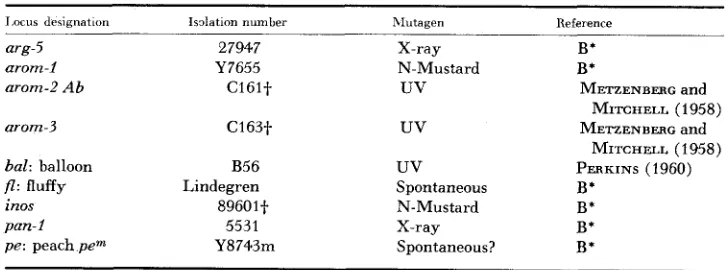
Biological: Table 1 contains all pertinent information regarding the origin of mutant strains used in this investigation. The symbols arg, arom, inos and pan refer to gene loci that are involved in the synthesis of arginine, the aromatic amino acids and PAB, inositol, and pantothenic acid, respectively. Locus numbers were assigned to arom mutants in the order in which sufficient genetic and/or functional dissimilarities were observed. Since subsequent investigation has indi- cated that C161 probably is an aberration of some sort, Ab has been added to the locus designation (arom-2) assigned and the locus number reserved for the point mutation involving the first missing reaction in the metabolic sequence in strains bearing arom-2 Ab. The mutant strains will be referred to by their locus desig- nation throughout.
The standard types used were 38-2a and 38-8A. These were obtained from SY7A and Y7655a ( a r o m - I ) after five successive sib crosses. Both arom-2 Ab and arom-3 were backcrossed three times to the standard strains in order to obtain reasonable homogeneity and the proper heterocaryon compatibility back- ground.
The growth requirements of the arom mutants were satisfied by the addition of 40 mg each of phenylalanine, tyrosine, tryptophan and 0.25 mg PAB per liter of VOGEL'S synthetic medium (VOGEL 1956). Shikimic acid, 400 mg per liter was
TABLE 1
Mutant strains
I.ocus de5imatmn Isolation number arg-5
arom-I arom-2 A b
arom-3
bal: balloon p : fluffy inos
pan-I
p e : peach p e m
27947 Y7655 C l 6 l t C163t B56 Lindegren 8960lt 5531 Y8743m ~ hlutagen X-ray N-Mustard
uv
uv
uv
Spontaneous N-Mustard X-ray Spontaneous? ~~ Reference B* B*METZENBERG and METZENBERC and PERKINS (1960)
B* B* B* B*
MITCHELL (1958) MITCHELL (1958)
' B, BAHHTT PI a l . (1954).
LINKAGE A N D FUNCTION 887
added in place of the aromatic amino acids and PAB. The requirements for arginine and inositol were satisfied by the addition of 100 mg L-arginine and 10 mg of inositol per liter. Crosses of the arom mutants were found to be most fertile when the crossing medium was supplemented with 0.1 to 0.25 of the aro- matic requirement. Random ascospore isolates were obtained by the sorbose plating method (NEWMEYER 1954).
Chemical: The strains used in the enzymatic analysis were grown in standing culture for three to four days in synthetic medium supplemented with the aro- matic amino acids plus any other specific compound required for growth. The grinding and extraction procedure has been described (GROSS 1958). Generally, only a two- to four-hours extraction in 0.1 M Tris-HC1 buffer p H 8.0 was em- ployed.
I n order to avoid error introduced by the conversion of DHS to PCA by 5- dehydroshikimic acid dehydrase (DHS dehydrase) and the endogenous TPN reduction exhibited by fresh extracts of Neurospora, measurements of the specific activity of 5-dehydroshikimic acid reductase (DHS reductase and 5-dehydro- quinase) were done on 0 to 0.75 saturated (NH,) ,SO, fractions after freezing and thawing (which inactivates more than 80 percent of the DHS dehydrase). 2-Keto-
3-deoxy-~-arabo-heptonic acid 7-phosphate synthetase (KDHP synthetase) was measured in 0.4 to 0.55 (NH4),S04 fractions dialyzed for 12 hours against M/30 pH 7.4 KPO4 buffer with M thioethanol. 5-Dehydroquinic acid synthetase
(DHQ synthetase) was measured in similarly dialyzed 0.35 to 0.75 saturated (NH,) ,SO4 fractions. PCA oxidase and DHS dehydrase were measured directly in crude extracts.
In all cases where no enzyme activity was found, the entire crude extract as well as precipitates obtained by stepwise
(NH,)
,SO, fractionation (0.2 saturated(NH,,
so4
per step) were examined for activity.DHS reductase was measured in a reaction mixture containing 1 p mole shikimic acid, 10 p moles triphosphopyridine nucleotide (TPN)
,
0.1 ml enzyme preparation in 2 cc 0.1 M Tris-HC1 buffer p H 8.0. The initial reaction velocity was determined by the increase in optical density at 340 mp(E340 T P N H = 6.22x l o q ) during the first five minutes of the reaction.
5-Dehydroquinase activity was measured by following the productio3 of 5- dehydroshikimic acid (DHS) from DHQ (MITSUHASHI and DAVIS 1954). The reaction mixture contained 0.1 ml enzyme preparation plus 1 p mole DHQ in
3 m! 0.1 M Tris-HC1 pH 7.4. Because of end absorption of the crude (NH,),SO, fraction, the reaction velocity was determined by measuring the increase i n absorption at 240 mp (DHS pH 7.4
The activity of PCA oxidase and DHS dehydrase were measured in 2 mlO.1 M Tris-HC1 pH 7.4 by the spectrophotometric and colorimetric procedures described previously (GROSS, GAFFORD, and TATUM 1956; GROSS 1958).
KDHP synthetase activity was measured by the procedure of SRINIVASAN and SPRINSON (1959). The synthesis of DHQ from KDHP was followed by measuring the disappearance of KDHP colorimetrically and the appearance of DHQ as determined by bioassay using an arom auxotroph of Aerobacter aerogenes A1 70-
888 S . R. GROSS A N D A. FEIN
143S1 ( SRINIVASAN, KATAGIRI, and SPRINSON 1959). All bacterial strains men- tioned in this paper were the generous gift of DR. B. D. DAVIS.
A unit of enzyme activity is defined as the amount of enzyme that converts 1 mp mole substrate per minute under the assay conditions described. Protein concentrations were determined by the procedure of LOWRY, ROSEBROUGH, FARR, and RANDALL (1951).
DHS and DHQ were isolated from culture filtrates of mutant strains of E . coli by the procedures of SALAMON and DAVIS ( 1953) and WEISS, DAVIS, and MINGIOLI
( 1953). Cyclohexylammonium erythrose 4-phosphate dimethylacetal and the barium salt of 2-keto-3-deoxy-~-arabo-heptonic acid 7-phosphate (KDHP) were the generous gifts of DR. D. B. SPRINSON. Sodium erythrose-4-phosphate was pre- pared by the procedure of BALLOU, FISHER, and MCDONALD (1955). Barium KDHP was converted to the sodium salt before use. All other compounds used were obtained from commercial sources.
E X P E R I M E N T A L RESULTS
General physiological and genetic information regarding arom mutants: The mutant arom-l (Y7655) has been shown to be unable to convert DHS to shikimic acid (TATUM et al. 1954). It accumulates some DHS and large quantities of proto- catechuic acid (PCA) in its growth medium. It will grow on shikimic acid as a sole replacement of its requirement for the aromatic amino acids and PAB. Its growth on shikimic acid, both in liquid culture and on agar, attains the rate of the standard strains only after an extensive lag period when sucrose or glucose is supplied as the carbon source. No lag in response to shikimic acid is observed when succinate or aspartate serve as the carbon source (MARY HURD, unpublished observations). This phenomenon closely resembles the glucose inhibition of the induced synthesis of ,&galactosidase in E. coli, which has been interpreted as being the result of the inhibition of the synthesis of the permeability mechanism for the inducer (COHN 1956). The arom-1 locus has been found to lie distal to p e (peach) and proximal to jl (fluffy) on linkage group I1 (GARNJOBST in BARRATT, NEWMEYER, PERKINS, and GARNJOBST 1954).
Strains bearing mom-2
Ab
(C161) have been found not to accumulate any of the hydroaromatic precursors of the aromatic ring ( METZENBERG and MITCHELL 1958). Taken at face value this implies that a reaction is blocked prior to the synthesis of DHQ. However, it was observed that shikimic acid does not replace the aromatic requirement of arum-2Ab.
We have confirmed this and have shown that it also does not respond to DHS or DHQ. Failure to respond to the presumed intermediates and the absence of accumulated compounds related to the hydro- aromatic compounds suggested, among other possibilities, that a permeability barrier to hydroaromatic compounds exists in those strains with C (Cal. Tech) genetic background, and/or arom-2Ab
is a mutation that leads to the completeloss of the reaction sequence involved in the synthesis of the aromatic ring a t least from a step prior to the synthesis of DHQ to a product of shikimic acid.
LINKAGE A N D FUNCTION 889
standard strains grew on shikimic acid in place of the aromatic requirement. Hence, if a genetically controlled permeability barrier were involved, its determi- nant must be closely linked to arom-2 Ab.
The arom-3 mutant (C163), unlike arom-2 Ab and arom-I, is comparatively “leaky” and has only a partial requirement for PAB. It does not respond to shikimic acid for growth. A careful examination of the products accumulated during growth using sensitive chromatographic and bioautographic procedures (for methods employed see TATUM et al. 1954) revealed the pre2ence of shikimic acid, DHS, and large amounts of PCA. The accumulation of shikimic acid by arom-3 apparently was missed by METZENBERG and MITCHELL ( 1958) because of the relatively small quantity accumulated and the relative insensitivity of the bioassay employed by them. The accumulation pattern observed conforms with that expected for a mutant blocked in a reaction subsequent to the production of shikimic acid.
The physiological behavior of the double mutant arom-2 Ab arom-3 is identical with arom-2 Ab. The arom-l arom-3 double mutant secretes the same compounds as does arom-I, but like arom-3, fails to respond to shikimic acid. Since all at- tempted crosses of arom-l by arom-2 Ab have been sterile, the arom-2 Ab arom-2 double mutant has not been synthesized.
Pairwise tests of functional complementation of the arom mutants employing the usual criterion of heterocaryotic growth on minimal medium revealed that combinations of arom-l plus arom-3 and arom-2 Ab plus arom-3 rapidly formed prototrophic heterocaryons while arom-2 Ab plus arom-I failed to complement each other. Combinations of pan arom-I plus inos arom-2 Ab, when tested on medium containing the full supplement of aromatic amino acids, grew success- fully thus ruling out the possibility of the production of a specific inhibitor of growth in the arom-2 Ab plus arom-1 heterocaryon.
The evidence thus far presented is consistent with the following conclusions: ( 1 ) At least one common functional process is impaired in arom-l and arom-2 Ab. (2) I n addition to the disfunction held in common, arom-2 Ab is unable to synthesize DHQ and is also unable to convert shikimic acid to some intermediate subsequent to it in the synthesis of the aromatic ring. (3) The metabolic disfunc- tion of arom-3 involves a reaction subsequent to the synthesis of shikimic acid. This reaction can proceed in both arom-I and arom-2 Ab.
Genetic analysis of arom mutants: The apparent functional “allelism” of arom-2 Ab and arom-2, as determined by the analysis of complementation, sug- gested that these mutants should behave as alleles in the strict genetic sense. However, complete sterility of crosses of arom-I by arom-2 Ab prevented a direct genetic analysis. Instead, a comparative analysis of linkage to linkage group I1 markers was performed.
890 S. R. GROSS AND A. FEIN
the production of microconidia, a large error is introduced in scoring random segregants from crosses of arom-2 Ab by pe". Problems of allele recovery and scoring were partly avoided by performing a tetrad analysis using the double mu- tant pen' f 2 which produces microconidia exclusively ( BARRATT and GARNJOBST
1949) and allows the unequivocal detection of exchanges in the pe" f 2 interval by the production of segregants with the characteristic f l phenotype.
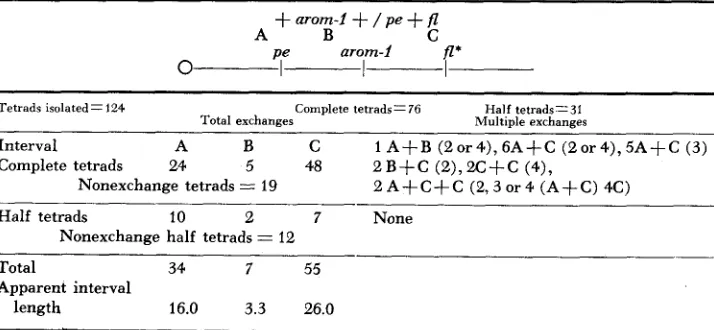
The results of crosses of pe" f l by all of the arom mutants in addition to arg-5 are presented in ,Table 2. Asci which yielded representatives of at least three of the four spore pairs are tabulated as complete tetrads. In view of the poor yield of complete tetrads in crosses involving arcm-2 Ab, the data obtained from those asci yielding members of two spore pairs from the same half of the ascus are in- cluded and referred to as half tetrads. Some multiple exchanges cannot be ob- served in half tetrads; hence the estimates of interval distances are biased down- wards to the extent of the half tetrad frequency.
The data obtained are very heterogeneous with regard to interval lengths. This was expected in view of the heterogeneous origin of the mutants employed (STADLER 1956; MITCHELL 1959; PERKINS 1959). However, it can be concluded that: (1 ) All of the arom mutants are located in the right arm of linkage group 11. (2) arom-l is apparently located between p e and f l (as observed by GARNJOBST in BARRATT e t al. 1954). ( 3 ) The most probable position of arom-3 is to the left of p e near arg-5 and centromere.
The data from the arom-2 Ab by pe" f l cross demonstrate an extreme shortening
of the centromere to pe interval and the absence of exchanges between p e and arom-2 Ab. However, instead of a corresponding decrease in the p e f l region a slight increase in exchange frequency was observed.
The extreme contraction of the centromere to p e interval in the arom-2 A b
TABLE 2
Tetrad analysis of arom and arg-5 x pe fl crosses
V I I I
Tetrads isolated= 124 Complete tetrads= 76 Half tetrads131
Interval A B C 1 A + B ( 2 o r 4 ) , 6 A + C ( 2 o r 4 ) , 5 A + C (3)
Total exchanges Multiple exchanges
Complete tetrads 24 5 48 2 B + C ( 2 ) , % + C (4),
Nonexchange tetrads = 19 2 A + C + C ( 2 , 3 or 4 ( A + C ) 4C) -
Half tetrads 10 2 7 None
Total 34 7 55
Apparent interval
Nonexchange half tetrads = 12
LINKAGE AND FUNCTION
+
arom-2 Ab+
/ p e+
fz
891
A B C
p e orom-2 Ab
fzt
0-
I
I
I-
Tetrads isoIated=209 Complete tetrads=61 Half tetradsy57
Complete tetrads 1 0 42 1 A + C ( 2 o r 4 ) , 3 C + C (4) Nonexchange tetrads = 22
Half tetrads 6 0 41 2 A + C ( 2 o r 4 ) , 2 C + C (4) Nonexchange half tetrads = 14
Total 7 0 83 Apparent interval
length 3.0 0 35.0
mom-3
+ +
/+
p e f larom-3 pe f *
A B C
0
I
I-Tetrads isolated= 107 Complete tetradsz94 Half tetrads= 12
Complete tetrads 12 34 53 3 A + C ( 3 ) , 4 A + C ( 2 o r 4 ) , 7 B + C ( 3 ) 1 B + C (2),lJ3+C ( 4 ) , E + C (4.1,
1 A + B + C ( 2 o r 4 ( A + B ) 2(B+C)), Nonexchange tetrads = 17 1 A + B + C ( 2 o r 4 (A+B) 4(B+C))
Half tetrads 0 4 8 1 B + C @ ) , I
c+c
(4) Nonexchange half tetrads = 2Total 12 38 61 Apparent interval
length 5.5 18.0 29.0
a%?-5
+ +
/+
p e f lA B C
arg-5 p e P*
0
I
I-
I
Tetrads isolatedr97 Complete tetradsZ96 Half tetrads= 1
Complete tetrads 1 17 39 4 B + C ( 3 ) , I B + C ( 2 ) , 1 B + C ( 4 ) ,
Nonexchange tetrads = 47 2 c + c (4)
Half tetrads 0 0 0 None Nonexchange half tetrads = I
Total 1 17 39 Apparent interval
length 0.52 8.9 20.0
* Gene order is derived from the data.
-+
Assumed order of arom-2 Ab and p e .892 S . R . GROSS A N D A. FEIN
cross was accompanied by the appearance of a high frequency of spore abortion patterns ( MCCLINTOCK 1945) and poor germination among the normal eight spored asci. The fact that six out of seven of the exchanges in the centromere to p e interval were recovered in half tetrads might be indicative of selection against tetrads with exchanges in this region. However, an analysis of strand recovery among the incomplete tetrads failed to reveal any indication of preferential recovery different from that observed in the complete and half tetrads.
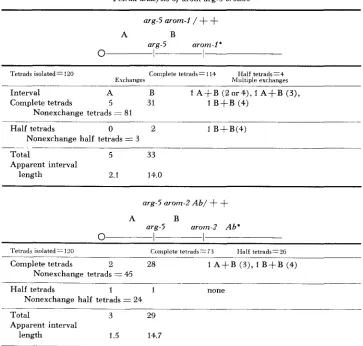
The apparent tight linkage of arom-2 Ab to centromere was also unexpected since an analysis of random segregants and tetrads from crosses of arom-2 Ab by arg-5 and mom-3 indicated that arom-2 Ab segregated fairly frequently from both loci (ten to 20 percent). The lengths of the arg-5-arom-2 Ab and arg-5-arom-1 intervals were therefore compared by tetrad analysis. In the crosses listed in Table 3, the double mutants, arg-5 arom-2 Ab and arg-5 arom-l were crossed to
TABLE 3
Tetrad analysis of arom arg-5 crosses arg-5 arom-1 /
+ +
A B
arg-5 arom-l*
0
I
I
Tetrads isolated= 120 Complete tetrads= 114 Half t e t r a d s Z 4
Exchanges Multiple exchanaes
Interval A B 1 A + B ( 2 o r 4 ) , 1 A f B (3),
Complete tetrads 5 31 1 B + B (4)
Nonexchange tetrads = 81
Half tetrads 0 2 1 B + B ( 4 )
Nonexchange half tetrads = 3
Total 5 33
Apparent interval
-
~ ____
length 2.1 146.0
arg-5 arom-2 Ab/
+
+
A B
0 I I
arg-5 arom-2 Ab*
~ ~~~~
-
Tetrads isolated= 120 Cumplete tetrads= 7 3 Half tetradsZ2G
Complete tetrads 2 28 1 A4-B ( 3 ) , 1 B + B (4)
Nonexchange tetrads = 46
Half tetrads 1 1 none
Nonexchange half tetrads = 24
Total 3 29
Apparent interval
_ _ _ _ _ ~ _ _ _ _ _____
_ _ ~
length 1.5 14.7
~ ~ ~~~
* Gene order is derived from the data.
L I N K A G E A N D F U N C T I O N 893
the standard
+
+
in order to maximize tetrad recovery. In this cross, as in all of those done with arom-2 Ab, many abortive asci were observed. However, the tetrad recovery from completely mature asci was greatly improved. The poor yield of arg-5 arom-2 A b segregants, however, led to the recovery of a large pro- portion of the nonexchange tetrads as half tetrads. Exchanges in half and com-plete tetrads are therefore summed in order to avoid bias.
The data obtained for the arg-5-arom-1 and arg-5-arom-2 Ab intervals are surprisingly homogeneous. Although variations of interval lengths observed in other crosses make determinations of confidence limits almost meaningless, the conclusion that ai-om-2 A b and arom-I are at least closely linked is inescapable. The tetrad analysis of the arom-3 by pe”
fl
cross indicated that arom-3 was about 18 units proximal from pe in the region of arg-5. Although the linkage of arom-3 to arom-I and arom-2 A b is loose, in view of the paucity of information with regard to the relatioa of physical distance with “distance” in the recombina- tional sense, it seemed of interest to determine whether arg-5, a locus controlling an overtly different biochemical function, is located between the loci controlling aromatic biosynthesis.The orientation of the arg-5 and arom-3 loci was determined with the aid of the colonial mutant-balloon (bal)
.
PERKINS ( 1959) showed that bal was very close to the centromere of linkage group I1 and unequivocally established the orderbal - arg-5 - pe. W e have observed bal to segregate from centromere independ- ently of arom-3 (one out of 24 tetrads) which indicates that it is probably in the left arm of linkage group 11.
TABLE 4
Three point crosses involving bal, arg-5 and arom-3
bal
+
mom-3 /+
arg-5+
bal+
arom-3-0
-0
+
arg-5i
+
Supplemented plates Minimal plates-prototrophs Interval length
Total Morphology Morphology
viable swres* bal
+
Total bal+
Frequency - . ara-5/arom-38,060 3,660 4,400 22 22 0 0,00273 0.55
bal arg-5
+
/+
+
arom-3+
+
arom-3-0
bal arg-5
1
+
-0
Supplemented plates Minimal plates-prototrophs Interval length
Total Morphology Morphology
viable swres’ bal
+
Total bal+
Freouencv ara-5/arom-314,700 6,180 8,480 61 3 58 0.00415 0.83
894 S. R. GROSS A N D A. F E I N
Table 4 contains the results of an analysis of random segregants from crosses of bal arg-5 by arom-3 and bal arom-3 by arg-5. Since the great majority of pro- totrophic segregants from the bal arg-5 by arom-3 crosses were morphologically
+
and from the bal arom-3 by arg-5 cross were bal, the order bal-arg-5-arom-3 is established. The orientation of the arom mutants is such that no known mutant genes yielding auxotrophic phenotypes lie between arom-l (and arom-2 A b ) and arom-3. However, two loci controlling some morphological properties of Neuro- spora, pe and 584 (PERKINS, personal communication), are apparently located within the arom-3 - arom-l interval.
Reversion of arom mutants: A careful examination of the relative reversion frequencies of the arom mutants was undertaken using arom inos and arom pan-l double mutants. Macroconidia were irradiated with doses of ultraviolet light lead- ing to a survival of ten to 50 percent. Complete and partial reversions were se- lected for on medium supplemented only with calcium pantothenate and inositol and on medium supplemented with the above and PAB plus any two of the three required aromatic amino acids. The reversion frequency of arom-l was found to be highest when reversions for the tryptophan requirement were selected (7.5 x
per nucleus-assuming an average of two nuclei per macroconidium, and 6 x per nucleus when selection for complete reversion was employed). Three out of four “reversions” of arom-2 were found to be due to nonlinked suppressors. arom-3 shows little variation in reversion frequency on the different selective media and has a mean reversion frequency of 2.5 x per nucleus. No rever- sions of arom-2 A b have been observed under comparable conditions among 5 x
lo9 irradiated nuclei. Limitations of the number of conidia that can be plated without interfering with the growth of revertants (GRIGG 1952) prevent a more extensive quantitative search for reversions. However, massive transfers of arom- 2 A b conidia to selective media have never been observed to yield revertants under conditions in which contamination could be ruled out.
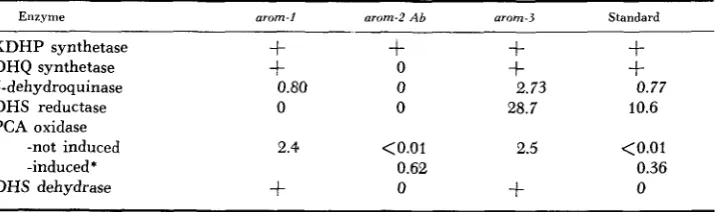
Enzymatic complements of the arom mutants: The growth response and ac- cumulation pattern of the arom mutants suggested that arom-l is deficient in the ability to convert DHS to shikimic acid and that arom-3 is unable to carry out some reaction subsequent to the synthesis of shikimic acid. The behavior of arom- 2 Ab, however, was suggestive of a multiple loss of enzymatic functions in the synthesis of shikimic acid and one of its products. These conclusions were con- firmed largely by the direct assay of the specific enzymes present in crude and partially purified extracts of the mutant strains.
LINKAGE A N D FUNCTION 895
TABLE 5
Enzyme complements of arom and standard strains
Enzyme arom-f arom-2 A b arom-3 Standard
KDHP synthetase DHQ synthetase 5-dehydroquinase
DHS reductase
PGA oxidase
-not induced -induced* DHS dehydrase
+
+
+
+
+
0+
+
0.80 0
e.
73 0.770 0 28.7 10.6
2.4 <O.Ol 2.5 <O.Ol
0.62 0.36
+
0+
0Enzymatic activity is expressed as units of activity per mg protein in fractions described in MATERIALS AND METHODS.
Each value is the average specific activity observed in at least two independent preparations. +-Enzymatic activity was observed, but the determination of specific activity is subject to error-see text. &No activity observed. ‘-The syn- thesis of PCA oxidase was induced by the addition of 100 mg vanillic acid per liter growth medium.
tion of the specific activity of DHS dehydrase is subject to considerable error be- cause of the instability of the enzyme. However, the sensitivity of the assay per- mits the detection of at least five percent of the minimum activity observed in arom-I and arom-3. The observed specific activity of DHS dehydrase varied be- tween 0.1 to 0.5 of that found for PCA oxidase. Because of the errors in the deter- mination of the specific activities of DHS dehydrase, KDHP synthetase and DHQ synthetase, only the presence or absence of detectable quantities of these enzymes in the various preparations is indicated in Table 5.
It should be pointed out that the enzymatic conversion of KDHP to DHQ is a
rather complex reaction (SRINIVASAN et aZ. 1959). The participation of only one enzyme in the reaction has as yet not been completely established ( SRINIVASAN, personal communication). For the sake of simplicity we refer to the enzyme or enzymes as DHQ synthetase.
The data in Table 5 confirm most of the deductions drawn from the informa- tion previously presented. DHS reductase is absent in crude extracts of both arom-I and arom-2 Ab. In addition, arom-2 Ab is apparently missing the entire enzymatic apparatus for converting KDHP to DHS while retaining the ability to synthesize KDHP from erythrose-4-phosphate and phosphoenol pyruvate. The entire sequence of reactions studied is present in arom-3, thus supporting the notion that arom-3 is blocked in a reaction subsequent to the synthesis of shikimic acid, The specific activity of dehydroquinase and DHS reductase were found to be considerably higher in mom-3 than in arom-l or the standard strains. How- ever, the probable lack of isogenicity between the strains obfuscates any special significance of these observations.
896 S. R. GROSS A N D A. F E I N
product (some mutants blocked in the synthesis of phenylalanine and tyrosine have also been found to accumulate PCA)
.
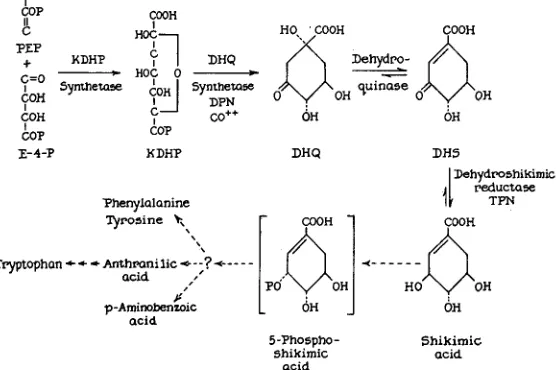
PCA is a substrate and an inducer of the synthesis of PCA oxidase (GROSS and TATUM 1955; GROSS 1959). Extracts of arom-1 and arom-3 contain PCA oxidase at the earliest stages of mycelial growth. The accumulation of PCA, the presence of DHS dehydrase and PCA oxidase are then excellent criteria for the involvement of a metabolic block subsequent to the synthesis of DHS. The virtual absence of these two enzymes in extracts of arom-2 A b therefore seems to be a consequence of its inability to synthesize the hydro- aromatic compounds. The induction of PCA oxidase synthesis in arom-2 A b is equivalent to that observed in the standard type when vanillic acid or PCA (in- ducers of PCA oxidase) are added to the growth medium (GROSS and TATUM 1955).The reactions involved in the synthesis of shikimic acid and the aromatic amino acids are summarized in Figure 1. 5-Phosphoshikimic acid is included in the scheme as a probable intermediate. This compound is accumulated by many arom mutants of E. coli (DAVIS 1955) and has been implicated in the synthesis of anthranilic acid (SRINIVASAN 1959). Although it has not as yet been demon- strated that 5-phosphoshikimic is derived from shikimic acid by direct phosphory- lation, it is provisionally considered to be the immediate product of shikimic acid. Phosphorylated intermediates are usually not accumulated in culture filtrates of Neurospora, presumably because of the presence of active phosphatases (AMES and MITCHELL 1955). Compound "?" is included in the scheme as an hypotheti- cal intermediate to explain the genetic and biochemical information described below.
COOH
b P COOH
&
HO,. COOH+ KDHP
#OH Symhetos
'Tl
y
H
J
5Yy$=
DHQ 0J $ o ~ o ~ o H
PEP
c=o
-
HOf 0-
C
COH CO++ OH OH
COP i 0 P
E-4-P XDHP DHq DHS
Fhenvlalanine Tyrosine k.
TPyptOphon + * Anthmnilic 9 - -? +-- - -
acid ,,'
g .
p-AminoJwnwx acid
TPN COOH
---(lo.
HOOH
5-Phospho- Shikimic
Shikimic acid
acid
FIGURE 1.-Reaction sequence involved in the synthesis of the aromatic amino acids and PAB. Brackets signify that the compound has not been definitely established as an intermediate.
PEP, phosphoenolpyruvate; E - ~ - P , erythrose +-phosphate; KDHP 2-keto-3-deoxy-~-arabo-heptonic
L I N K A G E A N D F U N C T I O N 89 7
The isolation of additional arom mutants: Although arom-2 A b is phenotypi- cally similar to arom-l in its inability to synthesize DHS reductase and is closely linked to arom-1, the infertility of crosses between these mutants has prevented the direct demonstration of allelism. The coincidental deficiency of DHS reduc- tase in both mutants and the deficiency in the synthesis of at least two additional enzymes in arom-2 A b strongly suggest that the individual genetic determinants of the synthesis of the deficient enzymes are included within the arom-2 Ab re- gion. Support for this conclusion could be obtained by the examination of the linkage relationships of mutants controlling reactions deficient in arom-2 A b
other than the conversion of DHS to shikimic acid.
In addition to the above, it was clear that additional support was required for the conclusion that arom-2 Ab does not respond to shikimic acid for growth as a consequence of its inability to carry out a reaction subsequent to the synthesis of shikimic acid. As indicated previously, the inability of arom-2 A b to utilize shi- kimic acid for growth in place of the aromatic supplement could conceivably be due to the loss of a permeability mechanism. Proof of the deficiency in arom-2 Ab of a reaction subsequent to shikimic acid synthesis could be obtained if a mutant were found which failed to respond to shikimic acid, did not complement arom-2 Ab, but did complement arom-l and arom-3 and, in addition, was tightly linked to arom-2.
A search for m o m mutants was therefore undertaken employing the "inositol- less death" procedure (LESTER and GROSS 1959). After permitting the inactivation of UV irradiated conidia to proceed for four days on minimal sorbose medium or medium supplemented with phenylalanine, tryptophan and PAB, the plates were supplemented with inositol plus either the entire growth factor requirement of the arom mutants o r tyrosine. Shikimic acid proved to be a poor supplement for the selection of arom mutants, for the growth of arom-l on shikimic acid in sor- bose medium is very slow.
Fourteen arom mutants as well as a large number of unclassified auxotrophs were obtained from three experiments. The arom mutants fell into two classes. The first of these consisted of 11 mutants which behaved as heteroalleles of arom- 3. Their behavior, in complementation tests, suggested the existence of five func- tional subareas of the arom-3 locus. One of the mutants of this class-R2212, which forms a slow growing prototrophic heterocaryon with arom-3, has been examined genetically as well as enzymologically. It falls in the same region of linkage group I1 (closely linked to arg-5) as does arom-3, rarely forms prototro- phic segregants in crosses with arom-3 and is biochemically indistinguishable from arom-3.
898 S. R. GROSS A N D A. F E I N
in a reaction subsequent to the production of shikimic acid. Their failure to com- plement arom-2 A b indicates that arom-2 Ab, in addition to its deficiency of the three enzymes necessary to convert KDHP to shikimic acid is also deficient in the ability to convert shikimic acid into one of its products. Thus, it is not necessary to invoke the notion of a permeability barrier to explain the failure of arom-2 A b to grow on shikimic acid.
The search for arom mutants was by no means exhaustive and, in fact, was terminated upon obtaining the desired class of mutants. DR. R. W. COLBURN (personal communication) obtained a number of arom mutants by a modifica- tion of the selection procedure of WOODWARD, DEZEEUW, and SRB (1954) after X-ray treatment. Four of these were found to be alleles of arom-1.
Genetic analysis of arom-4 mutants: The locus designation arom-4 was assigned to the new class of arom mutants, and one of them, R2204, (referred to hereafter as arom-4) was used in the genetic analysis.
An analysis of random segregants from crosses of arom-4 by arg-5 pem
fl
and arom-3 revealed that arom-4 is within the same area of linkage group I1 as is arom-I-approximately four units from pe between pe andfl
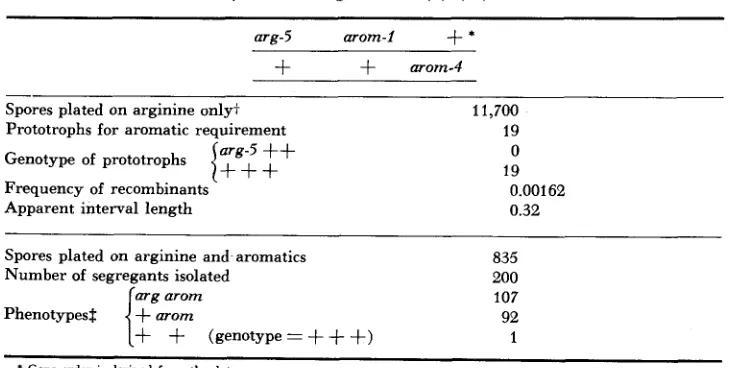
and about 20 units from arg-5. The direct determination of allelism of arom-4 with mom-2 Ab could not be done because crosses of the two, like crosses of arom-1 by arom-2 Ab, have been completely sterile. However, a critical estimate of the linkage of arom-4 to arom-l and the order of the loci with respect to arg-5 was obtained from the three point cross-arg-5 arom-1 by arom-4-summarized in Table 6.Since there was no obvious selection against the recovery of arg-5 segregants, and all of the segregants prototrophic with respect to the aromatic requirement did not require arginine for growth, the order arg-5 - arom-I - arom-4 is established.
TABLE 6
Three point cross-arg-5 arom-I
+
/+
+
arom-4~ ~~ ~~
arg-5 arom-f + *
4- t arom-4
-
Spores plated on arginine onlyf
Genotype of prototrophs
Frequency of recombinants
Apparent interval length 0.32
11,700
0
19 0.00162
Prototrophs for aromatic requirement 19
Spores plated on arginine and aromatics 835
arg arom 107
Phenotypes$
+
arom 921
Number of segregants isolated 200
{
+
+
(genotype =+ +
+)* Gene order is derived from the data.
t Approxjmately 84 percent of the spores plated were viable.
L I N K A G E A N D F U N C T I O N 899
The interval between arom-I and arom-4 was found to be quite small (0.32 units). If one assumes that the arom-l - m o m 4 interval measured is reasonably
close to the average interval length for the postulated loci controlling the syn- thesis of the hydroaromatic intermediates, then an approximate length of one unit is obtained for the entire cluster.
The physiological deficiencies of the arom mutants are illustrated in Figure 2, and the linkage relationships are illustrated in Figure 3.
There is no direct evidence that the reaction controlled by arom-4 precedes that of arom-3 in the biosynthetic sequence. However, the association of the de- terminants of the three prior reactions in the sequence with arom-4 within the arom-2 Ab aberration is prejudicial in favor of the order illustrated. Compound
"?" is postulated as a common intermediate for all of the aromatic compounds as the simplest explanation for the quadruple requirement of arom-3.
DISCUSSION
Linkage and function: The data presented above indicate that the genes deter- mining the synthesis of at least four enzymes involved in the sequential produc- tion of precursors of the aromatic amino acids are clustered in a rather small region of linkage group I1 of Neurospora. This constitutes the first demonstration of extensive linkage of the genetic determinants of sequential biosynthetic re-. actions in a n organism other than E . coli and Salmonella. Gene clustering of this sort can therefore no longer be considered a result of a selective mechanism peculiar to the mode of physiological activity of the enteric bacteria. However, since most of the linked sequences studied in the enteric bacteria have been found to be quite randomly distributed in the genome of the fungi, serious restrictions
PEP arom-2 QPOm-2
4-
-
KDHP -75-* DHQ + b D H 5E-4-P Q p O m - > Y m - *
Shikimic acid Tryptophan
.
*,?
-+
acid k..
.
menylalanined- ;-' a r ~ " '
v p o s i n e +J'
'.
TAB < - - -
FIGURE 2.-Physiological deficiencies of the arom mutants. See legend of Figure 1 for defini- tions of abbreviations.
arom-2Ab
/M/
bal arg-5 arom-1
I n i l I I I f l
hhXIl-3 pk &om-4
900 S. R . GROSS A N D A . F E I N
must be placed on general hypotheses concerning the maintenance of linkage in the two groups of organisms.
There appears to be no selective advantage for the concerted heterocatalytic functions of the linked genes in terms of the ultimate synthesis of essential metab- olites. Heterocaryons of arom-l and arom-4 are indistinguishable from the stand- ard strains with regard to morphology and rate of growth. Furthermore, the significance of the relationship between linkage and the similarity of the com- pounds involved in the various enzymatic reactions is obscure. Each of the en- zymes displays a different mechanism of catalvsis and must, in addition to differ- ent binding sites for the various cofactors involved, have at least configurational differences about the substrate binding site. It was, therefore, no surprise to find that the separation of 5-dehydroquinase from DHS reductase could be almost completely accomplished simply by ammonium sulfate fractionation and/or ion exchange chromatography on diethylaminoethylcellulose (GROSS, unpublished). JACOB (1959) has proposed that the rates of the heterocatalytic syntheses of a gene cluster are controlled at the chromosomal level by “repressers” ( VOGEL
1957) which may, in some cases at least, be synthesized as a consequence of the specific reaction sequence involved. According to this view no a priori restrictions are placed on the nature of the reactions involved. They may be related in terms of a specific biosynthetic sequence as well as participation in a common physio- logical process. Thus. the genes determining coli-phage synthesis in
E.
coli K-12 are linked and are subject to repression (JACOB 1959) in a manner similar to that of the gene cluster determining the biosynthesis of tryptophan (COHEN and .JACOB 1959). The selective advantage for clustering, then, would be derived not from the efficiency that might be obtained from an “assembly line” production of substrates but from the control of reactions by the alteration in the relative rates of synthesis of specific proteins during growth. According to this view, no intuitive restrictions are placed on the most advantageous arrangements of genes for any particular organism, and it becomes just as easy to envision the linkage of genes determining morphogenetic properties (e.g., T ,Ki,
F u in the mouse; DUNN 1956) as the linkage of those involved in the production of essential metabolites. Hence, the different linkage pattern in the enteric bacteria and the fungi might not represent a tendency toward randomness in the fungi but, more interestingly from a physiological and developmental point of view, the requirement for dif- ferent patterns of control of growth and differentiation in the two groups of or- ganisms.L I N K A G E A N D F U N C T I O N 90 1
The autoinduced biosynthesis of enzymes: That at least some enzymes in Neurospora are subject to wide variations in synthetic rate is obvious from the data presented with regard to PCA oxidase and DHS dehydase. The standard strain and arom-2 Ab produce very little of these enzymes during growth in the usual media. The synthesis of PCA oxidase, at least, can be induced in both of these strains by the addition of PCA or a number of analogues to the growth medium (GROSS and TATUM 1955). Of particular interest here is the fact that both DHS dehydrase and PCA oxidase are present in high concentration in arom- 1 , arom-3 and arom-4 as part of the constitutive complement of enzymes. Thus, the presence of these enzymes in the mutant strains apparently stems from the accumulation of their inducer-substrates as a consequence of interference in the normal biosynthesis of the aromatic ring. This enzymatic pleiotropy leads to the diversion of the precursors of aromatic biosynthesis into a constitutive series of reactions leading ultimately to their total catabolism (GROSS 1959).
Thus, whether or not one wishes to view enzymatic induction as a reversal of “ r e p r e s ~ i o n ~ ~ ( VOGEL 195 7 ) , the heterocatalytic activity of genes of Neurospora are subject to wide variation. It is important to note in this respect that although DHS is a n intermediate in aromatic biosynthesis the presence of DHS dehydrase could only be demonstrated under condition of DHS accumulation. Apparently the concentration of DHS in mycelia of the standard strains never reaches induc- ing concentrations.
902 S. R. GROSS A K D A. FEIN
quencies of less than Secondly, the assumption that the loss of a number of heterocatalytic functions can only be interpreted as a consequence of a deletion does not seem at all necessary. Until further genetic and cytogenetic work can be done with arom-2 Ab, it seems best to consider arom-2 A b some sort of small chromosomal aberration in the immediate vicinity of arom-1 and arom-4.
SUMMARY
The genetic and physiological properties of several arom mutant strains of Neurospora are described. The most likely interpretation of the evidence pre- sented is that the genes responsible for the production of at least four enzymes involved in the synthesis of the aromatic ring are closely linked in linkage group 11. Another gene involved in the same reaction sequence, while also on linkage group 11, is loosely linked to the others. The inability of arom-2 A b to carry out four reactions in the sequence appears to be due to an aberration in the arom-1 and arom-4 region of linkage group 11.
The problem of linked genes controlling related physiological reactions has been discussed in terms of the involvement of common control mechanisms for protein synthesis.
Autoinduced enzyme synthesis is proposed as the mechanism leading to the appearance of two enzymes, as part of the constitutive enzymatic complement of arom-1, arom-3 and arom-4, that are present, if at all, only in extremely low concentrations in arom-2 A b and the standard strains.
ACKNOWLEDGMENTS
The authors wish to express their appreciation to DRS. D. D. PERKINS, MARY B. MITCHELL and H. K. MITCHELL for their generous contribution of mutant strains, to DRS. D. B.
S P R I N S O N . ~ ~ ~
P. R. SRINIVASAN for their gifts of several compounds required for this investigation and to MARY HURD and ELSIE WAGNER for technical assistance.LITERATURE CITED
AMES, B. N., and B. CARRY, 1959
AMES, B. N., and H. K. MITCHELL, 1955
BALLOU, C. E., H. 0. L. FISHER, and D. L. MACDONALD, 1955 &erythrose 4-phosphate. J. Am. Chem. Soc. 77: 5967-5970.
BARRATT, R. W., D. NEWMEYER, D. D. PERKINS, and L. GARNJOBST, 1954
Neurospora crcrssa. Advances in Genet. 6 : 1-93.
BARRATT, R. W., and L. GARNJOBST, 1949
of Neurospora crassa. Genetics 34: 351-369.
COHEN, G. N., and F. JACOB, 1959
dam la formation du tryptophane chez Escherichia coli. Compt. Rend. 248: 3490-3492. COHN, M., 1956
Coordinate repression of the synthesis of four histidine bio-
The biosynthesis of histidine. J. Biol. Chem. 212:
The synthesis and properties 01
Map construction in
Genetics of a colonial microconidiating mutant strain
Sur la repression de la synthkse des enzymes intervenant
On the inhibition by glucose of the induced synthesis of P-galactosidase in synthetic enzymes by histidine. Proc. Natl. Acad. Sci. U S . 45: 1463-1461.
LINKAGE AND FUNCTION 903
Escherichia coli. pp. 41-48. Enzymes: Units of Biological Structure and Function. Edited by
0. H. GAEBLER. Academic Press. New York.
DAVIS, B. D., 1955 Biosynthesis of the aromatic amino acids. pp. 799-811. Amino Acid Metabo- lism. Edited by W. D. MCELROY and H. B. GLASS. Johns Hopkins Press. Baltimore, Maryland. Complex loci in microorganisms. Ann. Rev. Microbiol. 13: 377-406.
Analysis of a complex gene in the house mouse. Cold Spring Harbor Sym-
Back mutation assay method in microorganisms. Nature 169: 98-100. DEMEREC, M., and P. E. HARTMAN, 1959
DUNN, L. C., 1956
GRIGG, G. W., 1952 GROSS, S. R., 1958
posia Quant. Biol. 21 : 187-194.
The enzymatic conversion of 5-dehydroshikimic acid to protocatechuic acid. Enzymatic autoinduction and the hypothesis of intracellular permeability barriers in
The metabolism of protocatechuic acid by
Structvral spwificity of inducers of protocatechuic acid
J. Biol. Chem. 233: 1146-1151.
Neurospora. Trans. N.Y. Acad. Sci. 22 : 44-48. GROSS. S. R., R. D. GAFFORD. and E. L. TATUM, 1956
Neurospora. J. Biol. Chem. 219: 781-796. GROSS, S . R., and E. L. TATUM, 1955
oxidase synthesis in Neurospora. Science 122: 1141. JACOB, F., 1959
LESTER, H. E., and S. R. GROSS. 1959 Neurospora. Science 129: 572.
LOWRY, 0. H., N. J. ROSEBROUGH, A. L. FARR, and R. J. RANDALL, 1951 with the Folin phenol reagent. J. Biol. Chem. 193: 265-275.
MCCLINTOCK, B., 1945 Am. J. Botany 32: 671-678.
METZENBERG, R. L., and H. K. MITCHELL, 1958
Neurospora crassa. Biochem. J. 68: 168-172. MITCHELL, M. B., 1959
MITSUHASHI, S., and B. D. DAVIS, 1954
NERMEYER, D., 1954
PARDEE, A. B., 1959 1959
Genetic control of viral functions. Harvey Lectures, Ser. 53 : (In press). Efficient method f o r selection of auxotrophic mutants of
Protein measurement
Preliminary observations of the chromosomes of Neurospora crassa.
The biosynthesis of aromatic compounds by
Genetic recombination i n Neurospora. Genetics 43: 799-813.
Conversion of 5-dehydroquinic acid to 5-dehydroshikimic acid by 5-dehydroquinase. Biochim. et Biophys. Acta 15: 54-61.
A plating method for genetic analysis in Neurospora. Genetics 39: 604-618.
Mechanisms for control of enzyme synthesis and enzyme activity in bac- teria. pp. 295-304. Ciba Foundation Symposium on the Regulation of Cell Metabolism.
Edited by G. E. W. WOLSTENHOLME and C. M. OCONNOR. Little Brown and Co. Boston, Massachusetts.
PERKINS, D. D., 1959 New markers and multiple point linkage data in Neurospora. Genetics
PONTECORVO, G., 1958 Trends in Genetic Analysis. Columbia University Press. New York. SALAMON, I. I., and B. D. DAVIS, 1953
SRINIVASAN, P. R., 1959
SRINIVASAN, P. R., M. KATAGIRI, and D. B. SPRINSON, 1959
SRINIVASAN, P. R., and D. B. SPRINSON, 1959
STADLER, D. R., 1956 44: 1185-1208.
The isolation of a precursor of shikimic acid. J. Am. Chem. Soc. 75: 5567-5571.
Biosynthesis of anthranilic acid from 5-phosphoshikimic acid and L-glutamine. Federation Proc. 18: 329.
The conversion of phosphoenolpyru- vic acid and D-erythrose 4-phosphate to 5-dehydroquinic acid. J. Biol. Chem. 234: 713-715.
2-Keto-3-deoxy-D-arabo-heptonic acid 7-phos- phate synthetase. J. Biol. Chem. 234: 716-722.
904
TATUM, E. L., S. R. GROSS, G. E H R E N S V ~ D , and L. GARNJOBST, 1954 compounds by Neurospora. Proc. Natl. Acad. Sci. U.S. 40: 271-276. VOGEL, H. J., 1956
13: 42-43.
U. S. 43 : 491-496.
S. R. GROSS A N D A. FEIN
Synthesis of aromatic
A convenient growth medium for Neurospora. Microbial Genetics Bull. Repressed and induced enzyme formation: a unified hypothesis. Proc. Natl. Acad. Sci.
Identification of a n early precursor as 5-
The separation and isolation of par- ticular biochemical mutants of Neurospora by differential germination of conidia, followed by filtration and selective plating. Proc. Natl. Acad. Sci. U.S. 40: 192-200.
1957