Copyright 0 1996 by the Genetics Society of America
Limited Dispersal, Deleterious Mutations and the Evolution of Sex
Joel
R.
Peck
School of Biological Sciences, The University of Sussex, Falmer, Brighton B N l 9QG, United Kingdom Manuscript received April 5, 1995
Accepted for publication November 22, 1995
ABSTRACT
This study presents a mathematical model that allows for some offspring to be dispersed at random, while others stay close to their mothers. A single genetic locus is assumed to control fertility, and this
locus is subject to the occurrence of deleterious mutations. It is shown that, at equilibrium, the frequency of deleterious mutations in the population is inversely related to the rate of dispersal. This is because dispersal of offspring leads to enhanced competition among adults. The results also show that sexual reproduction can lead to a decrease in the equilibrium frequency of deleterious mutations. The reason for this relationship is that sex involves the dispersal of genetic material, and thus, like the dispersal of offspring, sex enhances competition among adults. The model is described using the example of a hermaphroditic plant population. However, the results should apply to animal populations as well.
D
EBATE on the evolution of sex continues apace, but there is still no general agreement about the probable solution to the mystery (MAYNARD SMITH 1978;BELL 1982; MICHOD and LEVIN 1988; HAMILTON et al.
1990; KONDRASHOV 1993). One approach to the evolu- tion-of-sex problem that has received considerable at- tention has to do with deleterious mutations. A number of researchers have claimed that sex can help to amelio- rate the effects of deleterious mutations either by facili- tating the repair of these mutations (BERNSTEIN et al. 1988; MICHOD 1993) or by producing a decrease in the frequency of deleterious mutations in the population
(MULLER 1964; HAIGH 1978; KONDRASHOV 1988; LYNCH
et al. 1993). However, theoretical studies of deleterious mutations and the evolution of sex have generally as- sumed a homogeneous environment, and few models have considered the effects of population structure
(KONDRASHOV 1993).
In this study, a model of an hermaphroditic plant population is presented. The model allows for recur- rent deleterious mutations. It is assumed that the popu- lation is structured in a very simple way, so that each individual lives on a site that is capable of supporting, at most, one adult plant. The results show that, if some seeds are not dispersed from the seed-parent’s site, then the equilibrium frequency of deleterious mutations (and thus the equilibrium genetic load) is higher than it would have been in a homogeneous population. Fur- thermore, the equilibrium level of genetic load de- creases monotonically as the rate of dispersal increases. The results also show that sexual reproduction acts in a manner similar to seed dispersal. In particular, genetic load decreases as the rate of sexual reproduc- tion increases. This is because sex involves the dispersal of pollen grains. The relation between sex and genetic
Author e-mail:[email protected]
Genetics 1 4 2 1053-1060 (March, 1996)
load that is described here may help to explain the maintenance of sex despite its apparent cost.
The mechanism described here that produces a re- duced load for sexual species can operate in a one- locus model. Thus, the mechanism has nothing to do with genetic recombination. This suggests that the model presented here is very different from most evolu- tion-of-sex models, which typically depend on recombi- nation (FELSENSTEIN 1974). However, the model is not entirely unique in this respect. Other evolution-of-sex models that do not depend on recombination include studies by KIRKPATRICK and JENKINS (1989) and by
Es
HEL and WEINSHALL (1987).It is possible to provide an intuitive account that ex- plains the results presented in this study. However, this will be deferred until the model and the results have been fully described.
THE MODEL
Consider a diploid population of annual seed-bear- ing plants. Each adult is assumed to produce a very large (effectively infinite) number of seeds, and a pro- portion
d,
of these seeds is produced by sexual means, while the rest are produced asexually (where 0 5d,
I1054 J. R. Peck
tion during that generation. Standard Mendelian segre- gation is involved in the production of both ovules and pollen. When an adult produces a seed asexually, it simply copies its genetic material into the seed, so that the seed and its parent are genetically identical, except for new mutations.
Consider a single genetic locus in which the wild-type allele is designated by B. Assume that this allele is sub- ject to unidirectional mutation, which occurs at a rate
of p per generation (where 0 < y
<
1). The probability that a new mutation will be incorporated into a seed is independent of whether the seed has been produced sexually or asexually. Mutant alleles are deleterious, and for simplicity it is assumed that all mutant alleles have the same effect upon fertility. Mutant alleles are desig- nated by 6.There are three possible genotypes, BB, Bb, and bb. The frequencies of these three genotypes among the adults during a given generation are represented by x, y and z, respectively (with x
+
y
+ z
= 1). Assume that the number of seeds (and pollen grains) produced by adults with the BB, Bband 66 genotypes are proportional to 1, (1 - sl) and (1 - s2), respectively. As b is deleteri-ous, let us assume 0
<
sL 5<
1.Assume that the habitat in which the plant species lives contains an infinite number of sites, each of which can support the development of, at most, one adult plant (and thus, the population is infinite in size). Of the seeds produced by any given adult, a proportion m are dispersed, and each of these lands on a randomly chosen site. A proportion (1 - m) are not dispersed,
and these seeds remain on their seed-parents' sites. After the seeds have been shed, the adults die, and on each site a seed that is randomly chosen from the seeds present on that site germinates to produce a juve- nile. Each juvenile survives to adulthood with probabil- ity (1 - a ) . Thus, during seed production, a fraction
a of the sites are unoccupied (where 0 5 a
<
1). The value of a is intended to reflect the level of environmen-tal harshness or disturbance. High values of a mean that the environment is harsh and/or disturbed, in that survival to adulthood is unlikely. Note that the probabil- ity of surviving to adulthood is the same for all individu- als, regardless of genotype. Thus, the model does not allow for viability selection.
Assume that, if m = 0, then a = 0. This assumption is necessary, as when m = 0 there is no movement of seeds between sites, and thus, if m = 0 and, at the same time a
>
0 , the population would go extinct. This would happen because, if m = 0 and a>
0 , then juveniles would not mature into adults on some sites during each generation, and these empty sites would never be recol- onized by the movement of seeds between sites.This completes the description of the model. The description leads to a set of deterministic recursion equations, which are derived in the APPENDIX.
RESULTS
After many generations of mutation and selection, we can expect that the frequency of deleterious muta- tions in the population will approach an equilibrium. In general, it is difficult to write useful expressions for the exact positions of the equilibria, except in the case of the equilibrium that lies at x = y = 0, and z = 1 (this is the equilibrium that occurs when b is fixed in the population, and BB and Bb genotypes are entirely a h sent). To simplify things somewhat, let us make the biologically reasonable assumption that the mutation rate ( p , ) is low. If sI is sufficiently large in comparison to p , and if m,
+
and a are not all equal to zero, then we can show that the equilibrium frequency of b will be low at the equilibrium that will be attained if we start with a pure B population ( i e . , with x = 1 and y = z = 0 ) . Unless specified otherwise, all references to equilibrium henceforth in this paper will refer to this low-frequency- of4 equilibrium.Let 2, y^ and i represent the equilibrium frequencies of BB, Bb, and bb adults, respectively. If m,
4 and
a are not all equal to zero, and if s1 is sufficiently large in comparison to p, then y^ is guaranteed to be small, and we can write the following:ji" 4p(l - S I
+
msl)[2s,(l - s , ) [ a
+
m(1 - a ) ( 2 - m ) ]+
2ms:+
4 s l ( 1 - a ) ( l - sl)(l - 2m+
m 2 ) ] (1)The derivation of Equation 1 is explained in the APPEN- DIX. Let
j
represent the right side of Equation 1. It is straightforward to show that Equation 1 is accurate, except for terms of orderj"
and terms of order py (see the APPENDIX). Throughout this paper,=
will mean the same thing ( i e . , that the equation in question is accurate, except for terms of orderj'
and terms of order p'). It is also Straightforward to show that, so long asj2
and p2 are very small, y^ is a locally stable equilib- rium that will be approached from any very low initial frequency of b (this is demonstrated in the APPENDIX). Say thatw
represents a quantity that is proportional to the average fertility of population members. In par- ticular, letw
= x+
y ( 1 - s])+ z(
1 - s y ) . If we assume that m,+
and a are not all equal to zero, and that SI is sufficiently large to ensure that$
is small, then it is possible to write a simple but reasonably accurate ap- proximation fora.
This is because, when these assump- tions are met, we have i = O($'), and thus we can write-
7 7
"
1 - p , . (2)Limited Dispersal and Sex 1055
maximum possible value of
u.
In the present model we have w,,, = 1 , and so we can define load as follows:L = l - U ( 3 )
Note that, in this traditional definition, load constitutes a comparison of the mean fitness to the fitness of the best-possible genotype, regardless of whether this best- possible genotype is actually present in the population.
Load when all seeds are dispersed or when (Y M 1: Let us now turn to the question of how the various parameters affect genetic load. To begin, consider the case where m = 1, so that the distribution of the differ- ent sorts of seeds is the same on each site. In this case, we can use Equation 1 to show that at equilibrium
I,
=
2 p . (4)This is a classic result, which is due to J. B. S. HALDANE
(1937). This same equilibrium value of L holds in the limit as a -P 1 for any positive value of m. This makes
sense, as a high value of a has a similar effect to setting m = 1 , in that, before germination, most sites have the same distribution of the different seed types. This is because, when a is close to 1.0, there is no adult on most sites, and the seeds on these empty sites are drawn at random from the total pool of seeds produced by all adults. Note that when m = 1 (or in the limit as a -+ l ) , the equilibrium value of L is independent of
4,
the proportion of sexually produced seeds. In other words, when seeds are highly dispersed, the degree of sexuality has virtually no effect on mean fitness, and the same is true when nearly all juveniles die before they achieve adulthood.Load under asexuality when no genetic material is dispersed Next, let us consider the case where 4 = 0,
m = 0 and a = 0. This is the case where no genetic material is dispersed in the form of seeds, and none is dispersed in the form of reproductively successful pol- len grains. This case was excluded when Equation l
was derived. Using the equations in the APPENDIX, it is straightforward to show that, when 4 = 0, m = 0 and a = 0, the value of z rises inexorably until equilibrium is achieved at 2 = 0,
9
= 0 and 2 = 1 . In other words, the frequency of b increases until it goes to fixation. To be more precise, if 2' is the frequency of bb adults in the next generation, then, when4
= 0, m = 0 and a = 0, we have z' = z+
yp+
xp2, At equilibrium, only 66 individuals are present in the population. Once this equilibrium is achieved, the equilibrium level of load is given byL = s,. ( 5 )
This represents the lowest level of fertility possible un- der the assumptions of the model. This result holds because, if there is no movement of genetic material between sites, then for each site there is only one adult that can provide the genetic material necessary to pro-
duce a juvenile on that site during the next generation. This means that there is no competition between adults. In the absence of competition, differential fertility has no power to impede the force of mutation, and eventu- ally b approaches fixation, load approaches its maximal value, and fertility approaches its minimum value.
The effect of migration on load: For the remainder of this paper, let us exclude the case where 4 = 0, m
= 0 and a = 0 and return to our assumption that sI is sufficiently large to ensure that
9
is small. Under this assumption, what is the effect of the rate of migration upon the level of load at equilibrium? We have seen that when no genetic material is dispersed by any means, load reaches its maximum possible value (Equa- tion 5). Thus, it is not surprising to learn that, in gen- eral, the equilibrium value of L (which will be desig- nated asi)
is a monotonically decreasing function ofm, the rate of migration. In particular, the relation is as follows:
[-4p(1 - a ) ( l - s l ) ( l - m)
ai
x
( 2 -4 ) ( 2
- SI+
ms1)I- M
d m [ 2 ( 1 - s l ) [ a
+
m ( l - a )X ( 2 - m ) ]
+
2msl+
+ ( l - a )X ( 1 - s l ) ( l - 2 m
+
m2)]' ( 6 )Examination of this equation reveals that, in the limit as a goes to 1.0, m has no effect on load at equilibrium. This result is already implied by Equation 4. Equation
6 also reveals that m has no effect on the equilibrium level of load in the limit as s1 approaches 1.0.
The effect of sexual reproduction on load How does the rate of sexual reproduction affect genetic load? To answer this question, let us examine the partial derivative of
i
with respect to 4. This is given by[-4p(1 - a ) ( l - SI)
ai
X ( 1 - sI+
m s l ) ( l - m)']_.
84
[ 2 ( 1 - s l ) [ a+
m ( 1 - a ) xX ( 2 - m ) ]
+
2msl+
4(1
- a )X ( 1 - s l ) ( l - 2 m
+
m2)12( 7 )
1056 J. R. Peck
effective when
+
is large, so that most seeds are pro- duced after incorporation of genetic material donated by a pollen grain.The effect of mutation rate on load The partial de- rivative of
I:
with respect to the rate of mutation ( p ) is given byai
ap
[2(1 - s l ) [ a+
m ( l - a )- M 4(1
- SI
+
msl)x
(2 - m ) ]+
2ms,+
+(1 - a )X (1 - s l ) ( l - 21n
+
m 2 ) ] (8)Examination of Equation 8 reveals, as one would ex- pect, that the equilibrium level of load always increases with p. In fact, we can make an even stronger statement in light of Equation 8. In particular,
i
is approximately proportional to p. This must be so because p does not appear on the right side of Equation 8.The effect of juvenile viability on load The relation- ship between juvenile viability ( a ) and the equilibrium level of load is given by:
[ - 4 m - + ) ( I - S I )
ar:
x
( 1 - SI+
rnSl)(l - m)']d a [2(1 - SI) [ a
+
m(1 - a )"M
X ( 2 - m ) ]
+
2msl+
+(1 - a )X (1 - s l ) ( l - 2m
+
m2)]' (9)This equation shows that, so long as m
<
1, the equilib- rium level of genetic load will decrease as a increases. This is not surprising given that (as mentioned pre- viously) a high value of a leads to a high level of compe- tition between adults.The effect of the strength of fertility selection on load: As we saw earlier, the strength of fertility selection
(s,) has virtually no effect on the equilibrium level of genetic load when m = 1, or in the limit as a -P 1 (see
Equation 4). However, when m
<
1, the value of s1 does have an effect oni,
and the relation is as follows:dl: - 4 m p ( l - a ) ( 2 - +)(1 - m)'
as1
[2(1 - s , ) [ a+
m(1 - a )- M
X (2 - m ) ]
+
2msl+
+(1 - a )X ( I - s , ) ( l - 2 m
+
rn')12
(10)This equation shows that, when rn
<
1, an increase ins I will result in a decrease in the level of load at equilib- rium. In the limit as sI approaches unity, we have
lim
i
= 2p. (11),,-I
Thus, the lowest level of load that can be achieved by manipulating sI is the same as the lowest level that can be achieved by manipulating m or a (see Equation 4).
The case where m = 0 and a = 0: Let us now consider the special case where m = 0 and a = 0, so that there
is no movement of seeds between sites, and all juveniles survive to adulthood. In this case, is given by
I , = - .
-
4P+
This is a striking result, as it tells us that when there is no movement of seeds between sites, the degree of sexuality can have a very large effect upon load. Further- more, when
+
= 1, half of all the genetic material in seeds comes from outside of the seed-parent's site, and yet load is twice what it would be if there were complete dispersal of seeds (rn = 1). Note also, from Equation12, that when m = 0 and a = 0, the effect o f + o n load is strongest when
+
is small, but it is substantial even when+
is large. In particular, in the limit as+
ap- proaches 1 .O, load decreases linearly as+
increases, and slope in the region of+
= 1 is approximately equal to -4p. (However, recall that Equation 12 is only valid so long as+
is not so small that j takes on a substantial value.)Equation 12 was derived under the assumption that
j is small. As implied by the discussion of Equation 5, this assumption will be violated if m = 0, a = 0 and
+
is sufficiently small. However, Equation 12 is roughly accurate for a wide variety of biologically reasonable parameter choices. For example, if p = s1 = 0.02 and+
= 0.1, then we have f=
0.02. Any error in the estimation of the equilibrium load is on the order of s l [ j '+
p'] (see Equations 2 and 3 ) . Thus, in this case, errors should be on the order of 10".The case where m
>
0 and a>
0: What is the effect of the magnitude of+
upon load when m>
0 and a>
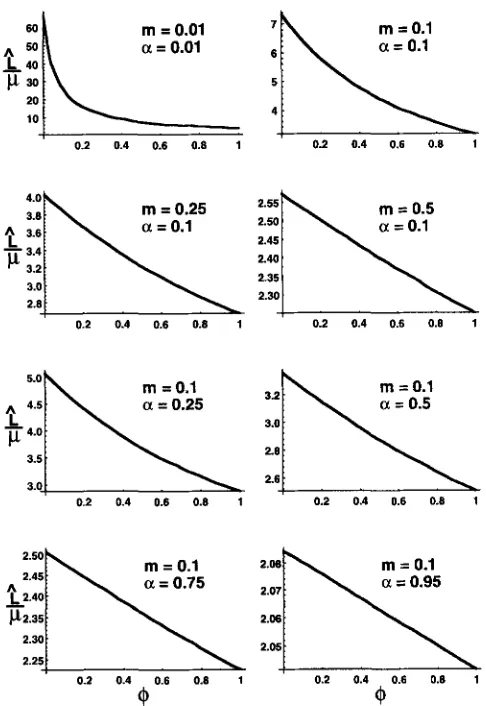
O? This question is addressed by Figure 1. The figure shows that when s I is small in absolute terms (but large in comparison to p ) , the decrease in load brought about by a transition from+
= 0 (asexuality) to4
= 1 (obligate sexuality) is substantial (in excess of 10%) for a wide range of parameters. As the figure shows, this can be s o even for high values of a ( ~ . g . , a = 0.75) or high values of rn ( ~ . g . , m = 0.5).DISCUSSION
Limited Dispersal and Sex 10.57
rn = 0.01
a = 0.01
10
0.2 0.4 0.6 0.8 1
rn = 0.25
a = 0.1
3.0 2.8
0.2 0.4 0.6 0.8 1
m = 0.1
a = 0.25
3.5
0.2 0.4 0.6 0.8 1
m = 0.1
a = 0.75
p 2 . 3 5 2.30
0.2 0.4 0.6 0.8 1
m = 0.1
a = 0.75 L 2.40
p 2 . 3 5
2 1 " - L l
2.25 0.2 0.4 0.6 0.8 1
rn = 0.1
a = 0.1
rn = 0.1
a = 0.1
0.2 0.4 0.6 0.8 1
m = 0.5
a = 0.1
2.35
0.2 0.4 0.6 0.8 1
0.2 0.4 0.6 0.8 1
rn = 0.1
a = 0.95
2.06
2.05
0.2 0.4 0.6 0.8 1
Q
FIGURE 1.-The ordinate gives the value of L / p , as calcu- lated using Equations 1, 2 and 3. The abscissa gives the value of
4,
which represents the probabilityAthat a given seed was produced by sexualmeans.
Note that L is approximately pro- portional to p when f is small, so these curves apply for a broad range of parameter values. In all cases, s, = 0.02 was used. However, when j i s small, these curves are more or less the same for all reasonably small values of s,. The values of the other relevant parameters are as indicated in each panel. The accuracy of these curves was checked using the complete recursions from the APPENDIX (with p = and s2 = 0.04). Special attention was paid to cases where L is large, as these should be the cases where the accuracy of the approximations is worst. In all cases examined, the values given by the curves deviated from the actual values by less than 0.05%.surprising if population subdivision did not increase genetic load, even in a population like the one studied here, which is infinite, but divided into finite subpopu- lations (each of which can support one adult).
The analysis focused on how the various parameters of the model affect
i,
which is the equilibrium level of genetic load. The results show that dispersal decreases the equilibrium level of load. What is more intriguing is the observation that if dispersal is limited ( i e . , m<
l ) , then the rate of sexual reproduction also reduces
the equilibrium level of genetic load. This result makes sense in light of the relation between dispersal and load. After all, under the assumptions of the model, sex
involves outbreeding, and thus it necessarily involves the movement of genetic material (ie., pollen) from one site to another. Therefore, sex is a type of dispersal. It was also shown that, under the assumptions of the model, the equilibrium level of load
(i)
is enhanced by a high mutation rate. Furthermore, if dispersal is limited,i
is inversely related to the rate of juvenile survival (cy) and to the strength of fertility selection against heterozygotes (s,).An intuitive explanation for the relation between lim- ited dispersal and genetic load was given after presenta- tion of Equation 5. The basic idea is that dispersal of genetic material (either by seed dispersal or by dispersal of reproductively successful pollen grains) leads to an increase in the genetic diversity of the individuals who compete for each of the sites upon which an individual can grow to adulthood. Genetic diversity generally en- hances the effectiveness of natural selection (FISHER
1930; CROW and KIMURA 1970). Thus, genetic load is lower when there is more dispersal than when there is less. This intuitive explanation suggests that results similar to those presented here could be generated for a model in which fitness depends on multiple loci, or for a model in which individuals live in populations that contain more than one adult. I have produced preliminary results that show that population subdivi- sion can increase genetic load when an infinite-sized population is subdivided into groups that contain multi- ple individuals. However, much more must be done before the generality of the results presented here can be accepted. The intuitive explanation also suggests that a process similar to the one documented here would favor the evolution of inbreeding-avoidance mechanisms.
The model presented here incorporates fertility se- lection. This is both mathematically convenient and bio- logically plausible for many plants. However, it seems clear that similar results could be produced for a viabil- ity-selection model. To see this, let us modify the model by assuming that all breeding adults produce the same number of seeds, and that the germination of these seeds and the survival of the resulting plants to repro- ductive age depends on the seeds' genotypes. Clearly,
if there is one-way mutation to deleterious alleles, and if there is no movement of genetic material between sites as a result of colonization, migration or sexual reproduction, then deleterious alleles will become fixed in the population as a result of genetic drift o n each of the sites (so long as the probability of survival is positive for all genotypes). However, if selection is sufficiently strong and migration or sex helps to keep the popula- tion of juveniles on each of the sites genetically hetero- geneous, then it will be possible to keep the frequency of deleterious mutations from rising to a high fre- quency.
1058 J. R. Peck
in natural populations. However, so long as the fre- quency of b is small (as assumed in the estimation of j by
8)
the effects of back mutation should be negligible. Nevertheless, if a similar model to the one presented here were to be produced for a finite population, incor- poration of back-mutation might be worthwhile, as it would prevent permanent fixation of b when (and if) this disfavored allele drifts to high frequency.It might also be interesting to study a model in which a continuous range of mutant effects are possible, and in which there is no limit to the effects on fitness that can be produced by the variants at a locus. In such a model, we might expect that genetic drift would lead to a steady increase in genetic load under the condi- tions used to derive Equation 5, where there is no mech- anism for the dispersal of genetic material between sites. So long as there is some limit to fecundity, this should eventually lead to extinction of the population
[i.e., a “mutational meltdown” (LYNCH rt al. 1993, 1995)l.
Unfortunately, it is not at all clear that the effects documented in this study can account for the evolution and maintenance of obligate sexuality and outbreeding in natural populations. It should be recognized that the model is a highly simplified caricature of reality, and thus it must be regarded as an early foray into the study of dispersal and sex in natural populations. The as- sumed population structure is extremely simple, with a maximum of one breeding adult per site, and a migra- tion scheme that does not take account of how the sites are arranged in space. Furthermore, only a single locus is assumed to control fitness, and this is certainly false in natural populations. Nevertheless, it is reasonable to expect that the results produced will, at least, provide an indication of the qualitative nature of the results that would be obtained from a much more realistic model.
The applicability of the model depends, in part, on parameter values in natural populations. For example, (the right side of Equation 1) is used extensively in the model, but it is only a reasonably accurate approxi- mation to
7
when it is reasonably small. If the per-locus mutation rate is at a biologically reasonable level (sayl o - ” ) , then this presents no problem so long as there is significant dispersal of genetic material among sites (if., at least one of the parameters
4,
m and CY must besubstantially in excess of zero) and selection coefficients are of the level typically calculated in mutation-accumu- lation experiments [such as the classic work of MUM
(1972)l. In these experiments, selection coefficients of
-2% are commonly observed. With p = and s = 0.02, takes on a low value even with quite restricted genetic dispersal. For example, with these values, if m = 0.05,
4
= 0 and a = 0, then we have9
=
0.01. However, mutations with very small selection coeffi- cients may well be common (OHTA 1992). If mutations are sufficiently small in effect, the analytic methodsused here will not be applicable, though it would not be surprising if a model that incorporated very small effect mutations produced results similar to those pre- sented here.
Clearly, the processes described here can not account for sex and outbreeding if juvenile survival rates are very low, or if seeds are highly dispersed. This is encour- aging, as highly dispersed plant species are often par- tially or fully asexual or selfed (STEBBINS 1958; BAKER
1974). In animals, the picture is less clear. BELL claims that strong dispersers (r.g., butterflies and dragonflies) tend to be sexual (BELL 1982), and this appears to con- tradict one of the basic predictions of the theory. How- ever, the strong dispersers cited by BELL have larval stages that are not highly dispersed. Much selection can occur during larval maturation, so the contradiction may be more apparent than real. In animals with inter- nal fertilization, there is also opportunity for selective abortion. The same may be true for many plants (STE- PHENSON and BEKTIN 1983). With some modification, the model could probably be made to apply to these selective-abortion situations. After modification, the group of embryos produced and nurtured by an adult would constitute the group of siblings on a site. Of course, in this case, there would be no migration be- tween “sites.” Thus, the effect of the rate of sexual reproduction upon genetic load could be very large in this instance (see Equation 12).
It is interesting to note that harsh environments (xe- ric areas, high altitudes, high levels of disturbance, etc.) are apparently associated with asexuality and/or in- breeding in both plants and in animals, and these envi- ronments may well be characterized by low rates of juvenile survival (STEBBINS 1958; BAKEK 1974; BELL
1982; LYNCH 1984; but see BIERZYCHUDEK 1985 for a contrary view regarding plants). The apparent associa- tion between environmental harshness and asexuality or inbreeding is consistent with the theoretical predic- tions of the model. In particular, we have seen that the rate of sexual reproduction has little effect on genetic load when the environment is very harsh (as reflected in a low juvenile-survival rate).
The relevance of the results presented here depends on the load experienced at each locus, and on the way in which load at different loci combines. The per-locus load depends on the deleterious mutation rate, as well as on the processes described above. Current estimates of genomic mutation rates in higher plants and animals range from 0.1 to 100, though both the low-end and the high-end of this range seem unlikely ( M U M I el al. 1972; KONDRASHOV 1988; CHARLESWORTH et al. 1990;
H o u m et nl. 1992; KONDKASHOV and TURELIJ 1992; KEIGHTLEY 1994). If actual mutation rates are on the
Limited Dispersal and Sex
fold cost of sex (MAYNARD SMITH 1978). However, if mutation rates are more substantial, then a modest ame- lioration of per-locus load levels might be sufficient.
The benefits of sex that are highlighted by the results presented here are largest when dispersal of seeds be- tween sites occurs at a low rate (see Figure l ) . With this in mind, it is important to recognize that the convenient assumption that dispersed seeds land on randomly se- lected sites is unlikely to be met in most natural popula- tions. Rather, it is probably safe to say that seeds will typically be more likely to land on sites close to their seed-parents, rather than on distant sites (HAFWER 1977). This phenomenon may well make seed dispersal less effective and thus accentuate the benefits of sex. It seems likely that the benefits of sex are further accentu- ated in real populations because the typical distance of pollen dispersal is probably much greater than the typi- cal distance of seed dispersal.
The results presented in this paper are relevant for determining the outcome of ecological contests be- tween competing species. However, it would be worth- while to consider whether processes similar to those described here can produce an advantage for sexuality when there is variation in the mode of reproduction within species, rather than between them.
As a final note of caution regarding the applicability of the results, it is important to recognize that, in a complex structured population, differences in levels of genetic load are not the only determinant of the out- come of ecological contests. Analysis relevant to this point will be presented elsewhere.
Evolutionary processes related to the ones described in this paper might be important in a variety of contexts. The results suggest that the effectiveness of natural se- lection is diminished when dispersal is limited. If this is so, then we should expect that in a finite population limited dispersal would enhance the rate of fixation of very mildly deleterious mutations. Because of the large number of loci that affect fitness, the resulting “drift load” can have a large impact on viability and fertility
(KIMURA et d . 1963; TACHIDA 1990; h N D E 1994; KON- DRASHOV 1995; LYNCH et al. 1995). Similarly, in a popu- lation that is both asexual and finite, the results suggest that limited dispersal will tend to accelerate the action of MUI.L.EK’S ratchet and related processes (MULLER 1964; WAGNER and GBRIEL 1990; J. R. PECK, G. Bm-
~ A u , and S. C. HEATH, unpublished results). Finally, as the effectiveness of constant selection pressures is apparently diminished by asexuality when dispersal is limited, it seems plausible to suggest that obligately sex- ual populations will respond to the transitory selection pressures that can be produced by a fluctuating envi- ronment more readily than asexual or partially asexual species.
Thanks are due to AIXXEY KONI)MSHOV and A1.1c:e CRI:ICKSHANK for valuable advice and assistance. The research was supported by NERC grant GR3/8367 and by a grant to N. BARTON from the BBSRC.
1059
LITERATURE CITED
BAKER, H. G., 1974 The evolution of weeds. Annu. Rev. Ecol. Syst. 5: 1-24.
BELL, G., 1982 The Ma.rtnpirre of Nature. University of California Press, San Francisco.
BF.RNSTEIN, H., F. A. HOPF and R. E. MICHOI), 1988 Is meiotic recom- bination an adaptation for repairing DNA, producing genetic variation, or both? pp. 139-160 in TheEvolution of Sex: A n Exami-
nation of Cummt Ideas, edited by R. E. M~(:IK)II and B. R. IXVIN. Sinauer, Sunderland, MA.
BIERZYCHL~DEK, P., 1985 Patterns in plant parthenogenesis. Expe- rientia 41: 1255-1263.
CHARI.ESMJORTH, B., D. C w m x s w o ~ r l I and M. T. MORGAN, 1990 Genetic loads and estimates of mutation rates in highly inbred plant populations. Nature 347: 380-382.
CROW, J. F., and M. KIMURA, 1970 A n Introduction to Population Gmrt-
ics TheoT. Burgess, Minneapolis.
ESHEI., I., and D. WEINSHAIL, 1987 Sexual reproduction and viability of future offspring. Am. Nat. 130: 775-787.
FEI.SENSTE:IN, J., 1974 The evolutionary advantage of recombination. Genetics 78: 737-756.
FISHER, R. A,, 1930 7’hr C;meticnl Theory of NaturdSelertion. Clarendon Press, Oxford.
HAIGH, J., 1978 The accumulation of deleterious genes in a popula- tion-Muller’s ratchet. Theor. Popul. Biol. 1 4 251 -267. HAI.DANE, J. B. S., 1937 The effect of variation on fitness. Am. Nat.
71: 337-349.
HAMII.TON, W. D., R. AXEI.ROL) and R. TANESE, 1990 Sexual repro- duction as an adaptation to resist parasites ( a review). Proc. Natl. Acad. Sci. USA 87: 3566-3573.
HARPPR,J. I.., 1977 I’opulation Biolo~y ofPlantr. Academir Press, Lon- don.
H O ~ J I . E , D., D. K. HOFFMASI~K, S. ASSIMA(:OPOUI.OS and B.
<:HARIXSMT)RTH, 1992 The genomic mutation rate for fitness
in Drosophila. Nature 359: 58-60.
KEIGHTIXY, P. D., 1994 The distribution of mutation effects on via- bility in Drosophila mlanogaster. Genetics 138: 1315-1322.
KIMLM, M., T. MARKNAMA a n d J . F. CROW, 1963 The mutation load in small populations. Genetics 48: 1303-1312.
KIRKPATRICK, M., and C . D. JENKINS, 1989 Genetic segregation and the maintenance o f sexual reproduction. Nature 339: 900-301. KONL>RASHOV, A. S., 1988 Deleterious mutations and the evolution
of sexual reproduction. Nature 336: 435-440.
KONI)RASHOV, A. S., 1993 Classification of hypotheses on the advan- tage of amphimixis. J. Hered. 84: 372-387.
KONDRASHOV, A. S., 1995 Contamination of the genome by very slightly deleterious mutations-Why have we not died 100 times over? J. Theor. Bid. 175: 583-594.
K O N D R A S I I ~ V , A. S., and M. T ~ ~ K E I . I . I , 1992 Deleterious mutations, apparent stabilizing selection and the maintenance of quantita- tive variation. Genetics 132: 603-618.
LANDE, R., 1994 Risk of population extinction from fixation of new deleterious mutations. Evolution 48: 1460-1469.
LYNCH, M., 1984 Destabilizing hybridization, general-purpose geno- types and geographic parthrnogenesis. Q. Rev. Biol. 59: 257-
290.
LM\T(:li, M., R. BURGER, D. BIITCHER and W. GABRIEI., 1993 The mutational meltdown in asexual populations. J. Hered. 84: 339-
344.
12M\Tc.H, M., J. C o N E R Y and R. B ~ R G E R , 1995 Mutational meltdowns in sexual populations. Evolution (in press),
MARL”, T., 1970 On the fixation probability of. mutant genes in a subdivided population. Genet. Res. Camb. 15: 221-225.
M N N A R I ) SMITH, J., 1978 TheE7mhrlion Of’Sex. Cambridge University Press, Cambridge.
MICHOD, R. E., 1993 Genetic error, sex, and dip1oidy.J. Hered. 84:
360-371.
MICHOD, R. E., and B. R. LEVIN (Editors), 1988 Thefihlution of Sex:
An Examinntion of Currmt Ideas. Sunderland, Sinauer, MA.
MUKAI, T. S., S. J. CHIC:LISA, L. E. METTI.ER and J. F. CROW, 197’2 Mutation rate and dominance of genes affecting viability in Dro- sophila melanoga.ytw. Genetics 72: 339-355.
1060 J. R. Peck
OHTA, T., 1992 The nearly neutral theory of molecular evolution. Annu. Rev. Ecol. Syst. 23: 263-286.
STEBBINS, G. L., 1958 Longevity, habitat and release of genetic vari- ability in the higher plants. Cold Spring Harbor Symp. Quant. B i d . 23: 365-378.
STEPHENSON, A. G., and R. I. BERTIN, 1983 Sexual selection in plants, pp. 110-149 in Pollination Biology, edited by L. REAL.
TACHIDA, H., 1990 A population genetic model of selection that maintains specific trinucleotides at a specific location. J. Mol.
WAGNER, G . P., and W. GABRIEL, 1990 Quantitative variation in finite parthenogenetic populations: what stops Muller's ratchet in the absence of recombination? Evolution 44: 715-731.
Evol. 31: 10-17.
Communicating editor: M. LYNCH
APPENDIX
This appendix presents the derivations of the basic recursions for x, y and z. In addition,
9
will be derived, and it will be demonstrated that y^ is stable so long as it is small.Let
p*
represent the frequency of B among pollen grains and ovules. It is straightforward to show thatp*
is given by
Let us number the three genotypes as 1 , 2 and 3 for BB, Bb, and bb, respectively. Say that an adult with genotype i produces seeds with genotypes BB, Bb and bb in frequencies x$, y:, and ,:z respectively. These seeds may be produced both by sexual means and by asexual means. Consider a Bb adult (which is the most complicated case). The frequency of BB seeds, Bb seeds and bb seeds among this adult's asexually produced seeds is clearly 0, (1 - p ) , and y, respectively. For sexu- ally produced seeds the corresponding frequencies are
2, respectively, where @ = (1 - $I*). After summation and simplification, we have the following:
( 1 - y ) P / 2 , ( 1 - p)f
+
pp*+
p*/2, andyf
+
f/
The values of x$, yf, and :z are derived in a similar manner for i = 1 and i = 3.
Let x,, ym and z, represent, respectively, the fre- quency of BB, Bb and bb genotypes within the total col- lection of all seeds produced in the population. Thus, we have x, = [x$
+
y ( 1 - sl)@+
z ( 1 - s2)$]/a,[(xz?
+
y ( 1 - sl)$+
z(1 - s2)z$]/a. Let a$*, yT* andym = [ q T
+
y ( 1 - sl)y?+
4 1 -sdyt/al
and z, =zF* represent, respectively, the frequency of BB, Bb and bb seeds on sites occupied by adults with genotype i
after seed dispersal. Thus, for example, we have
$*
= $(l - s l ) ( l - m) + m a x ,(1 - s l ) (1 - m)
+
m73 9 ('45)YT
-.+ - yT(1 - sl) (1 - m)
+
may,,,9 ('46)
and so forth. Note that these equations reflect the fact that after seed dispersal the site of an adult with a rela- tively low fertility will contain a smaller proportion of seeds that were produced on that site than will be the case on the site of a high-fertility adult.
The final step in the derivation is very simple. The probability that a seed with a given genotype will germi- nate on a site occupied by an adult with genotype 12 is just
x$*,
yf* and zf* for seeds with genotypes BB, Bb, and bb, respectively. On sites on which the juvenile has died before producing seeds, these same probabilities are given by x , y,, andz
,
,
respectively. Thus, if the value ofx,
y and z in the next generation are repre- sented by XI, yr and zr, then we have(1 - s l ) ( l - m)
+
ma
X' = (1 - CY) (X$*
+
YX#*
+
%X$*)+
CYX,, (A7) y r = ( 1 - a)(xyT*+
JJ$*
+
zyJ*)+
aym, (AS)and
2 = ( 1 - a ) (X$*
+
y$*+
z$*)+
CYZ,~. (A9)We know that x r = 1 - yr - z' and x = 1 - y - z, and
so these three recursions can be reduced to two.
As stated in the main text, ?represents the right side of Equation 1, and it gives the approximate value of the equilibrium frequency of
y
(y)
when y^ is small. The difference between yand $is on the order of[y
+
$1.
To derive
j,
we simply take the value of yr from Equation AS and solve the equation yr =y
for y after settingz
= 0,y
= (1 - x), and ignoring terms that include y2,y2 or yy (we can safely set z = 0 because, under the assumptions of the model, .i is on the order of
[q
+
y'] when y is small). Note that ?is a unique solution of this equation.We can show that
j
is stable when it is small by using Equation AS to approximate yr, and setting z = 0, y =( 1 - x), and ignoring terms that include p2, yz or yy.