ISSN: 2319-8753
International Journal of Innovative Research in Science,
Engineering and Technology
(An ISO 3297: 2007 Certified Organization) Vol. 3, Issue 3, March 2014
Study and Implementation of Gain Boost Class-C
Inverter in CMOS 50nm Technology
Atulkumar Sojitra
1, Arun Nandurbarkar
2P.G student, Department of Electronics & Communication, L.D.College of Engineering, Ahmedabad, Gujarat, India,
Associate Professor, Department of Electronics & Communication, L.D.College of Engineering, Ahmedabad, Gujarat,India2
Abstract:This paper describes the Gain boost class–C inverter circuit, which is used in place of OTA (Operational Trans-conductance Amplifier) block in ∑Δ modulator .The gain boost class-C inverter behaves as a low voltage, subthreshold amplifier and boosts its DC gain for the high precision requirement. First a traditional cascade class-C inverter is presented, another inverter circuit present in this paper is “Gain boost class-C inverter”. It is implemented in 50nm CMOS technology and simulation is done using the LTSpice simulation tool.
Keywords: CMOS, cascode inverter, LT-Spice, gain boost class-C inverter.
I.INTRODUCTION
The continuing feature size scaling in CMOS technology has enabled the digital system to decrease power consumption and lower costs while also increasing reliability. The supply voltages must be scaled along with transistor dimension to maintain the device’s reliability. However, the threshold voltage is not scaled as aggressively as the supply voltage to avoid leakage current in transistors. Therefore, the design of low-voltage analog circuits in the scaled CMOS technology poses significant challenges. Especially, the design of an operational transconductance amplifier (OTA), a key analog building block, has been the main bottleneck in low-voltage analog circuits. Low voltage OTAs have been explored [1]–[2], but the supply voltages of the OTAs are restricted and have reached the limits of further scaling, because they are strictly limited by the input common-mode voltage.
A number of design techniques have been investigated to overcome these challenge. Considering the OTA itself, a body-driven OTA and digitally assisted OTAs, have been reported. To remove the need for OTAs, comparator-based [3], time-based [4], and charge-domain [5] circuits have been proposed. A comparator-based circuit is proposed to replace an OTA by a comparator and current sources [3] that remove feedback and stability concerns, but a comparator also has difficulties with low supply voltages.
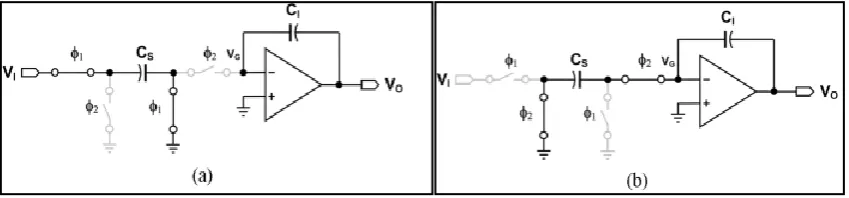
Fig. 1 Conventional SC integrator using OTA. (a) Φ1 Phase. (b) Φ2 Phase.
ISSN: 2319-8753
International Journal of Innovative Research in Science,
Engineering and Technology
(An ISO 3297: 2007 Certified Organization) Vol. 3, Issue 3, March 2014
used in place of the OTA in many different SC (Switched Capacitor) circuits in the CMOS technologies Fig. 1 and Fig. 2. The gain boost class-C inverter is proposed in this paper, which boosts the inerter dc gain to 83 dB in the typical condition
Fig. 2SC integrator using inverter, Φ1 phase.
This paper is organized into five sections. Section II discuss the inverter as an amplifier. Section III describes the cascode class-C inverter and gain boost class-class-C inverter and section V gives simulation results of the gain boost class-class-C inverter.
II. INVERTER AS AN AMPLIFIER
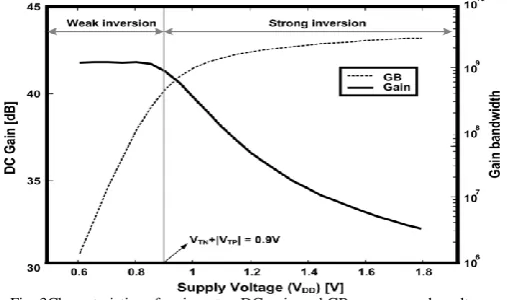
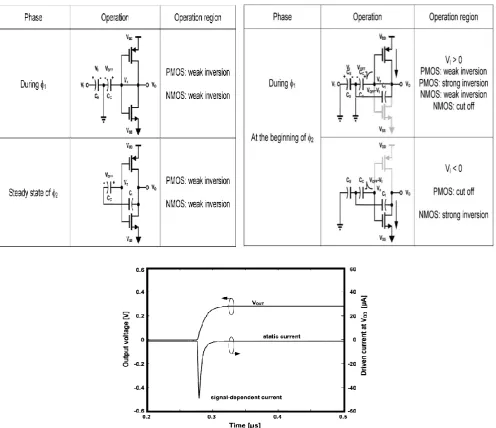
In SC circuits, the open loop DC-gain of an amplifier determines the accuracy of the charge transfer, while the gain-bandwidth product (GB) of an amplifier determines its operation speed. Fig. 3 shows the DC-gain and GB of a push-pull CMOS inverter with respect to the supply voltage (VDD). The DC-gain of an inverter is maximized in the weak inversion region, whereas the GB of an inverter increases with respect to supply voltage and is saturated as the operating region enters the strong inversion region. To obtain both high DC-gain and wide GB, the inverter should operate at the boundary between the weak and strong inversion regions, which can be realized by using a supply voltage equal to the nominal sum of the NMOS transistor’s threshold voltage, VTN and PMOS transistor’s threshold voltage, VTP. According to the supply voltage, the push-pull inverters can be classified into class-AB or C inverters. When VTN + |VTP |< VDD, the inverter behaves as a class-AB amplifier, while itoperates as a class-C inverter, when VTN + |VTP | >= VDD. If the supply is chosen to be VTN + |VTP |, the inverter-based SC circuit operates as described in Table I. During Φ1, the inverter
Fig. 3Characteristics of an inverter: DC-gain and GB versus supply voltage.
𝑉
𝑋=
𝐴
1+𝐴
𝑉
𝑂𝐹𝐹−
𝑉𝐶𝐼
1+𝐴
≈ 𝑉
𝑂𝐹𝐹 (1)ISSN: 2319-8753
International Journal of Innovative Research in Science,
Engineering and Technology
(An ISO 3297: 2007 Certified Organization) Vol. 3, Issue 3, March 2014
obtained with minimum static current because one necessary transistor is operating in the strong inversion region providing high slew rate during transition, and then both transistors operate in the weak inversion region during the steady state providing highDC-gain. Fig. 4 shows the simulated step response of an inverter-based SC integrator when VDD = |VTP |+ VTN. The large signal-dependent current flows only during the transition while the static current is kept very low. When a class-C inverter is used foran amplifier, the settling time can be reduced by about 75% without increasing the static current, because it has a very low short circuit current.
Table I
Operation of class-c inverter at different clock phase
Fig. 4Simulated step response: output voltage and driven current at VDD.
III. CASCODE AND GAIN BOOST CLASS-C INVERTER
ISSN: 2319-8753
International Journal of Innovative Research in Science,
Engineering and Technology
(An ISO 3297: 2007 Certified Organization) Vol. 3, Issue 3, March 2014
A. Circuit Analysis
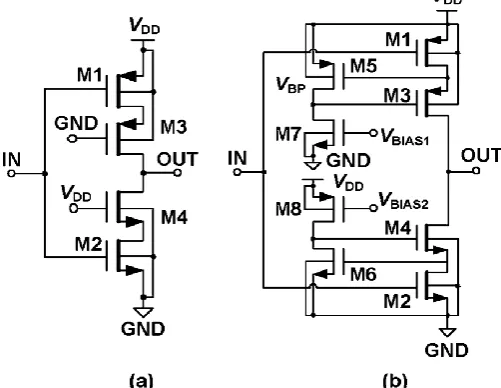
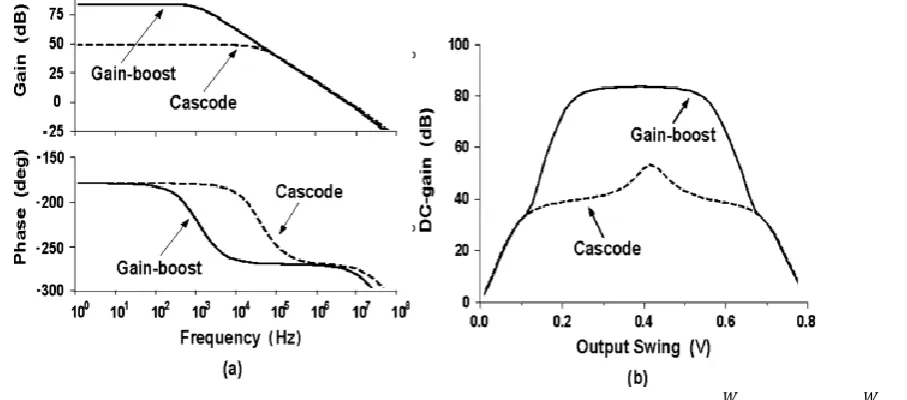
A traditional cascode class-C inverter is shown in Fig. 5(a), and its nominal supply voltage is 0.8V.To copy with the requirement of the class-C inverter (the supply voltage is slightly lower than the sum of the | VTH | PMOS and NMOS input transistors), both of the input transistors M1 and M2 use regular- VTH core devices. At typical corner, M1 VTH is (-0.4262 V), and M2 VTH is 0.4026 V. However, the inverter dc-gain is insufficient (52dB in our simulation) for some high-resolution applications.Fig.5 (b) adds a gain-boost module to the class-C inverter. The gain-boost module, including transistors from M5 to M8, build up two current-voltage feedback loops together with transistors M3 and M4, respectively. As a result, the output impedance And the dc gain of the gain-boost class-C inverter are enhanced.
Fig.6 (a) shows the simulated dc gain and phase margin of the cascode and gain-boost class-C inverters with a 5.75-pF load capacitor. The gain-boost class-C inverter achieves 83-dB dc gain as compared with a 52-dB dc gain in the traditional cascode inverter of the same size at an 0.8-Vsupply.To avoid the loss of output swing, transistors M5 and M6 in the gain- boost inverter employ the low - VTH core devices (The othertransistors use regular- VTH core devices). At a typical corner,
Fig. 5(a) Traditional cascode class-C inverter and (b) gain-boost class-C inverter.
M5 VTH is 0.30 V, and M6 VTH is 0.25 V. As shown in Fig. 6(b), when the inverter output varies from 0.16 to 0.62V, the gain-boost inverter keeps a dc gain larger than 60dB, while a worst 37-dB dc gain isobtained by the cascade inverter.In our design, the inverteroutput swing is controlled to be within 0.4V. The gain-boost class-C inverter fully satisfies the dc-gain requirement of 60dB, while the traditional cascade inverter fails. In addition, the gain-boost inverter consumes 34.5 µW at a 0.8-V supply, where the gain-boost modules consume only 3.2 µW (9.3 % power overhead).
B. PSRR and CMRR
The single-ended class-C inverter has a relatively high supply voltage gain
(𝐴
𝑃=
𝑑𝑉𝑜𝑢𝑡ISSN: 2319-8753
International Journal of Innovative Research in Science,
Engineering and Technology
(An ISO 3297: 2007 Certified Organization) Vol. 3, Issue 3, March 2014
As we known, the common-mode voltage gain of a single-ended class-C inverter is equal to its differential-mode voltage gain. Therefore, for a single -ended inverter, CMRR = 0. However the inverter CMRR can be also improved by the ever, the inverter CMRR can be also improved by the pseudo-differential structure. In the pseudo-differential inverter, the CMRR specification is also dependent on the mismatch. Fig. 8(a)shows the simulation circuit of theinverter CMRR (CS = 5pF, CI = 25 pF, CL = 1 pF), in which the dc operation point of the inverter input is set to be VCM + VOFF through 1T-H inductance. The inverter CMRR versus frequency is shown in Fig. 8(b). The pseudo-differential inverter with 2% transistor mismatch achieves a CMRR better than 94 dB over audioband while a 34-dB CMRR is obtained when considering 2% CI mismatch. Therefore, the match
between CS and CI is important for CMRR optimization(the mismatch of 𝐶𝑆
𝐶𝐼directly affects the cancellation of
common-modedisturbance in two single-ended branches).Generally, the 𝐶𝑆
𝐶𝐼 mismatch is expected tobe less than0.5%. By comparison,the CMRR is less sensitive to the transistor mismatch, because both of two inverters behave as decent amplifiers in spite of transistor mismatch.
Fig. 6Cascode and gain-boost class-C inverters: (a) Frequency response and (b) dc gain versus output swing. Inverter sizes: (𝑊
𝐿)
2 = 192m/0.15m, (𝑊 𝐿)
2 =
ISSN: 2319-8753
International Journal of Innovative Research in Science,
Engineering and Technology
(An ISO 3297: 2007 Certified Organization) Vol. 3, Issue 3, March 2014
Fig. 7 Pseudo-differential class-C inverter: (a) PSRR simulation circuit and (b) PSRR versus frequency.
IV.SIMULATION RESULT
In this section, the functional simulation results of the gain boost class-C inverter have been presented. Functional simulation of gain boost class-C inverter is done in LT-Spice software using 50 nm CMOS technology.
Table II denotes the short-channel MOSFET parameters for general analog design with a scale factor of 50 nm. In Fig. 5, a proposed Gain boost class– C inverter circuit is shown. The frequency of the analog signal input is varied in the way that the minimal propagation time delay is obtained. For the purpose of functional simulation of the circuit, as shown in fig 9(a) the input of the inverter is set as 0.3V to 0.5V pulse signal and output voltage is 0V to 0.8V, inverted and amplified pulse signal. Here the supply voltage, Vdd is 0.8V. Fig.9 (b) is for pulsed input of 0.38V to 0.42V and the output is 0.025V to 0.792V, inverted and amplified.
ISSN: 2319-8753
International Journal of Innovative Research in Science,
Engineering and Technology
(An ISO 3297: 2007 Certified Organization) Vol. 3, Issue 3, March 2014
TABLEII
MOSFET MODEL PARAMETERS FOR 50NM CMOS TECHNOLOGY
(a) (b) Fig. 9Simulation for input pulse (a) 0.3V to 0.5V (b) 0.32V 0.48V
Fig. 10 Output for linear input from 0V to 0.8V.
Short-Channel MOSFET parameters VDD=1V and a scale factor of 50 nm
Parameter NMOS PMOS
Bias Current, ID 10µA 10µA
VDS,sat and VSD,sat 50 mV 50 mV
VGS and VSG 350 mV 350 mV
VTHN and VTHP 280 mV 280 mV
vsatn and vsatp 110 × 103 m/s 90 × 103 m/s
Tox 14Å 14Å
ISSN: 2319-8753
International Journal of Innovative Research in Science,
Engineering and Technology
(An ISO 3297: 2007 Certified Organization) Vol. 3, Issue 3, March 2014
V.CONCLUSION
IN THIS PAPER, A GAIN BOOST CLASS-C INVERTER CIRCUIT IS PROPOSED.OTA HAS A PROBLEM WITH THE REQUIREMENT OF
HIGHER POWER SUPPLY AND CASCODE CLASS-C INVERTER HAS LOWER DC GAIN WHICH IS LESS SUITABLE FOR DIFFERENT SIGMA
DELTA MODULATOR. GAIN BOOST CLASS-C INERTER IS PRESENTED USING 50NM CMOS TECHNOLOGY. THIS ARCHITECTURE
ACHIEVES DC GAIN OF 83- DB. AS A FUTURE WORK, WE CAN DESIGN LOW POWER LOW VOLTAGE INVERTER BASED ∑∆
MODULATOR USING THIS INVERTER DESIGN.
REFERENCES
[1]. L. Yao, M. S. J. Steyaert, and W. Sansen, “A 1-V 140-µW88-dB audio sigma-delta modulator in 90-nm CMOS,” in IEEE J. Solid-State Circuits, vol. 39, no. 11, pp. 1809–1818, Nov. 2004.
[2]. J. Goes, B. Vaz, R. Monteiro, and N. Paulino, “A 0.9-V sigma delta modulator with 80 dB SNDR and 83 dB DR using a single-phase technique,” IEEE Int. Solid-State Circuits Conf. Dig. Tech. Papers, Feb. 2006, pp. 74–75.
[3]. J. K. Fiorenza, T. Sepke, P. Holloway, C. G. Sodini, and H.-S. Lee, “Comparator-based switched-capacitor circuits dor scaled CMOS technologie,”IEEE J. Solid-State Circuits, vol. 41, no. 12, pp. 2658–2668, Dec. 2006
[4]. H. Yang and R. Sarpeshkar, “A time-based energy-efficient analog-to-digital converter,” inIEEE J. Solid-State Circuits, vol. 40, no. 8, pp. 1590–1601, Aug. 2005.
[5]. S. Paul, H.-S. Lee, J. Goodrich, T. Alailima, and D. Santiago, “A Nyquist-rate pipelined oversampling A/D converter,” inIEEE J. Solid-State Circuits, vol. 34, no. 12, pp. 1777–1787, Dec. 1999.
[6]. B. J. Hosticka, “Dynamic CMOS amplifiers,” inIEEE J. Solid-State Circuits, vol. 14, pp. 1111–1114, Dec. 1979.
[7]. F. Krummenacher, “Micropower switched capacitor biquadratic cell,” inIEEE J. Solid-State Circuits, vol. 17, pp. 507–512, June 1982.
[8]. B. Nauta, “A CMOS transconductance-C filter technique for very high frequencies,” inIEEE J. Solid-State Circuits, vol. 27, pp. 142–153, Feb. 1992. [9]. R. H. M. van Veldhoven, R. Rutten, and L. J. Breems, “An inverter based hybrid sigma delta modulator,” in IEEE Int. Solid-State Circuits Conf. Dig.
Tech. Papers, Feb. 2008, pp. 492–493.
[10]. Hao Luo,Yan Han, Ray C.C. Cheung, “A 0.8-V 230-µW DR Inverter –Based Sigma Delta Modulator for Audio Applications,” inIEEE J. Solid-State Circuits, vol. 48, pp. 2430–2441, Oct. 2013.
[11]. R. J. Baker, H. W. Li and D.E Boyce, CMOS Circuit Design, Layout And Simulation, New York, IEEE Press, 2008. [12]. Phillip E. Allen and Douglas R. Holberg, CMOS Analog Circuit Design, Oxford University Press, Inc. 2002.