Vol. 3 , Issue 4 , April 2014
Design of High Speed Split SAR ADC
With Improved Linearity
J.Shaba
1, S.Pooranachandran
2PG Scholar, Department of ECE, Velalar College of Engineering and Technology, Tamilnadu, India1 Assistant Professor, Department of ECE, Velalar College of Engineering and Technology, Tamilnadu, India2
Abstract: Recently low power Analog to Digital
Converters(ADCs) have been developed for many energy constrained applications such as wireless sensor networks and bio-medical applications. Successive approximation register (SAR) ADC are good candidates for low power applications and widely used for low energy application due to its minimum analog blocks. The static linearity performance in terms of the integral nonlinearity and differential nonlinearity and the parasitic effects of the split DAC, are analyzed. A code-randomized calibration technique is done to correct the conversion nonlinearity in the conventional SAR ADC, which is verified by behavioral simulation. Here the SAR ADC is designed in such a way that the control module completely control the splitting up of modules and the speed of operation is changed using low level input bits.A dedicated multiplexer can be used to minimize the capacitor array structure.The control module controls the clock signal and determines the time at which the analog signal should enter the SAR logic.On attaining control over the time of arrival of input signals the speed of conversion can be increased and power utilisation can be minimised.
Keywords:Linearity analysis, linearity calibration,
SARADCs, split DAC
I. INTRODUCTION
Successive approximation registers (SAR) analog-to-digital converters (ADCs) are used as an alternative to the pipelined ADCs for battery-powered mobile applications, such as DVB-T, DVB-H and TDMB [1] which require medium speed (10 MS/s–100 MS/s) and medium-resolution (8–10 b). SAR ADCs achieve very low power consumption due to their simple structural design and operation. However, the SAR conversion relies basically on the arrangement of a
capacitive DAC that subtracts the reference voltage from the input signal. The kT/C noise, capacitor mismatches, and parasitic of the split DAC[2] affect the conversion precision. For medium resolution the kT/C noise requirement is satisfied with small capacitance, while other nonidealities like parasitic and nonlinearity, whose effect depends on the structure and the switching approach of the DAC, becomes significant. SAR ADCs uses Binary weighted capacitive DAC structure. But the capacitance of the DAC array increases exponentially with the resolution, which results in larger consumption of switching energy, area, and settling time. A valuable substitute for medium resolution[3]-[5] is the split capacitive DAC. But it has the limitation that the parasitic capacitors destroy the desired binary ratio of the capacitive DAC array, thus degrading the conversion linearity.
This paper analyzes the conversion nonlinearities, induced by supply noise, switching methods, and parasitic effects in SAR ADCs.The internal node parasitic in the split DAC is also analyzed,since it degrades the conversion linearity. This limitation can be fixed by a code-randomized digital calibration technique in order to improve the differential nonlinearity (DNL) and integral nonlinearity (INL).
II. SAR ADC OVERVIEW
Vol. 3 , Issue 4 , April 2014
algorithm, the N-bit register is initially set to midscale (that is, 100... .00, where the MSB is set to 1). This forces the DAC output (VDAC) to be VREF/2, where VREF is the reference voltage given to the ADC. VIN is then compared with VDAC to determine if VIN is less than, or greater than, VDAC. If VIN is greater than VDAC, the
comparator output is logic high, or 1, and the MSB of the N-bit register remains at 1
Fig. 1: N-bit SAR ADC architecture
III. EXISTING SYSTEM
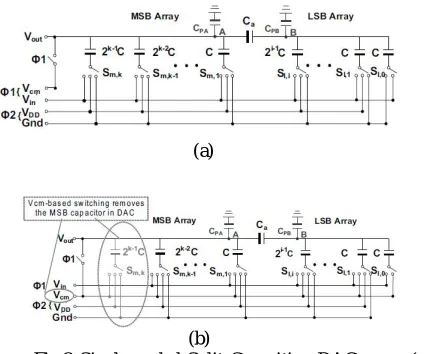
When supply voltage is used as reference voltage the switching power becomes dynamic which is correlated with the switching sequence. Fig. 2(a) represents a conventional single-ended n-bit split DAC structure. During the global sampling phase, the input signal represented as Vin is stored in the entire capacitor array. The algorithmic conversion then starts by switching only the MSB capacitor to VDD and the others to Gnd. Accordingly, Vout settles to −Vin and the comparator output Out_{comp}in the first MSB decision will be
The comparator output predicts the switching logic for the MSB capacitor. If Out_ {comp} results low Sm,k is
switched back to Gnd. If Out_{comp}becomes high, then Sm,k maintained VDD. Simultaneously, the Sm,k−1 (the
MSB/2) switches to VDDfor the next bit comparison. The above process repeats for n− 1 cycles.The conventional
charge redistribution method is not effective in terms of power when discharging the MSB and charging the MSB/2 capacitor.
The Vcm based switching method reduces the array capacitance to half resulting in 90% energy saving when compared with conventional method.Fig.2(b) represents the Vcm based switching algorithm. During the sampling phase voltage Vin gets stored in the capacitor array. During the conversion phase the bottom-plates of the capacitors gets switched to the Vcm first, which raises the voltage −Vin at the output.
(a)
(b)
Fig.2 Single ended Split Capacitive DAC array (a) Conventional Switching. (b) Vcm based switching
IV. CHOICE OF THE ARCHITECTURE
Vol. 3 , Issue 4 , April 2014
The basic architecture of the proposed scheme is split SAR ADC with additional control module in the form of multiplexer that can control the splittg up of modules is shown in figure 3. The SAR ADC can be implemented in a configurable manner with different frequency inputs while configurable means that the entire ADC architecture can work with different performance by changing the Vref of the ADC. Normally in all ADC Vref,Vin,Vth plays a major role in ADC conversion.By varying the values of Vref we can change tyeperformance of the ADC. The different values of Vref can be stored through multiplexer. A counter can be used to select the mux inputs. Reference signal generator can be used to generate different analog signals to test the ADC structure.
Fig 3: Configurable split SAR ADC
V. ARCHITECTURE DESCRIPTION
A. DAC Architecture
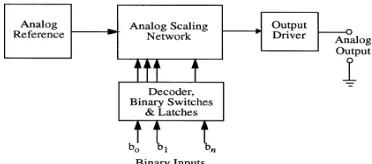
The digital-to-analog (D/A) converter is used to decode a digital word into a discrete analog level. Depending on the application, the input signal can be voltage or current. Figure 3 shows a high level block diagram of a basic D/A converter. A binary word is stored and decoded which drives a set of switches that control a scaling network. The analog scaling network is based on voltage scaling, current scaling, or charge scaling. The scaling network is used to scale the appropriate analog level from the analog reference circuit and is applied to the output driver. A voltage scaling network is formed by a simple serial string of identical resistors between a reference voltage and ground. A switch does the work of tapping the voltages off the resistors and applies them to the output driver. Current scaling approach depends on switched scaled current sources. Charge scaling is obtained by providing capacitor divider with a reference voltage using scaled capacitors where the total capacitance value is determined by the digital code. Choice of the architecture depends on the components available in the target technology, conversion rate, and resolution.
In an SAR-ADC the power is mainly consumed in the DAC, the comparator, the reference buffers and the digital circuits. One of the most important building blocks that determine the accuracy and conversion speed of the converter and also consume most of the overall power dissipation of the SA-ADC, is the DAC. The DAC required in the SA-ADC can be realized in various ways; e.g., capacitor-based DAC, switched-current DAC or R-2R ladder DAC. Among these architectures, the capacitor-based DAC has become more popular because of its zero quiescent current. Furthermore, in most technologies resistor mismatch and tolerance are greater than capacitor mismatch and tolerance.
Fig 4: Basic D/A converter block diagram
B. Sample and hold circuit
In the sample mode, the output of an ideal sample-and-hold circuit is equal to the input signal at that particular instant. When switched to the hold mode, the output should remain constant at that value of the input signal that existed at the instant of switching. A simple sample-and-hold circuit is shown in Figure5 .This circuit uses a FET switch that passes the signal through during the sample period and disconnects it during the hold period. Whatever signal was present at the time the FET is turned off is then held on the capacitor C. The choice of a value for C is a compromise between two conflicting requirements: Leakage currents in the FET and the op-amp cause the capacitor voltage to droop during the hold period according to the equation:
Vol. 3 , Issue 4 , April 2014
integrated circuits that simply require the connection of an external hold capacitor.
Fig. 5: Circuit diagram of sample and hold circuit
C. Sunchronous binary counter
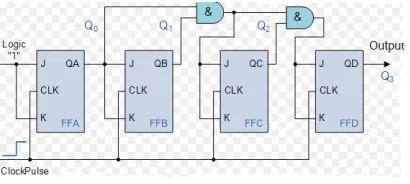
With the Synchronous Counter, the external clock signal is connected to the clock input of every individual flip-flop within the counter so that all of the flip-flip-flops are clocked together simultaneously (in parallel) at the same time giving a fixed time relationship. In other words, changes in the output occur in "synchronization" with the clock signal. This results in all the individual output bits changing state at exactly the same time in response to the common clock signal with no ripple effect and therefore, no propagation delay. In the proposed architecture the synchronous 4 bit counter will increment once for every clock cycle and takes two clock cycles to overflow, so every cycle it will alternate between a transition from 0 to 1 and a transition from 1 to 0. Notice that this creates a new clock with a 50% duty cycle at exactly half the frequency of the input clock. If this output is then used as the clock signal for a similarly arranged D flip-flop one will get another 1 bit counter that counts half as fast.
Fig 6: 4 bit synchronous up counter
D. Signal generator
A standard analog summing circuit can be used to introduce a shift in the ramp-like signal by adding a small dc voltage to the ramp-like signal. The circuit of Fig. 7 shows one such op-amp based summing circuit. The shift can be added by either closing switch s2 or by
closing switch s3. If the gain of the op-amp is sufficiently high, this circuit will provide a constant dc offset but if the op amp gain is not sufficiently high, nonlinearities in the operational amplifier will introduce small nonlinearities in the shift. It is well-known that the offset voltage of an operational amplifier invariably introduces an undesirable shift in the output voltage of most op-amp based circuits.If the offset voltage of an operational amplifier can be controlled by a switch, however, the offset voltage change from when the switch is open to when the switch is closed will provide two signals that are ideally different by a constant shift. The circuit diagram for such a ramp generator is as shown in Fig.7 where switch s3 is used to intentionally introduce mismatch internal to the operational amplifier. The offset voltage in an operational amplifier is comprised of two parts, the systematic part and the random part. The random part, caused by random mismatches and process variations, is not of concern to us. This is because it would be common to both ramp-like signals. Likewise, the systematic part which is common to both ramp-like signals is not of concern either.
Fig 7: Signal generarator
VI. DESCRIPTIONS OF PROPOSED ADC
A. Comparator
Comparator is desirable to attain the fast conversion. Ramp generator produces the ramp voltage, and it is compared with the comparator input voltage. Finally, comparator generating the hit pulse, if the ramp voltage is better than the input voltage. The difference between the ramp and the input voltage is called as hit pulse. And it passes all the way through the registers and encoders.
B. Registers, encoders and multiplexer
Vol. 3 , Issue 4 , April 2014
READ and WRITE registers. Gray counter and MCG outputs are linked to the encoders. At last step, all data values are composed by means of the multiplexer. Multiplexer perform the operation of first in first out operation(FIFO).
VII. RESULTS AND ANALYSIS OF SPLIT SAR ADC
The power and sampling rate analysis is done by implementing the SARADC in XilinxISE9.2i is shown in Table 1
Table 1: Analysis of power consumption
Screen Shots
Figure 8: 4:12 Decoder
Figure 9: 12:1 Multiplexer
Figure 10: Successive Approximation Register
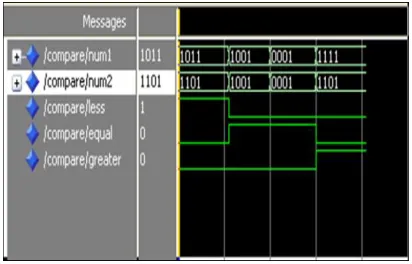
Figure 11 : 4 bit comparator
VIII. CONCLUSION
Vol. 3 , Issue 4 , April 2014
FUTURE WORK
Different types of DAC array can be introduced to reduce the linearity erors of SAR ADC. Additional use of capacitive structure may result in improving the conversion efficiency.
ACKNOWLEDGMENT
The authors acknowledge the contributions of the students, faculty of Velalar College of Engineering and Technology for helping in the design of check circuitry,and for tool support.The authors also thank the anonymous reviewers for their thoughtful comments that helped to improve this paper.The authors would like to thank the anonymous reviewers for their constructive critique from which this paper greatly benefited.
REFERENCES
[1] U.-F. Chio, H.-G. Wei, Z. Yan, S. Sai-Weng, U. Seng-Pan, R. P. Martins, and F. Maloberti, “Design and experimental verification of a power effective Flash-SAR subranging ADC,” IEEE Trans. Circuits Syst. II, Exp. Briefs, vol. 57, no. 8, pp. 607–611, Aug. 2010.
[2] Y. Zhu, U.-F. Chio, H.-G. Wei, S.-W. Sin, U. Seng-Pan, and R. P. Martins, “A power-efficient capacitor structure for high-speed charge recycling SAR ADCs,” in Proc. IEEE Int. Conf. Electron. CircuitsSyst., Aug.–Sep. 2008, pp. 642–645.
[3] M.Saberi, R.Lofti, K. Mafinezhad, and W.A. Serdijn,”Analysis of power consumption and linearity in capacitive digital to analog converters used in successive approximation ADCs,” IEEE Trans.Circuit Syst. I, Regular Papers,vol.58,no.8,pp.1736-1748,Aug 2011.
[4] Y.K. Cho,Y.D .Jeon,J.W.Nam,and J.K Kwon,”A 9-bit 80 MS/s successive approximation register with capacitor reduction technique,”IEEETrans.CircuitSyst.IIExp.Briefs,vol 57,no.7, pp. 502-506, Jul. 2010
[5] M.S.W.Chen and R.W.Brodersen,”A 6b 600 MS/s 1.46 mW asynchronous ADC in 0.13 m CMOS,” in IEEEInt.Solid state Circuit Conf . Dig.Tech Papers Feb 2006 pp 574-575.
[6] B.P.Ginsburg and A.P.Chandrakasan,”500 MS/s 5-bit ADC in 65 nm CMOS with split capacitor array DAC,”IEEE J.solid state circuit,vol.42,no.4,pp.739-747,Apr2007.
BIOGRAPHY
Shaba.J has received B.E degree in Electronics and Communication Engineering from Anna University, Coimbatore 2011. She is currently pursuing Master of Engineering in VLSI Design in Velalar College of Engineering and Technology under Anna University, Chennai. She has presented one paper in National Conferences. Her areas of interest in research are VLSI Signal Processing, VLSI architectures.