Copyright 8 1988 by the Genetics Society for America
Identification of the Genomic Locations of Duplicate Nucleotide Sequences
in Maize by Analysis of Restriction Fragment Length Polymorphisms
Tim Helentjaris,” David Weber? and
Scott Wright**Molecular Biology Group, NPI, Salt Lake City, Utah 84108, and fGenetics Group, Department of Biological Sciences, Illinois State University, Normal, Illinois 61 761
Manuscript received February 28, 1987 Revised copy accepted November 2, 1987
ABSTRACT
While preparing a linkage map for maize based upon loci detected through the use of restriction fragment length polymorphisms (RFLPs), it was found that 62 of the 2 17 cloned maize sequences tested (29%) detected more than one fragment on genomic Southern blots. Thus, more than one nucleotide sequence is present within the maize genome which is in part homologous to each of these cloned sequences. The genomic locations of these “duplicate” sequences were determined and it was found that they usually originated from different chromosomes. The process which produced them did not operate randomly as some pairs of chromosomes share many duplicate sequences while many other pairs share none. Furthermore, these shared duplicate sequences are generally arrayed in an ordered arrangement along these chromosomes. It is believed that chromosomal segments which contain several duplicate loci in a generally ordered arrangement must have had a common origin. The presence of these duplicated segments supports the idea that allopolyploidy may have been involved in the evolution of maize. Nevertheless, the duplicate loci do not primarily involve five pairs of chromosomes and thus, five pairs of homeologous chromosomes are not currently present within the maize genome. The data clearly indicate that maize is not a recent allotetraploid produced by hybridization between two individuals with similar genomic structures; however, the data are also consistent with the possibility of these shared duplicate chromosomal segments having been generated through internal duplication.
A
LTHOUGH maize is generally considered to be a true diploid, it has been repeatedly suggested that it originated as an amphidiploid hybrid and has an allopolyploid genomic structure. ANDERSON (1945) noted that certain genera related to corn contain 5chromosomes in their haploid genomes, and he sug- gested that corn originated as an allotetraploid hybrid of “something like a 5-chromosomed Sorghum crossed with some 5-chromosomed relative of Coix.” T h e reported experimental hybridization of Coix and maize (HARADA et al. 1954; NOWACKI, ANIOU and BEIBER 1972) has provided support for this possibility.
Numerous cytological observations, such as the pairing between nonhomologous chromosomes in monoploid maize (TING 1966) and formation of bivalents during diakinesis-metaphase I (MOLINA and NARANJO 1986) have also been interpreted to dem- onstrate the presence of large segments shared in common between chromosomes. RHOADES (1951) summarized genetic inheritance data that he felt
indicated that the maize genome contained areas of duplicated sequences. More recently, “duplicated” isozymic loci have been found in maize in parallel linkages (GOODMAN et al. 1980; MCMILLIN and SCAN- DALIOS 1980; GOODMAN and STUBER 1983; WENDEL, GOODMAN and STUBER 1985), and this also appears to demonstrate the presence of duplicated sequences
Genetics 118: 353-363 (February, 1988)
and shared chromosomal segments within the maize genome.
One difficulty with each of these observations, is that they only suggest that duplicated sequences are present within the maize genome. None of these studies has actually demonstrated that common DNA sequences exist at different chromosomal locations within the maize genome. A procedure, restriction fragment length polymorphism (RFLP) analysis, has recently been developed which allows the direct detection and mapping of a nucleotide sequence within a genome. We previously applied this proce- dure to maize and demonstrated that loci can be detected which hybridize to a single cloned DNA sequence, and that the relative genomic locations of these loci can be determined through both linkage (HELENTJARIS et al. 1985) and monosomic (HE- LENTJARIS, WEBER and WRIGHT 1986) analyses. This report describes the identification and mapping of a number of duplicated DNA sequences within the
maize genome by this process, and provides direct evidence as to the structure and origin of the maize genome.
MATERIALS AND METHODS
354 T. Helentjaris, D. Weber and S. Wright
was constructed from leaf mRNAs and used as described previously (HELENTJARIS et al. 1985). Seventy-nine of the 284 RFLP loci on our RFL.P map were detected with these cDNA clones. Second, HindIII-generated genomic DNA fragments were sized, cloned into pUC8, and then selected for homology to sequences present in low copy number in the maize genome (HELENTJARIS et al. 1986). Seventy-two of the RFLP loci were detected by clones of this type. Third, a second library of genomic sequences was con- structed as above except that the methylation-sensitive restriction enzyme, PstI, was used to digest the DNA. For the most part, this type of library yields a much higher percentage of unique sequence clones and abolishes the need for evaluating the probes and discarding those ho-
mologous to repetitive sequences in the maize genome. One hundred-fourteen of the RFLP loci were detected using this library. Essentially no significant differences were noted in either the distribution of these three types of clones within the maize genome or their level of duplication. The last source of probe sequences were clones of known identity supplied to us by other investigators (listed in WRIGHT, HELENTJARIS and KIKUCHI 1987).
Because many of the cloned sequences hybridized to more than one genomic fragment, extensive efforts were made to confirm that these results were not due to some type of cloning artifact. We checked our cDNA clones for the presence of internal PstI sites as evidence of fortuitously ligated sequences. Only a few internal sites were found, and the number was statistically consistent with the premise that they represented naturally-occurring internal PsfI sites. Our genomic DNA clones contained inserts which had been size-selected, and we later checked individual clones both for the final insert size and the presence of internal Hind1 11 or PstI sites. No results were obtained that were inconsistent with the hypothesis that each of these clones was the result of an independent cloning event.
Plant materials: Populations used to map cloned se- quences were as follows. Forty-seven F2 progeny from inbreds H427 x 761 and 196 F2 progeny from inbreds Tx303 X Co159 were used in linkage studies and analyzed by maximum likelihood as reported earlier (HELEN-IIAKIS el al. 1986). Forty-nine progenv from a backcross of (Man- gelsdorfs Multiple Tester x W22) X Mangelsdorfs Mul- tiple Tester were also used to map cloned sequences that were uninformative in the above two F2 populations. Fi- nally, monosomic analysis was carried out as described previously (HELENTJARIS, WEBER and WRIGHT 1986).
Other methods: All other methods for the preparation of plant DNA, Southern blots, and hybridization (aqueous with 5 x SSC at 60") and wash (0.25 x SSC at 60") conditions were as described previously (HELENTJARIS el al.
198.5, 1986).
RESULTS
While preparing genetic linkage maps for maize based upon loci detected by RFLPs (HELENTJARIS et
al. 1986; HELENTJARIS, WRIGHT and WEBER 1986), we found that many of the maize clones detected more than one fragment on genomic Southern blots. T h i s was despite the fact that efforts were made to utilize clones that hybridized only to unique or low- copy sequences in the maize genome. Multiple frag- ments were observed no matter which restriction enzyme was used to digest the genomic DNA and this suggested that duplicated sequences were being
p r e n l a l + F l monosomic individuals
FI(:I.KF. I.--Sl~~nosomic ;111;11\sis 0 1 . ;I clone tlctno~~srr;~ring t l ~ r - plicate loci. A clonc, GID-06, \vas used t o probe a Southern blot containing genomic DNAs prepared from t w o inbred lines, 85- MT antl Rx' /r-Xl. a diploid F I , antl F I individuals monosomic for specific maize chromosomes. Numbers almve the monosomic in- tlivitluals denote the missing chromosome in each case. The lane labeled "markers" contains molecular weight markers.
detected in the maize genome. Of the 2 17 informative maize clones generated and tested to date, 62 (28.6%) appeared to detect duplicate sequences.
One important point to be considered here is that while one can be fairly certain about the relatedness of loci detected by this method, one must be more careful about drawing conclusions about loci which this study has not detected as being duplicated. For instance, the Css (sucrose synthetase-2) locus shares considerable sequence homology with theshl (sucrose synthetase-1) locus (MCCARTY, SHAW a nd H ANNAH 1986); however, under our hybridization and wash conditions, the Css probe does not hybridize with t he shl locus and the shl probe does not hybridize with the Css locus. T h e alcohol dehydrogenase-1 and -2 loci a r e also known to have considerable sequence homology (DENNIS et al. 1985); however, we cannot detect both duplicated loci with either clone alone using our hybridization and wash conditions, which a r e fairly stringent in order to simplify o u r analysis of hybridization patterns for mapping purposes. If less stringent conditions were used, some of the
probes which detected only one fragment might detect additional fragments.
T h e chromosomal locations of the sequences in the maize genome which hybridized with each cloned sequence were determined by genetic linkage analysis (HELENTJARIS et al. 1986) and/or by monosomic anal- ysis (HELENTJARIS, WEBER and WRIGHT 1986). An example of a monosomic analysis utilizing clone G l D - 06 used as a probe on a Southern blot is shown in Figure 1. This clone hybridizes with two DNA frag- ments in each of the parents (85-MT and Rg'lr-xl). In both parents (which are highly inbred), the hy- bridization signal for one fragment is more intense than for the other. Both diploid and monosomic
Duplicated RFLP Loci in Maize 355
from the female parent is missing in monosomic 2 plants while the other fragment (59B) from the female parent is missing in monosomic
7
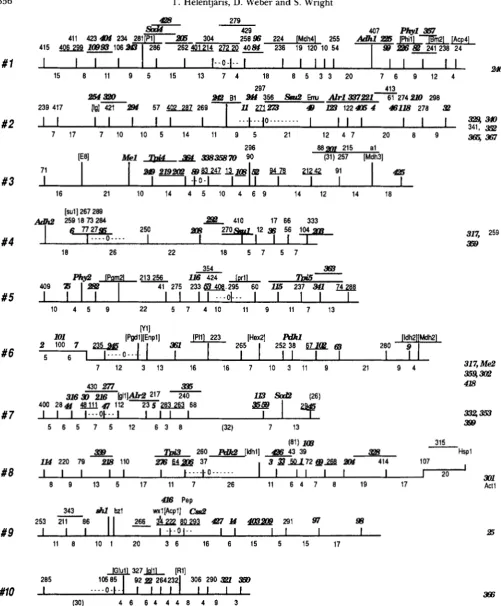
plants. Our initial interpretation of these results was that the two intense fragments observed in the two inbreds rep- resented alleles at one genetic locus on chromosome 2 (210A and 2 10B) and the two less intense fragments represented alleles at a second locus on chromosome 7 (59A and 59B). We believe the observed difference in signal intensity of the two loci reflects differing rates of homology to the cloned sequence rather than differing copy numbers in the genome or some other explanation. Our assumption of two duplicate loci was later confirmed by linkage analysis, and the two duplicate loci were placed on our maize RFLP linkage map; locus 59 is located on chromosome 7 and 2 10 is located on chromosome 2 (HELENTJARIS et al. 1986). Therefore, two distinct loci are detected by significant homology to this single cloned sequence.We have identified a number of such “duplicate” sequences which are homologous to specific probes and have placed these loci on our RFLP linkage map using both genetic linkage and monosomic analyses. Our current map is shown in Figure 2 . Linkage data are available for most of the loci, and the map positions of these loci are indicated by their numerical designations above vertical marks placed along the horizontal axes representing the chromosomes.
Other loci without linkage data, but still assigned to specific chromosomes, are placed along the right side of the map. T h e linkage groups derived from these analyses have been correlated with the conventional maize linkage map in five ways: (1) through mono- somic analyses (HELENTJARIS, WEBER and WRIGHT
1986), (2) through linkage analysis with morpholog- ical marker loci (HELENTJARIS, WRIGHT and WEBER
1986), (3) through linkage analysis with isozyme loci (unpublished work with C. STUBER and M. EDWARDS),
(4)
through RFLP analysis of clones for genes with known genomic locations (WRIGHT, HELENTJARIS and KIKUCHI 1987), and (5) through the use of B-Atranslocations (which has allowed us to determine the approximate locations of centromeres, manuscript in preparation). We have denoted all loci in this figure (in bold and italics) which were detected by RFLP analyses as duplicate sequences in the maize genome. An analysis of the distribution of these duplicate loci is presented in Table 1. The number of RFLP loci per chromosome and the number of duplicated RFLP loci per chromosome both differ significantly from a uniform distribution at P
<
0.001 and P <0.05, respectively, using a goodness of fit
x’
test. However, neither the number of RFLP loci nor the number of duplicated RFLP loci per unit of chro- mosome physical length (NEUFFER, JONES and ZUBER 1968) is significantly different from a uniform dis- tribution at P<
0.05, demonstrating that whenadjusted for chromosome length, the density of both unique and duplicated sequences is fairly uniform throughout the maize genome. Further, the percent- ages of duplicated RFLP loci per chromosome are not significantly different from each other at P
<
0.05 using a contingencyx’
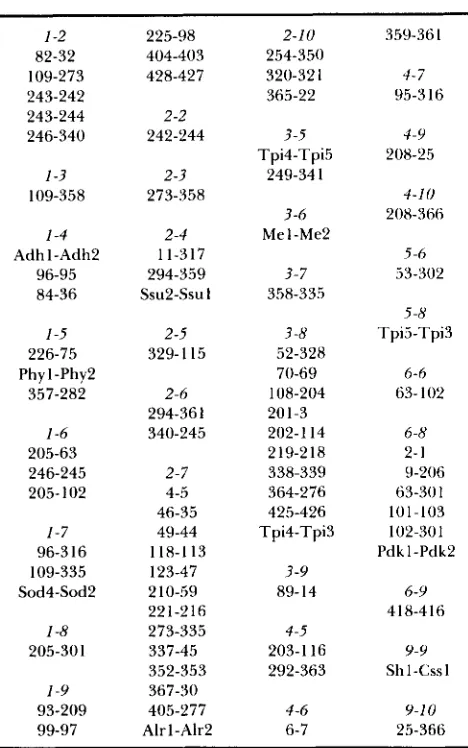
test.T h e distribution of these duplicate loci shared among nonhomologous chromosomes is shown in Table 2. The nonrandom arrangement of these du- plicated loci is evident with certain chromosome pairs sharing many loci and other chromosome pairs hav- ing none. For example, chromosomes 2 and 7 share 13 pairs of duplicate loci and chromosomes 3 and 8
share 10, while no pairs of duplicate loci have been found to date by this method for 16 of the 45 pairwise combinations of nonhomologous chromosomes. We detected only three intrachromosomal duplications, where the duplicate loci are both on the same chro- mosome at different locations. For example, loci 63
and 102 are detected by the same clone, and are 9 map units apart on chromosome 6. Thus, intrach- romosomal duplications are infrequent in the maize genome; however, it should be pointed out that very closely linked duplicate loci would often be over- looked by this method of analysis. Although two hybridizing fragments might be detected, the two duplicate loci would usually cosegregate and segre- gant individuals might not be detected unless many progeny were analyzed.
Clearly, the mechanism that produced these pairs of duplicate loci must have operated in a nonrandom manner. This becomes especially evident when one examines the map positions of these duplicate loci along these chromosomal pairs. The map positions of pairs of duplicate loci on chromosomes 2 and 7 are presented in Figure 3. Only pairs of duplicate loci shared by chromosomes 2 and 7 are indicated, and those detected by the same cloned sequences are connected with a line. Clearly, the 13 pairs of dupli- cate loci shared by these chromosomes are arranged in the same approximate order within the two chro- mosomes. This is strong evidence that the chromo- somal segments containing these sequences, well over 50 map units in both chromosomes, possess extensive regions of homology besides the small cloned se- quences tested, and almost certainly had a common origin.
Most of‘the duplicated loci on chromosome 2 which are shared with chromosome 7 are located on the long arm of this chromosome. This largely homolo-
356 T. Helentjaris, D. Weber and S. Wright
# 7
#2
# 3
#4
#5
#6
# 7
#8
#9
#70
m? 279
c
411 423 g# 234 2 8 1 F B 304
429 407 Phyl a57
2 5 8 s 224 [Mdh4] 255 A d d 2a5 hi1 7 m 2 ] \Acp4]
415 E 1 0 6 2 B
I
286 262-4084
236 19 120 10 54I
fB&&
241 238 24I
I
I
I
I I
I
"0- "I
I
I l l
I I
I
I I
15 8 11 9 5 15 13 7 4 18 8 5 3 3 20 7 6 9 12 4 2#i
254m
B%3 B1 BH 297 356 Erm Ah1 3 3 7 2 2 1 6 1 2 7 4 2 l O 298 413239 417 l g l T 2 9 1 57 269
-
1
11a
2
7
3
4 E? 1 2 2 m 4 46lB 276 Z8 8 m 215 a i
(31) 257 [Mdh3]
16 21 10 14 4 5 10 4 6 9 14 12 14 18
[sui] 267 289
259 1873284 2(12 410 17 66 333
6 772795 250 aap 270,- 12 36 56 104
""0""
I
I
I I
I I
I
18 26 22 18 5 57 7
354 s3
Phy2 lParn2l 213 256 116 424 brll
41 275 233 u . 2 9 5 60 u5 237 341 B A Q
I
I
I
I I
".o"-I
I
10 4 5 9 22 5 7 4 10 11 9 11 7 13
Nil
I I I I I I f I I I I
7 12 3 13 16 16 7 10 3 11 9 21 9 4 317, Me2
5 6 5 7 5 12 6 3 8 (32) 7 13
(81) l(19 315
XB
-
260 pdk2 [Idhi] 466 43 39 a3 h P 1w
220 79 228 110m § 4 a
37 3 a _ s c U 7 2 @ 2 6 8 2I# 414 107I l l I I I t "._ 10"""
I
I I I I I1
20 I8 9 13 5 17 11 7 26 11 6 4 7 8 19 17 m 1 Act1
285
25
FIGURE 2.-Our current maize RFLP linkage map. Horizontal lines denote the chromosomes and RFLP loci are represented above the
lines by numerical designations. Where the exact location of either single or multiple loci is unknown, this ambiguity is denoted as an underlined segment. Loci along the right side of the figure have been assigned to chromosomes but linkage data are not available. Loci in
brackets were detected as morphological markers or isozymes, while all other loci were detected by RFLP analysis. Those RFLP loci shown
in bold and italics possess duplicated sequences elsewhere in the genome. Numbers below the horizontal lines are distances between loci
Duplicated RFLP Loci in Maize 357
TABLE 1
Distribution of unique and duplicated loci in maize
Chromosome No.
1 2 3 4 5 6 7 8 9 10
No. RFLP loci** 47 43 30 28 23 20 30 33 23 13
No. duplicated RFLP loci* 17 24 13 10 9 12 15 15 10 4
Percent of RFLP loci duplicated" 36.1 55.8 43.3 35.7 39.1 60.0 50.0 45.4 43.5 30.7
Relative length of chromosomeb 229 196 179 175 175. 122 140 140 122 100
No. of RFLP locihelative length" 0.205 0.219 0.168 0.160 0.131 0.164 0.214 0.236 0.189 0.130
No. duplicated RFLP loci/relative length" 0.074 0.122 0.073 0.057 0.051 0.098 0.107 0.107 0.082 0.040
a Not significantly different from a uniform distribution adjusted for chromosome length.
Values from NEUFFER, IONES and ZUBER (1968).
* Significantly different "from a uniform distribution at P C 0.05.
** Significantly different from a uniform distribution at P < 0.001
TABLE 2
Distribution of shared duplicate loci among maize chromosomes 1-2 82-32 109-273 243-242 243-244 246-340 1-3 109-358 1-4 Adhl-Adh2 96-95 84-36 1-5 226-75 Phy 1-Phy2 357-282 1-6 205-63 246-245 205- 102 1-7 96-3 16 109-335 Sod4-Sod2 1-8 205-30 1 1-9 93-209 99-97 225-98 404-403 428-427 2 -2 242-244 2-3 273-558 2-4 11-317 294-3.59 ssu2-ssu I
2-5 329- 1 15
2-6 294-361 340-245 2-7 4-5 46-35 49-44 118-1 13 123-47 2 10-59 221-216 273-335 337-45 352-353 367-30 Alrl-Alr2 405-277 2-10 254-350 320-32 1
365-22
3-5 Tpi4-Tpi5
249-34 1
3-6
Me 1 -Me2
3-7 3.58-335 3-8 52-328 70-69 108-204 201-3 202-1 14 338-339 364-276 42.5-426 Tpi4-Tpi3 3-9 89-14 219-218 4-5 203- 1 16 292-363
4-6 6-7
359-36 I
4-7
95-3 16
4-9 208-2.5 4-10 208-366 5-6 53-302 5-8 Tpi5-Tpi3 6-6 63- 102 6-8
2- 1 9-206 63-30 1 101-103 102-301 Pdkl-Pdk2 6-9 418-416 9-9 Shl-Cssl 9-10 25-366
Duplicate loci detected by single cloned sequences and shared
between chromosomes are listed in order of the chromosome pairs.
Chromosome pairs with no shared duplicate loci are not listed.
while three other loci (320,365, and 254) are similarly duplicated on chromosome I O . Thus, at least small portions of these latter chromosomes also may share a common origin with segments of chromosome 2.
The centromere on chromosome 7 is not precisely located on our RFLP map, and although most of these loci are known to be in the long arm, it is uncertain how many if any of these duplicate loci region are located in the short arm of this chromosome.
One other interesting observation is that our most distal RFLP locus on the long arm of chromosome 2 , locus 32, is duplicated on chromosome I at locus 82. This does not seem to fit the overall pattern that most of the long arm of 2 shares homology with chromosome 7. We have observed that this locus, 32, is deleted in some maize inbred lines, while all of the remaining proximal loci on the long arm of 2 are still present. Perhaps this represents a transposition from chromosome 1 onto 2 which is a more recent event in the evolution of maize and may also be correlated with the observation that there are two cytological forms of chromosome2 in maize (NEUFFER, JONES and ZUBER 1968).
358 T. Helentjaris, D. Weber and S. Wright
# 2
I I
I I
I I
I
I
367 35a
# 7
FIGURE 3.-Duplicate loci shared I I by 44&65'Ly\
maize ""0 chromosomesmrE7
.. 2 and 7. 5 Loci connected by a line areu
loci detected by the*353
same clone.# 3
# 8
# 6
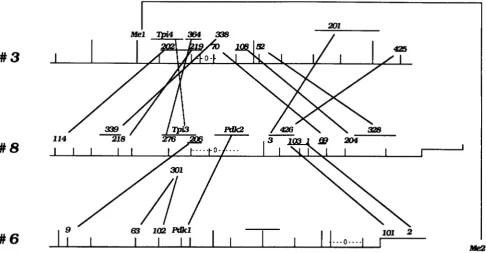
FIGURE 4.-Duplicate loci shared by maize chromosomes 3, 6 and 8. Designations are the same as in Figure 3. Chromosome 6 is shown in reversed order to clarify the relationship between it and chromosome 8.
surrounded by the two 3-8 clusters with one overlap. Interestingly, the duplicate loci on chromosome 6
are widely spaced, but at least two pairs, 1-2 and 103- 101, are located extremely close together on both chromosomes. Only one pair of duplicate loci was found on chromosomes 3 and 6, Me1 and Me2 (NADP malic enzyme).
While the chromosome pair, 2 and 7, and the group involving chromosomes 3, 6 and 8, contain the largest number of pairs of duplicate loci detected in this study, other regions of homology were also detected. Five loci (97,98,209,403 and 427) located in a relatively short segment of the long arm of chromosome 9 are duplicated on chromosome I ; however, the corresponding loci on chromosome
1 are widely separated into two distinct groups. Three pairs of closely linked duplicate loci are also located on chromosomes I and 5 . Most of the other dupli-
cated RFLP loci are found as smaller blocks or isolated cases.
DISCUSSION
Numerous data of several types have been previ- ously obtained that suggest that the maize genome contains at least some duplicated sequences and possibly much larger segments shared between chro- mosomes. Since ANDERSON'S (1945) supposition that maize originated as an amphydiploid, based upon chromosome numbers of five and ten for maize and some of its relatives, other indirect evidence such as the experimental hybridization of Coix and maize
(HARADA et al. 1954; NOWACKI, ANIOU and BEIBER
Duplicated RFLP Loci in Maize 359
Pairing between nonhomologous chromosomes lacking homologs has also been considered as evi- dence for large scale interchromosomal homology in maize. TINC (1966) analyzed diakinesis in monoploid maize and reported that 50.9% of the cells contained one or more bivalents or multivalents. He indicated that this was “convincing evidence that modern maize is an allopolyploid with perhaps a base number of 5.” However, FORD (1952), SNOPE (1967), and WEBER and ALEXANDER (1972) observed lower frequencies of pairs (29.6, 15.3 and 15.4%, respectively) at diak- inesis in maize monoploids.
MOLINA and NARANJO (1986) analyzed diploid maize plants and reported that 10 bivalents were regularly formed; however, “secondary associations were observed and a maximum of five groups of two bivalents was frequent at diakinesis-metaphase I.”
Such associations of bivalents have not been observed in diploid maize analyzed by one of us (D. F. WEBER, unpublished results). MOLINA (1982) examined Zea perennis (2n = 40) and reported that 10 bivalents and
5 quadravalents were present in 55% of the cells. They also examined F1 hybrids involving Zea mays, Zea perennis and Zea diploperennis, and from obser- vations made on meiotic cells in these F1 hybrids, they concluded that there was “strong evidence in favor of n = 5 for the genus Zea” (MOLINA and NARANJO 1986).
Exchanges between unpaired nonhomologous maize chromosomes have also identified the locations of presumptive redundant sequences within the maize genome. WEBER and ALEXANDER (1972) re- covered 22 reciprocal translocations from monoploid
X diploid crosses in maize, and they found that twelve of the translocations involved chromosomes 6 and 7 and two involved chromosomes 2 and 6 at cytologically indistinguishable breakpoints. Because these translocations were found repeatedly, the breakpoints of these translocations (and probably the other eight translocations recovered from these crosses) presumably identify sites of interchromoso- mal homology.
The most specific prediction regarding the orga- nization of the maize genome has been made by BENNETT (1983). He attempted to predict the mean spatial order of the 10 haploid chromosomes in maize and noted that his model suggested that maize is an allotetraploid. He predicted that chromosomes 1 and
5 , 2 and 4 , 3 and 9, 6 and 7, and 8 and 10 were putative homoeologs in the maize genome. Our cur- rent study has mapped 81 pairs of duplicate RFLP loci among the 45 possible nonhomologous chro- mosome pairs (1.8 per pair) while BENNETT’S pre- dicted homoeologous chromosome pairs had seven loci (1.4 per pair). Thus, his predicted homoeologous chromosome pairs did not contain more of these than would be expected by chance.
Correlation of our observations with the cytological data and evidence for alloploidy is confusing. This is due somewhat to the fact that although many of these studies predict large duplicated areas within the maize genome, these studies taken together with our results rarely predict the same areas. For instance in WEBER and ALEXANDER (1972), twelve 6-7 trans- locations and two 2-6 translocations were recovered. However, none of the duplicate loci identified in the current study involved chromosomes 6 and 7, and only two involved chromosomes 2 and 6 . Also, they did not recover any 2-7, 3-8, or 6-8 translocations in their study, while these were the most common duplications found in our study. In their type of study, recombination may have taken place primarily between highly homologous, but relatively small re- gions in nonhomologous chromosomes, regions that were not detected by the limited number of probes utilized in the current study. Alternatively, the trans- locations recovered in their study may have been produced by recombination between segments in two chromosomes which each contained the same se- quence repeated many times. It is possible that the same type of small but highly repeated sequences is responsible for certain cytological observations re- ported earlier but they do not correspond to the areas of duplication we have detected. Sequences repeated numerous times in restricted regions of nonhomologous chromosomes are known to exist in the knobs of maize chromosomes (PEACOCK et al. 1981) and in heterochromatin. We would not detect RFLP loci in such regions unless they were inter- spersed with low copy number sequences, because we are only able to utilize clones that are present in very low copy number. Perhaps this might also ex- plain why some regions of our RFLP map are not well populated with RFLP loci, as these areas may primarily contain sequences present in the genome in high copy number and few, if any, sequences in low copy number. For instance, our RFLP map currently has only one RFLP locus on the short arm of chromosome 10.
There are other lines of evidence which point to at least very small areas of duplication in the maize genome but that may also support the idea of larger areas of shared chromosomal segments. RHOADES
(195 1 ) pointed out that at least 14 cases of duplicate, two of triplicate, and one of quadruplicate factor inheritance were known at that time. All of the alleles had to be in the recessive condition for the mutant phenotype to be expressed, a fact suggestive of duplicate loci. While certainly suggestive, these types of
360 T. Helentjaris, D. Weber and S. Wright
an ancient amphidiploid origin or represent later occurring duplications cannot be decided at this time.”
RHOADES (1951, 1955) also pointed out that the long arm of chromosome 9 , the short arm of 5, the distal region of the long arm of 4 , and 8 contained few known mutants and might contain redundant regions. The numerous duplicated loci we have de- tected on chromosome 8, and its extensive homology with chromosomes 3 and 6 are in agreement with his prediction concerning chromosome 8. The duplicate RFLP and isozyme loci on chromosomes I and 5 is in agreement with his prediction regarding chro- mosome 5 . Also, the current conventional maize genetics map contains few known mutants in the long arm of chromosome 2, and this is consistent with our observation that the long arm of chromosome 2 is largely homologous with portions of chromosome 7. RHOADES (195 1) also noted that many of the duplicate loci then known were on chromosome 9, including duplicate loci in both the long and short arm. We have found ten duplicated loci on chromosome 9, and the duplicate loci of five of these are on chromosome I . Another pair of duplicate loci, sucrose synthetase-1 (shl) and sucrose synthetase-2 (Css), are both located on chromosome 9, with shl in the short arm and Css in the long arm (MCCARTY et al. 1986). More recently, “duplicate” maize isozymic loci (iso- zymes with common enzymatic activities) have been identified. Several maize isozymes, including alcohol dehydrogenase (Adh), catalase (Cat), isocitrate de- hydrogenase (Idh), and malate dehydrogenase (Mdh), have been shown to be produced by two or more loci, and many of these have been mapped within the maize genome (MCMILLIN and SCANDALIOS
1980; GOODMAN and STUBER 1983; WENDEL, GOOD- MAN and STUBER 1985). T h e presence of duplicated isozymes have been interpreted as providing strong evidence for internal duplication and possibly poly- ploidy in a number of species (GOTTLEIB 1982). Several examples of parallel linkages of duplicate isozyme loci have been reported in maize (GOODMAN et al. 1980; WENDEL et al. 1986). For example, Zdh2 and Mdh2 are located on chromosome 6 and Zdhl and Mdhl are both located on chromosome 8. Mdh4, Amp1 , Amp2, Pgml and Cat2 are all located on chro- mosome 1 , while Mdh5, Amp3, Pgm2 and Cat1 are found on chromosome 5 . These parallel linkages are certainly suggestive of common derivations for seg- ments of these pairs of chromosomes.
Our current RFLP results are also very consistent with information on these “duplicate” isozymic loci. Because duplicate isozymic loci produce enzymes with the same catalytic activity, it has been assumed that the templates of these loci may possess similar nu- cleotide sequences. However, this assumption in maize has only been shown to be true for one pair
of duplicate isozymic loci, the Adhl and Adh2 loci (DENNIS et al. 1985). Previously, chromosomes 3 and 6, 6 and 8, and I and 5 were all reported to contain duplicate and linked pairs of isozymic loci. In the current study, we have found that there indeed are homologous DNA sequences that are shared among chromosomes 3 , 6 and 8, and 1 and 5 and they are clustered into distinct regions. The Zdhl and Zdh2 (on chromosomes 8 and 6, respectively); Mdhl, Mdh2, and Mdh3 (on chromosomes 8, 6 and 3 ) ; Tpi3 and Tpi4 (on chromosomes 8 and 3 ) ; and Hex1 and Hex2 (on chromosomes 3 and 6) duplicated isozymic loci are located on three chromosomes where we have detected significant duplicated segments (GOODMAN
et al. 1980; WENDEL et al. 1986). A number of 1-5 duplicated RFLP loci are also closely located to re- gions where duplicate isozyme loci had previously been mapped. Thus, our current data are very con- sistent with data from duplicate isozymic loci, and this provides very strong support for the concept that duplicate isozymic loci often do indeed identify re- gions of similar nucleotide sequences and possibly also infer much larger related chromosomal
segments.
T h e duplications we have detected and mapped in the maize genome could have been produced by several mechanisms: (1) formation of tandem dupli- cations with subsequent dispersal, (2) reverse tran- scription of mRNA or hnRNA with subsequent rein- sertion into the genome, (3) fusion of related genomes, or (4) internal duplication of chromosome segments. Examination of the individual character- istics of each model may provide some indication as to their relative roles in the generation of the dupli- cations we have detected.
Tandem duplications have previously been shown to be present in the maize genome in the nucleolar organizing region (MCCLINTOCK 1933), centromeres
(MCCLINTOCK
1938), the A locus (LAUGHAN 1949), the R locus (STADLER and NEUFFER 1953), and in maize knobs (PEACOCK et al. 1981). The methods used here would usually not detect exact or inexact tandem duplications with a low copy number (less than five) because they would be detected as either comigrating or non-comigrating fragments that cosegregate to a very high degree. Hence, our data, provides little information about this type of duplication or whether it transposes to different genomic locations.Duplicated RFLP Loci in Maize 36 1
one played a significant role in generating the du- plications detected in this study as there is little reason to expect that copies of segments would be inserted non-randomly. In other words, there is little reason to expect that segments duplicated from the long
arm of chromosome 2 would be preferentially in- serted into chromosome 7 in an ordered arrangement and not into other regions of the genome.
As indicated earlier, it has repeatedly been sug- gested that two genomes with N = 5 fused to produce an ancient amphidiploid which evolved into the mod- ern maize genome, in a manner analogous to that three genomes with N = 7 are believed to have fused to produce the modern wheat genome (SEARS 1975).
T h e regions of presumptive homoeology involving chromosomes 2 and 7, ? and 8, 6 and 8, and others identified in the current study demonstrate that large segments of considerable homology exist within the maize genome. Such regions would be present if fusion of related genomes occurred at some time during the evolution of maize. On the other hand, this study clearly demonstrates that five pairs of homoeologous chromosomes are not currently
present within the maize genome. T h e data simply do not identify five pairs of chromosomes which share large numbers of duplicate loci over most of their length. In fact, the current study identified pairs of duplicate loci involving chromosome 1 with eight of the nine other maize chromosomes, and chromosomes 2, 3 , 4 and 6 each had duplicate loci on seven nonhomologous chromosomes. We con- clude that maize is not the result of a recent allopo- lyploid event because it does not now contain hom- oeologous chromosomes. However, the extensive largely homologous segments and numerous dupli- cated loci identified in the current study suggest that an allopolyploidization event may have been involved in its evolution. If such an event occurred, the genome has been extensively restructured after it occurred. One disconcerting observation connected with this model is that the events necessary for this restruc- turing (chromosome aberrations) are currently infre- quent in maize as evidenced from the fact that no detectable translocations were found in 55 strains of maize from Latin America (COOPER and BRINK 1937),
and neither translocations nor inversions were found in 90 strains of corn from Latin America (RHOADES
and DEMPSEY 1953).
Finally, it is possible that the related sequences we have detected were generated through internal du- plications of chromosome segments within the maize genome. Although our observations are certainly consistent with such a derivation, it is difficult to distinguish this model from the model that maize had an allopolyploid origin followed by extensive restructuring of the genome and sequence diver- gence. However, certain facts are of interest. First,
our study detected extensive regions of duplication in only certain segments of the chromosomes. If these were the result of fusion of two genomes, then some mechanism must have existed(s) which either pro- moted or prevented sequence divergence differen- tially over large chromosomal segments so that we are now unable to detect all loci as being duplicated elsewhere in the maize genome. Alternatively, some of these duplicated sequences may have been lost during the evolution of maize, and this would also explain why we were unable to detect them. Secondly, because many segments exist as dispersed multiple copies and not just “duplicated” sequences, we feel this also argues against fused genomes as the only source of duplications. For instance, the data for triose phosphate isomerase, Tpi, obtained through both isozyme analysis and RFLP analysis with a gene clone, confirm that there are at least three dispersed sequences for this enzyme. The same was also seen for some of the randomly chosen sequences of un- known function we used.
Obviously, it is not clear which of the latter two mechanisms played the most important role in de- termining the current structure of the modern maize genome. Possibly all four mechanisms, tandem du- plication, reverse transcription and reinsertion, gen- ome fusion, and partial duplication, have operated to some degree, with one or both of the latter two mechanisms playing a significant role in determining the current “global” genomic structure. However, the relative importance of these mechanisms is not clear at this time. Perhaps a similar search for duplications and parallel linkages in related genera such as Teo- sinte, Tripsacum, Sorghum, or even some of the N
= 5 species using the maize probes which identify duplicated sequences would be most informative. If, for instance, the duplicate maize clones showed more homology to each other than they did to any of the genes from the putative precursors, this might sug- gest that they were derived from internal duplication of a common ancestor genome as opposed to having been generated during an ancient fusion event of two separate genomes. If there appears to be some organization to the process of duplication, that is some duplications are found in some but not all relatives, then this also might shed light on the ancestry of maize.
It is also important to consider the differences we have found when comparing the genomes of maize and tomato plants. As described in this paper, 62 of the 217 informative maize probes tested (28.6%)
362 T. Helentjaris, D. Weber and S. Wright
fourteen times as numerous in maize as in tomato. BERNATZKY and TANKSLEY (1986b) also found that the majority of their cloned tomato sequences rep- resented “unique” sequences, but found a higher percentage of duplicated sequences, a result that may be due to ancillary factors such as differences in hybridization conditions. Another difference be- tween maize and tomato is the much higher level of polymorphism in maize. If we hybridize a labeled maize probe with DNAs from unrelated maize lines which were digested with three different restriction enzymes, we almost invariably identify a polymorph- ism. However, when the same procedure is carried out with DNAs prepared from different varieties of cultivated tomatoes, polymorphic clones are rarely identified (less than 5 % ) . In fact, in our previous work (HELENTJARIS et al. 1986) and the work by BERNATZKY and TANKSLEY (1986a), it was necessary to analyze interspecific crosses in Lycopersicon to find sufficient polymorphisms to construct a genetic map. Clearly, the maize genome is very different from the tomato genome in at least two ways: (1) it has a much higher level of redundancy in low copy number sequences, and
(2)
it has a far higher level of poly- morphisms. The reasons for these differences are currently unknown; however, it will be especially interesting to observe what will be found in other organisms as RFLP mapping efforts are carried out with them. Will there be a correlation between the level of polymorphisms and the level of duplication of low copy number sequences in these organisms? It is also interesting to consider how these two facts relate to our other observation (HELENTJARIS et al.1985) that those species which are primarily out- crossing in nature yield a high degree of polymorph- ism when analyzed by RFLPs as compared to the much lower degree of polymorphism exhibited by species that are primarily self-pollinated.
In any case, there can be no doubt that the RFLP method is a much more efficient and precise method of screening a genome for duplications than any previously employed tests. The potential number of informative RFLP loci is virtually unlimited and with several groups obtaining and mapping RFLP loci in maize, we should shortly see a substantial increase in our knowledge of the structural arrangement of the maize genome.
In addition to others acknowledged in earlier manuscripts who
furnished clones for this work, we would like to thank M. MAR-
C H I O N N I for the triose phosphate isomerase (Tpi) clone, M. M.
SACHS for the alcohol dehydrogenase 2 (Adh2) clone, W. TAYLOR
for the RUBP-C small subunit (Ssu) clone, L. C. HANNAH for the
sucrose synthetase-2 (Css) clone, J. SCANDALIOS for the superoxide
dismutase (Sod) 2 and 4 clones, and P. COLLINS for the NADP
malic enzyme (Me) and pyruvate phosphate dikinase (Pdk) clones,
all of which demonstrated duplicated loci. We would like to
acknowledge the significant technical contribution of Y . KIKUCHI
in helping to add more duplicated RFLP loci to the maize RFLP
linkage map. Additionally we would like to acknowledge the
significant efforts of C. STUBER and M. EDWARDS in helping us to
place the isozyme loci on our linkage map. We would also like to
acknowledge the contributions of ALAN KATZ for carrying out the
statistical analyses in Table 1 and SUSAN PATTERSON and JAN
TIVANC for preparing the figures for this manuscript. We would like to thank Sandoz Ltd. (Basel, Switzerland) and its subsidiary company, Northrup King Co., whose funding supported the initial
work reported herein as well as Funk Seeds International for
providing nursery facilities in which part of the material utilized in this study was grown. This work was supported in part by grant
6-CRCR-1-2213 from the United States Department of
Agriculture.
L I T E R A T U R E CITED
ANDERSON, E., 1945 What is Zea mays? A report of progress.
Chron. Bot. 9: 88-92.
BENNETT, M. D., 1983 The spatial distribution ofchromosomes. In: Kew Chromosome Conference I I . pp 71-79, Edited by P. E.
BKANDHAM and M. D. BENNETT. George Allene 8c Unwin,
London.
BEKNATZKY, R., and S. D. TANKSLEY, 1986a Toward a saturated
linkage map in tomato based on isozymes and random cDNA
sequences. Genetics 112: 887-898.
BERNATZKY, R., and S. D. TANKSLEY, 1986b Majority of random
cDNA clones correspond to single loci in the tomato genome.
Mol. Gen. Genet. 203: 8-14.
COOPER, D. C., and R. A. BRINK, 1937 Chromosome homology
in races of maize from different geographical regions. Am.
Nat. 71: 582-587.
DENNIS, E. S., M. M. SAGHS, W. L. GEKLAm, E. J. FINNEGAN and
W. J. PEACOCK, 1985 Molecular analysis of the alcohol de-
hydrogenase 2 (Adh2) gene of maize. Nucleis Acids Res. 13:
FORD, L. E. 1952 Some cytogenetic aspects of maize nonoploids
and monoploid derivatives. Doctoral thesis, Iowa State College, Ames, Iowa.
GOODMAN, M. M., and C. W. STUBEK, 1983 Maize. pp. 1-33. In:
Isozymes in Plant Genetics and Breeding, Part B, Edited by S. D.
.TANKSLEY and T. J. OmoN. Elsevier, Amsterdam.
GOODMAN, M. M., C. W. STUBER, K. NEWTON and H. H. WEISSIN-
GER, 1980 Linkage relationships of 19 enzyme loci in maize.
Genetics 96: 697-710.
G u r - I - L E I B , L. D., 1982 Conservation and duplication of isozymes
in plants. Science 216: 373-380.
HAKADA, K. M., A. MURKAMI. A. FUKUSHIMA and M. NAKAZIMA,
1954 Breeding study on the forage crops. Studies 011 the
intergenic hybridization between the genus Zea and Coix
(Maydeae) I. Kyoto Preffectural Univ. Faculty Agric. Sci. Rep.
6: 139-145.
HELEN.IJARIS, T., D. F. WEBER and S. WRIGHT, 1986 Use o f
monosomics to map cloned DNA fragments in maize. Proc.
Natl. Acad. Sci. USA 83: 6035-6039.
HELENTJARIS, T., S. WK1C;H-r and D. WEBER, 1986 Construction
of genetic linkage map in maize using restriction fragment
polymorphisms. Maize Genet. Coop. News Lett. 60: 118-120.
HELENTJARIS, T., G. KING, M. SLOCLIM, C. SIEDENSTKANG and S.
WEGMAN, 1985 Restriction fragment polymorphisms as
probes for plant diversity and their development as tools for
applied plant breeding. PI. Mol. Biol. 5: 109-1 18.
HELENTJARIS, T., M. SLOCUM, S. W w w r , A. SC:HAEFEK, and J .
NIENHUIS, 1986 Construction of a genetic linkage maps in
maize and tomato using restriction fragment length poly-
morphisms. Theor. Appl. Genet. 72: 761-769.
LAUGHAN, J. R., 1949 The action of allelic forms of the gene A
in maize. 11. The relation of crossing over to mutation of Ah.
Proc. Natl. Acad. Sci. USA 35: 167-178.
Duplicated RFLP Loci in Maize 363
MCCAKTY, D. R., J. R. SHAW and L. C. HANNAH, 1986 Cloning
of the sucrose synthetase-2 gene. Maize Genet. Coop. News
Lett. 60: 58-60.
MCCARTY, D. R., S. WKIwrr, T. HELENTJARIS, J . SHAW and L. C.
HANNAH, 1986 T h e sucrose synthetase-2 gene is genetically
linked to s h l . Maize Genet. Coop. News Lett. 60: 60-61.
MCCLINTOCK, B., 1933 T h e relation of a particular chromosomal
element to the development of nucleoli in Zea mays. 2. Zell-
forsch. Mikrosk. Anat. 19: 191-237.
MCCLINTOCK, B., 1938 T h e production of homozygous deficient
tissues with mutant characteristics by means of the aberrant
mitotic behavior of ring-shaped chromosomes. Genetics 26:
315-376.
MCMILLIN, D. E., and J. G. SCANDALIOS, 1980 Duplicated cytosolic
malate dehydrogenase genes in Zea mays. Proc. Natl. Acad.
Sci. USA 77: 4866-4870.
MOLINA, M. C., 1982 Cytogenetic studies on interspecific hybrids
between Zea diploperennis and Zea perennis. Maize Genet. Coop.
News Lett. 56: 96.
MOLINA, M. C., and C. A. NARANJO, 1986 Cytological evidence
for a basic number x = 5 in Zea polypoid complex. Maize
Genet. Coop. News Lett. 60: 77-79.
NEUFFER, M. G., L. J . JONES and M. S. ZUBEK, 1968 In: 7 h e
Mutants of Maize. p. 4. Crop Science Society of America, Madison, Wisc.
NOWACKI, E. A., A. ANIOU and D. BEIBEK, 1972 An attempted
cross of Zea mays and Coix Lacrymajobi and the serological
relationships of these species. Bull. Acad. Pol. Sci. 20: 695-
697.
PEACOCK, W. J., E. S. DENNIS, M. M. RHOAUES and A. .J. PKYOK,
I981 Highly repeated DNA sequence limited to a knob
heterochromatin in maize. Proc. Natl. Acdd. Sci. USA 78:
4490-4494.
RHOADES, M. M., 1951 Duplicate genes in maize. Am. Nat. 85:
RHOADES, M. M., 1955 T h e cytogenetics of maize. In: Corn and
105-1 10.
Corn Improvement, Edited by G. F. SPKAGUE. Academic Press, New York.
RHOADES, M. M., and E. DEMPSEY, 1953 Cytogenetic studies of
deficient-duplicate chromosomes derived from inversion het-
erozygotes in maize. Am. J . Bot. 40: 405-424.
SEAKS, E. R., 1975 T h e wheats and their relatives. pp. 59-91. In:
Handbook of Genetics, Vol. 11, Edited by R. C. KING. Plenum Press, New York.
SNOPE, A. J . , 1967 T h e relationship of abnormal chromosome 10
to P-chromosomes in maize. Chromosoma 21: 243-349.
S r A m m , L. J . , and M. G. NEUFFEK, 1953 Problems of gene
structure. 11. Separation of R’elements (S) and (P) by unequal
crossing over. Science 117: 47 1-472.
S T E I N , J. P., R. P. MUNJAAL, L. LAGACL, E. C. LAI, B. W. OMALLEY
and A. R. MEANS, 1983 Tissue-specific expression of a
chicken calmodulin pseudogene lacking intervening se-
quences. Proc. Natl. Acad. Sci. USA 80: 6485-6489.
TIN(;, Y. C., 1966 Duplications and meiotic behavior of the
chromosomes in haploid maize (Zea mays L.) Cytologia 31:
WEUEK, D. F., 1974 Screening for redundant regions in Zra mays
with monosomic X diploid crosses. Genetics 77: s69-70.
WEBEK, D. F., and D. E. ALEXANDEK, 1972 Redundant segments
in Zea mays detected by translocation of monoploid origin.
Chromosoma 39~27-42.
WENL)EL,J. F., M. M. GOODMAN and C. W. S - r m m , 1985 Mapping
data for 34 isozyme loci currently being studied. Maize Genet.
Coop. News Lett. 59: 90.
WENDEI.,J. F., C . W. ST-UBEK, M. D. EDWARDS and M. M. GOODMAN,
1986 Duplicated chromosome segments in Zea mays L.: fur-
ther evidence from Hexokinase isozymes. Theor. Appl. C renet.
WKIc;tiT, S., T . HEL EN TJ A KI S and Y. KIKUCHI, 1987 RFLP map-
ping of cloned genes. Maize Genet. Coop. News Lett. 61: 89-
90. 324-329.
72: 178-185.