Copyright 0 1994 by the Genetics Society of America
Evidence That
TUPl/SSNG
Has
a Positive Effect
on
the Activity of
the
Yeast Activator HAP1
Li
Bang and
Leonard GuarenteDepartment of Biology, Massachusetts Institute of Technology, Cambridge, Massachusetts 0 2 1 3 9
Manuscript received September 13, 1993 Accepted for publication November 23, 1993
ABSTRACT
The activity of the yeast transcriptional activator HAPl is controlled by heme and the heme effect is mediated through the heme domain of HAP1. In this report, we show that HAPl activity is significantly reduced in strains deleted of T U P l or SSN6, and addition of a heme analog does not allow HAPl to regain its full activity. Deletion of the heme domain alleviates the requirement for T U P l / S S N 6 . The results suggest that TUPl/SSN6 have a positive effect on the activity of HAPl and this effect is mediated through the heme domain. Although TUPl/SSN6 generally repress transcription of many genes, our data indicate they may have positive effect on the expression of certain genes.
H
AP1 is a transcription factor that controls the ex- pression of many mitochondrial enzymes involved in the oxidative phosphorylationelectron transport pathway. It is a zinc finger DNA binding protein and its activity is modulated by the availability of oxygen (PFEIFER et al. 1989). The presence of oxygen allows syn- thesis of heme which serves as the inducer of HAPl ac- tivity in vivo. HAPl is a 1483 residue protein containinga zinc finger DNA binding domain and dimerization domain between residues 1-148, a heme responsive do- main between residues 244 and 444, a highly acidic ac- tivation domain between residues 1309 and 1483, and a 800-residue internal region of unknown function. The zinc finger of HAPl is homologous to a family of yeast transcription factors including GAL4, LAC9 and MAL63
(JOHNSTON 1987).
HAPl forms dimers and binds to different sequence elements, such as the UASl of CYCl (is-1-cytochrome
c), the UAS of CYC7 (is-2-cytochrome c), and the UAS of CYTl (cytochrome c,). In vitro, HAPl will not bind to DNA unless heme is included in the reaction. In vivo, HAPl will only activate the promoters when the level of heme is sufficiently high (GUARENTE et al. 1984; PFEIFER et al. 1987,1989). HAPl activity in wild-type cells can be activated further by the addition of the heme analog, deuteroporphyrin IX (dpIX), to the media (GUARENTE
et al. 1984; PFEIFER et al. 1989). Many lines of evidence suggest that heme regulates HAPl activity by binding directly to the heme domain of HAPl (PFEIFER et al. 1989; ZHANG et al. 1993). Binding of heme allows HAPl to dimerize and bind to DNA. Further, recent experi- ments in this (L. ZHANG and L. GUARENTE, manuscript submitted) and the Guiard laboratory ( ~ L O V I C H et al. 1993) show that one or more cellular factors interacts with the heme domain of HAPl and represses its DNA binding and transcriptional activity in the absence of heme. That is, heme initiates a series of events leading
Genetics 136: 813-817 (March, 1994)
to HAPl activation, including the disassembling of the multiple component, HAPl repression complex, and dimeriztion of HAPl (L. ZHANG and L. GUARENTE, manu- script submitted).
TUPl/SSNG form a high molecular weight com- lex that represses transcription of many promoters
(WILLIAMS et al. 1991; KELEHER et al. 1992). Repression of transcription by a 2 and MIGl also requires TUP1/ SSN6 (reviewed in TRUMBLY 1992). Further, positioning TUPl/SSNG at a lexA site via fusion to lexA also elicits repression, suggesting that the TUPl/SSN6 complex is the active agent in mediating repression by a 2 and MIGl (KELEHER et al. 1992; TRUMBLY 1992). Deletion or mu- tations of TUPl or SSN6 increases transcription from many yeast promoters, including SUC2 and AN31
(SCHULTZ and CARLSON 1987; ZHANC et al. 1991). This could occur, for example, if the TUPl/SSN6 complex bound to the transcriptional activators in these systems to repress their activity. Thus, we explored the possibility that the general repressor, TUPl/SSN6, was the cellular factor that bound HAPl in the absence of heme. How- ever, our experiments show that, in contrast to our ex- pectation, TUPl/SSN6 have a positive role in the heme induction of HAP1 activity. We discuss this finding in light of a model for heme regulation of oxygen-induced genes in yeast.
MATERIALS AND METHODS
Yeast strains and methods: Saccharomyces cereuisiae strains
used were BWG 1-7a (a, leu2-2, 112, his4-519, adel-100, ura3-52) (GUARENTE et al. 1984), LPY22 (a, leu2-2, 112, his4- 519, adel-100, ura3-52, hap1A::LEUZ) ( T U R C O ~ and GUARENTE 1992), 1-7aAtup1, and L P e 2 A t u p l . Deletion of
T U P l was constructed using plasmid pFW36 as described (WILLIAMS and TRUMBLY 1990). 1-7aAssn6 was generated using plasmid pDSB as described (TRUMBLY 1988). The deletions were confirmed by Southern analysis or complementation. Cells were grown in WD or synthetic complete media (ROSE
814 L. Zhang and L. Guarente
TABLE 1
Effect of deleting TUPl or SSN6 on the Pgalactosidase
activities of various reporters
Reporter
w
Ann6 AfuplA N B l <1 400 150
His 66 ( H I M ) 89 56 67 SD5 ( G A L ) 1163 1203 1706 UASl/CYC1 220 10 14
Walactosidase activities of different reporters were assayed in 1-7a. I-7aAtupI, and 1-7aAssn6 cells. Cells were grown in 2% glu- cose dropout medium or 2% galactose dropout medium for assaying SD5 reporter activity. All the reporters were constructed using the basal CYCI promoter lacking any UASs. The Uk$2upl/CYCI re- porter and the UASl/CYCI reporter contain the CYCI promoter sequences up to -265, and -229 to -312, respectively (GUARENTE rf al.
1984). SD5 contains the UAS of GAL I-lo promoter (GUAFENTE el al.
1982). His 66 contains the 89bp HIS4 promoter fragment containing BASl, BAS2, and GCN4 binding sites (ARNDT ef al. 1987). The ANBI
reporter contains sequences upstream to -312 of pLG669-Z (GUAREWE et al. 1984). W = wild type.
UAS2upl/CYCI 48 33 30
valactosidase assays: Cells carrying plasmids were gen- erally grown in selective synthetic complete media containing 2% glucose (ROSE et al. 1988). Cells carrying HAPl expression plasmids under the control of UASGAL (TURCOTE and
GUARENTE 1992; S D S H A P l ) were grown in 2% raffinose and then induced with 2% galactose for 8 hr before assaying for Pgalactosidase activity. Strains deleted of TUPl or SSN6 were maintained at room temperature instead of 30". EDTA was added to the cells prior to Pgalactosidase assays as described (TRUMBLY 1986). At least three independent transformants were assayed and average values were listed here.
Yeast extracts and DNA-binding assays: Cells were grown as described above. 200 ml of cells were harvested by centrifu- gation and washed in buffer A [200 mM Tris-HCI, pH 8.0, 400 mM (NH,),SO,, 10 mM MgCI,, 1 mM EDTA, 10% glyc- erol, 1 mM phenylmethylsulfonyl fluoride (PMSF), 7 mM 2-mercaptoethanol, 1 pg/ml leupeptin, 1 pg/ml pepstatin], and resuspended in buffer B [20 mM Hepes, pH 8.0, 5 mM EDTA, 20% glycerol, 1 mM PMSF, 7 mM 2-mercaptoethanol,
1 pg/ml leupeptin, 1 pg/ml pepstatin]. Then, cells were permeabilized by agitation with 0.75 volume of glass beads as described by PFElFER et al. (1987). Extracts were collected after centrifugation of the permeabilized cells. The radiola- beled UASl/CYCl was prepared as described (TURCOTTE and GUARENTE 1992; ZHANG et al. 1993). The binding reac- tions were carried out exactly as described (ZHANG et al.
1993). The reaction mixtures were loaded onto 4% poly- acrylamide gels in 1/2TBE and electrophoresis was carried out at 4".
RESULTS
TUPl/SSNG
affects H A P l transcriptional activity: HAPl associates with a high molecular complex in the absence of heme to repress its activity (FYI-LOVICH et al. 1993; L.ZHANC
and L. GUARENTE, manuscript submit- ted). We wished to investigate whether TUPl/SSNG comprised this repression complex. If so, activation by HAPl may no longer require heme in a tup1 or ssn6deletion mutant. Table 1 shows the effects of deleting
T U P l or SSNG on the activities of various reporters. De- letions of SSNG or TUP1 had no significant effect on
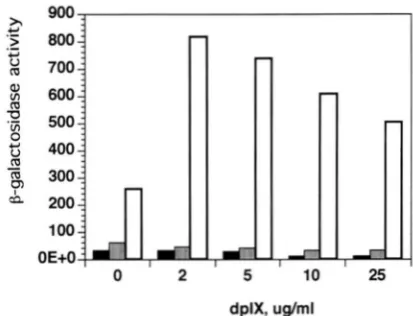
0 2 5 10 25
dplX, uglml
F ~ G U R E 1.-The effect of the heme analogue, dpIX, on the HAPl activity in cells deleted of TUPl or SSN6. w a l a c - tosidase activity of UASl/CYCI reporter (pLGA312AAX,
GUARENTE et al. 1984) was assayed in 1-7a, 1-7aAtup1, and l-i'aAssn6 cells in the presence of various concentrations of
dpIX. The unfilled, filled, and black bars represent the
Pgalactosidaseactivityin 1-7a, 1-7aAtup1, and 1-7aAsssn6cells, respectively.
transcription by the HIS4 (His-66) promoter (ARNDT et al. 1987), the GALI-IO (SD5) promoter (GUARENTE
et al. 1982), or the HAP2/3/4responsive UASBupl el- ement (GUARENTE et al. 1984). Also, as expected, the
A N B l promoter was greatly stimulated in the Assn6 or
A t u p l strains (ZHANC et al. 1991). However, contrary to expectation, the level of UASl was greatly decreased in the Assn6 or A t u p l strains. This is the first instance in which SSNG and TUPl have been shown to be positive regulators. This unusual finding prompted us to aban- don the model that TUPl/SSN6 repressed HAPl and to investigate further their requirement to activate HAP1.
TUPl/SSNG
affects H A P l activity through the heme domain: To determine if the effect of TUPI/SSN6 de- letion on HAP1 activitywas related to heme synthesis, we tested how HAPl activity is affected by the addition of the heme analog, deuteroporphyrin IX (dpIX). Addi- tion of dpIX to heme deficient cells allows HAP1 to gain full activity, while addition of dpIX to wild type cells further enhance HAPl activity above its normal level (GUARENTE et al. 1984; PFEIFER et al. 1989). If the lower activity of HAPl in A t u p l or Assn6 cells are due to de- ficiency in heme synthesis, addition of dpIX should complement that defect and allows HAP1 to gain full activity. Pgalactosidase assays show that dpIX increased activity of a T U P l strain above the normally activated levels as expected, but did not affect the low levels in theAtup1 strain (Figure 1). This result suggests that the reduction of HAPl activity in the absence of TUPl or SSNG gene product is not due to the lack of heme syn-
thesis, but may indicate a more direct involvement of these factors in activation by HAP1.
Effect of TUPl/SSN6 on HAPl 815
HAPl Constructs AhaplTUP1 Ahapldtupl
HAL 1861 1444
HAP1 1058 294
ABe-B 1862 1443
ABe-K 945 1380
ABg-K 1585 307
AB-K 1577 3 6 0
AKpn 2.6 3.4
SD5HAPl 539 164
I
I
I
I
0 2 4 4 4 4 4 7 4 6 1 3 0 7 1 4 8 3 BstE II BamH I Bgl II Kpn I (Be) (B) (Bg) ( K )
FIGURE 2.-The heme domain mediates the effect of TUPl on the HAPl activity. walactosidase activity of UASl/CYCI reporter (pLGA312AAX-HZS, TURCOTTE and GUARENTE 1992) was assayed in LPW2 cells (AhaplTUPl) or cells deleted of TUPl (hap1 Atupl) in the presence ofvarious HAPl deletion constructs (derivatives of p W 1 , PFErFER et al. 1989), which were expressed from the HAPl promoter except for SD9HAPI(expressed from the CALI-IO promoter). The HAPl DNA binding domain (DNA), the heme domain
(HEME), the activation domain (ACT), and relevant restric- tion sites are shown. HAL is a fusion protein containing the HAPl DNA binding domain (1-244) and the GAL4 activation domain (753-881). AKpn is a HAPl derivative deleted of the activation domain and does not activate transcription (PFEIFER et al. 1989).
strains deleted for HAPl or both HAPl and TUPI. The activity of HAPl was significantly reduced in the absence of TUPl whether the protein was expressed from its own promoter (HAP1) or the GAL promoter (SDSHAPZ, Figure 2). The level of activation was sig- nificantly higher in this experiment than that of Table 1, probably because higher levels of HAPl were ex- pressed from the high copy plasmids. This elevation re- duces the foldeffect of deleting TUPl, although a sig- nificant effect remains. Because the reduction in UASl activity in the Atupl strain was observed when HAPl was expressed from the GAL promoter, the requirement for TUPl is not related to transcription of the HAPl gene
(see Table 1).
Deletions outside of the heme domain (444-1307) did not alleviate the requirement for TUPl (see row ABg-K or row AB-K, Figure 2). However, deletion of the heme domain abolished the requirement (see row ABe-K and row ABe-B, Figure 2). Similar experiments in Assn6 cells also show this effect of deleting the heme
WT ATUPl hSSN6
n n n
Heme
-
+
-
+
-
+
“ H M C
1 2 3 4 5 6
FIGURE 3.-TUP1 and SSNG have no effect on DNA-binding of both HMC and DC. DNA-binding reactions were carried out using extracts prepared from 1-7a, 1-7aAtup1, and 1-7aAssn6 cells overexpressing I”1. A final concentration of 20 ng/pl heme was included in the DNA binding reaction mixtures loaded in lanes 2,4 and 6. To reveal the high molecular weight complex (HMC), the gel was run for an extended time period at 4” and the free probe was out of the gel.
domain (data not shown). These data show that TUPl/ SSNG are required as positive regulators, only when the heme domain of HAP1 is present.
Previously, we (L. ZHANG and L. GUARENTE, manuscript submitted) and FWLOVICH et al. (1993) observed that one or more cellular factors interacts with the heme do- main of HAP1 in the absence of heme. Addition of heme disrupts this high molecular weight, multiple compo- nent, HAPl complex and allows HAPl to dimerize, lead- ing to HAPl DNA binding and transcriptional activation
(ZHANG et al. 1993; L. ZHANG and L. GUARENTE, manu- script submitted). Since the TUPl/SSN6 requirement for HAP1 activity appeared to function through the heme domain of HAPl, it seemed possible that TUPl/ SSNG might assist the conversion of the high molecular weight complexes (HMC) to dimeric complexes (DC) upon heme addition. However, we found that deletion of TUPl/SSN6 has no effect on the formation of the high molecular weight complex or dimeric complexes (Figure 3). TUPl/SSNG are therefore likely involved in the activation process after the high molecular weight complexes are converted to dimeric complexes by heme.
DISCUSSION
816 L. Zhang and L. Guarente
CYC 1
low [OZ]
ANBl
FIGURE 4.-A model illustrating the effect of TUPl/SSNG on the HAP1 controlled CYCl promoter
and the A N B l promoter. Under heme
low oxygen condition, HAP1 activ-
ity is repressed by the repressor INH
(Rep) or the inhibitor (INH)
while the A N B l promoter is ac-
tive. Under high oxygen condi- tion, HAP1 is active and the CYCl promoter is transcribed but the
INH and the A N B l promoter are high [OZ]
repressed by TUPl/SSNG. ROX is a repressor of the A N B l promoter
(LOWRY and ZITOMER 1988). CYCl
heme
are believed to form coiledcoil structures (SHULTZ et al.
1990; WILLIAMS et al. 1991; WILLIAMS and TRUMBLY 1990). These coiled-coil structures could allow TUPl/SSN6 to interact with other proteins, thereby regulating their activities.
In this report, we show that TUPl/SSNG plays a posi- tive role in mediating the heme induction of HAPl tran- scriptional activity. When TUP1 or SSN6 is deleted from the chromosome, HAPl activity is reduced and addition of the heme analogue, deuteroporphyrin IX, does not allow HAPl activity to be recovered. Deletion of the heme domain of HAPl alleviates the requirement for TUPl/SSN6. However, TUPl/SSNG are not present in a higher molecular weight HAPl complex formed in the absence of heme and are not required for conversion of high molecular weight repression complexes to dimeric complexes in response to heme.
What do TUPl/SSNG do to activate HAPl? One model is that they bind to the heme domain to increase the ability of HAPl to activate transcription. However, this seems unlikely given that TUPl/SSNG can repress the C Y C l promoter when bound nearby via fusion to l e d (KELEHER et al. 1992). A second model is that TUPl/SSNG repress a gene encoding an inhibitor of HAPl activity ( I N H ) that functions through the heme
ANB 1
O T
INH
domain when heme is bound to the protein. We imagine that such an inhibitor might function under the con- ditions of low concentrations of intracellular heme to maintain tight repression of HAPl activity. Thus, under these conditions, HAPl uncomplexed with heme would be repressed by the previously identified putative repres- sor (Rep; L. ZHANG and L. GUARENTE, manuscript s u b mitted; FITLOVICH et al., 1993) and HAPl complexed with heme would be repressed by the INH (Figure 4). Upon induction, Rep would be neutralized by conver- sion of all of HAPl to the heme-bound form, and, we imagine, synthesis of INH may be down regulated by a mechanism that uses TUPl/SSN6. By this view, the heme domain of HAPl provides a surface that can be contacted by several regulatory proteins in the cell. The interaction between INH and HAPl could be weak and transient, since we did not detect any stable INH-HAP1 complexes in DNA mobility shift assays (not shown).
TUPl/SSNG have been shown to be involved in the transcriptional regulation of various genes such as glu- cose repression of SUC2 and repression of a specific genes by a2 and al/a2 (SCHULTZ and CARLSON 1987;
Effect of TUPl/SSNG on HAP1 817
it is inactive in the absence of oxygen. HAPl activates the expression of many enzymes such as cytochrome c and c1 under aerobic condition. Since TUPl/SSN6 is also involved in the repression of ANBI, a gene which is ex- pressed under anaerobic conditions but repressed un- der aerobic conditions (ZHANG et al. 1991), it appears that TUPl/SSN6 play a global role in the transcriptional regulation of genes whose expression is under the con- trol of the oxygen level in the environment (see Figure
4). However, since HAPl is not required for growth on nonfermentable carbon sources, the effect of TUP1/ SSN6 on HAPl cannot account for the poor growth of
Atupl or Assn6 strains on nonfermentable carbon sources. We believe the TUPl/SSN6 effect on HAPl ac- tivity is more related to cellular response to oxygen than carbon source.
We are grateful to R. TRUMBLY for providing plasmids. We thank N. A u s m c o , J. HORIUCHI, R. POLLOCK and N. SILVERMAN for critical reading of the manuscript. This work is supported by a National In- stitute of Health grant GM30454 to L.G. L.Z. is a fellow of the Jane Coffin Childs Memorial Fund for Medical Research.
LITERATURE CITED
ARNDT, K. T., S m , C. and G. FINK, 1987 Multiple global regulators control HIS4 transcription in yeast. Science 237: 874-880. FITLOVICH, S., M. GERVAIS, C. ACRIMONTI and B. G u m , 1993 Evidence
for an interaction between the Cwl (HAP1) activator and a cel- lular factor during heme-dependent transcriptional regulation in the yeast Saccharomyces cereuisiae. EMBO J. 12: 1209-1218. GUARENTE, L., R. R. YOCUM and P. GIWORD, 1982 A GAL10-CYC1 hy-
brid yeast promoter identifies the GAL4 regulatory region as an upstream site. Proc. Natl. Acad. Sci. USA 7 9 7410-7414. GUARENTE, L., B. LALONDE, P. GILFORD and E. &I, 1984 Distinctly
regulated tandem upstream activation sites mediate catabolite re- pression of the CYCl gene of S. cerevisiae. Cell 36: 503-511. JOHNSTON, M., 1987 A model fungal gene regulatory mechanism: the
GAL genes of Saccharomyces cereuisiae. Microbiol. Rev. 51: 458-476.
KELEHER, C., M. J. REDD, J. SCHULTZ, M. CARISON and A. D. JOHNSON,
1992 SsnGTupl is a general repressor of transcription in yeast. Cell 6 8 709-719.
LOWRY, C. V., and R. S. ZITOMER, 1988 ROXl encodes a heme-induced repression factor regulating ANBI and CYC7 of
S. cereuisiae. Mol. Cell. Biol. 8 4651-4658.
PFEIFER, K., T. P m m and L. GUARENTE, 1987 Yeast HAPl activator binds to two upstream activation sites of different sequences. Cell
PFEIFER, K., K. KIM, S. KOCAN and L. GUARENTE, 1989 Functional dis- section and sequence of yeast HAPl activator. Cell 5 6 291-301. ROSE, M. D., F. WINSTON and P. HIETER, 1988 Methods in Yeast Ge-
netics. Cold Spring Harbor Laboratory, Cold Spring Harbor, N.Y. SCHULTZ, J., and M. CARLSON, 1987 Molecular analysis of SSN6, a gene
related to the SNFl protein kinase of Saccharomyces cereuisiae.
Mol. Cell. Biol. 7: 3637-3645.
SCHULTZ, J., L. MARSHALL-CUUSON and M. CARISON, 1990 The N-terminal TPR region is the functional domain of SSN6, a nuclear phosphoprotein of Saccharomyces cereuisiae. Mol. Cell. Biol. 9: 4744-4756.
TRUMBLY, R. J., 1986 Isolation of Saccharomyces cereuisiae mutants constitutive for invertase synthesis. J. Bacteriol. 166: 1123-1 127.
TRUMBLY, R. J., 1988 Cloning and characterization of CYC8 gene me- diating glucose repression in yeast. Gene 73: 97-1 11.
TRUMBLY, R. J., 1992 Glucose repression in the yeast Saccharomyces cereuisiae. Mol. Microbiol. 6: 15-21.
TURCOTTE, B., and L. GUARENTE, 1992 HAPl positive control mutants specific for one of the two binding sites. Genes Dev. 6: 2001-2009. WILLIAMS, F. E., and R. J. TRUMBLY, 1990 Characterization of TUP1,
a mediator of glucose repression in Saccharomyces cereuisiae.
Mol. Cell. Biol. 10: 6500-6511.
WILLIAMS, F. E., U. VARANASI and R. J. TRUMBLY, 1991 The CYC8 and TUP1 proteins involved in glucose repression in Saccharomyces cereuisiae are associated in a protein complex. Mol. Cell. Biol. 11:
ZHANG, M., L. S. ROSENBLUM-VOS, C. V. LOWRY, K. A. BOAKYE and R. S. ZITOMER, 1991 A yeast protein with homology to the Psubunit of G proteins is involved in control of heme-regulated and catabolite-repressed genes. Gene 97: 153-161.
ZHANG, L., 0. BERMINCHAM-MCDONOGH, B. TURCOTTE and L. GUARENTE, 1993 Antibody-promoted dimerization bypasses the regulation of DNA binding by the heme domain of the yeast transcriptional activator HAP1. Proc. Natl. Acad. Sci. USA 90: 2851-2855. 4 9 19-27.
3307-3316.