Grimmett.)
by
Kasi Shannon Lynch
A thesis submitted to the Graduate Faculty of North Carolina State University
in partial fulfillment of the requirements for the Degree of
Master of Science
Clinical Mental Health Counseling
Raleigh, North Carolina
2011
APPROVED BY:
_______________________________ _______________________________ Dr. Marc Anderson Grimmett Dr. Sylvia Nassar-McMillan
Chair of Advisory Committee
DEDICATION
BIOGRAPHY
Kasi Lynch spent her childhood and adolescence in New Jersey before moving to North Carolina in 2002 to attend college. Kasi completed her undergraduate career at the University of North Carolina Wilmington (UNCW) in 2006 obtaining her Bachelor of Arts in Psychology. She began her graduate career at North Carolina State University (NCSU) in 2008 working towards her Master of Science degree in Clinical Mental Health Counseling. While at NCSU, Kasi began her career in academia as a teaching assistant educating the students in the undergraduate course of Educational Psychology. In her last year in her degree program Kasi had the opportunity to achieve her goal of serving child survivors of domestic violence and sexual assault by being hired as a children‘s counselor in the
ACKNOWLEGDEMENTS
TABLE OF CONTENTS
LIST OF TABLES……… vii
LIST OF FIGURES……….. viii
CHAPTER ONE: INTRODUCTION……….. 1
Rational for Study………. 2
Purpose of Study………... 8
CHAPTER TWO: LITERATURE REVIEW ………... 10
Historical Context……….. 10
What‘s in a Name?... 13
Relational Aggression and Gender………. 14
Summary………. 17
CHAPTER THREE: METHODS………... 18
Participants……….. 18
Measures……….. 18
Demographic Questionnaire……… 18
Relational Aggression Survey……… 18
The Peer Nomination Instrument of Social Behavior ………. 20
Program Evaluation………. 21
Procedure and Data Collection……… 22
Pre-Assessment……….... 22
Relational Aggression Program……….... 23
Post- Assessment and Spring Intervention………... 28
Data Analysis……… 29
Multivariate ANOVA………. 30
Preliminary MANOVA……….. 30
Experimental MANOVA……… 31
Program Goal A: Increase in Knowledge of Relational Aggression…….. 31
Program Goal B: Decrease in Relational Aggression………... 31
Program Goal C: Increase in Pro-Social Behaviors……… 32
CHAPTER FOUR: RESULTS……….... 34
Data Cleaning……… 34
Preliminary Analysis………. 35
Experimental Analysis………... 37
CHAPTER FIVE: DISCUSSION……… 39
Summary of Results... 39
Program Goal A: Increase Participant‘s Knowledge of Relational Aggression…. 39 Program Goal B: Decrease Relationally Aggressive Behaviors……….. 39
Program Goal C: Increase Pro-Social Behaviors………... 40
Implications for Easton Academy……… 40
Implications for Additional Future Research……… 46
Limitations of the Program……… 48
Conclusion……… 49
References……… 50
APPENDICES……… 57
Appendix A: Consent Form………. 58
Appendix B: Pre-Assessment Instruments (Experimental)………. 63
Appendix C: Post-Assessment Instruments (Experimental)………... 69
Appendix D: Pre-Assessment Instruments (Delayed Control)………... 81
Appendix E: Post-Assessment Instruments (Delayed Control)……… 89
LIST OF TABLES
LIST OF FIGURES
CHAPTER ONE: INTRODUCTION
In G. Stanley Hall‘s two volume work Adolescence, Hall addresses a multitude of issues surrounding the period of adolescence in which Hall refers to as a period of ―storm and stress‖. In this text one feature of adolescence Hall addressees is adolescent aggression and remarkably records the first difference between genders in terms of aggression stating that ―In the teens she almost always learns to control the more violent physical outbreaks, but may . . . use her tongue in place of her fists‖ (Arnett, 2006). Despite this remarkable early recognition of
a gender differences in aggression, prior to the late 1980‘s there was a great imbalance in human aggression research with too great a focus on male forms of aggression, with male subjects, and male researchers (Björkqvist, 2001). As a result, the literature concluded that males were more aggressive than females. While research does continue to support that males have been shown to be both more physically and verbally aggressive than females (Crick & Grotpeter, 1995) more recent research has found that females are equally as aggressive as their male counterparts (Crothers, Field, & Korbet, 2005).
that it is used to harm others through the hurtful manipulation of peer relationships or friendships (Crick & Bigbee, 1998).
Rationale for Study
There are two main components of relational aggression: imbalance of power and intent to harm (Randall, 2008). In relational aggression the aggressor (sometimes referred to as the Queen Bee) purposely and intentionally perpetrates relationally aggressive behaviors onto their target (the one receiving the aggressive behaviors). Behaviors perpetrated by the aggressor may be motivated by fear, power, security, popularity, and/or control (Randall, 2008). More specifically relationally aggressive behaviors perpetrated by the aggressor include, but are not limited to: spreading rumors, social exclusion, betrayal or trust (Neal, 2007). It can be spreading a rumor to break up a friendship or couple, someone bringing invitations to a party and handing them out to a whole table minus one, purposely pushing someone out of a friend group, making fun of someone behind their back, and any behavior purposely and intentionally used to harm or manipulate a relationship. These behaviors are many times not outwardly overt, and therefore fly under the radar, and are not seen as aggression. Unfortunately, it is also why these behaviors go unnoticed and/or get ignored.
According to society this is just what girls do, or better yet my favorite saying (note the sarcasm) ―girls being girls‖. Psychologist long ignored jealousy, quarreling, slander, gossip, and other similar behaviors as aggression (Underwood, 2003). With these behaviors ignored as aggressive behaviors and this ―girls will be girls‖ concept of reality, these
adolescence for females and the devaluation of the young women‘s feelings by adults in regard to their hurt by the behaviors has the ability to continue to perpetrate the problem. (Simmons, 2002).
As much as people would like to believe the old saying ―sticks and stones may break my bones, but words will never hurt me‖, present research on relational aggression disproves this statement as an unfortunate lie. Although it is a fairly new topic that has been
introduced, over the past decade more literature has begun to focus on relational aggression due to its high prevalence and psychological effects on victims, as well as perpetrator‘s. While it must be noted that males can and do use relational aggression, most of the research indicates that it is more commonly an issue in the female population. It serves a problem for females ranging from their childhood through their adulthood, peaking in late middle school (McKay, 2003).
Studies have shown that relational victimization within the general peer group during adolescence is associated with significant adjustment problems, such as poor peer
been found to interfere with learning. According to the National Association of School
Psychologists, 22% of children between fourth and eighth grades report academic difficulties due
to peer abuse (Randall, 2008). Relational aggression can create a negative school and class environment (Underwood, 2003).
Aggression in peer relationships may also affect young adolescents‘
romantic/intimate relationships. Relationally aggressive behaviors among adolescent girls may include boyfriend stealing, rumors targeted toward breaking up a couple, and other types of behaviors associated with coming between a young women and her intimate partner
(Underwood, 2003). Peer relationships also set the stage for these romantic relationships and peer aggression in friendships may result in leaving adolescent women vulnerable to
aggression in their intimate relationship (Wiseman, 2002).
All the associated problems surrounding relational aggression can in turn impact adolescents‘ development in negative ways (Crick & Bigbee, 1998) during adolescence, as well as into their adult lives. Much of the damage done through relationally aggressive behaviors carries with the targets of the aggression throughout their lives. Psychological and emotional damage can be prominent during adolescence, but does not mean it ends there. Most targets of relational aggression can distinctly remember these experiences and the pain endured through them
Again, it must be noted that since relational aggression is a new concept in the literature much research needs to continue to be done on the topic to further support the theories presented.
With this being stated, one of the potential roots of relational aggression that has been explored is gender socialization. Young girls learn from modeling the behaviors of their female caretakers and through this learn to develop an interest in others focusing on empathy, and mutual sensitivity and responsibility in their relationships (Letendre, 2007). Girls learn and understand the societal gender norms and incorporate these views in their behavior, thus girls with traditional gender identities match up with the traditional gender schema (Bem, 1981). Within this traditional gender schema for women is the understanding that girls are encouraged to be emotional creatures, with the exception of the expression of anger. Expressing anger is considered unladylike, and inappropriate for females, thus women are not encouraged to use overt forms of aggression and search for more covert means (Crothers, Field and Kolbert, 2005). These girls then resort to the use of relational aggression to
express their anger, resolve conflict, and establish dominance (Bem, 1981).
When adolescents harm a peer, she/he will select a method that will cause the most harm within that peer group (Bowie, 2007). Relational aggression‘s sole purpose is to harm an individual‘s relationships, thus for female‘s relational aggression would be the most appropriate form of aggression to use. In addition, Letendre (2007) states that female‘s sense of self is deeply intertwined with female‘s connection with others and this is threatened when there is conflict. Fear of losing valuable relationships causes female‘s to use covertly
aggressive behaviors. The impact of relational aggression as it relates to females friendships may led to loneliness (Prinstein, Boergers, & Vernberg, 2001) as well as lack of formation of positive self concept and low self-esteem.
Until recently, most of the interventions on aggression for adolescents have lacked a focus on the gender differences within aggressive behavior, focusing on the more overt forms of aggression (Letendre 2007). Due to the detrimental negative effects of relational
aggression on female adolescents, a need for relational aggression interventions was
recognized by a group of concerned adults in Erie, Pennsylvania and the Ophelia Project was born (McKay, 2003).
confident and healthy‖ (McKay, 2003). The Ophelia Project reaches these goals by offering programs for professional development of educators (i.e. faculty and staff workshops, speaker‘s bureau), school programming (i.e. CASS: Creating a Safe School Program; curricula materials for K-12), community building (i.e. National Opheliate Program;
Community collaborations with the Girl Scouts), as well as research and assessment through the Ophelia Projects research center the Ophelia Institute. (The Ophelia Project, 2007).
In addition to the Ophelia Project there are additional individuals committed to the education and interventions of relational aggression. Many of these individuals have written books to achieve these goals, have their own programs and resources to aid in their efforts, and/or conduct research in relational aggression. These individuals include: Rosalind Wiseman, Cheryl Dellasega, Rachel Simmons, and Marion Underwood.
Another individual in the field is Dr. Cheryl Dellasega, co-author of the book 12 Strategies That Will End Female Bullying written with Dr. Charisse Nixon. 12 Strategies That Will End Female Bullying is a book educating readers on relational aggression and providing them with strategies in dealing with young girls experiences with relational aggression (Dellasega & Nixon, 2003). Dr. Dellasega also has her own set of resources for confronting relational aggression on her website, as well as Club and Camp Ophelia, two programs helping teen girls build healthy relationships through arts based curriculum and mentoring (Cheryl Dellasega, 2010).
Purpose of the Study
At Easton Academy (i.e., pseudonym created for the study), a private all female school, a one day intervention for relational aggression has been built into the academic curricula through their life-skills programming for the ninth grade students. It is self-reported by the school that relational aggression is a problem among the ninth graders at the academy and that programming is a continued need to address the issue. The school spends a great amount of effort and resources providing the life-skills programming. For these
reasons it is imperative to examine the efficacy of the relational aggression component of the life-skills programming to ensure that the one day program is meeting the needs of the school‘s target population.
CHAPTER TWO: LITERATURE REVIEW Historical Context
Despite early mention of aggression in females in Hall‘s 1916 work Adolescence, historically in the field of social science research aggression has been a phenomenon more closely studied within the male population. The imbalance in aggression research continued to permeate the field until the mid 1960‘s when Feshbach (1964) put forth some of the first empirical studies examining indirect aggression (Underwood, 2003).
Feshbach studied children‘s interactions with a newcomer and made some of the first observations of gender differences in aggression began to emerge (Feshbach, 1964;
Feshbach, 1969; Feshbach & Feshbach 1969). Feshbach hypothesized that while boys would respond to the newcomer in a more directly aggressive manner, girls would respond in a more indirectly aggressive manner (Underwood, 2003). The results of her studies concluded that differences in gender are demonstrated children‘s use of indirectly aggressive behaviors (Feshbach, 1964; Feshbach, 1969; Feshbach & Feshbach 1969). Due to these observations Feshbach encouraged scholars to continue to empirically examine gender difference in indirectly aggressive behaviors; however her fellow scholars did not follow her
recommendations (Underwood, 2003).
researcher. Female forms of aggression were not focused upon, or, alternatively, researchers thought female aggression was exactly like male aggression, only less‖ (p. 272). Although Bjorkqvist and his team were a male majority they were among the first to examine sex-differences and developmental trends in aggressive behavior (Bjorkqvist, 2001). After interviewing school-aged children to develop their quantitative measures, Bjorkqvist and his colleagues began their research on aggression by first examining the prevalence of direct and indirect aggression among 8-11 year old boys and girls (Lagerspetz, Bjorkqvist, and
Pletonen, 1988) found that females may be just as aggressive as their male counterparts (Underwood, 2003). In the 1988 study, as well as in later research such as Björkqvist, Lagerspetz, and Kaukiainen (1992), the Finish researchers found that while young boys use more direct aggression, young girls utilize more indirect aggression.
During roughly the same time period Björkqvist, Lagerspetz, and colleagues were beginning to study indirect aggression in Finland, Cairns and Cairns began studying aggression in America. Cairns, Cairns, Neckerman, Ferguson, and Gariepy (1989) named the aggression they were studying social aggression. Cairns et. al conducted a longitudinal study in North Carolina examining conflicts in youth peer relationships of a cohort of students from fourth grade through eleventh grade. In the study, each year the researchers asked the participants to describe recent conflicts with peers. It was found that girls tended to report few physical altercations; however as the girls got older they experienced more disputes in regard to social conflicts (Cairns et al., 1989).
aggression and coined the term relational aggression (Crick & Grotpeter, 1995). In the Crick and Grotpeter (1995) study a series of assessments, including a peer nomination measure of sociometric and behavior, was given over two separate sixty minute sessions. The peer nomination instrument consisted of 19 items, included a peer sociometric and four subscales designed to assess social behavior: relational aggression overt aggression, pro-social behavior, and isolation. The peer nomination instrument was completed by a group of 491 third through sixth grade students from four public schools in a Midwestern town. The four goals of the study were to: (a) develop a reliable measure for relational aggression that did not confound with other measures of aggression (b) to assess the gender differences in relational aggression (c) to access the degree in which relational aggression is distinct from overt aggression and (d) to assess whether relational aggression is related to
social-psychological maladjustment. The results of the study indicated that relational aggression was more characteristic of girls than boys, separate from overt aggression, and is related to social-psychological maladjustment. Some of the social problems include relationally aggressive children being less liked by peers, having poor peer relations, and being socially isolated, while the psychological problems include internalizing problems such as loneness and depression.
and relational aggression, but chose to continue the work in the field of social aggression because ―it seemed best to describe the function of these behaviors, namely, to do social harm‖ (Underwood, 2003). Galen and Underwood, therefore, chose the ―construct‖ best suited to what they wanted to study based on the definition of the construct.
What’s in a Name?
As can be seen through the historical context of relational aggression, it was not until 1995 that the term was created and operationalized. Prior to this, the differences in gender in aggression research were examined through the study of indirect versus direct aggression and social aggression. Even after the construct of relational aggression was introduced, researchers continue research examining all three constructs. So the question remains ―what‘s in a name?‖
The meaning of this question is to explore further whether these terms represent different terms for the same construct, or if they are they in fact different constructs. The initial question leads to an additional question: is it appropriate to blend indirect, social, and relational aggression and use them interchangeably? Relational aggression is also sometimes referred to as social aggression and/or indirect aggression (Coyne, Archer, & Eslea, 2006), however these may not be appropriate uses of the terms if they are in fact separate constructs.
Coyne, Archer, & Eslea (2006) examined the three constructs of indirect social and relational aggression and found that there is support that the terms are distinct, but
overlapping constructs. Thus, in its present state research on indirect social and relational aggression combines three largely, but not perfectly, overlapping constructs in which
Underwood, Galen & Paquette, 2001a). Although scholars differ in their agreement of whether or not the constructs are separate or overlapping, the majority of scholars tend to agree that more research is needed for shared understanding in the debate (Coyne, Archer, & Eslea, 2006; Underwood, 2003).
Similar to the approach used by Galen and Underwood, relational aggression was selected as the focus of this study as the definition includes behaviors most congruent to the phenomena of interest. For these reasons the term and construct of ―relational aggression‖ utilized in this study.
Relational aggression is defined as a form of aggression in which peers intentionally seek to harm and/or manipulate others interpersonal relationships (Crick, 1996). The ―intent to harm and/or manipulate others interpersonal relationships‖ is distinction from indirect and social aggression that elected me to utilize the construct of relational aggression in my research. While the intent may be present in indirect or social aggression, and both may be utilized in relational aggression to achieve its goals, it is the definition of relational
aggression that was the most appropriate fit for this study. Relational Aggression and Gender
Consistent with the social gender construction of ―female,‖ theories of the
development of psychopathology also suggest that girls are more likely than boys to behave in ways that preserve relationships. Research suggests that girls may be more vulnerable than boys to the harms of relational aggression, including peer rejection and victimization (Crick and Nelson, 2002; Paquette and Underwood, 1999), which is consistent with the adolescent using the method of aggression that will cause the most harm within that peer group (Bowie, 2007). In addition girls also may be more likely than boys to use more covert, indirect, or relational aggression as a means of achieving social goals, such as maintaining status, power, and popularity in peer groups (Pepler et al., 2004; Putallaz et al., 2004; Zahn-Waxler and Polanichka, 2004; Leadbeater, Boone, Sangstar, and Mathieson, 2006) and/or control, fear, and/or security (Randall, 2008).
Although there are still debates on the gender differences in relational aggression Leadbeater, Boone, Sangstar, and Mathieson, (2006) assert that there may be sex differences in the functions and consequences of physical and relational aggression. Many theorists have noted that, compared to boys, girls show greater relational orientation and greater reactivity to interpersonal stressors (Cross and Madsen, 1997; Rudolph, 2002; Leadbeater, Boone, Sangstar, and Mathieson, 2006). In reviewing literature on gender differences and implications related to relational aggression use and negative effects Merrell, Rohanna, Buchanan, and Tran (2006) state:
peer rejection in girls. Paquette and Underwood (1999) found that while both girls and boys reported that incidences of relational aggression made them feel worse about themselves than incidences of physical aggression, girls reported feeling more hurt by it. Furthermore, the frequency of experiencing relational aggression was tied to negative feelings of self-worth for girls more than for boys. These findings seem to show that while both boys and girls experience relational aggression, the negative effects may be more pronounced for girls (p. 349).
Thus, while it is important to recognize that males may utilize and be affected by relational aggression as well, the main population affected tends to be the adolescent female
population.
Summary
Relational aggression has been shown to lead to damaging and lasting psychological effects on victims, as well as perpetrators including loneliness, depression, peer rejection, and adjustment problems (Crick et. al, 2001). Relational aggression can be even more
detrimental to the victim because of its consequential effects on the social and psychological development. The experience of being a victim of relational aggression can be traumatic and have lasting damage to the victim‘s image of self (Gomes, 2007).
CHAPTER THREE: METHODS Participants
The participants of the study were 52 students between the ages of 13 and 15 years old in the 9th grade class at a private, all female, school referred to, for the purpose of this study, as Easton Academy.
Measures
The measures used for the study incorporated pre- and post- assessments and included: the Demographic Questionnaire (DQ), the Relational Aggression Survey (RAS), the Peer Nomination Instrument of Social Behavior (PNISB), comparative media literacy assessments, and a program evaluation. All of the information contained in the each of the packets consisted of the same materials for the respective pre- and post-assessments;
however the order of the measures were varied in an attempt to control for threats to internal validity.
Demographic Questionnaire (DQ)
The Demographic Questionnaire contains eight demographic questions in an effort to gain the demographic information of the participants. Information obtained through the questionnaire included the participant‘s age, race, type of student (boarding or day), height and weight (included for the comparative media literacy program) and hometown. See Appendix B for the Demographic Questionnaire.
Relational Aggression Survey (RAS)
Aggression (Randall and Bowen, 2008) and Girl Wars: 12 Strategies to End Female Bullying (Dellasega & Nixon, 2003).
Section I of the RAS, the Relational Aggression Prevalence Survey, was extracted from Mean Girls: 101 ½ Creative Strategies and Activities for Working with Relational Aggression (Randall and Bowen, 2008, pp.18-27). The main purpose of the Relational Aggression Prevalence Survey is to assess the present relational aggression use in the school, as well as the participant‘s individual participation in relational aggression. The Relational Aggression Prevalence Survey was the survey previously used to gather data to assess the current relational aggression programming at Easton Academy. See Appendix C, section I of the RAS, to review the Relational Aggression Survey.
Section II of the RAS, the Relational Aggression Likert Scale, consists of 15 Likert scale statements assessing the thoughts, opinions, and feelings of female students on
Section III of the RAS, the Relational Aggression Quotient is comprised of the Relational Aggression Quotient Survey included in Mean Girls: 101 ½ Creative Strategies and Activities for Working with Relational Aggression (Randall and Bowen, 2008, pp.18-27). The main purpose of the survey is to assess the participant‘s relational aggression beliefs and actions. See Appendix C, section III of the RAS to review The Relational Aggression Quotient.
Section IV of the RAS, the Relational Aggression Checklist, contains the relational aggression checklist from Girl Wars: 12 Strategies to End Female Bullying (Dellasega and Nixon, 2003, pp.237-232). The checklist, consisting of 48 items, is used to assess the participant‘s use of relational aggression (29 items), victimization of relational aggression (9 items), negative bystander behaviors (2 items), and power moves/pro-social behaviors (8 items). See Appendix C, section IV. The Relational Aggression Checklist of the RAS to review the measure.
Section V of the RAS, the Knowledge Questionnaire, consists of nine knowledge based questions, and twelve opportunities within these questions to show knowledge of the subject, used to assess the participant‘s knowledge gained through the programming of relational aggression. See Appendix C, section V of the RAS to review The Knowledge Questionnaire.
The Peer Nomination Instrument of Social Behavior (PNISB)
aggression, physical aggression, verbal aggression, nonverbal aggression, internalizing behavior, and affective intensity (Werner and Crick, 1999).
Reliability coefficients for all of the subscales are as follows: pro-social behavior (Cronbach's α = .91), relational aggression (Cronbach's α = .87), physical aggression (Cronbach's α = .82), verbal aggression (Cronbach's α = .89), nonverbal aggression (Cronbach's α = .93), internalizing behavior (Cronbach's α = .62), and affective intensity (Cronbach's α = .42) (Werner and Crick, 1999). These reliability coefficients indicate an overall high degree of internal consistency within the measure, with the exception of the internalizing behaviors and affective intensity subscales. At the time of the study there was no validity data present for the measure.
In using the measure, the participants receive the PNISB along with a roster of their classmates‘ names, in which each classmate‘s name is coded with a number. Each of the 34 items in the measure is a description of social behavior in which the participant is instructed to select five individuals from the class roster who best fit the description and list those students‘ numbers on the answer space provided for each description. See Appendix D to review the PNISB.
Program Evaluation
Procedure and Data Collection
After obtaining approval from the North Carolina State University Institutional Review Board, the 55 students were randomly assigned using a computerized random assignment procedure to either the relational aggression group or a delayed-control group. The experimental group consisted of 27 students receiving the relational aggression program in the fall semester lead by the principal researcher. The delayed-control group consisted of 28 students receiving a comparative program in the fall on media literacy and eating
disorders lead by Dr. Millie Maxwell, PhD, a clinical instructor in the Eating Disorders Program in the Department of Psychiatry in the School Of Medicine at the University of North Carolina at Chapel Hill.
The comparative program on media literacy and easting disorders, which educated the young women on eating disorders and the role of media in this pathology, is another program included in the life skills programming at the school that the students are required to
participate in. In the past the media literacy program has taken place in the fall and the relational aggression program has taken place in the spring. To assist with the study the school agreed to split the 9th graders up and have both programs take place in the fall and spring. Thus, in the spring, the media literacy participants received the relational aggression program, and therefore all participants received the relational aggression program and served as participants in the study.
Pre-Assessment
Aggression Checklist of the RAS, the Knowledge Questionnaire of the RAS, and comparative media literacy/eating disorder assessments. See Appendix B for the pre-assessment instruments.
The program was conducted after completion of the pre-assessment questionnaires. The programming for both groups provided pertinent information that targeted the social and developmental stages of the participants. The facilitation of each program (i.e., relational aggression and media literacy/eating disorders) was standardized and included similar elements in an effort to make the programs as comparable as possible for the students. Both programs included educational pieces, inclusion of media components, skills training, large group activities as well as small group activities of roughly six to eight students. Small groups were led by one of three facilitators in both groups. Two facilitators in each group were female members of the school administration, familiar with the programming and subject matter. The principal researcher served as the third facilitator for the relational aggression program. Millie Maxwell, PhD, served as the third facilitator for the media literacy/eating disorders program.
Relational Aggression Program
relationships), the causes of relational aggression (e.g., gender socialization, importance of female friendships), relationally aggressive behaviors (e.g., gossiping, social exclusion), the different roles one may play (e.g., the Queen Bee, the target, the bystander), the impact of relational aggression (i.e., role plays, personal stories), how technology may be used (e.g., cyber-bullying), what one may do if she experiences relational aggression (e.g., coping skills), what one may do if she sees relational aggression taking place (e.g., bystander intervention), how the media plays a role (e.g., Gossip Girl), and further resources on relational aggression (e.g., school counselor, the Ophelia Project, books), etc.
A power point was created for the organization of the program and for visual guides for the students. Students were also given a packet of information which included the activities and the power point presentation; see Appendix F for the information packet.
The program was divided into the following four sections: The Language of Peer
Aggression, Normative Beliefs, Healthy Friendships, and Bystander Intervention/ Empathy. Part I. The Language of Peer Aggression opened with a discussion of peer aggression. The discussion was drawn directly from ―Topic 1: The Language of Peer Aggression‖ found in The Ophelia Project‘s High School lessons resource It Has a Name Relational Aggression (The Ophelia Project, 2009, pp.7-11). To supplement the peer aggression discussion media clips from the CW series Gossip Girl found at
http://www.youtube.com/watch?v=lNwjcBA4uq4 and
After completion of ―Topic 1: The Language of Peer Aggression‖ informational components were shared with the young women to educate them on relational aggression. First the girls were asked who uses relational aggression more males of females and were then provided the answer that according to research, while both males and females utilize relational aggression, it has been found to be more problematic within the adolescent female population. Then, in an effort to explore why females may utilize relational aggression more the ―Girls, Girls, Girls‖ activity (pp. 59) as well as the ―Sugar Sparks‖ activity (pp. 42) from Mean girls: 101 ½ strategies and activities for working with relational aggression (Randall and Bowen, 2008) were used. In addition, the researcher distributed Sour Patch Kids candy to the students and asked them to discuss how a sour patch kid is like a relationally
aggressive girl and how girls can sometimes be sweet and then other times be sour.
After the completion of these activities the principal researcher then provided the students with research on the roots of females‘ relational aggression. The roots discussed were as follows:
Gender socialization: Young girls learn from modeling the behaviors of their female caretakers. Through this they learn to develop an interest in others focusing on empathy, and mutual sensitivity and responsibility in their relationships (Letendre, 2007). Girls learn and understand the societal gender norms and incorporate these views in their behavior, thus girls with traditional gender identities match up with the traditional gender schema (Bem, 1981). Within the traditional gender schema for women is the
females, thus women are not encouraged to use overt forms of aggression and search for more covert means (Crothers, Field and Kolbert, 2005). These girls then resort to the use of relational aggression to express their anger, resolve conflict, and establish dominance (Bem, 1991).
Importance of relationships/friendships: Crothers, Field, and Korbet (2005) state that female friendships are among the most important relationships that females develop during their lifetime, and Gillian (2003) believes acceptance by other women becomes essential to a women‘s identity. Therefore damage to females‘ relationships may be detrimental to their development and relational aggression can cause even more negative effects for adolescent females. When adolescents harm a peer, she/he will select a method that will cause the most harm within that peer group (Bowie, 2007). Relational aggression‘s sole purpose is to harm an individual‘s relationships, thus for female‘s relational aggression would be the most appropriate form of aggression to use. In addition, Letendre (2007) states that female‘s sense of self is deeply intertwined with female‘s connection with others and this is threatened when there is conflict. Fear of losing valuable relationships causes female‘s to use covertly aggressive behaviors. The impact of relational aggression as it relates to females friendships may led to loneliness (Prinstein, Boergers, & Vernberg, 2001) as well as lack of formation of positive self concept and low self-esteem.
why or why not. The principal research then shared that although more research is needed in the area, some findings shows that while relational aggression can transcend through
cultures, in cultures where a more independent and strong feminine figure is desired (i.e. African-American women and Latina women) relational aggression is not as prominent an issue. The students were then asked their thoughts on these findings.
After the discussion on culture, the students were then ask what they believed some of the motivators of relational aggression might be. The main five (fear, power, control, popularity, and security) motivators were then shared with the students, as well as the two different types of relational aggression (proactive and reactive). Negative consequences of relational
aggression were then shared with the students in terms of significant adjustment problems including: poor peer relationships, internalizing problems (low self-esteem, loneliness, depression, anxiety), externalizing difficulties (delinquent behavior), future peer rejection, and suicide. It was also noted that these negative consequences can occur in both targets and aggressors of relational aggression.
Bringing Part I., The Language of Relational Aggression, to a close was a discussion on cyber-bullying. The students were asked to define cyber-bullying, a definition was provided, and examples of cyber-bullying were asked for and provided.
After a two hour and ten minute break for lunch, Part III of the program, Healthy
Friendships, began. For this piece of the program, the students participated in the activity for ―Topic 3: Friendship‖ found in The Ophelia Project‘s High School lessons resource It Has a Name Relational Aggression (The Ophelia Project, 2009, pp. 12-15).
To bring the program to a close Part V of the program, Bystander Intervention and Empathy, consisted of a series of activities and discussions from the Ophelia Project‘s It Has A Name Relational Aggression: High School Lessons (The Ophelia Project, 2009) and Mean girls: 101 ½ strategies and activities for working with relational aggression (Randall and Bowen, 2008). First the student‘s competed the ―It‘s Her Story‖ Activity (Randall and Bowen, 2008, pg. 65), followed by the Ophelia Project‘s ―Topic 5: The Power of One: The Role of Bystander Intervention‖ (The Ophelia Project, 2009, pp. 25-27), followed by the ―Walkin‘ in Her Shoes‖ Activity (Randall and Bowen, 2008, pg. 64), followed by the ―Handling It‖ Activity (Randall and Bowen, 2008, pg. 51), and closing with ―Thunder and Lighting‖ (Randall and Bowen, 2008, pg. 37).
The program then came to a close with the principal research sharing websites and books for the young women as resources for more information, as well as giving them the contact information to reach her and the school‘s counseling staff. An opportunity for questions was then presented.
Post- Assessment and Spring Intervention
assessments, and a brief program evaluation. See Appendix C for the post-assessment instruments.
In the spring semester, students participated in the opposite programming they participated in during the fall. Students who focused on relational aggression in the fall focused on media literacy in the spring (and vice versa). Prior to beginning the programming in the spring students completed the pre-assessment measures including: the Relational Aggression Checklist of the RAS, the Knowledge Questionnaire of the RAS, and
comparative media literacy/eating disorder assessments. In addition the Peer Nomination Instrument of Social Behavior (PNISB) was included. See Appendix D for the spring pre-assessment instruments. At the end of the day, students completed the post-pre-assessments which included: a brief program evaluation and some comparative media literacy assessments and. See Appendix E for the spring post-assessment instruments.
Data Analysis
The Knowledge Questionnaire and the Relational Aggression Checklist (i.e., relationally aggressive behaviors and pro-social behaviors), from fall pre-assessment, were used to confirm no existing pre-intervention group differences. The Knowledge
The results of the Relational Aggression Checklist of the RAS and the Knowledge Questionnaire of the RAS were compiled using the IBM computer statistics program named the Statistical Package for the Social Sciences (SPSS). A Multivariate Analysis of Variance (MANOVA) was used for a preliminary analysis and the experimental data analysis.
The Multivariate Analysis of Variance
A Multivariate Analysis of Variance (MANOVA) was used for both the preliminary and experimental data analysis. A MANOVA tests whether the mean differences between the groups on a combination of dependent variables was likely to have happened by chance. A Multivariate ANOVA is similar to an Analysis of Variance (ANOVA) in that it assesses the group means by comparing the their variances. The difference between an ANOVA and a MANOVA is that an ANOVA assess the independent variable in terms of one dependent variable, while a MANOVA allows for the independent variable to be assessed in terms of multiple dependent variables (Braunstein, 2007). Therefore, using a MANOVA allowed for analysis of each of the criterion variables while controlling the significance level at p < .05. By allowing this it provided a better opportunity of identifying what it is that changed as the independent variable changed. Secondly, using a Multivariate ANOVA was statistically stronger than using a series of ANOVAs in that it protected against a higher likelihood of committing a Type I error (Braunstein, 2007).
Preliminary MANOVA
Relational Aggression Checklists were complied in the MANOVA to assess for potential differences.
Experimental MANOVA
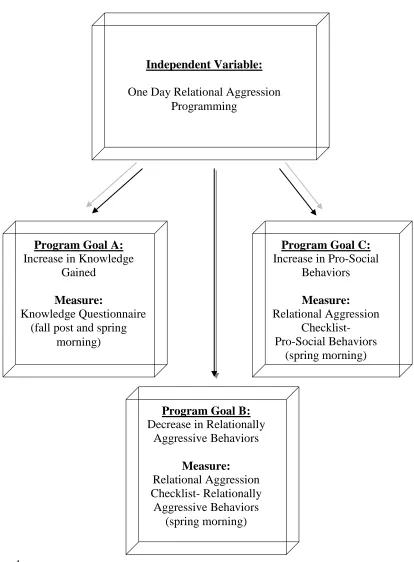
After completion of the preliminary MANOVA, the experimental MANOVA was utilized to examine the independent variable (the one day relational aggression program), in relation to the three criterion variables (the program goals): (a) increased knowledge acquired through the program (i.e., measured by the Knowledge Questionnaire (KQ), (b) decrease in the prevalence of relational aggression (i.e., measured by the aggressive behaviors on the Relational Aggression Checklist), and (c) increase in pro-social skills (i.e., measured by the pro-social behaviors on the Relational Aggression Checklist). The measure used for each program goal and how the measure was quantified for input into the Multivariate MANOVA is described below (See Figure 1 for a visual representation of the information).
Program Goal A: Increase in Knowledge of Relational Aggression. To examine if the program increased the participant‘s knowledge of relational aggression, the subject knowledge of the experimental group and the delayed-control group were compared. The Knowledge Questionnaire of the fall post-assessment and the morning spring assessment was used to examine if the experimental group displayed more knowledge of relational
aggression in comparison to the delayed-control group. The results of the questions on the Knowledge Questionnaire were examined and quantified. The number of correct responses was tallied for each participant and these results were imported into the MANOVA.
relationally aggressive behaviors of the experimental group and the delayed-control group were compared. The Relational Aggression Checklist of the fall post-assessment and of the morning spring assessment was used to examine if the experimental group had participated in less relationally aggressive behaviors in comparison to the delayed-control group. The relationally aggressive behaviors indicated on the Relational Aggression Checklist were tallied for each participant and these results were imported into the MANOVA.
Program Goal C: Increase in Pro-Social Behaviors. To examine if the program had an impact on pro-social skills used by the participants, the pro-social behaviors of the
Figure 1.
Flowchart of Measures Included in Experimental MANOVA Program Goal A:
Increase in Knowledge Gained
Measure:
Knowledge Questionnaire (fall post and spring
morning)
Program Goal B: Decrease in Relationally
Aggressive Behaviors Measure: Relational Aggression Checklist- Relationally Aggressive Behaviors (spring morning)
Program Goal C: Increase in Pro-Social
Behaviors Measure: Relational Aggression Checklist- Pro-Social Behaviors (spring morning) Independent Variable:
CHAPTER FOUR: RESULTS
A Multivariate Analysis of Variance (MANOVA) was used to examine the effect of the independent variable (the one day relational aggression program) on the three criterion variables (the program goals): (a) increased knowledge acquired through the program (i.e., measured by the Knowledge Questionnaire (KQ), (b) decrease in the prevalence of relational aggression (i.e., measured by the aggressive behaviors on the Relational Aggression
Checklist), and (c) increase in pro-social skills (i.e., measured by the pro-social behaviors on the Relational Aggression Checklist).
Data Cleaning
transformation of the variables inferential and descriptive statistics were then re-computed to re-assess for normality. Assumptions of a MANOVA were met.
Upon competition of data cleaning, demographic statistics were calculated for the participants using SPSS. The age range of the participants ranged from 13-15 years old (M= 14.24). The self-identifying racial make-up of the participants constituted 75% White Americans, 11%Biracial Americans, 8% African-American, and 6% Asian. Participants identified their hometown locations as the South Eastern United States (94%, North Carolina, South Carolina, Virginia, Maryland, and Georgia) and Korea (6%) Of the participants in the study 64% were day students, while 36% were boarding students. Preliminary Analysis
Table 1.1
Results of the Preliminary MANOVA Analysis
___ Experimental Delayed-Control
(n=18) (n=18)
Measure M SD M SD F df p RACL
Aggressive Behaviors 5.11 3.08 4.72 4.56 .09 1 .77
RACL
Pro-Social Behaviors 5.94 1.76 5.17 2.20 1.37 1 .25
Experimental Analysis
Results of the Experimental MANOVA indicated significant differences between the experimental and treatment-delayed groups after the intervention, Pillai‘s Trace = .51, F = 8.20, df = (31), p = .001,The univariate F tests showed there was a significant difference between the experimental group and the delayed-control group for the fall Knowledge Questionnaire, F = 31.49, df = (1), p = .001, and for the spring Knowledge Questionnaire, F = 14.58, df = (1), p = .001.
While the univariate F tests showed significance for the both the fall and spring Knowledge Questionnaires, the univariate F tests showed there was not a significant
Table 1.2.
Results of the Experimental MANOVA Analysis
___ Experimental Delayed-Control
(n=18) (n=18)
Measure M SD M SD F df p
Fall Post-Test
Knowledge Questionnaire 5.33 2.40 1.28 1.53 31.49 1 .001
__
Spring Morning Assessment RACL
Aggressive Behaviors 5.72 4.50 5.56 4.64 .18 1 .69 RACL
Pro-Social Behaviors 5.56 2.09 5.06 2.31 .30 1 .60
CHAPTER FIVE: DISCUSSION
In this chapter a summary of the results of the Experimental ANOVA are reviewed individually by program goal and then summarized as a whole. The meaning of these results is then discussed. Implications for both Easton Academy and future research are also
addressed in this chapter, as well as limitations of the study and the program. A conclusion is then presented at the end of the chapter.
Summary of Results
Program Goal A: Increase Participant’s Knowledge of Relational Aggression
The results of the Experimental MANOVA indicated a significant difference between the experimental group and the delayed-control group both at the post-assessment in the fall and the morning assessment in the spring for the Knowledge Questionnaire. The significance found indicates the program successfully increased the participant‘s knowledge of relational aggression, both immediately following the program in the fall and after a ten week period of time passing when assessed in the morning of the spring programming.
Program Goal B: Decrease Relationally Aggressive Behaviors
The results of the Experimental MANOVA did not indicate a significant difference between the experimental group and the delayed-control group at the post-assessment in the morning assessment in the spring for a decrease in relationally aggressive behaviors. The lack of significance found indicates the program did not successfully decrease the
Program Goal C: Increase Pro-Social Behaviors
The results of the Experimental MANOVA did not indicate a significant difference between the experimental group and the delayed-control group at the post-assessment in the morning assessment in the spring for an increase in pro-social behaviors. The lack of
significance found indicates the program did not successfully increase the participant‘s use of pro-social behaviors upon assessment in the morning of the spring programming.
The results of the Experimental MANOVA therefore indicated that while the program successfully increased the experimental group‘s knowledge of relational aggression, the program did not have a significant impact on decreasing relationally aggressive behaviors or increasing the pro-social behaviors of the participants. These findings indicate that the one day relational aggression workshop was effective at increasing the participants knowledge; however was not effective at decreasing the relationally aggressive behaviors of the
participants, or increasing the pro-social behaviors of the participants. Implications for Easton Academy
An option for Easton Academy‘s relational aggression programming is to continue to utilize the literature to create the most effect programming possible at their institution. As relational aggression programming is still new, there is still developing literature that may be able to provide additional resources for school-based programming. One such example of developing literature that may prove useful is Leadbeater (2010). In Leadbeater (2010) a review of community-university research prevention efforts were addressed lending important information for school based relational aggression programming.
The programs identified in the article: (a) WITS, Walk Way, Ignore, Talk, Seek Help), (b) WITS LEADs (WITS Leadership Program-Look and Listen, Explore Points of View, Act, Did it work? Seek Help, and (c) PRASIE (Preventing Relational Aggression in Schools Everyday), focus on the students‘ exposure to learning about relational aggression and strategies to combat it, while also emphasizing that there is a more contextual focus in combating relational aggression. Prior to these programs, the effects of prevention programs on other contextual influences were rarely assessed including family, school, classroom, or neighborhood characteristics that support bullying (Hoglund & Leadbeater, 2004). In more recent prevention programs, however, it has been shown that addressing relational aggression from a contextual perspective has a greater impact on addressing relationally aggressive behaviors and pro-social skills (Leadbeater, 2010).
prevention and education for students, school, parents, and the community alike. Some information on how to approach relational aggression programming from a more contextual perspective is provided by Leadbeater (2010):
Personal targets for the prevention of aggression and victimization need to take into account the sensitivities of young adolescents to the regard of their peers. The
the students showed a great degree of engagement with the program and connected with the information during the program. Upon completion of the one day program, both in the fall and in the spring, the young women and faculty facilitators shared positive feedback with the principal researcher. Both the students and facilitators shared verbally that they felt the program was well executed, important, and enjoyable. Many of the young women provided positive feedback on their program evaluations, as well sharing that they enjoyed the
program and were interested in the possibility of getting involved with the topic themselves in a school based group. For these reasons it could potentially benefit Easton Academy to continue the present programming within the contextual model in an effort to reach the students.
There are, however some modifications of the present program that could potentially serve as more of a benefit to the students. One modification is to reduce the amount of lecture time in the educational piece of the program and to include more interactive skill building activities. Many of the women stated this on their program evaluation sheets and it is important that their voices be heard. As the program showed a significant difference between the groups for increasing the knowledge, but not for any change of the student‘s behaviors, it would be important to try to increase the skill building set. The effort would therefore be to have an impact on the young women‘s behaviors, while keeping their level knowledge increased.
pro-social behaviors it may be more effective to assess the changing of the student‘s behaviors as a result of the combination of the contextual programming, rather than the one day
programming. The one day program goals may therefore be modified to be inclusive of a different set of goals. Much of the program materials aim towards educating the young women to assist them in identifying relational aggression, understanding what relational aggression is and looks like in their lives, allow targets to identify, understand and evaluate their experience, to begin to teach empathy and bystander intervention, and to teach the young women to learn to take responsibility for their actions. The program goals of the one day program may therefore need to be modified to better fit what the aim of the programming resources are.
In addition, although many scholars may doubt the efficacy of a one day program it is imperative to see the benefits of a one day program. Although quantitatively there may not have been significance in the behaviors of the young women, they individually may have experienced something significant within the program. It may therefore be pertinent for Easton Academy, and other schools involved in relational aggression programming and assessment, to include a qualitative piece to the study in order to gain a richer understanding of the young women‘s qualitative experience of the programming.
topic, no rules in place regarding relational aggression, and therefore no clear consequences or interventions from teachers in place. It is therefore imperative to have the faculty and administration of the school trained in relational aggression prevention and intervention. Within the literature it has been found that teachers‘ knowledge, attitudes, and behaviors can be vital to limiting relational aggression in school settings (Yeung & Leadbeater, 2010), and that training for the teachers and administration of the school could reduce relational
victimization, as more knowledgeable teachers may be better equipped to stop victimization (Verlaan and Termel, 2010). In relation to the contextual targets of combating relational aggression, particularly important to Easton Academy and other school based programming, is creating a safe school climate that does not tolerate relationally aggressive behaviors. The relational aggression programming designed to reduce the relationally aggressive behaviors of the students and increase the pro-social skills of the students, therefore, relies upon the training and knowledge of school faculty and administration, as well as the students.
In conclusion, including the parents, faculty, and staff in addition to the students will provide a potentially more effective means of reducing the relational aggressive behaviors present in their school, as well as increasing the pro-social skills of their students. While Easton Academy is taking steps to provide programming to their student‘s on relational aggression, integrating this more contextual perspective on the relational aggression programming may provide a more effective means for the combating the relational aggression within their school. Application of the contextual model, assessment, and
literature of contextual programming to the school‘s efforts would be pertinent next steps for Easton Academy‘s efforts to reduce the problem of relational aggression within their school. Implications for Additional Future Research
While more recent research provides support for the efficacy of contextual approaches to relational aggression programming and intervention, assessment and enhancement of these programs are necessary. Continuous assessment is important to provide consistent feedback and reform the program when necessary. In addition, contexts may also vary by culture and the cultural sensitivity of programs for children from immigrant or aboriginal groups, or from rural or inner city locations, needs to be assessed (Leadbeater & Sukhawathanakul, 2010). As Easton Academy was overall a homogenous population,
extending the program evaluation to different cultures and different settings may provide more insight on the efficacy of the program across diverse populations and contexts.
the Peer Nomination Instrument of Social Behavior (PSNB) for older adolescents (college) there are no measures for adolescents between the grades of 7th -12th. In relation, there is vastly limited research on these ages within the literature of relational aggression. An empirically validated measure of relational aggression is needed for these adolescents and more research needs to be completed for adolescents in these grades.
Another implication from the lack of empirically validated measures is that the peer nomination measures are the only empirically valid measures in the field of relational aggression research. The lack of valid measures is a limitation for all relational aggression research. All of the information in the field is therefore reliant on the peer nomination of the children and adolescents. In terms of limitations of the research in the field this creates a mono-method bias. It is therefore is necessary to develop additional empirically valid measures within the field. In order to properly assess the efficacy of programs, empirically validated measures are needed to ensure the validity of the results of the evaluation. Limitations of the Study
In addition, as there is no peer nomination measure in existence for the age range of the adolescents in the study, the principal researcher chose to utilize the Peer Nomination of Social Behavior (18-23 yr olds) as opposed to the Peer Nomination Instrument (9-11yr olds). The decision on which measure to utilize was based upon the language utilized in the
measures. Using the PSNB instead of the PNI may have served as a limitation to the present study; however as addressed in implications for future research the true limitation is the lack of existence of a measure for the age range of the participants in the present study.
As there are no other existing measures presently used in relational aggression research, other resources were needed to be able to assess the goals of the present study, resulting in the use of measures that had not undergone empirical validation. Although some of the measures were previously used by the school for assessment, the lack of empirical validation of the measures questions the validity of the results of the study in itself.
In addition, generalizability may serve as a threat to external validity of the present study. As the goals of the present study were based on the goals for the specific population at Easton Academy, due to the homogenous nature of the population (predominantly white females ages 13-15 years old from the Southeastern part of the United States attending a private school), the result of the present study may be challenging to generalize to additional populations.
Limitations of the Program
would either be absent due to the weekend, or not fully present due to it being the end of the week. In addition, the fall programming fell on a day that a popular movie came out in which many of the participants had attended the midnight showing. The participants that attended the movie where therefore already fatigued, and some absent during the morning programming. In the spring the programming fell on the Friday prior to the school‘s Spring Break. Due to this timing many students were absent, or left early, due to the upcoming vacation.
Conclusion
The one day relational aggression program proved to be effective in increasing the participant‘s knowledge of relational aggression. It did not prove effective, however, at changing the participant‘s behaviors (i.e., decreasing the participant‘s relationally aggressive behaviors and/or increasing the participant‘s pro-social skills). As more recent research has found that addressing relational aggression from a contextual perspective proves to be a more effective means of combating relational aggression, this contextual perspective should be implemented at Easton Academy, and other schools in need of relational aggression programming.
REFERENCES
Archer, J. and Coyne, S.M. (2005). An integrated review of indirect, relational and social aggression. Personality and Social Psychology Review 9(3), 212-230
Arnett, J.J. (2006). G Stanley Halls Adolescence: Brilliance and nonsense. History of Psychology, 9(3), 186-197. DOI: 10.1037/1093-4510.9.3.186
Bem, S. (1981). Gender schema theory: a cognitive account of sex typing. Psychological Review, 88(4), 354-364.
Björkqvist, K., Lagerspetz, K. M. J. and Kaukiainen, A. (1992). Do girls manipulate and boys fight? Developmental trends in regard to direct and indirect aggression.
Aggressive Behavior, 18, pp. 117–127. doi: 10.1002/10982337(1992)18:2<117::AID-AB2480180205>3.0.CO;2-3
Björkqvist, K. & Niemelä, P. (1992). New trends in the study of female aggression. In K. Björkqvist & P. Niemelä (Eds.), Of mice and women: Aspects of female aggression (3–16). San Diego, CA: Academic Press.
Björkqvist, K. (1994). Sex differences in physical, verbal, and indirect aggression: A review of recent research. Sex Roles, 30, 177–188.
Björkqvist, K. (2001). Different names, same issue. Social Development, 10(2), pp. 272 274.
Braunstein, J.W. (2007). ANOVA and MANOVA in Dissertation & Thesis Research. Retrieved from: http://www.researchconsultation.com/anova-manova-analysis-of-variance-statistics.asp
Cairns, R.B. and Cairns, B.D. (1984). Predicting aggressive patterns in girls and boys: A developmental study. Aggressive Behavior, 11, 227-242.
Cairns, R. B., Cairns, B. D., Neckerman, H. J., Ferguson, L. L., & Gariepy, J. (1989). Growth and aggression: Childhood to early adolescence. Developmental Psychology, 25, 320– 330.
Crick, N. R., & Grotpeter, J.K. (1995). Relational aggression, gender, and social-psychological adjustment. Child Development, 66, 710-762.
Crick, N.R.(1996). The role of overt aggression, relational aggression, and pro-social behavior in the predication of children‘s future social adjustment. Child Development, 67, 1003-1014.
Crick, N.R., Casas, J.F., & Mosher, M. (1997). Relational and overt aggression in preschool. Developmental Psychology, 33, 610-617.
Crick, N. R., & Bigbee, M.A. (1998). Relational and overt forms of victimization: A multiinformant approach. Journal of Counseling and Clinical Psychology, 66, 337-347.
Crick, N.R. et al. (2001). Relational victimization in childhood and adolescence: I hurt you through the grapevine. In J. Juvonen & S. Graham (Ed.), School-based peer
harassment: The plight of the vulnerable and victimized (196-214). New York: Guilford Press.
Nelson, D.A, & Crick, N.R. (2002). Parental psychological control: Implications for childhood physical and relational aggression. In B.K. Barber (Ed.), Intrusive parenting: How psychological control affects children and adolescents (161-189). Washington, D.C: American Psychological Association (APA) Books.
Crick, N.R. & Zahn-Waxler, C. (2003). The development of psychopathology in females and males: Current progress and future challenges. Development and Psychopathology 15(3), pp. 719-742.
Cross, S.E. and Madsen, I. (1997). Models of self: Self-construals and gender. Psychological Bulletin, 122, 5-37.
Crothers, L.M., Field, J.E., & Korbet, J.B. (2005). Navigating power, control, and being nice: Aggression in adolescent girls‘ friendships. Journal of Counseling and Development, 83, 349-354.
Coyne, S.M., Archer,J., & Eslea, M. (2006). We're not friends anymore! Unless…: the frequency and harmfulness of indirect, relational, and social aggression. Aggressive Behavior, 32, Dellasega, C. and Nixon, C. (2003). Girl Wars: 12 Strategies that will end female bullying. New York: Fireside.
Feshbach, N.D. (1964). The function of aggression and the regulation of the aggressive drive. Psychological Review, 71, 257-272.
Feshbach, N. D. (1969). Sex differences in children‘s modes of aggressive responses towards outsiders. Merrill-Palmer Quarterly, 15, 249–258.
Feshbach, N.D. and Feshbach, S. (1969). The relationship between empathy and aggression in two age groups. Developmental Psychology, 4, 381-386.
Galen, B. R. & Underwood, M. K. (1997). A developmental investigation of social aggression among children. Developmental Psychology, 33, 589–600.
Gilligan, C. (2003). The birth of pleasure: A new map of love. New York: Random House. Gomes, M.M. (2007), A concept analysis of relational aggression. Journal of Psychiatric and
Mental Health Nursing, 14, 510–515. doi: 10.1111/j.1365-2850.2007.01120.x
Heppner, P., Wampold, B.E., and Kivilighan, D.M. (2008). Research Design in Counseling. (3rd Ed.). United States : Thompson Brooks/Cole Publishing Company
Hoglund, W. L., & Leadbeater, B. J. (2004). The effects of family, school, and classroom ecologies on changes in children‘s social competence and emotional and behavioral problems in first grade. Developmental Psychology, 40, 533–544.
Lagerspetz, K. M. J., Björkqvist, K., & Peltonen, T. (1988). Is indirect aggression typical of females? Gender differences in aggressiveness in 11- to 12-year-old children. Aggressive Behavior, 14, 403–414.
Leadbeater, B. J., Boone, E. M., Sangster, N. A. and Mathieson, L. C. (2006). Sexdifferences in the personal costs and benefits of relational and physical aggression in high school. Aggressive Behavior, 32, 409–419. doi: 10.1002/ab.20139
Leadbeater, B., Sukhawathanakul, P., & Sklar, N. (2010). Peer victimization in rural and urban communities: Understanding and addressing differences. Manuscript submitted for publication.
Letendre, J. (2007). ―Sugar and spice but not always nice‖: Gender socialization and its impact on development and maintenance of aggression in adolescent girls. Child and Adolescent Social Work Journal, 24(4), 353-368, DOI: 10.1007/s10560-007-0088-7.
Maccoby, E. E. (1998). The two sexes: Growing up apart, coming together. Cambridge, MA: Harvard University Press.
Maltz, D.N. and Borker, R.A. (1982). A cultural approach to male-female
miscommunication. In J.J. Gumperz (Ed.), Language and Social Idenity (195-216). New York: Cambridge University Press.
McKay, C.A. (2003, March/April). Relational aggression in children: The Ophelia project makes a difference. Camping Magazine, 76(2), 24-29.
Merrell, K.W., Buchanan, R., and Tran, O. (2006). Relational aggression in adolescents and children: A review with implications for school settings. Psychology in the Schools, 43(3), DOI: 10.1002/pits.20145.