ISSN: 2319-8753
I
nternational
J
ournal of
I
nnovative
R
esearch in
S
cience,
E
ngineering and
T
echnology
(An ISO 3297: 2007 Certified Organization)
Vol. 3, Issue 11, November 2014
Efficient Hybrid Control of Shell and Tube Heat
Exchanger Using Interval Type-2 and Adaptive
Neuro Fuzzy Based Fuzzy Inference System
Borkar Pravin Kumar
1, Agrawal G.K
2, Qureshi M.F
3,
Jha Manoj
4Department of Mechanical Engineering, Rungta College of Engineering & Technology, Raipur, India1
Department of Mechanical Engineering, Govt. Engineering College, Bilaspur, India2
Department of Electrical Engineering, Govt. Polytechnic Narayanpur, India3
Department of Applied Mathematics, RSR Rungta College of Engineering & Technology, India4
ABSTRACT: In this paper, adaptive network based fuzzy inference system (ANFIS) was used in control applications of a Shell and Tube Heat Exchanger as interval type-2 fuzzy logic controller (IT-2FL). Two adaptive networks based fuzzy inference systems were chosen to design type-2 fuzzy logic controllers for each control applications. The whole integrated system for control of Shell and Tube Heat Exchanger is called IT2 FLC+ANFIS controller. Membership functions in interval type-2 fuzzy logic controllers were set as an area called footprint of uncertainty (FOU), which is limited by two membership functions of adaptive network based fuzzy inference systems; they were upper membership function (UMF) and lower membership function (LMF). This paper deals with the design and application of an IT2 FLC+ANFIS controller for a Shell and Tube heat exchanger. The IT2 FLC+ANFIS controller of the heat exchanger is compared with classical PID control. System behaviors were defined by Lagrange formulation and MATLAB computer simulations. The simulation results confirm that interval type2 fuzzy is one of the promises for successful control of heat exchangers. The advantage of this approach is that it is not a linear-model-based strategy. Comparison of the simulation results obtained using IT2 FLC+ANFIS controller and those obtained using classical PID control demonstrates the effectiveness and proves its simplicity and superiority over the conventional PID controller.
KEYWORDS: Adaptive network based fuzzy inference system, interval type-2 fuzzy controller, Shell and Tube Heat Exchanger, control simulation
I. INTRODUCTION
The ANFIS is a cross between an artificial neural network and an interval type2 fuzzy inference system (IT2FIS) and represents Takagi-Sugeno fuzzy model as generalized feed forward neural network, and trains it with Shell and Tube Heat Exchanger I/O data, thereby adjusting the parameters of the antecedent membership functions as well as those of the functional consequents. A procedure for designing adaptive type-2 FLCs has been developed. An ANFIS (Adaptive Neuro Fuzzy Inference System) technique is used to reduce the computational load of adaptive type-2 FLCs without losing the control efficiency. In fact the use of an ANFIS technique allows to decrease the number of the FLC rules needed to achieve a good control, reducing the computational load, making the controller more flexible and guaranteeing a high performance.
ISSN: 2319-8753
I
nternational
J
ournal of
I
nnovative
R
esearch in
S
cience,
E
ngineering and
T
echnology
(An ISO 3297: 2007 Certified Organization)
Vol. 3, Issue 11, November 2014
DOI: 10.15680/IJIRSET.2014.0311063
II. MODEL OF HEAT EXCHANGER
A typical interacting chemical process for heating consists of a chemical reactor and a shell and tube heat exchanger system. The process fluid which is the output of the chemical reactor is stored in the storage tank. The process fluid considered in this case is water. The storage tank supplies the fluid to the shell and tube heat exchanger system. The heat exchanger heats up the fluid to a desired set point using super heated steam supplied from the boiler. The storage tank supplies the process fluid to the heat exchanger system using a pump and a non returning valve. The super heated steam or hot water comes from the boiler and flows through the tubes, whereas, the process fluid flows through the shells of the shell and tube heat exchanger system. Different assumptions have been considered. The first assumption is that the inflow and the outflow rate of fluid are same, so that the fluid level is maintained constant in the heat exchanger. The second assumption is the heat storage capacity of the insulating wall is negligible. In this feedback process control loop, the controller is reverse acting; the valve used is of air to open (fail-close) type. A thermocouple is used as the sensing element which is implemented in the feedback path of the control architecture. The temperature of the outgoing fluid is measured by the thermocouple and the output of the thermocouple (voltage) is sent to the transmitter which eventually converts the temperature output to a standardized signal in the range of 4-20 mA. This output of the transmitter unit is given to the controller unit. In this heat exchanger system a PID controller has been taken as the controlling unit.
The PID controller implements the control algorithm, compares the output with the set point and then gives necessary command to the final control element via the actuator unit. The actuator unit is a current to pressure converter and the final control unit is an air to open (fail close) valve. The actuator unit takes the controller output in the range of 4-20 mA and converts it in to a standardized pressure unit, i.e. in the range of 3-15 psig. The valve actuates according to the controller decisions.
There can be two types of disturbances in this process, one is the flow variation of input fluid and the second is the temperature variation of input fluid. But in practice the temperature variation of input fluid is a more prominent disturbance than the flow variation in input fluid. So, in only temperature disturbance has been considered. The output of the feedback controller is given to the control valve. We have developed a block diagram shown in figure 1 of these control loops and modeled the heat exchanger system, actuator, valve, sensor using the experimental data available. The transfer function model of the individual systems are generated which in turn combined to acquire the transfer function of the whole system.
Fig.1 Modeling of heat exchanger system.
Experimental data has been used to find out the transfer function of each block and different controllers are used for controlling this system these are describing in below.
Experimental Data
ISSN: 2319-8753
I
nternational
J
ournal of
I
nnovative
R
esearch in
S
cience,
E
ngineering and
T
echnology
(An ISO 3297: 2007 Certified Organization)
Vol. 3, Issue 11, November 2014
Exchanger response to the flow gain = 50o C /(kg/sec)
Time constant = 30 sec
Exchanger response to variation of process fluid flow gain = 3o C/Kg/sec
Exchanger response to variation of process temperature gain = 1o C /Kg/sec
Control valve has capacity = 1.6 kg/sec of steam
Time constant of the control valve = 3 sec
The range of sensor = 50o C to 150o C
Time constant of sensor = 10 sec
Transfer function of disturbance variables (Temperature disturbances)
Transfer function of the Process 50 30𝑠 + 1
Gain of the Valve 0.133
Transfer function of the Valve 0.0009975 30𝑠 + 1
Gain of I to P Converter 0.75
Disturbance Variables 1 30𝑠 + 1, 3 30𝑠 + 1
Critical Gain KC
Transfer function of the Sensor 0.16 10𝑠 + 1,
III. INTERVAL TYPE-2 FUZZY DYNAMIC MODEL OF HEAT EXCHANGER
Concept of Interval type-2 fuzzy sets
An interval type-2 fuzzy set (IT2 FS) 𝐴 is characterized as (Castillo et al 2008; Galluzzo et al 2008):
𝐴 = 𝑢𝜖 𝐽 1 𝑥, 𝑢
𝑥⊆[0,1]
𝑥𝜖𝑋 = 𝑥𝜖𝑋 𝑢𝜖 𝐽𝑥⊆[0,1]1 𝑢 𝑥 (1)
Where x, the primary variable, has domain X; u ε U , the secondary variable, has domain 𝐽𝑥 at each 𝑥 ∈ 𝑋 ; 𝐽𝑥
is called the primary membership of x and is defined in (5); and, the secondary grades of 𝐴 all equal 1. Note that (1)
means: 𝐴 : 𝑋 → 𝑎, 𝑏 : 0 ≤ 𝑎 ≤ 𝑏 ≤ 1 . Uncertainty about 𝐴 is conveyed by the union of all the primary
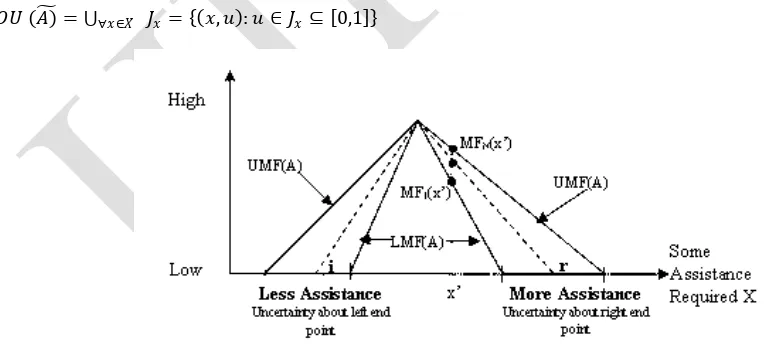
memberships, which is called the footprint of Uncertainty (FOU) of 𝐴 (see Fig.2), i.e.
𝐹𝑂𝑈 (𝐴) = ∀𝑥∈𝑋 𝐽𝑥= 𝑥, 𝑢 : 𝑢 ∈ 𝐽𝑥⊆ 0,1 (2)
ISSN: 2319-8753
I
nternational
J
ournal of
I
nnovative
R
esearch in
S
cience,
E
ngineering and
T
echnology
(An ISO 3297: 2007 Certified Organization)
Vol. 3, Issue 11, November 2014
DOI: 10.15680/IJIRSET.2014.0311063
The upper membership function (UMF) and lower membership function (LMF) of 𝐴 are two type-1 MFs
that bound the FOU (Fig.2). The UMF is associated with the upper bound of FOU (𝐴 ) and is denoted 𝜇 𝐴 𝑥 , ∀𝑥 ∈ 𝑋,
and the LMF is associated with the lower bound of FOU (𝐴 ) and is denoted 𝜇𝐴 𝑥 , ∀ 𝑥 ∈ 𝑋, 𝑖. 𝑒.
𝜇 𝐴 𝑥 ≡ 𝐹𝑂𝑈(𝐴) ∀ 𝑥 ∈ 𝑋 (3)
𝜇𝐴 𝑥 ≡ 𝐹𝑂𝑈(𝐴 ) ∀ 𝑥 ∈ 𝑋 (4)
Note that 𝐽𝑥 is an interval set, i.e.
𝐽𝑥 = 𝑥, 𝑢 : 𝑢 ∈ 𝜇𝐴 𝑥 , 𝜇 𝐴 𝑥 (5)
So that FOU(𝐴) in (2) can also be expressed as
𝐹𝑂𝑈 (𝐴) = ∀𝑥∈𝑋 𝜇𝐴 𝑥 , 𝜇 𝐴 𝑥 (6)
An interval type-2 fuzzy logic system (IT2 FLS), which is a FLS that uses at least one IT2 FS, contains five components—fuzzifier, rules, inference engine, type-reducer and defuzzifier- that are inter-connected, as shown in Fig. 3. The IT2 FLS can be viewed as a mapping from inputs to outputs (the path in Fig. 3, from
―Crisp Inputs‖ to ―Crisp Outputs‖), and this mapping can be expressed quantitatively as Y = f (x). This IT2
FLS is finding its way into many engineering applications, and is also known as interval type-2 fuzzy logic controller (IT2 FLC) (Hagras, 2007), interval type -2 fuzzy expert system, or interval type-2 fuzzy model.
Fig..3 Type-2 Fuzzy logic system.
The inputs to the IT2 FLS prior to fuzzification may be certain (e.g., perfect measurements) or uncertain
(e.g., noisy measurements). T1 or IT2 FSs can be used to model the latter measurements.
The IT2 FLS works as follows: the crisp inputs are first fuzzified into either type -0 (known as singleton
fuzzification), type-1 or IT2 FSs, which then activate the inference engine and the rule base to produce output IT2 FSs. These IT2 FSs are then processed by a type-reducer (which combines the output sets and then performs a centroid calculation), leading to an interval T1 FS called the type-reduced set. A defuzzifier then defuzzifies the type-reduced set to produce crisp outputs. Rules are the heart of a FLS, and may be provided by experts or can be extracted from numerical data. In either case, rules can be expressed as a collection of IF– THEN statements.
We assume there are M rules where the ith rule has the form
Ri: IF x1 is F 1i and xp is F pi , THEN y is Gi i = 1, … , M (7)
This rule represents a T2 relation between the input space, X1× … ×Xp, and the output space, Y, of the
ISSN: 2319-8753
I
nternational
J
ournal of
I
nnovative
R
esearch in
S
cience,
E
ngineering and
T
echnology
(An ISO 3297: 2007 Certified Organization)
Vol. 3, Issue 11, November 2014
Associated with the p antecedent IT2 FSs, 𝐹𝑘𝑖, 𝑎𝑟𝑒 𝑡ℎ𝑒 𝐼𝑇2 𝑀𝐹𝑠 𝜇𝐹
𝑘𝑖 𝑥𝑘 (k=1,…,p), and associated
with the consequent IT2 FS 𝐺 𝑖 is its IT2 MF 𝜇
𝐺 𝑦 .
The major result for an interval singleton T2 FLS, i.e. an IT2 FLS in which inputs are modeled as perfect measurements (type-0 FSs) is summarized in the following:
The ANFIS is a fuzzy Sugeno model put in the framework of adaptive systems to facilitate learning and adaptation (Jang, 1993; Zhang et al 2004). Such framework makes the ANFIS control more systematic and less reliant on expert knowledge. To present the ANFIS architecture, two fuzzy IF-THEN rules based on a first order Sugeno model are considered:
Rule 1: If (x is A1) and (y is B1) then (f1 = p1x + q1y + r1). Rule 2: If (x is A2) and (y is B2) then (f2 = p2x + q2y + r2).
Where x and y are the inputs, Ai and Bi are the fuzzy sets, fi is the outputs within the fuzzy region specified by the fuzzy rule, pi, qi and ri are the design parameters that are determined during the training process (Widrow et al. 1985). The proposed ANFIS model combined the neural network adaptive capabilities and the fuzzy logic qualitative approach (Zadeh, 1989). Intelligent systems based on fuzzy logic are fundamental tools for nonlinear complex system control. Type-2 fuzzy sets are used to control uncertainty and imprecision in a better way. These type-2 fuzzy sets were originally presented by Zadeh (1975) and are essentially ―fuzzy fuzzy‖ sets where the fuzzy degree of membership is a type-1 fuzzy set (Zadeh, 1989). The new concepts were introduced by Liang and Mendel allowing the characterization of a type-2 fuzzy set with a superior membership function and an inferior membership function; these two functions can be represented each one by a type-1 fuzzy set membership function. The interval between these two functions represents the footprint of uncertainty (FOU), which is used to characterize a type 2 fuzzy set shown in Fig.2.
Structure of interval type-2 fuzzy logic inference system was given in Fig.2. After all these instructions about
ANFIS and interval type-2 fuzzy inference systems, ANFIS controllers were used in control applications, then IT2-FL controllers were built according to performances of ANFIS controllers over the double inverted pendulum, a single flexible link and flexible link carrying pendulum systems. Realization phases of this study were given in Fig.4.
Defuzzification process
Once the fuzzy controller is activated, the rule evaluation is performed and all the rules which are true are fired. Utilizing the true output membership functions, the defuzzification is then applied to determine a crisp control action. The defuzzification is to transform the control signal into an exact control output. For the Sugeno-style
inference, we have to choose between wtaver (weighted average) or wtsum (weighted sum) defuzzification method. In the
defuzzification process of the adaptive network based fuzzy logic controller, the method of weighted average (wtaver) is
used:
Overall Output O5 = u
i i
i i i
w
z
w
(8)
In this study, adaptive networks based fuzzy inference system (ANFIS) controller was designed and applied to Heat Exchanger. ANFIS controller was used for control of Heat Exchanger with interval type-2 membership functions and definite number of rule bases. Moreover this ANFIS controller was combined to create an interval type-2 fuzzy logic controller. Eventually an interval type-2 fuzzy logic controller was obtained for proposed Heat Exchanger by using adaptive network based fuzzy inference system.
In this paper, the forward hybrid learning algorithm is used for the neural network part of the ANFIS controller. The continuous interval type-2 fuzzy dynamic model, proposed by (Liang et al 2000) is described by interval type-2 fuzzy if-then rules. It can be seen as a combination of linguistic modeling and mathematical regression, in the sense that the antecedents describe interval type-2 fuzzy regions in the input space in which consequent functions are
valid. The ith rule is of the following form (Song-Shyong et al 2007). Plant Rule i:
ISSN: 2319-8753
I
nternational
J
ournal of
I
nnovative
R
esearch in
S
cience,
E
ngineering and
T
echnology
(An ISO 3297: 2007 Certified Organization)
Vol. 3, Issue 11, November 2014
DOI: 10.15680/IJIRSET.2014.0311063 Where x(t)=[x1(t), x2(t), ..., xn(t)]
T∈
Rn is the state vector, u(t) = [u1(t), u2(t), ..., um(t)] ∈ R m
is the control input, y(t) = [y1(t), y2(t), ..., yp(t)]T∈ RP is the controlled output, Mij are interval type-2 fuzzy sets, z(t)=[z1(t), z2(t), ..., zs(t)] are the premise parameters, Ai ∈ Rnxn is the state transition matrix, Bi∈ Rnxm is input matrix, Ci ∈ Rpxn is output matrix. Let us use product as t- norm operator of the antecedent part of rules and the center of mass method for defuzzification. The final output of the interval type-2 fuzzy system is inferred as follows (Goodwin et al1984; Song-Shyong et al 2007):
𝑥 𝑡 = 𝜇 𝑖 𝑧 𝑡 𝐴 𝑖 𝑥 𝑡 +𝐵𝑖 𝑢 𝑡 𝑁 𝑖=1 𝜇𝑖 𝑁 𝑖=1 𝑧 𝑡
= 𝑁𝑖=1ℎ𝑖 𝑧 𝑡 𝐴𝑖 𝑥 𝑡 + 𝐵𝑖 𝑢 𝑡 (9) 𝑦 𝑡 = 𝑁𝑖=1𝜇𝑖 𝑧 𝑡 𝐶𝑖 𝑥 𝑡
𝜇𝑖 𝑁 𝑖=1 𝑧 𝑡
= 𝑁𝑖=1ℎ𝑖 𝑧 𝑡 𝐶𝑖 𝑥 𝑡 (10)
Where, ℎ𝑖 𝑧 𝑡 = 𝜇𝑖 𝑧 𝑡 𝜇𝑖 𝑧 𝑡 𝑁 𝑖=1 (11) 𝜇𝑖 𝑧 𝑡 = 𝑀𝑖 ` 𝑗 𝑠
𝑗 =1 𝑧𝑗 𝑡 (12) ℎ𝑖 𝑧 𝑡 = 1
𝑁
𝑖=1 (13)
ANFIS
A Takagi-Sugeno (1985) fuzzy system may be presented in the form of a neural network structure. This form is called ANFIS (Adaptive Neuro Fuzzy Inference System) (Jang, 1993). The main advantage of the ANFIS technique
is the construction of an input-output mapping based on both human knowledge (in the form of fuzzy if-thenrules) and
stipulated input-output data pairs.Type-2 fuzzy controller optimization
𝑂𝑖1= 𝐹𝑂𝑈 𝐴 = 𝑈𝑥∈𝑋 𝜇 𝐴 𝑖 𝑥 , 𝜇𝐴 𝑖 𝑥 (14) Where,
𝜇𝐴 𝑖 𝑥 = 𝐹𝑂𝑈 𝐴 , 𝜇 𝐴 𝑖 𝑥 = 𝐹𝑂𝑈 𝐴 , 𝜇𝐵 𝑖 𝑥 = 𝐹𝑂𝑈 𝐵 and 𝜇 𝐵𝑖 𝑥 = 𝐹𝑂𝑈 𝐵
𝑂𝑖2= 𝑊𝑖= 𝜇 𝐴 𝑖 𝑥1 , 𝜇𝐴 𝑖 𝑥1 × 𝜇 𝐵 𝑖 𝑥2 , 𝜇𝐵𝑖 𝑥2 (15) 𝑂𝑖3= 𝑊𝑖=
𝑊𝑖 𝑊𝑗
4 𝑗 =1
(16)
Rule Reduction Technique usingAdaptive interval type-2 fuzzy logic controller
The use of a large number of rules in a fuzzy logic controller makes the control system more accurate and precise, providing a high performance, but increases the computational load of the processor. The reduction of the rule number of adaptive interval type-2 fuzzy controllers is possible through the ANFIS optimization technique that uses as inputs a type-1 fuzzy controller with a large number of rules and the error and the integral of the error. In the proposed optimization method, the inputs and the outputs of a type-1 fuzzy controller with a 49 rule base constitute the training data for the adaptive network-based fuzzy inference system (ANFIS). The training paradigm uses a gradient descent and a least squares algorithm to optimize the antecedent and the consequent parameters respectively. This allows obtaining a new fuzzy system with a rule base made up of only three rules Fig. 4(a) but with the same high control performance of the original fuzzy controller. The optimized type-1 fuzzy system, with first order Sugeno inference, represents the new type-1 fuzzy controller and takes the place of the previous type-1 fuzzy controller with 49 rules.
ISSN: 2319-8753
I
nternational
J
ournal of
I
nnovative
R
esearch in
S
cience,
E
ngineering and
T
echnology
(An ISO 3297: 2007 Certified Organization)
Vol. 3, Issue 11, November 2014
The procedure to tune the type-2 fuzzy controller starts with type-1 fuzzy sets because it is not possible to apply the ANFIS directly to a type-2 fuzzy system (Mendel, 2001). The new optimized type-1 fuzzy system obtained with ANFIS is therefore used to initialize the parameters of the new type-2 fuzzy system. The center of type-2 Gaussian membership functions is the same of that of type-1 Gaussian membership functions, while the amplitude values for the external (upper) and internal (lower) membership functions of type-2 fuzzy sets are instead chosen minimizing the integral of absolute error (iae). In addition each amplitude value of a type-1 fuzzy Gaussian membership function is the average of the amplitude values of the lower and upper type-2 fuzzy Gaussian membership functions (Fig. 4b). This new optimized type-2 fuzzy system, with first order Sugeno inference, constitutes the new type-2 fuzzy controller with only 3 rules.
The output scaling factor (SF) of the main fuzzy controller is periodically updated online by the fuzzy rules of a secondary fuzzy controller, according to the current trend of the controlled process. The interval type-2 adaptive fuzzy logic controller used here, is characterized by a normal interval type-2 fuzzy controller with 3 rules and by an adaptive mechanism, constituted by a interval type-1 fuzzy controller with 2 rules.
The control variable generated by the type-2 fuzzy logic controller u‘(t) multiplied by the scaling factor K is updated, with the product operator, by the signal that comes from the adaptive type-1 fuzzy controller K1u‘‘. The resulting signal u(t) is then sent to the plant, characterized by time-variant parameters Fig. 5. The error (e) and the integral of the error (int e) are, also in this case, the inputs of the two fuzzy controllers (the main and the adaptive).
Fig.5 Block diagram of the adaptive type-2 fuzzy logic controller
III. SIMULATIONS RESULTS
Consider two heat exchangers shown in Fig.6. The measured and controlled output is temperature from second exchanger. The control objective is to keep the temperature of the output stream close to a desired value 343 K or input it is 1 pu. The control signal is input temperature of hot water. Assume ideal condition for hot water with zero heat losses. We neglect accumulation ability of exchanger‘s walls. Hold-ups of exchanger as well as flow rates and liquid specific heat capacity are constant.
ISSN: 2319-8753
I
nternational
J
ournal of
I
nnovative
R
esearch in
S
cience,
E
ngineering and
T
echnology
(An ISO 3297: 2007 Certified Organization)
Vol. 3, Issue 11, November 2014
DOI: 10.15680/IJIRSET.2014.0311063
To obtain the two shell system proposed in fig. 6, the process transfer function disused is considered twice.
PID Controller for Two Shell heat exchanger Temperature control
The Characteristic equation (1+ G(s)* H(s) = 0) in this case is obtained as below.
900s3 + 420s2 + 43s + 0.798Kc + 1 = 0 (17)
Applying Routh stability criterion in eq. (18) gives Kc = 23.8.
Auxiliary equation
420s2 + 0.798Kc + 1 = 0 (18)
From eq. (19)
ω = 0.218 and T = 28.79 The equation of PID controller is
𝑐 𝑡 = 𝑐𝑜+ 𝐾𝑐 𝑒 𝑡 + 1
𝑡𝑖 𝑒 𝑡 + 𝑡𝑑 𝑡
0
𝑑𝑒 (𝑡)
𝑑𝑡 (19)
According to Zeigler-Nichols tuning criteria; Kp=0.6Kc, Ti=0.5T and Td=0.125T.
For the PID controller in the heat exchanger, the values of tuning parameters are obtained as Kp=14.28, Ti=14.395, Td=3.59, P= Kc = 23.8 I= Kc/Ti = 0.99 D= Kc*Td= 85.446 For the PID controller in the heat exchanger, the values of tuning parameters obtained are
Kp=14.28, τi=14.395, τd=3.59 and P= 23.8, I= 1.65, D=85.442. Hence the gain values obtained for Zeigler-Nichols PID controller are
Kp= 14.66, Kc = 14.41 and Kd = 3.60.
By using the relationship between Zeigler-Nichols PID controller and Cohen-Coon PID controller the gain values of Cohen-Coon PID controller are obtained as Kp= 17.136, Kc = 17.274 and Kd = 5.758. The complete simulation model for the two shell heat exchanger outlet temperature (Tco) control with respect to change in temperature of hot water at the inlet (Thi) using the two PID controllers with their obtained gain values is shown in fig.7.
Fig.7 Complete simulation model for the two shell heat exchanger outlet temperature (Tco) control using PID controllers.
ISSN: 2319-8753
I
nternational
J
ournal of
I
nnovative
R
esearch in
S
cience,
E
ngineering and
T
echnology
(An ISO 3297: 2007 Certified Organization)
Vol. 3, Issue 11, November 2014
This section deals with the development of a hybried proposed controller with development of ANFIS controller followed by IT2 FLC based controller.
IT2 Fuzzy Logic Controller
Interval type 2 fuzzy has the great ability to overcome the demarits of type 1 fuzzy logic. So in this subsection presents a detailed description of the developed IT2 fuzzy logic controler. During the development of interval type 2 fuzzy controller error and rate of change of error are considered as two input variables and the controller output is named as type2op. the membership function plots of all the two input variables and one out put variable are shown in fig.8(a),8(b),8(c) respectively .
.
.
Layout of the developed IT2 Fuzzy logic controller is shown in fig. 9, surface plot is shown in fig.10 and rule base developed for the IT2 fuzzy logic controller are shown infig.11 .
Fig.8(a) Membership functions of first input variable ‗error‘.
Fig.8(b) Membership functions of second input variable ‗rate of change of error‘
Fig.8(c) Membership functions of output variable ‗type2op‘
ISSN: 2319-8753
I
nternational
J
ournal of
I
nnovative
R
esearch in
S
cience,
E
ngineering and
T
echnology
(An ISO 3297: 2007 Certified Organization)
Vol. 3, Issue 11, November 2014
DOI: 10.15680/IJIRSET.2014.0311063
Adaptive Neuro Fuzzy controller for Proposed IT2 FLC + ANFIS Controller
This subsection deals with the devevelopment of adaptive neuro fuzzy controller to make a hybrid configuration with developed IT2 FLC controller. for the development of proposed ANFIS controller 72 input and target points have been taken as given in table 1.
The layout and membeship functions of the developed ANFIS controller after sucessful training and testing are shown in fig.12 and fig.13.
Fig.12 Layout of the developed ANFIS controller Fig.13 Input membership plot of Developed ANFIS Controller
Table.1: Input and targets for the development of ANFIS Controller
S. No. Inputs for ANFIS Targets of ANFIS S. No. Inputs for ANFIS Targets of ANFIS
1 0.16 1.60E-08 37 2.56E-05 6.40E-08
2 0.16 1.60E-08 38 1.73E-05 6.40E-08
3 0.16 1.60E-08 39 1.17E-05 6.40E-08
4 0.16 1.60E-08 40 8.43E-06 6.40E-08
5 0.15999999 1.60E-08 41 6.36E-06 6.40E-08
6 0.159999738 1.61E-08 42 4.68E-06 6.40E-08
7 0.159993477 1.63E-08 43 3.17E-06 6.40E-08
8 0.159841321 1.72E-08 44 2.02E-06 6.40E-08
0 0.02 0.04 0.06 0.08 0.1 0.12 0.14 0.16
0 0.2 0.4 0.6 0.8 1
input1
D
e
g
re
e
o
f
m
e
m
b
e
rs
h
ip
in1mf1 in1mf2 in1mf3
Fig.10 Surface plot of the developed IT2 Fuzzy logic controller.
ISSN: 2319-8753
I
nternational
J
ournal of
I
nnovative
R
esearch in
S
cience,
E
ngineering and
T
echnology
(An ISO 3297: 2007 Certified Organization)
Vol. 3, Issue 11, November 2014
9 0.157638552 2.08E-08 45 1.31E-06 6.40E-08
10 0.149575658 2.64E-08 46 8.87E-07 6.40E-08
11 0.133613236 3.29E-08 47 6.06E-07 6.40E-08
12 0.110905038 3.98E-08 48 3.56E-07 6.40E-08
13 0.084740314 4.62E-08 49 1.36E-07 6.40E-08
14 0.058907043 5.20E-08 50 2.78E-17 6.40E-08
15 0.039952463 5.59E-08 51 0 6.40E-08
16 0.026921925 5.86E-08 52 0 6.40E-08
17 0.018088946 6.04E-08 53 -2.78E-17 6.40E-08
18 0.012138242 6.16E-08 54 -7.13E-08 6.40E-08
19 0.009083672 6.22E-08 55 -1.30E-07 6.40E-08
20 0.006796617 6.26E-08 56 -1.87E-07 6.40E-08
21 0.004816733 6.30E-08 57 -2.37E-07 6.40E-08
22 0.003291366 6.33E-08 58 -2.72E-07 6.40E-08
23 0.002324179 6.35E-08 59 -2.85E-07 6.40E-08
24 0.001737948 6.37E-08 60 -2.95E-07 6.40E-08
25 0.001318329 6.37E-08 61 -3.09E-07 6.40E-08
26 0.00095858 6.38E-08 62 -3.28E-07 6.40E-08
27 0.000658051 6.39E-08 63 -3.41E-07 6.40E-08
28 0.000451439 6.39E-08 64 -3.35E-07 6.40E-08
29 0.000328881 6.39E-08 65 -3.26E-07 6.40E-08
30 0.000250005 6.39E-08 66 -3.26E-07 6.40E-08
31 0.000186608 6.40E-08 67 -3.35E-07 6.40E-08
32 0.000130969 6.40E-08 68 -3.51E-07 6.40E-08
33 8.84E-05 6.40E-08 69 -3.50E-07 6.40E-08
34 6.22E-05 6.40E-08 70 -3.36E-07 6.40E-08
35 4.66E-05 6.40E-08 71 -3.30E-07 6.40E-08
36 3.54E-05 6.40E-08 72 -3.33E-07 6.40E-08
Fig.14 Rules developed for ANFIS Controller Fig.15 Plot of Training data for ANFIS
ISSN: 2319-8753
I
nternational
J
ournal of
I
nnovative
R
esearch in
S
cience,
E
ngineering and
T
echnology
(An ISO 3297: 2007 Certified Organization)
Vol. 3, Issue 11, November 2014
DOI: 10.15680/IJIRSET.2014.0311063
Fig.18 Structure of developed ANFIS Controller
Similarily the other plots which shows the characteristics of developed ANFIS are shown. Fig.14 shows rules developed for ANFIS Controller, Fig.15 shows plot of training data for ANFIS, training error obtaioned shown in fig.16, and testing error is shown in fig.17 for ANFIS controller.
In the previous section two simulation models have been successfully implemented in MATLAB R2012 b for two shell heat exchanger outlet temperature (Tco) control with respect to change in temperature of hot water at the inlet (Thi) using the two PID controllers and proposed IT2 FLC+ANFIS controller.This section elaborate the results obtained from PID and proposed controllers. The basic aim is to control the transfer of temperature from hot water whose temperature is Thi, to the cold water coming out from outlet of second shell heat exchanger with temperature Tco. For the testing of this transfer processes a unit step input is used as Thi is used hence the output response Tco termed as unit step response. Fig.19 and Fig.20 shows the controlled output Tco for unit step input Thi for the two PID controllers.
Fig.16 Plot of Training error for ANFIS Controller
ISSN: 2319-8753
I
nternational
J
ournal of
I
nnovative
R
esearch in
S
cience,
E
ngineering and
T
echnology
(An ISO 3297: 2007 Certified Organization)
Vol. 3, Issue 11, November 2014
Fig.21 shows the efficient control of output temperature Tco using the developed IT2 FLC + ANFIS controller and fig.22 shows the comparison of PID and developed IT2 FLC + ANFIS controller.
Fig.21 Plot of Tco for IT2 FLC + ANFIS controller.
0 20 40 60 80 100 120 140 160 180 200
0 1 2 3 4 5 6
Time In Sec
Tc o i n d e g re e K
Tco Output of Zeigler-Nichols Discrete PID Controller
Set Point
Zeigler-Nichols Discrete PID Controller
0 20 40 60 80 100 120 140 160 180 200
-1 0 1 2 3 4 5 6 7 8
Time In Sec
Tc o i n d e g re e K
Tco Output of Cohen-Coon Discrete PID Controller
Set Point
Cohen-Coon Discrete PID Controller
0 20 40 60 80 100 120 140 160 180 200
0 0.2 0.4 0.6 0.8 1 1.2 1.4
Time In Sec
Tc o in d eg re e K
Tco Output of IT2 FLC + ANFIS controller
IT2 FLC + ANFIS controller Set Point
0 20 40 60 80 100 120 140 160 180 200
-1 0 1 2 3 4 5 6 7 8
Time In Sec
Tc o in d eg re e K
Tco Output of IT2 FLC + ANFIS, Zeigler-Nichols and Cohen-Coon Discrete PID Controller
IT2 FLC + ANFIS controller Set Point
Zeigler-Nichols Discrete PID Controller Cohen-Coon Discrete PID Controller
Fig.19 Plot of Tco for Zeigler Nichols Discrete PID Controller.
ISSN: 2319-8753
I
nternational
J
ournal of
I
nnovative
R
esearch in
S
cience,
E
ngineering and
T
echnology
(An ISO 3297: 2007 Certified Organization)
Vol. 3, Issue 11, November 2014
DOI: 10.15680/IJIRSET.2014.0311063
Fig.22 Plot of Tco for comparison of PID and developed IT2 FLC + ANFIS controller.
V. DISCUSSION
The comparison of the two types of controllers (IT2 FS+ANFIS & PDI) was made using iae and ise criteria described below:
Integrated absolute error = iae = |𝑒|𝑑𝑡0𝑇 (20)
Integrated square error = ise = |𝑒0𝑇 2| 𝑑𝑡 (21)
The simulation results were compared also using integral quality criteria ise (integrated squared error)
and iae (integrated absolute error) (Ogunnaike and Ray, 1994). Fig.19 shows plot of Tco for Zeigler Nichols Discrete
PID Controller in which over shoot of five pu and above and settling time is beyond 200 second. Fig. 20 shows plot of Tco for Cohen Coon Discrete PID Controller in this controller the overshoot is eight pu and settling time is more than 200 second, overshoot is more than Zeigler Nichols Discrete PID Controller. Fig.21 shows plot of Tco for IT2 FLC + ANFIS controller which shows better results, there is no overshoot and settling time is also less i.e. nearly 143 second. Comparison is shown in fig.22.The results are compared in Table 3.
Table 3: Comparison of Results of iae and ise of IT2 FLC+ANFIS controller and PID Controllers Type of controllers Set-point tracking With Disturbance (In Temperature)
iae ise
IT2 FLC+ANFIS controller 6.391 0.608
PID Cohen-Coon 89.61 64.21
PID Ziegler-Nichols 54.67 22.6
The described controllers were compared using iae and ise criteria. The iae and ise values are given in Table 3. Used
IT2 FS+ANFIS controller is simple, and it offers the smallest values iae and ise.
VI. CONCLUSIONS
The Takagi-Sugeno fuzzy model is employed to approximate the nonlinear model of the controlled Heat Exchanger. An IT2 FS+ANFIS controller is developed to assure the stability of neuro-fuzzy model and neuro-fuzzy control system for the heat exchanger. As discussed the overshoot is minimized and settling time is also reduced to 143 second.
The union of the ANFIS optimization method and the adaptive fuzzy algorithm operating on the output scaling factor, allows to obtain a IT2 FS+ANFIS control able to minimize all the negative effects of parameter changes (step or ramp disturbances) achieving a very high control performance with a minimum computational load.
Simulation results shows that the IT2 FS+ANFIS control approach is robust and exhibits a superior performance to that of established traditional PID control methods. Set point tracking comparison using iae and ise values shows that the hybrid controller IT2 FLC+ANFIS controller shows smallest value of iae = 6.391 and ise = 0.608, it proves its simplicity and superiority over the conventional PID controller.
REFERENCES
[1] Castillo O., Aguilar L.T., Cazarez-Castro N.R. and Cardenas S., ―Systematic design of a stable type-2 fuzzy logic controller‖, Journal of Applied Soft Computing, Information and Control, Vol. 8, pp. 1274-1279, 2008.
[2] Galluzzo M., Cosenza B. and Matharu A., ―Control of a Nonlinear Continuous Bioreactor with Bifurcation by a Type-2 Fuzzy Logic Controller‖, Computers and Chemical Engineering, Vol. 32, pp. 2986-2993, 2008.
[3] Hagras H., ―Type-2 FLCs: ―A New Generation of Fuzzy Controllers‖, Computational Intelligence Magazine, IEEE, Vol. 2, No. 1, pp. 30–43, 2007.
[4] Mendel J. M., ―Uncertain rule-based fuzzy logic system: Introduction and new directions‖, Prentice-Hall, Englewood Cliffs, NJ. 2001, [5] Dugdale D. and Wen P., ―Controller optimization of a tube heat exchanger‖, Proc. 4th World Congress on Intelligent Control and Automation,
Shangai, China, 54-58, 2002.
ISSN: 2319-8753
I
nternational
J
ournal of
I
nnovative
R
esearch in
S
cience,
E
ngineering and
T
echnology
(An ISO 3297: 2007 Certified Organization)
Vol. 3, Issue 11, November 2014
[8] Castillo O, Melin P, Castro JR. ―Computational Intelligence Software for Interval Type-2 Fuzzy Logic‖, Proceedings of the 2008 Workshop on Building Computational Intelligence and Machine Learning Virtual Organizations, 2008.
[9] Goodwin G.C., Sin K.S., ―Adaptive filtering prediction and control‖, Prentice-Hall, Englewood Cliffs, N.J., 1984.
[10] Jang J.S.R., ―ANFIS: Adaptive-Network-Based Fuzzy Inference System‖, IEEE Trans. Syst. Man Cybern., Vol. 23 No.3: pp. 665-685, May. 1993.
[11] Liang Q, Mendel J. ―Interval type-2 fuzzy logic systems: Theory and design‖, IEEE Trans. Fuzzy Syst., Vol.8: pp. 535-550, 2000.
[12] Song-Shyong, C., Yuan-Chang C., Chen Chia C., S. Chau-Chung and S. Shun-Feng, ―Adaptive Fuzzy Tracking Control of Nonlinear Systems‖, Wseas, Transactions on Systems and Control, vol. 2, pp. 557- 566, 2007.
[13] Taborek, J. Shell-and-tube exchangers: Single phase flow, in: E. U. Schlunder (Ed.), ―Heat exchangers design handbook‖, Vol. 3, Section 3.3, Hemisphere Publishing Corp. 1983.
[14] Mendel J. M. and Bob John R. I., ―Type-2 fuzzy sets made simple,‖ IEEE Trans. on Fuzzy Systems, vol. 10, pp. 117-127, April 2002. [15] Hagras H., ―A hierarchical type-2 fuzzy logic control architecture for autonomous mobile robots,‖ IEEE Trans. on Fuzzy Systems, Vol.12, pp.
524-539, August 2004.
[16] Karnik N. N., Mendel J. M. and Liang Q., ―Type-2 fuzzy logic systems,‖ IEEE Trans on Fuzzy Systems, Vol. 7, pp. 643-658, Dec. 1999. [17] Karnik N. N. and Mendel J. M., ―Centroid of a type-2 fuzzy set,‖ Information Sciences, Vol. 132, pp. 195-220, 2001.
[18] Wu H. and Mendel J. M., ―Uncertainty bounds and their use in the design of interval type-2 fuzzy logic systems,‖ IEEE Trans. on Fuzzy Systems, Vol. 10, pp. 622-639, Oct. 2002.
[19] Lynch C., Hagras H. and Callaghan V., ―Embedded type-2 FLC for real-time speed control of marine and traction diesel engines,‖ Proc. Of 2005 IEEE Int‘l. Conf. on Fuzzy Systems, pp. 347-353, Reno, NV, May 2005.