SERIES REPRESENTATION OF POWER FUNCTION
KOLOSOV PETRO
Abstract. In this paper we discuss a problem of generalization of binomial distributed triangle,
that is sequence A287326 in OEIS. The main property of A287326 that it returns a perfect cube
n as sum of n-th row terms over k, such that 0 ≤ k ≤ n−1 or 1 ≤ k ≤ n, by means of its symmetry. In this paper we have derived a similar triangles in order to receive powersm= 5,7 as row items sum and generalized obtained results in order to receive every odd-powered monomial
n2m+1, m≥0 as sum of row terms of corresponding triangle. In other words, in this manuscript are found and discussed the polynomialsDm(n, k) andUm(n, k), such that, when being summed up overk in some range with respect tomandnreturns the monomialn2m+1.
Contents
1. Structure of the manuscript 1
2. Introduction 2
3. Generalization of sequence A287326 6
3.1. Properties ofDm(n, k) and Am,j 12
3.2. Example of use of theorem (3.30) 13
4. Another power identity 15
5. Acknowledgements 22
6. Conclusion 23
References 23
7. Application 1. Extended tables of polynomials, consistingUm(n, k) coefficients 24
1. Structure of the manuscript
The problem of finding expansions of monomials, binomials, trinomials, etc. is classical and a lot of theorems have been found, the most prominent examples are Binomial Theorem [2], Multinomial theorem, Worpitzky Identity [30], [34], Stirling numbers of second kind and falling factorial identity, [36], etc. In this paper we try to solve the classical problem of finding expansions of monomials. We start from binomial distributed triangle A287326, [11] in OEIS. The main property of A287326 that it returns a perfect cubenasn-th row sum, starting from 0, ..., n−1 or from 1, ..., nby means of its symmetry. Therefore, the following question stated:
• Is there a generalization of A287326 in order to receive monomial nt, t >3 as sum of n-th row terms of corresponding triangle, where t is natural?
Finding an analogs for t = 5,7 in section 3, we answer to above questions positively. Could this process be continued for each oddt= 1,3,5,7...similarly? Positive answer to this question is given by theorem (3.30).
Date: August 17, 2018.
Key words and phrases. Series Representation, Power function, monomial, Binomial Theorem, Multinomial the-orem, Worpitzky Identity, Stirling numbers of second kind, Faulhabers sum, finite difference, Faulhabers formula, central factorial numbers, binomial coefficients, Binomial distribution, binomial transform, Bernoulli numbers, OEIS, multinomial coefficients.
1
2. Introduction
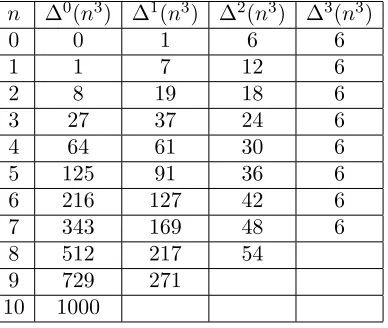
Let describe the derivation of the sequence A287326 in OEIS. Sequence A287326 returns the perfect cube nas row sum over k, 0≤k≤n−1, as well as sum over 1≤k≤n, by means of its symmetry. First, consider a difference table of perfect cubes ([4], eq. 7)
(2.1)
n ∆0(n3) ∆1(n3) ∆2(n3) ∆3(n3)
0 0 1 6 6
1 1 7 12 6
2 8 19 18 6
3 27 37 24 6
4 64 61 30 6
5 125 91 36 6
6 216 127 42 6
7 343 169 48 6
8 512 217 54 9 729 271
10 1000
Table 1: Difference table of perfect cubesn, 0≤n≤10 up to 3rd order. Reviewing above table, we have noticed that
∆(03) = 1 + 6·0 = 6 12+ 10 (2.2)
∆(13) = 1 + 6·0 + 6·1 = 6 22+ 20
∆(23) = 1 + 6·0 + 6·1 + 6·2 = 6 32+ 30
∆(33) = 1 + 6·0 + 6·1 + 6·2 + 6·3 = 6 42+ 40 ..
.
∆(n3) = 1 + 6·0 + 6·1 + 6·2 +· · ·+ 6·n= 6 n+12 + n+10
Above difference identity is closely related to Faulhaber’s sum of cubes, wheren3= 6 n+13 + n+11 , see ([21], p. 9). Note that ∆2(n3) could be found similarly using above identity, i.e ∆2(n3) = 6 n+13−2
+ n+11−2
.
Property 2.3. (Generalized finite difference of power using Faulhaber’s formula). Consider the identities, ([21], p. 9). For every odd power
n1 = n1
n3 = 6 n+13
+ n1
n5 = 120 n+2 5
+ 30 n+13
+ n1
.. . n2m−1 = P
1≤k≤m
(2k−1)!T(2m,2k) n+k2k−−11
The coefficients in these formulas are related to what Riordan[22] has called central factorial num-bers of the second kind. In his notation,
xm = X
1≤k≤m
T(m, k)x[k], x[k]=x(x+k2 −1)(x+k2 −2)· · ·(x+k2 + 1)
The coefficients T(2m,2k) are always integers, because the x[k+2] =x[k](x2/k4) implies the recur-rence
We can find the first order finite difference of odd power as decreasing the variable of corresponding binomial coefficients by 1, for example
∆n1 = n0 ∆n3 = 6 n+12
+ n0
∆n5 = 120 n+2 4
+ 30 n+12
+ n0
.. .
∆n2m−1 = P
1≤k≤m
(2k−1)!T(2m,2k) n+k2k−−21
Continue similarly, we can express each difference of order t ≥1. The central factorial numbers of the second kind (2k−1)!T(2m,2k) in above identities are terms of OEIS sequence A303675 and generated by
(2.4) (2k−1)!T(2m,2k) = 1
r
r
X
j=0 (−1)j
2r j
(r−j)2n=:Vm,k,
where r=n−k+ 1, this formula was provided by Peter Luschny in[27]. Repeated sums are equally easy, in Knuth’s notation (see [21], p. 10)
Σrn2m+1 = X 1≤k≤m
Vm,k
n+k+r
2k−1 +r
Therefore, reviewing the difference as inverse operator to summation for every oddt >0andm≥0, we have identity
∆rn2m+1 = X 1≤k≤m
Vm,k
n+k−r
2k−1−r
By property 2.3 we rewrite the cubes as
(2.5) n3 = X
1≤k≤n 6
k+ 1 2
+
k
0
Rewrite above expression with set every binomial coefficient to be n+12
= 1 + 2 +· · ·+ (n+ 1), then
n3 = (1 + 6·0) + (1 + 6·0 + 6·1) +· · ·+ (1 + 6·0 +· · ·+ 6·(n−1)) Particularizing above expression, we get
(2.6) n3 =n+ (n−0)·6·0 + (n−1)·6·1 +· · ·+ (n−(n−1))·6·(n−1)
Provided that nis natural. Now, let apply a compact sigma notation on (2.6), thus
(2.7) n3 =n+ X
1≤k≤n
6k(n−k)
As sum P
1≤k≤n6k(n−k) consists of n terms, we have right to move n in (2.7) under sigma notation, we get
(2.8) n3 = X
1≤k≤n
6k(n−k) + 1
Property 2.9. (Proof of symmetry). Let be a setsA(n) :={1, 2, . . . , n}, B(n) :={0, 1, . . . , n}, C(n) :={0, 1, . . . , n−1}, let be expression (2.8) denoted as
M(n, C(n)) = X k∈C(n)
where n is natural-valued variable and C(n) is iteration set of (2.8), then we have equality
(2.10) M(n, A(n)) =M(n, C(n))
Let review and denote expression (2.6) as
U(n, C(n)) = n+ 6· X
k∈C(n)
k(n−k)
then
(2.11) U(n, A(n)) =U(n, B(n)) =U(n, C(n))
Other words, changing of iteration sets of(2.6) and (2.8) by A(n), B(n), C(n) and A(n), C(n), respectively, doesn’t change resulting value for each natural x.
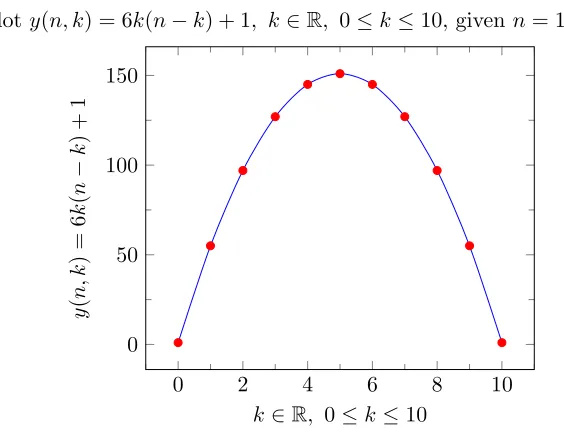
Proof. Let be a ploty(n, k) = 6k(n−k) + 1, k∈R, 0≤k≤10, givenn= 10
0 2 4 6 8 10
0 50 100 150
k∈R, 0≤k≤10
y
(
n,
k
)
=
6
k
(
n
−
k
)
+
1
Figure 2. Plot of 6k(n−k) + 1, k∈R, 0≤k≤n, wheren= 10.
Obviously, being a parabolic function, it’s symmetrical over n2, hence equivalent M(n, A(n)) =
M(n, C(n)) follows. Reviewing (2.6) and denoteu(n, k) =kn−k2, we can conclude, thatu(n,0) =
u(n, n) = 0, then equality of U(n, A(n)) =U(n, B(n)) =U(n, C(n)) immediately follows. This
completes the proof.
Review above property (2.9). Let be an example of triangle built using
Definition 2.12. For every n≥0
(2.13) D1(n, k) def= 6k(n−k) + 1, 0≤k≤n
overn from 0 ton= 4, wheren denotes corresponding row and k shows the item of rown.
(2.14)
Row 0: 1
Row 1: 1 1
Row 2: 1 7 1
Row 3: 1 13 13 1
Row 4: 1 19 25 19 1
Note thatn-th row sum of Triangle (2.14) over 0≤k≤n−1 returns perfect cuben. We can see that each row with respect to variablen= 0, 1, 2, 3, 4, ..., has Binomial distribution of row terms. One could compare Triangle (2.14) with Pascal’s triangle [1], [12]
Row 0: 1
Row 1: 1 1
Row 2: 1 2 1
Row 3: 1 3 3 1
Row 4: 1 4 6 4 1
Figure 4. Pascal’s triangle, sequence A007318 in OEIS, [1]. Let us approach to show a few properties of triangle (2.14) andL1(n, k).
Properties 2.15. Properties of triangle (2.14).
(1) Summation of n-th row of triangle (2.14) over kfrom0 to n−1 returns perfect cuben≥0
as follows
(2.16) n3 = X
1≤k≤n
D1(n, k)
(2) First item of each row’s number corresponding to central polygonal numbers sequence a(n) = n2+n+2
2 (sequence A000124 in OEIS, [13]) returns finite difference of consequent perfect
cubes. For example, let be a k-th row of triangle (2.14), such thatk= n2+n+22 , n= 0,1,2, ..., then item
(2.17) ∆(n3) =D1
n2+n+ 2 2 ,1
(3) Items of (2.14) have Binomial distribution of rows.
(4) Linear recurrence, for every k and n >0
(2.18) 2D1(n, k) =D1(n+ 1, k) +D1(n−1, k)
This linear recurrence is direct result of second order binomial transform of D1(n, k) by n. (5) Linear recurrence, for each n > k
(2.19) 2D1(n, k) =D1(2n−k, k) +D1(2n−k,0)
(6) From (1.24) for every n≥0 follows
(2.20) n3 = X
1≤k≤n
D1(n, k) =
X
1≤k≤n
D1
k2+k+ 2 2 ,1
(7) Triangle (2.14) is symmetric, i.e
(2.21) D1(n, k) =D1(n, n−k)
Corollary 2.22. Review identity (2.16) in sense of summation of D1(n, k) over some range W
with max(W) =T, then (2.16) returns
X
1≤k≤T
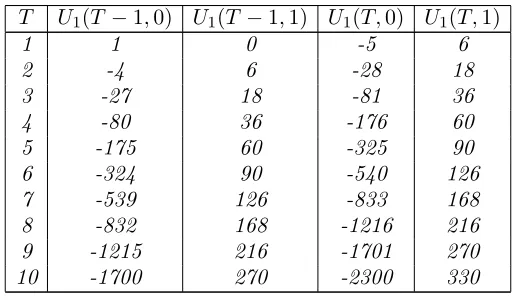
D1(n, k) =U1(T,0)n0−U1(T,1)n1,
where T = 1,2,3, ...,N. By property (2.9) we rewrite above expression as
X
0≤k≤T−1
D1(n, k) =U1(T −1,0)n0−U1(T−1,1)n1
T U1(T −1,0) U1(T−1,1) U1(T,0) U1(T,1)
1 1 0 -5 6
2 -4 6 -28 18
3 -27 18 -81 36
4 -80 36 -176 60
5 -175 60 -325 90
6 -324 90 -540 126
7 -539 126 -833 168
8 -832 168 -1216 216
9 -1215 216 -1701 270
10 -1700 270 -2300 330
Table 5. Table of coefficientsU1(T−1,0), U1(T −1,1), U1(T,0), U1(T,1)given T = 1, ...,10.
Therefore, for every integer n≥1, T =n,
∀T =n: n3 =
(
U1(T,0)n0−U1(T,1)n1,
U1(T−1,0)n0−U1(T −1,1)n1.
Coefficients|U1(T−1,1)|are terms of sequence A028896 in OEIS, [23]. Coefficients|U1(T,0)|are
terms of sequence A275709 in OEIS, [20].
In this section we have derived a binomial distributed triangle (2.14), such that perfect cube
n could be found as sum of n-th row terms of triangle (2.14) over k, in ranges 1 ≤ k ≤ n or 0≤k≤n−1, wherenis natural. Therefore, the follow question is stated:
Question 2.23. Is there a generalization of A287326 in order to receive monomial nt, t > 3 as sum of n-th row terms of corresponding triangle, where t is natural?
3. Generalization of sequence A287326
In order to get analogs of Triangle (2.14) one should solve a system of equations, where unknowns are coefficients of polynomial and variable of polynomial is k(n−k). Triangle (2.14) is generated by polynomialD1(n, k), n≥0, 0≤k≤n, defined by (2.12). Here, let derive a triangle generated by polynomial D2(n, k), n ≥ 0, 0 ≤ k ≤ n, such that sum of n-th row terms over k, in ranges 1≤k≤nor 0≤k≤n−1 returnsn5, wheren is natural
Example 3.1. We suspect thatn-th row of triangle that returnsn5as sum ofn-th row terms over
k, in 1≤k≤nor 0≤k≤n−1 is generated by
(3.2) D2(n, k) =A2,2(n−k)2k2+A2,1(n−k)1k1+A2,0(n−k)0k0, n≥0, 0≤k≤n,
whereA2,2, A2,1, A2,0 are unknown coefficients. Assume that for every integern≥0 holds
(3.3) n5 = X
1≤k≤n
To determine the coefficients A2,2, A2,1, A2,0, in (3.2) let rewrite (3.3) in extended view
A2,2
X
1≤k≤n
k2(n−k)2+A2,1
X
1≤k≤n
k(n−k) + X 1≤k≤n
A2,0 (3.4)
= A2,2
X
1≤k≤n
k2(n2−2nk+k2) +A2,1
X
1≤k≤n
kn−k2+ X 1≤k≤n
A2,0
= A2,2
X
1≤k≤n
k2n2−2nk3+k4+A2,1
X
1≤k≤n
kn−k2+ X 1≤k≤n
A2,0
= A2,2n2
X
1≤k≤n
k2−2A2,2n
X
1≤k≤n
k3+A2,2
X
1≤k≤n
k4+A2,1n
X
1≤k≤n
k
− A2,1
X
1≤k≤n
k2+ X 1≤k≤n
A2,0=n5.
Thus, we have received expression containing sums of powers of successive natural numbers, where powers are {1,2,3,4}. These formulas contain so-called Bernoulli numbers, [14]. For mentioned powers of successive natural numbers formulas are following
X
1≤k≤n
k= n 2+n
2 , (3.5)
X
1≤k≤n
k2 = 2n
3+ 3n2+n
6 ,
(3.6)
X
1≤k≤n
k3 = n
4+ 2n3+n2
4 ,
(3.7)
X
1≤k≤n
k4 = 6n
5+ 15n4+ 10n3−n
30 .
(3.8)
Now we substitute above identities to (3.4), respectively,
A2,2n2
2n3+ 3n2+n
6 − 2A2,2n
n4+ 2n3+n2
4 +A2,2
6n5+ 15n4+ 10n3−n
30
+ A2,1n
n2+n
2 −A2,1
2n3+ 3n2+n
6 +A2,0n
Particularizing the elements of above expression and moving them under the common divisor, we get
(3.9) A2,2n
5−A
2,2n+ 30A2,0
30 +A2,1
n3−n 6
We have to remember that expression (3.9) is the left side of the input equation (3.3). Therefore,
(3.10) n5 = A2,2n 5−A
2,2n+ 30A2,0
30 +A2,1
n3−n 6
In order to satisfy (3.10) for each natural n, coefficients A2,0, A2,1, A2,2 should be a solutions of following system of equations
1
30A2,2 = 1
A2,1 = 1
The only solution of above system is A2,2 = 30, A2,1 = 0, A2,0 = 1. Hereby, polynomialD2(n, k) takes the form
(3.11) D2(n, k) =A2,2(n−k)2k2+A2,1(n−k)1k1+A2,0(n−k)0k0 = 30k2(n−k)2+ 1
And for every natural n≥1 holds
n5 = X
1≤k≤n
D2(n, k) =
X
1≤k≤n
30k2(n−k)2+ 1 (3.12)
= X
0≤k≤n−1
D2(n, k) =
X
0≤k≤n−1
30k2(n−k)2+ 1
Let show few initial rows of triangle built by D2(n, k), that is analog of triangle (2.14), which returns monomial n5 as sum ofn-th row terms over k, as 1≤k≤nor 0≤k≤n−1, by means of its symmetry
(3.13)
1
1 1
1 31 1
1 121 121 1
1 271 481 271 1
1 480 1081 1081 481 1
Figure 6. Triangle generated by polynomial D2(n, k), n≥0, 0≤k≤n, sequence A300656 in OEIS, [15].
Similarly, finding the coefficientsA3,0, A3,1, A3,2, A3,3 in
(3.14) D3(n, k) =A3,3k3(n−k)3+A3,2k2(n−k)2+A3,1k1(n−k)1+A3,0k0(n−k)0,
we getA3,3= 140, A3,2 =−14, A3,1= 0, A3,0= 1, therefore, for each integer n≥0 holds
n7 = X
1≤k≤n
D3(n, k) =
X
1≤k≤n
140k3(n−k)3−14k2(n−k)2+ 1 (3.15)
= X
0≤k≤n−1
D3(n, k) =
X
0≤k≤n−1
140k3(n−k)3−14k2(n−k)2+ 1
Below we show a few initial rows of triangle generated by polynomial D3(n, k), n≥0, 0≤k≤n, the analog of triangle (2.14), such that monomialn7 could be found as sum ofn-th row terms over
k, as 1≤k≤nor 0≤k≤n−1, by means of its symmetry
(3.16)
1
1 1
1 127 1
1 1093 1093 1
1 3793 8905 3793 1
1 8905 30157 30157 8905 1
We assume now that generalization of A287326 holds for odd powers of the form 2m+ 1, m = 0,1,2, ..., where A287326 is partial case form= 1. To generalize our sequences A287326, A300656, A300785 for every odd power 2m+1, m≥0 one has to review the generating functions of sequences A287326, A300656, A300785 as follows. Let be definition
Definition 3.17.
Dm(n, k) := Am,mkm(n−k)m+Am,m−1km−1(n−k)m−1+· · ·+Am,0k0(n−k)0
= X
0≤j≤m
Am,jkj(n−k)j,
whereAm,j, 0≤j≤m are unknown coefficients. And, we assume that
(3.18) n2m+1 = X
1≤k≤n
Dm(n, k).
We want to notice that as we used a compact sigma notation on definition (3.17), i.e we rewrite (3.17) as P
0≤j≤mAm,jkj(n−k)j, thus the sum (3.18) returns indeterminate form of Dm(n, k) =
P
0≤j≤mAm,jkj(n−k)j on step k=nas Am,0(n−n)0k0 contains the term (n−n)0 = 00. Some textbooks leave the quantity 00 undefined, because the functions x0 and 0x have different limiting values whenx decreases to 0. But this is a mistake. We must define
∀x: x0= 1,
if the binomial theorem is to be valid when x = 0, y = 0, and/or x = y. The binomial theorem is too important to be arbitrarily restricted! By contrast, the function 0x is quite unimportant, [31]. Note that Dm(n, k) is generalization of (2.12) and (3.11). For example, generating functions of sequences A287326, A300656, A300785 are, respectively
D1(n, k) = 1 + 6k(n−k), forA287326
D2(n, k) = 1−0k(n−k) + 30k2(n−k)2, forA300656
D3(n, k) = 1−14k(n−k) + 0k2(n−k)2+ 140k3(n−k)3, forA300785
Where coefficientsAm,j, form= 1,2,3 are{A1,j}1j=0={1,6}, {A2,j}2j=0 ={1,0,30}, {A3,j}3j=0=
{1,−14,0,140}in definitions of generating functions of A287326, A300656, A300785. To generalize above result in order to receive monomial n2m+1 asP
1≤k≤nDm(n, k) =n2m+1, m= 0,1,2, ...one has to solve the system of equations. Complete set of coefficients {Am,0, . . . , Am,m} such that
P
1≤k≤nDm(n, k) =n2m+1, m≥0 holds can be found by solving the following system of equations
(3.19)
Dm(1,0) = 12m+1
Dm(2,0) +Dm(2,1) = 22m+1
Dm(3,0) +Dm(3,1) +Dm(3,2) = 32m+1 ..
.
Dm(r,0) +Dm(r,1) +· · ·+Dm(r, r−1) =r2m+1, r > m
List of solutions1 of system (3.19) is split and assigned to OEIS under the numbers A302971 (numerators of Am,j) and A304042 (denominators of Am,j). To reach recurrent formula of Am,j,
first let fix the unused values Am,j = 0, for j < 0 or j > m, so we don’t need to care about the summation range forj, then by expanding (n−k)j and using Faulhaber’s formula [7], we get
n−1
X
k=0
(n−k)jkj = n−1
X k=0 ∞ X i j i
nj−i(−1)iki+j
(3.20) = ∞ X i j i
nj−i (−1)
i
i+j+ 1
"∞
X
t
i+j+ 1
t
Btni+j+1−t−Bi+j+1
# = ∞ X i,t j i
(−1)i
i+j+ 1
i+j+ 1
t
Btn2j+1−t
| {z }
(?) − ∞ X i j i
(−1)i
i+j+ 1Bi+j+1n j−i
| {z }
()
whereBt are Bernoulli numbers [14]. Now, we notice that
(3.21) ∞ X i j i
(−1)i
i+j+ 1
i+j+ 1
t = 1 (2j+1)(2j
j)
, ift= 0;
(−1)j
t j 2j−t+1
, ift >0
In particular, the last sum is zero for 0< t≤j. Now we revise the (?) part of (3.20) according to results of (3.21), thus
∞ X i,t j i
(−1)i
i+j+ 1
i+j+ 1
t
Btn2j+1−t =
1 (2j+ 1) 2jj
+ X t>0
(−1)j
t
j
2j−t+ 1
Btn2j+1−t
Therefore, (3.20) takes the form
n−1
X
k=0
(n−k)jkj = 1
(2j+ 1) 2jj + X
t>0 (−1)j
t
j
2j−t+ 1
Btn2j+1−t
| {z }
(?) (3.22) − ∞ X i j i
(−1)i
i+j+ 1Bi+j+1n j−i
| {z }
()
Now, we keep our attention to (3.22) and we have to remember that if the sum over some variablei
contains ji, then instead of limiting its summation range toi= 0, ..., j, we can leti=−∞, ...,+∞
respectively, we get n−1
X
k=0
(n−k)jkj = 1 (2j+ 1) 2jjn
2j+1+
∞ X
`=−∞
(−1)j 2j+ 1−`
j `
B2j+1−`n` (3.23)
− ∞ X
`=−∞
j `
(−1)j−`
2j+ 1−`B2j+1−`n
`
= 1
(2j+ 1) 2jjn
2j+1+ 2
∞ X
odd`
(−1)j 2j+ 1−`
j `
B2j+1−`n`.
Now, using the definition ofAm,j, we obtain the following identity for polynomials in n
∞ X
j
Am,j 1
(2j+ 1) 2jjn
2j+1+ 2
∞ X
j,odd`
Am,j
j `
(−1)j
2j+ 1−`B2j+1−`n
` (3.24)
≡n2m+1.
Taking the coefficient ofn2m+1 in above expression, we get Am,m = (2m+ 1) 2mm
,and taking the coefficient of x2d+1 for an integer d in the range m/2 ≤ d < m we get Am,d = 0. Taking the coefficient ofn2d+1 in (3.24) for m/4≤d < m/2 , we get
(3.25) Am,d 1
(2d+ 1) 2dd + 2(2m+ 1)
2m m
m
2d+ 1
(−1)m
2m−2dB2m−2d= 0,
i.e
(3.26) Am,d = (−1)m−1
(2m+ 1)!
d!d!m!(m−2d−1)! 1
m−dB2m−2d.
Continue similarly, we can expressAm,j for each integerj in range m/2s+1 ≤j < m/2s (iterating consecutively s= 1,2, ...) via previously determined values ofAm,d, d < j as follows
(3.27) Am,j = (2j+ 1)
2j j
m
X
d=2j+1
Am,d
d
2j+ 1
(−1)d−1
d−j B2d−2j.
The same formula holds also form= 0. Note that in above summhave to bem≥2j+ 1 to return nonzero termAm,j.
Definition 3.28. We define here a generating function of sequence of coefficientsAm,j, such that
Pn−1
k=0Dm(n, k) =n2m+1, n≥0, m≥0, whereDm(n, k) is defined by (3.17)
Am,j :=
0, if j <0 or j > m
(2j+ 1) 2jj Pm
d=2j+1Am,d 2j+1d
(−1)d−1
d−j B2d−2j, if 0≤j < m (2j+ 1) 2jj
, if j=m
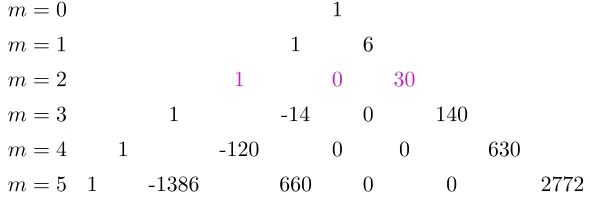
Five initial rows of triangle generated byAm,j, j ≥0, 0≤j≤m are
(3.29)
m= 0 1
m= 1 1 6
m= 2 1 0 30
m= 3 1 -14 0 140
m= 4 1 -120 0 0 630
Figure 8. Triangle generated byAm,j, j ≥0, 0≤j≤m, sequences A302971 (numerators of
Am,j) and A304042 (denominators ofAm,j).
Note that starting from row m ≥ 11 the terms of Triangle (3.29) consist fractional numbers, for example,A11,1= 800361655623,6. One can find complete list of the numerators and denominators of Am,j in OEIS under the identifiers A302971 and A304042, respectively, see [17],[18]. To verify the terms that definition (3.28) produces one should refer to Mathematica code2. Hereby, let be theorem
Theorem 3.30. For every non-negative integersn≥0 and m≥0 holds
nV =
P
1≤k≤n
Dm(n, k) = P 1≤k≤n
P
0≤j≤m
Am,jkj(n−k)j, forV = 2m+ 1
P
1≤k≤n 1
nDm(n, k) =
P
1≤k≤n 1 n
P
0≤j≤m
Am,jkj(n−k)j, forV = 2m,
where Dm(n, k) is defined by (3.17).
One can verify results concerning above theorem (3.30) via Mathematica code3. Therefore, theorem (3.30) answers to the question (2.23) positively, since for every m ≥ 0 exists a triangle, generated by Dm(n, k), n≥0, 0≤k ≤n, such that odd power n2m+1 can be reached as sum of
n-th row of corresponding triangle over 1≤k≤nor 0≤k≤n−1. Sequences A287326, A300656, A300785 are partial cases of theorem (3.30) for m= 1,2,3, respectively.
3.1. Properties of Dm(n, k) and Am,j. Here we show a few properties of definition Dm(n, k), some of them correlates with properties of partial case D1(n, k) in 2.15.
(1) Sum ofAm,j over j in range 0≤j ≤m gives
X
0≤j≤m
Am,j = 22m+1−1,
where Am,j is defined by (3.28).
(2) Similarly to property (2.21) of particular caseD1(n, k), items of{Dm(n, k)}nk=0, m≥0, n≥ 0 is symmetric, i.e
Dm(n, k) =Dm(n, n−k), for all k: 0≤k≤n.
(3) By property (2) for every integer n≥0, m≥0 immediately follows
n2m+1= X 1≤k≤n
Dm(n, k) = X 0≤k≤n−1
Dm(n, k)
(4) For everym≥0 the Am,m are terms of the sequence A002457, [19]. (5) For each m≥0
Am,0 = 1
(6) Assume that n <0, then theorem (3.30) can be applied as
nV =
P
1≤k≤|n|
Dm(n, k), forV = 2m+ 1
P
1≤k≤|n|
1
|n|Dm(|n|, k), forV = 2m
Property 3.31. (Linear Recurrence ofDm(n, k).) For every integern≥0 in D1(n, k), D2(n, k), D3(n, k) hold the recurrent relations
D1(n+ 1, k) = 2D1(n, k)−D1(n−1, k)
D2(n+ 2, k) = 3D2(n+ 1, k)−3D2(n, k) +D2(n−1, k)
D3(n+ 3, k) = 4D3(n+ 2, k)−6D3(n+ 1, k) + 4D3(n, k)−D3(n−1, k)
Review the coefficient Dm(n, k), which defined by m-order polynomial. It’s well known fact that
high order finite difference ∆m+kPm(x) = 0 for every x, where Pm(x) is m order polynomial and k >0,[8]. Recall Binomial Transform of sequencean. D. E. Knuth[35] has introduced the binomial
transform by
(3.32) aˆn=
n
X
k=0
n k
(−1)kak,
In particular, ˆan= ∆nan, therefore, for Dm(n, k) we have
(3.33) ∀t≥m: Dbm(n, k)t= X
j≥0
(−1)j
t+ 1
j
Dm(n+t−j, k)
≡0,
hereby, it gives us right to represent recursively every value of Dm(n+r, k), 0≤r≤t+ 1as
(3.34) (−1)r+1
t+ 1
r
Dm(n+t−r, k) =
X
j∈Z≥0/{r}
(−1)j+1
t+ 1
j
Dm(n+t−j, k)
In particular,
(3.35) Dm(n+t, k) =
X
j≥1
(−1)j+1
t+ 1
j
Dm(n+t−j, k)
Hereby, let be theorem
Theorem 3.36. By property (3.31), particularly, from expression (3.35), for every integer t≥m follows
(3.37) (n+t)2m+1=X k≥1
X
j≥1
(−1)j+1
t+ 1
j
Dm(n+t−j, k)
Proof. Direct consequence of theorem (3.30) and (3.35).
3.2. Example of use of theorem (3.30). In this subsection we show a detailed application of theorem (3.30). In this subsection we highlight the corresponding terms of Am,j, 0≤j ≤m and
T(n, k), 1≤k≤nwith different colors to be more easily to see regularity. Recall existing pattern, that is triangle of coefficientsAm,j defined by (3.28)
m= 0 1
m= 1 1 6
m= 2 1 0 30
m= 3 1 -14 0 140
m= 4 1 -120 0 0 630
m= 5 1 -1386 660 0 0 2772
By received formulaP
1≤k≤n
P
j≥0Dm(n, k) = n2m+1 each line of above triangle being multiplied by Tj>0(n, k) := kj(n−k)j and summed up to n or n−1 over k from 0 or 1, respectively, will result odd power of n2m+1, depending on the row Am,j, 0≤j ≤m is applied. Consider the case
n= 3, m= 2, we introduce triangle built using T(n, k) :=k(n−k), n ≥1, 1 ≤k≤n as upper triangular array, let be 1≤n≤5, 1≤k≤n
(3.38)
n= 1 n= 2 n= 3 n= 4 n= 5
0 1 2 3 4
0 2 4 6
0 3 6
0 4
0
Figure 10. Upper right triangle generated by T(n, k) =k(n−k), n≥1, 1≤k≤n, sequence A094053, [29] in OEIS.
Example 3.39. Consider theorem (3.30), let be n= 3 and m= 2, then
32·2+1 = 1·20+0·21+30·22
+ 1·20+0·21+30·22
+ 1·00+0·01+30·02
= 121 + 121 + 1 = 243
Items in above array are terms of the third row of triangle A300656.
Example 3.40. Consider theorem (3.30), let be n= 3 and m= 3, then 32·3+1 = 1·20−14·21+ 0·22+ 140·23
+ 1·20−14·21+ 0·22+ 140·23 + 1·00−14·01+ 0·02+ 140·03
= 1093 + 1093 + 1 = 2187
Items in above array are terms of the third row of triangle A300785.
Example 3.41. Consider theorem (3.30), let be n= 4 and m= 3, then 42·3+1 = 1·30−14·31+ 0·32+ 140·33
+ 1·40−14·41+ 0·42+ 140·43 + 1·30−14·31+ 0·32+ 140·33
+ 1·00−14·01+ 0·02+ 140·03 = 3739 + 8905 + 3739 + 1 = 16384
Items in above array are terms of the forth row of triangle A300785. We can perform same result for 42·3+1 in terms of multiplication of certain matrices,
42·3+1= [1,1,1,1]·
30 31 32 33 40 41 42 43 30 31 32 33 00 01 02 03
·
1
−14 0 140
Example 3.42. Consider theorem (3.30), let be n= 5 and m= 3, then 52·3+1 = 1·40−14·41+ 0·42+ 140·43
+ 1·60−14·61+ 0·62+ 140·63 + 1·60−14·61+ 0·62+ 140·63 + 1·40−14·41+ 0·42+ 140·43
+ 1·00−14·01+ 0·02+ 140·03
= 8905 + 30157 + 30157 + 8905 + 1 = 78125
Items in above array are terms of the fifth row of triangle A300785.
Example 3.43. Consider theorem (3.30), let be n= 5 and m= 4, then 52·4+1 = 1·40−120·41+ 0·42+ 0·43+ 630·44
+ 1·60−120·61+ 0·62+ 0·63+ 630·64
+ 1·60−120·61+ 0·62+ 0·63+ 630·64 + 1·40−120·41+ 0·42+ 0·43+ 630·44 + 1·00−120·01+ 0·02+ 0·03+ 630·04
= 160801 + 815761 + 815761 + 160801 + 1 = 1953125
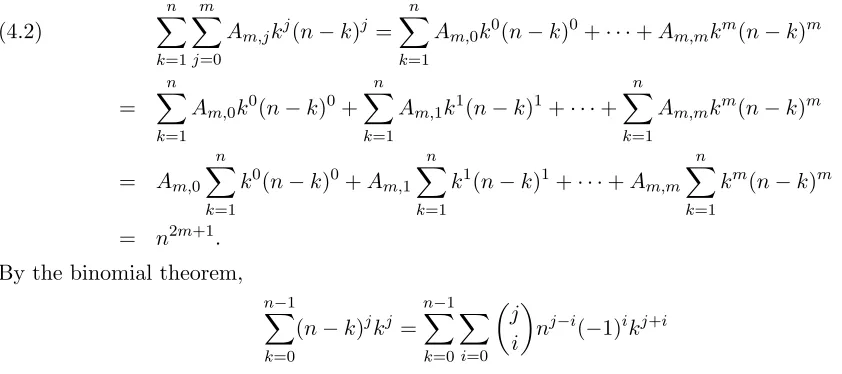
4. Another power identity
Review the Corollary (2.2), it says that partial case of theorem (3.30) returns the binomial of the form
X
M≤k≤N
D1(n, k) =
(
U1(T,0)n0+U1(T,1)n1, if M = 1, N =T
U1(T−1,0)n0+U1(T−1,1)n1, if M = 0, N =T −1
= n3, as T →n.
Let extend this idea, as we have complete theorem (3.30). We rewrite theorem (3.30) for odd powers as
X
M≤k≤N
Dm(n, k) =
(
Um(T,0)n0+· · ·+Um(T, m)nm, if M = 1, N =T
Um(T−1,0)n0+· · ·+Um(T −1, m)nm, if M = 0, N =T −1
= n2m+1, asT =n.
Above expression is so-called ’closed form’ of the theorem (3.30) for every particular n. Below we place a few examples of polynomialsP
0≤k≤m(−1)m
−kUm(T, k)·nk, where m= 2,
(4.1)
T U2(T,0)n0+U2(T,1)n1+U2(T,2)n2 1 31−60n+ 30n2
2 512−540n+ 150n2
3 2943−2160n+ 420n2
4 10624−6000n+ 900n2
5 29375−13500n+ 1650n2
6 68256−26460n+ 2730n2
7 140287−47040n+ 4200n2
8 263168−77760n+ 6120n2
9 459999−121500n+ 8550n2
Figure 11. Table of polynomials generated by P
1≤k≤T D2(n, k) =n5 asT →n, see definition (3.17) forD2(n, k).
Below we show a plots of few first polynomials P
1≤k≤T D2(n, k) for T = 1,2,3 and compare it with corresponding monomial n5 by the theorem (3.30),
31-60n+30n2
512-540n+150n2
2943-2160n+420n2
n5
2 3 4 5
500 1000 1500 2000 2500 3000
Figure 12. Local approximations of monomial n5 by corresponding polynomials P
1≤k≤TD2(n, k) forT = 1,2,3, by theorem (3.30).
We can see that monomial n5 can be easily approximated in neighborhood of every particular natural n. The polynomials from figure (11) can be generated using Mathematica code4. To understand the nature of coefficientsUm(T, k), let derive them directly by means of theorem (3.30),
n
X
k=1 m
X
j=0
Am,jkj(n−k)j = n
X
k=1
Am,0k0(n−k)0+· · ·+Am,mkm(n−k)m (4.2)
= n
X
k=1
Am,0k0(n−k)0+ n
X
k=1
Am,1k1(n−k)1+· · ·+ n
X
k=1
Am,mkm(n−k)m
= Am,0 n
X
k=1
k0(n−k)0+Am,1 n
X
k=1
k1(n−k)1+· · ·+Am,m n
X
k=1
km(n−k)m
= n2m+1.
By the binomial theorem, n−1
X
k=0
(n−k)jkj = n−1
X
k=0
X
i=0
j i
nj−i(−1)ikj+i
4Um(n,k) coefficients2.txt. - Mathematica code, generates the polynomials from figure (11), [39]. If necessary, one
We rewrite the main result of (4.2) as
Am,0 n
X
k=1
k0(n−k)0+Am,1 n
X
k=1
k1(n−k)1+· · ·+Am,m n
X
k=1
km(n−k)m (4.3)
= Am,0 n X k=1 X i=0 0 i
n0−i(−1)ik0+i+Am,1 n X k=1 X i=0 1 i
n1−i(−1)ik1+i
+ Am,2 n X k=1 X i=0 2 i
n2−i(−1)ik2+i+Am,3 n X k=1 X i=0 3 i
n3−i(−1)ik3+i
.. .
+ Am,m n X k=1 X i=0 m i
nm−i(−1)ikm+i =n2m+1
Rewrite expression (4.3) in extended view
Am,0 n
X
k=1
k0(n−k)0+Am,1 n
X
k=1
k1(n−k)1+· · ·+Am,m n
X
k=1
km(n−k)m (4.4)
= Am,0 n X k=1 0 0
n0(−1)0k0
+Am,1 n X k=1 1 0
n1(−1)0k1+
1 1
n0(−1)1k2
+ Am,2 n X k=1 2 0
n2(−1)0k2+
2 1
n1(−1)1k3+
2 2
n0(−1)2k4
+ Am,3 n X k=1 3 0
n3(−1)0k3+
3 1
n2(−1)1k4+
3 2
n1(−1)2k5+
3 3
n0(−1)3k6
.. .
+ Am,m n X k=1 m 0
nm(−1)0km+
m
1
nm−1(−1)1km+1+· · ·+
m m
n0(−1)mk2m
= n2m+1.
Let rewrite expression (4.4) again and move sigma notation under the brackets,
n2m+1=Am,0 n
X
k=1
k0(n−k)0 +· · ·+ Am,m n
X
k=1
km(n−k)m (4.5)
= Am,0
" n X k=1 0 0
n0(−1)0k0
#
+Am,1
" n X k=1 1 0
n1(−1)0k1+ n X k=1 1 1
n0(−1)1k2
#
+ Am,2
" n X k=1 2 0
n2(−1)0k2+ n X k=1 2 1
n1(−1)1k3+ n X k=1 2 2
n0(−1)2k4
#
+ Am,3
" n X k=1 3 0
n3(−1)0k3+ n X k=1 3 1
n2(−1)1k4+ n X k=1 3 2
n1(−1)2k5+ n X k=1 3 3
n0(−1)3k6
#
.. .
+ Am,m
" n X k=1 m 0
nm(−1)0km+ n X k=1 m 1
nm−1(−1)1km+1+· · ·+ n X k=1 m m
n0(−1)mk2m
For example, consider the polynomialPm
k=0(−1)m−kUm(n, k)nk, wherem= 3. We derive below a set of coefficientsU3(n,0), U3(n,1), U3(n,2), U3(n,3)
3
X
k=0
(−1)3−kU3(n, k)nk (4.6)
≡ A3,0
" n X k=1 0 0
n0(−1)0k0
#
+A3,1
" n X k=1 1 0
n1(−1)0k1+ n X k=1 1 1
n0(−1)1k2
#
+ A3,2
" n X k=1 2 0
n2(−1)0k2+ n X k=1 2 1
n1(−1)1k3+ n X k=1 2 2
n0(−1)2k4
#
+ A3,3
" n X k=1 3 0
n3(−1)0k3+ n X k=1 3 1
n2(−1)1k4+ n X k=1 3 2
n1(−1)2k5+ n X k=1 3 3
n0(−1)3k6
#
≡ n7.
The coefficientsU3(n,0), U3(n,1), U3(n,2), U3(n,3) in expression (4.6) are following
U3(n,0) = A3,0 n X k=1 0 0
(−1)0k0+A3,1 n X k=1 1 1
(−1)1k2
(4.7)
+ A3,2 n X k=1 2 2
(−1)2k4+A3,3 n X k=1 3 3
(−1)3k6,
U3(n,1) = A3,1 n X k=1 1 0
(−1)0k1+A3,2 n X k=1 2 1
(−1)1k3
(4.8)
+ A3,3 n X k=1 3 2
(−1)2k5,
U3(n,2) = A3,2 n X k=1 2 0
(−1)0k2+A3,3 n X k=1 3 1
(−1)1k4
(4.9)
U3(n,3) = A3,3 n X k=1 3 0
(−1)0k3.
(4.10)
Let rewrite above identities in compact form as,
U3(n, r = 0) = 3
X
t≥0
Am,t n X `=1 t t
(−1)t`2t
(4.11)
= 3
X
t≥0 n X `=1 Am,t t t
(−1)t`2t
U3(n, r = 1) = 3
X
t≥1
Am,t n X `=1 t t−1
(−1)t−1`2t−1
= 3
X
t≥1 n X `=1 Am,t t t−1
(−1)t−1`2t−1
U3(n, r = 2) = 3
X
t≥2
Am,t n X `=1 t t−2
(−1)t−2`2t−2
(4.13)
= 3
X
t≥2 n X `=1 Am,t t t−2
(−1)t−2`2t−2
U3(n, r = 3) = 3
X
t≥3
Am,t n X `=1 t t−3
(−1)t−3`2t−3
(4.14)
= Am,3 n
X
`=1
3
t−3
(−1)0`3
Note that above compact forms are depend on r = 0,1,2,3, as it can be seen by corresponding binomial coefficients, thus we have replaced kby `, to avoid confusion in notations. Therefore, for every 0≤r ≤m theUm(n, r) can be defined next way
Um(n, r) def= m
X
t≥r
Am,t n X `=1 t t−r
(−1)t−r`2t−r
(4.15)
= m
X
t≥r n X `=1 Am,t t t−r
(−1)t−r`2t−r
Similarly, the coefficientsUm(n−1, r) derived just by changing the iteration limits within the sum
Pn
`=1Am,t t t−r
(−1)t−r`2t−r in (4.15) from`∈ {1, n} to`∈ {0, n−1}
Um(n−1, r) def= m
X
t≥r
Am,t n−1
X
`=0
t t−r
(−1)t−r`2t−r
(4.16)
= m
X
t≥r n−1
X
`=0
Am,t
t t−r
(−1)t−r`2t−r
In above equation (4.16) it must be defined`0 = 1 for all`, see [31]. Mathematica implementations 56of expessions (4.15) and (4.16) are available in [41], [42]. Therefore, for everyn≥1, andm≥0,
we have identity
n2m+1 = X
0≤r≤m
(−1)m−rUm(n, r)·nr (4.17)
= X
0≤r≤m
(−1)m−rUm(n−1, r)·nr (4.18)
Expressions (4.17), (4.18) are analogs to Faulhaber’s odd power identity, see property (2.3) and [21], p. 9. Expressions (4.17), (4.18) could be verified via Mathematica codes 7 8. Here we’d like
5Um(n,k) coefficients row generating.txt. - Mathematica code, implementation of (4.15), prints ten initial rows of
coefficientsUm(n, k)
6Um(n-1,k) coefficients row generating.txt. - Mathematica code, implementation of (4.16), prints ten initial rows of coefficientsUm(n−1, k)
to show a few examples of polynomials generated by P
0≤k≤T−1D2(n, k), see definition (3.17) for
D2(n, k)
(4.19)
T U2(T −1,0)n0+U2(T−1,1)n1+U2(T−1,2)n2
1 1
2 32−60n+ 30n2
3 513−540n+ 150n2
4 2944−2160n+ 420n2
5 10625−6000n+ 900n2
6 29376−13500n+ 1650n2
7 68257−26460n+ 2730n2
8 140288−47040n+ 4200n2
9 263169−77760n+ 6120n2
10 460000−121500n+ 8550n2
Figure 13. Table of polynomials generated by P
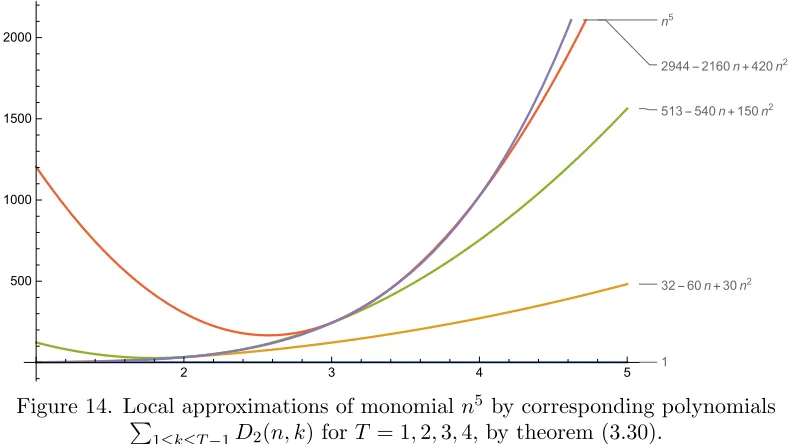
0≤k≤T−1D2(n, k). Below we show a plots of few first polynomials P
1≤k≤T−1D2(n, k) for T = 1,2,3,4 and compare it with corresponding monomialn5 by the theorem (3.30)
1
32-60n+30n2
513-540n+150n2
2944-2160n+420n2
n5
2 3 4 5
500 1000 1500 2000
Figure 14. Local approximations of monomial n5 by corresponding polynomials
P
1≤k≤T−1D2(n, k) for T = 1,2,3,4, by theorem (3.30).
The polynomials from figure (13) can be generated using Mathematica code9. Additionally, the generalized binomial series could be reached by means of identity
X
M≤k≤N
D1(n, k) =
(
U1(T,0)n0+U1(T,1)n1, if M = 1, N =T
U1(T−1,0)n0+U1(T−1,1)n1, if M = 0, N =T −1
= n3, as T →n.
For instance, for every naturaln
n3 =U1(T,0)·n0+U1(T,1)·n1
To reach higher powerm, let just multiply this identity bynm−3,
nm=U1(T,0)·nm−2+U1(T,1)·nm−3
9Um(n,k) coefficients.txt. - Mathematica code, generates the polynomials from figure (12), [40]. If necessary, one
Let rewrite this expression regarding to itself as recursion,
nm = U1(T,0)·[U1(T,0)nm−4+U1(T,1)nm−5] +U1(T,1)·[U1(T,0)nm−5+U1(T,1)nm−6] = U1(T,0)2·nm−4−2·U1(T,0)·U1(T,1)nm−5+U1(T,1)2·nm−6
Repeating above process similarlyj ≥1 times, we have
nm = X
k≥0 (−1)k
j k
U1(T,0)j−k·U1(T,1)k·nm−2j−k (4.20)
= X k≥0
(−1)k
j k
U1(T−1,0)j−k·U1(T −1,1)k·nm−2j−k
We believe we can perform similarly in terms of multinomial coefficients,
nm = X
k1+k2+...+kt=j
j k1, k2, . . . , kt
t
Y
`=1
(−1)`Ut(T, `)k`·nm−(t+1)j−k (4.21)
= X
k1+k2+...+kt=j
j k1, k2, . . . , kt
t
Y
`=1
(−1)`Ut(T−1, `)k`·nm−(t+1)j−k.
Note that we must setT =nin above identities. Another way to represent odd-powered monomial
n2m+1, m = 0,1,2, ... is to define a polynomial Um(n, k). As P
0≤k≤m(−1)m
−kU
m(n, k)·nk =
P
0≤k≤m(−1)m
−kUm(n−1, k)·nk, it follows that
2n2m+1 = X 0≤k≤m
(−1)m−kUm(n, k)·nk+ X 0≤k≤m
(−1)m−kUm(n−1, k)·nk
= X
0≤k≤m
(−1)m−k(Um(n, k) +Um(n−1, k))·nk,
Let be definition
(4.22) Um(n, k) def= 1 2
h
Um(n, k) +Um(n−1, k)
i
,
Therefore,
(4.23) n2m+1 = X
0≤k≤m
Um(n, k)·nk.
Expression (4.23) generates the following polynomials givenm= 2,
(4.24)
T U2(T,0)n0+U2(T,1)n1+U2(T,2)n2
1 16−30n+ 15n2
2 272−300n+ 90n2
3 1728−1350n+ 285n2
4 6784−4080n+ 660n2
5 20000−9750n+ 1275n2
6 48816−19980n+ 2190n2
7 104272−36750n+ 3465n2
8 201728−62400n+ 5160n2
9 361584−99630n+ 7335n2
10 610000−151500n+ 10050n2
Figure 15. Table of polynomials generated byP
Polynomials from Figure (15) could be generated using Mathematica code10. Let graphically show an approximation of monomialn5 by polynomials P
0≤k≤mU2(T, k)·nk forT = 1,2,3,4.
16-30n+15n2
272-300n+90n2
1728-1350n+285n2
6784-4080n+660n2
n5
2 3 4 5 6
1000 2000 3000 4000 5000
Figure 16. Local approximations of monomial n5 by corresponding polynomials
P
0≤k≤mU2(T, k)·nk forT = 1,2,3,4.
Definition (4.22) of coefficients Um(n, k) and identity (4.23) could be verified via Mathematica codes 11 12, respectively. Similarly to (4.20), (4.21) we can perform a binomial and multinomial representation of monomialnm, wheren, m are non-negative integers andT =n,
nm = X
k≥0 (−1)k
j k
U1(T,0)j−k· U1(T,1)k·nm−2j−k
(4.25)
= X k≥0
(−1)k
j k
U1(T−1,0)j−k· U1(T −1,1)k·nm−2j−k
And
nm = X
k1+k2+...+kt=j
j k1, k2, . . . , kt
t
Y
`=1
(−1)`Ut(T, `)k`·nm−(t+1)j−k
(4.26)
= X
k1+k2+...+kt=j
j k1, k2, . . . , kt
t
Y
`=1
(−1)`Ut(T −1, `)k`·nm−(t+1)j−k.
5. Acknowledgements
We would like to thank to Dr. Max Alekseyev (Department of Mathematics and Computational Biology, George Washington University) for sufficient help in deriving of Am,j coefficients, Dr. Hansruedi Widmer for useful comments concerning system of equations (3.19), Dr. Ron Knott (Visiting Fellow, Dept. of Mathematics at University of Surrey) for useful suggestions on writing of this article, and to Mr. Albert Tkaczyk for providing an analogs of triangle (2.14) for powers
m = 5,7, that are sequences A300656, A300785, respectively. Also, we’d like to thank to OEIS editors Michel Marcus, Peter Luschny, Jon E. Schoenfield and others for their patient and faithful volunteer work and for useful comments and suggestions during edition of sequences, concerned with this manuscript. We, also, thank to Tatyana Dryahlova for her help in translating of this manuscript in Russian.
10Combined U m(n,k) coefficients polynomials gf.txt. - Mathematica code, generates the polynomials from Figure
(15), [43].
6. Conclusion
In this paper particular pattern, that is binomial distributed triangle A287326 in OEIS, which shows perfect cube n as sum of row terms over 0 ≤ k ≤ n−1 or 1 ≤ k ≤ n is generalized, in this manuscript are found and discussed the polynomialsDm(n, k) and Um(n, k), such that, when being summed up over k in some range with respect to m and n returns the monomial n2m+1. As first step, we discussed analogs of A287326 for powers l = 5,7, sequences A300656, A300785, respectively, then we derived coefficients Am,j, such that for everyn≥0 andm≥0 holds
n2m+1 = X 1≤k≤n
Dm(n, k),
where
Dm(n, k) :=Am,mkm(n−k)m+Am,m−1km−1(n−k)m−1+· · ·+Am,0k0(n−k)0,
and Am,j is defined by (3.28). Therefore, question question (2.23) is answered positively. Section (3) is totally dedicated to complete and extended derivation of identityP
1≤k≤nDm(n, k) =n2m+1. Properties of triangle (2.14) and polynomialDm(n, k) are shown in properties 2.15 and subsection 3.1, respectively. Relation between Faulhaber’s sumP
nmand finite differences of power are shown in 2.3. In section 4 we have generalized the main result of Corollary (2.2) for all odd powers of the form 2m+ 1, m= 0,1,2, ... and proven an identities
n2m+1 = X
0≤r≤m
(−1)m−rUm(n, r)·nr
= X
0≤r≤m
(−1)m−rUm(n−1, r)·nr.
References
[1] Conway, J. H. and Guy, R. K. ”Pascal’s Triangle.” In The Book of Numbers. New York: Springer-Verlag, pp. 68-70, 1996.
[2] Abramowitz, M. and Stegun, I. A. (Eds.). Handbook of Mathematical Functions with Formulas, Graphs, and Mathematical Tables, 9th printing. New York: Dover, pp. 10, 1972.
[3] Arfken, G. Mathematical Methods for Physicists, 3rd ed. Orlando, FL: Academic Press, pp. 307-308, 1985. [4] Weisstein, Eric W. ”Finite Difference.” From Mathworld.
[5] Weisstein, Eric W. ”Power.” From Mathworld.
[6] Richardson, C. H. An Introduction to the Calculus of Finite Differences. p. 5, 1954.
[7] Johann Faulhaber, Academia Algebræ, Darinnen die miraculosische Inventiones zuden h¨ochsten Cossen weiters continuirt und profitiert werden. Augspurg, bey Johann Ulrich Sch¨onigs, 1631. (Call number
QA154.8 F3 1631a f MATHat Stanford University Libraries.), online copy.
[8] Bakhvalov N. S. Numerical Methods: Analysis, Algebra, Ordinary Differential Equations p. 59, 1977. (In russian) [9] The OEIS Foundation Inc.,The On-Line Encyclopedia of Integer Sequences, 1964-present https://oeis.org/ [10] N. J. A. Sloane et al., Entry ”Coordination sequence for hexagonal lattice”, A008458 in [9], 2002-present. [11] Petro, Kolosov, et al., Entry ”Triangle read by rows: T(n, k) = 6∗(n−k)∗k+ 1”, A287326 in [9], 2017. [12] N. J. A. Sloane and Mira Bernstein et al., ”Pascal’s Triangle”, Entry A007318 in [9], 1994-present. [13] N. J. A. Sloane. ”Central polygonal numbers” Entry A000124 in [9], 1994-present.
[14] Weisstein, Eric W. ”Bernoulli Number.” From Mathworld–A Wolfram Web Resource.
[15] Petro, Kolosov, et al., Entry ”Triangle read by rows: T(n, k) = 30∗(n−k)2∗k2+ 1”, A300656 in [9], 2018. [16] Petro, Kolosov, et al., Entry ”Triangle read by rows: T(n, k) = 140∗(n−k)3∗k3∗ −14∗(n−k)∗k+ 1”, A300785
in [9], 2018.
[17] Petro, Kolosov, et al., Entry ”Triangle read by rows: Numeator(Am,j), 0≤j≤m, m≥0”, A302971 in [9], 2018.
[18] Petro, Kolosov, et al., Entry ”Triangle read by rows: Denominator(Am,j), 0≤j≤m, m≥0”, A304042 in [9], 2018.
[19] N. J. A. Sloane, et al., Entry ”a(n) = (2n+ 1)!/n!2”, A002457 in [9].
[21] Donald E. Knuth., Johann Faulhaber and Sums of Powers, pp. 9-10., arXiv preprint, arXiv:math/9207222v1 [math.CA], 1992.
[22] John Riordan, Combinatorial Identities (New York: John Wiley & Sons, 1968).
[23] Joe Keane, et al., Entry ”6 times triangular numbers: a(n) = 3∗n∗(n+ 1)”, A028896 in [9], 1999. [24] Mathematica code, provides the list of solutions of system (3.19) up tor= 11
https://kolosovpetro.github.io/mathematica codes/solutions system 2 4.txt
[25] Mathematica code, implementation of definition (3.28)
https://kolosovpetro.github.io/mathematica codes/def 2 12.txt
[26] Mathematica code, implementation of theorem (3.30)
https://kolosovpetro.github.io/mathematica codes/expression 2 1.txt
[27] Petro Kolosov, Peter Luschny, Entry ”Triangle read by rows: coefficients in the sum of odd powers as expressed by Faulhaber’s theorem,T(n, k) forn≥1,1≤k≤n”, A303675 in [9], 2018.
[28] Donald E. Knuth., Two notes on notation., pp. 1-2, arXiv preprint, arXiv:math/9205211 [math.HO], 1992. [29] Reinhard Zumkeller, et al., Entry ”Triangle read by rows: T(n, k) =k(n−k),1≤k≤n.”, A094053 in [9], 2004. [30] Early, Nick., Combinatorics and Representation Theory for Generalized Permutohedra I: Simplicial Plates., p.
3, arXiv preprint, arXiv:1611.06640 [math.CO], 2016.
[31] Ronald Graham, Donald Knuth, and Oren Patashnik (1989-01-05). ”Binomial coefficients”. Concrete Mathe-matics (1st ed.). Addison Wesley Longman Publishing Co. p. 162. ISBN 0-201-14236-8, online copy.
[32] Anggoro, A.; Liu, E.; and Tulloch, A. ”The Rascal Triangle.” College Math. J. 41, 393-395, 2010., online copy. [33] Clark Kimberling., Entry ”The Rascal Triangle ”, A077028 in [9], 2002-present.
[34] Worpitzky, J.. ”Studien uber die Bernoullischen und Eulerschen Zahlen..” Journal fur die reine und angewandte Mathematik 94 (1883): 203-232. http://eudml.org/doc/148532.
[35] Donald E. Knuth, The Art of Computer Programming Vol. 3, (1973) Addison-Wesley, Reading, MA.
[36] Agoh, Takashi, and Karl Dilcher. ”Generalized convolution identities for Stirling numbers of the second kind.” Integers 8.1 (2008): Article-A25, online copy.
[37] Mathematica code, implementation of (4.17),
https://kolosovpetro.github.io/mathematica codes/Um(n,k) odd power identity.txt.
[38] Mathematica code, implementation of (4.18),
https://kolosovpetro.github.io/mathematica codes/Um(n,k) odd power identity2.txt.
[39] Mathematica code, generates the polynomials from figure (11),
https://kolosovpetro.github.io/mathematica codes/Um(n,k) coefficients.txt.
[40] Mathematica code, generates the polynomials from figure (12),
https://kolosovpetro.github.io/mathematica codes/Um(n,k) coefficients2.txt.
[41] Mathematica code, implementation of (4.15), prints ten initial rows of coefficientsUm(n, k),
https://kolosovpetro.github.io/mathematica codes/Um(n,k) coefficients row generating.txt.
[42] Mathematica code, implementation of (4.16), prints ten initial rows of coefficientsUm(n−1, k),
https://kolosovpetro.github.io/mathematica codes/Um(n-1,k) coefficients row generating.txt.
[43] Mathematica code, generates the polynomials from Figure (15),
https://kolosovpetro.github.io/mathematica codes/Combined U m(n,k) coefficients polynomials gf.txt.
[44] Mathematica code, verifies the values definition (4.22) produces,
https://kolosovpetro.github.io/mathematica codes/Combined U m(n,k) coefficients gf.txt.
[45] Mathematica code, verifies identity (4.23),
https://kolosovpetro.github.io/mathematica codes/Combined U m(n,k) coefficients odd power identity.txt.
7. Application 1. Extended tables of polynomials, consisting Um(n, k) coefficients In this application we attach an extended table, consisting of polynomials, generated byP
1≤k≤TDm(n, k) and P
0≤k≤T−1Dm(n, k) for various t and m. We begin from cases m = 2,3,4 given generating functionP
1≤k≤T Dm(n, k) and continue similarly with examples forP0≤k≤T−1Dm(n, k). The fol-lowing tables could be generated using Mathematica code Um(n,k) coefficients2.txt. Here we begin to show our tables form= 1,2,3,4 andT = 1,2, ...,40
t Polynomial(n) 1 31−60n+ 30n2
2 512−540n+ 150n2
5 29375−13500n+ 1650n2
6 68256−26460n+ 2730n2
7 140287−47040n+ 4200n2
8 263168−77760n+ 6120n2
9 459999−121500n+ 8550n2 10 760000−181500n+ 11550n2
11 1199231−261360n+ 15180n2 12 1821312−365040n+ 19500n2
13 2678143−496860n+ 24570n2
14 3830624−661500n+ 30450n2
15 5349375−864000n+ 37200n2
16 7315456−1109760n+ 44880n2
17 9821087−1404540n+ 53550n2
18 12970368−1754460n+ 63270n2
19 16879999−2166000n+ 74100n2
20 21680000−2646000n+ 86100n2
21 27514431−3201660n+ 99330n2
22 34542112−3840540n+ 113850n2
23 42937343−4570560n+ 129720n2
24 52890624−5400000n+ 147000n2
25 64609375−6337500n+ 165750n2
26 78318656−7392060n+ 186030n2 27 94261887−8573040n+ 207900n2
28 112701568−9890160n+ 231420n2 29 133919999−11353500n+ 256650n2
30 158220000−12973500n+ 283650n2
Figure 17. Table for m= 2, generating function: P
1≤k≤T Dm(n, k) over T = 1,2, ...,30.
t Polynomial(n)
1 −125 + 406n−420n2+ 140n3
2 −9028 + 13818n−7140n2+ 1260n3
3 −110961 + 115836n−41160n2+ 5040n3
4 −684176 + 545860n−148680n2+ 14000n3
5 −2871325 + 1858290n−411180n2+ 31500n3
6 −9402660 + 5124126n−955500n2+ 61740n3
7 −25872833 + 12182968n−1963920n2+ 109760n3
8 −62572096 + 25945416n−3684240n2+ 181440n3
9 −136972701 + 50745870n−6439860n2+ 283500n3
10 −276971300 + 92745730n−10639860n2+ 423500n3
11 −524988145 + 160386996n−16789080n2+ 609840n3
12 −943023888 + 264896268n−25498200n2+ 851760n3
13 −1618774781 + 420839146n−37493820n2+ 1159340n3
14 −2672907076 + 646725030n−53628540n2+ 1543500n3 15 −4267591425 + 965662320n−74891040n2+ 2016000n3
16 −6616398080 + 1406064016n−102416160n2+ 2589440n3 17 −9995653693 + 2002403718n−137494980n2+ 3277260n3
18 −14757360516 + 2796022026n−181584900n2+ 4093740n3
19 −21343778801 + 3835983340n−236319720n2+ 5054000n3
21 −42311023965 + 6895305186n−385201740n2+ 7470540n3
22 −58184203748 + 9059830318n−483589260n2+ 8961260n3
23 −78909220801 + 11763094056n−601122480n2+ 10664640n3
24 −105663629376 + 15107395800n−740468400n2+ 12600000n3
25 −139843308125 + 19208957950n−904530900n2+ 14787500n3 26 −183091507300 + 24199135506n−1096460820n2+ 17248140n3
27 −237330365553 + 30225676068n−1319666040n2+ 20003760n3 28 −304794997136 + 37454030236n−1577821560n2+ 23077040n3
29 −388070250301 + 46068712410n−1874879580n2+ 26491500n3
30 −490130237700 + 56274711990n−2215079580n2+ 30271500n3
31 −614380739585 + 68298954976n−2602958400n2+ 34442240n3
32 −764704580608 + 82391815968n−3043360320n2+ 39029760n3
33 −945510081021 + 98828680566n−3541447140n2+ 44060940n3
34 −1161782683076 + 117911558170n−4102708260n2+ 49563500n3
35 −1419139853425 + 139970745180n−4732970760n2+ 55566000n3
36 −1723889362320 + 165366538596n−5438409480n2+ 62097840n3
37 −2083091040413 + 194491000018n−6225557100n2+ 69189260n3
38 −2504622113956 + 227769770046n−7101314220n2+ 76871340n3
39 −2997246219201 + 265663933080n−8072959440n2+ 85176000n3
40 −3570686196800 + 308671932520n−9148159440n2+ 94136000n3
Figure 18. Form= 3, generating function: P
1≤k≤T Dm(n, k) over T = 1,2, ...,40.
t Polynomial(n)
1 751−2640n+ 3780n2−2520n3+ 630n4
2 162512−325440n+ 245700n2−83160n3+ 10710n4
3 4297023−5837040n+ 3001320n2−695520n3+ 61740n4
4 45586624−47125200n+ 18484200n2−3276000n3+ 223020n4 5 291683375−244000800n+ 77546700n2−11151000n3+ 616770n4
6 1349845776−949440240n+ 253906380n2−30746520n3+ 1433250n4 7 4981676287−3024769440n+ 698619600n2−73100160n3+ 2945880n4
8 15551330048−8309593440n+ 1689523920n2−155675520n3+ 5526360n4
9 42670773999−20362676400n+ 3698370900n2−304479000n3+ 9659790n4
10 105670786000−45562677600n+ 7478370900n2−556479000n3+ 15959790n4
11 240716895551−94670349840n+ 14174871480n2−962327520n3+ 25183620n4
12 511605381312−184966507440n+ 25461891000n2−1589384160n3+ 38247300n4
13 1025515755823−343092771840n+ 43707229020n2−2525042520n3+ 56240730n4
14 1955262884624−608734803600n+ 72168875100n2−3880359000n3+ 80442810n4
15 3569884005375−1039300430400n+ 115225437600n2−5793984000n3+ 112336560n4
16 6275713432576−1715757781440n+ 178643314080n2−8436395520n3+ 153624240n4
17 10670440655087−2749811239440n+ 269883324900n2−12014435160n3+ 206242470n4
18 17613015856848−4292605722240n+ 398449531620n2−16776146520n3+ 272377350n4
19 28312660615999−6545162506800n+ 576282961800n2−23015916000n3+ 354479580n4
20 44440660664000−9770762509200n+ 818202961800n2−31079916000n3+ 455279580n4
21 68269062114351−14309505635040n+ 1142398899180n2−41371850520n3+ 577802610n4 22 102840862500112−20595287515440n+ 1570974936300n2−54359003160n3+ 725383890n4
23 152176783290623−29175447644640n+ 2130550596720n2−70578587520n3+ 901683720n4 24 221524231290624−40733355636000n+ 2852919846000n2−90644400000n3+ 1110702600n4
25 317654602459375−56114215014000n+ 3775771408500n2−115253775000n3+ 1356796350n4
27 627146261293887−102714466735440n+ 6407922490200n2−181354088160n3+ 1979499060n4
28 865161520339648−136716646589040n+ 8229467839320n2−224724215520n3+ 2366732340n4
29 1180316760605999−180186334891200n+ 10477899992700n2−276412311000n3+ 2812319370n4
30 1593659760714000−235298734894800n+ 13233519992700n2−337648311000n3+ 3322619370n4
31 2130981114417151−304630522458240n+ 16588283906880n2−409793771520n3+ 3904437600n4 32 2823673440038912−391217063149440n+ 20647028001600n2−494350940160n3+ 4565040480n4
33 3709710869661423−498615539455440n+ 25528776924420n2−592972130520n3+ 5312170710n4 34 4834761029884624−630974381822400n+ 31368137616900n2−707469399000n3+ 6154062390n4
35 6253442526125375−793109409951600n+ 38316781679400n2−839824524000n3+ 7099456140n4
36 8030741767978176−990587103477840n+ 46545018909480n2−992199287520n3+ 8157614220n4
37 10243603824112687−1229815433857440n+ 56243464735500n2−1166946059160n3+ 9338335650n4
38 12982712871538448−1518142701993840n+ 67624804267020n2−1366618682520n3+ 10651971330n4
39 16354478705823999−1863964838829600n+ 80925655683600n2−1593983664000n3+ 12109439160n4
40 20483246706016000−2276841638834400n+ 96408535683600n2−1852031664000n3+ 13722239160n4
Figure 18. Form= 4, generating function: P
1≤k≤T Dm(n, k) over T = 1,2, ...,40. E-mail address: [email protected]
![Figure 4. Pascal’s triangle, sequence A007318 in OEIS, [1].](https://thumb-us.123doks.com/thumbv2/123dok_us/8009587.1331285/5.612.67.546.214.607/figure-pascal-s-triangle-sequence-a-in-oeis.webp)
![Figure 7. Triangle generated by polynomial D3(n, k), n ≥ 0, 0 ≤ k ≤ n, sequence A300785 inOEIS, [16].](https://thumb-us.123doks.com/thumbv2/123dok_us/8009587.1331285/8.612.169.436.256.356/figure-triangle-generated-polynomial-d-sequence-a-inoeis.webp)

![Figure 10. Upper right triangle generated by T(n, k) = k(n − k), n ≥ 1, 1 ≤ k ≤ n, sequenceA094053, [29] in OEIS.](https://thumb-us.123doks.com/thumbv2/123dok_us/8009587.1331285/14.612.213.399.158.227/figure-upper-right-triangle-generated-t-sequencea-oeis.webp)