Fashion’s Influence
on
Garment Mass Production:
Knowledge, Commodities
and the
Capture of Value
Sally Weller
A thesis submitted in total fulfilment of the requirements of the degree of
Doctor of Philosophy
Centre for Strategic Economic Studies Victoria University, Melbourne
AUSTRALIA
ABSTRACT
In affluent communities, it is difficult to think about clothing without considering issues of fashion. Yet, in analyses of the garment industries, fashion is rarely considered in detail, and is certainly not analysed as a structuring force over the configuration of garment production industries. Yet through fashion, garments as commodities are complexly embedded in social and cultural processes and in the specificities of place. Although the structures of the global garment production industries have been the subject of numerous studies from a variety of theoretical perspectives, none hitherto have addressed the influence of fashion on the structures and locations of garment production.
This thesis begins with the idea that fashion is a complex and influential form of knowledge. It explores the effects of fashion ideas on the global garment system through a case study of the ideas and commodity flows that bring fashions and garments to the Australian market. It traces the interconnections between global knowledge flows and global commodity flows in a manner attuned to the relationships between knowledge, power, industrial organisation and the capture of surplus value from the production system. The analysis highlights how Australia’s position in garment production is framed by its geographical position on the periphery of the fashion world.
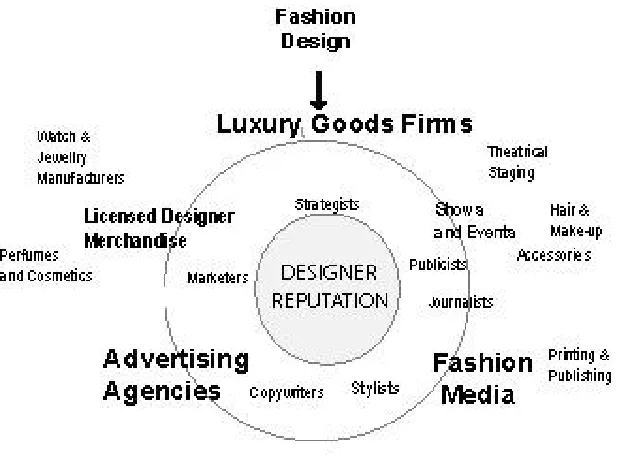
The first part of the thesis explores fashion’s impact on consumer desires and on the production system. In contrast to previous analyses, which have focused on the temporal movement of fashion changes, the discussion emphasises the stylistic aspects of fashion − the knowledges that create fashion styling and the mechanisms by which fashion knowledge diffuses in time and space. It shows that fashions in the globalised media are dominated by the styles of a relatively small number of designers who are located in key cities, who are linked closely to the beauty and media industries through licensing agreements, and whose style authority is protected by intellectual property rights. The uneven penetration of the elite fashions shown in the media generates uneven global landscapes of fashion.
Nonetheless, the elite fashion system provides leadership to the mass production system by orchestrating the fashion trend direction and the timing of fashion seasons. This structure mitigates market uncertainty in the mass production sector. The mass production garment system follows the lead of elite styles, generating a plethora of interpretations, imitations, derivatives and copies depending on producer firms’ relation to intellectual property rights. Through these processes, fashion produces a global hierarchy stratified by style aesthetics, authenticity, production quality and price-income clustering. These segmentations are expressed by firms as fashion brands.
The second part of the thesis examines the restructuring of the Australian garment industries in the 1990s to show how fashion altered the trajectories of firms as they adapted to Australia’s new market-oriented accumulation strategy. These chapters examine changing retail, production and import sourcing frameworks to show how the imperatives of fashion shaped the strategies of firms. Various examples specify how the globalisation of garment production is patterned by the interaction of the world of ideas and knowledges, in fashion, with the world of goods.
ACKNOWLEDGMENTS
Many people have assisted in the preparation of this thesis. My supervisor Peter Sheehan provided an environment that allowed me the flexibility to develop my ideas and priorities. His comments at various stages of the research and writing process were as insightful as they were supportive. Michael Webber provided numerous inspirations to the development and theorisation of the work-in-progress. Our discussions pushed ideas to new stages and directions.
Other people and institutions have given me help and support at different stages of the ongoing research. Victoria University’s Tradedata service provided me with the data sets for analysis in this thesis and in related work. I am grateful to the many people who provided me with information and resources at different parts of the project, especially to people in Australia, Hong Kong and Fiji who gave up their time to explain their roles in the garment industry. Listening to the discussions in the Economic Geography and International Political Economy list-servers connected me to wider intellectual communities that I could possibly access locally.
The Australian Federal Government, through an Australian Post-Graduate Award, enabled me and my children to (barely) survive financially for duration of this project. I am indebted to other sources of funding: Victoria University assisted with annual stipends, and supplemented some of my travel costs. I am also grateful to the Commonwealth Department of Industry Science and Resources, the Woolmark Company, and the Victorian Government and the Australian Council of Trade Unions for providing intermittent consultancy work.
DECLARATION
This thesis contains original research by me, unless otherwise stated in the text. This work has not been submitted previously, in whole or part, in respect of any other academic work. Content that draws on my own previously published work is indicated in the text. The dissertation is less than 100,000 words in length, exclusive of appendices, bibliography and footnotes.
Sally Weller September 2003
...
Copyright in the text of this thesis rests with the author. Copies (by any process) either in full, or extracts, may only be made in accordance with instructions given by the author and lodged with the Victoria University Library. Details may be obtained from the Librarian. This page must form part of any such copies made. Further copies (by any process) made in accordance with such instructions may not be made without permission (in writing) of the Author.
TABLE OF CONTENTS
Abstract………..………. (i)
Acknowledgements………. (iii)
Declaration………... (iv)
Table of Contents……….……… (v)
List of Tables………... (xiii)
List of Figures……….………. (xv)
List of Abbreviations………. ………... (xvii)
CHAPTER 1 Introduction and Overview……… 1
1.1 Globalisation, Clothing and Fashion……….. 2
1.2 Aim and Themes………. 4
1.3 The Scope of Enquiry……….. 5
1.4 Placing the Study in Economic Geography………. 7
1.5 Methodological Approach………... 9
1.6 Field Methods and Analysis 11 1.7 Structure of the Thesis………. 15
CHAPTER 2 Critique Of Geographies Of Garment Production……...…… 18
2.1 Metaphors of Clothing Production…………..………... 19
2.1.1 Market-based Metaphors………...… 21
2.1.2 The New International Division of Labour………..………. 24
2.1.3 Global Commodity Chains……… 26
2.1.4 Networks and Garment Production Districts…………..…... 32
2.1.5 Global Production Networks………..…… 37
2.1.6 Conclusion: Practical Adequacy………. 38
2.2 The Nature of Fashion………. 41
2.2.1 Fashion, Status and Identity………..………. 41
2.2.2 Fashion as Social Knowledge………. 46
2.2.3 The Meaning of Clothes……….. 46
2.2.5 The Value of Meaningful Objects………... 49
2.2.6 Conclusion: Fashion, Value and Knowledge……….. 52
2.3 Fashion and Globalisation………... 53
2.4 Conclusion……….. 56
PART 1 FASHION AND THE PRODUCTION SYSTEM ……….………. 59
CHAPTER 3 Australia In Global Flows Of Fashion Ideas.……… 60
3.1 The Media in Australia……….…….. 61
3.1.1 Fashion on Television………. 62
3.1.2 Fashion in Magazines……….. 65
3.1.3 Advertising as Linkage………... 66
3.1.4 The Media as Image Creation………. 68
3.2 Globalising Fashion: the Case of Marie Claire ……….. 69
3.2.1 Marie Claire and Global Fashion ………... 70
3.2.2 Marie Claire’s Format ……… 71
3.2.3 Marie Claire’s Content ………... 71
3.2.4 Marie Claire and Elite Fashion………... 73
3.2.5 Marie Claire compared to Vogue……… 76
3.2.6 Summation: The Media and Global Elite Fashion………….. 77
3.3 Diffusion and Resistance……… 78
3.3.1 The Penetration of Media Information……… 78
3.3.2 The Effectiveness of Advertising……… 78
3.3.3 Fashion as Hybridisation………. 80
3.3.4 Local Culture?... 81
3.3.5 Conclusion: Global and Local Fashions ……… 85
3.4 Conclusion ………. 85
CHAPTER 4 The Commodification Of Fashion Ideas ……….… 87
4.1 Creating the Landscapes of Fashion……….. 88
4.1.1 Fashion Design……….……….. 88
4.1.3 Fashion as Intellectual Property………..………... 93
4.2 The Restructuring of Elite Design………. 97
4.2.1 Expansion into Licensing………... 98
4.2.2 Restructuring of the Elite Garment Production………….… 101
4.2.3 Corporatisation of the Luxury Goods Sector………... 105
4.2.4 Globalisation of Luxury Goods Sector………... 108
4.3 Fashion’s Coordination of Space and Time………... 110
4.3.1 The Place of Elite Fashion………..……... 110
4.3.2 Fashion Events as Regulating the Rhythms of Fashion…... 112
4.3.3 Clothing’s Place in the Fashion System………. 114
4.4 Conclusion……….……… 115
CHAPTER 5 Fashion Knowledge in Mass Production ……….. 117
5.1 Capturing Fashion Knowledge………..………... 118
5.1.1 The Protection of Complexity……….…... 118
5.1.2 The Transmission of Fashion Knowledge……….………… 119
5.2 Managing Fashion’s Uncertainty ………..……… 120
5.2.1 Elite Fashion Shows as Peer Review ……… 120
5.2.2 The Role of the Cognoscenti ……… 121
5.2.3 Fashion Predictions and Uncertainty ………..….. 122
5.2.4 Fashion Predictions and Production Planning ……….. 123
5.3 The Transmission of Elite Styles into the Mass Market ……….. 125
5.3.1 Sanctioned Copying ………..…… 125
5.3.2 Licensing ………... 126
5.3.3 Designer Ready-to-Wear Ranges ……….. 128
5.3.4 Diffusion Lines ………. 129
5.4 The Transmission of Fashion Styles beyond Elite Firms………. 131
5.4.1 Copies and ‘Knock-offs’……… 132
5.4.2 Imitations ……….. 133
5.4.3 Interpretations ………... 136
5.5 Style Authenticity and Power ………..… 138
5.5.1 Intellectual Property Rights in Production…………... 138
5.5.3 Knowledge and Power………... 141
5.6 Conclusion ………..………. 142
CHAPTER 6 Fashion Ideas, Brands and Firm Strategies……….………... 144
6.1 The Economics of Fashion……….... 145
6.1.1 Fashion Business as Time Competition.. . ………... 146
6.1.2 Fashion Business as Controlling Market Spaces………….... 149
6.1.3 The Basis of Competition 152 6.2 Fashion, Brands and Commodities………... 152
6.2.1 The Nature of Fashion Brands……….……….. 153
6.2.2 Brands and Commodities……….. 154
6.2.3 The Qualities of Fashion Brands………..……….. 155
6.3.4 Brands as Communities of Practice………... 156
6.3.5 Conclusion: The Power of Brands………... 158
6.3 An Articulated Production System………..……. 159
6.3.1 Brandspaces………... 160
6.3.2 Concept Flows………... 161
6.3.3 Translation Flows………... 161
6.3.4 Commodity Flows……….……. 165
6.3.5 Coordinating Multiple Flows……… 169
6.4 The Organisation of Fashion into Firms………... 170
6.4.1. Spatialising Multiple Flows……… 170
6.4.2 Vertical Integration and Disintegration………. 171
6.5 Conclusion……….... 173
PART 2 FASHION’S INFLUENCE ON INDUSTRIAL ORGANISATION AND COMMODITY FLOWS……… 175
CHAPTER 7 Australia’s Internationalisation Strategy………..… 176
7.1 Australian Trade and Industry Policy………. 176
7.1.1 Re-regulating the TCF Sector ………... 179
7.1.2 Managed Change ……….. 181
7.1.4 Contradictory Policy Objectives……….... 183
7.1.5 Conclusion: Australia’s Internationalisation………... 185
7.2 Global Garment Trade ………. 186
7.2.2 Global Trade Patterns ……….. 186
7.2.1 The Effects of Global Trade Regulation ……….. 188
7.3 Regionalised Trading Patterns ………..………. 190
7.4 Conclusion ………... 194
CHAPTER 8 The Restructuring of Australian Garment Retailing…….. 195
8.1 Clothing Markets in Australia ………..………… 196
8.1.1 Aggregate Demand for Garments……….. 196
8.1.2 Changing Demographics ……….. 198
8.1.3 The Capacity to Consume ……….... 200
8.1.4 Segmentation in Market Spaces ……… 200
8.1.5 Summary: Preferences and Demand ………. 202
8.2 The Clothing Retail Sector ……… 202
8.2.1 Department Stores………. 203
8.2.2 Specialty Chains……….... 205
8.2.3 Small Retailers, Boutiques and Local Designers …………. 206
8.2.4 New Retail Forms ………... 207
8.2.5 Summary: Competing Retail Forms ……… 208
8.3 Retail Restructuring ………... 208
8.3.1 Department Stores versus Specialty Chains ………. 209
8.3.2 Changing Market Shares ………... 210
8.3.3 Industry Concentration and Firm Size ……….. 212
8.4 Retailer Power and Retailing Profits……….. 214
8.4.1 The Restructuring of Retail Capital ……….. 214
8.4.2 Retailing and the Capture of Surplus ……… 214
8.4.3 The Production-Consumption Interface………. 217
8.5 Conclusion ……… 217
CHAPTER 9 The Internationalisation of Garment Commodity Flows..… 219
9.2 Effects on Prices and Volumes……… 222
9.2.1 Effects on Clothing Prices………. 222
9.2.2 Price Relativities……….... 224
9.2.3 Import Penetration ……… 225
9.3 Domestic Restructuring and Convergence ……… 227
9.3.1 Local Restructuring……… 229
9.3.2 The Growth of Outworker Production ………..…… 230
9.3.3 Changing Employment Conditions……… 231
9.3.4 Convergence in Business Strategies………..………… 232
9.3.5 Changing Production to Retail Flows……… 235
9.3.6 Price Setting and Margins……….. 236
9.4 International Commodity Flows and Local Specialisation……… 238
9.4.1 Import Strategies……… 238
9.4.2 International Retailers’ entry into the Australian Market….. 240
9.5.1 Patterns of Internationalised Commodity Flows……… 241
9.5 Conclusion ……… 248
CHAPTER 10 Fiji: Capturing Value in Production Networks……… 251
10.1 Background to the Fiji Industry ……… 252
10.2 The Configuration of the Garment Industry in Fiji……… 257
10.2.1 Transnational Branch Plants………...… 258
10.2.2 Australian Offshore Production……….… 259
10.2.3 Fiji’s Independent Producers……….. 259
10.3 Local Relationships in the Fiji Independent Sector……….. 260
10.3.1 Complementary Specialisation………... 260
10.3.2 Production-based Cooperation……… 261
10.3.3 Political Co-operation………. 261
10.3.4 Cultural Commonalities……….. 261
10.3.5 Conclusion: Localised Embeddedness……… 262
10.4 Transnational Relationships in the Supply Chain………..…… 263
10.4.1 Role Definitions………..… 263
10.4.2 The Role of Trust……… 264
10.4.4 Translating Designs into Garments………. 266
10.4.5 Market Risk………. 267
10.4.6 Capturing Value……….. 267
10.4.7 Conclusion: Transnational Networks………. 269
10.5 Events Surrounding the Speight Coup……….….. 270
10.5.1 Changing Conditions……… 270
10.5.2 Altered Perceptions of Risk………. 271
10.5.3 Bargaining and Inter-firm Relationships……….. 273
10.5.4 Restructuring and Industrial Upgrading………... 273
10.6 Conclusion ……… 274
CHAPTER 11 Hong Kong: Capturing Value from Global Flows………… 277
11.1 Background to Hong Kong’s Development……….. 278
11.1.1 Regional Geo-Politics………. 278
11.1.2 Hong Kong’s Local Growth Trajectory………. 279
11.1.3 Global Positioning………. 280
11.1.4 Hong Kong as a Global City……….. 282
11.2 Fashion Knowledge Flows and Garment Commodity Flows………… 282
11.2.1 The Hong Kong-PRD Garment Production Complex…… 283
11.2.2 Fashion-Oriented Export Specialisation………. 285
11.2.3 Hong Kong and Fashion Knowledge……….. 287
11.3.4 Conclusion: Hong Kong in Global Garment Production… 289 11.3 The Role of Hong Kong’s Intermediaries………. 290
11.3.1 Relationships with Globalising Brands……… 290
11.3.2 Intermediaries in the Production System……… 293
11.3.3 Relationships with Production Plants in the PRD………… 297
11.3.4 Cross Border Garment Trade in the PRD 300 11.4 Relationships with Australian Buyers……… 303
11.4.1 Making Up Australian Designs……… 304
11.4.2 Buying Hong Kong Designs……… 304
11.4.3 Price Negotiations……… 306
11.5 Capturing Value: Hong Kong’s Re-export Margin……… 307
CHAPTER 12 Conclusion: Ideas, Commodities and Value ………..……. 311
12.1 Fashion in Garment Mass Production: Summary of Findings………... 312
12.1.1 The Fashion System……… 312
12.1.2 Fashion and Mass Production………. 313
12.1.3 Fashion and Restructuring……….. 315
12.1.4 Fashion and Trade……….………..…… 317
12.2 Power, Profit and The Capture of Surplus Value………... 319
12.2.1 Capturing Value from the Production System…..……….. 320
12.2.2 Inter-Regional Transfers of Value……….. 322
12.3 Implications for Industrial Organisation…………..……… 325
12.3.1 Knowledge in Production and in Place………. 325
12.3.2 Knowledge and Power……… 326
12.3.3 Spatialised Industrial Organisation………..……..… 329
12.3.4 Social Embeddedness……..………...… 331
12.3.5 Regulation and Industrial Organisation………..…… 332
12.5 Further Research ………... 332
12.6 Conclusion ………..……….………. 333
Appendices………. 336
LIST OF TABLES
Table 2.1 Fifteen Main Garment Exporting Nations, 1990 and 1999……... 20
Table 2.2 Limitations of Commodity Chain Analysis……….….. 31
Table 2.3 Metaphors for Clothing Industries ……… 39
Table 3.1 Penetration of Communications Media in Australia……… 62
Table 3.2 Australian Fashion and Transnational Media Groups……... 65
Table 3.3 Advertisements in Marie Claire, April 2000, Four Editions…... 73
Table 3.4 Clothing Designers in Five Marie Claire National Editions…... 74
Table 3.5 Country of Edition and Origin of Clothing Firms………..…... 75
Table 3.6 Most Mentioned Brands, April 2000……… 76
Table 3.7 Leading Designers: Marie Claire and Vogue, April 2000…... 77
Table 4.1 The Spaces of Fashion……….….… 92
Table 4.2 Haute Couture, circa 2000………..…. 97
Table 4.3 Ralph Lauren Licences, circa 1990……….. 99
Table 4.4 Consolidation of Elite Fashion Firms……… 107
Table 4.5 Markets for Luxury Goods……… 109
Table 5.1 Couture, Designer Ready-to Wear and Diffusion Lines………... 130
Table 5.2 Examples of Interpretation ……….…….. 137
Table 6.1 Traditional and Customer Capitalism Compared……….. 151
Table 6.2 Flows in Relation to Space, Time and Uncertainty………... 169
Table 7.1 Growth in Global Garment Trade………. 186
Table 7.2 Garment Import Shares, Selected Countries, 1999………... 187
Table 7.3 Regional Garment Trade as Share of World Apparel Trade……. 191
Table 8.1 Clothing and Footwear in Household Consumption Expenditure 197 Table 8.2 Household Consumption Expenditure, 1993-94………... 199
Table 8.3 Market Segmentation: ‘The Female Persuasion’………..… 201
Table 8.4 Competitive Structure of the Specialty Sector, Australia……….. 206
Table 8.5 Australia’s Clothing Markets………... 208
Table 8.6 Retail Sales of Clothing Sales By Retail Sector……… 211
Table 8.7 Retail Sales: Market Shares by Store Type ………. 212
Table 8.8 Retail Concentration, 1998/99………..………. 213
Table 8.9 Performance of Publicly Listed Clothing Retailers………..…… 215
LIST OF FIGURES
Figure 2.1 The Organisation of Global Commodity Chains …………..… 29
Figure 2.2 Complementarities in Industrial Districts………... 35
Figure 3.1 Fashion Designers in Marie Claire……….……… 72
Figure 4.1 Competing Styles in Fashionspace………. 93
Figure 4.2 The Internationalisation of the Elite Sector………..……. 104
Figure 4.3 The Spring/Summer 2002 Fashion Calendar………. … 113
Figure 4.4 The Fashion Image-Production System………..………… 115
Figure 5.1 Sanctioned Copying……… 127
Figure 5.2 Imitation in the Australian Garment Market……….. 135
Figure 5.3 Knowledge Flows and Mass Production Forms………. 139
Figure 5.4 Fashionspace as a Hierarchy based on Design Authenticity …. 140 Figure 6.1 The Product Cycle for Fashion Garments………. 148
Figure 6.2 Time and Uncertainty……… 149
Figure 6.3 Brands in the Production System……….. 160
Figure 6.4 Concept Flows – Design and Consumption……….. 162
Figure 6.5 Translation Flows – Design and Reproduction………. 164
Figure 6.6 Commodity flows – Production to Consumption……….. 167
Figure 6.7 Firms in Brandspaces ……… 171
Figure 7.1 Regional shares in World Trade in Clothing, 2000……..…….. 190
Figure 7.2 Import Sources, Italy and the United States, 1990-96………... 193
Figure 8.1 Changes in Household Consumption Expenditure………….… 197
Figure 8.2 Change in Population, 1996-2001………... 199
Figure 8.3 Department Stores’ Share of Sales……… 205
Figure 9.1 Retail Prices of Clothing and All Groups, 1973 to 1997…….. 223
Figure 9.2 Price indices for clothing production, 1989-90 = 100……….. 224
Figure 9.3 Clothing Imports and Manufacturers Sales………... 226
Figure 9.4 Market Shares of Australian TCF Producers 1968-1995... 227
Figure 9.5 Parallel Imports of Designer Brands……….. 242
Figure 9.6 Imports by Garment Type, Australia, 1996-99………. 244
Figure 9.7 Port of Loading and Country of Origin, 2000…………... 247
Figure 10.1 Fiji Garment Exports, 1986 – 1997 ……….. 256
Figure 10.3 The Fiji Garment Industry before the Speight Coup………….. 258
Figure 10.4 Revenue, Cost and Profit Margins, Fiji ………. 269
Figure 11.1 Hong Kong Exports of Articles of Apparel and Clothing……... 283
Figure 11.2 Hong Kong Exports by Product Type………..………….. 286
Figure 11.3 Hong Kong’s Outward Processing Trade………... 302
Figure 12.1 Vertical Disintegration and Value Frameworks………. 321
LIST OF ABBREVIATIONS
ABS Australian Bureau of Statistics
ACP Australian Consolidated Press
AFTA ASEAN Free Trade Area ARA Australian Retailers Association
ASIC Australian Standard Industrial Classification
ANZCERTA Australia - New Zealand Closer Economic Relations Trade Agreement ANZSIC Australian and New Zealand Standard Industrial Classification
APEC Asia-Pacific Economic Cooperation ASEAN Association of South East Asian Nations ATC Agreement on Textiles and Clothing
CIF Customs, Insurance and Freight (inclusive of, in trade price)
DCs Developed Countries
EBIT Earnings Before Interest and Tax EDI Electronic Data Interchange EOI Export Oriented Industrialisation
ETMs Elaborately Transformed Manufactures
EU European Union
FDB Fiji Development Bank
FDI Foreign Direct Investment
FOB Free On Board (exclusive of customs, insurance and freight) FTIB Fiji Trade and Investment Board
GATT General Agreement on Tariffs and Trade GCC Global Commodity Chains
GDP Gross Domestic Product
HK Hong Kong
ICS Import Credit Scheme
IPR Intellectual Property Right
JIT Just-in-Time LDCs Less Developed Countries LVMH Möet Hennessy Louis Vuitton
MFA Multi-Fibre Arrangement
NIE Newly Industrialised Economy NIDL New International Division of Labour NTB Non Tariff Barrier
OAP Overseas Assembly Provisions
OBPT Operating Profit Before Tax
OECD Organisation for Economic Cooperation and Development
OEM Original Equipment Manufacture
OPT Outward Processing Trade
PPP Purchasing Power Parity
PRD Pearl River Delta
QR Quick Response
SEZ Special Economic Zone (South China) SITC Standard International Trade Classification SOE State Owned Enterprise
SPARTECA South Pacific Regional Trade and Economic Cooperation Agreement TCF Textiles Clothing and Footwear
TNC Transnational Corporation
TRIP Trade-Related Intellectual Property
UNCTAD United Nations Conference of Trade and Development UNIDO United Nations Industrial Development Organisation VAN Value Added Network
WIPO World Intellectual Property Organisation WTO World Trade Organisation
CHAPTER 1
INTRODUCTION AND OVERVIEW
The fashion clothing industries involve the production, circulation and consumption of garments as material objects and the production, circulation and consumption of fashion as a system of ideas. As these two realms internationalise, the intersections between their respective flows have intensified, instigating new strategies among the world’s garment producers, traders, and retailers. These changes have increased the need to synchronise garment designs and consumer preferences, have encouraged new forms of industrial organisation, and have increased the economic significance of the meanings contained in and conveyed by garments. As these changes alter the nature of firms and the organisation of the world’s clothing industries, structures of regulation are undergoing a complementary transformation – shifting from a reliance on trade barriers that limit flows of material objects to a system of regulation of intellectual property that limit flows of fashion knowledge. This thesis demonstrates that the control of fashion ideas and the intellectual property of clothing design has emerged as a central structuring force over the garment industry’s global configuration.
1.1 Globalisation, Clothing and Fashion
In economic anthropology, cultural studies and cultural geography, garments are viewed as objects saturated with social and cultural meaning. From those perspectives, dress practices are linked reflexively to personal identity, group association and social status. Thus, clothing’s meanings are both complex and inherently unstable, shifting across space and time, and between cultures and places, as fashion moods change.
Clothing’s social role implies that it cannot be viewed as an inert traded commodity. Yet clothing’s meaningful nature has barely been acknowledged in political economy and has never been analysed in relation to the globalisation of the clothing production industries. As a result, existing descriptions or metaphors of the global clothing sector have not adequately theorised how fashion trends, design skills and the control of design-based intellectual property influence the competitiveness of firms and the spatial configurations of the industry. Recognising the power of fashion meaning enables the global garment industries to be viewed as stratified by their different approaches to the management of meaning and by their different positions in relation to the globalising landscapes of fashion ideas. The influence of fashion in the production system can then be examined by tracing the processes by which the meanings embodied in clothing are commodified as commercial fashion ideas and disseminated as mass-produced garments.
As one of the most globalised of the world’s industries, the clothing production industry has been used frequently to illustrate the efficacy of various theories of growth, trade and regional development. Moreover, depending on the particular theoretical prism through which it is viewed— industrial networks, global commodity chains or the ‘new international division of labour’ for example—global clothing production takes on many different appearances. None of these theorisations have adequately described the range of spatial configurations and inter-linkages of clothing industries in the concrete world. While this may demonstrate the contextualised nature of economic organisation, it may also suggest that none of the existing metaphors have taken into account all the factors that produce the observed patterns of trade and industry. Understanding the influence of fashion on the production system improves the capacity to explain how and why clothing industries develop and prosper in some places and not others.
knowledge in the economy (OECD 1996). Comprehending the specific role of fashion knowledge demands untangling the relationship between tacit and codified knowledges, originality, the transformation of knowledge into (intellectual) property and the diffusion of knowledge into consumer preferences and firm strategies. It demands tracing the multiple avenues and scales through which knowledge flows: its different rates and levels of permeability, which in turn depend on the receptivity of audiences. Fashion knowledge intersects with the production system in four aspects: as tacit fashion knowledge circulating in places, as codified and accessible fashion knowledge transmitted through the (global) mass media, as propriety fashion knowledge transmitted organisationally via firms’ brand identities, and as the complex fashion knowledge that is embedded in the design qualities of garments. Knowledge assets are transformed into economic power through the timely coordinated application of these multiple expressions.
Fashion knowledge operates in the production system through shifting valuations of garments in relation to time (in the fashion cycle) and space (in the differences in garment preferences between places) as they traverse geographical, social and cultural boundaries in trade. The Australian case is illuminating because local fashion is separated both temporally and spatially from the global central places of fashion.
By describing how fashion knowledge influences the production system, its forms of industrial organisation and the competitiveness of its constituent firms, this thesis challenges two central contentions of contemporary descriptions of the clothing industry ― the assertion of ‘buyer-led’ dominance in supply chains and expectation that production location is determined primarily by labour costs ― and replaces them with an emphasis on the coordination and synchronisation of material and ideas flows. In that context, surplus accrues to firms that capture the value shift that accompanies garments’ transition between value frameworks. More broadly, this work contributes to an understanding of how ideas and actions intersect across spaces and scales.1
1.2 Aim and Themes
This work explicates how ideas about fashion are incorporated into material objects (clothing) and how the production of fashion meaning influences industrial organisation and shapes the geographies of industrial location, global trade, and the constitution of places. This aim can be broken down into seven questions:
(i) How is meaning imbued into clothing? This question requires an exploration of the social roles of dress and fashion, the processes that put stylistic knowledge into garments, the multiple meanings that clothes embody, and the mechanisms employed by firms to stabilise meaning and knowledge across social and geographical space.
(ii) How are fashion ideas transmitted and diffused globally, across national boundaries, and what are the barriers to their diffusion? This requires identification of the depth and scope of fashion information systems and the variety of institutional and organisational vehicles for the transmission of fashion ideas. It calls for an examination of the interdependences between fashion’s media images and fashion’s product markets.
(iii) How does fashion knowledge get into the production system? Here the focus is drawn to the commercialisation of fashion ideas by firms and to showing how the various adaptations, mutations, embellishments, copies and reproductions spawned by fashion colonise different places and different segments of the consumer market. This involves exploring how fashion knowledge is ‘captured’ by production firms, as intellectual property. It also involves detailing fashion’s influence over the technical aspects of production management.
(iv) How are different aspects of the clothing production system linked to each other? How does fashion influence the construction of their economic and social relations across space and how does that interaction shape the flows of garments between places? Here the focus shifts to examining how different forms of relations within and between firms are linked simultaneously to their positions in both globalising fashion ideas flows and globalising production structures.
(v) How does fashion create value in garments, and how do firms extract surplus from fashion’s value system? This demands exploring how fashion shifts the valuation of garments across times and places, and then showing how shifting value frameworks relate to the extraction of surplus by firms.
(vi) How does the fashion system interact with changing international geo-politics and with the structures of regulation at the sub-national, national and international scales? How do regulations promote or constrain firms’ strategic organisation of clothing marketing and production? The volume and direction of global garment flows are sensitive to changes in national, regional and international regulations and to the economic and political instabilities that arise in places. Focusing on the role of meaning and style stimulates interest in how the global regulation influences the configuration of the fashion landscape and the locations of different aspects of fashion production.
(vii) Why do the configurations of clothing production differ between places, and how do fashion knowledge flows influence agglomerative and dispersive tendencies? This question requires incorporating the effect of fashion into an appreciation of the attraction between industries and places, specialisation, transaction costs and other factors that inform contemporary understandings of industrial location and the processes of regional growth.
In sum, these questions explore the formative role of fashion ideas in industrial organisation, in the space-economy of the garment production industries, and in the creation of value. Refocusing interest on the socially embedded processes that produce and transmit value through the production system and between places and nations challenges the expectation that poor countries can develop their economies through clothing-related industrialisation.
1.3 The Scope of Enquiry
examining globalisation as a process of intersecting global flows of fashion ideas and their materialisations as garments.
Examining the intersection of fashion ideas and fashion commodity flows requires a broader scope than is provided by a conventional definition of the clothing industry as a production sector (Jones 2002), but also a wider view than the usual alternative of focusing at the firm level (Dicken and Thrift 1992, see also Walker 1988). While a sectoral approach ‘focuses attention away from any single firm or role in the sequence of discovering, producing and delivering a product, redirecting attention to the interconnections and interdependences between them’ (Hirsch 2000:356 cited in Power 2002:106), it not does accommodate the influence of flows of ideas that are external to the production sector. Firm level analysis, on the other hand, excludes structural relationships between sectors. The objectives of this project demand a broad perspective, one that encompasses all aspects of the production system relating to both commodity and ideas flows, including the arenas of production, media and consumption. It demands that garments’ content and value is considered across a total trajectory from design to production, through exchange and distribution, to consumption. Such a broad definition transcends the artificial and increasingly inappropriate dichotomies between manufacturing and services (Cohen and Zysman 1987), but also enables the study of firm strategies to be integrated into the context of the system as a whole.
To explicate the role of meanings and ideas in the production system, the study concentrates on a narrow range of commodities known as ‘outerwear’ garments, which constitute the more fashion-oriented segment of clothing industries and markets.2 By this means, flows of garments can be situated simultaneously in multi-level historical contexts and in the structures created to supply specific markets. Not all outerwear is ‘fashionable’, of course, but even the most basic outerwear garments are influenced by fashion trends to some extent (Chapter 2). Related products (such as footwear, jewellery and accessories) and linkages with the textiles production system are excluded from the discussion except when they contribute to the story of outerwear and fashion.
The emphasis on particular commodities allows examination of how their nature plays a role in forming the patterns of their trade pathways.
By dealing with specific industries at specific times and places, this commodity-oriented approach retains many of the advantages of sectoral research. It ensures that empirical research is grounded in reality rather than in the expectations of one or other trade or economic theory (Noponen et al 1993), and enables consideration of the interplay between various forces that together create observed industrial configurations: local place-based mechanisms, national regulations and policies, international agreements, firm authority, tensions between political and market forces, and international geo-political conditions.
However, how the effects and importance of these factors are interpreted depends to an extent on the perspective of the observer. Viewed from Australia, processes that appear in the Northern Hemisphere as self-evidently true are frequently at odds with (Southern Hemisphere) reality (Larner and Le Heron 2002). Therefore, this project commences from an awareness of positionality in relational space/time configurations within the global economy, which Sheppard (2002:307) views as ‘shaping and shaped by the trajectories of globalisation and as influencing the conditions of possibility of places’. When global garment trading patterns and fashion trends are viewed from a specific vantage point (Australia), they appear coherent socially and spatially, rather than as a chaotic mess of 'complexly multi-linear flows’ (Pred and Watts 1992: xv). Accordingly, the study examines the configuration of Australian clothing supply systems in the years 1990 to 2000.
1.4 Placing the Study in Economic Geography
how, why and when firms are embedded socially, organisationally and geographically, how they capture and exploit knowledge, and how the nature of commodities influences that way in which firms interact. 3
While this work contributes to an economic geography grounded in political economy, it consciously engages with cultural geography, anthropology, cultural studies and sociology: shifting meanings and values, material cultures, the relation between objects and the virtual worlds of images. As Pred (1996:12) observes, the economic, cultural and social dimensions are ‘interarticulated, enmeshed and mutually constituted’. The overall approach has been influenced by the notion of intersecting global flows (Appadurai 1986a, 1996, see also Thrift and Olds 1996, Olds 2001), previous studies of material cultures (Cook and Crang 1996, Crang 1996), and previous interrogations of the political economy of fashion and clothing industries (Davis 1992, Fine and Leopold 1993). In addition, it draws on an economic geography that incorporates cultural analysis (Schoenberger 1997, Gertler 1997, 2002, Thrift and Olds 1996), incorporates insights from geography’s ‘cultural’ turn (Jackson 1989, 1993, Jackson and Thrift 1995) and from cultural studies (Miller 1995, Slater 1997, Edwards 2000, Mitchell 2000). These diverse strands are accommodated through a perspective that appreciates both structural relations and contextualised action, that focuses on relational power geometries (Massey 1993), that recognises the multiple forms and practices of power (Allen 2000), and that insists on the continuing relevance of cause (Yeung 2002a). This thesis contributes to five contemporary debates in economic geography:
(i) Examining how the meanings that accompany objects shape industry structures and trade flows enhances geography’s understanding of globalisation processes (Angel 2002).
(ii) Illuminating the interplay between production and the market contributes to the continuing debate about the relationship between manufacturing and services, and production and consumption (Lash and Urry 1987, 1994, Cohen and Zysman 1987, Harvey 1990, Fine and Leopold 1993).
3 The notion of embeddedness refers to the ways in which economic, social and political
(iii) Interrogating how fashion ideas influence production and trade contributes to a better understanding of the economic significance of ideas and knowledge flows (Bryson et al 2000, Boisot 1998, Gertler 2002).
(iv) Thinking about how the ideas embodied in and surrounding objects shape the strategies of firms and their interactions introduces hitherto under-examined influences on firm strategy, inter-firm networks and place-bounded competitiveness.
(v) Understanding fashion meaning as a source of power and profit linked to trans-national shifts in perceptions of value enables more accurate specification of the processes that shape global commodity flows and the extraction of surplus.
Consciously combining the ‘cultural’ and ‘economic’ spheres in a manner that maps culturally-embedded powers enable thinking about industry, trade and economic development in a manner informed by political economy but attuned to contemporary criticisms of it.4 In addition, the approach strives to introduce to economic geography a deeper appreciation of the economic significance of phenomena that are associated with ‘women’s’ interests. While feminist geographers have rejected the masculinist paradigm (Gibson-Graham 1996), and have documented the disadvantaged economic position of women (Hanson and Pratt 1995), mainstream economic geographies continue to marginalise issues concerned with ‘women’s’ interests.
1.5 Methodological Approach
This work adopts a critical realist ontology and methodological framework, but it rejects the dogged materialism that is sometimes associated with realist scholarship. Critical realism sees the world as open, structured, dynamic and holistic, and as existing independently of our knowledge of it (Bhaskar 1997[1975], Fleetwood 1999, Lawson 1997, 1999, Pratt 1995, Sayer 1985a, 1992, see Appendix A). Central to a critical realist perspective is the notion that entities have powers that may or may not be exercised, depending on contextual conditions or contingencies. Since power is a capacity, how it operates is always an empirical question. Because it recognises non-material agents as having the potential to act as causal forces, critical realism provides a suitable
framework for examining how non-tangibles like fashion ideas act in the global garment trading system. According to Yeung (1995), the advantages of a critical realist approach include its capacity to:
(i) Incorporate the role of society and culture in shaping economic outcomes;
(ii) Recognise the diversity of economic formations and address how they arise and change;
(iii) Emphasise the role of space as constitutive of economic phenomena;
(iv) Focus on concrete, historically specific phenomena, and avoid fetishising transient and contingent social forms;
(v) Interrogate the role of the state in shaping industrial configurations and the behaviour of economic actors;
(vi) Avoid abstractions that confuse or conflate necessary with contingent conditions. From a critical realist perspective, research method 'covers the clarification of modes of explanation and understanding, the nature of abstraction, as well as the familiar subjects of research design and methods of analysis’ (Sayer 1992:3). Empirical research in a realist framework does not merely focus on regularities in data but asks what conditions must hold if the observed regularities are to actually occur (Sayer 1992:122). In this context, sampling must be representative of the key causal processes and mechanisms identified by the research questions. Since causation is concerned with necessity rather than universality or regularity, correlations between variables are not sufficient to assert a causal connection without other supporting evidence. The aim of research, then, is explanation rather than prediction: future occurrences can only be predicted where the necessary and sufficient conditions for the event to occur are known (Sayer 1992:131). It follows that research claims allow for fallibility. Rather than locating a timeless ‘truth’, critical realism instead employs the notion of 'practical adequacy’ – the idea that analyses must generate expectations of the world that are actually realised, be inter-subjectively intelligible, and be acceptable in terms of linguistic expression (Sayer 1992:69). Critical realism therefore relies on corroboration and convergence of different types of evidence. The validity of conclusions does not rely on replication, which has questionable utility in dynamic social contexts, but instead stresses identifying whether particular causal powers are realised in time- and place-specific contexts.
qualitative, as indicated by the different strands of inquiry, and which in turn derive from the research questions (Massey and Meegan 1985).5 Each strand of the research is interconnected and informs the others, enhancing the validity of findings through a process of triangulation (Webb et al 1965). Integrating the discussion with relevant literatures strengthens the validity of interpretations. The reliability of conclusions is enhanced by attention to the technical aspects of data collection and by comparison with other studies.
Critical realism anticipates an iterative research process in which case studies clarify understanding and in turn shape future research agendas (Angel 2002). Accordingly, this work builds on previous studies of the clothing sector in Australia (Webber and Weller 2001a), its forms of restructuring (Weller 1999) and modes of internationalisation (Weller 2000a) to examine Australia’s positioning in the fashion system at a global scale.6
1.6 Field Methods and Analysis
This section describes how the study of fashion’s role in garment production was conducted in practice. It discusses how and why different methods were used in the empirical research and provides and overview of how the data were collected, interpreted and analysed. A critical realist perspective supports the identification of methods that are the most appropriate to the research questions while at the same time pursuing a critical and cautious methodology that seeks to explore and contrast multiple perspectives to arrive at ‘practically adequate’ conclusions. Morrow (1994) argues that critical methodology must include three components: (1) logics-in-use; (2) historicist and deconstructive reflexivity; and (3) existential reflexivity (which refers essentially to
5 Empirical analysis is crucial to theory building: ‘(T)heories make their strongest claims at the abstract level about necessary or internal relations, and about causal powers, or in other words, about necessity in the world. Where relations between things are contingent, their form must always be an empirical question, that is, one which must be answered by observing actual cases’ (Sayer 1992:143).
insider knowledge). The idea of logics-in-use validates methods-in-use by critical reflection on the research questions and tentative evidence, so that logics operate as heuristic devices.
The research questions posed in Section 1.4 span diverse realms and as such present challenges for research design and data collection. A critical realist approach implies the deployment of multiple methods – both intensive and extensive – to collect, analyse and present information (Sayer 1984, Pratt 1995). This project’s multi-strategy approach deployed different mixes of methods in different parts of the research. As the project developed, it became increasingly clear that while quantitative investigation could establish the facts about patterns of international clothing sourcing, it would be necessary to rely on qualitative methods to answer the ‘why’ and ‘how’ of commodity chain and network relationships.
The third of Morrow’s (1994) three fundamental research elements – existential reflexivity – was in abundant supply in this study, which commenced after the author had been engaged in research on the Australian textiles, clothing and footwear industries for a number of years. As such, the project was grounded in extensive knowledge of the situation of the Australian industry, the networks of information and resources on which it relied, and the dominant explanations for its situation at the turn of the millennium. The author’s considerable ‘insider’ knowledge of how the industry operated both in Australia and overseas produced the seeds of an understanding of Australia’s peripherality in economic relations which subsequently framed the selection of questions, methods, approaches and research sites.
The decision to focus the field research on Australian firms’ immediate links into Fiji, Hong Kong and China enabled the work to focus on the nature of links and their relations to the fashion industry, while at the same time highlighting the commonalities in firms’ strategic approaches.
The research program comprised three distinct and sequential aspects – understanding fashion, explicating how fashion influenced the restructuring of the Australian industry, and finally understanding how fashion shaped international clothing production supply chains.
(i) The first component – understanding fashion – relied on desk research exploring the structures of ownership and control in the global fashion complex and Australia’s role within it. This part of the work includes a quantitative ‘content analysis’ of Australian fashion magazines to demonstrate the depth of the global influences over Australian fashion. It also draws extensively on secondary data from a range of inter-disciplinary sources to introduce new interpretations.
Australian industry draw on qualitative interviews with key firms which focused on understanding the Australian clothing industry’s position in the global fashion complex.
Each of the field components of the research was strengthened and validated by the incorporation of data from various secondary and statistical sources. Published statistics were most useful when describing national systems of clothing production and clothing trade flows, but their structure made it difficult to identify the relationship between commodity trade flows and the international patterning of the fashion system. During the course of the project newspaper clippings, company reports and stock market analysts’ assessments of the main companies operating in the clothing and fashion industries in Asia and Australasia were collected and analysed. These provided an additional check on the veracity of interview data and also informed the analysis and theory development process. Desk research at the University of Hong Kong and University of the South Pacific (Suva) introduced materials and perspectives that were not available in Australia and repositioned the author’s localised (Australian) perspective. The Fiji Reserve Bank provided detailed unpublished data on the development of the Fiji clothing industry.
Numerous texts are available to guide the analysis of qualitative data. The nature of the research questions, and the explicit intention to suspend a priori acceptance of either ‘chain’ or ‘network’ understandings of industrial organisation (Chapter 2) promoted the use of a ‘grounded theory’ approach to qualitative analysis (Strauss 1987), in which understanding emerges from the data in a process of iteration. This approach fits well with a critical orientation. The analysis also drew extensively on techniques to summarise, categorise and map the relationships between different concepts arising from the data (Miles and Huberman 1984).
To conclude this section, what follows is the outcome of a multi-stage and multi-method research program spanning three nations. The work transcends the artificial division between qualitative and quantitative methods in an effort to arrive at an explanation which provides – to the satisfaction of an author embedded in the complexities of this industry – a practically adequate explanation of its global configurations.
1.7 Structure of the Thesis
regional scales requires a multi-layered approach that spans multiple levels and connects inter-related themes. It is difficult, therefore, to select an entry point that will satisfy the pragmatic desire to develop a coherent presentation and at the same time respect the complexities of the task. Bell and Valentine (1997) resolve the problem in their study of food consumption practices by beginning with the body, moving ‘up’ through various consumption sites (household, locality, culture), to end with global production frameworks. Du Guy’s (1996) collection describing ‘cultures of consumption’ reverses the sequence by starting with sites of global production and working ‘back’ to the body. Neither adequately addresses the complex differentiations that arise within and between scales (see Allen et al 1998). To accommodate the complexity of the task, this thesis comprises two parts: the first develops an understanding of the global fashion system’s influence on production, while the second applies that understanding to the Australian garment industries’ positions in global commodity flows. The sequence of chapters is:
1. Introduction and Overview
2. Critique of Geographies of Clothing Production. PART 1 Fashion and the Production System
3. Australia’s Position in Global Flows of Fashion Ideas 4. The Commodification of Fashion Ideas
5. Fashion Knowledge in Mass Production 6. Fashion in Brands and Firm Strategies
PART 2 Fashion’s Influence on Industrial Organisation and Commodity Flows 7. Australia’s Internationalisation Strategy: Engaging the Global Economy 8. Restructuring of Australian Garment Retailing
9. The Restructuring and Internationalisation of Garment Commodity Flows 10. Fiji: Capturing Value in Production Networks
11. Hong Kong: Capturing Value from Global Flows 12. Conclusion: Ideas, Commodities and Value
CHAPTER 2
CRITIQUE OF GEOGRAPHIES OF
GARMENT PRODUCTION
In economic geography, the configurations of production systems and the internationalisation of industries have been viewed as the outcome of multiple forces, including firms’ exploitation of the uneven geographies of production costs, the incentives and disincentives created by regulation, technological change, specialisation of firms and labour markets and the ‘spatial fix’ unrecoverable costs (Smith 1984, Clark et al 1986, Sheppard and Barnes 1990, Sayer and Walker 1992, Dicken 1992, Clark and Wrigley 1997). In recent times, influenced by ‘new’ institutional and ‘actor-network’ theories, economic geography has directed its attention to the scope of firms or groups of firms, to their (networked) inter-relationships, their spatial expressions and the operation of power and knowledge. Different accounts or metaphors explaining the global configuration of the clothing industries have incorporated these forces, in various combinations, with different degrees of success in terms of explaining the patterns of garment production and the trade flows that are observed in the concrete world.
This chapter demonstrates that a practically adequate understanding of the global garment industries requires a broader scope − one that understands the configuration of the production system in the context of the ideas promoted by the global media industries and the changing nature of the consumer market; which incorporates the manner in which fashion trends influence the strategies of firms, the power relationships between firms, the nature of commodities and the spatial organisation of both the production of fashion and fashion in production. The chapter begins by describing critically different ‘ways of seeing’ or metaphors of the garment production industries.1
The discussion highlights their common interest in the interplay between power, knowledge and the capacity to capture profit, and also their common disinterest in the influence of fashion trends on the production system. Section Two introduces the literature of fashion, exploring the complex interconnections between clothing preferences, fashion, personal identity and social status. It discusses the implications of fashion for the garment production system and specifies the issues that have been ignored by existing accounts − the timing of production cycles, the nature of commodities, the relationship between production and consumption and the synchronisation of production to shifting demand. Existing metaphors have not considered how the material production of garments is related to the cultural production of fashion, or how the interaction between fashion industries and production influences industrial location decisions and patterns of trade. Section Three concludes that by viewing fashion trends as global flows of ideas, which interact with global flows of garments, the garment sector illuminates broader questions about the processes associated with globalisation.
Overall, by building explicitly from the gaps in antecedent scholarship, this chapter provides a starting point for a re-conceptualisation of the clothing industries that visualises fashion as a landscape that both grounds and sustains the garment production industries.
2.1 Metaphors of Garment Production
change processes. The discussion explores each metaphor’s conceptualisation of garment production firms, their inter-relationships, and the manner in which each envisages clothing production’s embeddedness in social, cultural, economic, political and regulatory frameworks.
From a critical realist perspective, the crucial test of an explanation’s efficacy is its capacity to explain concrete phenomena. Recent garment export trends for the world’s fifteen main garment exporting countries highlight the diversity of the world’s garment production locations. Table 2.1 shows that China has become the world’s largest clothing exporting nation, but that Italy – a high wage European nation – is the world’s second largest exporter. Hong Kong – one of the most affluent cities in East Asia – has significant domestic garment exports in addition to its re-exporting of garments from China: Hong Kong re-exports and exports are the world’s third and fourth largest garment exporters.
Table 2.1 Fifteen Main Garment Exporting Nations, 1990 and 1999 (SITC 84, Rev 3).
Country 1990 1999 Change 1990-99
$US m $US m $US m %
China (b) 9669 30078 20409 211
Italy 11838 13240 1402 12
HK re-exports 6140 12800 6660 108
HK dom. Exports 9266 9571 305 3
United States 2564 8793 5705 223
Mexico 587 7805 7218 1230
Germany 7881 7441 -440 – 6
Turkey 3330 6516 3186 96
France 4670 5690 1020 22
Korea, Rep. of 7878 4871 – 3007 – 38
United Kingdom 3041 4487 1446 48
Indonesia 1646 3857 2211 134
Thailand 2816 3449 633 22
Portugal 3490 3151 -339 – 10
Taipei 3987 2883 – 1104 – 28
Source: WTO (2000) International Trade Statistics, Table IV 81.
Taiwan) are declining. In addition, exports from medium wage countries that are located close to high wage countries – places such as Mexico and Turkey – are increasing in magnitude, apparently at the expense of production sites further from western markets (Chapter 9). The sections below appraise critically different metaphors of garment production in terms of their capacity to explain both the localisation and globalisation of garment production industries.
2.1.1 Market-based Metaphors
Market-based views of the clothing industry understand economic processes in terms of the allocation of scarce resources among alternative uses. The market establishes the optimal allocation following the law of diminishing returns (Jevons 1957[1871], Samuelson 1980).2 From this perspective, garments are simple manufactured commodities whose tradability and value is established through bargaining between buyers and sellers. Economic transactions are assumed to occur between independent and autonomous buyer and seller firms whose actions are motivated by profit seeking. Industries and economies are imagined as comprising aggregates of large numbers of (small) producers that interact in trade, but that do not exert market power.
Regarding the location of production sites, neo-classical industrial location theory views location choices as a function of the costs of inputs (labour and materials), transportation, and other transaction costs incurred shifting inputs to productions site and outputs to markets (Weber (1971[1909]). Transaction cost economics adds to this equation the costs of doing business across geographical space, particularly the cost of maintaining relationships between buyers and sellers (Williamson 1971, 1975). Since clothing manufacture has low capital intensity and modest technological demands (Hoffman and Rush 1988), market forces favour clothing production in places with plentiful, low cost labour.
In this conceptualisation, explanations of the internationalisation of garment industries rely on Ricardo’s (1981[1817]) theory of comparative advantage,
complemented by Hecksler and Ohlin’s (1991) factor-proportions extension, which demonstrates logically that nations benefit from trading in goods produced using their abundant factors. Thus, countries where capital is expensive relative to the price of labour have a comparative advantage in producing labour intensive goods (and vice-versa). Comparative advantage is essentially a theory of specialisation where dynamic gains accrue from specialisation-derived economies of scale; gains from trade are realised when factor price differences exceed the costs of moving goods between nations. Following this logic, export-oriented industrialisation policies in numerous less developed countries have encouraged clothing production as the first step in a sequential development process (Toyne et al 1984, World Bank 1995).
Because in this metaphor gains from trade derive from national differences in factor prices, a market-driven allocation process with minimal government interference achieves optimal outcomes. It follows that the increasing volumes of world trade in garments over the last twenty years (see Table 7.1) is understood as the outcome of technological advances (primarily in transport and communications) and trade barrier liberalisations that have reduced transaction costs and enabled market forces to operate more efficiently. Accordingly, studies of international clothing trade conducted within this metaphor emphasise the (adverse) effects of trade restrictions and other governmental ‘distortions’ of market processes (for example, Keesing and Wolf 1980, Wolf et al 1984, Mody and Wheeler 1987, Cline 1990, Anderson 1992, Trela and Whalley 1990, Industry Commission 1997).
The neo-classical metaphor provides an insufficient explanation of the clothing industries’ industrial structures and global trajectory. Its assumption of perfect competition rarely holds in the clothing sector, since market segmentation creates price inelasticies and encourages the emergence of quasi-monopolistic firms. Its focus on the forces of supply and demand overlooks temporal and spatial causes or reduces them to differences in the prices of capital, labour or transport.3 The historical development of society and the conflictual economic and social processes that generate wealth are ignored (Johnston et al 1994:150). The narrow focus on ‘economic’ relationships
excludes consideration of the social, cultural and political processes that influence the production system through fashion trends. Because garments are commodities whose prices are the sum of their inputs plus a mark-up (the magnitudes of which depend on the interaction of supply and demand), the structure of the consumer market and the effects of fashion are excluded from its worldview.
In garment trade, moreover, the assumptions underpinning comparative advantage rarely hold true: technologies are seldom the same between countries (Birnbaum 2000); the factors of production (especially capital) are not immobile (Corbridge et al 1994), and mobile capital does not necessarily flow to places with lower production costs (Sheppard and Barnes 1990). Clothing’s highly segmented markets undermine the assumption of constant returns to scale, and clothing prices (in the fashion-oriented parts of the market) are rarely a simple mark-up over the costs of production (Hufbauer and Chilas 1974, Storper 1992, Webber and Weller 2001a). In addition, comparative advantage’s orientation, which considers trade relationships at the national scale between ‘national’ industries, is at odds with the global or supra-national strategies of transnational business (Hoogvelt 1982, Barnet and Cavanagh 1994).
In an extension of neo-classical economics, Krugman (1979, 1995) and Krugman and Venables (1995) build on Marshallian locational economies of agglomeration and the expectation of increasing (rather than decreasing) returns to model trade in terms of market power and market size in conditions of monopolistic competition.4 By demonstrating the influence of market power, their models highlight the competitive advantages that accrue from specialisation and path dependent cumulative growth (see also Arthur 1996). Accordingly, strategic trade theory explains the high levels of intra-nation garment trade within high wage countries in terms of multiple markets for differentiated products which span large geographical areas. It also explains the growth of cross-border production in places like Mexico in terms of intra-industry trade, which also reflects place-based specialisation (Hanson 1996). However, the new spatialised models popularised in Krugman (1995) reduce space to transaction costs, lack of predictive utility, and overly abstract economic processes (Sheppard and Barnes 1990, Barnes 1996, Martin and Sunley 1996, Sheppard 2000). While the competitive advantages of large markets and powerful regions are familiar to
geographers (Myrdal 1957, Pred 1966), Krugman’s approach of forcing increasing returns into equilibrium models creates problems that do not arise in disequilibrium models such as those developed by Webber and Rigby (1996).
2.1.2 The New International Division of Labour
Labour process theories such as the New International Division of Labour (NIDL) have been an influential tool for understanding the configuration of global garment production (Fröebel et al 1980). The NIDL, like the neo-classical view, focuses on factor price differences; but it emphasises firms’ exploitation of national inequalities as they vertically disintegrate production and relocate labour intensive tasks to low wage sites.5 Thus, the NIDL is simultaneously an explanation of the de-industrialisation of ‘old’ industrial regions in advanced economies and an explanation of the industrialisation of the Newly Industrialised Economies in Asia (NIEs). Since the NIDL minimises labour costs and maximises labour control, it can be understood as an internationalisation of the Babbage principle: reducing labour costs through the fragmentation of tasks and their allocation to workers based on the minimum level of required skill (Elson 1986, see also Jenkins 1984). From this perspective, the expansion of clothing production in less developed countries is the outcome of a crisis of accumulation in the advanced economies, where, to restore profitability in the face of high labour costs and union power, firms either intensified or automated production in situ, or relocated their production functions to low wage countries. Since there are limited opportunities for the automation of garment manufacture (Hoffman and Rush 1988), relocation is the dominant strategy.
At the core of NIDL is the clothing industry’s exploitation of ‘cheap’ labour, especially through the commodification of women’s labour (Mitter 1986b, Benería and Roldán 1987, Elson 1989, 1994b, Robotham and Mitter 1994). Popular exposés of exploitative practices in global garment production (Ross 1997, Klein 2000, Blowfield