International Journal of COPD
Predictive properties of different multidimensional
staging systems in patients with chronic
obstructive pulmonary disease
Toru Oga1
Mitsuhiro Tsukino2
Takashi Hajiro3
Akihiko Ikeda4
Koichi Nishimura5 1Department of Respiratory Care
and Sleep Control Medicine, Graduate School of Medicine, Kyoto University, Kyoto, Japan;
2Department of Respiratory Medicine,
Hikone Municipal Hospital, Hikone, Japan; 3Department of Respiratory
Medicine, Tenri Hospital, Tenri, Japan;
4Department of Respiratory Medicine,
Nishi-Kobe Medical Center, Kobe, Japan; 5Department of Respiratory
Medicine, Rakuwakai Otowa Hospital, Kyoto, Japan
Correspondence: Toru Oga
Department of Respiratory Care and Sleep Control Medicine, Graduate School of Medicine, Kyoto University, 54, Kawahara, Shogoin, Sakyo-ku, Kyoto, 606-8507, Japan
Tel +81 75 751 3852 Fax +81 75 751 3854
Background: Chronic obstructive pulmonary disease (COPD) is considered to be a respiratory disease with systemic manifestations. Some multidimensional staging systems, not based solely on the level of airflow limitation, have been developed; however, these systems have rarely been compared.
Methods: We previously recruited 150 male outpatients with COPD for an analysis of factors related to mortality. For this report, we examined the discriminative and prognostic predictive properties of three COPD multidimensional measurements. These indices were the modified BODE (mBODE), which includes body mass index, airflow obstruction, dyspnea, and exer-cise capacity; the ADO, composed of age, dyspnea, and airflow obstruction; and the modified DOSE (mDOSE), comprising dyspnea, airflow obstruction, smoking status, and exacerbation frequency.
Results: Among these indices, the frequency distribution of the mBODE index was the most widely and normally distributed. Univariate Cox proportional hazards analyses revealed that the scores on three indices were significantly predictive of 5-year mortality of COPD (P , 0.001). The scores on the mBODE and ADO indices were more significantly predictive of mortality than forced expiratory volume in 1 second, the Medical Research Council dyspnea score, and the St. George’s Respiratory Questionnaire total score. However, peak oxygen uptake on progressive cycle ergometry was more significantly related to mortality than the scores on the three indices (P , 0.0001).
Conclusion: The multidimensional staging systems using the mBODE, ADO, and mDOSE indices were significant predictors of mortality in COPD patients, although exercise capacity had a more significant relationship with mortality than those indices. The mBODE index was superior to the others for its discriminative property. Further discussion of the definition of disease severity is necessary to promote concrete multidimensional staging systems as a new disease severity index in guidelines for the management of COPD.
Keywords: COPD, multidimensional staging systems, BODE index, ADO index, DOSE index
Background
Chronic obstructive pulmonary disease (COPD) is now considered as a respiratory disease with systemic manifestations.1 COPD first affects the lungs primarily, and
then structural and functional changes also take place in other organs. The degree of airflow limitation as defined by forced expiratory volume in 1 second (FEV1) has been used as an index of disease severity, partly because of its significant relationship with mortality.2,3 Guidelines indicate that some multidimensional staging systems
Dove
press
O R I G I N A L R E S E A R C H
open access to scientific and medical research
Open Access Full Text Article
International Journal of Chronic Obstructive Pulmonary Disease downloaded from https://www.dovepress.com/ by 118.70.13.36 on 22-Aug-2020
For personal use only.
Number of times this article has been viewed
This article was published in the following Dove Press journal: International Journal of COPD
disease severity,1,4 although the definition of disease severity
remains elusive.
The BODE index, incorporating measurements of nutrition, airflow limitation, dyspnea, and exercise capacity, has been established for multidimensional staging.5 It is
use-ful in predicting mortality and hospitalizations and in reflect-ing disease modification and progression.6 More simplified
indices such as the ADO index, composed of age, dyspnea, and airflow limitation,7 and the DOSE index, composed of
dyspnea, airflow limitation, smoking status, and exacerba-tion frequency,8 have been developed recently and have been
validated. In two European cohorts, both the ADO index and the updated BODE index significantly predicted the 3-year mortality risk after the first hospital admission due to an exacerbation of moderate-to-severe COPD, although the original BODE index did not accurately predict such a risk.7 The DOSE index was related to a range of clinically
important outcomes of COPD such as health status, hospi-tal admission, or respiratory failure, and was predictive of exacerbations.8 Although some multidimensional staging
systems have been developed recently, these indices have rarely been compared.
More information about the properties of these indices or relationships is needed so that they can be better used in clinical practice or trials and, furthermore, be adopted concretely in the guidelines in future. We hypothesized that the BODE, ADO, and DOSE indices would be useful as predictors of mortality in COPD, but that they would have some different characteristics. We previously examined the factors related to 5-year mortality using multiple measure-ments in patients with COPD.9 In the present study, by
reviewing those data, we analyzed the discriminative and predictive properties of those multidimensional indices in patients with COPD.
Materials and methods
Patients
We previously recruited 150 consecutive male outpatients with COPD and analyzed factors related to mortality.9
Entry criteria included (1) smoking history of more than 20 pack-years, (2) maximal FEV1/forced vital capacity ratio of less than 0.7 and prebronchodilator FEV1 of less than 80% of the predicted value, (3) regular attendance at Kyoto University, Kyoto, Japan, outpatient clinic over 6 months, (4) no uncontrolled comorbidities, and (5) no COPD exac-erbations over the preceding 6 weeks. The study protocol was approved by the institutional ethical committee of Kyoto University.
Measurements
Pulmonary function tests were performed at least 12 hours after the withdrawal of inhaled bronchodilators.9 Patients
performed spirometry at 15 and 60 minutes after inhaling salbutamol (400 µg) and ipratropium bromide (80 µg) using a metered-dose inhaler with a spacer device.
Exercise tests were performed on symptom-limited progressive cycle ergometry 60 minutes after the inhalation of bronchodilators as described in detail previously.9–11 Patients
wore a face mask and began unloaded pedaling for 3 minutes, after which the workload was increased progressively by an increment of 1 W every 3 seconds to the limit of tolerance. The exercise data were recorded with an automated exercise testing system. Peak oxygen uptake (Vo2) that was reached
during exercise was calculated. Predicted values were cal-culated using the standard equation.12,13
Dyspnea was evaluated by the Japanese version of the modified Medical Research Council (MRC) dyspnea scale, which is a 5-point scale (0–4) based on degrees of various physical activities that precipitate dyspnea.14,15
Higher scores on the MRC indicate more severe dyspnea. Health status was assessed by the Japanese version of the St. George’s Respiratory Questionnaire (SGRQ).9,16,17 The
SGRQ consists of 50 items divided into the three components of symptoms, activity, and impacts, and the total score was calculated with scores ranging from 0 to 100. Higher scores on the SGRQ indicate a more severe health status.
Multidimensional staging
The BODE index was principally based on the original report5 whose score comprises the body mass index (BMI),
percentage of the predicted FEV1, dyspnea by the MRC, and 6-minute walking distance (6MWD) as an exercise capacity component. Scores ranged from 0 (best status) to 3 (worst status) for FEV1 and MRC, and 0 or 1 for BMI. In the present study, we employed the modified BODE index (mBODE), which used Vo2 as % predicted, as tested by the progressive cycle ergometry instead of the 6MWD, and was previously developed and validated.18,19 The % predicted was scored as
follows: score 0 for .70% predicted, score 1 for 60%–69% predicted, score 2 for 40%–59% predicted, and score 3 for 40,% predicted. Points for each component were added together so that the mBODE index ranged from 0 to 10.
The ADO index was calculated based on the original report,7
with the score comprising age, dyspnea by the MRC, and FEV1. Scores ranged from 0 (best status) to 5 (worst status) for age, 0–3 for MRC, and 0–2 for FEV1. Points for each component were added so that the ADO index ranged from 0 to 10.
Dovepress Oga et al
International Journal of Chronic Obstructive Pulmonary Disease downloaded from https://www.dovepress.com/ by 118.70.13.36 on 22-Aug-2020
The DOSE index was calculated primarily based on the original report,8 with scores comprising dyspnea by the MRC,
FEV1, smoking status, and exacerbation frequency per year. Scores ranged from 0 (best status) to 3 (worst status) for MRC, 0–2 for FEV1 and the exacerbation frequency, and 0 or 1 for smoking status. In the present study, the modified DOSE (mDOSE) index was calculated using the question “During the last year, how many severe or very unpleasant attacks of chest trouble have you had?” on the SGRQ, instead of exacerbation frequency over the previous year as indicated in the original manuscript.8 Points for each component were
added so that the DOSE index ranged from 0 to 8.
Statistical analysis
Results were expressed as mean ± standard deviation, unless otherwise stated. Relationships between the mBODE, ADO, and mDOSE indices were analyzed by Spearman’s correla-tion coefficient tests. The survival status of all patients after 5 years was assessed. The duration from entry to the last attendance or death was recorded. Univariate and multivari-ate Cox proportional hazards analyses were performed to investigate the relationships between the clinical measure-ments and mortality. Results of regression analyses were presented in terms of estimated relative risks (RR) with cor-responding 95% confidence intervals. P-values of less than 0.05 were considered to be statistically significant.
Results
Baseline characteristics of the 150 male patients with stable COPD are shown in Table 1 and elsewhere.9 Their average
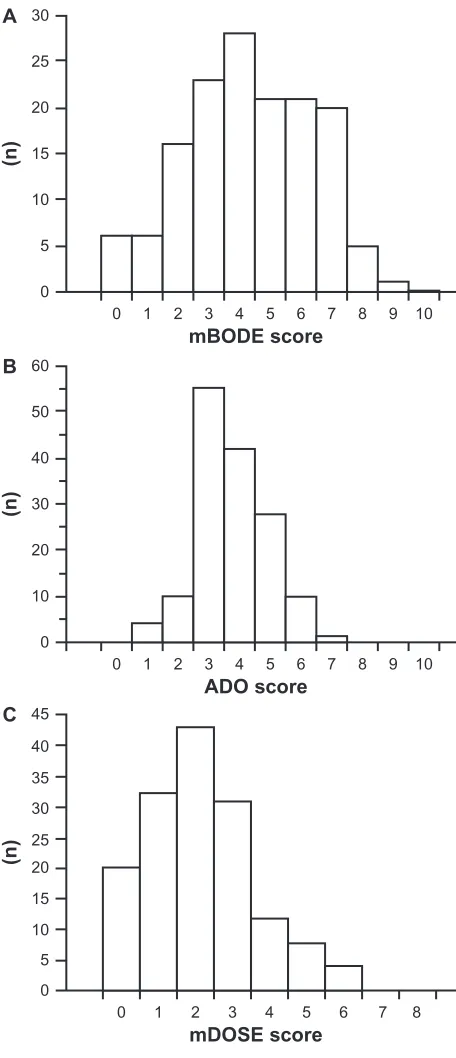
age was 69 ± 7 years and the postbronchodilator FEV1 was 47.4% ± 17.4% predicted. The frequency distributions of mBODE, ADO, and mDOSE scores are shown in Figure 1. The histograms showed widely and virtually normal distribu-tion of the mBODE scores. The ADO scores were more nar-rowly distributed than the mBODE scores, with 55 patients (37%) and 42 patients (28%) scoring 3 and 4, respectively. The median of the mDOSE score was 2, with the distribution
of scores tending to skew toward the lower scores. There were significant relationships between the three indices (mBODE vs ADO, correlation coefficients [rs] = 0.60,
P , 0.0001; ADO vs mDOSE, rs = 0.55, P , 0.0001; and mDOSE vs mBODE, r = 0.64, P , 0.0001).
Table 1 Multidimensional staging of 150 male patients with chronic obstructive pulmonary disease
Characteristics Mean ± SD Range
mBODE index (0–10) 4.3 ± 2.0 0–9
ADO index (0–10) 3.8 ± 1.2 1–7
mDOSE index (0–8) 2.2 ± 1.5 0–6
Note: On the mBODE, ADO, and mDOSE indices, higher scores indicate a more severe status.
Abbreviations: ADO, age, dyspnea, and airflow obstruction; mBODE, modified body mass index, airflow obstruction, dyspnea, and exercise capacity; mDOSE,
0
0 1 2 3 4 5
mBODE score
(n)
6 7 8 9 10
5 10 15 20 25 30
A
0
0 1 2 3 4 5
mDOSE score
(n
)
6 7 8
5 10 15 20 25 30 35 40 45
C
0
0 1 2 3 4 5
ADO score
(n)
6 7 8 9 10
10 20 30 40 50 60
B
Figure 1 Frequency distributions of the (A) mBODE score, (B) ADO score, and (C) mDOSE score in patients with chronic obstructive pulmonary disease. In each, a higher score indicates a more severe status.
Abbreviations: ADO,age, dyspnea, and airflow obstruction; mBODE, modified body mass index, airflow obstruction, dyspnea, and exercise capacity; mDOSE, modified dyspnea, airflow obstruction, smoking status, and exacerbation frequency.
Dovepress Multidimensional staging in COPD
International Journal of Chronic Obstructive Pulmonary Disease downloaded from https://www.dovepress.com/ by 118.70.13.36 on 22-Aug-2020
Of the 150 patients enrolled, six were unavailable for follow-up and 31 patients died.9 Causes of death were as
follows: 20 due to COPD or COPD-related diseases, four due to malignant disorders (two lung cancer cases), one due to myocardial infarction and hepatic failure, respectively, and five due to unknown reasons.
Univariate Cox proportional hazards analyses were performed to investigate the relationship between clinical indices and mortality (Table 2 and elsewhere9). Age, BMI,
FEV1, peak Vo2, MRC, and the SGRQ total score were all significantly related to mortality. All the mBODE, ADO, and mDOSE indices were strongly related to mortality (RR = 1.618, P , 0.0001; RR = 2.342, P , 0.0001; and RR = 1.521, P = 0.0002, respectively).
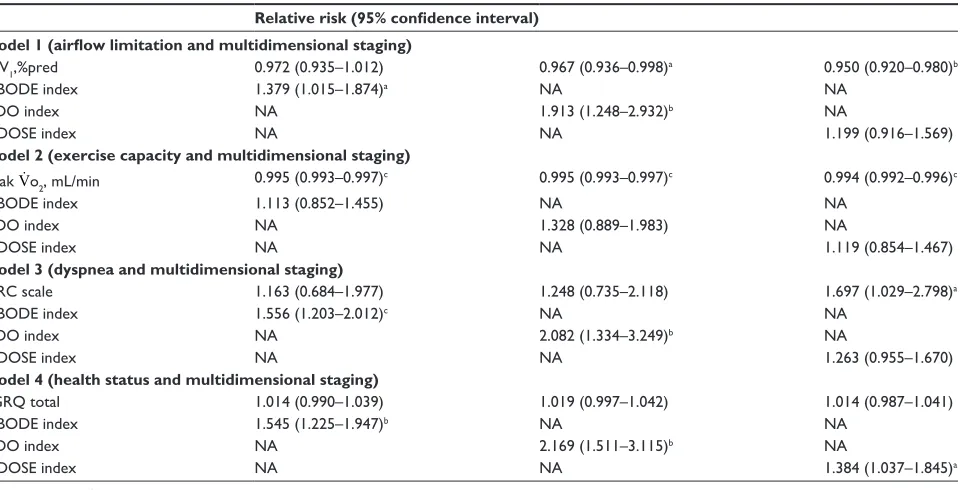
To investigate the abilities of the aforementioned three multidimensional staging methods to predict mortality as compared with airflow limitation, exercise capacity, dyspnea, and health status, multivariate Cox proportional hazards analyses were performed (Table 3). Model 1 includes three analyses investigating the relationships between each index and FEV1 with mortality. The mBODE and ADO indices were more significantly related to mortality than FEV1, but mDOSE index was not. Model 3 includes three analyses investigating the relationships between each index and MRC with mortality. The result was the same with Model 1. These results indicate that predictive properties of mBODE and ADO indices might be stronger than those of FEV1 and MRC as well as mDOSE index. In contrast, Model 2 includes three analyses investigating the relationships between each index and peak Vo2 with mortality. Peak Vo2 was more significantly
related to mortality than all three indices (P , 0.0001), indi-cating that the predictive property of exercise capacity might be stronger than different multidimensional staging. Model 4 includes three analyses investigating the relationships between each index and SGRQ with mortality. In contrast with Model 2, all three indices were more significantly related to mortality than the SGRQ total score.
To investigate which of the mBODE, ADO, and mDOSE indices was the most significantly correlated with mortality,
stepwise multivariate Cox proportional hazards analysis was performed (Table 4). Both the mBODE and ADO indices were significantly related to mortality (RR = 1.351, P = 0.027; and RR = 1.653, P = 0.031) but not the mDOSE index (P = 0.87).
Discussion
We evaluated the predictive and discriminative properties of different multidimensional staging systems in patients with COPD. Among the mBODE, ADO, and mDOSE indices, the mBODE index seemed to have the best discriminative property. We found that all three indices were significantly predictive of mortality, although the predictive ability of the mDOSE tended to be inferior to the other two. In contrast, values for the peak Vo2 on progressive cycle ergometry were more significantly correlated with mortality than any of the three multidimensional staging systems.
We previously examined predictors of mortality in patients with COPD and reported that exercise capacity, dyspnea, and health status were significantly related to mor-tality independently of airflow limitation.9,20,21 These results
suggested the need to incorporate these systemic elements in addition to FEV1 in evaluating patients with COPD. Among the three indices, the mBODE and ADO indices were more strongly predictive of mortality than FEV1, MRC, or SGRQ. Thus, these multidimensional staging systems seem to be more useful in prognostic assessments than airflow limitation, dyspnea, or health status alone in patients with COPD. After evaluating their properties well in different study situations, they will be used in clinical settings.
The relationships between the mBODE, ADO, and mDOSE indices were moderate, indicating that they do not necessarily evaluate the same aspects of COPD, although some components are common to all three indices. In fact, the stepwise multivariate Cox proportional hazards analysis showed that both the mBODE and ADO indices were inde-pendently related to mortality in patients with COPD. Thus, using more than one index might have some complementarily or additive advantage in prognostic assessment.
There were differences in the discriminative proper-ties among the mBODE, ADO, and mDOSE indices. The mBODE score was more widely and normally distributed than the scores of the other indices examined, indicating its superior discriminative property. In our single popula-tion sample, the age component of the ADO index might have varied less widely than the original report of the ADO index,7 as shown here that about 65% of our patients scored
3 or 4. Regarding the mDOSE index, firstly, its range from 0 to 8 is narrower than the BODE and ADO indices ranging
Table 2 Univariate Cox proportional hazards analyses in patients with chronic obstructive pulmonary disease
Relative risk 95% confidence interval P-value
mBODE index 1.618 1.301–2.013 ,0.0001
ADO index 2.342 1.662–3.300 ,0.0001
mDOSE index 1.521 1.223–1.890 0.0002
Abbreviations: ADO, age, dyspnea, and airflow obstruction; mBODE, modified body mass index, airflow obstruction, dyspnea, and exercise capacity; mDOSE, modified dyspnea, airflow obstruction, smoking status, and exacerbation frequency.
Dovepress Oga et al
International Journal of Chronic Obstructive Pulmonary Disease downloaded from https://www.dovepress.com/ by 118.70.13.36 on 22-Aug-2020
from 0 to 10. Secondly, in the present study, the median score on the mDOSE index was low at 2, and its distribution was skewed toward lower scores, which were consistent with the original report.8 Thus, although the ADO and DOSE indices
are simple and easy assessments for use in primary care set-tings, as they do not include an exercise capacity component, their discriminative properties may be limited.
In the present study, peak VO2 was more strongly related to mortality than the mBODE, ADO, and mDOSE indices, indicating that peak VO2 is an important factor in COPD in relation to mortality. In addition to studies examining pre-dictors of mortality in COPD,9 peak VO
2 is reported to be a
useful prognostic factor in other disorders22,23 such as
inter-stitial lung diseases,24 primary pulmonary hypertension,25
cyctic fibrosis,26 or chronic heart failure.27 Cardiopulmonary
exercise testing has some utility in diagnosis and functional evaluation, and prognostic stratification is considered to be
a major indication for cardiopulmonary exercise testing in patients with pulmonary or cardiac disorders.23
In the present study, we compared different multidimen-sional staging systems from the viewpoint of the relationship of their scores with mortality. Although these or similar indices are sometimes referred to as disease severity indices, strictly speaking, disease severity in COPD has not been defined. When disease severity is considered according to the closeness of death, assessing results of these systems would be appropriate in predicting mortality. However, there are other ideas about defining disease severity, such as its relationship with health status or exacerbations. It seems that multidimensional staging is superior to the current means of disease staging based on the level of FEV1.28,29 A standardized
definition of disease severity is needed to eliminate confusion and to officially establish a novel disease severity staging system not based solely on FEV1 in future.
As a limitation, although several multidimensional staging systems in addition to the BODE, ADO, and DOSE indices have been developed in recent years,30,31 we did not
assess them in the present study.
Conclusion
We demonstrated that the multidimensional staging systems of the mBODE, ADO, and mDOSE indices were significant predictors of mortality in patients with COPD. The mBODE
Table 3 Multivariate Cox proportional hazards analyses in patients with chronic obstructive pulmonary disease Relative risk (95% confidence interval)
Model 1 (airflow limitation and multidimensional staging)
FEV1,%pred 0.972 (0.935–1.012) 0.967 (0.936–0.998)a 0.950 (0.920–0.980)b
mBODE index 1.379 (1.015–1.874)a NA NA
ADO index NA 1.913 (1.248–2.932)b NA
mDOSE index NA NA 1.199 (0.916–1.569)
Model 2 (exercise capacity and multidimensional staging) Peak Vo 2, mL/min 0.995 (0.993–0.997)
c 0.995 (0.993–0.997)c 0.994 (0.992–0.996)c
mBODE index 1.113 (0.852–1.455) NA NA
ADO index NA 1.328 (0.889–1.983) NA
mDOSE index NA NA 1.119 (0.854–1.467)
Model 3 (dyspnea and multidimensional staging)
MRC scale 1.163 (0.684–1.977) 1.248 (0.735–2.118) 1.697 (1.029–2.798)a
mBODE index 1.556 (1.203–2.012)c NA NA
ADO index NA 2.082 (1.334–3.249)b NA
mDOSE index NA NA 1.263 (0.955–1.670)
Model 4 (health status and multidimensional staging)
SGRQ total 1.014 (0.990–1.039) 1.019 (0.997–1.042) 1.014 (0.987–1.041)
mBODE index 1.545 (1.225–1.947)b NA NA
ADO index NA 2.169 (1.511–3.115)b NA
mDOSE index NA NA 1.384 (1.037–1.845)a
Notes:aP, 0.05, bP, 0.01, cP, 0.001.
Abbreviations: ADO, age, dyspnea, and airflow obstruction; FEV1, forced expiratory volume in 1 second; mBODE, modified body mass index, airflow obstruction, dyspnea,
and exercise capacity; mDOSE, modified dyspnea, airflow obstruction, smoking status, and exacerbation frequency; MRC, Medical Research Council; NA, not applicable; SGRQ, St. George’s Respiratory Questionnaire;Vo2, peak oxygen uptake.
Table 4 Stepwise multivariate Cox proportional hazards analysis in patients with chronic obstructive pulmonary disease
Relative risk 95% confidence interval P-value
mBODE index 1.351 1.035–1.765 0.027
ADO index 1.653 1.047–2.610 0.031
mDOSE index 0.87
Abbreviations: ADO, age, dyspnea, and airflow obstruction; mBODE, modified body mass index, airflow obstruction, dyspnea, and exercise capacity; mDOSE,
Dovepress Multidimensional staging in COPD
International Journal of Chronic Obstructive Pulmonary Disease downloaded from https://www.dovepress.com/ by 118.70.13.36 on 22-Aug-2020
International Journal of COPD
Publish your work in this journal
Submit your manuscript here: http://www.dovepress.com/international-journal-of-copd-journal The International Journal of COPD is an international, peer-reviewed journal of therapeutics and pharmacology focusing on concise rapid reporting of clinical studies and reviews in COPD. Special focus is given to the pathophysiological processes underlying the disease, intervention programs, patient focused education, and self management protocols.
This journal is indexed on PubMed Central, MedLine and CAS. The manuscript management system is completely online and includes a very quick and fair peer-review system, which is all easy to use. Visit http://www.dovepress.com/testimonials.php to read real quotes from published authors.
was superior to other indices for its discriminative property. An understanding of the properties or characteristics of the indices is important when using them in clinical practice, and, at the same time, a definition of disease severity needs to be established in order to propose the indices assessed in this report as a new disease severity index.
Disclosure
The authors declare that they had no competing interests.
References
1. Global Initiative for Chronic Obstructive Lung Disease. Global strategy for the diagnosis, management, and prevention of chronic obstruc-tive pulmonary disease. Available at: http://www.goldcopd.com (last accessed September 20, 2011).
2. Standards for the diagnosis and care of patients with chronic obstructive pulmonary disease. American Thoracic Society. Am J Respir Crit Care Med. 1995;152:S77–S121.
3. Optimal assessment and management of chronic obstructive pulmonary disease (COPD). The European Respiratory Society Task Force. Eur Respir J. 1995;8:1398–1420.
4. Celli BR, MacNee W; ATS/ERS Task Force. Standards for the diag-nosis and treatment of patients with COPD: a summary of the ATS/ ERS position paper. Eur Respir J. 2004;23:932–946.
5. Celli BR, Cote CG, Marin JM, et al. The body-mass index, airflow obstruction, dyspnea, and exercise capacity index in chronic obstructive pulmonary disease. N Engl J Med. 2004;350:1005–1012.
6. Cote CG, Celli BR. BODE index: a new tool to stage and monitor progression of chronic obstructive pulmonary disease. Pneumonol Alergol Pol. 2009;77:305–313.
7. Puhan MA, Garcia-Aymerich J, Frey M, et al. Expansion of the prognostic assessment of patients with chronic obstructive pulmo-nary disease: the updated BODE index and the ADO index. Lancet. 2009;374:704–711.
8. Jones RC, Donaldson GC, Chavannes NH, et al. Derivation and validation of a composite index of severity in chronic obstructive pulmonary disease: the DOSE Index. Am J Respir Crit Care Med. 2009;180:1189–1195.
9. Oga T, Nishimura K, Tsukino M, et al. Analysis of the factors related to mortality in chronic obstructive pulmonary disease: role of exercise capacity and health status. Am J Respir Crit Care Med. 2003;167:544–549. 10. Oga T, Nishimura K, Tsukino M, et al. The effects of oxitropium
bro-mide on exercise performance in patients with stable chronic obstructive pulmonary disease. A comparison of three different exercise tests. Am J Respir Crit Care Med. 2000;161:1897–1901.
11. Oga T, Nishimura K, Tsukino M, et al. Exercise capacity deterioration in patients with COPD: longitudinal evaluation over 5 years. Chest. 2005;128:62–69.
12. American Thoracic Society; American College of Chest Physicians. ATS/ACCP statement on cardiopulmonary exercise testing. Am J Respir Crit Care Med. 2003;167:211–277.
13. Jones NL, Makrides L, Hitchcock C, et al. Normal standards for an incremental progressive cycle ergometer test. Am Rev Respir Dis. 1985;131:700–708.
14. Oga T, Nishimura K, Tsukino M, et al. Longitudinal deteriorations in patient reported outcomes in patients with COPD. Respir Med. 2007;101:146–153.
15. Hajiro T, Nishimura K, Tsukino M, et al. Analysis of clinical methods used to evaluate dyspnea in patients with chronic obstructive pulmonary disease. Am J Respir Crit Care Med. 1998;158:1185–1189.
16. Jones PW, Quirk FH, Baveystock CM, Littlejohns P. A self-complete measure of health status for chronic airflow limitation: the St. George’s Respiratory Questionnaire. Am Rev Respir Dis. 1992;145:1321–1327.
17. Hajiro T, Nishimura K, Tsukino M, et al. Comparison of discriminative properties among disease-specific questionnaires for measuring health-related quality of life in patients with chronic obstructive pulmonary disease. Am J Respir Crit Care Med. 1998;157:785–790.
18. Cote CG, Pinto-Plata VM, Marin JM, et al. The modif ied BODE index: validation with mortality in COPD. Eur Respir J. 2008;32:1269–1274.
19. Cardoso F, Tufanin AT, Colucci M, et al. Replacement of the 6-min walk test with maximal oxygen consumption in the BODE index applied to patients with COPD: an equivalency study. Chest. 2007;132:477–482.
20. Nishimura K, Izumi T, Tsukino M, Oga T. Dyspnea is a better predic-tor of 5-year survival than airway obstruction in patients with COPD. Chest. 2002;121:1434–1440.
21. Oga T, Nishimura K, Tsukino M, et al. Dyspnoea with activities of daily living versus peak dyspnoea during exercise in male patients with COPD. Respir Med. 2006;100:965–971.
22. ERS Task Force. Recommendations on the use of exercise testing in clinical practice. Eur Respir J. 2007;29:185–209.
23. Ferrazza AM, Martolini D, Valli G, Palange P. Cardiopulmonary exercise testing in the functional and prognostic evaluation of patients with pulmonary diseases. Respiration. 2009;77:3–17.
24. Miki K, Maekura R, Hiraga T, et al. Impairments and prognostic factors for survival in patients with idiopathic pulmonary fibrosis. Respir Med. 2003;97:482–490.
25. Wensel R, Opitz CF, Anker SD, et al. Assessment of survival in patients with primary pulmonary hypertension: importance of cardiopulmonary exercise testing. Circulation. 2002;106:319–324.
26. Nixon PA, Orenstein DM, Kelsey SF, Doershuk CF. The prognostic value of exercise testing in patients with cystic fibrosis. N Engl J Med. 1992;327:1785–1788.
27. Corrà U, Mezzani A, Bosimini E, Giannuzzi P. Cardiopulmonary exer-cise testing and prognosis in chronic heart failure: a prognosticating algorithm for the individual patient. Chest. 2004;126:942–950. 28. Funk GC, Kirchheiner K, Burghuber OC, Hartl S. BODE index versus
GOLD classification for explaining anxious and depressive symptoms in patients with COPD: a cross-sectional study. Respir Res. 2009;10:1. 29. Funk GC, Kirchheiner K, Burghuber OC, Hartl S. Classifying the
severity of COPD: are the new severity scales better than the old? Int J Tuberc Lung Dis. 2009;13:783–790.
30. Briggs A, Spencer M, Wang H, et al. Development and validation of a prognostic index for health outcomes in chronic obstructive pulmonary disease. Arch Intern Med. 2008;168:71–79.
31. Esteban C, Quintana JM, Aburto M, et al. A simple score for assessing stable chronic obstructive pulmonary disease. QJM. 2006;99:751–759.
Dovepress
Dove
press
Oga et al
International Journal of Chronic Obstructive Pulmonary Disease downloaded from https://www.dovepress.com/ by 118.70.13.36 on 22-Aug-2020