Sponge based CCA2 secure asymmetric encryption for arbitrary
length message
Tarun Kumar Bansal Donghoon Chang Somitra Kumar Sanadhya
Indraprastha Institute of Information Technology, Delhi (IIIT-D), India {tarunb,donghoon,somitra}@iiitd.ac.in
Abstract
OAEP and other similar schemes proven secure in Random-Oracle Model require one or more hash functions with output size larger than those of standard hash functions. In this paper, we show that by utilizing popular Sponge constructions in OAEP framework, we can eliminate the need of such hash functions. We provide a new scheme in OAEP framework based on Sponge construction and call our schemeSponge based asymmetric encryption padding (SpAEP). SpAEP is based on 2 functions: Sponge and SpongeWrap, and requires only standard output sizes proposed and standardized for Sponge functions. Our scheme is CCA2 secure for any trapdoor one-way permutation in the ideal permutation model for arbitrary length messages. Our scheme utilizes the versatile Sponge function to enhance the capability and efficiency of the OAEP framework. SpAEP with any trapdoor one-way permutation can also be used as a key encapsulation mechanism and a tag-based key encapsulation mechanism for hybrid encryption. Our scheme SpAEP utilizes the permutation model efficiently in the setting of public key encryption in a novel manner.
Keywords: OAEP, Sponge function, public key encryption, hybrid encryption, CCA2 security.
1
Introduction
The Optimal Asymmetric Encryption Padding (OAEP), proposed by Bellare and Rogaway at Eu-rocrypt ‘94 [1], is a technique for converting the RSA trapdoor permutation into a chosen ciphertext secure system in the random oracle model (ROM). In Crypto ’01, Shoup described a modification to OAEP, called OAEP+, that provably converts any trapdoor one way permutation (f) into a chosen ciphertext secure system in the random oracle model. In 2003, Phan and Pointcheval [2, 3] intro-duced OAEP-3R which is RCCA secure (“relaxed CCA” [3] equivalent to “replayable CCA” [4]- a slightly weaker notion than general CCA2) with any trapdoor one way permutation (f) in ROM. Let “ciphertext overhead” [5] stand for the difference between the length of ciphertext and plain-text. OAEP-3R was shown to have only t-bit ciphertext overhead, whereas OAEP and OAEP+ have 3t-bit ciphertext overhead, where t stands for security requirement in bits1. In 2008, Abe, Kiltz and Okamoto [5] showed that security reduction of OAEP-3R forces ciphertext overhead to be 2t. A new scheme called OAEP-4X was introduced in [5] which provides CCA2 security for any trapdoor one way permutation in ROM. OAEP-4X has only t-bit ciphertext overhead which was shown to be optimal (lowest achievable bound). In OAEP-4X, reduction of t-bit ciphertext over-head with respect to OAEP-3R has only limited practical application such as in a highly bandwidth
1A security requirement oft-bit implies that at-least 2tqueries are required to break the scheme with probability
constrained network. Therefore, for general applications ciphertext overhead reduction byt-bits is a less interesting case.
Number of hash functions used in OAEP is 2 and these are used in a 2 round structure. OAEP+ is also 2 round structure but uses 3 hash functions (2 hash function can run in parallel while encryption). OAEP-3R is 3 round structure that uses 3 hash functions and OAEP-4X is 4 round structure that uses 4 hash functions. Each of these schemes (OAEP, OAEP+, OAEP-3R and OAEP-4X), proven secure in ROM, requires one or more hash functions with arbitrary size output. For example, for RSA-2048 (or RSA-3072) trapdoor one-way permutation, minimum number of hash function with arbitrary size output required in OAEP, OAEP+, OAEP-3R and OAEP-4X are 1, 1, 2 and 2 respectively.
Currently, no cryptographic standard specifies an instantiation for hash function of arbitrary size. However, some instantiations are implicit in PKCS #1 v2.1 [6], because RSA-OAEP [1] is standardized. For example, RSA-OAEP requires two random hash functions G and H with small input size (less than the RSA modulus) and arbitrary size output. Both G and H are both instantiated in PKCS by the MGF1 pseudo-random number generator [6]. MGF1 uses a hash function in counter mode: MGF1(x) =h(xhcount0i)||h(xhcount1i)||h(xhcount2i)||. . ., where h is either SHA-1 or a SHA-2. Because MGF1 is not a regular standardized hash function, we use a term “non-standard hash function” for such functions, which instantiate a hash function of arbitrary output size by utilizing standard fixed length hash functions (e.g., SHA-1, SHA-2) to generate arbitrary hash output. Similarly, in other OAEP-type schemes, instantiation of such hash functions is done by using similar “non-standard hash function”.
OAEP-type schemes (OAEP, OAEP+,OAEP-3R) discussed above, work only for restricted message length (less than input size of trapdoor one-way permutation) except OAEP-4X, which works for long messages (more than input size of trapdoor one-way permutation) as well. To encrypt lengthy messages, OAEP-4X uses one extra hash function and a passively secure symmetric encryption scheme along with 4 hash functions. In OAEP-4X, the ability of handling long messages is the result of utilizing well known Tag-KEM/DEM framework [7, 8]. Tag-KEM/DEM is considered a hybrid encryption scheme [9, 7, 10, 11, 12, 13, 14, 15]. In hybrid paradigm, an asymmetric key encapsulation mechanism (KEM) combines with a symmetric data encapsulation mechanism (DEM). Traditionally, KEM is a probabilistic algorithm that produces a random symmetric key and an asymmetric encryption of that key as the key encapsulation. DEM is a deterministic algorithm that takes a symmetric key, generated by KEM, and encrypts the message under that key. In Tag-KEM/DEM framework, KEM takes a feedback, referred to as the ‘tag’, from DEM part and then generates key encapsulation. Final ciphertext results from concatenation of key encapsulation and encryption of message. This traditional hybrid paradigm suffers from high ciphertext overhead (difference between plaintext and ciphertext length) equivalent to the size of asymmetric encryption of key.
Motivation: Almost all previous public key cryptography literature dealing with OAEP-based encryption, requires a perfect random function ( a Random oracle) over an arbitrary domain, whereas in practice one is given a random function or permutation over a relatively small domain: practical block-cipher, hash functions and permutations have smaller block size and fixed output length. Therefore, for generating lengthy hash output, RSA-Full Domain Hash [16, 17, 18] or the Mask Generation Function (MGF1) [6] in RSA-OAEP are currently implemented with a complex construction of fixed length hashes and counters. For m blocks input and n blocks hash output, a fixed length hash function has to run approximately m ×n times. All of above mentioned schemes (OAEP, OAEP+, OAEP-3R, OAEP-4X) proven secure in ROM require one or more hash functions with output size larger than standard sizes (e.g., SHA-1, SHA-512). [19] showed that the hash function instantiation proposed in the literature for such cases are weaker than a random oracle, where hash functions are assumed to behave like random oracle in the security analysis. The “non-standard hash function” (like MGF1) are not well analyzed in literature, have complex construction of fixed length hash functions with counter and are also proven weaker than random oracle. This raises a question on the possibility of modifying the OAEP framework which does not require any “non-standard hash function” and where all the computations are performed in standardized input-output settings.
Development of schemes from OAEP to OAEP-4X shows differences in the number of rounds, depending upon calls to the hash functions used. OAEP and OAEP+ is considered as 2 round structure, OAEP-3R as 3 round and OAEP-4X as 4 round. This naturally poses a question on the possibility of further development of the OAEP-type scheme and reduce the number of rounds.
We have seen OAEP-type construction are good candidate in hybrid encryption for constructing KEMs like in [8] and improvements in OAEP-type construction helps the RKEMs and hybrid encryption also.
Presently, major existing and proposed crypto-systems are based on standard assumptions or proven secure in random oracle model for public key cryptography. The crypto-systems based on permutations, proven secure in ideal permutation model, and using them efficiently are yet to be explored to develop new outlooks and techniques that can cross-pollinate and advance cryptography as a whole. An open problem mentioned in [7] about having a hybrid construction from different primitives like permutation, also helps us to pursue in this direction.
Interestingly, popular Sponge constructions [20], based on iterative permutation, are found to be a suitable solution of all the questions mentioned above. Sponge constructions work in standardized input-output settings [21, 20, 22, 23] and are useful for encryption, Authentication Encryption (AE), variable length input/output and for MAC generations [24]. In a Sponge function, form blocks input andnblocks hash output, roughlym+ncalls of internal primitive permutation are required. Other than that, number of permutation calls in a Sponge function [20], used as hash function, and SpongeWrap [22], a modification of Sponge function used as AE, is equal in general. Therefore, versatility of Sponge function encourages the designers to come up with more useful and efficient design. The glimpse of popularity of Sponge functions can be seen clearly in CAESAR [25] and PHC [26] competition. Therefore, it is interesting to consider a permutation based or more concretely a Sponge construction based OAEP-type scheme having a security proof in ideal permutation model which can also be utilized in hybrid encryption.
Sponge function and in a SpongeWrap are generally the same for equal number of input-output data blocks.
We provide new direction for constructing asymmetric key cryptographic schemes in ideal permu-tation model by utilizing permupermu-tations, having smaller/practical domain, in SpAEP. Almost all previous public key cryptography literature dealing with OAEP-based encryption requires hash functions (or a random function) over an arbitrary domain.
SpAEP uses the Sponge function and the SpongeWrap in standard input-output settings, pro-posed for “Sponge functions” [21, 20, 22, 23], as per security requirement. Therefore, SpAEP remove the requirement of having “non-standard hash function”, which is required in OAEP, OAEP+, OAEP-3R and OAEP-4X for generating hash output of different sizes than standard size (“non-standard output size”).
In SpAEP, both functions (Sponge function and SpongeWrap) are used in parallel during encryp-tion to speed-up the process. Therefore, we consider SpAEP as 1 round structure in comparison to other OAEP-type schemes.By functions in parallel we refer to potential parallelism properties of Sponge functions, where output of permutation calls of Sponge function feed into permutation calls of SpongeWrap as input in pipe-lined fashion. Let Sponge function and SpongeWrap haven, n >0, permutation calls respectively, then output ofnthpermutation of SpongeWrap is feed into
(n+ 1)thpermutation of SpongeWrap and partial output in nth permutation of Sponge function. This means (n+ 1)th permutation of SpongeWrap andnth permutation of Sponge function can be processed in parallel. However, the functions are not parallelized during decryption.
Features of SpAEP and Comparison with other OAEP-type schemes
Although the permutation used in Sponge is invertible, we do not use this fact for our construc-tion and provide inverse-freeness. Therefore our construcconstruc-tion allows using permutaconstruc-tions which are inefficient to invert but efficient in the forward direction. That is, computation time, imple-mentation or memory efficiency of the forward direction of the permutation can be exploited by user in our design. Moreover, our design allows using a non-invertible mapping in the Sponge function.
Conceptually, our approach is similar to the schemeTag-KEM with partial ciphertext recovery [8] but in our case the message can be directly recovered. Therefore, our scheme can be used as a Tag-KEM with partial message recovery. (We do not pursue this line in this paper due to the space limitation). This Tag-KEM version of our scheme is similar to OAEP-4X, which trivially take us to the comparison among OAEP-4X and SpAEP and other OAEP-type schemes. Letf be a trapdoor one-way permutation then we denote the instantiation of our scheme withf
by f-SpAEP. The f-SpAEP can process arbitrary length messages. Our scheme is CCA2 secure when used with any trapdoor one-way permutation.
We provide a formal security proof of f-SpAEP in adaptive chosen ciphertext attack (CCA-2) notion in the ideal permutation model. Instead of directly using security proof, in ROM, of sponge construction, we prefer a dedicated proof from scratch in ideal permutation model to avoid multi-stage game problem [27, 28]. Although [2] introduced an efficient scheme in ideal permutation model with full domain permutation encryption, still it remained impractical because having such big permutation size equivalent to trapdoor one-way permutation size is itself hard. Similar problem of output size occurs when a scheme requires hash output different (generally larger) than standard sizes.
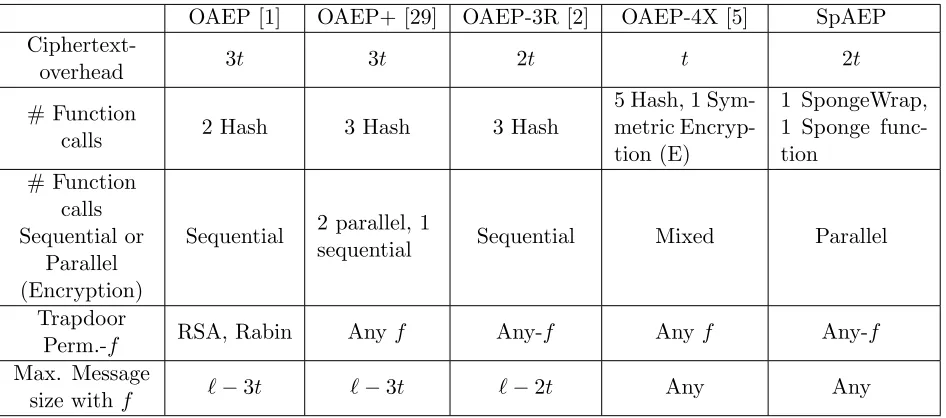
In Table 1, we compare OAEP [1], OAEP+ [29], OAEP-3R [2] and OAEP-4X [5] with SpAEP. In Table 1 cipher text overhead values are taken from Table 1 [5].
OAEP [1] OAEP+ [29] OAEP-3R [2] OAEP-4X [5] SpAEP
Ciphertext-overhead 3t 3t 2t t 2t
# Function
calls 2 Hash 3 Hash 3 Hash
5 Hash, 1 Sym-metric Encryp-tion (E)
1 SpongeWrap, 1 Sponge func-tion
# Function calls Sequential or
Parallel (Encryption)
Sequential 2 parallel, 1
sequential Sequential Mixed Parallel
Trapdoor
Perm.-f RSA, Rabin Anyf Any-f Anyf Any-f
Max. Message
size withf `−3t `−3t `−2t Any Any
Table 1: Comparison of OAEP, OAEP+, OAEP-3R, SpAEP, OAEP-4X Here t is the security requirements in term of number of bits. In order to break the scheme with probability 1 number of queries required are 2t. `is input-output size of trapdoor one way permutationf.
In Table 1, for OAEP, number of functions run in parallel during encryption is zero, both hash function run sequentially. Similarly in the case of OAEP-3R, all three hash function calls are sequential. OAEP+ uses three hash functions, out of which only two function calls can run in parallel. In OAEP-4X, for messages having size less than input size of trapdoor one-way permutation, only 4 hash function calls are required sequentially. For long messages(message size more than input size of trapdoor one-way permutation), OAEP-4X uses 5 hash function (H1, H2, H3, H4, G) calls and one symmetric encryption scheme (E). Initially only two hash function calls run in parallel (H1,G) then H2 and E runs parallel, and then H3 and H4 runs sequentially. Overall in OAEP-4X, for long messages, only two functions calls can run in parallel at instant. From Table 1, we can clearly see that SpAEP is a simple and efficient scheme in comparison to other schemes. Although SpAEP hast-bit extra ciphertext overhead with respect to OAEP-4X, yet as explained earlier this is a minor concern in general applications.
One may argue that in OAEP based schemes, for final encryption and decryption, trapdoor one-way permutation show dominance in computation time with respect to OAEP type structure. This makes each and every scheme in-advantageous over other schemes in terms of computation efficiency. We hope this may not be the case always or in future. Recent development in lattice based cryptography [30, 31, 32] shows up that computation time of trapdoor function can reduce significantly compared to existing traditional trapdoor permutation. Therefore, it is fruitful to have OAEP type schemes that are better than existing one and compatible with latest trends.
2
Preliminaries
We discuss some preliminaries in this section.
Ideal Permutation: An permutation π is a bijective function on a finite domain D and finite range R with D = R. An ideal permutation is a permutation chosen uniformly at random from all the available permutations. Let D=R={0,1}b, then π ←−$Perm(D, D), where Perm(D, D) is the collection of all permutations on D. Mathematically, π :D→R is a permutation, if for every y∈R there is one and only onex∈Dsuch that π(x) =y.
Trapdoor one way Permutation and their security: We recall the security notion of a trapdoor one way permutation scheme. This scheme requires a trapdoor permutation generator. This is a PPT algorithm F such that F(1`) outputs a pair of deterministic algorithms (f, f−1) specifying a permutation and its inverse on {0,1}`. We associate to F an evaluation time t
F(·):
for all `, all (f, f−1) ∈[F(1`)] and allC ∈ {0,1}`, the time to compute f(C) (given f and C) is tF(`). Note that the evaluation time depends on the setting: for example on whether or not there is hardware available to compute f.
We will be interested in two attributes of a (possibly non-uniform) algorithm Btrying to invert
F(1`)-distributed permutations; namely its running time and its success probability.
Definition 1. Let F be a trapdoor permutation generator. We say that f is a one-way trapdoor permutation if for any efficient adversary B trying to invert F such that
AdvowtpF (B Succeeds)=Pr[(f, f−1)← F(1`);y←− {$ 0,1}`:B(f, y) =C such thatf(C) =y]≤,
where is negligible in `.
CCA, CCA2 Security: For probabilistic public key scheme (P KE), indistinguishability is de-fined by the following experiment between an adversary A and a challenger. For schemes based on computational security, the adversary is modeled by a probabilistic polynomial time Turing machine, meaning that it must complete the game and output a guess within a polynomial number of time steps. The schemeP KE comprise (G,Epk,Dsk). Secret/Private keys (pk,sk) is the gener-ated byG andsis the auxiliary information collected byAusing oracleO1. Epk(M) represents the encryption of a messageM under the public keypkandDsk represents the decryption of ciphertext y under secret key sk.
Experiment: ExpindP KE,−atkA−d(`)
1. (pk,sk)←− G$ (1`); (M0, M1, s)← AO1(·); y← Epk(Md); 2. d0 ← AO2(·)(M
0, M1, y, s);
3. return d0;
where |M0|=|M1|and y cannot be queried to O2 oracle, and atk=CCA-1 : O1(·) =Dsk(·) andO2(·) =Epk
The scheme is IND-CCA1/IND-CCA2 [33] secure if adversaryAhas a non-negligible advantage in winning (d0 =d) the above game. The definition of security we have presented here is from [34].
It is known to be equivalent to other notions, such as non-malleability [33, 35] , which is called NM-CCA-2 in [33].
Pr[ExpP KE,ind−ccaA2−d(`) =d|d←− {$ 0,1}]≤ negl(`) +12.
3
General View of OAEP+
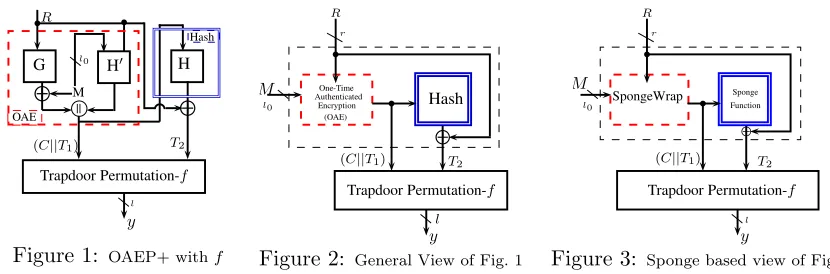
In this section we provide a general view2 of the OAEP+ with f as the trapdoor one way permu-tation in an informal way. This helps us to elaborate the basis of the design of our scheme. This general view is shown in Figure 2, 3. It has three parts:
1. One time Authenticated Encryption (OAE): This is a one time authentication encryption that uses a one time keyR and generates an encoded message C and TagT1 of message M. Message will be padded to suitable length according to OAE.
2. Hash: This is a deterministic hashing algorithm. The concatenation of the outputs of OAE with a one time key R is the input of this hashing algorithm. It outputsT2.
3. Trapdoor one way Permutation: This is a trapdoor one way permutation f : {0,1}` → {0,1}`, which takes the concatenation of the outputs of OAE and Hash and produces the
final encryption.
y Trapdoor Permutation-f
l
|| M
R
G H′ H
Hash
(C||T1) T2
OAE ⊕
l0
b
⊕
b
Figure 1: OAEP+ withf
y
b
Encryption Hash
Trapdoor Permutation-f
M
l l0
R
Authenticated r
b
One-Time
(OAE)
(C||T1) T2 ⊕
Figure 2: General View of Fig. 1
y
b
Sponge
Trapdoor Permutation-f
M
l l0
R
r
b
(C||T1) T2
⊕
SpongeWrap
Function
Figure 3: Sponge based view of Fig. 2
Figure 1 shows OAEP+ construction with f as the trapdoor one way permutation. G, H0 and H are the hash functions used in OAEP+. If we map OAEP+ on our general view then the combination of G and H0 is OAE while H is the Hash part. G provides a kind of one time pad encryption (OTE) to message M, H0 provides hash tag T1 of M and H produces hash tag T2 of OTE and tagT1.
In this work, we provide f-SpAEP as an example of this general view where the f-SpAEP scheme uses SpongeWrap as OAE and a Sponge function asHash part with different IV.
One can view and use our scheme in hybrid encryption model and can also utilize in key/data encapsulation method. But in this paper we are more focused over sponge applicability in OAEP framework.
4
SpAEP-Sponge based Asymmetric Encryption Padding
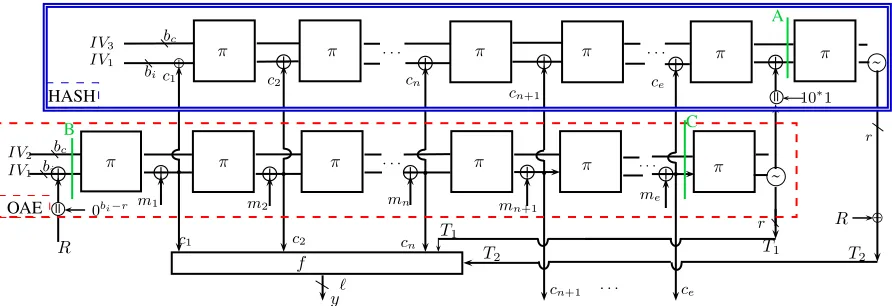
SpAEP is a Sponge function based construction. SpAEP iterates a fixed permutationπ :{0,1}bi× {0,1}bc → {0,1}bi×{0,1}bcin a exact way to the Sponge construction and SpongeWrap [22, 20, 21].
The bit length of input and output ofπ, called bit rate, isb=bi+bc. The termbiis called input
rate and the termbcis called capacity rate. The permutationπis the only underlying cryptographic
primitive used by SpAEP. For using SpAEP for asymmetric key setting, one can use any trapdoor one way permutation f :{0,1}` → {0,1}` such as RSA. The resulting scheme is called f-SpAEP.
The output of functionf isy ∈ {0,1}` and the trapdoor off is represented byf−1. bxcrrepresents
the firstr bit ofx or we can say itr-bit chop function. Similarly, dxerepresents the lastr bit ofx. See Figure 4 for graphical presentation.
SpAEP handles the arbitrary length message and π is fixed length permutation of input rate bi. SpAEP uses a reversible padding function pad(·) to generate bi-bit length blocks. For scheme
to be compatible with f, scheme uses pad(·) to divided the message into two parts(Mn, Me).
First part should have minimum n-block message where each block is of bi-bit length such that
`=n∗bi+ 2r,`≥biandn≥1. SpAEP process thisn-block messageMn=m1||. . .||mnand gives
output c1||. . .||cn which is the input of f. SpAEP process the second part of the message Me =
mn+1||. . .||me and gives output Ce = cn+1||. . .||ce. If Me is an empty string, then Ce will also
remain as empty string. SpAEP also outputsr-bit tagT1 andT2 which is also the input off. Final output of the f-SpAEP will be y||Ce, where y =f(Cf = c1||. . .||cn||T1||T2). In case (`, bi, r) are
chosen such thatnis not an integer value, thendcne|Cf|−`bits removes and append toCeto ensure |Cf|=`. Then Cf =c
1||. . .||bcnc(bi−(|c[1,n]|−`)) and C e=dc
ne(|c[1,n]|−`)||cn+1||. . .||ce. In paper we
will considernas integer only which means|Cf|=`. Accordingly, Encryption :SpAEP−Eπ f and
Decryption : SpAEP −Dπ
f−1 of f-SpAEP are described in Algorithms 1 and 2 respectively.
The encryption and decryption procedures of SpAEP use forward direction of the permutation. Therefore we can have a permutation that is more efficient in forward direction than in inverse.
CCA2 Security of f-SpAEP3: Next we provide a formal proof of CCA2 security of f-SpAEP. As described in Section 2, the experiment of adversaryA forf-SpAEP is the following.
Experiment: ExpindF−−SpAEPcca2−dπ,A(`)
( f |{z}
pk
, f−1 |{z}
sk
)←− F$ ;
(M0, M1, s)← Aπ(·),SpAEP−Dfπ−1(·);
y∗||Ce∗ ←SpAEP −Efπ(Md); . . . one time encryption query
d0 ← Aπ(·),SpAEP−Dπf−1(·)(M0, M1, y∗||Ce∗, s); return d0;
where SpAEP −Dπf−1(·) is decryption oracle and SpAEP −Efπ(·) is encryption algo-rithm.
3In this paper for security proof,f-SpAEP andF-SpAEPπrefer to same thing. Inf−SpAEP,fand its trapdoor
IV1 f cn c2 c1 . . . R
m1 m2 mn
π π π π bi bc IV2 c2 π π π π bi bc IV3 IV1
c1 cn
cn+1 . . .
b b b π
mn+1 π . . . . . . me ce T1 T2 ℓ y
⊕
⊕
⊕
⊕
⊕
⊕
⊕
⊕
⊕
⊕ π⊕
b b T1 T2cn+1 . . . ce
r
˜
r
R ⊕
⊕
π10∗1 HASH
OAE 0bi−r
˜
Figure 4: SpAEP with any trapdoor one way permutation f and public invertible permutation π : {0,1}bi × {0,1}bc ← {0,1}bi × {0,1}bc. SpAEP accepts message M and internally OAE call
pad(M)=m1||. . .||mn||mn+1||. . .||me such that n = (`−2r)/bi, |pad(M)| ≥ (`−2r) and each
message bock is of lengthbiwhere`is size of trapdoor permutation-f and|R|=|T1|=|T2|=r. The symbolO∼ represents takingr-bit output frombi-bit input. The symbolO|| represent concatenation.
Algorithm 1:Encryption:
SpAEP−Efπ(M) =y||Ce
1 Initialization:
IV1 = 0bi,IV2 = 0bc,IV3 =IV2⊕1, w=IV2, x=IV1
2 Random Nonce: R←− {$ 0,1}r 3 pad(M) =m1||m2||. . .||me,
where |mi|=bi ∀1≤i≤e 4 x=x⊕R||0br−r
5 for i= 1→edo 6 (x||w) =π(x||w)
7 x=x⊕mi
8 ci =x
9 (x||w) =π(x||w); T1 =bxcr 10 x=IV1 and w=IV3 11 for i= 1→edo
12 x=x⊕ci
13 (x||w) =π(x||w)
14 x=x⊕T1||0br−r 15 (x||w) =π(x||w) 16 T2=bxcr⊕R
17 Cf =c1||c2||. . .||cn||T1||T2;
Ce=c
n+1||. . .||ce 18 y=f(Cf)
19 Return: y||Ce
Algorithm 2:Decryption:
SpAEP−Dfπ−1(y||Ce) =M or ⊥
1 Initialization: IV1 = 0bi,IV2 = 0bc,IV3=IV2⊕1,
w=IV3, x=IV1
2 Cf =c1||c2||. . .||cn||T1||T2 =f−1(y);
cn+1||. . .||ce=Ce
3 C0 =c1||c2||. . .||cn||T1||T2||cn+1||. . .||ce, where |ci|=bi,|T1|=|T2|=r for 1≤i≤e
4 for i= 1→edo
5 x=x⊕ci
6 (x||w) =π(x||w)
7 x=x⊕T1||0br−r
8 (x||w) =π(x||w);R=bxcr⊕T2 9 x=R||0br−r;w=IV2
10 for i= 1→edo 11 (x||w) =π(x||w) 12 mi =x⊕ci
13 x=ci
14 (x||w) =π(x||w);T10 =bxcr 15 if T1 =T10 then
16 if ∃ M s.t. M =unpad(m1||. . .||me)then 17 Return:M
18 else
19 Return: Invalid
20 else
Theorem 1. The success probability of any adversary A for CCA2 attack in ideal permutation π
onF −SpAEPπ is
Pr[ExpindF−−SpAEPcca2−dπ,A(`) =d|d
$
←− {0,1}]≤ 1
2 +
(q−1)q 2b+1 +
q(q+ 1) 2bc +
5qD
2r +
qπA+qπ−1
2r
+AdvowtpF (BA Succeeds) +(qπA+qπ−1)
min(2r,2bc),
where q is the total number of (π and π−1) queries, qπ and qπ−1 are the number of π and π−1 queries, qπA is the number of π queries by A, qD is the number of decryption queries and b, bc, r
are the same as defined earlier, B is an adversary that finds the complete input Cf of trapdoor one way permutation f given y ←− {$ 0,1}` such that y =f(Cf), without having knowledge of f−1. Adversary B uses A as a subroutine internally. Advfowtp(BA Succeeds) is the success advantage that a particular adversary B has in breaking the trapdoor one-way permutation f. The time and space requirements of B are related to A as follows:
T ime(B) =O(T ime(A) + (qπA+qπ−1)·tf + (qπA+qπ−1+qD)·`); (1)
Space(B) =O(Space(A) + (qπA+qπ−1)·`). (2)
Here, tf is the time required to compute f, and space is measured in the number of storage bits.
Proof. See Appendix A
5
Conclusion
We presented a new variant, SpAEP, of OAEP using Sponge constructions that does not require hash output of arbitrary length, whereas all previous OAEP based encryption proven secure in random-oracle model require one or more hash output of arbitrary length. Versatility of Sponge construction helps us to reduce number of round function as compared to previous OAEP-type schemes (OAEP, OAEP+, OAEP-3R, OAEP-4X) and in constructing KEMs that require a PKC scheme with ability of randomness recovery. Ability of handling long messages enables the use of SpAEP with any trapdoor one-way permutation as hybrid encryption.
References
[1] Mihir Bellare and Phillip Rogaway. Optimal Asymmetric Encryption. In Alfredo De San-tis, editor, EUROCRYPT, volume 950 of Lecture Notes in Computer Science, pages 92–111. Springer, 1994.
[2] Duong Hieu Phan and David Pointcheval. Chosen-Ciphertext Security without Redundancy. In Chi-Sung Laih, editor, Advances in Cryptology - ASIACRYPT 2003, 9th International Conference on the Theory and Application of Cryptology and Information Security, Taipei, Taiwan, November 30 - December 4, 2003, Proceedings, volume 2894 of Lecture Notes in Computer Science, pages 1–18. Springer, 2003.
[4] Ran Canetti, Hugo Krawczyk, and Jesper Buus Nielsen. Relaxing Chosen-Ciphertext Security. In Dan Boneh, editor, Advances in Cryptology - CRYPTO 2003, 23rd Annual International Cryptology Conference, Santa Barbara, California, USA, August 17-21, 2003, Proceedings, volume 2729 ofLecture Notes in Computer Science, pages 565–582. Springer, 2003.
[5] Masayuki Abe, Eike Kiltz, and Tatsuaki Okamoto. Chosen Ciphertext Security with Optimal Ciphertext Overhead. IEICE Transactions, 93-A(1):22–33, 2010.
[6] RSA Laboratories. PKCS #1 v2.1: RSA cryptography standard, June 2002.
[7] Masayuki Abe, Rosario Gennaro, and Kaoru Kurosawa. Tag-KEM/DEM: A New Framework for Hybrid Encryption. J. Cryptology, 21(1):97–130, 2008.
[8] Tor E. Bjørstad, Alexander W. Dent, and Nigel P. Smart. Efficient KEMs with Partial Message Recovery. In Steven D. Galbraith, editor,Cryptography and Coding, 11th IMA International Conference, Cirencester, UK, December 18-20, 2007, Proceedings, volume 4887 of Lecture Notes in Computer Science, pages 233–256. Springer, 2007.
[9] Ronald Cramer and Victor Shoup. Design and Analysis of Practical Public-Key Encryption Schemes Secure against Adaptive Chosen Ciphertext Attack.IACR Cryptology ePrint Archive, 2001:108, 2001. http://eprint.iacr.org/2001/108.
[10] Kaoru Kurosawa and Yvo Desmedt. A New Paradigm of Hybrid Encryption Scheme. In Matthew K. Franklin, editor,Advances in Cryptology - CRYPTO 2004, 24th Annual Interna-tional CryptologyConference, Santa Barbara, California, USA, August 15-19, 2004, Proceed-ings, volume 3152 ofLecture Notes in Computer Science, pages 426–442. Springer, 2004.
[11] Alexander W. Dent. A Designer’s Guide to KEMs. In Kenneth G. Paterson, editor, Cryptogra-phy and Coding, 9th IMA International Conference, Cirencester, UK, December 16-18, 2003, Proceedings, volume 2898 of Lecture Notes in Computer Science, pages 133–151. Springer, 2003.
[12] Eike Kiltz. Chosen-Ciphertext Security from Tag-Based Encryption. In Shai Halevi and Tal Rabin, editors,Theory of Cryptography, Third Theory of Cryptography Conference, TCC 2006, New York, NY, USA, March 4-7, 2006, Proceedings, volume 3876 ofLecture Notes in Computer Science, pages 581–600. Springer, 2006.
[13] Joonsang Baek, Willy Susilo, Joseph K. Liu, and Jianying Zhou. A New Variant of the Cramer-Shoup KEM Secure against Chosen Ciphertext Attack. In Michel Abdalla, David Pointcheval, Pierre-Alain Fouque, and Damien Vergnaud, editors, Applied Cryptography and Network Security, 7th International Conference, ACNS 2009, Paris-Rocquencourt, France, June 2-5, 2009. Proceedings, volume 5536 of Lecture Notes in Computer Science, pages 143– 155, 2009.
[14] Tatsuaki Okamoto. Authenticated Key Exchange and Key Encapsulation in the Standard Model. In Kaoru Kurosawa, editor,Advances in Cryptology - ASIACRYPT 2007, 13th Inter-national Conference on the Theory and Application of Cryptology and Information Security, Kuching, Malaysia, December 2-6, 2007, Proceedings, volume 4833 of Lecture Notes in Com-puter Science, pages 474–484. Springer, 2007.
Cryptology Conference, Santa Barbara, CA, USA, August 19-23, 2007, Proceedings, volume 4622 ofLecture Notes in Computer Science, pages 553–571. Springer, 2007.
[16] Mihir Bellare and Phillip Rogaway. Random Oracles Are Practical: A Paradigm for Designing Efficient Protocols. In Proceedings of the 1st ACM Conference on Computer and Communi-cations Security, CCS ’93, pages 62–73, New York, NY, USA, 1993. ACM.
[17] Mihir Bellare and Phillip Rogaway. The exact security of digital signatures - how to sign with RSA and rabin. In Ueli M. Maurer, editor, Advances in Cryptology - EUROCRYPT ’96, International Conference on the Theory and Application of Cryptographic Techniques, Saragossa, Spain, May 12-16, 1996, Proceeding, volume 1070 of Lecture Notes in Computer Science, pages 399–416. Springer, 1996.
[18] Jean-S´ebastien Coron. On the Exact Security of Full Domain Hash. In Mihir Bellare, editor, Advances in Cryptology - CRYPTO 2000, 20th Annual International Cryptology Conference, Santa Barbara, California, USA, August 20-24, 2000, Proceedings, volume 1880 of Lecture Notes in Computer Science, pages 229–235. Springer, 2000.
[19] Ga¨etan Leurent and Phong Q. Nguyen. How Risky Is the Random-Oracle Model? In Shai Halevi, editor, Advances in Cryptology - CRYPTO 2009, 29th Annual International Cryptol-ogy Conference, Santa Barbara, CA, USA, August 16-20, 2009. Proceedings, volume 5677 of Lecture Notes in Computer Science, pages 445–464. Springer, 2009.
[20] Michael Peeters Guido Bertoni, Joan Daemen and Gilles Van Assche. Sponge functions, 2007. ECRYPT Hash Function Workshop.
[21] Michael Peeters Guido Bertoni, Joan Daemen and Gilles Van Assche. Permutation-based encryption, authentication and authenticated encryption.Directions in Authenticated Ciphers, 2012.
[22] Guido Bertoni, Joan Daemen, Michael Peeters, and Gilles Van Assche. Duplexing the Sponge: Single-Pass Authenticated Encryption and Other Applications. In Ali Miri and Serge Vau-denay, editors, Selected Areas in Cryptography, volume 7118 of Lecture Notes in Computer Science, pages 320–337. Springer, 2011.
[23] Guido Bertoni, Joan Daemen, Michael Peeters, and Gilles Van Assche. The Sponge Functions Corner. http://sponge.noekeon.org/.
[24] Elena Andreeva, Beg¨ul Bilgin, Andrey Bogdanov, Atul Luykx, Bart Mennink, Nicky Mouha, and Kan Yasuda. APE: Authenticated Permutation-Based Encryption for Lightweight Cryp-tography. In Carlos Cid and Christian Rechberger, editors,FSE. Springer, 2014.
[25] Competition for Authenticated Encryption: Security, Applicability, and Robust-ness(CAESAR), 2014. https://competitions.cr.yp.to/caesar.html.
[26] Password Hashing Competition (PHC), 2014. https://password-hashing.net/index.html.
[28] Arno Mittelbach. Salvaging Indifferentiability in a Multi-stage Setting. In Phong Q. Nguyen and Elisabeth Oswald, editors, Advances in Cryptology - EUROCRYPT 2014 - 33rd Annual International Conference on the Theory and Applications of Cryptographic Techniques, Copen-hagen, Denmark, May 11-15, 2014. Proceedings, volume 8441 of Lecture Notes in Computer Science, pages 603–621. Springer, 2014.
[29] Victor Shoup. OAEP Reconsidered. J. Cryptology, 15(4):223–249, 2002.
[30] Chris Peikert. Lattice Cryptography for the Internet. In Michele Mosca, editor,Post-Quantum Cryptography - 6th International Workshop, PQCrypto 2014, Waterloo, ON, Canada, October 1-3, 2014. Proceedings, volume 8772 of Lecture Notes in Computer Science, pages 197–219. Springer, 2014.
[31] Rikke Bendlin, Sara Krehbiel, and Chris Peikert. How to Share a Lattice Trapdoor: Threshold Protocols for Signatures and (H)IBE. In Michael J. Jacobson Jr., Michael E. Locasto, Payman Mohassel, and Reihaneh Safavi-Naini, editors, Applied Cryptography and Network Security -11th International Conference, ACNS 2013, Banff, AB, Canada, June 25-28, 2013. Proceed-ings, volume 7954 ofLecture Notes in Computer Science, pages 218–236. Springer, 2013.
[32] Daniele Micciancio and Chris Peikert. Trapdoors for Lattices: Simpler, Tighter, Faster, Smaller. In David Pointcheval and Thomas Johansson, editors, Advances in Cryptology -EUROCRYPT 2012 - 31st Annual International Conference on the Theory and Applications of Cryptographic Techniques, Cambridge, UK, April 15-19, 2012. Proceedings, volume 7237 of Lecture Notes in Computer Science, pages 700–718. Springer, 2012.
[33] Mihir Bellare, Anand Desai, David Pointcheval, and Phillip Rogaway. Relations Among No-tions of Security for Public-Key Encryption Schemes. In Hugo Krawczyk, editor, CRYPTO, volume 1462 ofLecture Notes in Computer Science, pages 26–45. Springer, 1998.
[34] Charles Rackoff and Daniel R. Simon. Non-Interactive Zero-Knowledge Proof of Knowledge and Chosen Ciphertext Attack. In Joan Feigenbaum, editor,CRYPTO, volume 576 ofLecture Notes in Computer Science, pages 433–444. Springer, 1991.
[35] Danny Dolev, Cynthia Dwork, and Moni Naor. Non-Malleable Cryptography (Extended Ab-stract). In Cris Koutsougeras and Jeffrey Scott Vitter, editors,STOC, pages 542–552. ACM, 1991.
[36] Mihir Bellare and Phillip Rogaway. Code-Based Game-Playing Proofs and the Security of Triple Encryption. IACR Cryptology ePrint Archive, 2004:331, 2004.
[37] Mihir Bellare and Phillip Rogaway. The Security of Triple Encryption and a Framework for Code-Based Game-Playing Proofs. In Serge Vaudenay, editor,EUROCRYPT, volume 4004 of Lecture Notes in Computer Science, pages 409–426. Springer, 2006.
A
Proof of Theorem 1
Proof. We will use Game based playing technique [36, 37]. We start from the original CCA2 game as defined in Section 2. In this proof we denote “ExpindF−−SpAEPcca2−dπ,A(`) = d |d ←− {$ 0,1}” by
EXF−SpAEPπ,A denote the event that A outputs d0 = dwhere d ←− {$ 0,1}. We want to show
that |P r[EXf−SpAEP,A]|=12 +negl(`). We slightly changef-SpAEP into a sequence G0, G1,. . ., G12 such that:
P r[EXF−SpAEPπ,A]=P r[EXG0,A]
P r[EXG(i−1),A]=P r[EXGi,A]+negl(`) ∀1≤i≤11
P r[EXGi,A]= 12
Each game has the following functions:
Encryption (Enc),Decryption(Dec): perform Encryption and Decryption, π,π−1: public invertible permutation and its inverse,
πEnc,πDec: permutation π calls by encryption and decryption functions,
πA,πA−1: permutation π, π−1 calls by adversary A.
Encryption,Decryption,πA and π−A1 are public oracles, which are also accessible to the adversary. In each game, the following sets are maintained: Iπ by π andπ−1,IEnc byπEnc,IDec byπDec and
IA byπA and πA−1 to store input-output relations.
Another setY :{g:g∈ {0,1}bc}is also maintained internally byπandπ−1for storing capacity
bits. The set Y is initialized to {IV2, IV3} becauseIV2 is the capacity part of the input to first π of OAE part and IV3 is the capacity part of the input to the first π of Hash part. The set Y is updated on every call to π. Precisely, two bc-bit values are appended to Y on eachπ call. These
two values are the capacity bits of the inputs and output of π.
Note that q=qπ+qπ−1,qπ =qπA+qπEnc and qD= number of decryption queries. Further, the
encryption query has (2ne+ 1) calls to πEnc.
In each of the games G0, G1, G2, G3, G4, G5 we make small incremental changes in the permutation to make it ideal permutation. In games G6, G7, we make changes in the Decryption oracle and make it independent of f. Finally, in games G8, G9, G10, G11, G12 we make changes inEncryption oracle along with some changes inπA oracle to achieve that dof Mdis independent
of all previous queries. We represent theHash part of SpAEP as a functionHπ(j1, j2, j3..., ji, ji+1) whose output J is such that
J||∗=πEnc(πEnc(. . .(πEnc(πEnc(j2||0bc⊕j1)⊕j3||0bc)⊕j4||0bc). . .⊕ji−1||0bc)⊕ji||0bc+br−r)⊕
ji+1||0bc+br−r , where π is b-bit permutation, j1 ∈ {0,1}b, (j2, j3, . . . ji−1) ∈ {0,1}bi, (J, ji, ji+1) ∈
{0,1}r and ∗ ∈ {0,1}bc.
Game G0: This game perfectly simulates the f-SpAEP.
Pr[EXF−SpAEPπ,A]=Pr[EXG0,A].
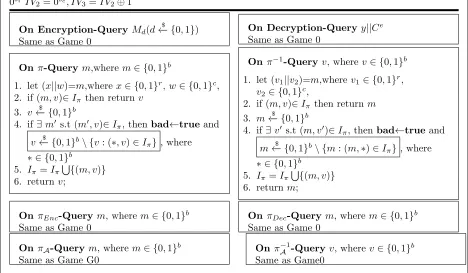
Game G0 and Game G1: The Code for both these games is exactly same. In the permutation, both games choose their response randomly while excluding the previous responses, in order to satisfy the permutation property.
Game G1 and Game G2: Both the games are same till bad occurs. The event bad occurs when a collision overb-bit outputs of permutationπ takes place. Ifq is the total number of queries toπ and π−1, then Pr[bad] is≤ q(q−1)
2b+1 .
|P r[EXG2,A]−P r[EXG1,A]|=Pr[bad]≤ (q2−b+11)q.
Game G2 and Game G3: Both the games are the same where the output of π is not checked for collision over previous responses.
|P r[EXG3,A] =P r[EXG2,A]|.
Game G3 and Game G4: Both the games are the same tillbadoccurs. The eventbadoccurs if there is a collision over c-bit output of permutation π. Pr[bad] is≤ q(q+1)
2bc . |P r[EXG4,A]−P r[EXG3,A]|=Pr[bad]≤ q(2q+1)bc .
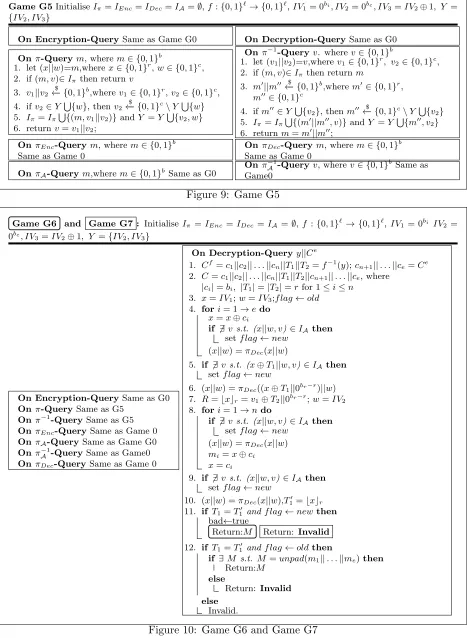
Game G4 and Game G5: Both the games are the same.
|P r[EXG5,A] =P r[EXG4,A]|.
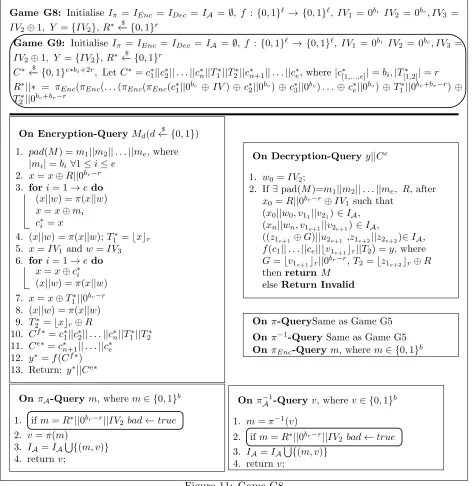
Game G5 and Game G6: Both the games are same. In Game G6 only a dummy operation of f lag ←new is added in the Decryption oracle to denote a new query. The query is new in the sense that neither the query nor any part of the query during internal calls to πDec was queried
earlier by the adversary. That is, query 6∈IA.
|P r[EXG6,A] =P r[EXG5,A]|.
Game G6 and Game G7: Both the games act similarly tillbadoccurs. The eventbadoccurs inDecryption oracle when a new query results inT1 =T10 (mentioned in Algorithm 2 line 15). The
bad event occurs with probability 5qD
2r +
qπA+qπ−1
2r .
|P r[EXG7,A]−P r[EXG6,A]|=Pr[bad]≤ 52qrD +
qπA+qπ−1
2r .
Let (v1||v2) =πDec(x||w), wherex,v1 ∈ {0,1}bi andw,v2 ∈ {0,1}bc. In decryption, a input is a
new query toπDec when ((x||w),(v1||v2))∈/IAand old query when ((x||w),(v1||v2))∈IA. If anew
query (x||w) is input toπDec during decryption, then πDec outputsv1||v2, where v2 ∈/ Y. That is, v2 is also new. Since v2 is unseen so far, it ensures that the input to the next call of π is certainly new. Further, since v2 is new, next input x0||v2 satisfies the condition (x0||v2,∗) ∈/ IA, where ∗
stands for anybbit value. Therefore onenew query makes all subsequent inputs toπDec(·) as new.
Any new query to πDec implies that a ciphertext y queried to Decryption oracle has never been
generated by the adversary. In Game G7, Decryption oracle return Invalid whenever adversary makes such a query.
IV1 f cn c2 c1 . . . R
m1 m2 mn
π π π π bi bc IV2 c2 π π π π bi bc IV3 IV1
c1 cn
cn+1
. . .
b b b π
mn+1
π . . . . . . me ce T1 T2 ℓ y ⊕ ⊕ ⊕ ⊕ ⊕ ⊕ ⊕ ⊕ ⊕ ⊕ π ⊕ b b T1 T2
cn+1 . . . ce
r
˜
r
R ⊕
⊕ π
10∗1
HASH
OAE 0bi−r
˜
A
C B
Figure 5: f-SpAEP with three checkpoints for testing if a new query has been made.
In Hash-part, if any input before A is new, then A is also new as explained earlier. Hence a decryption query is certainly new if A is new. In the case of checkpoints B and C, it is not possible that B isnew query and C is old query. This follows from our discussion above. Therefore we only need to check C to determine if there is a new query in the OAE part.
During encryption, let us denote the values at checkpoints A, B and C by α, R∗||0br−r||IV
2 and β respectively. Let y∗||Ce∗ be the target ciphertext and C∗ = Cf∗||Ce∗ where Cf∗ =
c∗1||. . .||c∗n||T1∗||T2∗ and Ce∗=c∗n+1||. . .||c∗e such thaty∗=f(Cf∗). The following cases cover all the possible cases for new query.
CASE-1 (A new, B new, C new): The bad event occurs only when tag T1 = T10 (shown in Algorithm 2 and Appendix A: game G7).
(a) C6=β: ThenT1 =T10 implies collision of the outputs ofπ overr-bit value. Proba-bility of this event is qD
2r forqD queries toDecryption oracle
(b) C=β: Then T1 = T1∗ which means ci = c∗i for all i such that 1 ≤ i ≤ n and
R = R∗. This in turn results in T2 = T∗
2. This leads to C = C∗, which is not allowed because adversary can not query y∗ =f(C∗) to Decryption oracle.
CASE-2 (Anew, B new, C old): This case is impossible. It is due to the fact that if B is new, then all subsequent inputs to πDec including C are also new.
CASE-3 (A new, B old, C new): The bad event occurs only when tag T1 =T10 as in CASE-1. This happens with probability qD
2r.
CASE-4 (Anew, Bold, Cold):
(a) A6=α: B and C are old queries in this case and hence R, T1 is already known to the adversary. T2 is also fixed due to the query y||Ce to the Decryption oracle. Further,bπ(A)cr=R⊕T2results inT1 =T10, which is a collision of output ofπ(A) over r-bit value. Probability of this event is qD
2r for qD queries to the Decryption
oracle.
(b) A=α: This results inT2=T2∗ due to the permutation property ofπ. This leads to ci =c∗i for allisuch that 1≤i≤n. IfR=R∗, theny=y∗ which is not allowed.
CASE-5 (Aold, B new, Cnew): The bad event occurs only when TagT1 =T10 as in CASE-1,3. This happen only with probability qD
2r.
CASE-6 (Aold, Bnew, Cold): This case is impossible. It is due the fact that if B is new, then all the subsequent inputs to πDec including C are also new.
CASE-7 (Aold, Bold, Cnew): Same as CASE-1,3,5.
CASE-8 (Aold, Bold, Cold): The bad event can not occur in this case.
Game G7 and Game G8: Both the games are same. Game G7 and G8 both return Invalid
when a new query is given to the Decryption oracle. In Game G8, a message M is returned only when all the input-output relations ofπ, which would be possible during the encryption of M, are already in IA. Game G8 iterates over all the possible pairs of (input,output) of π ∈ IA . This makes theDecryption oracle independent of f.
On query y||Ce, the Decryption oracle returns a valid M only if the adversary knows the plaintext-ciphertext pair (M, y||Ce); otherwise it returnsInvalid.
|P r[EXG8,A] =P r[EXG7,A]|.
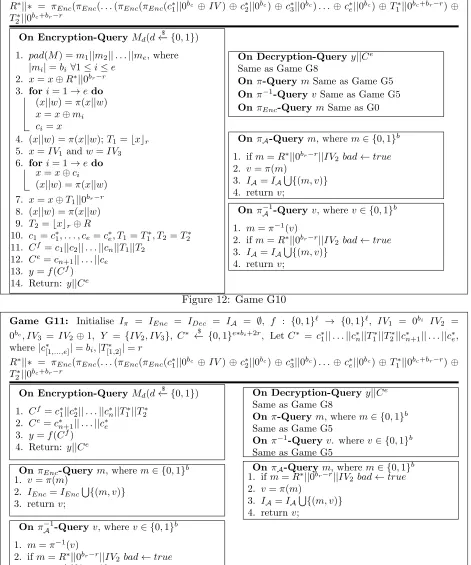
Game G8 and Game G9: We start incremental changes inEncryption oracle from Game G9. In G8,R∗ is generated randomly. In G9, R∗ is computed using the value of randomly generated c∗i (1≤i≤e) andT1∗, T2∗ . The value of R∗ is calculated viaHπEnc(IV, c∗
1, c∗2, . . . , c∗e, T1∗)⊕T2∗. Since π is an ideal permutation and T2∗ is a random value, R∗ will also be random. Therefore, G8 and G9 are same.
|P r[EXG9,A] =P r[EXG8,A]|.
Game G9 and Game G10: In the game G10, R∗ is generated in same way as in G9. In Encryption oracle, π is a ideal permutation which results in random c∗i(1≤i≤n). Therefore, in G10, the values ofci for all iare replaced by random values ci∗. Similarly T1 is replaced with T1∗. Due to initial random R∗, T2 = T2∗ . Both games G9 and G10 will behave the same way until ‘Bad’. The Bad event occurs when the adversary queriesR∗||0br−r||IV
2 toπA or receives response
R∗||0br−r||IV
2 from πA−1. In G10, R∗ is calculated using C∗, unlike C using the R∗ as in G9. In
G9, relation betweenc1, c2, . . . , ce is generated byR∗. However, relation betweenc∗1, c∗2, . . . , c∗e does
not exist in G10. This gap in the relation can be exploited by the adversary if adversary queries R∗||0br−r||IV
2 toπA or receives responseR∗||0br−r||IV2 from πA−1. |P r[EXG10,A]−P r[EXG9,A]|=Pr[Bad].
Game G10 and Game G11: Both the games are same. In game G10, C∗ = C. In G11, Encryption oracle replacesC∗ with randomly generated C, without callingπEnc. Both games G10
and G11 return a randomy∗||Ce =f(Cf∗ =Cf)||Ce. The Bad event in G10 takes place in G11 as
Bad1.
Game G11 and Game G12: Game G12 is the final game of adversaryA. From G11, a random yis the output ofEncryption oracle andCis unknown to adversary independent ofMb. Therefore,
if a randomC is given to theAin G12, then R∗ will be unknown to the adversary. Bad1 event in G10 is same as Bad2 in G11.
|P r[EXG12,A] =P r[EXG11,A]|, Pr[Bad1]=Pr[Bad2].
If a random C is given to theA in G12, thenR∗ will be unknown to the adversary andC will be independent of dofMd Therefore,
|P r[EXG12,A] = 12.
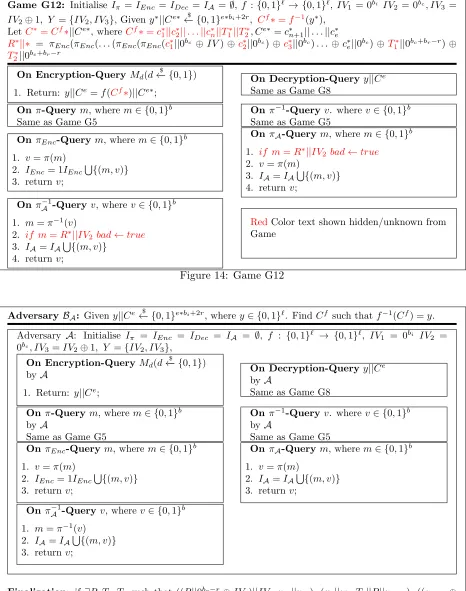
Given a target ciphertexty, AdversaryBA usesA as a black box, whileAuses G12.
A detailed description of the games and adversary B is given in Appendix B. The probability of Bad2 is as follows.
Pr[Bad2] = Pr[R∗||0br−r||IV
2 is queried to (πA orπ−A1)]
= Pr[(R∗||0br−r||IV
2 is queried to (πA orπA−1))∧(IEnc ⊂IA)]
+ Pr[(R∗||0br−r||IV
2 is queried to (πA orπA−1))∧(IEnc 6⊂IA)].
(IEnc⊂IA) implies that all the input-output relations ofπEnc are also known to the adversaryA
via setIA. ThereforeA knows allc∗i for 1≤i≤eand T1∗. Moreover, the adversaryA learnsT2∗ if it is allowed to queryR∗||0br−r||IV2.
Giveny||Ce, ifR∗||0br−r||IV
2is queried to (πA orπ−A1), then it revealsC completely. Therefore,
Pr[Bad2] =Advowtpf (BA) + Pr[(R∗||IV2 is queried to (πA orπA−1))∧(IEnc 6⊂IA)].
IEnc 6⊂IA implies that one of the inputs toHπEnc() is unknown to the adversary A. It results in
unknown output value from HπEnc(). Since T
2 is already random therefore R∗ remains unknown and random to A. Therefore,R∗||IV2 query toπA is equivalent to random guessing of R∗.
Pr[Bad2]=Advowtpf (BA)+(qπA+qπ−1) min(2r,2c) .
B
Games
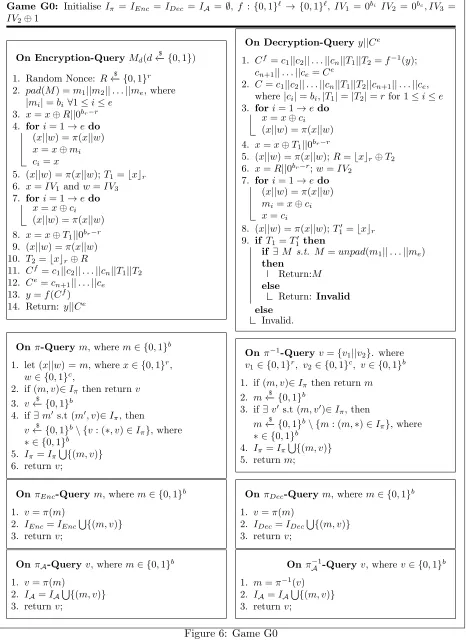
Game G0: Initialise Iπ = IEnc =IDec =IA =∅, f : {0,1}` → {0,1}`, IV1 = 0bi IV2 = 0bc, IV3 =
IV2⊕1
On Encryption-QueryMd(d←− {$ 0,1})
1. Random Nonce: R←− {$ 0,1}r
2. pad(M) =m1||m2||. . .||me, where |mi|=bi ∀1≤i≤e
3. x=x⊕R||0br−r 4. fori= 1→edo
(x||w) =π(x||w)
x=x⊕mi
ci=x
5. (x||w) =π(x||w);T1=bxcr
6. x=IV1 andw=IV3
7. fori= 1→edo
x=x⊕ci
(x||w) =π(x||w) 8. x=x⊕T1||0br−r
9. (x||w) =π(x||w) 10. T2=bxcr⊕R
11. Cf =c
1||c2||. . .||cn||T1||T2
12. Ce=c
n+1||. . .||ce
13. y=f(Cf)
14. Return: y||Ce
On Decryption-Queryy||Ce
1. Cf =c
1||c2||. . .||cn||T1||T2=f−1(y);
cn+1||. . .||ce=Ce
2. C=c1||c2||. . .||cn||T1||T2||cn+1||. . .||ce,
where|ci|=bi,|T1|=|T2|=rfor 1≤i≤e
3. fori= 1→edo
x=x⊕ci
(x||w) =π(x||w) 4. x=x⊕T1||0br−r
5. (x||w) =π(x||w);R=bxcr⊕T2
6. x=R||0br−r;w=IV
2
7. fori= 1→edo (x||w) =π(x||w)
mi=x⊕ci
x=ci
8. (x||w) =π(x||w);T10=bxcr
9. if T1=T10 then
if ∃M s.t. M =unpad(m1||. . .||me) then Return:M else Return: Invalid else Invalid.
On π-Query m, wherem∈ {0,1}b
1. let (x||w) = m, wherex∈ {0,1}r,
w∈ {0,1}c,
2. if (m, v)∈Iπ then returnv
3. v←− {$ 0,1}b
4. if∃m0 s.t (m0, v)∈I
π, then
v←− {$ 0,1}b\ {v: (∗, v)∈I
π}, where ∗ ∈ {0,1}b
5. Iπ =IπS{(m, v)}
6. returnv;
On π−1-Queryv={v
1||v2}. where
v1∈ {0,1}r, v2∈ {0,1}c, v∈ {0,1}b
1. if (m, v)∈Iπ then returnm
2. m←− {$ 0,1}b
3. if∃ v0 s.t (m, v0)∈I
π, then
m←− {$ 0,1}b\ {m: (m,∗)∈I
π}, where ∗ ∈ {0,1}b
4. Iπ=IπS{(m, v)}
5. returnm;
On πEnc-Querym, where m∈ {0,1}b
1. v=π(m)
2. IEnc=IEncS{(m, v)}
3. returnv;
On πDec-Query m, wherem∈ {0,1}b
1. v=π(m)
2. IDec=IDecS{(m, v)}
3. returnv;
On πA-Query v, where m∈ {0,1}b
1. v=π(m)
2. IA=IAS{(m, v)}
3. returnv;
On πA−1-Queryv, wherev∈ {0,1}b
1. m=π−1(v)
2. IA=IAS{(m, v)}
3. returnv;
Game G1 and Game G2 : Initialise Iπ =IEnc = IDec = IA = ∅, f : {0,1}` → {0,1}`, IV1 =
0bi IV
2= 0bc, IV3=IV2⊕1
On Encryption-QueryMd(d←− {$ 0,1})
Same as Game 0
On Decryption-Queryy||Ce
Same as Game 0
On π-Query m,wherem∈ {0,1}b
1. let (x||w)=m,wherex∈ {0,1}r,w∈ {0,1}c, 2. if (m, v)∈Iπ then returnv
3. v←− {$ 0,1}b
4. if∃m0 s.t (m0, v)∈I
π, thenbad←trueand
v←− {$ 0,1}b\ {v: (∗, v)∈I
π}, where ∗ ∈ {0,1}b
5. Iπ =IπS{(m, v)}
6. returnv;
On π−1-Queryv, where v∈ {0,1}b
1. let (v1||v2)=m,wherev1∈ {0,1}r,
v2∈ {0,1}c,
2. if (m, v)∈Iπ then returnm
3. m←− {$ 0,1}b
4. if∃ v0 s.t (m, v0)∈I
π, then bad←trueand
m←− {$ 0,1}b\ {m: (m,∗)∈I
π}, where ∗ ∈ {0,1}b
5. Iπ=IπS{(m, v)}
6. returnm;
On πEnc-Querym, where m∈ {0,1}b
Same as Game 0
On πDec-Query m, wherem∈ {0,1}b
Same as Game 0 On πA-Query m, wherem∈ {0,1}b
Same as Game G0
On π−A1-Query v, where v∈ {0,1}b
Same as Game0 Figure 7: Game G1 and Game G2
Game G3 and Game G4 : Initialise Iπ = IEnc = IDec = IA = ∅, f : {0,1}` → {0,1}`, IV1 =
0bi IV
2= 0bc, IV3=IV2⊕1, Y ={IV2, IV3}
On Encryption-QueryMd(d←− {$ 0,1})
Same as Game G0
On Decryption-Queryy||Ce
Same as Game G0
On π-Query m, wherem∈ {0,1}b
1. let (x||w)=m,wherex∈ {0,1}r,w∈ {0,1}c, 2. if (m, v)∈Iπ then returnv
3. v1||v2←− {$ 0,1}b,wherev1∈ {0,1}r,
v2∈ {0,1}c,
4. ifv2∈YS{w}, thenbad←trueand
v2←− {$ 0,1}c\YS{w}
5. Iπ =IπS{(m, v1||v2)} andY =YS{v2, w}
6. returnv=v1||v2;
On π−1-Queryv. wherev∈ {0,1}b
1. let (v1||v2)=v,where
v1∈ {0,1}r, v2∈ {0,1}c,
2. if (m, v)∈Iπ then returnm
3. m0||m00←− {$ 0,1}b,wherem0 ∈ {0,1}r,
m00∈ {0,1}c,
4. ifm00∈Y S{v
2}, thenbad←trueand
m00←− {$ 0,1}c\Y S{v 2}
5. Iπ=IπS{(m0||m00, v)}and
Y =Y S
{m00, v2}
6. returnm=m0||m00;
On πEnc-Querym, where m∈ {0,1}b
Same as Game 0
On πDec-Query m, wherem∈ {0,1}b
Same as Game 0 On πA-Query m, wherem∈ {0,1}b
Same as Game G0
On π−A1-Query v, where v∈ {0,1}b
Game G5InitialiseIπ=IEnc=IDec=IA=∅,f:{0,1}`→ {0,1}`,IV1= 0bi, IV2= 0bc, IV3=IV2⊕1, Y = {IV2, IV3}
On Encryption-QuerySame as Game G0 On Decryption-QuerySame as G0
Onπ-Querym, wherem∈ {0,1}b
1. let (x||w)=m,wherex∈ {0,1}r,w∈ {0,1}c, 2. if (m, v)∈Iπthen returnv
3. v1||v2←− {0$ ,1}b,wherev1 ∈ {0,1}r,v2∈ {0,1}c, 4. ifv2∈Y S{w}, thenv2←− {0$ ,1}c\YS{w} 5. Iπ=IπS{(m, v1||v2)}andY =YS{v2, w} 6. returnv=v1||v2;
Onπ−1-Query v. wherev∈ {0,1}b
1. let (v1||v2)=v,wherev1∈ {0,1}r, v2∈ {0,1}c, 2. if (m, v)∈Iπthen returnm
3. m0||m00←− {0$ ,1}b,wherem0∈ {0,1}r,
m00∈ {0,1}c 4. ifm00∈YS
{v2}, thenm00←− {0$ ,1}c\YS{v2} 5. Iπ=IπS{(m0||m00, v)}andY =YS{m00, v2} 6. returnm=m0||m00;
OnπEnc-Query m, wherem∈ {0,1}b Same as Game 0
OnπDec-Query m, wherem∈ {0,1}b Same as Game 0
OnπA-Querym,wherem∈ {0,1}bSame as G0 Onπ −1
A -Query v, wherev∈ {0,1}bSame as
Game0
Figure 9: Game G5
Game G6 and Game G7 : InitialiseIπ=IEnc =IDec=IA=∅,f :{0,1}`→ {0,1}`,IV1 = 0bi IV2 = 0bc, IV
3=IV2⊕1, Y ={IV2, IV3}
On Encryption-QuerySame as G0
Onπ-QuerySame as G5
Onπ−1-Query Same as G5 OnπEnc-Query Same as Game 0 OnπA-QuerySame as Game G0 Onπ−1
A -Query Same as Game0 OnπDec-Query Same as Game 0
On Decryption-Queryy||Ce
1. Cf =c1||c2||. . .||cn||T1||T2=f−1(y);cn+1||. . .||ce=Ce 2. C=c1||c2||. . .||cn||T1||T2||cn+1||. . .||ce, where
|ci|=bi, |T1|=|T2|=rfor 1≤i≤n 3. x=IV1;w=IV3;f lag←old
4. fori= 1→edo x=x⊕ci
if 6 ∃ vs.t. (x||w, v)∈IAthen
setf lag←new
(x||w) =πDec(x||w)
5. if 6 ∃vs.t. (x⊕T1||w, v)∈IAthen
setf lag←new
6. (x||w) =πDec((x⊕T1||0br−r)||w) 7. R=bxcr=v1⊕T2||0br−r;w=IV2 8. fori= 1→ndo
if 6 ∃ vs.t. (x||w, v)∈IAthen
setf lag←new
(x||w) =πDec(x||w) mi=x⊕ci x=ci
9. if 6 ∃vs.t. (x||w, v)∈IAthen
setf lag←new
10. (x||w) =πDec(x||w),T10=bxcr 11. if T1=T10 andf lag←newthen
bad←true
Return:M Return: Invalid
12. if T1=T10 andf lag←oldthen
if ∃M s.t. M=unpad(m1||. . .||me)then Return:M
else
Return: Invalid else
Invalid.
Game G8: Initialise Iπ = IEnc =IDec =IA =∅, f : {0,1}` → {0,1}`, IV1 = 0bi IV2 = 0bc, IV3 =
IV2⊕1, Y ={IV2},R∗←− {$ 0,1}r
#
" !
Game G9: Initialise Iπ =IEnc = IDec =IA = ∅, f : {0,1}` → {0,1}`, IV1 = 0bi IV2 = 0bc, IV3 =
IV2⊕1, Y ={IV2},R∗←− {$ 0,1}r
C∗←− {$ 0,1}e∗bi+2r, LetC∗=c∗
1||c∗2||. . .||c∗n||T1∗||T2∗||c∗n+1||. . .||c∗e, where|c∗[1,...,e]|=bi,|T[1∗,2]|=r
R∗||∗ = π
Enc(πEnc(. . .(πEnc(πEnc(c∗1||0bc ⊕IV)⊕c∗2||0bc)⊕c∗3||0bc). . . ⊕c∗e||0bc)⊕T1∗||0bc+br−r)⊕
T∗
2||0bc+br−r
On Encryption-QueryMd(d←− {$ 0,1})
1. pad(M) =m1||m2||. . .||me, where |mi|=bi ∀1≤i≤e
2. x=x⊕R||0br−r 3. fori= 1→edo
(x||w) =π(x||w)
x=x⊕mi
c∗
i =x
4. (x||w) =π(x||w);T∗ 1 =bxcr
5. x=IV1 andw=IV3
6. fori= 1→edo
x=x⊕c∗
i
(x||w) =π(x||w) 7. x=x⊕T1∗||0br−r
8. (x||w) =π(x||w) 9. T∗
2 =bxcr⊕R
10. Cf∗=c∗
1||c∗2||. . .||c∗n||T1∗||T2∗
11. Ce∗=c∗
n+1||. . .||c∗e
12. y∗=f(Cf∗)
13. Return: y∗||Ce∗
On Decryption-Queryy||Ce
1. w0=IV2;
2. If∃ pad(M)=m1||m2||. . .||me, R,after
x0=R||0br−r⊕IV1such that
(x0||w0, v11||v21)∈IA,
(xn||wn, v1e+1||v2e+1)∈IA,
((z1e+1⊕G)||u2e+1 ,z1e+2||z2e+2)∈IA,
f(c1||. . .||ce||bv1e+1cr||T2) =y, where
G=bv1e+1cr||0 br−r,T
2=bz1e+2cr⊕R
thenreturn M
else Return Invalid
On π-QuerySame as Game G5 On π−1-QuerySame as Game G5
On πEnc-Querym, wherem∈ {0,1}b
On πA-Query m, wherem∈ {0,1}b
1.
ifm=R∗||0br−r||IV
2 bad←true
2. v=π(m)
3. IA=IAS{(m, v)}
4. returnv;
On πA−1-Queryv, wherev∈ {0,1}b
1. m=π−1(v)
2.
ifm=R∗||0br−r||IV
2 bad←true
3. IA=IAS{(m, v)}
4. returnv; Figure 11: Game G8
Following special notations is begin used during Game G8, G9, G10, G11, G12 andBAin decryption oracle:
1. During OAE part of SpAEP, we represent input-output relation of π’s subsequent calls for pad(M) =m1||. . .||meby (v1i+1||v2i+1) =π(xi||wi), wherexi =v1i⊕{mi},wi =v2i0≤i≤e,
v10 = IV1,m0 = R, w0 = IV2, v1i, xi ∈ {0,1}
r and v
2i, wi ∈ {0,1}
c. Then c
i will represent
mi⊕v1i, here 1≤i≤e.
Game G10: Initialise Iπ =IEnc =IDec =IA=∅, f :{0,1}` → {0,1}`, IV1 = 0bi IV2 = 0bc, IV3 =
IV2⊕1, Y = {IV2, IV3}, C∗ ←− {$ 0,1}e∗bi+2r, LetC∗ = c∗1||c∗2||. . .||c∗n||T1∗||T2∗||c∗n+1||. . .||c∗e, where |c∗[1,...,e]|=bi,|T[1∗,2]|=r
R∗||∗ = π
Enc(πEnc(. . .(πEnc(πEnc(c∗1||0bc ⊕IV)⊕c∗2||0bc)⊕c∗3||0bc). . .⊕c∗e||0bc)⊕T1∗||0bc+br−r)⊕
T∗
2||0bc+br−r
On Encryption-QueryMd(d←− {$ 0,1})
1. pad(M) =m1||m2||. . .||me, where |mi|=bi ∀1≤i≤e
2. x=x⊕R∗||0br−r 3. fori= 1→edo
(x||w) =π(x||w)
x=x⊕mi
ci=x
4. (x||w) =π(x||w);T1=bxcr
5. x=IV1 andw=IV3
6. fori= 1→edo
x=x⊕ci
(x||w) =π(x||w) 7. x=x⊕T1||0br−r
8. (x||w) =π(x||w) 9. T2=bxcr⊕R
10. c1=c∗1, . . . , ce=ce∗, T1=T1∗, T2=T2∗
11. Cf =c
1||c2||. . .||cn||T1||T2
12. Ce=c
n+1||. . .||ce
13. y=f(Cf)
14. Return: y||Ce
On Decryption-Queryy||Ce
Same as Game G8
On π-QuerymSame as Game G5 On π−1-Queryv Same as Game G5
On πEnc-Query mSame as G0
On πA-Querym, wherem∈ {0,1}b
1. ifm=R∗||0br−r||IV
2 bad←true
2. v=π(m)
3. IA=IAS{(m, v)}
4. returnv;
On πA−1-Queryv, wherev∈ {0,1}b
1. m=π−1(v)
2. ifm=R∗||0br−r||IV
2 bad←true
3. IA=IAS{(m, v)}
4. returnv;
Figure 12: Game G10
Game G11: Initialise Iπ = IEnc = IDec = IA = ∅, f : {0,1}` → {0,1}`, IV1 = 0bi IV2 =
0bc, IV
3 = IV2⊕1, Y = {IV2, IV3}, C∗ ←− {$ 0,1}e∗bi+2r, LetC∗ =c∗1||. . .||c∗n||T1∗||T2∗||c∗n+1||. . .||c∗e,
where|c∗[1,...,e]|=bi,|T[1∗,2]|=r
R∗||∗ = π
Enc(πEnc(. . .(πEnc(πEnc(c∗1||0bc ⊕IV)⊕c∗2||0bc)⊕c∗3||0bc). . .⊕c∗e||0bc)⊕T1∗||0bc+br−r)⊕
T∗
2||0bc+br−r
On Encryption-QueryMd(d←− {$ 0,1})
1. Cf =c∗
1||c∗2||. . .||c∗n||T1∗||T2∗
2. Ce=c∗
n+1||. . .||c∗e
3. y=f(Cf)
4. Return: y||Ce
On Decryption-Queryy||Ce
Same as Game G8
On π-Querym, where m∈ {0,1}b
Same as Game G5
On π−1-Queryv. wherev∈ {0,1}b
Same as Game G5 On πEnc-Querym, where m∈ {0,1}b
1. v=π(m)
2. IEnc=IEncS{(m, v)}
3. returnv;
On πA-Querym, wherem∈ {0,1}b
1. ifm=R∗||0br−r||IV
2 bad←true
2. v=π(m)
3. IA=IAS{(m, v)}
4. returnv; On π−A1-Query v, wherev∈ {0,1}b
1. m=π−1(v)
2. ifm=R∗||0br−r||IV
2bad←true
3. IA=IAS{(m, v)}
4. returnv;
Game G12: Initialise Iπ =IEnc =IDec =IA=∅, f :{0,1}` → {0,1}`, IV1 = 0bi IV2 = 0bc, IV3 =
IV2⊕1, Y ={IV2, IV3}, Given y∗||Ce∗←− {$ 0,1}e∗bi+2r, Cf∗=f−1(y∗),
LetC∗=Cf∗||Ce∗, whereCf∗=c∗
1||c∗2||. . .||c∗n||T1∗||T2∗, Ce∗=c∗n+1||. . .||c∗e
R∗||∗ = πEnc(πEnc(. . .(πEnc(πEnc(c∗1||0bc ⊕IV)⊕c∗2||0bc)⊕c∗3||0bc). . .⊕c∗e||0bc)⊕T1∗||0bc+br−r)⊕
T2∗||0bc+br−r
On Encryption-QueryMd(d←− {$ 0,1})
1. Return: y||Ce=f(Cf∗)||Ce∗;
On Decryption-Queryy||Ce
Same as Game G8 On π-Query m, wherem∈ {0,1}b
Same as Game G5
On π−1-Queryv. wherev∈ {0,1}b
Same as Game G5 On πEnc-Querym, where m∈ {0,1}b
1. v=π(m)
2. IEnc= 1IEncS{(m, v)}
3. returnv;
On πA-Querym, wherem∈ {0,1}b
1. if m=R∗||IV
2 bad←true 2. v=π(m)
3. IA=IAS{(m, v)}
4. returnv; On π−A1-Query v, wherev∈ {0,1}b
1. m=π−1(v) 2. if m=R∗||IV
2 bad←true 3. IA=IAS{(m, v)}
4. returnv;
RedColor text shown hidden/unknown from Game
Figure 14: Game G12
Adversary BA: Giveny||Ce←− {$ 0,1}e∗bi+2r, wherey∈ {0,1}`. Find Cf such thatf−1(Cf) =y. Adversary A: Initialise Iπ = IEnc = IDec = IA = ∅, f : {0,1}` → {0,1}`, IV1 = 0bi IV2 =
0bc, IV
3=IV2⊕1, Y ={IV2, IV3},
On Encryption-Query Md(d←− {$ 0,1})
byA
1. Return: y||Ce;
On Decryption-Query y||Ce
byA
Same as Game G8 On π-Query m, wherem∈ {0,1}b
byA
Same as Game G5
On π−1-Query v. wherev∈ {0,1}b
byA
Same as Game G5 On πEnc-Querym, where m∈ {0,1}b
1. v=π(m)
2. IEnc= 1IEncS{(m, v)}
3. returnv;
On πA-Querym, wherem∈ {0,1}b
1. v=π(m)
2. IA=IAS{(m, v)}
3. returnv; On π−A1-Query v, wherev∈ {0,1}b
1. m=π−1(v)
2. IA=IAS{(m, v)}
3. returnv;
Finalization: if ∃R, T1, T2 such that ((R||0br−r⊕IV1)||IV2, v11||v21), (xe||we, T1||P||v2e+1), ((z1e+1⊕
T1||00
br−r
)||u2e+1,(T2 ⊕ R)||P||z2e+2) ∈ IA and f(c1||. . .||cn||T1||T2) = y, then return C f =