Business Website Features of the B2C E-commerce
By
Madhury Khatun
MBA (AIS, NZ), MSc (Dhaka Uni), BSc (Hons) (Dhaka Uni)
College of Business Victoria University Melbourne, Victoria, Australia
Submitted in fulfilment of the requirements of the degree of Doctor of Philosophy
Page i of 327
Abstract
Small business decision-makers require effective decision support solutions for their operational and strategic decision-making. Current decision support solutions provide various system provisions for managerial decisions. They remain limited in meeting the decision-makers’ cognitive requirements, specifically for small businesses in the business-to-consumer (B2C) online environment. Small businesses continuously suffer from a range of issues associated with changing business environment, technology, and consumer preferences. In order to address these issues, a small business must have an interactive website that offers a competitive platform. Small business managers often lack knowledge of how to update their websites. More than half Australian small businesses in the retail sector use their websites for promotions. Although it is essential for managers to have a digital strategy using effective websites, social media, and mobile applications, most owners/managers have lack of confidence in making decisions strategically in this significant matter.
The objective of the study was to design an innovative decision support systems (DSS) solution to address the issues faced by owners/managers in making strategic decisions, particularly in their implementation of an effective website. The solution artefact was designed as an instantiation (a type of artefact) prototype. Practitioner groups evaluated it within the target small business retail industry. It was designed to provide support to small business owners/managers in making strategic decisions when selecting useful website features to achieve competitive advantage. As the DSS is a well-recognised research tradition within the information systems (IS) discipline, it was anticipated that the artefact would improve the current provisions of DSS and enable an innovative solution to support managerial decision-making in the context of online B2C business problems.
Page ii of 327
through multiple focus group sessions involving owners/managers in evaluating the artefact. Qualitative and descriptive analysis approaches were adopted to analyse the data. These users evaluated the usability, efficacy, and performance of the DSS prototype instantiation. The evaluation was critical to producing a user-friendly DSS to meet end-user needs and for further improvements of the prototype.
Page iii of 327
Declaration of Originality
The work contained in this thesis has not been previously submitted for a degree at any higher educational institutions. This PhD thesis is no more than 100,000 words in length excluding table of contents, appendices, and references. To the best of my knowledge and belief, the contents of this dissertation have not been published by any authors except where due references are made in the thesis itself.
Page iv of 327
Acknowledgement
I would like to thank the Al-Mighty Allah, for providing me the strength to complete my doctoral study. This work was guided and supervised by my principal supervisor Associate Professor Dr Shah Miah in the College of Business, Victoria University. I acknowledge my principal supervisor for encouraging, supporting and overall assisting me throughout my PhD journey as well as for helping with developing a number of good publications. I am profoundly grateful to him for his valuable time, expert advice, kind help, and cooperation.
I would also like to express my gratitude to Associate Professor Stephen Burgess, in the College of Business, Victoria University. Dr Burgess was my associate supervisor. I am very thankful to him for his cooperation on my PhD journey. For part of my journey, Dr M. A. Rashid from the School of Engineering and Advanced Technology, Massey University, Auckland, New Zealand, was my external supervisor. So too was Dr Neda Abdelhamid, Senior Lecturer of the Information Technology Programme, Auckland Institute of Studies, Auckland, New Zealand. I am very grateful to both of them for their valuable time, expert advice and cooperation.
Page v of 327
Dedication
Page vi of 327
Table of Contents
ABSTRACT ... I
DECLARATION OF ORIGINALITY ... III
ACKNOWLEDGEMENT ... IV
DEDICATION ...V
TABLE OF CONTENTS ... VI
LISTS OF TABLES...XVII
LISTS OF FIGURES... XIX
LIST OF PUBLICATIONS FROM THIS PHD THESIS ...XXII
LIST OF ABBREVIATIONS ... XXIII
GLOSSARY ... XXV
CHAPTER 1: INTRODUCTION ... 1
1.1RESEARCH BACKGROUND AND PROBLEM STATEMENTS ... 2
1.2MOTIVATION AND RESEARCH OBJECTIVES ... 5
1.3RESEARCH QUESTIONS AND CONTRIBUTIONS ... 6
1.3.1 Main research contributions and major outcomes ... 7
1.4THE STRUCTURE OF THE THESIS ... 9
1.5CHAPTER SUMMARY………...11
CHAPTER 2: SMALL BUSINESS STRATEGIC DECISIONS IN THE B2C ECOMMERCE ENVIRONMENT ... 13
2.1SMALL BUSINESS DEFINITION ... 13
2.2MANAGERIAL CHARACTERISTICS AND SHORTCOMINGS OF SMALL BUSINESSES... 15
2.2.1 Lack of resources and expertise... 16
2.2.2 ICT skills and use ... 16
2.2.3 Small business tendencies to only sell products locally ... 17
2.3SMALL BUSINESSES IN AUSTRALIA AND THEIR CONTRIBUTIONS ... 17
2.4E-COMMERCE... 18
2.4.1 Types of e-commerce ... 19
Page vii of 327
2.4.3 The benefits of B2C e-commerce ... 20
2.4.3.1 Early e-commerce benefits ... 20
2.4.3.2 An online meeting place for buyers and sellers ... 21
2.4.3.3 A convenient platform for buyers and sellers ... 21
2.4.3.4 Other potential benefits of B2C e-commerce ... 21
2.4.3.5 E-commerce benefits for small businesses ... 22
2.5SMALL BUSINESS PROBLEMS IN THE B2C E-COMMERCE ENVIRONMENT... 22
2.5.1 Factors that influence consumer online purchasing ... 23
2.6THEORETICAL JUSTIFICATORY KNOWLEDGE ... 25
2.6.1 Benefits of websites and their features ... 25
2.6.2 Website feature categories and requirements in the B2C e-commerce environment ... 26
2.6.3 Small business website features within the B2C e-commerce environment . 28 2.6.4 DSS for a small business in the B2C e-commerce environment ... 31
2.7CHAPTER SUMMARY ... 32
CHAPTER 3: DECISION SUPPORT SYSTEM SOLUTIONS ... 33
3.1DSS DEFINITIONS ... 33
3.2DSS BENEFITS TO BUSINESS ... 34
3.3THE SCOPE OF DSS ... 35
3.4THEORIES AND DECISION MODELS OF DSS ... 37
3.4.1 Theories and models of managerial decision-making processes ... 37
3.4.1.1 Comparison of three decision models ... 38
3.4.1.1.1 Intelligence phase ... 39
3.4.1.1.2 Design phase... 40
3.4.1.1.3 Choice phase... 40
3.4.1.2 Reasons for the adoption of the MRT model and its theories ... 41
3.4.2 A conceptual DSS solution framework ... 44
3.4.2.1 The identification phase of MRT model... 45
3.4.2.1.1 Analysis of the external environment and related factors ... 46
3.4.2.1.2 Analysis of the internal environment and related factors... 47
3.4.2.2 The development phase of MRT model ... 48
3.4.2.3 The selection phase of MRT model ... 49
Page viii of 327
CHAPTER 4: RESEARCH METHODOLOGY ... 52
4.1RESEARCH PHILOSOPHY ... 52
4.1.1 Fundamental differences between quantitative and qualitative research strategies ... 53
4.2RESEARCH METHODOLOGY ... 56
4.2.1 Philosophical grounds of using DSR as a research methodology ... 56
4.2.2 The specific DSR method ... 60
4.2.3 HMPR guidelines in DSR... 61
4.2.3.1 HMPR guideline 1: Design as an artefact ... 64
4.2.3.2 HMPR guideline 2: Problem relevance ... 64
4.2.3.3 HMPR guideline 3: Design evaluation ... 64
4.2.3.4 HMPR guideline 4: Research contributions ... 64
4.2.3.4.1 Theoretical contributions ... 64
4.2.3.4.2 Methodological contributions... 65
4.2.3.4.3 Practical contributions ... 65
4.2.3.5 HMPR guideline 5: Research rigour ... 65
4.2.3.6 HMPR guideline 6: Design as a search process ... 66
4.2.3.7 HMPR guideline 7: Communication of research ... 66
4.3RESEARCH DESIGN STAGES ... 66
4.3.1 Stage one of the research design... 67
4.3.2 Stage two of the research design ... 68
4.3.2.1 Sample source for case studies ... 70
4.3.2.2 A pilot study ... 70
4.3.2.3 Case study method with multiple cases ... 70
4.3.2.4 Sample size for case studies ... 71
4.3.2.5 Sampling techniques for case studies ... 71
4.3.2.5.1 Probability or representative sampling ... 72
4.3.2.5.2 Non-probability or judgement sampling... 72
4.3.2.6 Data collection technique through multiple case studies... 72
4.3.2.7 Designing interview questionnaire for multiple case studies ... 74
4.3.2.8 Data analysis methods ... 75
4.3.2.8.1 Top-down and bottom-up methods ... 75
Page ix of 327
4.3.2.8.3 Inductive content analysis method ... 76
4.3.2.9 The data source for content analysis ... 77
4.3.2.10 Qualitative data reduction methods ... 77
4.3.3 Stage three of the research design ... 79
4.3.3.1 Design the initial DSS solution prototype ... 80
4.3.3.2 Evaluation of the initial DSS prototype ... 80
4.3.3.2.1 Evaluation of the initial DSS prototype by the researcher and supervisor ... 81
4.3.3.2.2 Evaluation of the initial DSS prototype by end-users... 81
4.3.3.2.3 Data collection techniques and data source of the DSS prototype evaluation by end-users ... 81
4.3.3.3 Producing the final DSS solution artefact ... 81
4.4DATA ANALYSIS TOOLS... 81
4.5ETHICS APPROVAL ... 82
4.6CHAPTER SUMMARY ... 82
CHAPTER 5: WEB CONTENT ANALYSIS AND RESULTS ... 84
5.1THE IMPORTANCE OF WEBSITE CONTENT ... 84
5.2CONTENT ANALYSIS ... 85
5.3THE ADVANTAGES OF A CONTENT ANALYSIS METHOD ... 85
5.4THE LIMITATIONS OF A CONTENT ANALYSIS METHOD ... 86
5.5APPLYING A CONTENT ANALYSIS METHOD TO WEBSITE CONTENT ... 86
5.5.1 First step: Formulate research questions ... 87
5.5.2 Second step: Selection of the sample ... 88
5.5.3 Third step: Define categories of contents, units of analysis and coding units88 5.5.3.1 Define the categories of contents... 88
5.5.3.2 Units of analysis and coding units ... 89
5.5.4 Fourth step: Train the coder and check the reliability of the coding ... 89
5.5.5 Fifth step: Analysing and interpreting data ... 90
5.6WEBSITE SOURCES AND FINDING TECHNIQUES ... 90
5.6.1 Source of small business websites and finding techniques ... 90
5.6.2 Source of overseas websites and finding techniques ... 91
Page x of 327
5.7.1 Findings from analysing content related to information-based website
features... 92
5.7.1.1 Comparative results on information-based website features ... 93
5.7.2 Findings from analysing content related to communication-based website features... 95
5.7.2.1 Comparative results on communication-based website features ... 96
5.7.3 Findings from analysing content related to transaction-based website features ... 97
5.7.3.1 Comparative results on transaction-based website features ... 98
5.7.4 Findings from analysing related to distribution-based website features ... 100
5.7.4.1 Comparative results on distribution-based website features ... 100
5.8SUMMARY OF FINDINGS ... 101
5.9CHAPTER SUMMARY ... 103
CHAPTER 6: CASE STUDIES FINDINGS AND DATA ANALYSIS ... 104
6.1DATA ANALYSIS PROCESSES ... 104
6.2FINDINGS ... 105
6.2.1 The experience of case study data collection ... 105
6.2.1.1 Responses from the sample and analysis ... 105
6.2.2 Part I of the questionnaire: Findings based on small business profiles ... 106
6.2.2.1 Results and analysis ... 107
6.2.3 Part II of the questionnaire: Findings based on small business owner/manager profiles ... 108
6.2.3.1 Results and analysis ... 109
6.2.4 Part III of the questionnaire: Findings based on business models, owner/manager awareness of online shopping problems in Australia and their experiences ... 110
6.2.4.1 Results and analysis ... 112
6.2.5 Part IV of the questionnaire: Using SWOT matrices ... 113
6.2.5.1 Findings based on owners/managers’ knowledge about internal and external business environmental factors ... 114
6.2.5.1.1 Results and analysis... 115
Page xi of 327
6.2.5.2.1 Results on small business internal strengths or resources ... 118
6.2.5.2.2 Results on small business strategies to effective use of internal resources ... 119
6.2.5.2.3 Results analysis... 121
6.2.5.3 Findings based on small business internal weaknesses and strategies to counter weaknesses by exploiting opportunities ... 121
6.2.5.3.1 Results on small business internal problems and strategies to address them ... 122
6.2.5.3.2 Results analysis... 124
6.2.5.4 Findings based on external opportunities and small business strategies to exploit them ... 125
6.2.5.4.1 Results and analysis... 126
6.2.5.5 Findings based on external threats and small business strategies to minimise them ... 127
6.2.5.5.1 Results and analysis... 128
6.2.5.6 Findings based on owners/managers’ awareness about overseas competitors and the products they sell to Australia ... 129
6.2.5.6.1 Results and analysis... 130
6.2.5.7 Findings based on owner/managers’ knowledge of the adoption levels of features on overseas websites and their strategies to maintain features on their own websites... 130
6.2.5.7.1 Results and analysis... 131
6.2.5.8 Findings based on the level of adoption of features on small businesses websites ... 133
6.2.5.8.1 Results and analysis... 134
6.2.5.9 Findings based on owners/managers’ strategic decisions to select relevant website features in the B2C E-commerce environment ... 135
6.2.5.9.1 Results and analysis... 135
6.3SUMMARY ON SMALL BUSINESS INTERNAL ISSUES AND NEEDS ... 136
6.4CHAPTER SUMMARY ... 138
CHAPTER 7: DSS REQUIREMENTS ANALYSIS AND DESIGN METHODS 139 7.1DSS REQUIREMENT ANALYSIS ... 139
Page xii of 327
7.1.1.1 The identification phase... 140
7.1.1.1.1 Small business internal issues, needs and DSS requirements analysis ... 141
7.1.1.1.2 Small business external environmental factors and DSS requirement analysis ... 142
7.1.1.2 The development phase ... 143
7.1.1.3 The selection phase ... 143
7.2DSS DEVELOPMENT APPROACHES... 144
7.2.1 The monolithic system development approach ... 146
7.2.2 The incremental or agile system development approach ... 146
7.2.3 The joint application development approach ... 146
7.2.4 The rapid application development approach ... 147
7.2.5 The evolutionary prototyping system development approach ... 147
7.2.6 UCD principles for DSS solution design, development and evaluation ... 149
7.3CHAPTER SUMMARY ... 153
CHAPTER 8: A NEW DSS ARTEFACT DESIGN AND DEVELOPMENT ... 154
8.1THE CONTEXT OF THE WFE-DSS DESIGN AND DEVELOPMENT ... 154
8.2OBJECTIVES OF THE NEW DSS SOLUTION ARTEFACT DESIGN AND DEVELOPMENT ... 156
8.3DESIGN AND DEVELOPMENT PROCEDURES ... 160
8.3.1 Design and development principles ... 160
8.3.1.1 The knowledge acquisition layer ... 161
8.3.1.2 The DSS application layer ... 162
8.3.2 Components of the WFE-DSS prototype artefact ... 162
8.3.2.1 User as human decision-maker and its judgements ... 165
8.3.2.2 User interface ... 165
8.3.2.2.1 User interface design ... 166
8.3.2.3 WFE-DSS database ... 167
8.3.2.3.1 Data sources and database design ... 168
8.3.2.4 The knowledge base component... 170
8.3.2.4.1 Rule-based system development, algorithm specification and knowledge creation ... 173
8.4FUNCTIONAL MODEL OF THE NEW WFE-DSS ... 175
Page xiii of 327
8.4.2 User interface for selecting small business website features ... 177
8.4.3 User interface for selecting competitor website features ... 178
8.4.4 User interface for identifying current and desired website features ... 180
8.5CHAPTER SUMMARY ... 182
CHAPTER 9: EVALUATION OF THE NEW WFE-DSS PROTOTYPE ... 184
9.1EVALUATION ... 184
9.2SYSTEM EVALUATION GOALS ... 184
9.3SELECTION OF EVALUATION METHODS FOR THE WFE-DSS PROTOTYPE ... 187
9.3.1 The initial phase of the WFE-DSS prototype evaluation ... 191
9.3.2 The second phase of the evaluation through focus group sessions ... 192
9.3.2.1 Formulate the research question or problem ... 193
9.3.2.2 Identify the sample frame ... 193
9.3.2.2.1 The number of each type of focus group to run the artefact ... 193
9.3.2.2.2 The desired number of participants (sample size) and sources... 194
9.3.2.3 Identify a moderator ... 194
9.3.2.4 Developing a questioning route ... 195
9.3.2.5 The recruitment of participants... 197
9.3.2.6 Conduct the focus group ... 197
9.3.2.7 Analyse and interpret data ... 199
9.4EVALUATION RESULTS ... 200
9.4.1 Evaluation results based on the Likert scale questionnaire ... 200
9.4.1.1 The WFE-DSS prototype usability results analysis ... 201
9.4.1.2 The WFE-DSS prototype efficacy results analysis ... 203
9.4.1.3 The WFE-DSS prototype performance results analysis ... 204
9.4.1.4 A summary of WFE-DSS prototype evaluation results by score ratings ... 205
9.4.2 The WFE-DSS prototype evaluation results from the semi-structured and unstructured questionnaire ... 206
9.4.2.1 Part I: Owner/manager ICT skills ... 206
9.4.2.2 Part IIA: WFE-DSS usability assessments from the semi-structured questions ... 207
Page xiv of 327
9.4.2.3 Part IIB: Efficacy assessment results from the unstructured questions 209
9.4.2.3.1 Results analysis based on how small businesses decide what website
features to select without this tool ... 211
9.4.2.3.2 Results analysis based on how everyday business practice might change if small businesses used the artefact for managing website features ... .212
9.4.2.3.3 Evaluation results analysis based on the possible benefits and disadvantages of using the tool ... 213
9.4.2.3.4: Suggestions from users for improvements to the WFE-DSS ... 214
9.4.3 Captured comments from the focus groups interviews ... 215
9.4.3.1 User experience results analysis ... 216
9.5THE STRENGTHS AND LIMITATIONS OF THE WFE-DSS ... 217
9.6IMPROVEMENTS IN THE WFE-DSS PROTOTYPE AFTER THE EVALUATION ... 218
9.7CHAPTER SUMMARY ... 218
CHAPTER 10: CONCLUSIONS AND FURTHER RESEARCH DIRECTIONS ... 220
10.1MAIN RESEARCH PROBLEM AND OUTCOMES WITH IMPLEMENTATION STEPS ... 220
10.2KEY FINDINGS ... 223
10.2.1 Key findings from the empirical investigations ... 224
10.2.2 Key findings from the initial WFE-DSS prototype evaluation ... 224
10.2.2.1 Key findings from the Likert scale questionnaire ... 225
10.2.2.2 Key findings from the semi-structured questions ... 226
10.2.2.3 Key findings from the unstructured questions ... 226
10.2.2.4 Key findings from interviews about the user experience ... 226
10.3RESEARCH CONTRIBUTIONS ... 227
10.3.1 Theoretical research contributions... 227
10.3.2 Methodological research contributions ... 229
10.3.3 Practical research contributions ... 230
10.4RESEARCH STRENGTHS, LIMITATIONS AND FURTHER RESEARCH DIRECTIONS ... 231
10.4.1 The improvement of theory development ... 232
10.4.2 The improvement of the method ... 233
10.4.3 Future research topics ... 234
Page xv of 327
REFERENCES ... 237
APPENDICES ... 265
APPENDIX A: EMAIL INTERVIEW QUESTIONNAIRE FOR MULTIPLE CASE STUDIES ... 265
APPENDIX B: ICDT CATEGORIES OF WEBSITE FEATURES... 271
APPENDIX C: A MODEL OF TRADITIONAL DATA CODING AND
COLLECTION TECHNIQUES (SCREENSHOT). ... 272
APPENDIX D: WEBSITE FEATURES - DESCRIPTIONS AND USEFULNESS ... 273
APPENDIX E: A SMALL-SCALE DATABASE SHOWN ON THE EXTERNAL USER INTERFACE CREATED BY THE ICDT CATEGORIES OF WEBSITE FEATURES ... 275
APPENDIX F: A SUMMARY OF HARDWARE AND SOFTWARE
REQUIREMENTS ... 277
APPENDIX G: WFE-DSS PROTOTYPE EVALUATION QUESTIONNAIRES ... 278
1. ... WFE-DSS PROTOTYPE TOOL EVALUATION QUESTIONNAIRE USING A LIKERT SCALE ... 280 2. .. WFE-DSS PROTOTYPE EVALUATION USING A SEMI-STRUCTURED AND UNSTRUCTURED QUESTIONNAIRE ... 281 APPENDIX G1: DESCRIPTIONS OF SOME WFE-DSS EVALUATION
MATRICES ... 284
APPENDIX G2: DETAIL OF RESULTS BASED ON LIKERT SCALE
APPROACH... 285
Page xvii of 327
Lists of Tables
Table 2.1: Small business definitions used by Commonwealth agencies ... 14
Table 2.2: Various definitions of e-commerce ... 18
Table 2.3: Major differences between B2B and B2C e-commerce ... 19
Table 2.4: Other success factors and benefits of e-commerce. ... 21
Table 2.5: Some factors that influence consumers in shopping online ... 23
Table 3.1: DSS definitions ... 33
Table 4.1: Fundamental differences between quantitative and qualitative research strategies ... 53
Table 4.2: A synopses of four research paradigms relevant to this study ... 54
Table 4.3: HMPR seven guidelines for DSR ... 62
Table 4.4: Justificatory knowledge links to research questions ... 68
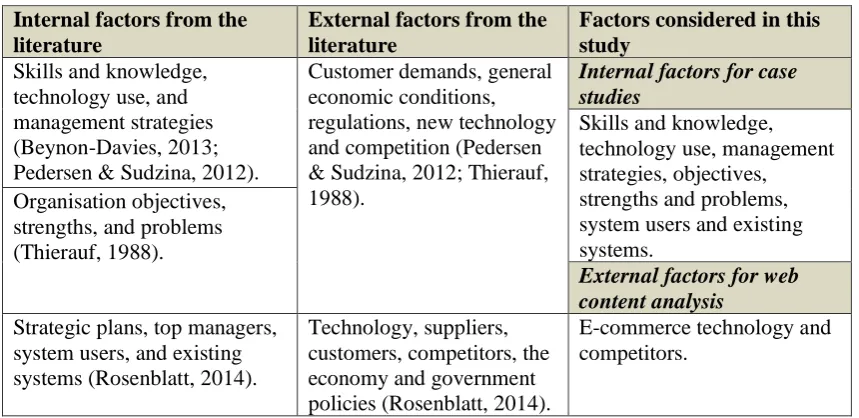
Table 4.5: Internal and external business environmental factors ... 69
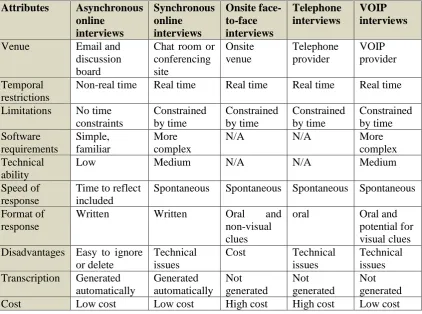
Table 4.6: Comparison attributes of online and in person interviews ... 74
Table 4.7: Benefits of the content analysis method ... 76
Table 4.8: Benefits of the inductive content analysis method ... 77
Table 4.9: Data reduction procedures ... 78
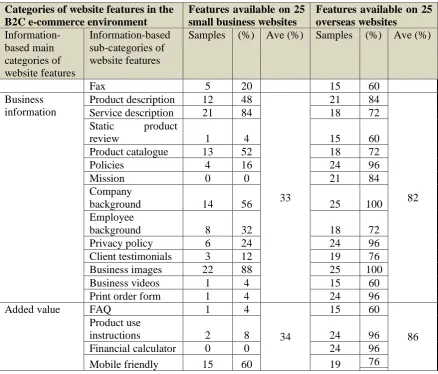
Table 5.1: Information-based features available on small business and overseas websites ... 92
Table 5.2: Communication-based features available on small business and overseas websites ... 95
Table 5.3: Transaction-based features available on small business and overseas websites ... 98
Table 5.4: Distribution-based features available on small business and overseas websites ... 100
Table 5.5: Summary of findings from the content analysis using the ICDT model ... 102
Table 6.1: Owners/managers’ responses based on company profiles ... 107
Table 6.2: Small business owner/manager profiles in the B2C e-commerce environment ... 108
Page xviii of 327
Table 6.4: Knowledge about the internal and external business
environment and associated factors ... 114
Table 6.5: Owners/managers’ responses on small business internal strengths and strategies to leverage those strengths to maximise opportunities ... 116
Table 6.6: Small business strategies for the effective use of internal resources to maximise business opportunities ... 119
Table 6.7: Owner/manager responses on internal weaknesses and strategies to address problems for exploiting opportunities ... 122
Table 6.8: Internal weaknesses/problems and needs and small business strategies to address them to create opportunities ... 123
Table 6.9: Owners/managers’ responses to external opportunities and strategies to optimise use of such opportunities ... 125
Table 6.10: Some common external opportunities in the online retail environment and strategies to optimise use of these... 126
Table 6.11: Small business responses on external threats and strategies to minimise them ... 127
Table 6.12: Small business awareness about overseas competitors and their products ... 129
Table 6.13: Small business responses about their knowledge of features on overseas websites and strategies to maintain their own website features ... 130
Table 6.14: Small business responses regarding ICDT categories of features available on their websites ... 133
Table 6.15: Small business strategies to select relevant features on their websites ... 135
Table 6.16: A summary of small business internal issues presented using the streamlined code-to-theory model ... 137
Table 8.1: Support components of the DSS solution development environment ... 163
Table 9.1: Benefits and limitations of user participation ... 190
Table 9.2: Focus group sessions for the WFE-DSS prototype evaluation ... 199
Table 9.3: A summary of WFE-DSS prototype evaluation results using the Likert scale ... 205
Page xix of 327
Table 9.5: Usability assessment results from the semi-structured questions ... 207
Table 9.6: Effectiveness assessment from the unstructured questions ... 209
Table 9.7: Owner/manager comments on their overall experience of using the WFE-DSS prototype ... 216
Table 9.8: Summary of a SWOT analysis of the WFE-DSS prototype... 217
Lists of Figures
Figure 1.1: Thesis chapters ... 9Figure 3.1: Comparison three models with phases of the decision-making process ... 39
Figure 3.2: A conceptual DSS solution framework in the theoretical view ... 45
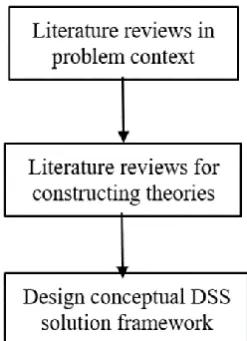
Figure 4.1: Research design stages ... 67
Figure 4.2: Steps for stage one of the research design ... 67
Figure 4.3: Steps for stage two of the research design ... 69
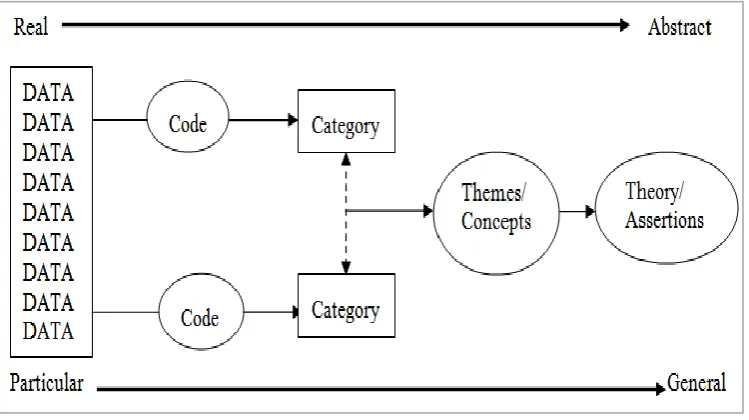
Figure 4.4: A streamlined codes-to-theory model ... 79
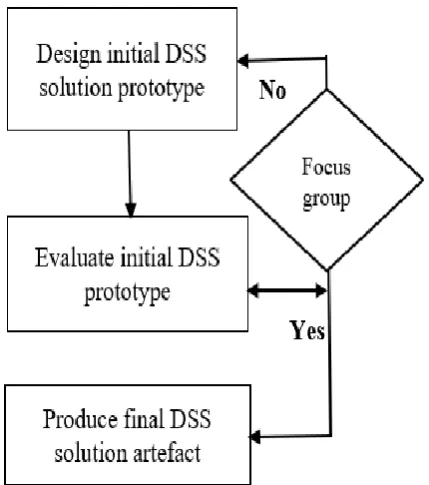
Figure 4.5: Steps for stage three of the research design ... 80
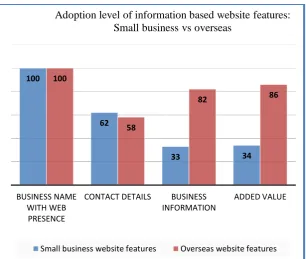
Figure 5.1: Comparison of thelevel of information-based features on small business websites vs. overseas websites ... 94
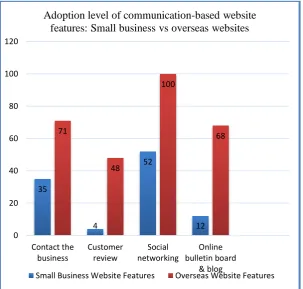
Figure 5.2: Comparison of the level ofcommunication-based features on small business vs overseas websites ... 96
Figure 5.3: Comparison of the level of transaction-based features on small business vs overseas websites ... 99
Figure 5.4: Comparison of the level of distribution-based features on small business website vs overseas competitor websites ... 101
Figure 5.5: Comparative results’ summary of the adoption level of ICDT-based small business website features vs overseas competitors ... 102
Figure 6.1: Key findings based on small business profiles ... 108
Figure 6.2: Key findings based on small business owner/manager profiles ... 110
Figure 6.3: Key findings based on owner/manager awareness and experience of the problem in the online retail sector and adopted business model ... 112
Page xx of 327
Figure 6.5: Knowledge about the external business environment
and associated factors ... 116
Figure 6.6: Visual representations of small business internal strengths or resources ... 118
Figure 6.7: Key findings related to external threats ... 128
Figure 6.8: Small business strategies to minimise external threats ... 129
Figure 6.9: Small business knowledge about features on overseas competitor websites ... 131
Figure 6.10: Small business strategies to maintain their own website features ... 132
Figure 6.11: Features available on small business websites... 134
Figure 6.12: Small business strategies in the selection of features on their websites ... 135
Figure 7.1: Different stages of prototyping and SDLC approaches ... 145
Figure 8.1: Design principles of the WFE-DSS artefact as an instantiation ... 161
Figure 8.2: WFE-DSS components ... 164
Figure 8.3: The general structure of SELECT query ... 170
Figure 8.4: A basic form of rules... 173
Figure 8.5: An example rules in pseudocode for the WFE-DSS ... 174
Figure 8.6: Afunctional model of the WFE-DSS (use case diagram) for end-user (owner/manager) interactions with the system and knowledge acquisition processes ... 176
Figure 8.7: The WFE-DSS welcome window interface ... 177
Figure 8.8: UI for selecting small business website features ... 178
Figure 8.9: UI for selecting competitor website features ... 179
Figure 8.10: UI for analysing and identifying current and desired small business website features compared with its domestic or overseas competitors ... 180
Figure 8.11: Example of a UI with a recommendation summary and metadata ... 181
Figure 8.12: Example of a UI showing recommendation details from the comparative analysis ... 182
Figure 9.1: The main window of the initial WFE-DSS prototype ... 192
Figure 9.2: Focus group steps in DSR ... 193
Figure 9.3: Usability evaluation results from end-users ... 202
Page xxi of 327
Figure 9.5: Performance evaluation results from end-users ... 204 Figure 9.6: Owner/manager ICT skills ... 207 Figure 9.7: WFE-DSS prototype usability evaluation results
from the semi-structured questions... 209 Figure 9.8: Efficacy evaluation results based on how the WFE-DSS
might change everyday business practice ... 212 Figure 9.9: WFE-DSS porotype evaluation results relating to
Page xxii of 327
List of Publications from this PhD Thesis
Academic conference papers (peer reviewed):
1. Khatun, M., & Miah, S. J. (2015). A DSS framework for maintaining relevant features of the small business B2C websites. In the Proceedings of the 26th Australasian Conference on Information System (ACIS' 2015), November 30 - December 4th, Adelaide, Australia
2. Khatun, M., & Miah, S. J. (2016). Design of a decision support system framework for small business managers: A context of B2C e-commerce environment. In the Proceedings of the Future Technologies Conference (FTC’ 2016), December 6-7, San Francisco, United States. IEEE, 1274-1281.
3. Khatun, M., & Miah, S. J. (2017). The design functions of a knowledge-based decision support system in the B2C e-commerce problem domain. In the Proceeding of the 4th Asia-Pacific World Congress on Computer Science and Engineering 2017, 11-13 December, Mana Island Resort and Spa, Fiji.
Journal publication:
Page xxiii of 327
List of Abbreviations
ABS - Australian Bureau of Statistics
ABN - Australian Business Number
B2C - Business-to-Consumers
CA - Content Analysis
C# - C Sharp
DB - Database
DBMS - Database Management Systems
DSS - Decision Support System
DS - Design Science
DSR - Design Science Research
DIISRTE - Department of Industry, Innovation, Science, Research, and Tertiary Education
GST - Goods and Services Tax
HRE - Human Research Ethics
HTML - Hypertext Markup Language
ICDT - Information, Communication, Transaction and Distribution
IS - Information System
ICT - Information and Communication Technology
IT - Information Technology
JAD - Joint Application Development
KB - Knowledge Base
KBMS - Knowledge Base Management System
KM - Knowledge Management
KMDSS - Knowledge Management Decision Support System
Page xxiv of 327
NFRs - Non-functional Requirements
NTPs - New Theoretical Propositions (NTPs)
PDSS - Personal Decision Support Systems
RAD - Rapid Application Development
SBCB - Small Business Commissioner Bill
SDLC - System Development Life Cycle
SEO - Search Engine Optimisation
SQL - Structured Query Language
SWOT - Strengths, Weaknesses, Opportunities, and Threats
TSELC - The Senate Economic Legislation Committee
UCD - User-centred Design
UCDE - User-centred Design Environment
UI - User Interface
URL - Uniform Resource Locator
VUHREC - Victoria University Human Research Ethics Committee WFE-DSS - Website Features Evaluation Decision Support Systems
Page xxv of 327
Glossary
Terms Definition
B2C E-commerce B2C e-commerce is one of the primary forms of
commerce where any business transaction is executed electronically between companies and consumers (Stair & Reynolds, 2010).
Database (DB) A DB is the best way to store and manage data
(Coronel & Morris, 2016). DB Management System
(DBMS)
A DBMS is made up of software that operates DBs and provides storage, access, security, backup and other facilities to meet end-user requirements (Singh, 2015).
Design Science Research (DSR) The DSR approach is involved in problem-solving
activities, with an end goal to produce an artefact that must be built and then evaluated (Hevner, March, Park & Ram, 2004).
Decision Support System (DSS) The DSS is an applied area within the IS discipline
that focuses on solution design to support and improve managerial decision-making (Arnott & Pervan, 2012).
Joint Application Design (JAD) The JAD is a team-based system development
approach and seeks active user participation (Rosenblatt, 2014).
Knowledge Base (KB) A KB is a collection of facts, rules, and procedures
organised into representations. Traditionally, a KB refers to the data and set of rules used by an expert system (Power, 2014).
Knowledge Management (KM) KM aims to capture, codify, and disseminate
knowledge across organisations to enhance value, and the value is the performance-based knowledge system for strategic decision-making (Adler, 2008).
Non-functional Requirements (NFRs)
The NFRs describe how the system works, showing system performance, usability, and usefulness (Glinz, 2007).
Personal DSS (PDSS) A PDSS is a small-scale system that develops for one
manager, or a small number of independent managers, to support one decision task (Arnott & Pervan, 2008).
Prototype A prototype is a smaller-scale system development
method in the IS research domain, focused on user requirements (Haag & Cummings, 2009).
Rapid Application Development (RAD)
RAD is a system development approach for a business solution that delivers a series of stand-alone sub-systems to create a comprehensive and complex application (Kroenke, Bunker, & Wilson, 2014).
Small Business Small business is any business with less than 20
employees (SBCB, 2013). Structure Query Language
(SQL)
The SQL is a widespread language for creating, updating and querying databases. The SQL is also DBMS software (Stair & Reynolds, 2016).
User-centred Design (UCD) A UCD is a design philosophy and approach that
Page xxvi of 327
the stages of planning and designing the system requirements to implementing and testing the product (Baek, Cagiltay, Boling & Frick, 2008).
User-centred Design Environment (UCDE)
The UCDE is a system design method involved in secondary design activities by end-users that focuses on decision-support parameters, aids comparative analysis of current and desired states, obtains expert analysis and generate reports for business decision-making (Miah, Kerr, & von Hellens, 2014).
User Interface (UI) The UI is one of the components of a DSS architecture
1
Chapter 1: Introduction
Managers continuously analyse problems and explore opportunities for the growth of their businesses. Managerial roles require strategic decision-making to deal with the varying requirements of trading in the business environment (Baizyldayeva, Vlasov, Kuandykov & Akhmetov, 2013; Eisenhardt, 1989; Miah et al., 2014). However, decision-making can be difficult for managers working in a highly competitive business environment (Baizyldayeva et al., 2013). Decision-making can be particularly difficult for a manager in the business-to-consumer (B2C) electronic commerce (e-commerce) environment, through which millions of consumers interact directly with company websites searching for products. Consumers also evaluate goods and services at many e-commerce sites until they find a suitable site to make a purchase (Haag & Cummings, 2009). B2C e-commerce is one of the main forms of online business, with online transactions made directly between companies and individual consumers (Al-Qaed, 2008).
Therefore, creating an appropriate business strategy is fundamental for meeting the demands of any change in the external business environment. Many organisations address such needs internally to maintain their business performance (St-Jean, Julien & Audet, 2008). However, owners/managers of many small businesses are poor planners, and their goals are unclear, inadequately defined and have short-term based on personal intuition (Mazzarol, 2004). In addressing such issues, a small business needs technology-based support and solutions. Researchers have also found that small firm strategies with no alignment to information technology (IT) generate a lower level of business performance (Bergeron, Raymond & Rivard, 2004). Therefore, many organisations are motivated to adopt or build their own IT applications, such as a decision support system (DSS) that can assist them in gaining a competitive advantage (Power, 2016).
2
knowledge about the business environment (Hunter, 2011). As a result, IT artefact design research for managerial decision support solutions are acknowledged as necessary to improve business strategies (Hevner et al., 2004; Miah et al., 2014).
Previously research related to small businesses has focused on social and economic issues rather than technological developments. A few studies have addressed decision support requirements for online small businesses in the context of developing IT artefacts. Although various forms of DSSs are widely used in many organisations, there is a propensity among researchers to apply the same findings about experience and techniques in large organisations directly to small businesses, without recognising that there are different DSS needs within small businesses (Duan & Xu, 2009). Duan and Xu (2009) also argue that DSSs in small businesses are used for operational rather than strategic decision-making, which is of paramount task. This indicates that small businesses find strategic decision-making too challenging because of uncertain business environments. It is important to take this into account when looking to understand decision-makers’ intuition and judgement in DSS design.
This study developed a new DSS artefact utilising the design science research (DSR) philosophy, which assists the researcher and “creates and evaluates IT artefacts intended to solve identified organisational problems” (Hevner et al., 2004, p. 77). It adopted the DSR seven guidelines developed by Hevner, March, Park and Ram (2004), known simply as HMPR guidelines, for overall research design. In DSR, the research background and problems must be introduced, followed by the research motivation and development of study objectives (Gregor & Hevner, 2013). The research questions developed to achieve research objectives are also outlined followed by a description of the thesis structure.
1.1 Research background and problem statements
3
the benefit of selling their products, anytime and anywhere (Al-Qaed, 2008). These advantages have influenced the rapid expansion of online markets, creating more new business opportunities for companies (Lacka et al., 2014).
Understandably, the demands on B2C e-commerce continue to rise, as more people prefer to shop online (Poon & Lau, 2006). Online shopping has grown significantly in recent years (Kwee-Fah, 2016). Its scope is continuously diversifying, with new options to buy products online (Abdul-Muhmin, 2011; Poon & Lau, 2006; Mohapatra, 2012). Consequently, B2C e-commerce has developed rapidly over recent years (Al-Maghrabi & Dennis, 2011). As a result, an e-commerce website, mainly a B2C e-commerce website for small businesses, can be popular with online shoppers. E-commerce provides many benefits to small enterprises as a relatively efficient and effective channel for delivering and exchanging information, advertising, marketing and completing transactions. In some cases, it facilitates the distribution of goods and services to trading partners and customers (Buxton & Walton, 2014; Marshall & McKay, 2002).
E-commerce also provides many benefits for both consumers and companies. One of the benefits is a convenient platform for buyers and sellers (AL-Qaed, 2008). This creates a sales and distribution channel between companies and consumers (Corbitt, Thanasankit & Yi, 2003; Turban, Lee, King, Liang & Turban, 2009). Ultimately, it helps to reduce the infrastructure costs for online retailers (WTO, 2013).
4
as many Australian consumers buy products from overseas websites instead of local websites (Deloitte, 2013; Frost & Sullivan, 2012; Irvine et al., 2011; Khatun, 2011; PwC, 2012; Sensis, 2013; Sivasailam, 2012; Todd, 2012). This creates loss of potential online domestic sales in Australia (Ewing, 2011; Todd, 2012; Wright, 2012). According to the Department of Industry, Innovation, Science, Research, and Tertiary Education (DIISRTE, 2012), small businesses in Australia represent 95.6 percent of all businesses, so the potential loss of online sales is significant.
Many studies have identified some factors associated with purchasing products from overseas websites. These factors include affordable prices, better products with a greater range, and high-quality services (Forrest & Sullivan, 2012). Also, overseas websites provide a free or lower delivery cost (Forrest & Sullivan, 2012; PwC, 2012). Moreover, a strong Australian dollar (Moodie, 2012) and GST exemption for goods under AU$1,000 on overseas purchases (Irvine et al., 2011), have made international online purchases very attractive. Recently, the Australian Government announced changes to this GST exemption. As of 1 July 2017, overseas online retailers who sell into Australia are required to register for GST, the costs of which are passed on to the Australian consumer (Bullot & Hornbrook, 2015).
This study differs from previous studies that have focused on the various factors associated with consumers’ buying decisions. Instead, it focuses on the improvement of managerial strategic decisions, particularly the selection of competitive features on B2C websites. Small businesses need IT support for their strategic decision-making in the B2C e-commerce environment, particularly for improving their website features and attracting potential online customers. Many researchers in the small business domain have recognised that the owner/manager is the most important resource in this type of organisation and their decisions are the most significant factor in improving organisational performance (Hansen & Hamilton, 2011; Mazzarol, Sophie & Geoffrey, 2009).
5
1.2 Motivation and research objectives
To address the problems discussed above, one needs to establish the relationship between the factors that impact consumers’ purchases from overseas websites and owners/managers strategic decisions concerning the selection of relevant features that need to be available on small business websites. In addition to understanding this relationship, the main motivation of this study was to develop a new DSS-based solution to assist owners/managers of small businesses in making strategic decisions in the B2C e-commerce environment. DSS solutions fall within the information system (IS) discipline focused on improving managerial decision-making (Arnott & Pervan, 2012). The new DSS will specifically help owners/managers in making strategic decisions about the best features to include in their websites to attract consumers. This will allow a small business to achieve competitive advantage in the dynamic B2C e-commerce environment. Hence, this study has the following specific objectives:
1. To identify the factors influencing products being purchased from overseas competitor websites rather than small business B2C websites.
2. To investigate the relationship between factors (theoretically and empirically) that influence consumer online purchasing and owner/manager strategic decisions concerning the selection of relevant features on their B2C websites.
3. To develop a new DSS-based solution to help owners/managers of small businesses make strategic decisions when implementing relevant features on their websites.
6
E-commerce website features help to determine site quality include accessibility, speed, navigability, and content. Companies need to make full use of the current technology and manage the information on their websites in order to enhance their online performance (HernaNdez, JimeNez, & MartíN, 2009). Significant time, resources, and attention have been given in the past to explore how businesses can attract more customers to their online stores (Ashraf, Thongpapanl, & Spyropoulou, 2016). However, no one has focused on a DSS-based solution in such an environment. It was for this reason that owners/managers’ strategies to select competitive features for their retail websites were considered for this study.
A DSS is significant for the current study related to addressing small business issues and needs because it can provide potential solutions to organisational problems (Arnott & Pervan, 2012). The DSS also can assist in improving managerial, strategic making competencies (Arnott & Pervan, 2012; Power, 2016), and can help decision-makers understand underlying issues in a system (Wienclaw, 2008). Therefore, a DSS can help managers make better decisions (Pick, 2008; Wienclaw, 2008).
When managers make decisions in an electronic trading environment, in which markets change rapidly and consumer demands are ever increasingly, it is difficult to forecast the online environment and attract customers (Power, Sharda & Kulkarni, 2007). Appropriate decisions and actions must be taken in such situations, as interactions change in response to different business environmental factors, such as competition (Hall, 2008). Therefore, the employment of a DSS becomes not only desirable but essential for business decision-makers (Alalwan, 2013).
1.3 Research questions and contributions
In seeking to address the objectives as stated above, this study developed the following research questions (RQs):
1. RQ 1: What significant factors influence consumers to purchase products from overseas websites rather than local small business B2C websites?
7
3. RQ 3: How could a new DSS solution artefact be designed and evaluated through well-executed methods?
These RQs are addressed in different chapters of the thesis. In order to answer the RQ 1, the study was built strategies through reviewing the relevant literature. Particular focus studies were selected from the Australian context as discussed in Chapter 2. A series of theoretical or justificatory knowledge scenarios have been formulated that suggest further investigations and a solution. Accordingly, web content analysis has been carried out, which is documented in Chapter 5. Case studies have also been carried out; the results are documented in Chapter 6. These investigations were significant in identifying the small business problems and needs that formed the DSS-based solution design requirements. In responding to the RQ 2, the study further created strategies on how to build the solution. Therefore, literature reviewing in the DSS domain has been carried out to create justificatory knowledge or theory that established a DSS-based solution. In addressing the RQ 3, such as how to develop a DSS-based solution for small businesses in the B2C e-commerce environment, this study reviewed relevant literature to develop the conceptual DSS framework in the theoretical basis, which is documented in Chapter 3. The practical DSS design and development using rigorous methods are discussed and documented in Chapter 7, Chapter 8 and Chapter 9. However, the DSR was adopted as the overall research methodology, as discussed in Chapter 4, to achieve the research objectives related to the three research questions.
1.3.1 Main research contributions and major outcomes
8
Theoretical knowledge has been crafted first by reviewing the relevant and available literature on the small business problem domain in the B2C e-commerce environment and DSS field. A conceptual DSS solution framework has also been designed in the theoretical basis that builds the bridge between theoretical and practical knowledge. This DSS ultimately assists to take steps to produce a knowledge-based (KB) practical solution, known as the website features evaluation DSS (WFE-DSS).
New theories or justificatory knowledge have also been created from the empirical studies through web content analysis, and case studies. The new series of justificatory knowledge are described as the small business problems, needs, and DSS-based solution design requirements. One of the significant contributions of this study was to produce knowledge through case studies. The results inform the lack of knowledge of the majority of small business owners/managers of the business environment. The lack is mainly in respect of the external business environments and associated factors. These factors are significant in the context of their inability to make strategic decisions in the B2C e-commerce environment. Previous studies also found that many small business owners have limited knowledge about the external business environment (Bridge & O'Neill, 2009; DeLone, 1981; Fassehi, 2014). An organisation’s external environment involves customers, suppliers, competitors, governments, and other social and economic forces, including technological (Fernie et al., 2015). These factors or forces impact on the organisational decision-making processes (Fernie et al., 2015; Xue, Liang, & Boulton, 2008). Ultimately, factors related to the external environment change the structure of an organisation over time. Only those which adopt changes can survive (Fernie et al., 2015).
9
environment in which societies, organisations, an individual live, work, learn, and adapt for surviving (Botha, Kourie, & Snyman, 2008; Malhotra, 2003). Ultimately, knowledge is a capability that includes the potential to influence action and improve decision-making (Moreno & Cavazotte, 2015). Therefore, in the online retail environment, small businesses need to analyse the environment to enhance their knowledge and adopt changes. It is these aspects upon which the current study focused.
Further, theories or justificatory knowledge have been elaborated upon through evaluating the DSS prototype by focus group studies to confirm that the prototype meets the small business needs and further improvement of the prototype. Finally, the main practical contribution of this study was the DSS-based solution (WFE-DSS) that can assist small business to identify its website problems and get recommendations for solutions in the B2C e-commerce environment. Conclusively, an owner/manager can assess or analyse its current website features against its successful competitors (data from the external business environment) using the innovative DSS. This artefact is a KB-DSS type that can convert data (website features) into information, then to knowledge, in the selection of competitive features to enable a small business website to remain competitive.
1.4 The structure of the thesis
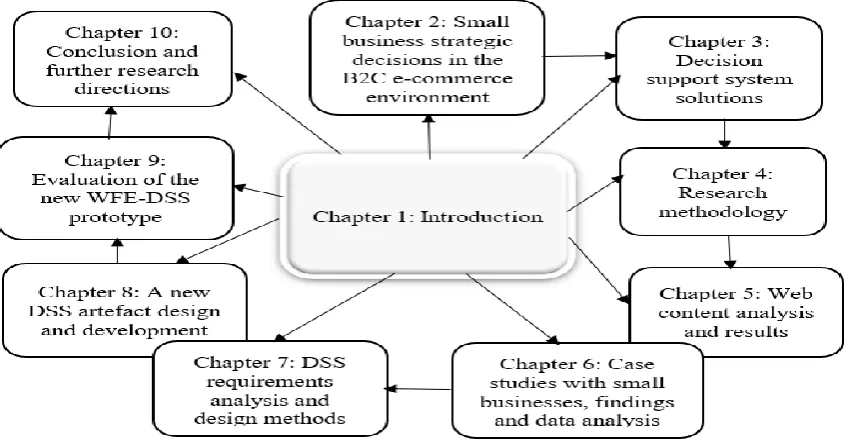
This thesis comprises ten chapters including this introductory chapter. Figure 1.1 provides a snapshot of the thesis structure. This section briefly introduces each chapter in terms of its focus.
10
Chapter 2: Small business strategic decisions in the B2C e-commerce environment
Through an extensive review of the literature within the small business B2C e-commerce, strategic decision, and DSS domains, small business problems are identified in this chapter. The theoretical concepts are defined and concepts constructed using descriptive and justificatory knowledge for further investigations of small business issues and DSS-based solution within this type environment.
Chapter 3: Decision support system solutions
This chapter introduces the conceptual or theoretical DSS solution framework used in this study to identify small business issues, needs, and practical DSS requirements. The conceptual DSS was designed using the Mintzberg, Raisinghani and Theoret (1976) or MRT model, a strategic decision-making theoretical model developing for managers. Various definitions and benefits of DSS are discussed in this chapter to meet the specifics of small business DSS development requirements.
Chapter 4: Research methodology
This chapter first describes the research philosophy, a broad concept related to the development of knowledge for the period of the research. The research methodology is then introduced, with an overview of the overall strategy for conducting the research and the different stages of the research design. This chapter also describes the particular research approach, including the use of the DSR methodology for small business DSS design, development and evaluation perspectives. In addition, this chapter describes the data collection and analysis methods, as well as the ethical considerations of conducting the research.
Chapter 5: Web content analysis and results
This chapter describes the significant issues that exist on small business websites in the B2C e-commerce environment. This concerns the number and extent of important features on their websites, identified through web content analysis. This investigation process is one of the assessment methods for analysing the business environmental factors, which is necessary in DSS design and development. In this study, the external factor is small firms’ overseas competition in the B2C e-commerce environment.
11
This chapter discusses empirical results from multiple case studies with small businesses in the Australian online retail sector. The aim of the case studies was to identify small business internal issues, their strategic needs, and requirements for a new DSS development. From this data, new theoretical propositions (NTPs) or concluding concepts that are series of justificatory knowledge are constructed in relation to small business internal issues. DSS requirements could then be addressed.
Chapter 7: DSS requirements analysis and design methods
Using the MRT model in the conceptual DSS framework, this chapter provides an analysis to rationalise small business internal issues related to their strategic decision-making competencies within the B2C e-commerce environment. This analysis helped to identify the small business problems, needs and DSS requirements. The chapter also discusses issues that exist on small business websites through the analysis of website features. Various system development approaches are reviewed in this chapter for the purpose of selecting rigorous methods for both the construction and evaluation of the DSS artefact prototype. Methods for DSS design, development and evaluation include user-centred design (UCD) as user-focused and involvements, evolutionary and prototyping.
Chapter 8: A new DSS artefact design and development
This chapter describes the small business DSS design and development procedures, including the initial DSS prototype (instantiation) development. A small-scale knowledge-based DSS prototype was designed for owners/managers of small businesses following the UCDE (user-centred design environment) method. Chapter 8 also describes the small business DSS solution design and development principles and various DSS components that are vital for the small business DSS architecture. The chapter then describes the functional model of the DSS artefact with various user interfaces (UIs) for interaction between users and the system.
Chapter 9: Evaluation of the new WFE-DSS prototype
12
completed, identifying usability, efficacy, performance and overall user experience of using the artefact prototype. The results of the assessment validate to produce a user-friendly solution artefact for an owner/manager of a small business.
Chapter 10: Conclusion and further research directions
This chapter reiterates the goals of the study and key findings of the research project, while summarising the entire research. It also describes the research contributions from theoretical, methodological and practical perspectives. In addition, research strengths and limitations are described. Further research directions are discussed at the end of this chapter. The next chapter describes the small business strategic decision-making in the B2C e-commerce environment and reviews the related literature.
1.5 Chapter summary
13
Chapter 2: Small Business Strategic Decisions in the
B2C Ecommerce Environment
This chapter reviews the literature related to strategic decision-making for small business owners/managers in the online retail environment. Definitions of small business are discussed in this chapter, including the one selected as appropriate for the purpose of this study. Other areas discussed in this chapter are e-commerce, B2C e-commerce and its benefits for businesses, including small business. The website features commonly used in the B2C E-commerce environment, and their benefits are reviewed. DSS practices for small businesses in the B2C e-commerce environment are also discussed. Relevant theoretical concepts or justificatory knowledge are presented with the intention of identifying small business problems and how to resolve them. Factors related to research problems identified through analysis of the early studies in the literature enabled an examination of the problems faced by small businesses in the Australian B2C e-commerce context. The chapter concludes with a summary that represents a clear problem definition and their importance for target stakeholders through the relevant literature review.
2.1 Small business definition
Although the concept of “small business is quite intuitive, there is no consistently used small business definition” (Connolly, Norman & West, 2012, p.1). According to the DIISRTE (2012, p. vii) report, “no single definition of a small business will suit all the needs of government or the private sector. This is reflected in the many different ways a small business can be defined.” The Small Business Commissioner Bill 2013 (SBCB, 2013) indicates that financial institutions in Australia use a wider range of benchmarks to define a small business, including loan size, number of employees, revenue, and balance-sheet indicators.
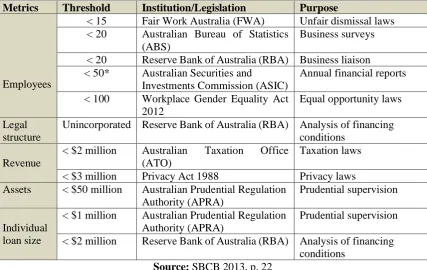
14
and services tax (GST). In addition, a small business must have 0–19 employees. This includes micro firms, which are small businesses with 0–4 employees (DIISRTE, 2012). By contrast, the ABS defines a medium business as an active trading company with 20– 199 employees, and a large business with 200 or more employees.
Table 2.1: Small business definitions used by Commonwealth agencies
Metrics Threshold Institution/Legislation Purpose
Employees
< 15 Fair Work Australia (FWA) Unfair dismissal laws < 20 Australian Bureau of Statistics
(ABS)
Business surveys < 20 Reserve Bank of Australia (RBA) Business liaison < 50* Australian Securities and
Investments Commission (ASIC)
Annual financial reports < 100 Workplace Gender Equality Act
2012
Equal opportunity laws Legal
structure
Unincorporated Reserve Bank of Australia (RBA) Analysis of financing conditions
Revenue
< $2 million Australian Taxation Office (ATO)
Taxation laws < $3 million Privacy Act 1988 Privacy laws Assets < $50 million Australian Prudential Regulation
Authority (APRA)
Prudential supervision
Individual loan size
< $1 million Australian Prudential Regulation Authority (APRA)
Prudential supervision < $2 million Reserve Bank of Australia (RBA) Analysis of financing
conditions
Source: SBCB 2013, p. 22
According to the DIISRTE (2012), there were over two million active trading small businesses in Australia as at June 2011. Non-employing businesses numbered the most. These were owner-operated and accounted for 61.2 percent of all small businesses; micro businesses accounted for 23.9 percent. The remaining small businesses were accounted for 10.8 percent.
15
of small businesses are owner-operated (SBCB, 2013; DIISRTE, 2012). Based on the discussions above, for this study, the researcher adopted the definition of small business based on companies with 0-19 employees (DIISRTE, 2012).
2.2 Managerial characteristics and shortcomings of small businesses
Managers are responsible for addressing changing demands within the business environment and making strategic decisions for efficient business operations (Baizyldayeva et al., 2013; Eisenhardt, 1989; Miah et al., 2014). As a rule, decision-makers work in challenging and dynamic environments and are overloaded with information (Baizyldayeva et al., 2013). They also investigate problems and create opportunities in these environments to suit their business requirements (Hall, 2008) and support business goals and actions (D'Amboise & Muldowney, 1988).
Although owners/managers of small businesses are key decision-makers (Burgess et al., 2009; Parker & Castleman, 2009), their goals are often unclear, inadequately defined, and short-term (Sexton & Van Auken, 1985). Also, mistakes are made repeatedly by small firms (Sharda, Delen & Efraim, 2015) with no forward planning. They make strategic decisions based more on own thinking and lack decision-making competence when looking to adopt advanced technology (Mazzarol, 2004). Only a few small businesses apply strategic planning in their operational development (Sexton & Van Auken, 1985).
While many small business owners/managers do have business strategies, they are not usually related to an effective web presence (Fisher, Craig & Bentley, 2007), particularly in terms of what website features they require to meet those strategies. For a provisional web presence, such features might include product and service information that promotes their business, a catalogue with price lists, frequently asked questions (FAQs), internal site links that add value for a visitor to the site, and industry-specific information. For a transactional web presence, features might include online ordering, processing and payment activities to sell products or services. However, small businesses are typically traditional in the use of IT, using it for various purposes but not related to effective web presence (Burgess et al., 2009).
16
• Lack of resources and expertise (Burgess & Schauder, 2003; SBCB, 2013; Tatnall, Burgess & Singh, 2004).
• Inadequate skills for using Information and Communication Technology (ICT) (Burgess et al., 2009).
• A tendency to only sell their products locally (SBCB, 2013; SELC, 2013; Sensis, 2005).
Each of these areas are discussed as follows.
2.2.1 Lack of resources and expertise
Many large businesses have extensive resources with specialised management teams and employees who can complete specific tasks. However, small businesses run by an individual or with a small group of people, may not have the same level of competence. Owners/managers need to deal directly with multiple issues, including the immediate pressures associated with daily business operations, cash flow management and compliance with various Australian Commonwealth, state or territory laws. But many owners/managers lack the expertise necessary to deal with all the issues that may arise (SBCB, 2013). Unlike large businesses, small businesses are operated by fewer individuals and an owner of the firm. Generally, they have a less sophisticated management structure (SBCB, 2013).
Small businesses are also constrained by a lack of resources, both financial and human, and no strategic, long-term focus (Tatnall et al., 2004). Moreover, many small businesses do not have the time or resources to address potential changes in their existing systems or business environment. Many of them lack the technical expertise and proper planning practices to help them take advantage of opportunities (Burgess & Schauder, 2003).
2.2.2 ICT skills and use
17
Although ICT provides significant benefits, Australian small businesses have been slow to adopt ICT compared with large companies, particularly in the use of technology to an effective web presence (Burgess et al., 2009). Also, many owners/managers of small businesses are poor planners, particularly in using DSSs that are much more user-friendly. DSS use remains an issue for small business operations (Magee, 2007). Small businesses have limited resources for IT development, as well as using commercially developed DSS software (Duan & Xu, 2005; Khosrow-Pour, 2008).
2.2.3 Small business tendencies to only sell products locally
Many small businesses prefer to sell their products to local customers and therefore do not need an online presence. For example, an early study found that 61 percent of small businesses in Australia mainly sell to local customers (Sensis, 2005). Also, a survey carried out by the Senate Economic Legislation Committee (SELC, 2013) in Australia indicated that the majority of small businesses operate in one location, sell goods or services to nearby customers, and have poor market control. Similarly, the SBCB (2013) identified that small businesses prefer to sell their products only to local customers and set up their businesses in one location.
Despite the small business shortcomings discussed above however, their contributions to the national economy are significant.