Towards Automatically Penalizing Multimedia
Breaches
Easwar Vivek Mangipudi
Purdue University [email protected]Krutarth Rao
Hewlett Packard [email protected]Jeremy Clark
Concordia UniversityAniket Kate
Purdue University [email protected]Abstract—This work studies the problem of automatically penalizing intentional or unintentional data breach (APB) by a receiver/custodian receiving confidential data from a sender. We solve this problem for multimedia data by augmenting a blockchain on-chain smart contract between the sender and receiver with anoff-chaincryptographic protocol, such that any significant data breach from the receiver is penalized through a monetary loss. Towards achieving the goal, we develop a natural extension of oblivious transfer called doubly oblivious transfer
(DOT) which, when combined with robust watermarking and a claim-or-refund blockchain contract provides the necessary framework to realize the APB protocol in a provably secure manner. In our APB protocol, a public data breach by the receiver leads to her Bitcoin (or other blockchain) private signing key getting revealed to the sender, which allows him to penalize the receiver by claiming the deposit from the claim-or-refund contract. Interestingly, the protocol also ensures that the malicious sender cannot steal the deposit, even as he knows the original multimedia document or releases it in any form. We implement our APB protocol, develop the required smart contract for Bitcoin and observe our system to be efficient and easy to deploy in practice for multimedia documents. We analyze our DOT-based design against partial adversarial leakages and observe it to be robust against even small leakages.
I. INTRODUCTION
Data breach attacks on cloud hosts are increasing every year [1], [2], [3], [4], the reasons for which vary from compromises of ill-maintained data servers to careless data custodians. Although it has been observed and reported that 90%of these data breaches can be avoided with good security practices on the custodian’s infrastructure [5], there is no evident decrease in the number. In these cases, taking legal actions is not only expensive and time consuming but it is also difficult to establish the responsibility in today’s geo-politically distributed data flows.
This work aims at raising the bar for the data receivers/cus-todians by introducing a complementary security mechanism that is inexpensive, automated, and is not restricted by the geo-political boundaries. In particular, our goal is to make the data custodians more accountable through automatically enforceable monetary penalties resulting in immediate loss of funds, and we call the associated contract the automated penalization of breach(APB) contract. Applicability scenarios for APB contracts range from industrial media custodianship, leaking privately shared personal data (pictures and other me-dia files) of others on social meme-dia and even to non-disclosure agreements between mutually distrusting entities [6].
Example Scenario 1 - Data Custodianship: Data Cus-todianship refers to the responsibility of safe storage and custody of the data [7]. A serious breach of the storage typically results in criminal litigation against the custodian. APB can be useful when legal action is undesirable due to the uncertainty of recovering the payment (which increases if the winning party is owed court costs in addition to the actual remedy) [8]. We assume that the data owner/sender and the custodian/receiver agree on an amount of money that will be awarded to the owner should specified documents be demonstrably leaked by the custodian. Towards automatically ensuring that the owner will receive the funds, this amount could take the form of a surety bond that is held in trust by a Bitcoin or other permission-less/permissioned blockchain based cryptocurrency smart contract.
Example Scenario 2 - Media Download: In the case of a users downloading paid media that should not be publicly shared on online platforms, the downloaders make a timed deposit along with the actual payment, for a agreed upon time and value for the download. The deposit can be forfeited by the media provider upon dishonest sharing of the content, in case of no such incident it will be returned to the download-er/customer.
APB does not preclude the use of the court system, it simply complements it, or shifts the responsibility of bringing legal action to the entity seeking to recover their bond. Allowing an escalation to court is important as some disclosures are in the public interest (whistle-blowing) [9]. In fact, in certain cases, a third party might pay the value of the bond for the information (news media, crowdfunding, etc.). We expect that the proposed mechanism encourages the parties involved to follow better security practices and the proposed APB protocol is a step in that direction.
In our core protocol, the sender and receiver create a claim-or-refund transaction on Bitcoin [10], [11], [12] where an amount is deposited that can be spent at any time with a jointly signed transaction, or spent after a period of time by an sender-only signed transaction. The document provided to the receiver has the receiver’s signing (private) key embedded in it with a robust binary watermarking scheme that cannot be removed (or retrieved) by anyone except the embedding party. The challenging aspects of the APB protocol involve arranging for the signing key to be embedded such that (1) the sender does not learn the value of the key at the time of embedding, (2) the receiver does not learn the document contents until the key is embedded, and (3) the sender is convinced the embedded key is the receiver’s correct signing key. Within these constraints, to perform the embedding the parties must jointly perform a two-party computation with their respective private inputs. Our novel DOT and committed receiver oblivious transfer (CROT) protocols, securely realize this two-party computation to ensure that the sender can retrieve the receiver’s embedded key from the document if it leaks (widely enough to reach the sender) and spend the deposited cryptocurrency.
We have implemented the APB system using the Relic library for the cryptographic primitives, a robust image wa-termarking scheme and claim-or-refund contract for Bitcoin. Given the prevalence of robust watermarking in the multimedia industry [13], [14], we find our APB system to be easy to deploy. Our single-threaded implementation takes on average 1.73 seconds when an 1.3MB image is used as data for the transfer when the 256-bit key is embedded once.
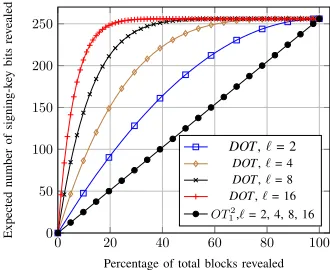
Given theinherentnon-cryptographic robustness guarantees of the robust watermarking system, we also analyse partial data disclosures. In particular, even when the receiver decides to reveal the document partially, our proposed DOT protocol ensures that the embedding party or the sender can retrieve significantly more number of bits than when the standard oblivious transfer is used for the transfer. For example, when the receiver’s 256-bit signing key is embedded 16 times in the multimedia document, even a 15% leakage of document blocks reveals roughly235bits of receiver’s key to the sender withDOT as opposed to roughly only50bits that are revealed when oblivious transfer is employed.
II. ANOVERVIEW OFAPB
Problem Definition. We consider a setting where a sender wishes to disclose a multimedia document M to a receiver. The receiver is expected to hold a public key-secret key pair (pk, sk), where the keyskis a signing key of a (say) Bitcoin wallet corresponding to pk. Instead of the sender directly sending M to the receiver, we expect the sender and receiver to jointly compute a function f((M, pk), sk) which should provide the receiver a versionMskofM that has been tagged (or robustly watermarked) with the key sk. The protocol should abort (or not produce a meaningfulMsk) ifskfrom the receiver and pk from the sender are not a matching key pair. At the end of the protocol, the sender does not learnskorMsk and the receiver does not learn any further information about
Unauthorized sharing
Penalization
Bitcoin Network
`
Watermarking
Data transfer
Contract creation Sender
Receiver
Confidential data/document
Oblivious Transfer
Key Extraction
Fig. 1: APB Protocol: High-level View
M. The receiver’s Bitcoin wallet holds the escrow deposit for accountability.
We consider the problem in a mutually distrustful setting, and either the sender or the receiver can be malicious. A malicious sender can try to learn the signing key of the receiver so as to steal the deposit. When appropriate, he can also make the document public and try to accuse the receiver of dishonest disclosure. The malicious receiver, on the other hand, can try to remove/replace the watermark from the obtained document, and release the modified version to the public without revealing her key. In such an adversarial setting, we wish to satisfy the following privacy and integrity goals:
-Sender Privacy: Before the transfer completes, no informa-tion regarding the document is available to the receiver. -Receiver Privacy: Before the disclosure of document by the receiver, no information regarding the receiver’s signing key is available to the sender.
- Sender Integrity: In case of false accusation by the sender, no action is taken.
-Receiver Integrity(Revealing property): In case of disclosure of the document by the receiver, the signing key of the receiver is revealed to the sender.
We formalize these properties as an ideal functionality in Figure 5 in Section V.
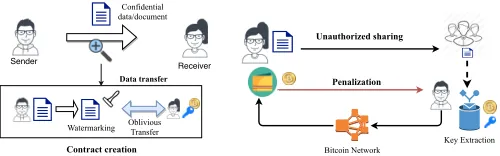
Solution Overview. We propose the APB protocol, depicted in Figure 1 involving the two parties Sender and Receiver. The sender has the multimedia documentM and the receiver has the signing key sk. The receiver initially makes a time-locked bitcoin deposit of an agreed value of funds that can be opened only if the signing-key of the receiver is available. The sender divides the document into several blocks and creates two watermarked versions (corresponding to0and1) foreach block. The parties run multiple1-out-of-2Oblivious Transfer (OT2
1) protocol instances, one for transfer of each of the document blocks. The sender uses the watermarked blocks as inputs while the receiver uses each of the bits of his signing key as choice bits for the OT12s and obtains one version of each block i.e., for a 256-bit signing key of the receiver, the sender (in the simplest case) divides the document into 256 blocks and creates two versions for each block using robust watermarking. The sender and receiver then perform 256OT2 1 s, where the choice bit for each OT2
deposit is indeed formed of the bits used for OT2 1 s.
As the document is transferred through oblivious transfer, the sender can not gain any information about the signing-key of the receiver. However, if the document is revealed/disclosed before the time of expiry of the agreement, the sender learns the signing key of the receiver from the watermark of the revealed document. He can then proceed to penalize the malicious receiver by transferring the funds to himself. The multipleOT2
1 s, one for each block, ensure that the watermark embedded in the document corresponds to the signing-key bits. To transfer the funds out of the deposit, the sender needs both his and the receiver’s signature which can not be obtained before the document is revealed to the public. Thus, he can penalize the receiver only if she is dishonest. If the receiver is honest, the agreement would expire after the agreed time and the funds will be transferred back to her. The transactional logic of the deposit is depicted as pseudo-code in Algorithm 1.
Algorithm 1 Claim-or-Refund contract logic
1: ifCurrent timetnow≥t then
2: Direct the locked funds back to the contract creator 3: else
4: ifBoth the sender and receiver sign the transactionthen 5: Direct the funds to the mentioned recipient
6: else
7: Transaction is invalid
The receiver instead of full disclosure, can disclose the document partially to the public. She can reveal, say, half of the total256 blocks received, so that only half the number of bits of her signing-key are revealed to the sender. However, for a256-bit key of the receiver, the sender can in-fact divide the document into more numbers of blocks than just256. This way, he can embed the key multiple times in the document, for example, the sender can divide it into 512 parts so that the key gets embedded twice. The sender can perform 512 OT2
1 s with the receiver using her 256-bit key twice for the same. In such a scenario, the sender can extract more number of bits upon partial disclosure. Also, the information in the document may not be “uniform” throughout the document, so the sender can also try to embed the key multiple times in a document part where there is “more” information by dividing it into more number of parts at those document locations.
The receiver understands that one bit of her signing key is watermarked in each of document blocks received using that bit in OT2
1. She also knows which particular bit is embedded in a particular document block, this is because, the watermark embedded in a block is same as the choice bit used forOT12in obtaining a document block. Leveraging this knowledge, the receiver can try to minimize the number of bits revealed to the sender. For example, with the sender dividing the document into512blocks and the receiver having a256-bit signing-key, the receiver can reveal 100 blocks of the received document revealing only 50 bits to the sender. She can achieve this by revealing two blocks received with each bit for 50 bits. To
prevent such an attack we propose a primitive called Doubly Oblivious Transfer (DOT). DOT prevents the receiver from learning which bit (index of the bit) of her key is watermarked into a certain block.
In DOT the sender has two messages m0, m1 and the receiver has two bitss0, s1 (refer Figure 8 in Appendix). The sender has an extra choice bitc using which he transfersmsc (associated with the bitsc) to the receiver. At the end ofDOT instance, the receiver cannot determine the value of c and m1−sc and the sender does not know the bit sc that has been used in the transfer ofmsc.1 Refer Figure 8 in Appendix for
the pictorial depiction of the simplest form ofDOT protocol. For APB, the sender can useDOT to transfer the document to the receiver such that she has no information about which of her bits is embedded in a certain document block. As we analyze in Section V-A, this greatly improves the expected number of bits revealed to the sender in case of partial disclo-sure. For example, with the sender dividing the document into 512blocks and256-bit key at the receiver, upon disclosure of 100 blocks, the expected number of bits that the sender can extract is90.3instead of50while using just oblivious transfer. Notice that our APB protocol augments cryptographic prim-itive with a smart contract. Given the limited expressibility of Bitcoin contracts our (off-chain) cryptographic solution seems necessary but this may not be the case for turing-complete systems like Ethereum [15]. However, defining the complete solution as a smart contract will not be or may not remain inexpensive enough. Further comments regarding the contracts can be found in Appendix E .
III. FUNCTIONALBLOCKS
Robust Bit Watermarking. Once the dishonest receiver reveals the document, the sender learns the signing-key using watermark of the revealed document. For watermarking doc-ument blocks, we use arobust bit watermarking scheme with the property that the watermarked bit0or1cannot be removed without loss of significant information from the block. The actual watermarking scheme used can vary based on the type of the document being watermarked. We mostly follow the definition of robust watermarking by Adelsbach et al. [16].
Let M denote the set of all documents, WM ⊆ {0,1} the set of two watermarks. K indicates the set of all keys and λ indicates the security parameter. The watermarking scheme is defined using three algorithms, one each for key generation, embedding and detection of the watermark. Gen (λ) is a probabilistic algorithm that outputs a key k∈K for the givenλ.Embed(M, w, k)takes the multimedia document M, watermarkw∈WMand keykas inputs and generates a watermarked documentM0 whileDetect (M0, k, w)takes the watermarked documentM0, the keykand the watermarkwas input and outputs>if the watermark inM0 matchesw, else outputs⊥. For non-blind watermarking schemes, the detection algorithm takes the original documentM also as input.
1Fors
0 =s1 =b, the receiver knows that she receivedmb; however,
We require the watermarking scheme to satisfy the three properties of Effectiveness, Robustness and a weaker version of imperceptibility (as in [16]) called Bit-imperceptibility. Effectivenessindicates that a keykused to embed a watermark should also detect the watermark i.e., ∀M ∈ M,∀k ∈ K and ∀w ∈ WM, if Embed(M, w, k) → M0, then Detect(M0, k, w) = >. Robustness states that no proba-bilistic polynomial-time (PPT) adversary should be able to effectively change or remove the watermark in the water-marked document without leaving the document itself unus-able. Bit-imperceptibility indicates that the knowledge of the watermarked document with some unknown watermark bit w ∈ WM should not reveal any additional information on the watermark bit that can be feasibly extracted. We discuss the robust watermarking algorithms in Section VI.
Oblivious Transfer. 1-out-of-2 oblivious transfer (OT12) is a two-party (a sender and a receiver) computation mechanism, where the sender has two messages M0 and M1 and the receiver has a bit b ∈ {0,1}. The goal is to transfer Mb to the receiver and at the end of the protocol, the receiver should not learn any information about M1−b and the sender should not learnb. We consider the oblivious transfer protocol, called the Verified Simplest OT by Doerner et al. [17] which is an extended version of OT protocol by Chou et.al. [18], recalled in Appendix A along with Figure 7. The multiplicative group G used for the protocol is Gap-DH [19] and the additional verification step forces the receiver to make oracle queries before receiving the encryptions from the sender, there by making the protocol UC-Secure.
Bitcoin Claim-or-Refund Contract. Bitcoin [20] is a peer-to-peer decentralized network where participants are represented by a public and private key pair. The hash of the public key serves as the user’s address and the private key is used to sign and authorize transactions. Script in Bitcoin is a stack-based language simulating a Push Down Automata and is used to write a smart contract. Spending funds typically involves exe-cuting/running two scripts on the spender’s machine. The first is scriptPubKey which is embedded in the input transaction under the script field. It entails the conditions that must be met to spend the unspent transaction outputs (UTXO). The second one isscriptSigwhich is an unlocking script provided by the user who wants to spend the UTXO. When scriptSig and scriptPubKey are executed in sequence, the user gets to know if the transaction is valid. Bitcoin offers both sender and receiver of the funds an aspect of privacy until the funds in the deposit are directed to a recipient i.e., in our case, after the documents become public and the key gets revealed to the sender. Such privacy is not observable in any other non-blockchain financial system.
Time-Locked Compensation Deposits: We construct scriptPubKey with two prominent Bitcoin scripting
language operators: OP CHECKLOCKTIMEVERIFY
and OP CHECKMULTISIGVERIFY.
OP CHECKLOCKTIMEVERIFY allows users to create transactions whose outputs can only be spent in the future.
OP MULTISIGVERIFY allows the creation of transactions which need multiple signatures. In our case, the receiver creates a deposit which is locked till a future timet. The funds of the deposit can be transferred only if both the signatures of sender and the receiver are submitted before the timet. After timet, the unspent funds are transferred back to the receiver. Embedding such instructions into the funds is commonly referred to as a smart contract. Our smart contract automates the claim-or-refund functionality. The funds are transferred either when the time of the agreement expires or when the signatures of both sender and receiver are available.
The scriptPubKey that receiver uses in the contract is
IF
OP CHECKLOCKTIMEVERIFY OP DROP
pkR OP CHECKSIGVERIFY ELSE
OP 2pkR pkSOP 2 OP CHECKMULTISIGVERIFY ENDIF
IV. DOUBLYOBLIVIOUSTRANSFER— DOT
In our solution, the receiver obtains the document blocks by running OT12 multiple times with her signing key bits as the choice bits. However, while running OT12, the receiver understands that each of the message that is received by using choice bit is indeed affected by the choice bit i.e., the receiver knows the index of the bit embedded through watermark in a received message/document block. To overcome this, we propose a primitive, in which the receiver, after giving multiple bits as input, receives several messages corresponding to the input bits, but the receiver does not have any information about which bit was used as choice bit for choosing a certain message. In the simplest case the sender has two messages along with a choice bit and the receiver has two bits. The sender chooses one of the indices of the bits of the receiver and the receiver receives the message corresponding to the bit of the chosen index. Here, the sender does not know which message has been received by the receiver and the receiver does not know which of her two bits is chosen as the choice bit to choose the messages. Hence we call itDoubly Oblivious Transfer (DOT) Protocol.
Ideal functionalityFDOT interacts with senderSand receiverR. - Upon receiving the input (s0, s1), s0, s1 ∈ {0,1} from R, store
both(s0, s1).
- Upon receiving the input (M0, M1) with M0, M1 ∈ {0,1}∗and
the choice bitc∈ {0,1}fromS, store(M0, M1, c).
- After receiving all the inputs, check ifs0, s1, c∈ {0,1}, M0, M1∈
{0,1}∗
, if yes, forwardMsc toR, else abort.
Fig. 2: Ideal FunctionalityFDOT of DOT
Figure 2 represents the ideal functionality2 of the DOT
protocol. Recall that DOT hides the indexc andm1−sc from
2What is presented is a simplified ideal functionality with the
Sender Receiver
Message blocks:M0 andM1, Choice bit:c Bits: s0, s1
Setup
Multiplicative (Public) GroupG, Generatorg
(pkS, skS) (pkR, skR)
pk=pkS∗pkR
For alli: 0≤i≤1, execute the steps below
Symmetric encryption of Message Blocks
g0, g1←RG
Enc0=EH(g0)(M0), Enc1=EH(g1)(M1)
d
Enci=π1(Enci), for permutationπ1
d
Enci −−−→
El-Gamal encryption of group elements
Set gc,0=g0, gc,1=g1 g1−c,0, g1−c,1←RG
ui,0=Epk(gi,0),ui,1=Epk(gi,1)
Oblivious Transfer [17]
RunOT2 1 for i
Inputui,0, ui,1 Inputsi
Outputui,si
Re-randomization, Forwarding and Decryption
vi,si=Rpk(ui,si) vi,si
←−−− xi,si =DskS(vi,si)
xc,sc −−−→
gc,sc=DskR(xc,sc) DecryptEncsd c usingH(gc,sc)appropriately
Fig. 3: Doubly Oblivious Transfer (DOT) Protocol
the receiver, but it need not essentially hide the valuescitself. Fors0=s1=b, the receiver knows the valuebbut not c.
Construction. We provide a construction which realizes the ideal functionality of DOT with two messages M0, M1 and a choice bit c at the sender and two bits s0, s1 at the receiver as given in the Figure 2. Both the parties possess public key-secret key pairs (refer Figure 3) and pk =pkS∗pkR where pkS, pkR are public keys of sender and receiver. The sender samples two elements from the group (can be points from the elliptic curve), encrypts the two messages using a sym-metric encryption E(.)(.) with the keys obtained by hashing the elements. These encryptions are randomly permuted and forwarded to the receiver in the form of Encid . This is the
first step in DOT. The sender then transfers the elements to the receiver such that the receiver can only decrypt Msc. The encryption and forwarding of messages prevents the need to map random message strings onto group elements for the ElGamal encryption in the next step.
The sender samples two more elements, populates gi,j, i, j ∈ {0,1} as shown in Figure 3 and encrypts all gi,j to the public key pk using Epk(.) - a Re-randomizable en-cryption like ElGamal enen-cryption to obtain ui,j. Now two OT2
1 instances are run, one for each i with ui,j as inputs. The receiver inputs si as the choice bit for the instance i of OT2
1. The encryption of the elements to the key pk later
helps the receiver to hide which keys have been obtained by her through OT2
1 and helps the sender to hide the order in which the keys have been forwarded. Hiding the order implies hiding the mapping between bits si and elements obtained by the receiver throughOT2
1. The receiver after receiving the differentui,sithroughOT2
1 proceeds by applyingRpk(.), a re-randomization operation to obtainvi,si. These re-randomized encryptions of obtained encrypted elements are now forwarded back to the sender. If there was no re-randomization step, the sender would know what elements have been obtained by the receiver and so will know what version of the message was taken by the receiver. Hence we use the re-randomization step to hide from the sender, information regarding which messages have been obtained by the receiver throughOT2
each of the messages. For the receiver to be able to recognize the correct message for the key, we need a mechanism.
To achieve the decryption and identification of the correct message block by the receiver, the sender initially appends each of the messages with a string which is obtained as a certain public functionfb(.)of key (like hash of the key) used
to encrypt the message before the encryption process. After decrypting each block with the key, the receiver matches the appended string with the locally calculated string using fb(.)
of the key. Whichever message has the correct match, is the correct message. Thus the receiver decrypts Msc.
Imagine the case when the initial encryptions are not permuted, then the receiver knows that the the encryptions received correspond to bit indices 0 and 1 in that order, so she can try to attack the system by setting one of the bits, say s0= 0 and the others1= 1, then which ever encryption gets decrypted, will reveal which of the twosis has been chosen by the sender. To prevent such a scenario, the initial permutation of the encryptions is necessary.
For a construction of the DOT protocol for a general case where the receiver has κbits (of signing key) and the sender has 2κmessages, refer Appendix B.
Theorem 1: The DOT protocol securely implements the functionality FDOT under the following conditions:
Corruption Model: Static corruption (the sender or receiver is corrupted at the beginning of the protocol).
Hybrid Functionalities: H is modelled as a random oracle and secure channels between the parties are assumed.
Computational Assumption: The encryption scheme used in the initial step is symmetric, non-committing and robust [18]. Group used for OT2
1 moduleGis a Gap-DH group.
Owing to space constraints proofs of all the theorems proving the security have been provided in Appendix D.
A. Committed Receiver Oblivious Transfer
Oblivious Transfer is used to transfer one message Mb where b ∈ {0,1} of the two messages M0 and M1 from sender to the receiver with bitb. However in our APB protocol which usesDOT (which in-turn usesOT2
1) we furtherrequire the bitb to be a bit of the signing-key of the receiver. With a simpleOT2
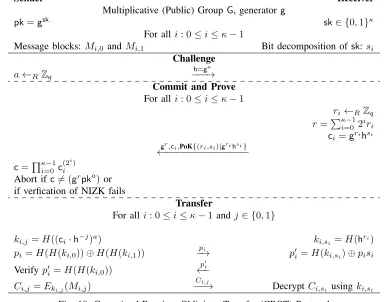
1, the sender can not be sure if that is the case. To overcome this, we propose the committed receiver oblivious transfer (CROT) primitive. InCROT, the receiver forwards a non-interactive zero knowledge (NIZK) proof of knowledge to prove that the bit inputs from the receiver are in fact bits of the signing key. The functionality of the protocolCROT is presented in the Figure 4. We depict the construction of the protocol in Figure 10 in the Appendix C.
Theorem 2: The CROT protocol securely implements the ideal functionalityFCROT under the following assumptions: Corruption Model: static corruption
Hybrid Functionalities:H is modeled as a random oracle and authenticated channels between users are assumed.
Computational Assumptions: Gis Gap-DH. The symmetric encryption used is non-committing and robust.
Ideal functionalityFCROT interacts with senderSand receiverR.
- R generates the key pair (sk, pk) and forwards the bits si ∈
{0,1}, i∈[0,· · ·, κ−1]and the κbit signing-key skto FCROT
which stores them.
-Sforwards the messagesMi,0, Mi,1;i∈[0,· · ·, κ−1]toFCROT
which stores them.
- After receiving the inputs from bothSandR,FCROT verifies if the
bits ofskare the bitssiand(pk, sk)are a key pair. If the verification
succeeds, it forwards the messagesMi,si,i∈[0,· · ·, κ−1]to the receiver, else, aborts.
Fig. 4: Ideal FunctionalityFCROT of CROT.
V. THEAPBPROTOCOL
Here, we detail the steps of the APB protocol which uses DOT with CROT. The watermarking and the DOT protocol are the off-chain cryptographic components while the smart-contract and the deposit are theon-chainparts.
1) NetworkSetup: The sender and receiver setup their Bitcoin identities by generating secret key-public key pairs; the sender has the document M.
2) DepositSetup(sk, t, V alue): A time-locked bitcoin de-posit is created by the receiver with the signing key sk for a timet and for a amount ofV alue. The deposit is a 2-of-2 multisig deposit requiring the secret keys of both the sender and the receiver to transfer the funds.
3) WaterMark(M): The document M is broken into κ blocksMi,0≤i≤κ−1for a κ-bit longsk and each block Mi is watermarked to generate two versionsMi,0, Mi,1. Any watermarking scheme which satisfies the previously mentioned properties (refer section III) can be used.
Utilizing Bitcoin. Before the APB protocol begins, after the two parties agree on the APB process, the sender shares his/her public key pkS with the receiver to create a deposit. The sender will assert that the receiver creates a transaction T X that is valid for a mutually agreed upon time t, and can be redeemed by the sender instantly with the signing keys of the sender (skS) and the receiver(skR). Here, the deposit should hold the funds equal to an agreed upon value V alue. VerifyDeposit(T X)at the sender verifies the above mentioned criterion. This algorithm receives the hash of the transaction as an input and verifies that the transaction meets the above mentioned criteria, i.e. it is a valid deposit that directs V alue to the sender if the sender has both the signing/private keys. Earlier versions of Bitcoin allowed senders to broadcast time locked transactions and these transactions would be in the unverified transactions pool until the time lock expired or an unlocking scriptSig was provided by the spender of T X. However, current (as of February 2019) Bitcoin transaction does not permit nodes to propagate transactions that have an active time lock. Therefore, the receiver sends T X over any secure communication channel so that the sender can verify and sign the transaction. Once the document becomes public, we are assured from the watermarking scheme that the leaked copy of the document will have the receiver’s signing key. Using the extraction algorithm Extract(M, Msk) the sender can reconstruct the signing key sk. Once the sender has sk, he can sign the transaction T X with the Sign(T X, sk) and broadcast the signed transaction directing the funds inT X to his Bitcoin address.
Analysis. Figure 5 presents the ideal functionality FAP B for APB, while Theorem 3 proves its security. Here we show that the functionality achieves the desirable properties discussed in Section II. The properties of sender and receiver privacy are trivially satisfied by the functionality as it does not reveal any information except transferring the corresponding watermarked blocks to the receiver. If the receiver discloses the document, the sender can extract the embedded watermark bits and hence the signing key of the receiver, thus satisfying the revealing property. If the sender tries to falsely accuse the receiver by revealing the document in any form, the receiver does not lose the deposit as the sender does not have the receiver’s key without disclosure, this achieves the sender integrity property. Though the penalization is shown as a step of APB, as it takes place outside of the transfer mechanism after the data breach in a non-interactive way, it is not included in the ideal functionality of the APB protocol.
Theorem 3:The APB protocol securely implements the ideal functionality FAP B under the following assumptions:
Corruption Model: static corruption
Hybrid Functionalities:H is modeled as a random oracle and authenticated channels between users are assumed.
Computational Assumptions: CDH and DDH are assumed to be hard inG,Gis Gap-DH. The symmetric encryption used is non-committing and robust.
Ideal functionalityFAP B interacts with senderSand receiverR.
- The receiver Rgenerates the key pair(sk, pk), forwards the bits
si∈ {0,1}, i∈[0,· · ·, κ−1]of theκbit signing-keyskandskto
the functionality which stores the received input.
- The sender S forwards the watermarked document blocks
Mi,0, Mi,1 ∈ {0,1}∗, i∈[0,· · ·, γ−1]to the functionality which
stores the received input.
- The functionality verifies if the bits of sk are the bits si, if the
verification succeeds, it forwards the message blocks Mi,l where l=sπ(i) toR, else, it aborts.
Fig. 5: Ideal FunctionalityFAP B of APB
A. Illustration
We illustrate the utility of APB withDOTusingCROTwith an example. The sender can break the document down into more thanκblocks, say2κ, to performCROT twice, there by embedding the receiver’s key two times. The finer he breaks the document, the more number of times he will be able to embed the receiver’s key and so can extract more number of bits upon partial disclosure. For a receiver with 256 bit key, the sender for embedding the key twice divides the document into 512 blocks and creates two watermarked versions for each of the 512 blocks and wishes to transfer 512 messages.
The receiver wishes to selectively reveal parts of the doc-ument to the public while not revealing too much of her key bits to the sender. It is understood that the receiver reveals at least enough number of blocks (not too few) to carry useful/sufficient information. Let us assume she wishes to reveal 100 document blocks. We wish to compare how many bits she will actually reveal to the sender when she reveals 100 document blocks when APB withDOT is used, to a scenario where just OT2
1 is used to transfer the messages instead of DOT.
If the sender uses just OT12 for the message transfer, he inputs one pair of messages for eachOT12 and performs 512 suchOT12instances to transfer the 512 messages. In this case, the receiver knows which document block has been obtained using a particular key bit and so knows which two blocks have a certain key bit embedded in them. As she knows which two blocks have the same bit embedded in them, she will reveal 50 such pairs (with the same key bit) to the public so that the sender can learn only 50 of her signing key bits .
However, if the sender uses DOT with CROT to transfer the document and the receiver decides to reveal 100 document blocks, as she does not know which key bit is embedded in a certain document block, she randomly picks 100 document blocks and reveals to the public. The expected number of key bits revealed to the sender in such a scenario would be 90.3 for 100 blocks as opposed to50bits with justOT2
1. Following [22], [23], the expected number of bits revealed to the sender when mblocks of the document are released withκ-bit key
being watermarked over ` times in the document is κ
1−
(κ−1)∗` m
/ κm∗`
Figure 6 indicates the number of bits revealed to the sender against the percentage of blocks revealed to the public when the signing-key is watermarked` times with`∈ {2,4,8,16}. When the key is embedded8 times, a leakage of20% of the document/file can leak up to211bits of the key whereas, when it is embedded 16 times, even a 15% leak reveals as many as 235 bits. This scenario is particularly useful with larger files like video files, where the key can be embedded many number of times such that even a minor clip of the video can reveal close to the whole of the signing key. The plot in the Figure 6 compares the number of signing-key bits revealed to the sender when APB uses DOT andOT. It clearly indicates that higher the number of times the key is embedded, higher are the number of bits revealed to the sender upon leakage. However, one has to note that the maximum number of times a key can be embedded by dividing the document depends on the document and its entropy.
Computation and Communication Overhead. For the transfer protocol, the number of exponentiations at the sender and receiver is linear in`. When DOT uses CROT, the number of exponentiations performed by the sender would be11`κ+` and by the receiver would be 7`κ. The communication in the DOT protocol involves forwarding two versions of AES encrypted blocks, messages of CROT and forwarding of κ ElGamal encrypted points by the receiver and the sender. In CROT, the sender forwards 2κ ElGamal encrypted elements while the receiver forwards 3κ elements including the proof of knowledge messages.
VI. IMPLEMENTATION ANDANALYSIS
We have implemented the APB protocol as a single-threaded program and analyzed its performance on a MacOS machine with 3.1 GHz Intel Core i7 and 16 GB RAM. Our implemen-tation involves the DOT protocol with robust watermarked images and a claim-or-refund contract as a Bitcoin script and as a Hyperledger chain-code. An execution run involves the transfer of an image to the receiver, and we examine the execution times for the different involved modules. The receiver’s key is 256-bit long and the sender breaks the document into blocks before proceeding with the protocol.
Watermarking. The sender, after creating the document blocks, watermarks each block with 0 and1 to generate two versions. We employ the watermarking system by Meerwald [24] which implements the Cox algorithm [25] of robust watermarking for the image blocks. The Cox algorithm is well-studied and benchmarked against several attacks [26]. In our scheme, we watermark the image document by embedding the key multiple times, Table I indicates the watermarking time taken where the 256-bit is embedded for ` = 1,4 and 16 indicating embedding once, 4 and 16 times. For ` = 1,4 the document in divided into 256 and 1024 blocks respectively which are transferred using theDOT protocol to the receiver who reconstructs the image from the received blocks. For demonstrative purposes, the original image before watermarking and the image reconstructed at the receiver for
` = 1 are available in Figure 11 in Appendix. While we use the Cox algorithm which is not proven to be robust, we reiterate that depending on the data type and application, any robust watermarking scheme can be used in our protocol for that specific application. Works such as [27], [28], [29] present different audio watermarking schemes while works like [30], [31] deal with robust video watermarking. For software watermarking, schemes suggested in [32], [33] can be considered.
Cryptographic Module - DOT. For the cryptographic part, we used the RELIC library [34]. The receiver’s key is 256-bit long. The sender breaks the document into blocks, en-crypts each of the watermarked document and forwards the blocks to the receiver in the first step of DOT protocol. The encryption used to for this step is AES in the counter mode. The sender generates group elements while participating in the DOT protocol to transfer the blocks which are ElGamal encrypted, which are later re-randomized by the receiver. The receiver decrypts the AES encrypted document blocks with the keys obtained through the ElGamal encryption and oblivious transfer.
Table I provides the computation timing details for the complete protocol i.e., the time including breaking the doc-ument into blocks to the point where the receiver reconstructs the document from received watermarked blocks. It presents the statistics of execution times taken over 100 runs of the experiment. Notice that the timing values reported are when the process is running in a single-thread. With multi-threading and pre-processing ElGamal encryption exponentiation, we expect significant improvement in performance and reduction in timing. To simulate the dishonest breach and eventual procurement of the leaked document by the receiver, the reconstructed image is sent to the sender of the document. The sender runs the key-extraction algorithm on the obtained image and extracts the receiver’s key to perform the penalization.
For further discussion on the scenario where the document is transferred tomultiple receivers, contracts used for penaliza-tion, fairness of the scheme in a failed transfer scenario and the case in which the receiver happens to be a miner, refer Appendix E.
VII. RELATED WORK ANDFURTHERDISCUSSION
Watermarking Full protocol `= 1 0.357±0.009 1.737±0.226 `= 4 1.346±0.213 16.067±0.638 `= 16 1.643±0.283 83.101±1.623
TABLE I: Time (mean ± standard deviation) taken (in sec-onds) for steps of the protocol when signing key is embedded
for `= 1,4 and16 0 20 40 60 80 100
0 50 100 150 200 250
Percentage of total blocks revealed
Expected
number
of
signing-k
ey
bits
re
v
ealed
DOT,`= 2
DOT,`= 4 DOT,`= 8 DOT,`= 16
OT2
1,`= 2, 4, 8, 16
Fig. 6: Number of bits revealed to sender upon dishonest disclosure by receiver when APDB is employed with OT2 1 andDOT with 256-bit signing key
the values to not learn the value until it is leaked; and (3) unlike in the smart contract variant [37], we cannot have the provider provision the signing key for use by both parties. For these reasons, we do not build our solution from traitor tracing schemes. In another line of work, Nasir et al. build a seller-buyer watermarking scheme in [38] where the watermark embedded in the document is not known to seller/sender but can identify the buyer once the document is distributed. The main drawback of their scheme is the requirement of a third trusted authority for providing the watermark for the buyer, also the sender needs to go through the legal procedure and prove to the judge that the buyer is indeed the one who leaked and the penalization is through court system. In [39] Andre et al.propose a zero-knowledge proof based protocol for providing proof of ownership of the document but does not involve proving that a certain party is the leaker or a way to penalize the leak.
Using bitcoin contracts for collatorizing the fair and correct execution of cryptographic protocols has been explored ear-lier [10], [11], [40]. Our bitcoin contract is a standard claim-or-refund transaction common in this literature. The main difference is that one party must prove that the singing key used in this transaction is consistent with the one taken as input to a private computation.
VIII. CONCLUSION
In this work, we devise and implement the APB proto-col that disincentives intentional or unintentional multimedia breach through automated penalization. Our aim here is to raise the bar for the data receivers/custodians by introducing a complementary security mechanism that is inexpensive, au-tomated, and is not restricted by the geo-political boundaries. To realize our protocol, we have employed robust water-marking and a claim-of-refund smart contract, and proposed a new primitive called Doubly Oblivious Transfer (DOT).DOT along with committed receiver oblivious transfer (CROT) not only ensures that the signing key used by the receiver for the deposit is same as the one used to obtain the document, but also provides no information to the receiver about which of her signing key bits has been embedded in a certain document part.
We have implemented the complete smart-contract protocol, and observed it to be practical and easy to deploy.
REFERENCES
[1] C. Hourihan and B. Cline, “A look back: U.s. healthcare data breach trends”,” https://hitrustalliance.net/content/uploads/2014/05/ HITRUST-Report-U.S.-Healthcare-Data-Breach-Trends.pdf, 2008. [2] “Man in the cloud (mitc) attacks,” https://www.imperva.com/docs/HII
Man In The Cloud Attacks.pdf, 2015.
[3] Y. Rahulamathavan, M. Rajarajan, O. F. Rana, M. S. Awan, P. Burnap, and S. K. Das, “Assessing data breach risk in cloud systems,” in2015 IEEE 7th International Conference on Cloud Computing Technology and Science (CloudCom), Nov 2015, pp. 363–370.
[4] T. Floyd, M. Grieco, and E. F. Reid, “Mining hospital data breach records: Cyber threats to u.s. hospitals,” in2016 IEEE Conference on Intelligence and Security Informatics (ISI), Sept 2016, pp. 43–48. [5] “Data protection and breach,” https://otalliance.org/system/files/files/
resource/documents/dpd 2015 guide.pdf, 2015.
[6] “Data breaches,” https://www.privacyrights.org/data-breaches?title= &breach type%5B%5D=267.
[7] “Nsw data and information custodianship policy,” https: //www.finance.nsw.gov.au/ict/sites/default/files/NSW%20Data%20and% 20Information%20Custodianship%20Polic%20v1-0.pdf.
[8] T. J. Cunningham, B. Huffman, and C. M. Salmon, “Settlement trends in data breach litigation,” https://www.financierworldwide.com/ settlement-trends-in-data-breach-litigation, 2014.
[9] C. M. Bast, “At what price silence: are confidentiality agreements enforceable?”William Mitchell Law Review, vol. 25, no. 2, 1999. [10] I. Bentov and R. Kumaresan, “How to use bitcoin to design fair
protocols,” inICC, 2014.
[11] M. Andrychowicz, S. Dziembowski, D. Malinowski, and L. Mazurek, “Secure multiparty computations on bitcoin,” in IEEE Symposium on Security and Privacy, 2014.
[12] T. Ruffing, A. Kate, and D. Schr¨oder, “Liar, liar, coins on fire!: Penalizing equivocation by loss of bitcoins,” inACM CCS, 2015. [13] “Friendmts,” https://www.friendmts.com/nab-2017-showcase/. [14] “Digital watermarking alliance,” http://digitalwatermarkingalliance.org/. [15] “Ethereum Website,” https://www.ethereum.org/.
[16] A. Adelsbach, S. Katzenbeisser, and A. Sadeghi, “A computational model for watermark robustness,” in8th International Workshop Infor-mation Hiding (IH), 2006, pp. 145–160.
[17] J. Doerner, Y. Kondi, E. Lee, and a. shelat, “Secure two-party threshold ecdsa from ecdsa assumptions,” in 2018 IEEE Symposium on Security and Privacy (SP), 2018, pp. 595–612. [Online]. Available: doi.ieeecomputersociety.org/10.1109/SP.2018.00036
[18] T. Chou and C. Orlandi, “The simplest protocol for oblivious transfer,” inLATINCRYPT, 2015.
[19] Z. A. Genc, V. Iovino, and A. Rial, “The simplest protocol for oblivious transfer revisited.” [Online]. Available: https://eprint.iacr.org/2017/370. pdf
[21] R. Canetti, Y. Lindell, R. Ostrovsky, and A. Sahai, “Universally composable two-party and multi-party secure computation,” in Proceedings of the Thiry-fourth Annual ACM Symposium on Theory of Computing, ser. STOC ’02. New York, NY, USA: ACM, 2002, pp. 494– 503. [Online]. Available: http://doi.acm.org/10.1145/509907.509980 [22] T. H¨arder and A. B¨uhmann, “Database caching – towards a cost model
for populating cache groups,” inAdvances in Databases and Information Systems, A. Bencz´ur, J. Demetrovics, and G. Gottlob, Eds. Berlin, Heidelberg: Springer Berlin Heidelberg, 2004, pp. 215–229.
[23] S. B. Yao, “An attribute based model for database access cost analysis,” ACM Trans. Database Syst., vol. 2, no. 1, pp. 45–67, Mar. 1977. [Online]. Available: http://doi.acm.org/10.1145/320521.320535 [24] P. Meerwald, “Watermarking source code,” Online, 2005. [Online].
Available: http://www.cosy.sbg.ac.at/∼pmeerw/Watermarking
[25] I. J. Cox, J. Kilian, F. T. Leighton, and T. Shamoon, “Secure spread spectrum watermarking for multimedia,”IEEE TIP, vol. 6, no. 12, pp. 1673–1687, 1997.
[26] I. Amer, T. Sheha, W. Badawy, and G. Jullien, “A tool for robustness evaluation of image watermarking algorithms,” inAdvanced Techniques in Computing Sciences and Software Engineering, K. Elleithy, Ed. Dordrecht: Springer Netherlands, 2010, pp. 59–63.
[27] B. Y. Lei, I. Y. Soon, and Z. Li, “Blind and robust audio watermarking scheme based on svd–dct,” Signal Processing, vol. 91, no. 8, pp. 1973 – 1984, 2011. [Online]. Available: http://www.sciencedirect.com/ science/article/pii/S0165168411000764
[28] W.-N. Lie and L.-C. Chang, “Robust and high-quality time-domain audio watermarking based on low-frequency amplitude modification,”IEEE Transactions on Multimedia, vol. 8, no. 1, pp. 46–59, Feb 2006. [29] Y. Erfani and S. Siahpoush, “Robust audio watermarking using
improved ts echo hiding,”Digital Signal Processing, vol. 19, no. 5, pp. 809 – 814, 2009. [Online]. Available: http://www.sciencedirect.com/ science/article/pii/S1051200409000426
[30] R. Lancini, F. Mapelli, and S. Tubaro, “A robust video watermark-ing technique in the spatial domain,” inInternational Symposium on VIPromCom Video/Image Processing and Multimedia Communications, 2002, pp. 251–256.
[31] J. Zhang, A. T. S. Ho, G. Qiu, and P. Marziliano, “Robust video watermarking of h.264/avc,”IEEE Transactions on Circuits and Systems II: Express Briefs, vol. 54, no. 2, pp. 205–209, Feb 2007.
[32] R. Venkatesan, V. Vazirani, and S. Sinha, “A graph theoretic approach to software watermarking,” inInformation Hiding, I. S. Moskowitz, Ed. Berlin, Heidelberg: Springer Berlin Heidelberg, 2001, pp. 157–168. [33] S. Kim and D. J. Wu, “Watermarking cryptographic functionalities from
standard lattice assumptions,” in Advances in Cryptology – CRYPTO 2017, J. Katz and H. Shacham, Eds. Cham: Springer International Publishing, 2017, pp. 503–536.
[34] “Relic: Efficient library for cryptography,” https://github.com/ relic-toolkit.
[35] B. Chor, A. Fiat, and M. Naor, “Tracing traitors,” inCRYPTO, 1994. [36] D. Boneh and M. Franklin, “An efficient public key traitor tracing
scheme,” inCRYPTO, 1999.
[37] A. Kiayias and Q. Tang, “Traitor deterring schemes: Using bitcoin as collateral for digital content,” inACM CCS, 2015.
[38] N. Memon and P. W. Wong, “A buyer-seller watermarking protocol,” IEEE Transactions on Image Processing, vol. 10, no. 4, pp. 643–649, April 2001.
[39] A. Adelsbach and A.-R. Sadeghi, “Zero-knowledge watermark detection and proof of ownership,” inInformation Hiding, I. S. Moskowitz, Ed. Berlin, Heidelberg: Springer Berlin Heidelberg, 2001, pp. 273–288. [40] A. Kosba, A. Miller, E. Shi, Z. Wen, and C. Papamanthou, “Hawk:
The blockchain model of cryptography and privacy-preserving smart contracts,” inIEEE Symposium on Security and Privacy, 2016. [41] A. Fiat and A. Shamir, “How to prove yourself: Practical solutions to
identification and signature problems,” inProceedings on Advances in cryptology—CRYPTO ’86, 1987, pp. 186–194.
[42] J. Camenisch and M. Stadler, “Proof systems for general statements about discrete logarithms,”Technical report/Dept. of Computer Science, ETH Z¨urich, vol. 260, 1997.
Fig. 8: Doubly Oblivious Transfer Primitive
APPENDIXA
1-OUT-OF-2 VERIFIEDSIMPLESTOBLIVIOUSTRANSFER:
Sender Receiver
MessagesM0, M1 choice bitb
a←RZq
h=ga
−−−→ r←RZq
c=grhb ←−−−−−
k0 =H(ca)
k1 =H((c/h)a)
p=H(H(k0))⊕H(H(k1)
p
−→ kb=H(hr)
Verifyp0=H(H(k0))
p0
←− p0=H(kb)⊕pb
C0=Ek0(M
0)
C1=Ek1(M
1
) −−−−→C0,C1
DecryptCb
Fig. 7: 1-out-of-2 Oblivious Transfer [17]
In this protocol, by Doerner et.al. [17] (an augmented version of Oblivious Transfer by Chou et al. [18]), given a multiplicative groupGand its generatorg, the sender initially chooses a random value a ←R Zq and the receiver chooses a random value r ←R Zq. The sender transmits h = ga to the receiver who computes c = gab+r and transmits to the sender. The sender then computes two keys k0 and k1 as k0 =H(ca) andk1 =H(ch−1)a and computes a challenge p =H(H(k0))⊕H(H(k1) and forwards it to the receiver. The receiver computes the key kb = H(hr) and returns p0 =H(kb)⊕pb. After verifying ifp0=H(H(k)), the sender encryptsM0andM1 using these two keys generatingC0and C1 which are then forwarded to the receiver. The receiver decrypts the messageMb using the key kc =hr. Depending onb, only one ofk0andk1would be equal togarcomputed by the receiver. The other keygar−r2 can not be computed by the receiver and hence learns no information aboutMb−1. As the
APPENDIXB
GENERALIZATION OFDOTPROTOCOL
The DOT protocol can be easily extended to work with multiple messages at the sender and κ-bit signing key of the receiver as shown in Figure 9. In the general case, the sender has a total of2κmessagesMi,j, for0≤i≤κ−1, j∈ {0,1} and the receiver has bitssn,0≤n≤κ−1. After participating in the protocol, the receiver receives Mi,l, l = sπ(i) for a permutation π of set of indices i chosen at the sender. The permutation of indices is the general case equivalent of the choice bit cof the two bit case.
Forwarding a random permuted order of encrypted messages remains similar for the general case. When the elements are sampled in the general case, sampling extra elements is not necessary. The sender performs a permutation πon the rows i of the elements gi,j to obtain bgi,j which are encrypted using Epk(.) as before. Now, bgi,j are input to i instances of OT2
1 to which the receiver inputs si as the choice bits for each instancei. The receiver obtainsui,si, re-randomizes the encryption using Rpk(.)and sends backvi,si. After receiving vi,si, the sender reverses the permutation order to obtain wi,si =π−1(vi,si). He then decrypts his layer of encryption usingDskS(.)and forwardsxi,sito the receiver who decrypts her layer of decryption to obtainbgi,si. Thesebgi,si are hashed to obtain the final keys which are then used to decrypt the
[
Enci received in the first step. Note that if the number of messages is not a multiple of 2κ, the sender can sample extra elements and encrypt them to input them in OT2
1. After receiving the encrypted elements from the receiver, he can discard the elements at the indices where the extra elements have been placed in the OT2
1 step. Also, if the receiver tries to attack the protocol by manipulating the cipher texts after the re-randomization step, she will not be able to receive meaningful keys for the correct decryption, she can gain no information regarding the sender’s messages or permutation applied on encrypted messages.
APPENDIXC CROTCONSTRUCTION
The protocol construction for the ideal functionality FCROT
as given is the Figure 4 is presented here. The sender has messagesMi,j for0≤i≤κ−1andj∈ {0,1}. The receiver has a signing key sk (si for 0 ≤ i ≤ κ−1 are the bits of sk). Given a multiplicative group G and its generator g, the sender initially chooses a random valuea←Zq and forwards h=ga to the receiver. This would be theSetupphase. In the next Commit and Prove phase, the receiver chooses random ri ←R Zq and computes ci = grihsi for 0 ≤ i ≤ κ−1. The ci values are forwarded to the sender as commitments to the bits si. The receiver also forwardsr=Pκ−1
i=0 2
iri to the
sender. Along with these, for 0 ≤ i ≤ κ−1, the receiver forwards non-interactive zero knowledge (NIZK) proofs of knowledge of exponents ri and si such that ci = gri+asi. Each of these NIZK proofs is realized using the standard Fiat-Shamir transformation [41] of an interactive sigma protocol for Pedersen commitments in the random oracle model. Following
the formal symbolic notation introduced by Camenisch and Stadler [42], each proof is depicted asPoK{(ri, si)|grihsi}in Figure 10. This phase is used by the receiver to prove that the bitssi used for the transfer are indeed the bits of the signing key sk. The sender verifies if c = grpka for the computed c = Qκ−1
i=0 c (2i)
i . He also verifies the NIZK proof. If both the verifications succeed, he proceeds with the protocol, else, aborts. The verification would also fail if (pk, sk) are not a key pair.
After successful verification the sender computes the keys ki,j=H((ci·h−j)a)for each 0≤i≤κ−1andj∈ {0,1}. The sender verifies if the receiver computed the keys using the verification step similar to Verified Simplest OT [17]. He forwards the challenges pi =H(H(ki,0))⊕H(H(ki,1)) for each i and receives the responses in the form of p0i and the sender verifies if p0i = H(H(ki,0)). The keys ki,j are used to encrypt messages Mi,j respectively to obtain the cipher textsCi,j. The cipher textsCi,j are forwarded to the receiver who attempts to decrypt the blocks Ci,si using the keys ki,si finishing the Transfer phase. The receiver can not compute the keyski,1−si (follows from Lemma 1 of [18]) and so can not decrypt Ci,1−si. One can observe that the protocol does not enforce the receiver to use “bits”, if the receiver uses any other values other than bits in CROT, the receiver receives encryptions which can not be decrypted.
The model for CROT includes static corruption of par-ties, modelling H as random oracle and group G being Gap-DH [19] while the encryption used is symmetric, non-committing and robust [18].
APPENDIXD
FORWARDEDPROOFS FORDOT, CROTANDAPB
Proof of security of DOT.
We prove the security ofDOT by constructing a simulator which generates an indistinguishable view in the real world -ideal world paradigm for the adversary.
Corrupted Sender: At the beginning of the protocol, the simulator answers all oracle queries randomly and stores the query and reply pairs in the form of(qk, rk). At a later point of time, it receives the encrypted messages Encdi, i∈ {0,1} and participates in oblivious transfer for the next step. The simulator sets bits si, i∈ {0,1} randomly with values from {0,1} as choice bits before participating in the protocol. For OT2
1 part of the protocol, the simulator invokes the simulator of the Verified Simplest OT [17] (which is an extended version of the oblivious transfer protocol and its simulator developed by Chou et al. [18], [19]) for the corrupted sender case (we call it, SOT). Through OT12 the simulator SDOT receives the
Sender Receiver Setup
Multiplicative (Public Group)G, Generatorg
(pkS, skS) (pkR, skR)
pk=pkS∗pkR
For alli: 0≤i≤κ−1,j∈ {0,1} execute the following steps
Message blocks:Mi,j Bits: sk for0≤k≤κ−1
gi,j←RG
Enci,j=EH(gi,j)(Mi,j)
d
Enci,j=π1(Enci,j)
d
Enci,j −−−−→ for permutationπ1
El-Gamal encryption of group elements
For eachj,bgi,j =π(gi,j) for Permutationπ ui,j =Epk(bgi,j)
Oblivious Transfer[17] (RunOT2
1 once fori)
Inputui,j Inputsi
Outputui,si
Re-randomization, Forwarding and Decryption
vi,si
←−−− vi,si =Rpk(ui,si) xi,si =DskS(vi,si)
wi,si =π−1(xi,si)
wi,si
−−−→ bgi,si=DskR(wi,si) Decrypt Enci,sd i using H(bgi,si)appropriately
Fig. 9: Doubly Oblivious Transfer Protocol (General Case)
key. It decrypts one of the received messages with the obtained key. If it results in an error, it aborts.
The simulator decrypts the initial Encdi as follows: for each i, k, from the initially stored pairs (qk, rk), it does Decrk(Enci)d . The first value that gets decrypted meaningfully
is set as Mi for any i. If no key rk decrypts meaningfully, it sets Mi =⊥. Then the simulator obtains the choice bit c of the sender as follows: during the OT2
1 protocol, the simulator SOT finds out message inputs from the sender side [18] and forwards them to SDOT. For each OT12 instance i, SDOTreceives two messagesgi,0, gi,1fromSOT, the simulator SDOT stores all the elements in the form of gi,j. For each i,
the simulator checks which of the elements gi,j, j ∈ {0,1}, matches with the decrypted element (obtained from sender in the last step of the protocol). Whenever a match is seen, c is set to i. The simulator SDOT forwards the messages Mi, i∈ {0,1} and choice bitcto the ideal functionality.
The adversary can not distinguish between a real world view and simulated view owing to the following facts: the simulator SOT is UC-Secure [17]; ElGamal encryption offers semantic security when DDH is hard; the real world honest receiver’s output will be different only if the simulator decrypts the encryptions received to a different value apart from the
ones used by the sender, but this happens with a negligible probability owing to the robustness of the encryption scheme.
Corrupted Receiver: The simulator initially generates two stringsC1←A1(1λ)andC2←A1(1λ)and forwards to the receiver. It then samples four group elements gi,j for i, j ∈ {0,1} and encrypts them using ElGamal encryption Epk(.) to obtain ui,j. It performs two instances of OT12 and uses ui,j as inputs for instance i of OT12. The receiver inputs si to the OT2
1 instance i. For the OT12 protocol, the simulator invokes the simulator of Verified Simplest Oblivious Transfer by Doerner et al. [17] for the corrupted receiver case (call it SOT). At a later point of time, it obtains an re-randomized elementsvi,si, decrypts its layer of encryption usingDskS()to obtainxi,si and forwardsxc,scfor a randomly chosen bitc. It then answers all oracle queries randomly except at the points gi,j. When queried on any of the points gi,j, the simulator sends the bits j, j to the functionality and obtains a message m0. It then replies to the query with a key k ←A2(Cp, m) wherepis uniformly picked from{1,2}for every instance of the simulation.
The receiver can not distinguish the real and simulated view. This is because: ElGamal encryption offers semantic security when DDH is hard,OT2
Sender Receiver
Multiplicative (Public) GroupG, generator g
pk=gsk sk∈ {0,1}κ
For alli: 0≤i≤κ−1
Message blocks:Mi,0 andMi,1 Bit decomposition of sk:si
Challenge
a←RZq h=g
a −−−→
Commit and Prove
For alli: 0≤i≤κ−1
ri←RZq r=Pκ−1
i=0 2 iri
ci=grihsi
gr,ci,PoK{(ri,si)|grihsi} ←−−−−−−−−−−−−−−−
c=Qκ−1
i=0 c (2i) i
Abort ifc6= (grpka)or if verfication of NIZK fails
Transfer
For alli: 0≤i≤κ−1andj∈ {0,1}
ki,j=H((ci·h−j)a) ki,si=H(h
ri)
pi =H(H(ki,0))⊕H(H(ki,1))
pi
−→ p0i=H(ki,si)⊕pisi
Verifyp0i=H(H(ki,0))
p0i ←−
Ci,j=Eki,j(Mi,j)
Ci,j
−−→ DecryptCi,si usingki,si
Fig. 10: Committed Receiver Oblivious Transfer (CROT) Protocol
that when the simulator does not abort, the indistinguishability holds from non-committing property of the encryption scheme.
Proof Outline of CROT. The security of the protocol directly follows from the fact that the OT2
1 protocol [17] is UC-secure under Gap-DH and ZK proof of knowledge of exponent forwarded by the receiver does not leak any information regarding si to the sender. Hence CROT is UC-secure. Let the simulator which simulates the indistinguishable view for adversary in the real world - ideal world paradigm for CROT be SCROT.
Proof Outline of APDB. The simulatorSAP B would simply invoke the simulator SDOT while interacting with corrupt sender and receiver. The protocol is secure as the simulator SDOT which internally invokesSCROT (instead of SOT), pro-duces an indistinguishable view for the adversary in the real world-ideal world paradigm.
APPENDIXE DISCUSSION
Multiple Receivers. In a scenario involving multiple receivers of the same document, the sender can embed the signing key of a each receiver multiple times into each receiver’s version of the document. He can do so by dividing the document into higher number of parts compared to the receiver’s key length. This ensures that, in case of collusion and each receiver contributing a small portion of his document while colluding,
the sender can still extract considerable amounts of signing keys from the revealed document.
Contracts. In Section III, we developed a penalization smart contract for the Bitcoin scripting system, which intentionally has a limited set of instructions. Systems like Ethereum [15] expand this set of instructions into a fully-featured program-ming language allowing it to perform much elaborate tasks where it is easily possible to write our claim-or-refund con-tract. However, despite the much better expressivity, it does not seem to be possible to create an elaborate contact that canefficientlysubstitute the required DOT protocol and robust watermarking scheme.We implemented the penalizing claim-or-refund smart contract as a Bitcoin smart contract as well as a Hyperledger chaincode, as they allow the systems to be ex-ecuted in a permissionless as well as permissioned blockchain setting. In the future, it would be interesting to create similar solutions using Solidity over the Ethereum network that can at least partially reduce the required cryptographic tools.
Fairness. The receiver deposits the bitcoins before the com-mencement of the protocol and so, if the document transfer does not go through, his funds will be locked till the end of the deposit time period. This is not ‘fair’ for the receiver. However, in a more realistic setting, in such a scenario the parties would just re-run the protocol and transfer the document.
(a) Original image before watermarking at the sender (b) Watermarked image reconstructed by the receiver
Fig. 11: Original and reconstructed images
incase of disclosure. This scenario can be prevented by the approach taken in [12, Sec. 6]. In case the sender has the knowledge only of the breach without having access to the revealed document, he can choose to make the watermarking algorithm’s private-key public to make the receiver lose her deposit.