
Plaintext Recovery Attack of OCB2
?Tetsu Iwata
Nagoya University, Japan
Abstract. Inoue and Minematsu [Cryptology ePrint Archive: Report 2018/1040] presented efficient forgery attacks against OCB2, and Poet-tering [Cryptology ePrint Archive: Report 2018/1087] presented a dis-tinguishing attack. In this short note, based on these results, we show a plaintext recovery attack against OCB2 in the chosen plaintext and ciphertext setting. We also show that the decryption oracle of the under-lying block cipher can be simulated. This complements the simulation of the encryption oracle of the block cipher by Poettering in [Cryptology ePrint Archive: Report 2018/1087].
Keywords: OCB2, plaintext recovery attack, chosen plaintext and ci-phertext setting
1
Introduction
OCB2 is an efficient authenticated encryption scheme proposed in [6]. In [1], Inoue and Minematsu presented efficient forgery attacks against OCB2, and Poettering presented an implication of the attack in the context of confidential-ity [3]. Specifically, Poettering presented a distinguishing attack under the chosen plaintext and ciphertext setting, and this breaks the privacy security notion in the sense of IND-CCA.
In this short note, based on the results of [1,3], we show a plaintext recov-ery attack against OCB2 in the chosen plaintext and ciphertext setting, i.e., Poettering showed that OCB2 allows a distinguishing attack and hence cannot achieve the privacy notion of IND-CCA, but we show that for a given ciphertext, the corresponding plaintext can be recovered if the adversary has access to the encryption and decryption oracles.1 This attack model is usually not covered in the provable security analysis, as the provable security notion only requires less ambitious goal of the adversary (and this is an important point in prov-able security results). A similar model was considered in the security analysis of
?
See [Cryptology ePrint Archive: Report 2019/311] that appeared on March 20, 2019, which is a joint report that includes the findings of [Cryptology ePrint Archive: Report 2018/1040] (by Inoue and Minematsu), [Cryptology ePrint Archive: Report 2018/1087] (by Poettering), and this report.
1
EAX-prime [2], while the attack against EAX-prime works without an encryp-tion oracle.
In [4], Poettering showed that the encryption EK of the underlying block
cipher can be simulated if the adversary has access to the encryption and de-cryption oracles of OCB2. That is, for any X∗ chosen by the adversary, it can compute Y∗ = E
K(X∗). We complement this by showing that the decryption
EK−1 can also be simulated with an overwhelming probability if the adversary has access to the encryption and decryption oracles of OCB2, i.e., for any Y∗ chosen by the adversary, it can computeX∗=E−1
K (Y∗).
To make the paper succinct, we follow exactly the same notation used in [1], and we omit the description of OCB2.
2
Plaintext Recovery Attack Model
We consider an attack model that closely follows [2]. A challenger has a secret key K. Let (C∗, T∗) be the encryption of (N∗, A∗, M∗), where a nonceN∗, associated dataA∗, and a plaintextM∗ are arbitrarily chosen by the challenger. However, we make assumptions that M∗ is long and C∗ has many blocks (for instance 3 or more blocks), and that whenC∗is broken into blocks as (C∗[1], . . . , C∗[m∗]), there exist indicesj, k∈ {1, . . . , m∗−1}such that C∗[j]6=C∗[k].
Then (N∗, A∗, C∗, T∗) is given to the adversary as a challenge. The adversary has access to the encryption and decryption oracles, and the goal is to recover M∗. The encryption oracle takes (N, A, M) as input and returns (C, T). The decryption oracle takes (N0, A0, C0, T0) as input and returns the corresponding plaintextM0 or the reject symbol⊥.
The adversary cannot use N∗ as a nonce in encryption queries (asN∗ was already used in encryption to generate the challenge). Also, the adversary is nonce-respecting and hence cannot repeat the same nonce in encryption queries. To avoid a trivial win, the adversary cannot use the challenge (N∗, A∗, C∗, T∗) in decryption queries.
3
Plaintext Recovery Attack
Let (C∗, T∗) be the encryption of (N∗, A∗, M∗), and (N∗, A∗, C∗, T∗) is given to the adversary as a challenge. The goal is to recoverM∗.
We first recoverL∗ =E
K(N∗). For this, we first perform the attack in [1,
Sect. 4.1].
1. Fix any N, M[2]∈ {0,1}n such thatN
6
=N∗, and let M = (M[1], M[2]) = (len(0n), M[2]).
2. Next, make an encryption query (N, A, M), where A is empty, and obtain (C[1], C[2], T).
3. LetC0=C[1]⊕len(0n) andT0=M[2]⊕C[2].
As explained in [1, Sect. 4.3], the adversary can recover three input-output pairs (X[1], Y[1]),(X[2], Y[2]),(X[3], Y[3]) of the block cipher, where Y[i] = EK(X[i]). If X[i] = N∗ for some i, then L∗ is Y[i]. Otherwise, let (N00, L00)
be one of (X[i], Y[i]) that satisfies N006=N. We note that there is a negligible probability that this fails. However, this can be avoided by repeating the above Steps 1–4 with a different nonceN. We could also follow [1, Sect. 4.2] to obtain more input-output pairs. We then proceed as follows:
1. Fix any A00∈ {0,1}∗ andM00[2]∈ {0,1}n, and let M00= (M00[1], M00[2]) = (N∗⊕2L00, M00[2]).
2. Make an encryption query (N00, A00, M00) and obtain (C00[1], C00[2], T00). 3. LetL∗ be C00[1]⊕2L00.
We see that Step 3 indeed givesL∗. See Fig. 1 for the generation process ofC00[1] for the encryption query (N00, A00, M00) of Step 2.
C′′[1]
2L′′
2L′′
EK
EK
N′′
L′′
M′′[1] =N∗⊕2L′′
Fig. 1. The generation process of C00[1] for the encryption query (N00, A00, M00) of Step 2.L∗=EK(N∗) is obtained asC00[1]⊕2L00.
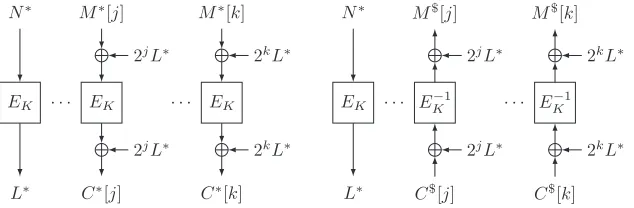
With the knowledge of L∗, following [1, Sect. 4.3], we modify C∗ to make a decryption query. Specifically, let C∗ = (C∗[1], . . . , C∗[m∗]) be the challenge ciphertext broken into blocks, and we first fix indicesj, k∈ {1, . . . , m∗−1}that satisfyC∗[j]6=C∗[k]. We then defineC$= (C$[1], . . . , C$[m∗]) as follows:
– C$[i] =C∗[i] fori∈ {1, . . . , m∗} \ {j, k}
– C$[j] =C∗[k]⊕2kL∗⊕2jL∗
– C$[k] =C∗[j]⊕2kL∗⊕2jL∗
Next, the adversary makes a decryption query (N∗, A∗, C$, T∗), i.e, this is almost the same as the challenge, but thej-th andk-th blocks ofC∗are modified. From the reasoning of [1, Sect. 4.3], the query will be accepted, and the adversary obtains M$. The goal of the attack,M∗, is obtained by swapping thej-th and k-th blocks of M$ and making necessary modifications. More precisely, from M$= (M$[1], . . . , M$[m∗]), we obtainM∗= (M∗[1], . . . , M∗[m∗]) as follows:
– M∗[i] =M$[i] fori∈ {1, . . . , m∗} \ {j, k}
– M∗[j] =M$[k]
– M∗[k] =M$[j]
⊕2kL∗⊕2jL∗
See Fig. 2 for the encryption process of (N∗, A∗, M∗) and the decryption process of (N∗, A∗, C$, T∗).
EK
EK
N∗
L∗
M∗[j] M∗[k]
C∗[j] C∗[k] 2jL∗ 2kL∗
2jL∗ EK
2kL∗
EK
N∗
L∗
2jL∗ 2kL∗
2jL∗ 2kL∗
C$[j] C$[k]
M$[j] M$[k]
EK−1 EK−1
Fig. 2. The encryption process of (N∗, A∗, M∗) (left) and the decryption process of (N∗, A∗, C$, T∗
) (right). In the right figure, we haveC$[j] =C∗
[k]⊕2kL∗⊕
2jL∗
and
C$[k] =C∗[j]⊕2kL∗⊕2jL∗, and it follows that M∗[j] =M$[k]⊕2kL∗⊕2jL∗ and
M∗[k] =M$[j]⊕2kL∗⊕2jL∗.
4
Block Cipher Decryption
We show that, for any Y∗, the adversary can computeX∗=E−1
K (Y∗).
We first perform the attack in [1, Sect. 4.1] by using any nonceN ∈ {0,1}n.
The adversary can recover L = EK(N), and from this, the adversary obtains
three input-output pairs (X[1], Y[1]),(X[2], Y[2]),(X[3], Y[3]) of the block ci-pher, where Y[i] =EK(X[i]).
Let (N0, L0) = (X[1], Y[1]), where we assume thatN06=N, and define
M∗= (X∗⊕2L0, X∗⊕22L0,0n)∈ {0,1}3n.
The approach we take is to computeC∗ andT∗ under the nonceN0 and empty A∗, and make a decryption query (N0, A∗, C∗, T∗). The adversary obtains M∗, andX∗ can be obtained in an obvious way.
The observation here is that the check sum ofM∗isΣ∗= 2L0⊕22L0, which is independent ofX∗, and we know all the block cipher input values to computeC∗ andT∗. See Fig. 3 for the encryption process of (N0, A∗, M∗). We need to derive the values ofC∗[3] andT∗ in Fig. 3. This can be done as in the computation of L∗ fromN∗ in the previous section.
1. Let (N00, L00) = (X[2], Y[2]), where we assume thatN006=N0 andN006=N. 2. Fix any A00 ∈ {0,1}∗, and let M00 = (M00[1], M00[2], M00[3]) = (len(0n)
⊕
23L0⊕2L00,2L0⊕22L0⊕233L0⊕22L00, M00[3]), whereM00[3]∈ {0,1}n can
3. Make an encryption query (N00, A00, M00) and obtain (C00[1], C00[2], C00[3], T00). 4. LetC∗[3] beC00[1]⊕2L00 andT∗be C00[2]⊕22L00.
See Fig. 4 for this step.
The final step is to make a decryption query (N0, A∗, C∗, T∗), where A∗ is empty,C∗= (Y∗⊕2L0, Y∗⊕22L0, C∗[3]), andC∗[3] and T∗ are obtained as above. The query will be accepted, and the oracle returnsM∗= (X∗⊕2L0, X∗⊕ 22L0,0n). The adversary can computeX∗from the knowledge ofL0, and we see that the entire process succeeds with an overwhelming probability.
N′
L′
X∗ 2L′
2L′
Y∗ 2L′ EK
EK EK
2L′
EK EK
22L′
22L′ 23L′ 233L′
0n
X∗ 22L′
Y∗ 22L′
len(0n)
C∗[3]
2L′ 22L′
T∗
C∗
Fig. 3.The encryption process of (N0, A∗, M∗).C∗[3] andT∗ are unknown.
N′′
L′′
EK
EK EK
(len(0n)
⊕23L′)⊕2L′′ (2L′⊕22L′⊕233L′)⊕22L′′
2L′′
2L′′ 22L′′
22L′′
C′′[1] C′′[2]
Fig. 4.The encryption process of (N00, A00, M00). We see thatC∗[3] =C00[1]⊕2L00and
T∗=C00[2]⊕22L00
.
5
Conclusions
in the sense of IND-CCA. The result of this note shows that the confidentiality can also be broken in the sense of plaintext recovery. We also showed that if the adversary has access to the encryption and decryption oracles of OCB2, it can simulate the decryption oracle of the underlying block cipher.
Acknowledgements. The author would like to thank Kazuhiko Minematsu for useful comments.
References
1. A. Inoue and K. Minematsu. Cryptanalysis of OCB2. IACR Cryptology ePrint Archive, 2018:1040, 2018.
2. K. Minematsu, S. Lucks, H. Morita, and T. Iwata. Attacks and Security Proofs of EAX-Prime. In S. Moriai, editor,FSE 2013, volume 8424 ofLNCS, pages 327–347. Springer, 2013.
3. B. Poettering. Breaking the confidentiality of OCB2. IACR Cryptology ePrint Archive, 2018:1087, 20181109:191507, 2018.
4. B. Poettering. Breaking the confidentiality of OCB2. IACR Cryptology ePrint Archive, 2018:1087, 20181111:223450, 2018.
5. B. Poettering. Breaking the confidentiality of OCB2. IACR Cryptology ePrint Archive, 2018:1087, 20181112:161425, 2018.
6. P. Rogaway. Efficient Instantiations of Tweakable Blockciphers and Refinements to Modes OCB and PMAC. In P. J. Lee, editor,ASIACRYPT 2004, volume 3329 of
![Fig. 1. The generation process ofStep 2. C′′[1] for the encryption query (N ′′, A′′, M ′′) of L∗ = EK(N ∗) is obtained as C′′[1] ⊕ 2L′′.](https://thumb-us.123doks.com/thumbv2/123dok_us/7968079.1321479/3.612.240.367.306.413/fig-generation-process-ofstep-encryption-query-ek-obtained.webp)
![Fig. 3. The encryption process of (N ′, A∗, M ∗). C∗[3] and T ∗ are unknown.](https://thumb-us.123doks.com/thumbv2/123dok_us/7968079.1321479/5.612.183.431.427.534/fig-encryption-process-n-m-c-t-unknown.webp)
