IJISET - International Journal of Innovative Science, Engineering & Technology, Vol. 2 Issue 4, April 2015.
www.ijiset.com
ISSN 2348 – 7968
853
Analysis of Vertical handoff parameters using novel algorithm
Abhijit Bijwe1, Dr. C.G.Dethe2
1. Department of Electronics & Communication. Engineering. , Priyadarshini Institute of Engineering
&Technology,Nagpur e-mail: [email protected],
2. Director ,UGC-Academic staff College,RTMNU, Nagpur e-mail: [email protected]
Abstract
Seamless communication is necessary in heterogeneous
networks for which vertical handover is necessary. In
this paper, our main objective is to analyze handover
between two WLAN, two Wimax, two UMTS networks.
The vertical handover decision is taken based on the
variance based algorithm, which calculates the variance
of parameters such as delay, jitter, bandwidth and packet
loss for various above mentioned networks and the
network with most of the parameters with minimum
variance is selected. This algorithm is also compared with
with other algorithms such as MEW (Multiplicative
experiment weighting), SAW (Simple Additive
Weighting), TOPOSIS (Technique for order preference
by similarity to ideal solution) and GRA (Grey Relational
Analysis). These algorithms are appropriate for different
traffic classes. Simulation results for proposed novel
algorithm in Matlab is discussed and compared with
other Multiple attribute decision making algorithm basis
of bandwidth; jitter, delay etc. are discussed in the paper.
It can be seen that the proposed variance algorithm gives
moderate packet delay than all the algorithms, Jitter is
also is Comparatively less than other algorithms.Also,
provides good bandwidth.
Keywords: SAW,TOPOSIS,GRA,MEW
I. INTRODUCTION
Access to various wireless networks such as WLAN, UMTS, Wimax etc is available to us . So there is need for switching from one wireless network to other for better services. Vertical handoff can be used for load
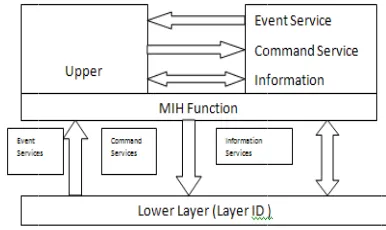
balancing to get high data rate etc. mechanism can support such switching and maintain the connectivity from one network to another. For this mobile devices with multiple interface card which may help in connecting to different access networks. This is called to vertical handoff which is different from horizontal handoff where the MN moves from one BS to another BS in the same network i.e. homogeneous network. The multiple interface card in mobile node can choose the access links such as wireless local area network (WLAN) IEEE 802.11, worldwide inter-operability for microwave access (Wimax) IEEE 802.16, UMTS network. There should be seamless transfer to the link which is appropriate as per the requirement e.g. for video session high data rate required. Seamless vertical handoff between heterogeneous network is expected. This can be done by using IEEE 802.21 standard (Media Independent handover) which enables vertical handoff. IEEE 802.21 creates frame work for the protocol needed for vertical handoff. Actual algorithms need to be implemented by the designer. The IEEE 802.21 standard gives link layer intelligence and other network information to higher layers in order to execute handover between different networks such as wi-fi and wi-max.The paper is organized as follows :
Section making SAW, G that the on the t Section algorith through
I INDEP IEEE 8 required handov differen layer in upper la IEEE Informa services network ,comma physica services behavio
Fig 2.1 M
n 3 explains abo g MADM algo
GRA and how e vertical hand traffic classes. n 4 gives the re hm on the bas hput jitter, drop
II. IMPO
ENDENT HAN 802.21 provid d for vertical h ver between he nt technologie ntelligence and
ayer to optimiz 802.21 defin ation services s Information s ks that exist and services ar al ,data link s gives chan or of physical
Media Independen
out the multipl orithm such as w it is included doff decision i
esult and conclu is of various p pping ratio, del
RTANCE NDOVER IEE des framework handoff. It faci eterogeneous n es. This stand d related netw ze vertical hand nes three ty
s, Command services provid
in a given re used by high
and logical l nges in state
l, data link, l
nt handover
le attribute dec TOPOSIS, M d at MAC lay is taken depen
usion for the a parameters suc lay etc.
OF ME EE 802.21 k for the pro
litates the seam network suppo dard provides work informatio
doff[6]. ypes of serv
services, E de multiple typ
geographical her layer to co link layers. E and transmis ogical link la
cision MEW, er so nding above ch as EDIA tocol mless orting link on to vices: Event pes of area ontrol Event ssion ayers. Fig 2.2
III. P Propo calcul jitter, menti param propo bandw Fig 3.1 Media Independ PROPOSED VA osed algorithm
lates the varia bandwidth an oned networks meters with min osed algorithm width, jitter, pa
Flow chart of Pr
dent handover fra
ARIANCE BA is variance ba ance of param nd packet los s and the netw nimum varianc m, handoff me acket loss etc ar
roposed algorithm ame work
ASED ALGOR ased algorithm meters such as s for various work with most
ce is selected. I etrics such as
IJISET - International Journal of Innovative Science, Engineering & Technology, Vol. 2 Issue 4, April 2015.
www.ijiset.com
ISSN 2348 – 7968
855 Variance = ∑ where x is any metrics such as
delay, bandwidth, jitter etc and µ is its mean of a set of samples of the particular parameters. N is set of samples.
ScoreProposed=argMAX
ΣN
i=110log10((delay2+bandwidth2+jitter2+packet
loss2/4)/(σ2
delay+ σ2bandwidth+ σ2jitter+ σ2packet loss))
IV. OTHER MADM ALGORITHMS USED FOR VERTICAL HANDOVER
SAW – simple additive weighting.[4]
Simple additive weighting(SAW)is the weighted sum method,where Score of each candidate network is calculated as below:
Score
SAW =arg MAX ∑ ∗(1)
Where Nij = Pij / max(Pij) for benefit parameters (eg:
Bandwidth) Nij = min(Pij)/ Pij for cost parameters
(eg:delay,Jitter). Pij can be any parameter such as Bandwidth, delay, jitter, packet loss etc. With i networks and j attributes
The Score of each candidate network is found and the score with maximum value is selected
TOPOSIS – Technique for order preference by similarity to ideal solution[4]
In this algorithm ideal solution is calculated. The selected candidate network will have shortest distance to ideal solution and will have longest distance from worst case solution.
To find the rank of network we this technique follows the step as below:
1. To construct normalized decision matrix consisting of various attributes such as Bandwidth, delay, Jitter, Packet loss etc Nij=Pij/√∑
2. To Compute weighted normalized matrix by Vij=Nij*Wj
3. To find positive and negative ideal solution A+ ={(maxV
ij/jЄJ), (minVij/jЄJ’)},
A- ={(minV
ij/jЄJ), (maxVij/jЄJ’)} where J is a
set of benefit parameters and J’ is a set of cost parameters
4. Calculate the separation distance between available networks and positive and negative
ideal solutions. S+= ∑ , S
-= ∑
5. Compute the closeness to ideal solution Ci=S-/(S+ + S-)
ScoreTOPSIS =arg ∈ Ci (2)
GRA(Grey relational Analysis)-
It is a technique of grey systems theory(GST) invented by Professor ju long Deng. Grey lies between black(no information) and white(full information) which means partial information. It is suitable for unascertained problems with poor information. GRA gives the similarity between the candidate network and best ideal network [4].Here, grey relational coefficient(GRC) is calculated, before that normalization of data and defining ideal sequence. Normalization of data is done for three situations larger the better, smaller the better, nominal the best. Nij=Pij-min(Pij)/(max(Pij)-min(Pij))
Nij= max(Pij)- Pij /(max(Pij)-min(Pij))
Nij=1-| Pij-mj |/max{ max(Pij)-mj,mj- min(Pij)}
mj is the largest value in the nominal the best situations.
∆=|P0j-Nij|, ∆ = ∈ , ∈ ∆ ,
∆ = ∈ , ∈ ∆
GRCi =1/m∑ ∆ ∆ / ∆ ∆
ScoreGRA=arg ∈ GRCi
856 MEW –Multiplicative Exponent Weighting[4]
is the weighted product of attributes method,where SCOREMEW is calculated by the best values of
attributes in networks.
SCOREMEW =arg ∈ ∏ (4)
The best algorithm with maximum score is selected for taking vertical handoff decision.
V. RESULTS & DISCUSSION
Performance evaluation of algorithms are done using Matlab simulation ,which considers three types of network with two each of the type .The networks considered are UMTS, WLAN, Wimax .The Range of value for various parameters are as follows : Bandwidth for UMTS network 0.1-2Mbps, Packet delay for UMTS network 25-50ms, Jitter for UMTS network 5-10ms. Bandwidth for WLAN network 1-54Mbps, Packet delay for WLAN network 100-150ms, Jitter for WLAN network 10-20ms. Bandwidth for Wimax network 1-60Mbps, Packet delay for Wimax network 60-100ms, Jitter for Wimax network 3-10ms. Here, we consider three cases as follows: 1) All Parameters are given equal weights 2) Delay, jitter are given 70% weights which suits voice connections 3) Bandwidth is given 70% weights which suits data connections. These cases are applicable to the algorithms where weights are used.
In variance based algorithm ,which calculates variance of each parameter and the network having at least two or more than two parameters with minimum variance is selected. In this algorithm weights are not assigned to the parameters.
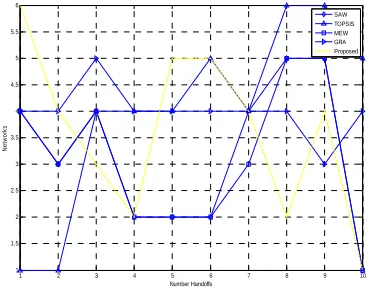
In Proposed algorithm 10 iterations are taken i.e. handoffs are taken and the network selected in each iteration is also shown in the figure below .Here,
1,2,3,4,5,6 represents UMTS1,UMTS2,WLAN1,WLAN2,Wimax1,Wimax2
respectively
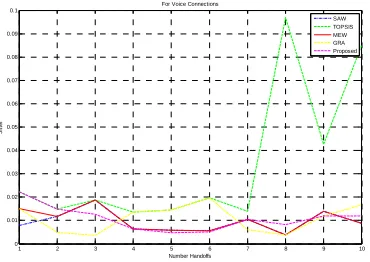
In the Simulation , Comparative analysis of various algorithms such as SAW, TOPSIS, MEW, GRA, Variance based algorithms. Various graphs have been
plotted on 1.Packet Delay Vs Number of Handoffs 2.Jitter Vs Number of Handoffs.
Fig 5.1 Network selection by the various algorithms
Here, the yellow lines indicate the selection of various network using Proposed algorithm which shows that initially Wimax network is selected and later on the other networks
Fig 5.2 Packet delay vs number of handoffs for various
algorithms
1 2 3 4 5 6 7 8 9 10
1 1.5 2 2.5 3 3.5 4 4.5 5 5.5 6
Number Handoffs
Ne
tw
o
rk
s
SAW TOPSIS MEW GRA Proposed
1 2 3 4 5 6 7 8 9 10
0.02 0.04 0.06 0.08 0.1 0.12 0.14 0.16
Number Handoffs
Pa
cke
t D
e
la
y
For Voice Connections
IJISET - International Journal of Innovative Science, Engineering & Technology, Vol. 2 Issue 4, April 2015.
www.ijiset.com
ISSN 2348 – 7968
857 Here, the pink line indicates Packet delay for the
Proposed algorithm which shows that delay is very high initially and later on it decreases except it is comparable with MEW algorithm.
Fig 5.3 Jitter vs number of handoffs for various
algorithms
Here, the pink line indicates Jitter for the Proposed algorithm which shows that is low which makes it ideal for voice communication.
Fig 5.6 Bandwidth vs Number of handoffs
Here, the pink line indicates Bandwidth for the Proposed algorithm which shows that bandwidth is low initially and later on it increases and is high compared to other algorithms. So it also provides bandwidth in addition low jitter and moderate packet delay.
V. CONCLUSION
It is quite clear from above discussion that, the proposed algorithm has the moderate packet delay than MEW, SAW, GRA, TOPSIS algorithms. Also, it is observed that the proposed algorithm offers low jitter than other algorithms. It also provides bandwidth in addition to low jitter and moderate packet delay These two observations makes the proposed algorithm best suited for voice connections. However, the observations obtained are from the simulation results. Hence, it is recommended that for practical scenarios the proposed algorithm can be utilized to have better voice communicationwith video calling facility.
VI. REFERENCES
[1] T. S. Rappport, Wireless Communications:Principles and Practice. Prentice Hall, July 1999.
[2] S. Mohanty and I. F. Akyildiz, “A cross-layer(Layer 2 + 3) handover management protocol for next-generation wireless systems,” IEEE
Trans. Mobile Computing, vol. 5, pp. 1347–1360, Oct. 2006.
[3] Yu-Chang Chen *, Ja-Hsing Hsia, Yi-Ju Liao, “Advanced seamless vertical handoff architecture for WiMAX and WiFi heterogeneous networks with QoS guarantees,” Elsevier,2009, Pp.281-293
[4] Enrique Stevens-Navarro and Vincent W.S. Wong “Comparison between Vertical Handoff Decision Algorithms for Heterogeneous Wireless Networks”,in :IEEE 0-7803-9392-9/06 2006 Pp.947-951
[5] Xiaohuan Yan,.Ahmet S¸ ekercioˇglu,Sathyanarayan “A Survey of vertical Decision algorithms in fourth generation Heterogeneous networks”Elsevier,2010, Pp.1848-1863
[6] HugoMarques, Jos´e Ribeiro,1 PauloMarques, and Jonathan Rodriguez, “Simulation of 802.21 Handovers Using ns-2,” Hindawi Publishing Corporation Journal of Computer Systems, Networks, and Communications
Volume 2010, Article ID 794749, 11 pages
[7] N. Nasser, S. Guizani, and E. Al-Masri. Middleware vertical handover manager: A neural network-based solution. In Proceedings of the 2007 IEEE International Conference on Communications (ICC'07), pages 5671{5676, Glasgow, Scotland, June 2007.
1 2 3 4 5 6 7 8 9 10
0 0.01 0.02 0.03 0.04 0.05 0.06 0.07 0.08 0.09 0.1
Number Handoffs
Ji
tt
e
r
For Voice Connections
SAW TOPSIS MEW GRA Proposed
1 2 3 4 5 6 7 8 9 10
0 1 2 3 4 5 6x 10
7
Number Handoffs
B
and
w
idt
h
For Voice Connections
858 [8] K. Pahlavan, P. Krishnamurthy, A. Hatami, M. Ylianttila, J. P.