Simple Proofs of Sequential Work
Bram Cohen1 and Krzysztof Pietrzak2?
1
Chia Network,[email protected]
2 IST Austria,[email protected]
Abstract. At ITCS 2013, Mahmoody, Moran and Vadhan [MMV’13] in-troduce and constructpublicly verifiable proofs of sequential work, which is a protocol for proving that one spent sequential computational work re-lated to some statement. The original motivation for such proofs included non-interactive time-stamping and universally verifiable CPU bench-marks. A more recent application, and our main motivation, are blockchain designs, where proofs of sequential work can be used – in combination with proofs of space – as a more ecological and economical substitute for proofs of work which are currently used to secure Bitcoin and other cryptocurrencies.
The construction proposed by [MMV’13] is based on a hash function and can be proven secure in the random oracle model, or assuminginherently sequential hash-functions, which is a new standard model assumption introduced in their work.
In a proof of sequential work, a prover gets a “statement” χ, a time parameterN and access to a hash-function H, which for the security proof is modelled as a random oracle. Correctness requires that an hon-est prover can make a verifier accept making onlyN queries toH, while soundness requires that any prover who makes the verifier accept must have made (almost)N sequential queries toH. Thus a solution consti-tutes a proof thatN time passed sinceχwas received. Solutions must be publicly verifiable in time at most polylogarithmic inN.
The construction of [MMV’13] is based on “depth-robust” graphs, and as a consequence has rather poor concrete parameters. But the major drawback is that the prover needs not justN time, but alsoN space to compute a proof.
In this work we propose a proof of sequential work which is much simpler, more efficient and achieves much better concrete bounds. Most impor-tantly, the space required can be as small as log(N) (but we get better soundness using slightly more memory than that).
An open problem stated by [MMV’13] that our construction does not solve either is achieving a “unique” proof, where even a cheating prover can only generate a single accepting proof. This property would be ex-tremely useful for applications to blockchains.
?
1 Introduction
1.1 Proofs of Sequential Work (PoSW)
Mahmoody, Moran and Vadhan [MMV13] introduce the notion of proofs of sequential work (PoSW), and give a construction in the random oracle model (ROM), their construction can be made non-interactive using the Fiat-Shamir methodology [FS87]. Informally, with such a non-interactive PoSW one can generate an efficiently verifiable proof showing that some computation was going on for N time steps since some statement χ was received. Soundness requires than one cannot generate such a proof in time much less thanN even considering powerful adversaries that have a large number of processors they can use in parallel.
[MMV13] introduce a new standard model assumption called “inher-ently sequential” hash functions, and show that the random oracle in their construction can be securely instantiated with such hash functions.
Random Oracle Model (ROM). PoSW are easiest to define and prove
secure in the ROM, as here we can identify a (potentially parallel) query to the RO as one time step. Throughout this paper we’ll work in the ROM, but let us remark that everything can be lifted to the same standard model assumptions (collision resistant and sequential hash functions) used in [MMV13].
A proof of sequential work in the ROM is a protocol between a prover
P and a verifier V, both having access to a random oracle H:{0,1}∗ → {0,1}w. Figure 1 illustrates PoSW as constructed in [MMV13] and also
here. We’ll give a more formal definition in§1.2.
Non-Interactive PoSW. The first message is sent fromVtoP, and is just a uniformly random w bit string χ. In applications this first message is a “statement” for which we want to prove that N time has passed since it was received. The distribution and domain of this statement is not important, as long as it has sufficiently high min-entropy, because we can always first hash it down to a uniformw bit string using the RO.
As the prover is public-coin, we can make the protocol non-interactive using the Fiat-Shamir heuristic [FS87]: A non-interactive PoSW for state-mentχ and time parameterN is a tuple (χ, N, φ, τ) where the challenge
γ = (H(φ,1), . . . ,H(φ, t)) is derived from the proofφby hashing with the
ProverP(N, t, w) VerifierV(N, t, w)
H:{0,1}∗→ {
0,1}w
χ← {0,1}w
γ← {0,1}t·w
verify(χ, N, φ, γ, τ)∈ {accept,reject}
(φ, φP) :=PoSW(χ, N)
τ:=open(χ, N, φP, γ)
statementχ
PoSWφ
challengeγ
answerτ
Fig. 1. Proofs of Sequential Work in the ROM as constructed in [MMV13] and this paper. N is the time parameter, i.e., PoSW(χ, N) makes N queries to Hcomputing φ, and any cheating prover ˜P that makes V accept must make almost N sequential queries toHcomputingφ.tis a statistical security parameter, the largertthe better the soundness: any ˜P making only (1−α)N sequential queries for someα >0, will succeed with probability at most (1−α)t (e.g. witht= 21, a cheating prover making
only 0.8·N sequential queries succeed with probability<1%).wis the output range of our hash function, which we need to be collision resistant and sequential,w= 256 is a typical value.
1.2 PoSW Definition
The PoSW we consider are defined by a triple of oracle aided algorithms
PoSW,openand verify as defined below.
Common Inputs P andV get as common input two statistical security parameters w, t ∈ N and a time parameter N ∈ N. All parties have
access to a random oracleH:{0,1}∗ → {0,1}w.
Statement V samples a randomχ← {0,1}w and sends it toP.
Compute PoSW P computes (ideally, making N queries toH sequen-tially) a proof (φ, φP) := PoSWH(χ, N). P sends φ to V and locally storesφP.
Opening Challenge V samples a random challenge γ ← {0,1}t·w and
sends it toP.
Open P computes τ :=openH(χ, N, φP, γ) and sends it toV.
Verify V computes and outputs verifyH(χ, N, φ, γ, τ)∈ {accept,reject}.
We require perfectcorrectness: if V interacts with an honestP, then it will output accept with probability 1. Thesoundness property requires that any potentially malicious prover Pe who makes V accept with good
probability must have queried H “almost” N times sequentially. This holds even if in every round Pe can query Hon many inputs in parallel,
1.3 The [MMV13] and our Construction in a Nutshell
In the construction from [MMV13], the statement χ is used to sample a fresh random oracle H. ThenP uses Hto compute “labels” of a directed acyclic graph (DAG) G, where the label of a node is the hash of the labels of its parents. Next, P computes a Merkle tree commitment of those labels, sends it to V, who then challenges P to open some of the labels together with its parents.
IfG= (V, E) is “depth-robust”, which means it has a long path even after removing many verticies, a cheating prover can either (1) try to cheat and make up many of the labels, or (2) compute most of the la-bels correctly. The security proof now shows that in case (1) the prover will almost certainly not be able to correctly open the Merkle tree com-mitments, and in case (2) he must make a large number of sequential
queries: if he cheats on labels of nodes S ⊆ V, then the number of se-quential queries must be at least as large as the length of the longest path in the subgraph on V −S. As G is depth-robust and S is not too large, this path is long.
Our construction is conceptually similar, but our underlying graph is much simpler. We use the nodes in the tree underlying the Merkle commitment not just for the commitment, but also to enforce sequen-tial computation. For this it suffices to add some edges as illustrated in Figure 3.
Our graph has some convenient properties, for example the parents of a leaf node v are always a subset of the nodes whose labels one needs to provide for the opening of the Merkle tree commitment of the label of v, so checking that the labels are correctly computed and verifying the opening of a leaf label can be done simultaneously without increasing communication complexity and with only a little bit of extra computation. But most importantly, the labels in our graph can be computed in topological order3while keeping only logarithmically many labels in mem-ory at any point, whereas computing the labelling of a depth-robust graph is much more expensive. In fact, because of this property depth-robust graphs are used to build so called memory-hard functions. Con-cretely, [ABP17] show that if the labelling of a depth-robust graph onN
nodes is done in timeT using spaceS, thenT·S∈Ω(N2). In particular, if one wants to compute the labels in time N, or even just some O(N), then linear Ω(N) space is required.
3
A topological ordering of the vertices of a DAG is an orderingv1, v2, . . . , v|V| such
There is a caveat. If using only logarithmic memory in our construc-tion, the prover needs to recompute all the labels in the opening phase, whereas one wouldn’t need any computation (just some lookups) in the opening phase if everything was stored. This is unfortunate, as it means we get a factor 2 difference in the sequential computation that is claimed, versus what has to actually be done, but some applications need this fac-tor to be close to 1. Fortunately there is a simple trade-off, where using slightly more memory one can make the opening phase much more effi-cient. The basic idea, which we describe in detail in §5.4, is to store all the 2m nodes at some level m of the tree. With this, one can compute any other node making just 2n−m queries.
1.4 More Related Work
Time Release Cryptography. The idea of “time-release” cryptography goes back to [CLSY93,May93].
Most related to PoSW are time-lock puzzles, which were introduced by Rivest, Shamir and Wagner [RSW00]. They give a construction of such puzzles based on the assumption that exponentiation modulo an RSA integer is an “inherently sequential” computation. A recent treatment with new constructions is [BGJ+16].
Time-lock puzzles allow a puzzle generator to generate a puzzle with a message of its choice encoded into it, such that this message can only be redeemed by a solver after tsteps of sequential work. Such a scheme can be used as a PoSW as the decoded message constitutes a proof of sequen-tial work, but as the puzzle generator has a trapdoor, this proof will not be convincing to anyone else and as it’s not public-coin, it can’t be made non-interactive by the Fiat-Shamir methodology. Although incompara-ble, time-lock puzzles seem to be more sophisticated objects than PoSW. Unlike for PoSW, we have no constructions based on random oracles, and [MMV11] give black-box separations showing this might be inherent (we refer to their paper for the exact statements). Existing PoSW (including ours) have another drawback, namely, that the proofs are not unique. We’ll discuss this in more detail at the end of §6.
Proofs of Work. Proofs of work (PoW) – introduced by Dwork and
with t zeros. If H is modelled as a random oracle, finding such an x re-quires an expected 2tnumber of queries, while verifying that x is a valid solution just requires a single query. Proofs of work are used to secure several decentralised cryptocurrencies and other blockchain applications, most notably Bitcoin.
1.5 Basic Notation
We denote with {0,1}≤n def= Sn
i=0{0,1}i the set of all binary strings of
length at mostn, including the empty string. Concatenation of bitstrings is denoted with k. For x ∈ {0,1}∗, x[i] denotes its ith bit, x[i . . . j] =
x[i]k. . .kx[j] and |x|denotes the bitlength ofx.
2 Building Blocks
In§2.1 below, we define the basic properties of graphs used in this work. Then in§2.2 we summarize the properties of the random oracle model [BR93] used in our security proof.
2.1 Graphs Basics
To define the [MMV13] and our construction we’ll need the following
Definition 1 (Graph Labelling).Given a directed acyclic graph (DAG)
G = (V, E) on vertex set V = {0, . . . , N −1} and a hash function H : {0,1}∗ → {0,1}w, the label `
i ∈ {0,1}w of i ∈ V is recursively
computed as (where u is a parent of v if there’s a directed edge from u to
v)
`i =H(i, `p1, . . . , `pd) where (p1, . . . , pd) =parents(i) . (1) Note that for any DAG the labels can be computed makingN sequential queries toHby computing them in an arbitrary topological order. If the maximum indegree of G is δ, then the inputs will have length at most
dlog(N)e+δ·w.
The PoSW by Mahmoody et al. [MMV13] is based on depth-robust graphs, a notion introduced by Erd˝os et al. in [EGS75].
Definition 2 (Depth-Robust DAG). A DAG G = (V, E) is (e, d)
For example, the complete DAGG= (V, E), |V|=N , E ={(i, j) : 0≤
i < j ≤N−1}is (e, N−e) depth-robust for anye, but for PoSW we need
a DAG with small indegree. Already [EGS75] showed that (Θ(N), Θ(N)) depth-robust DAGs with indegreeO(log(N)) exist. Mahmoody et al. give an explicit construction with concrete constants, albeit with larger inde-gree O(log2(N)polyloglog(N))∈O(log3(N)).
2.2 Random Oracles Basics
Salting the RO. In [MMV13] and also our construction, all three algo-rithms PoSW, open and verify described in §1.2 use the input χ only to sample a random oracle Hχ, for example by using χ as prefix to every
input
Hχ(·)def= H(χ,·) .
We will sometimes write e.g., PoSWHχ(N) instead PoSWH(χ, N). Using the uniform χ like this implies that in the proof we can assume that to a cheating prover, the random oracleHχjust looks like a “fresh” random
oracle on which it has no auxiliary information [DGK17].
Random Oracles are Collision Resistant.
Lemma 1 (RO is Collision Resistant). Consider any adversary AH
which is given access to a random function H :{0,1}∗ → {0,1}w. If A
makes at mostq queries, the probability it will make two colliding queries
x6=x0,H(x) =H(x0) is at most q2/2w+1.
Proof. The probability that the output of the i’th query collides with any of the i−1 previous outputs is at most i2−w1. By the union bound, we get that the probability that any ihits a previous output is at most
Pq i=1
i−1 2w <
q2
2w+1. ut
Random Oracles are Sequential. Below we show that ROs are “sequen-tial”, this is already shown in [MMV13], except that we use concrete parameters instead of asymptotic notations.
Definition 3 (H-sequence). An H sequence of length s is a sequence
x0, . . . , xs∈ {0,1}∗ where for eachi,1≤i < s,H(xi) is contained inxi+1
as continuous substring, i.e., xi+1 =akH(xi)kb for some a, b∈ {0,1}∗.
Lemma 2 (RO is Sequential). Consider any adversary AH which is
given access to a random function H:{0,1}∗→ {0,1}w that it can query
parallel queries. If Amakes at most q queries of total length Qbits, then the probability that it outputs anH-sequence x0, . . . , xs (as defined above)
is at most
q·Q+
Ps i=0|xi|
2w
Proof. There are two waysAcan output anHsequencex0, . . . , xsmaking
only s−1 sequential queries.
1. Lucky guess: It holds that for somei,H(xi) is a substring ofxi+1 and
the adversary did not make the query H(xi). As H is uniform, the
probability of this event can be upper bounded by
q·
Ps i=0|xi|
2w .
2. Collision: Thexi’s were not computed sequentially. That is, it holds
that for some 1≤ i≤j ≤s−1, a query ai is made in round i and
queryaj in round jwhereH(aj) is a substring ofai. Again using that
H is uniformly random, the probability of this event can be upper bounded by
q· Q
2w .
The claimed bound follows by a union bound over the two cases analysed
above. ut
Thus, whenever an adversary outputs an H-sequence of length s where
q·(Q+Psi=0|xi|) is much smaller than 2w– which in practice will certainly
be the case if we use a standard block length likew= 256 – we can assume that it made at least ssequential queries toH.
Merkle-Damg˚ard. The inputs to our hash functionH are of length up to (dlogNe+ 1)w bits (assuming N ≤ 2w, so the index of a node can be encoded into{0,1}w). We can build a function for abitrary input lenghts
from a compression function h : {0,1}2w → {0,1}w using the classical
Merkle-Damg˚ard construction [Dam90,Mer90]. Concretely, let y0 be the
statement χ (used for salting as outlined above) and then recursively define
H(x1, . . . , xz) =yz where yi=h(xi, yi−1) for i≥1.
One must be careful with this approach in our construction. As it’s possi-ble to computeyi using only the prefixx1, . . . , xi, an adversary might get
an advantage by computing such intermediateyi’s before the entire input
is known, and thus exploit paralellism to speed up the computation. This can be avoided by requiring that x1 is always the label of the node that
3 The [MMV13] Construction
In this section we informally describe the PoSW from [MMV13] using the high-level protocol layout from§1.2.
For any N = 2n, the scheme is specified by a depth-robust DAG
GDRn = (V, E) on |V| = N vertices. Let Bn = (V0, E0) denote the full
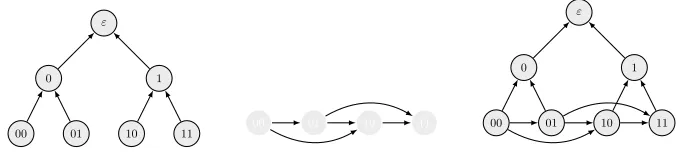
binary tree withN = 2n leaves (and thus 2N−1 nodes) where the edges are directed towards the root. LetGMMVn be the DAG we get fromBn, by
identifying theN leaves of this tree with theN nodes ofGDRn as illustrated in Figure 2
ε
0
00 01
1
10 11
ε
0
00 01
1
10 11
ε
0
00 01
1
10 11
Fig. 2.Illustration ofB2(left), a (toy example of a) depth-robust graphGDR2 (middle) and the correspondingGMMV
2 graph.
Now (φ, φP) := PoSWHχ(N) computes and stores the labels φP =
{`v}v∈{0,1}≤n (cf. Definition 1) of GMMVn using Hχ as hash function, and
sends the labelφ=`of the root toV. We remark that in [MMV13] this is
described as a two step process, where one first computes a labeling ofGDRn
(using a sequential hash function), and then a Merkle-tree commitment of the N labels (using a collision resistant hash function).
After receiving the challenge γ = (γ1, . . . , γt) from V, the prover P
computes the answerτ :=openHχ(N, φ
P, γ) as follows: For anyi,1≤i≤
t,τ contains the opening of the Merkle commitments of the label`γi, and the labels of the parents ofi, and moreover the labels labels required for the opening of the Merkle commitment of this label.4
Upon receiving the answer τ, V invokes verifyHχ(N, φ, γ, τ) to check if the labels `γi were correctly computed as in Eq.(1), and if the Merkle openings of the labels `γi are all correct.
To argue soundness, one uses the fact thatGDRn is (e, d) depth-robust with e, d=Θ(N). As Hχ is collision resistant, a cheating prover ˜P must
4
commit to unique labels {`0v}v∈{0,1}n of the leaves (that it can later open to). We say that a vertexi is inconsistent if it is not correctly computed from the other labels, i.e.,
`0i 6=H(i, `0p1, . . . , `p0d) where (p1, . . . , pd) =parents(i)
Letβ be the number of inconsistent verticies. We make a case distinction:
– If β ≥e, then one uses the fact that the probability that a cheating prover ˜P will be asked to open an inconsistent vertex is exponentially
(int) close to 1, namely 1−NN−βt, and thus ˜P will fail to make V
accept except with exponentially small probability.
– ifβ < e, then there’s a path of lengthd=Θ(N) of consistent verticies,
which means the labels `0i0, . . . , `0i
d−1 on this path constitute an Hχ
sequence (cf. Def.3) of lengthd−1, and as Hχ is sequential, ˜P must
almost certainly have made d−1 =Θ(N) sequential queries toHχ.
4 Definition and Properties of the DAG GPoSW n
In this section we describe the simple DAG underlying our construction, and prove state some simple combinatorial properties about it which we’ll later need in the security proof and to argue efficiency.
ε
0
00
000
0000 0001
001
0010 0011
01
010
0100 0101
011
0110 0111
1
10
100
1000 1001
101
1010 1011
11
110
1100 1101
111
1110 1111
Fig. 3.Illustration ofGPoSW4 . The setS∗={01,101,1100}– which e.g. could be derived fromS ={010,0110,0111,101,1010,1100}– is shown in red.DS∗ is the union of red
and orange nodes. ˆS = ˆS∗are the orange or red leaves. The path of length 2N−1− |BS|= 32−1−11 = 19 (as constructed in the proof of Lemma 4) is shown in blue.
Forn ∈N let N = 2n+1−1 and Bn = (V, E0) be a complete binary
tree of depth n. We identify the N nodesV ={0,1}≤n with the binary
vertexvisabove uifu=vkafor somea(thenuisbelow v). The directed edges go from the leaves towards the root
E0 ={(xkb, x) : b∈ {0,1}, x∈ {0,1}i, i < n} .
We define the DAGGPoSWn = (V, E) by starting withBn, and then adding
some edges. Concretely E = E0∪E00 where E00 contains, for all leaves
u ∈ {0,1}n, an edge (v, u) for any v that is a left sibling of a node on
the path from u to the root ε. E.g., for v = 1101 we add the edges (1100,1101),(10,1101),(0,1101), formally
E00 ={(v, u) : u∈ {0,1}n, u=ak1ka0, v=ak0} .
Lemma 3. The labels of GPoSWn can be computed in topological order using only w·(n+ 1)bits of memory.
Proof. The proof of the lemma follows by induction: to compute the labels of GPoSWn , start by computing the labels of the left subtree L, which is isomorphic to GPoSWn−1 . Once the last label`0 ofL is computed, keep only
this one label. Now compute the labels of the right subtreeR, which is also isomorphic to GPoSWn−1 , except that it has some incoming edges from the
left subtree. As all these edges start at `0, one can compute the labeling
of this graph with just w extra bits of space. Once the last label `1 of
R is computed, delete all labels except `0, `1, and compute the label of
the root `ε =H(ε, `0, `1). The memory required to compute the labels of
GPoSWn is thus the memory required for GPoSWn−1 plus w bits (to store `0
while computing the right subtree). GPoSW1 just has 3 nodes and so can trivially be computed with 3·w bits. Solving this simple recursion gives
the claimed bound. ut
Definition 4 (S, Sˆ ∗, DS). For a subset S ⊆V of nodes, we denote with
ˆ
S the set of leaves below S
ˆ
S ={vku∈ {0,1}n : v∈S, u∈ {0,1}n−|v|}
We denote with S∗ the minimal set of nodes with exactly the same set of leaves as S, i.e., S∗ ⊆V is the smallest set satisfying Sˆ∗ = ˆS.
We denote withDS all the nodes which are in S or below some node
in S
DS ={vkv0 : v∈S, v0 ∈ {0,1}≤n−|v|}
Lemma 4. The subgraph of GPoSWn = (V, E) on vertex set V −DS∗ (for
any S ⊆ V) has a directed path going through all the |V| − |DS∗| =
Proof. The proof is by induction on n, an example path is illustrated in Figure 3. The lemma is trivially true for GPoSW0 , which just contains a single node. Assume it’s true for GPoSWi , nowGPoSWi+1 consists of a rootε, with a left and right subgraphL andR isomorphic toGPoSWi , with extra edges going from the root of L – which is 0 – to all the leaves in R. If
ε∈S∗ the lemma is trivially true as |V| − |DS∗|= 0. If 0∈S∗, then all ofLis inDS∗, in this case just apply the Lemma toR≡GPoSW
i , and add
an extra last edge 1→ε. If 06∈S∗, apply the Lemma first to L≡GPoSWi
to get a path that ends in its root 0, then – if 16∈S∗ – apply the lemma to R ≡GPoSWi , to get a path that starts at a leaf v. Now add the edges 0→v and 1→ε. If 1∈S∗ we just add the edge 0→ε. ut
Lemma 5 (trivial). For any S∗, S ⊂V, DS∗ contains
|{0,1}n∩D S∗|=
|DS∗|+|S∗| 2
many leaves.
Proof. Let S∗ ={v1, . . . , vk}, using that Dvi∩Dvj =∅ for all i6=j (as otherwise S∗ would not be minimal), we can write
|{0,1}n∩DS∗|=
k X
i=1
|{0,1}n∩Dvi|.
As eachDvi is a full binary tree it has (|Dvi|+ 1)/2 many leaves, so
k X
i=1
|{0,1}n∩D vi|=
k X
i=1
|Dvi|+ 1
2 =
|DS∗|+|S∗|
2 .
u t
5 Our Construction
In this section we specify our PoSW based on the graphs GPoSWn .
5.1 Parameters
We have the following parameters:
H:{0,1}≤w(n+1) → {0,1}w the hash function, which for the security proof
is modelled as a random oracle, and which takes as inputs strings of length up tow(n+ 1) bits.
t A statistical security parameter.
M Memory available to P, we assume it’s of the form
M = (t+n·t+ 1 + 2m+1)w
for some integerm,0≤m≤n.
5.2 The PoSW,open and verify algorithms.
Our PoSW follows the outline given in§1.2 using three algorithmsPoSW,
open and verify. Note that n ≈ logN and m ≈ logM are basically the
logarithms of the time parameter N and the memory M (measured inw
bit blocks) we allow P to use.
(φ, φP) :=PoSWHχ(N) : computes the labels {`i}i∈{0,1}≤n (cf. Def. 1) of the graph GPoSWn (as defined in §4) using Hχ. It stores the labels
φP ={`i}i∈{0,1}≤m of the m highest layers, and sends the root label
φ=`ε toV.
τ :=openHχ(N, φ
P, γ) : on challenge γ = (γ1 . . . , γt), τ contains – for
every i,1 ≤i ≤t – the label `γi of node γi ∈ {0,1}
n and the labels
of all siblings of the nodes on the path from γi to the root (as in an
opening of a Merkle tree commitment), i.e.,
{`k}k∈Sγi where Sγi def
= {γi[1. . . j−1]k(1−γi[j])}j=1...n
and
τ def= {`γi,{`k}k∈Sγi}i=1...t .
E.g., for γi = 0101 (cf. Figure 3) τ contains the labels of 0101, 0100,
011, 00 and 1.
Ifm =n, P stores all labels in φP and thus this needs no queries to
Hχ. We’ll discuss the case 0< m < n in§5.4.
verifyHχ(N, φ, γ, τ) : Using that the graphsGPoSW
n have the property that
all the parents of a leafγi are in Sγi, for every i,1 ≤i≤ t, one first checks that`γi was correctly computed from its parent labels (i.e., as in Eq.1)
`γi
?
Then we verify the “Merkle tree like” commitment of`γi, by using the labels inτ to recursively compute, for i=n−1, n−2, . . .0
`γi[0...i]:=Hχ(γi[0. . . i], `γi[0...i]k0, `γi[0...i]k1)
and then verifying that the computed root`γi[0...0] =`ε is equal toφ received before.
5.3 Security
Theorem 1. Consider the PoSW from§5.2, with parameterst, w, N and a “soundness gap”α >0. IfP˜ makes at most(1−α)N sequentialqueries to Hafter receiving χ, and at most q queries in total, then V will output reject with probability
1−(1−α)t−2·n·w·q
2
2w
So, for example setting the statistical security parameter tot= 21, means a ˜P who makes only 0.8N sequential queries will be able to makeVaccept with ≤1% probability. This is sufficient for some applications, but if we want to use Fiat-Shamir to make the proof non-interactive, the error should be much smaller, say 2−50 which we get with t= 150.
Proof. The exponentially small 2·n·w·q2/2w loss accounts for the as-sumption we’ll make, that ˜P, after receiving χ (1) won’t find a collision in Hχ, and (2) whenever it outputs an Hχ-sequence of length s it must
have made s sequential queries to H. The concrete bound follows from Lemmas 1 and 2 (recall that Honly takes inputs of length≤(n+ 1)w).
After sendingφ, ˜P is committed to the labels{`i0}i∈{0,1}≤n it can open. We say a nodeiis inconsistent if its label`0i was not correctly computed, i.e.,
`0i 6=H(i, `0p1, . . . , `p0d) where (p1, . . . , pd) =parents(i) .
Let us mention thati can be consistent even though`0i6=`i (`i denoting
the label the honest P would compute), so being consistent is not the same as being correct. We can also determine these `0i from just looking at ˜P’s oracle queries, but for the proof we just need that they are unique. LetS ⊆V ={0,1}≤ndenote all inconsistent nodes. Then by Lemma 4
there’s a path going through all the nodes inV −DS∗. As all these nodes are consistent, the labels `0i on this path constitute an Hχ-sequence of
sequential queries (recall we assume ˜P did not break sequentiality ofHχ),
so we now assume
|DS∗|> αN =α(2n+1−1).
By Lemma 5 and the above equation
|{0,1}n∩D S∗|=
|DS∗|+|S∗|
2 > α2
n . (2)
˜
P will fail to produce a valid proof given t random challenges γ =
(γ1, . . . , γt) if there’s at least oneγi such that a node on the path fromγi
to the root is in S, i.e., γ∩Sˆ6=∅, or equivalently
γ∩DS∗ =γ∩Sˆ∗ =γ∩Sˆ6=∅.
By Eq.(2), and using that everyγi is uniform
Pr[γi 6∈DS∗] = 1− |{0,1}n∩DS∗|/2n<1−α
and as theγi are also independent
Pr[γ∩DS∗ =∅] =
t Y
i=1
Pr[γi6∈DS∗]<(1−α)t
so ˜P will fail to generate a valid proof with probability >1−(1−α)tas
claimed. ut
5.4 Efficiency
We’ll now discuss the efficiency of the scheme from §5.2 in terms of proof size, computation and memory requirements.
Proof Size The exchanged messages χ, φ, γ, τ are of length (we needw
bits to specify a label andn bits to specify a node)
|χ|=w |φ|=w |γ|=t·n |τ| ≤t·w·n
When we make the proof non-interactive using Fiat-Shamir (where γ is derived fromφ) the length of a proof for a given statementχ becomes
|φ|+|τ| ≤w(t·n+ 1)
With w = 256 bit blocks, t = 150, which is sufficient to get 2−50 secu-rity for soundness gap α = 0.2 (i.e., a cheating prover must make 0.8N
Prover Efficiency P’s efficiency is dominated by queries toHχfor
com-puting PoSWand open, so below we just count these.
PoSWHχ(N) can be computed makingN (sequential) queries toH
χ, each
input being of length at most (n+ 1)·wbits, and on average about 1/4 of that (for comparison, the construction from [MMV13] has inputs of lengthn2·polylog(n)·w).
openHχ(N, φ, γ) : Here the efficiency depends on m, which specifies the
size of the memoryM = (n+ 1 +n·t+ 2m+1)wwe allowP to use. Here
w·n·tbits are used to store the values inτ to send back, (n+1)·wbits are used to compute the label (cf. Lemma 3), and 2m+1w labels are used to storeφP, which contains the labels of themupmost levels{`i}i∈{0,1}≤m.
– Ifm=n,P stored all the labels computed byPoSWHχ(N), and thus needs no more queries.
– If m= 0, P needs to recompute all N labels. This is not very satis-fying, as it means that we’ll always have a soundness gap of at least 2: the honest prover needs a total of 2N sequential queries (N for each,PoSW and open), whereas (even an honest) prover with m =n
space will only requireNsequential queries. Fortunately there is a nice trade-off, where already using a small memory meansP just needs to make slightly more thanN queries, as described next.
– In the general case 0≤m≤n,P needs to compute 2n−m+1−1 labels for each of thet challenges, thus at most
t·(2n−m+1−1)
in total (moreover this can be done making 2n−m+1−1 queries sequen-tially, each withtinputs). E.g. ifm=n/2, this meansP uses around
√
N·wbits memory, and√N·tqueries on top of theN for computing
PoSW. For typical parameters √N ·t will be marginal compared to
N. More generally, for any 0≤β≤1, givenN1−β·wmemory means
P needsNβ·tqueries to computeopen(orNβ sequential queries with parallelismt).
For our example with w= 256, n= 40, t= 150, setting, say m= 20, meansP uses 70MB of memory, and the number of queries made by
5.5 Verifier Efficiency.
The verifier is extremely efficient, it must only sample a random challenge
γ (of lengtht·w) and computingverify(χ, N, φ, γ, τ) can be done making
t·nqueries toHχ, each of length at mostn·wbits. This is also basically
the cost of verifying a non-interactive proof.
6 Conclusions and Open Problems
We constructed a proof of sequential work which is much simpler and en-joys much better parameters than the original construction from [MMV13]. They also state three open questions, two of which we answer in this work. Their first question is:
Space Complexity of the Solver.In our construction of time stamping and time-lock puzzles for time N, the solver keeps the hash labels of a graph of N vertices. Is there any other solution that useso(N) storage? Or is there any inherent reason thatΩ(N) storage is necessary?
We give a strong negative answer to this question, in our construction the storage of the prover is onlyO(log(N)). Their second question is:
Necessity of Depth-Robust Graphs.The efficiency and secu-rity of our construction is tightly tied to the parameters of depth-robust graph constructions: graphs with lower degree give more efficient solutions, while graphs with higher robustness (the lower bound on the length of the longest path remaining after some of the vertices are removed) give us puzzles with smaller adversarial advantage. An interesting open question is whether the converse also holds: do time-lock puzzles with better parameters also imply the existence of depth-robust graphs with better parameters?
be n2n (2n for every layer), and one can show hat for any 0 ≤ α ≤ 1, removing nodes of weight α2n, will leave a path of length (1−α)2n.
Apart from [MMV13], depth-robust graphs have been used for cryp-tographic applications in at least one other case, namely to construct memory-hard functions [ABP17]. Moreover the proofs of space protocol from [DFKP15] is quite similar to the PoSW from [MMV13], the main difference being that the underlying graph does not have to be depth-robust, but needs to have high space complexity. Due to this similarities, it seems conceivable that using ideas from this work one can get improved constructions for memory-hard functions and proofs of space.
Let us also mention the third open question asked by [MMV13]. It asks whether a PoSW based only on random oracles can be used to achieve fairness in protocols like coin tossing. We refer to their paper for the details, and just mention that to achieve this, it’s sufficient to construct a PoSW with a “unique” proof (note that we already mention this problem in the related work section §1.4). That is, we not only require that to generate a proof one needs to spend sequential time, but for every input (statement and time parameter), it should be hard to come up with two different valid proofs. Such a property would also be very useful in other contexts, like for constructing blockchains, which was the main motivation for this work.
Unfortunately, our construction also does not have unique proofs. It’s an intriguing open problem to construct a PoSW with unique proofs and an exponential gap between proof generation and proof verification. Cur-rently, the publicly verifiable function with the largest gap between com-putation and verification is the sloth function [LW17], which is based on the assumption that computing square roots in a field of size p takes log(p) times longer than the inverse operation, i.e., squaring. Under this assumption, the gap is log(p), in practice one would probably use some-thing like log(p) ≈ 1000. Sloth is not a time-lock puzzle (as discussed in §1.4), as one can’t sample an input together with its output. It’s also not a good PoSW as there’s no further speedup if we only want to verify that a lot of sequential time has been spend on the computation, not correctness. Let us also mention that sloth, as well as our PoSW (but not [MMV13]) allow for a speedup of q in verification time if parallelism
q is allowed and the proof can be of size linear in q. Basically one adds
References
[ABP17] Jo¨el Alwen, Jeremiah Blocki, and Krzysztof Pietrzak. Depth-robust graphs and their cumulative memory complexity. InEUROCRYPT, LNCS, 2017. https://eprint.iacr.org/2016/875.
[BGJ+16] Nir Bitansky, Shafi Goldwasser, Abhishek Jain, Omer Paneth, Vinod Vaikuntanathan, and Brent Waters. Time-lock puzzles from randomized encodings. In Madhu Sudan, editor,ITCS 2016, pages 345–356. ACM, Jan-uary 2016.
[BR93] Mihir Bellare and Phillip Rogaway. Random oracles are practical: A paradigm for designing efficient protocols. In V. Ashby, editor,ACM CCS 93, pages 62–73. ACM Press, November 1993.
[CLSY93] Jin-yi Cai, Richard J. Lipton, Robert Sedgewick, and Andrew Chi-Chih Yao. Towards uncheatable benchmarks. InProceedings of the Eigth Annual Structure in Complexity Theory Conference, San Diego, CA, USA, May 18-21, 1993, pages 2–11, 1993.
[Dam90] Ivan Damg˚ard. A design principle for hash functions. In Gilles Brassard, editor,CRYPTO’89, volume 435 ofLNCS, pages 416–427. Springer, Heidel-berg, August 1990.
[DFKP15] Stefan Dziembowski, Sebastian Faust, Vladimir Kolmogorov, and Krzysztof Pietrzak. Proofs of space. In Rosario Gennaro and Matthew J. B. Robshaw, editors, CRYPTO 2015, Part II, volume 9216 of LNCS, pages 585–605. Springer, Heidelberg, August 2015.
[DGK17] Yevgeniy Dodis, Siyao Guo, and Jonathan Katz. Fixing cracks in the con-crete: Random oracles with auxiliary input, revisited. In EUROCRYPT 2017, pages 473–495, 2017.
[DN93] Cynthia Dwork and Moni Naor. Pricing via processing or combatting junk mail. In Ernest F. Brickell, editor,CRYPTO’92, volume 740 ofLNCS, pages 139–147. Springer, Heidelberg, August 1993.
[EGS75] Paul Erdoes, Ronald L. Graham, and Endre Szemeredi. On sparse graphs with dense long paths. Technical report, Stanford, CA, USA, 1975. [FS87] Amos Fiat and Adi Shamir. How to prove yourself: Practical solutions
to identification and signature problems. In Andrew M. Odlyzko, editor, CRYPTO’86, volume 263 of LNCS, pages 186–194. Springer, Heidelberg, August 1987.
[LW17] Arjen K. Lenstra and Benjamin Wesolowski. Trustworthy public random-ness with sloth, unicorn, and trx. IJACT, 3(4):330–343, 2017.
[May93] Timothy C. May. Timed-release crypto. http://www.hks.net/cpunks/cpunks-0/1460.html, 1993.
[Mer90] Ralph C. Merkle. A certified digital signature. In Gilles Brassard, editor, CRYPTO’89, volume 435 of LNCS, pages 218–238. Springer, Heidelberg, August 1990.
[MMV11] Mohammad Mahmoody, Tal Moran, and Salil P. Vadhan. Time-lock puzzles in the random oracle model. In Phillip Rogaway, editor, CRYPTO 2011, volume 6841 ofLNCS, pages 39–50. Springer, Heidelberg, August 2011. [MMV13] Mohammad Mahmoody, Tal Moran, and Salil P. Vadhan. Publicly verifiable
proofs of sequential work. In Robert D. Kleinberg, editor,ITCS 2013, pages 373–388. ACM, January 2013.
![Fig. 1. Proofs of Sequential Work in the ROM as constructed in [MMV13] and thisthe soundness: any queries tosucceed with probability at most (1only 0of our hash function, which we need to be collision resistant and sequential,paper](https://thumb-us.123doks.com/thumbv2/123dok_us/7985699.1324967/3.612.140.477.122.213/sequential-constructed-soundness-tosucceed-probability-collision-resistant-sequential.webp)