Multi-Input Functional Encryption in the Private-Key Setting:
Stronger Security from Weaker Assumptions
Zvika Brakerski∗ Ilan Komargodski† Gil Segev‡
Abstract
We construct a general-purposemulti-inputfunctional encryption scheme in the private-key setting. Namely, we construct a scheme where a functional key corresponding to a function f enables a user holding encryptions of x1, . . . , xt to compute f(x1, . . . , xt) but nothing else.
This is achieved starting from any general-purpose private-key single-input scheme (without any additional assumptions), and is proven to beadaptively secure for any constant number of inputst. Moreover, it can be extended to a super-constant number of inputs assuming that the underlying single-input scheme is sub-exponentially secure.
Instantiating our construction with existing single-input schemes, we obtain multi-input schemes that are based on a variety of assumptions (such as indistinguishability obfuscation, multilinear maps, learning with errors, and even one-way functions), offering various trade-offs between security and efficiency.
Previous and concurrent constructions of multi-input functional encryption schemes either rely on stronger assumptions and provided weaker security guarantees (Goldwasser et al. [EU-ROCRYPT ’14], and Ananth and Jain [CRYPTO ’15]), or relied on multilinear maps and could be proven secure only in an idealized generic model (Boneh et al. [EUROCRYPT ’15]). In com-parison, we present a general transformation that simultaneously relies on weaker assumptions and guarantees stronger security.
∗
Department of Computer Science and Applied Mathematics, Weizmann Institute of Science, Rehovot 76100, Israel. Email: [email protected]. Supported by the Israel Science Foundation (Grant No. 468/14) and by the Alon Young Faculty Fellowship.
†
Department of Computer Science and Applied Mathematics, Weizmann Institute of Science, Rehovot 76100, Israel. Email: [email protected]. Supported in part by a grant from the I-CORE Program of the Planning and Budgeting Committee, the Israel Science Foundation, BSF and the Israeli Ministry of Science and Technology.
‡
School of Computer Science and Engineering, Hebrew University of Jerusalem, Jerusalem 91904, Israel. Email:
Contents
1 Introduction 1
1.1 Our Contributions . . . 2
1.2 Additional Related Work . . . 3
1.3 Overview of Our Constructions and Techniques . . . 4
1.4 Paper Organization . . . 8
2 Preliminaries 8 2.1 Pseudorandom Functions . . . 8
2.2 Private-Key Single-Input Functional Encryption . . . 9
2.3 Private-Key Two-Input Functional Encryption . . . 11
3 A Selectively-Secure Two-Input Scheme from any Single-Input Scheme 13 4 From Selective to Adaptive Security for Two-Input Schemes 24 References 37 A Generalization to t≥2 Inputs 39 A.1 Private-Keyt-Input Functional Encryption . . . 39
A.2 A Selectively-Securet-Input Scheme from any (t−1)-Input Scheme . . . 41
A.3 From Selective to Adaptive Security fort-Input Schemes . . . 51
B Deferred Proofs 63 B.1 Proofs of Claims 3.2–3.7 . . . 63
1 Introduction
The emerging vision of functional encryption [SW08, BSW11, O’N10] extends the traditional “all-or-nothing” view of encryption schemes. Specifically, functional encryption schemes offer additional flexibility by supporting restricted decryption keys. These keys allow users to learn specific func-tions of the encrypted data, without learning any additional information. Building upon the early examples of functional encryption schemes for restricted function families (such as identity-based encryption [Sha84, BF03, Coc01]), extensive research is currently devoted to the construction of functional encryption schemes offering a variety of expressive families of functions (see, for example, [SW08, BSW11, O’N10, GVW12, AGV+13, BO13, BCP14, GGH+13, GKP+13, Wat15, GGH+16, AJ15, ABS+15, BS15, BV15, KSY15]).
Until very recently, research on functional encryption has focused on the case of single-input
functions. In a single-input functional encryption scheme, a functional key skf corresponding to a
functionf enables a user holding an encryption of a valuexto computef(x), while not revealing any additional information on x. In many scenarios, however, dealing only with single-input functions is insufficient, and a more general framework allowing multi-input functions is required.
Goldwasser et al. [GGG+14] recently introduced the notion of a multi-input functional encryp-tion scheme. In such a scheme, a funcencryp-tional key corresponding to at-input functionf enables a user holding encryptions ofx1, . . . , xtto computef(x1, . . . , xt) without learning any additional
informa-tion on thexi’s. The work of Goldwasser et al. and their new notion are very well-motivated by a
wide range of applications based on mining aggregate information from several different data sources. These include, for example, running SQL queries on encrypted databases, computing over encrypted data streams, non-interactive differentially-private data release, and order-revealing encryption (all of which are relevant in both the public-key setting and the private-key one [BLR+15]).
Goldwasser et al. presented a rigorous framework for capturing the security of multi-input schemes in the public-key setting and in the private-key one. In addition, relying on indistinguisha-bility obfuscation and one-way functions [BGI+12, GGH+13, KMN+14], they constructed the first multi-input functional encryption schemes. In terms of functionality, their schemes are extremely expressive, supporting all multi-input functions that are computable by bounded-size circuits. In terms of security, however, their private-key scheme satisfies a weak selective notion, which does not allow the adversary to access an encryption oracle (which is quite crippling in the private-key set-ting), and requires an a-priori bound on the number of challenge ciphertexts (the ciphertext length in their scheme depends on the number of challenge ciphertexts).
Following the work of Goldwasser et al. [GGG+14], a private-key multi-input functional encryp-tion scheme that satisfies a more standard noencryp-tion of security (one that allows access to an encrypencryp-tion oracle) was constructed by Boneh et al. [BLR+15]. Their scheme is based on multilinear maps, and is proven secure in the idealized generic multilinear map model. In addition, in an independent and concurrent work, Ananth and Jain [AJ15] constructed a selectively-secure multi-input private-key functional encryption scheme based on any general-purposepublic-key functional encryption scheme (as an intermediate step in constructing an indistinguishability obfuscator).
Thus, constructions of multi-input functional encryption schemes in the private-key setting have so far either relied on stronger assumptions and provided weaker security guarantees [GGG+14, AJ15]1, or could be proven secure only in an idealized generic model [BLR+15].
1In terms of assumptions, the recent work of Asharov and Segev [AS15] shows that indistinguishability obfuscation
1.1 Our Contributions
In this paper we present a construction of private-key multi-input functional encryption from any
general-purposeprivate-key single-inputfunctional encryption scheme (without introducing any ad-ditional assumptions). The resulting scheme supports any set of efficiently-computable functions, and provides adaptive security in the standard model for any constant number of inputs. We prove the following theorem:
Theorem 1.1. Assuming the existence of any private-key single-input selectively-secure functional encryption scheme, for any constant t≥2 there exists a private-keyt-input adaptively-secure func-tional encryption scheme.
Assuming that the underlying private-key single-input scheme is sub-exponentially secure, our resulting scheme provides adaptive security for a super-constant number of inputs (we refer the reader to Section 1.3 for more details). Following [AAB+13, BS15], our scheme provides not only message privacy, but in fact a unified notion that captures both message privacy and function privacy (this notion is known as full security– see Section 2.3 for more details).
Instantiations. Instantiating our construction with existing private-key single-input schemes, we obtain new multi-input schemes based on a variety of assumptions in the standard model. Specifi-cally, we obtain schemes that are secure for an unbounded number of encryption and key-generation queries based on indistinguishability obfuscation or multilinear maps. In addition, if the number of encryption and key-generation queries is a-priori bounded, we can rely on much milder assumptions such as learning with errors [GKP+13] or even the existence of one-way functions or low-depth pseudorandom generators [GVW12]. See Section 2.2 for further discussion.
Comparison with previous and concurrent work. Compared to the previous work of Gold-wasser et al. [GGG+14] and Boneh et al. [BLR+15], our work yields stronger security guarantees and at the same time relies solely on a necessary assumption. Specifically, whereas Goldwasser et al. and Boneh et al. rely on indistinguishability obfuscation and multilinear maps, respectively, we rely on the existence of any general-purpose private-key single-input scheme, which is obviously necessary. Moreover, whereas the scheme of Goldwasser et al. provides a selective notion of security which, in addition, does not allow adversaries to access an encryption oracle and requires an a-priori bound on the number of challenge ciphertexts, and the scheme of Boneh et al. is proved secure only in an idealized generic model that does not properly capture real-world adversaries, our scheme provides adaptive security in the standard model for any number of challenge ciphertexts.
Compared to the concurrent work of Ananth and Jain [AJ15], our work again yields stronger security guarantees while relying on a weaker assumption. Specifically, whereas the construction of Ananth and Jain relies on public-key functional encryption and guarantees selective security (where, in addition, the adversary is not allow to access an encryption oracle), our construction relies on private-key functional encryption and guarantees full security. From the technical point of view, the scheme of Ananth and Jain is essentially “Step 1” of our approach (see Section 1.3), which was sufficient (together with additional techniques and assumptions) for constructing their obfuscator. The vast majority of our efforts in this paper are devoted for providing better security while simultaneously relying on weaker assumptions, as mentioned above.
Finally, we note that in addition to introducing the notion of a multi-input functional encryption scheme, Goldwasser et al. [GGG+14] introduced the more general notion of amulti-clientmulti-input functional encryption scheme. In such a scheme, each input coordinate is associated with its own encryption key, and security should be satisfied for all coordinates whose encryption keys are not known to the adversary. In this paper we do not consider this more general notion, and an interesting open problem is to extend our approach to the multi-client setting.
1.2 Additional Related Work
Extensive research has been devoted to the study of functional encryption, and for concreteness we focus here only on those previous efforts that are directly relevant to the techniques used in this paper.
Function-private functional encryption. The security guarantees of functional encryption typ-ically focus onmessage privacy. Intuitively, message privacy asks that a functional keyskf does not
help in distinguishing encryptions of two messages,m0 and m1, as long asf(m0) =f(m1). In vari-ous cases, however, it is also useful to consider function privacy [SSW09, BRS13, AAB+13, BS15], asking that a functional key skf does not reveal any unnecessary information on the function f.
Specifically, in the private-key setting, function privacy asks that an encryption of a message m
does not help in distinguishing two functional keys, skf0 and skf1, as long as f0(m) =f1(m). Brak-erski and Segev [BS15] recently showed that any private-key functional encryption scheme can be generically transformed into one that satisfies a unified notion of security, referred to asfull security, which considers both message privacy and function privacy.
Other than being a useful notion for various applications, function privacy was found useful as a building block in the construction of several functional encryption schemes [ABS+15, KSY15]. One of the key insights that we utilize in this work is that function-private functional encryption allows to successfully apply proof techniques “borrowed” from the indistinguishability obfuscation literature (including, for example, a variant of the punctured programming approach of Sahai and Waters [SW14]).
Key-encapsulation techniques in functional encryption. Key encapsulation (also known as “hybrid encryption”) is an extremely useful approach in the design of encryption schemes, both for improved efficiency and for improved security. Specifically, key encapsulation typically means that instead of encrypting a message m under a fixed key sk, one can instead sample a random key k, encrypt m under k and then encrypt k under sk. Recently, Ananth et al. [ABS+15] showed that key encapsulation is useful also in the setting of functional encryption. They showed that it can be used to transform any selectively-secure functional encryption scheme into an adaptively-secure one (in both the public-key setting and the private-key one). Their construction and proof technique hint that key encapsulation techniques may in fact be a general tool that is useful in the design of functional encryption schemes. Our constructions incorporate key encapsulation tech-niques, and exhibit additional strengths of this technique in the context of functional encryption schemes. Specifically, as discussed in Section 1.3, we use key encapsulation techniques to create “sufficient independence” between combinations of different ciphertexts, a crucial ingredient in our constructions (see Section 1.3 for a detailed comparison between our technique and that of Ananth et al.).
inputs, (2) selectively-secure public-key two-input functional encryption scheme, and (3) indis-tinguishability obfuscation. The works of Ananth and Jain [AJ15] and Ananth, Jain and Sahai [AJS15] show how to construct a selectively-secure private-key multi-input functional encryption scheme with polynomially many inputs (and thereby an indistinguishability obfuscator) from any sub-exponentially-securepublic-key single-input functional encryption scheme.2
1.3 Overview of Our Constructions and Techniques
In this section we provide a high-level overview of our constructions. For concreteness, we focus here mainly on two-input schemes, and then briefly discuss the generalization of our approach to more than two inputs (we refer the reader to Appendix A for the generalization tot-input schemes fort≥2). In what follows, we start by briefly describing the functionality and security properties of two-input schemes in the private-key setting. Then, we explain the main ideas underlying our constructions. We emphasize that the forthcoming overview is very high-level and ignores many technical details. For the full details we refer to Sections 3 and 4.
Functionality and security. In a private-key two-input functional encryption scheme, the master secret key msk of the scheme is used for encrypting any messages x and y (separately) to the first and second coordinates, respectively, and for generating functional keys for two-input functions. A functional keyskf corresponding to a functionf enables to computef(x, y) givenEnc(x) andEnc(y).
Building upon the previous notions of security for private-key multi-input functional encryption schemes [GGG+14, BLR+15], we consider a strengthened notion of security that combines both message privacy and function privacy (as in [AAB+13, BS15] for single-input schemes), to which we refer as full security.3 Specifically, we consider adaptive adversaries that are given access to “left-or-right” key-generation and encryption oracles. These oracles operate in one out of two modes corresponding to a randomly-chosen bit b. The key-generation oracle receives as input pairs of the form (f0, f1) and outputs a functional key for fb. The encryption oracle receives as input pairs
of the form (x0, x1) for the first coordinate, or (y0, y1) for the second coordinate, and outputs an encryption of xb oryb. We require that no efficient adversary can guess the bit b with probability
noticeably higher than 1/2, as long as for each such three queries (f0, f1), (x0, x1) and (y0, y1) it holds thatf0(x0, y0) =f1(x1, y1).
Intuition: Input aggregation. Given a two-input functionf(·,·), one can viewf as a single-input function, f∗, that takes a tuple (x, y), which we denote by xky to avoid confusion, and computes
f∗(xky) =f(x, y). Using a single-input scheme, we can generate a functional key for the function
f∗. We thus remain with the problem of aggregating the input. That is, we need to be able to encrypt inputsx and y, such that givenEnc(x) and Enc(y) it is possible to compute Enc(xky). At a very high-level, this is achieved by having the encryption ofx be an “aggregator”: To encrypt x, we will generate a functional key for the functionAGGx(·), that on inputyoutputs an encryption of
xky.4 There are many technical difficulties in realizing this intuition, as we explain in the remainder of this section.
2
Bitansky and Vaikuntanathan [BV15] achieved the same result (an indistinguishability obfuscator) as [AJ15] using a similar construction (at least conceptually) while relying essentially on the same assumptions. However, they construct an indistinguishability obfuscator directly without going through the equivalence to multi-input functional encryption schemes.
3We consider a unified notion capturing both message privacy and function privacy not only as a useful feature
for various applications. In fact, the function privacy of the resulting two-input scheme plays a crucial role when extending our results to more than two inputs.
4
Step 1: Functional keys as ciphertexts. Given any private-key single-input functional encryp-tion scheme,1FE, the first step in our transformation is to use both its ciphertexts and its functional keys as ciphertexts for a two-input scheme2FE: An encryption of a messagexto the first coordinate is a functional keyskx corresponding to a certain functionality that depends onx, and an encryption
of a messagey to the second coordinate is simply an encryption of y. Intuitively, the hope is that the function privacy of 1FE will hide x, and that the message privacy of 1FE will hide y. More specifically, a first attempt towards realizing this intuition is as follows:
1. The master secret key consists of two keys,mskinand mskout, for the single-input scheme1FE. The keymskin is used for encryption, and the keymskout is used to decryption.
2. An encryption of a message x to the first coordinate is a functional key skx,mskout that is generated using mskin and corresponds to the following functionality: Given an input y, it outputs an encryptionEncmskout(x||y) of x concatenated with y under mskout. An encryption of a messagey to the second coordinate is simply an encryption Encmskin(y) ofy under mskin. 3. A functional key for a two-input functionf is a functional key that is generated using mskout
for the functionf when viewed as a single-input function.
4. Given a functional key for a functionf, and two encryptionsskx,mskout andEncmskin(y), we first applyskx,mskout on Encmskin(y) for obtainingEncmskout(x||y), and then apply the functional key forf on Encmskout(x||y).
It is straightforward to verify that the above scheme indeed provides the required functionality of a two-input scheme. Proving its security, however, does not seem to go through: When “attacking” the keymskout, we clearly cannot embed it in the encryptionsskx,mskout generated to the first coordinate. A typical approach for dealing with such a difficulty (e.g., [ABS+15, BS15, KSY15]) is to embed all possibly-needed encryptions under mskout inside the ciphertexts of the two-input scheme (so that the key mskout will not be explicitly needed). Note, however, that when an adversary makes T encryption queries there may be roughly T2 different pairs of the form (x, y), and these T2 pairs cannot be embedded into T ciphertexts (we note that T = T(λ) may be any polynomial and it is not known in advance).
An additional approach is to use a public-key functional encryption scheme for the role played by mskout (i.e., replacing skx,mskout with skx,pkout). Although this solution allows to prove security, we view it as a “warm-up solution” as we would like to avoid relying on a stronger primitive than necessary. Specifically, we would like to rely on private-key functional encryption and not on public-key function encryption (as recently shown by Asharov and Segev [AS15], private-public-key functional encryption is significantly weaker than any public-key primitive).
Step 2: Selective security via “one-sided” key encapsulation. Our approach for resolving the difficulty described uses key-encapsulation techniques in functional encryption. Our main idea here is that when encrypting a message x, we sample a fresh keymsk? for the single-input scheme, and output two components: Encmskout(msk?) and skx,msk?. Given an encryption Encmskin(y) of a
message y, the componentskx,msk? enables to computeEncmsk?(x||y). In addition, a functional key for a functionf is now generated using mskout for the following functionality: Given an inputmsk?, it outputs a functional key for f (viewed as a single-input function) using msk?. This enables to computef(x, y) givenEncmsk?(x||y) and provides the required functionality.
This “one-sided” key encapsulation enables us to prove a selectively-secure variant of our notion of security.5 In this variant we require adversaries to specify their encryption queries in advance,
building on thespecific construction of [GGH+13] and assuming strong notions of obfuscation. In comparison, our approach applies to many inputs (as discussed below), and is based on minimal assumptions.
5
and they are then given adaptive access to the left-or-right key-generation oracle. The main idea underlying the proof of security is that our one-sided key encapsulation approach yields sufficient independence and allows attacking thex’s one by one, by attacking their corresponding encapsulated keys. Focusing on one messagexand its encapsulated keymsk∗, an adversary that makeTencryption queries y1, . . . , yT to the second coordinate induces only T pairs {(x, yi)}i∈[T] (instead of T2 pairs as above). Moreover, given that the encryption queries are chosen in advance, we can embed an encryption of x||yi under msk? inside the encryption of each yi. This way the key msk? is not
explicitly needed, and thus can be attacked (while not affecting any of the other x’s).
As discussed in Section 1.2, key-encapsulation techniques have been introduced into the setting of functional encryption by Ananth et al. [ABS+15]. Our approach builds upon and significantly extends their initial observations, and enables us to create “sufficient independence” between com-binations of different ciphertexts, a crucial ingredient in our constructions.
This enables us to construct a selectively-secure two-input scheme from any selectively-secure single-input one (we refer the reader to Section 3 for the scheme and its proof of security). Note, however, that this approach is limited to selective adversaries: embedding an encryption of x||yi
inside the encryption ofyi requires knowing xbefore the adversary queries for the encryption ofyi.
Step 3: Adaptive security via “two-sided” key encapsulation. Next, we present a general transformation from selective security to adaptive security (in fact, to our stronger notion of full security). Specifically, we rely on two building blocks: (1) any private-keyselectively-secure two-input
scheme, and (2) any private-keyadaptively-secure single-inputscheme (note that such a scheme can be generically constructed from any selectively-secure two-input scheme6). For this transformation we introduce a new technique which we call “two-sided” key encapsulation, where each pair of messages x and y has its own encapsulated key msk?. This, more subtle approach, enables us to “attack” a specific pair of messages each time, since each such pair uses a different encapsulated key: Ifxis known before ythen we embed x||y inside the encryption ofy, and ifxis known aftery
then we embed x||y inside the encryption of x. This leaves the problem of how to realize this idea of two-sided key encapsulation. Our two-sided key encapsulation works as follows.
1. The master secret key consists of two keys: A master secret keymskout for a selectively-secure two-input scheme, and a master secret keymskin for an adaptively-secure single-input scheme. 2. An encryption of a messageyconsists of two components: Encmskout(t) andEncmskin(y, t), where
tis a fresh random tag.
3. An encryption of a message x consists of two components: Encmskout(s) and skx,s, where s
is a fresh random tag. The functional key skx,s is generated using mskin and corresponds to the following functionality: Given an input (y, t), derive msk? = PRF(s, t),7 and output
Encmsk?(x||y).
4. A functional key for a function f is generated using mskout for the following functionality: Giventwo inputs,sand t, derivemsk? =PRF(s, t), and output a functional key for f (viewed as a single-input function) usingmsk?.
The crucial observation is that the master secret key mskout of the two-input selectively-secure scheme is used for encrypting random tags, whereas the plaintext itself is always encrypted using the master secret keymskin of the adaptively-secure single-input scheme. This enables us to prove the full security of the resulting scheme (we refer the reader to Section 4 for the scheme and its proof of security).
6
Any two-input scheme can be used as a single-input scheme by simply ignoring one of its coordinates, and then one can apply the selective-to-adaptive transformation of Ananth et al. [ABS+15] for single-input schemes.
7
Comparison to the selective-to-adaptive transformation of Ananth et al. [ABS+15]. Our two-sided key encapsulation technique shows that the usability of key-encapsulation in the context of functional encryption, demonstrated by Ananth et al. [ABS+15], can be significantly extended. Whereas their generic transformation from selective security to adaptive security for single-input scheme uses a rather direct form of key encapsulation, our approach requires a significantly more structured one in which the encapsulated key is not determined at the time of encryption, but rather generated “freshly” (in a pseudorandom manner) for any two messages x andy as above.
Specifically, Ananth et al. encrypted a messagemunder a selectively-secure keymsk, by sampling a fresh master secret keymsk? for a “one-time” adaptively-secure scheme, encryptedmunder msk?
and then encrypted msk? under msk. This direct encapsulation does not seem to extend to the two-input setting, as applying it independently in each coordinate seems to hurt both the security and the functionality of the scheme. By introducing our two-sided key-encapsulation idea we are able to balance between the need for using key encapsulation in each coordinate and the need for generating sufficient independence between different pairs of messages.
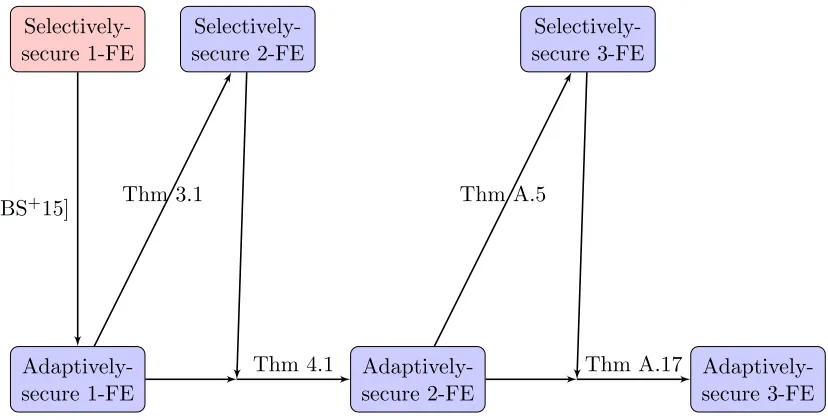
Step 4: Generalization tot-input schemes. The generalization of our result tot-input schemes, fort≥2, consists of two components. The first component is a construction that uses any (t− 1)-input scheme for building a selectively-securet-input scheme, for anyt≥2. The second component is a construction that uses any selectively-secure t-input scheme and a fully-secure (t−1)-input scheme for building a fully-securet-input scheme. Thus, for obtaining a fully-secure t-input scheme from any single-input scheme, one can iteratively apply both components alternatelyt times. This is illustrated in Figure 1 for the caset= 3 (and the same illustration generalizes to any t >3 in a straightforward manner).
Selectively-secure 1-FE
Adaptively-secure 1-FE
Selectively-secure 2-FE
Adaptively-secure 2-FE
Selectively-secure 3-FE
Adaptively-secure 3-FE [ABS+15] Thm 3.1
Thm 4.1 Thm A.17
Thm A.5
Figure 1: An illustration of the required iterative applications of our two transformations for obtaining an adaptively-secure three-input scheme based on any selectively-secure single-input scheme.
1.4 Paper Organization
The remainder of this paper is organized as follows. In Section 2 we provide an overview of the notation, definitions, and tools underlying our constructions. In Section 3 we present a construction of a selectively-secure two-input functional encryption scheme from any single-input scheme. In Section 4 we present a construction of a fully-secure two-input functional encryption scheme from any selectively-secure one. In Appendix A we generalize our approach tot-input schemes for t≥2, and in Appendix B we provide the formal proofs of our claims from Sections 3 and 4.
2 Preliminaries
In this section we present the notation and basic definitions that are used in this work. For a distribution X we denote by x ← X the process of sampling a value x from the distribution X. Similarly, for a set X we denote by x ← X the process of sampling a value x from the uniform distribution overX. For a randomized function f and an inputx∈ X, we denote by y←f(x) the process of sampling a value y from the distribution f(x). For an integer n ∈ N we denote by [n] the set {1, . . . , n}. A function neg:N→ R is negligible if for every constant c > 0 there exists an
integerNc such thatneg(λ)< λ−c for allλ > Nc.
Two sequences of random variables X={Xλ}λ∈Nand Y ={Yλ}λ∈N arecomputationally
indis-tinguishable if for any probabilistic polynomial-time algorithmA there exists a negligible function
neg(·) such that Pr[A(1λ, Xλ) = 1]−Pr[A(1λ, Yλ) = 1]
≤ neg(λ) for all sufficiently large λ ∈ N.
Throughout the paper, we denote byλthe security parameter.
2.1 Pseudorandom Functions
Let{Kλ,Xλ,Yλ}λ∈Nbe a sequence of sets and let PRF= (PRF.Gen,PRF.Eval) be a function family with the following syntax:
• PRF.Evalis a deterministic polynomial-time algorithm that takes as input a key K ∈ Kλ and a value x∈ Xλ, and outputs a value y∈ Yλ.
The sets Kλ, Xλ, and Yλ are referred to as the key space, domain, and range of the function
family, respectively. For easy of notation we may denote by PRF.EvalK(·) orPRFK(·) the function
PRF.Eval(K,·) for K ∈ Kλ. The following is the standard definition of a pseudorandom function family.
Definition 2.1 (Pseudorandomness). A function family PRF= (PRF.Gen,PRF.Eval) is pseudoran-dom if for every probabilistic polynomial-time algorithm A there exits a negligible function neg(·) such that
AdvPRF,A(λ)
def =
Pr
K←PRF.Gen(1λ) h
APRF.EvalK(·)(1λ) = 1 i
− Pr
f←Fλ h
Af(·)(1λ) = 1
i
≤neg(λ),
for all sufficiently large λ∈N, whereFλ is the set of all functions that map Xλ intoYλ.
In addition to the standard notion of a pseudorandom function family, we rely on the seem-ingly stronger (yet existentially equivalent) notion of a puncturable pseudorandom function family [KPT+13, BW13, SW14, BGI14]. In terms of syntax, this notion asks for an additional probabilistic polynomial-time algorithm,PRF.Punc, that takes as input a keyK ∈ Kλ and a setS ⊆ Xλ and out-puts a “punctured” key KS. The properties required by such a puncturing algorithm are captured
by the following definition.
Definition 2.2 (Puncturable PRF). A pseudorandom function familyPRF= (PRF.Gen,PRF.Eval, PRF.Punc) is puncturableif the following properties are satisfied:
1. Functionality: For all sufficiently largeλ∈N, for every setS ⊆ Xλ, and for everyx∈ Xλ\S
it holds that
Pr
K←PRF.Gen(1λ);
KS←PRF.Punc(K,S)
[PRF.EvalK(x) =PRF.EvalKS(x)] = 1.
2. Pseudorandomness at punctured points: Let A = (A1,A2) be any probabilistic poly-nomial-time algorithm such that A1(1λ) outputs a set S ⊆ Xλ, a value x ∈ S, and state
information state. Then, for any suchAthere exists a negligible function neg(·) such that
AdvPRF,A(λ)
def
= |Pr [A2(KS,PRF.EvalK(x),state) = 1]−Pr [A2(KS, y,state) = 1]| ≤neg(λ)
for all sufficiently large λ ∈ N, where (S, x,state) ← A1(1λ), K ← PRF.Gen(1λ), KS =
PRF.Punc(K, S), andy ← Yλ.
For our constructions we rely on pseudorandom functions that need to be punctured only at one point (i.e., in both parts of Definition 2.2 it holds that S = {x} for some x ∈ Xλ). As observed by [KPT+13, BW13, SW14, BGI14] the GGM construction [GGM86] of PRFs from any one-way function can be easily altered to yield such a puncturable pseudorandom function family.
2.2 Private-Key Single-Input Functional Encryption
parameterλ∈Nand outputs a master-secret keymsk. The key-generation algorithmFE.KGtakes as input a master-secret keymskand a single-input functionf ∈ Fλ, and outputs a functional keyskf.
The encryption algorithmFE.Etakes as input a master-secret key msk and a message x∈ Xλ, and
outputs a ciphertext ct. In terms of correctness we require that for all sufficiently largeλ∈N, for every functionf ∈ Fλ and message x∈ Xλ it holds thatFE.D(FE.KG(msk, f),FE.E(msk, x)) =f(x) with all but a negligible probability over the internal randomness of the algorithms FE.S, FE.KG, and FE.E.
In terms of security, we rely on the private-key variant of the existing indistinguishability-based notions for message privacy and function privacy. In fact, following [AAB+13, BS15], our notion of security combines both message privacy and function privacy. When formalizing this notion it would be convenient to use the following standard notion of aleft-or-right oracle.
Definition 2.3 (Left-or-right oracle). Let O(·,·) be a probabilistic two-input functionality. For each b∈ {0,1}we denote byOb the probabilistic three-input functionalityOb(k, z0, z1)
def
= O(k, zb).
Intuitively, a private-key functional-encryption scheme is secure if encryptions of messages x1,
. . . , xT together with functional keys corresponding to functions f1, . . . , fT reveal essentially no
information other than the values {fi(xj)}i,j∈[T]. We consider an adaptive notion of security, to which we refer to as full security, in which adversaries are given adaptive access to left-or-right encryption and key-generation oracles.
Definition 2.4 (Full security [AAB+13, BS15]). A private-key single-input functional encryption scheme FE = (FE.S,FE.KG,FE.E,FE.D) over a message space X = {Xλ}λ∈N and a function space
F = {Fλ}λ∈N is fully secure if for any probabilistic polynomial-time adversary A there exists a negligible function neg(·) such that
Advfull1FEFE,A,F(λ) def=
Pr
h
AKG0(msk,·,·),Enc0(msk,·,·)(1λ) = 1i−PrhAKG1(msk,·,·),Enc1(msk,·,·)(1λ) = 1i
≤ neg(λ)
for all sufficiently large λ ∈ N, where for every (f0, f1) ∈ Fλ × Fλ and (x0, x1) ∈ Xλ × Xλ with
which A queries the left-or-right key-generation and encryption oracles, respectively, it holds that
f0(x0) = f1(x1). Moreover, the probability is taken over the choice of msk ← FE.S(1λ) and the internal randomness ofA.
Known constructions. Private-key single-input functional encryption schemes that satisfy the above notion of full security and support circuits of any a-priori bounded polynomial size are known to exist based on a variety of assumptions.
Ananth et al. [ABS+15] gave a generic transformation from message (or selective-function) security to full security. Moreover, Brakerski and Segev [BS15] showed how to transform any message-private functional encryption scheme into a functional encryption scheme which is fully secure, and the resulting scheme inherits the security guarantees of the original one. Therefore, based on [ABS+15, BS15], given any selective-message (or selective-function) message-private func-tional encryption scheme we can generically obtain a fully-secure scheme. This implies that schemes that are fully secure for any number of encryption and key-generation queries can be based on indistinguishability obfuscation [GGH+13, Wat15], differing-input obfuscation [BCP14, ABG+13], and multilinear maps [GGH+16]. In addition, schemes that are fully secure for a bounded number
(where the length of ciphertexts grows with T and with an upper bound on the circuit size of the functions) [GVW12], and even based on one-way functions (for T = 1) [GVW12].
2.3 Private-Key Two-Input Functional Encryption
In this section we define the functionality and security of private-keytwo-inputfunctional encryption scheme (we refer the reader to Appendix A.1 for the generalization tot-input schemes for anyt≥2). LetX ={Xλ}λ∈N,Y ={Yλ}λ∈N, andZ={Zλ}λ∈Nbe ensembles of finite sets, and letF ={Fλ}λ∈N be an ensemble of finite two-ary function families. For each λ∈N, each functionf ∈ Fλ takes as input two strings, x∈ Xλ and y ∈ Yλ, and outputs a value f(x, y) ∈ Zλ. A private-key two-input
functional encryption scheme Π forF consists of four probabilistic polynomial time algorithmSetup,
Enc,KG and Dec, described as follows.
• Setup(1λ) – The setup algorithm takes as input the security parameterλ, and outputs a master secret keymsk.
• Enc(msk, m,i) – The encryption algorithm takes as input a master secret key msk, message input m, and an index i ∈ [2], where m ∈ Xλ if i = 1 and m ∈ Yλ if i = 2. It outputs a ciphertext cti.
• KG(msk, f) – The key-generation algorithm takes as input a master secret key msk and a functionf ∈ Fλ, and outputs a functional key skf.
• Dec(skf,ct1,ct2) – The (deterministic) decryption algorithm takes as input a functional key
skf and two ciphertexts ct1 and ct2, and outputs a stringz∈ Zλ∪ {⊥}.
Definition 2.5 (Correctness). A private-key two-input functional encryption scheme Π = (Setup, Enc,KG,Dec) for F is correct if there exists a negligible function neg(·) such that for every λ∈N, for everyf ∈ Fλ, and for every (x, y)∈ Xλ× Yλ, it holds that
Pr
Dec(skf,Enc(msk, x,1),Enc(msk, y,2)) =f(x, y)
≥1−neg(λ),
where msk←Setup(1λ), sk
f ←KG(msk, f), and the probability is taken over the internal
random-ness ofSetup,Enc and KG.
Intuitively, we say that a two-input scheme is secure if for any two pairs of messages (x0, x1) and (y0, y1) that are encrypted with respect to indices i = 1 and i= 2, respectively, and for every pair of functions (f0, f1), the triplets (skf0,Enc(msk, x0,1),Enc(msk, y0,2)) and (skf1,Enc(msk, x1,1),
Enc(msk, y1,2)) are computationally indistinguishable as long as f0(x0, y0) = f1(x1, y1) (note that this considers both message privacy and function privacy). The formal notions of security build upon this intuition and capture the fact that an adversary may in fact hold many functional keys and ciphertexts, and may combine them in an arbitrary manner. As in the case of single-input schemes, we formalize our notions of security using left-right key-generation and encryption or-acles. Specifically, for each b ∈ {0,1} and i ∈ {1,2} we let KGb(msk, f0, f1) def= KG(msk, fb) and
Encb(msk,(m0, m1),i)
def
= Enc(msk, mb,i). Before formalizing our notions of security we define the
notion of avalid two-input adversary.
Definition 2.6(Valid two-input adversary). A probabilistic polynomial-time algorithmAis avalid two-input adversary if for all private-key two-input functional encryption schemes Π = (Setup,KG, Enc,Dec) over a message spaceX × Y ={Xλ}λ∈N× {Yλ}λ∈Nand a function spaceF ={Fλ}λ∈N, for allλ∈Nandb∈ {0,1}, and for all (f0, f1)∈ Fλ, ((x0, x1),1)∈ Xλ×Xλ×{1}and ((y0, y1),1)∈ Yλ×
We consider two notions of security for two-input functional encryption schemes, both of which combine message privacy and function privacy. The first notion,full security, considers adversaries that have adaptive access to both the encryption oracle and the key-generation oracle. The second notion, selective-message security, considers adversaries that must specify all of their encryption queries in advance, but can then have adaptive access to the key-generation oracle. Full security clearly implies selective-message security, and our work shows that the two notions are in fact equivalent for multi-input schemes.
Definition 2.7 (Full security). A private-key two-input functional encryption scheme Π = (Setup, KG,Enc,Dec) over a message spaceX × Y ={Xλ}λ∈N× {Yλ}λ∈Nand a function spaceF ={Fλ}λ∈N is fully secure if for any valid two-input adversary A there exists a negligible function neg(·) such that
Advfull2FEΠ,F,A def=
PrhExpfull2FEΠ,F,A(λ) = 1i−1
2
≤neg(λ),
for all sufficiently large λ∈N, where the random variable Expfull2FEΠ,F,A(λ) is defined via the following experiment:
1. msk←Setup(1λ), b← {0,1}. 2. b0 ← AKGb(msk,·,·),Encb(msk,(·,·),·) 1λ,.
3. Ifb0 =b then output 1, and otherwise output 0.
Definition 2.8(Selective-message security). A private-key two-input functional encryption scheme Π = (Setup,KG,Enc,Dec) over a message spaceX × Y ={Xλ}λ∈N× {Yλ}λ∈N and a function space
F = {Fλ}λ∈N is selective-message secure if for any valid two-input adversary A = (A1,A2) there exists a negligible function neg(λ) such that
Advsel2FEΠ,F,A def
=
Pr
h
Expsel2FEΠ,F,A(λ) = 1
i −1
2
≤neg(λ),
for all sufficiently largeλ∈N, where the random variable Expsel2FEΠ,F,A(λ) is defined via the following experiment:
1. (~x, ~y,state)← A1 1λ, where~x= ((x01, x11), . . . ,(x0T, x1T)) and~y= ((y10, y11), . . . ,(yT0, yT1)). 2. msk←Setup(1λ), b← {0,1}.
3. ct1,i ←Enc(msk, xbi,1) and ct2,i←Enc(msk, ybi,2) fori∈[T].
4. b0 ← AKGb(msk,·,·)
2 1λ,ct1,1, . . . ,ct1,T,ct2,1. . . ,ct2,T,state
. 5. Ifb0 =b then output 1, and otherwise output 0.
Our definitions of a two-input functional encryption scheme is inspired by the definition of [BLR+15]. It is a natural generalization of the single-input case and gives rise to an order-revealing encryption. Moreover, as a concrete motivation, at-input scheme according to the above definition is enough to construct indistinguishability obfuscation for circuits witht input bits [GGG+14].8
Additional natural ways to define two-input functional encryptions schemes exist. Specifically, Goldwasser et al. [GGG+14] considered two such definitions. The first allows to encrypt a message
m independently of an index i∈[2]. Thus, given a key for a two-input functionf and encryptions of two messages x and of y, one can compute both f(x, y) and f(y, x). Hence, this definition
8Indeed, [AJ15] get a construction of at-input scheme for anyt≥1 which implies an indistinguishability obfuscator.
requires a stronger “validity requirement” (see Definition 2.6), which means it can support less functionalities. A construction which satisfies our (indexed) definition can be easily transformed into one which satisfies the above (non-indexed) definition by encrypting each message with respect to both indices.
The second, referred to as “multi-client”, considers each index as a different “client” and gives each of them his own secret key. In this setting, their security game is quite different, and in particular, an adversary is allowed to obtain the secret keys of a subset of the clients of his choice. The approach underlying our schemes does not seem to directly extend to the multi-client setting, and we leave it as an interesting path for future exploration.
3 A Selectively-Secure Two-Input Scheme from any Single-Input Scheme
In this section we construct a private-key two-input functional encryption scheme that is selectively secure. Let F ={Fλ}λ∈N be a family of two-ary functionalities, where for every λ∈N the setFλ
consists of functions of the formf :Xλ× Yλ → Zλ. Our construction relies on the following building blocks:
1. A private-key single-input functional encryption scheme1FE= (1FE.S,1FE.KG,1FE.E,1FE.D). 2. A pseudorandom function familyPRF= (PRF.Gen,PRF.Eval).
As discussed in Section 1.1, we assume that the scheme1FEis sufficiently expressive in the sense that 1FE supports the function family F (when viewed as a family of single-input functions), the evaluation procedure of the pseudorandom function familyPRF, the encryption and key-generation procedures of the private-key functional encryption scheme1FE, and a few additional basic opera-tions. Our scheme2FEsel= (2FEsel.S,2FEsel.KG,2FEsel.E,2FEsel.D) is defined as follows.
• The setup algorithm. On input the security parameter 1λ the setup algorithm 2FEsel.S
samplesmskout,mskin←1FE.S(1λ) and outputs msk= (mskout,mskin).
• The key-generation algorithm. On input the master secret keymskand a functionf ∈ Fλ, the key-generation algorithm2FEsel.KGsamples a random string z← {0,1}λ and outputs sk
f
←1FE.KG(mskout, Df,⊥,z,⊥), whereDf,⊥,z,⊥is a single-input function that is defined in Figure 1.
Df0,f1,z,u((msk
?, K, w)):
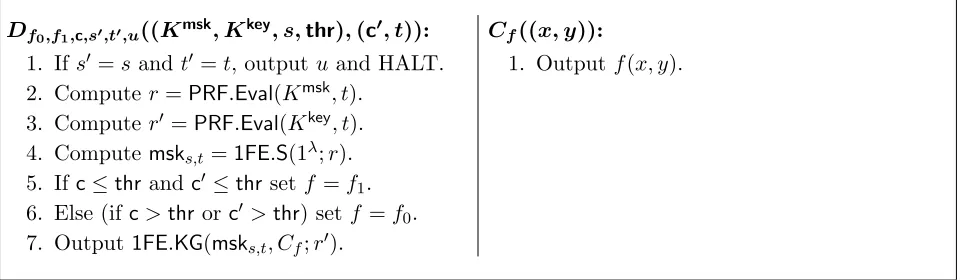
1. Ifmsk?=⊥, output u and HALT. 2. Compute r=PRF.Eval(K, z). 3. Output1FE.KG(msk?, Cfw;r).
Cf((x, y)):
1. Outputf(x, y).
Figure 1: The single-input functionsDf0,f1,z,u andCf.
• The encryption algorithm. On input the master secret keymsk, a messagemand an index
i∈[2], the encryption algorithm2FEsel.E has two cases:
– If (m,i) = (x,1), it samples a master secret key msk? ← 1FE.S(1λ), a PRF key K ← PRF.Gen(1λ), and a random string s∈ {0,1}λ, and then outputs a pair (ct
1,sk1) defined as follows:
ct1 ← 1FE.E(mskout,(msk?, K,0))
sk1 ← 1FE.KG(mskin,AGGx,⊥,0,s,msk?,K),
– If (m,i) = (y,2), it samples a random stringt∈ {0,1}λ, and outputs
ct2←1FE.E(mskin,(y,⊥, t,⊥,⊥)).
AGGx0,x1,a,s,msk?,K((y0, y1, t, s
0, v)):
1. Ifs0 =soutput v and HALT. 2. Compute r=PRF.Eval(K, t). 3. Output1FE.E(msk?,(xa, ya);r).
Figure 2: The single-input functionAGGx0,x1,a,s,msk?,K.
• The decryption algorithm. On input a functional keyskf and two ciphertexts, (ct1,sk1) and
ct2, the decryption algorithm 2FEsel.D computes ct0 = 1FE.D(sk1,ct2), sk0 = 1FE.D(skf,ct1) and outputs 1FE.D(sk0,ct0).
The correctness of the above scheme with respect to any family of two-ary functionalities follows in a straightforward manner from the correctness of the underlying functional encryption scheme
1FE. Specifically, consider any pair of messages x and y and any function f. The encryption of x
with respect to the index i =1 and the encryption of y with respect to the index i = 2 result in ciphertexts (ct1,sk1) and ct2, respectively. Using the correctness of the scheme 1FE, by executing
1FE.D(sk1,ct2) we obtain an encryption ct0 of the message (x, y) under the key msk?. In addition, by executing 1FE.D(skf,ct1) we obtain a functional keysk0 forCf under the keymsk?. Therefore,
executing1FE.D(sk0,ct0) outputs the value Cf((x, y)) =f(x, y) as required.
The following theorem captures the security of the scheme, stating that under suitable assump-tions on the underlying building blocks, the two-input scheme2FEselis selective-message secure (see Definition 2.8).
Theorem 3.1. Assuming that (1) 1FE is fully secure, and (2) PRF is a pseudorandom function family, then 2FEsel is selective-message secure.
We note that for proving that 2FEsel is message secure it suffices to require selective-message security from1FE. However, given the generic transformations of Ananth et al. [ABS+15] (from selective security to adaptive security) and of Brakerski and Segev [BS15] (from message security to full security), for simplifying the proof of Theorem 3.1 we assume that1FEis fully secure. In addition, when assuming that 1FE is fully secure, the scheme 2FEsel can be shown to satisfy a notion of security that seems in between selective-message security and full security. Specifically, this notion considers adversaries that first have adaptive access to encryptions only for the first coordinate, and then have adaptive access to encryptions only for the second coordinate (while having adaptive access to the key-generation oracle throughout the experiment). However, given our generic transformation from selective-message security to full security for multi-input schemes (see Section 4), for simplifying the proof of Theorem 3.1 we focus on proving selective-message security.
In addition, for concreteness we focus on the unbounded case where the underlying scheme supports an unbounded (i.e., not fixed in advance) number of key-generation queries and encryption queries. More generally, the proof of Theorem 3.1 shows that if the scheme corresponding to mskout supports T1 encryption queries and T2 key-generation queries, the scheme corresponding to mskin supportsT3encryption queries andT4key-generation queries, and the scheme corresponding to each
supports min{T1, T4, T5} encryption queries with respect to index i = 1, min{T3, T5} encryption queries with respect to indexi= 2 and min{T2, T6} key-generation queries. When the polynomials
T1, . . . , T6 are known in advance (i.e., do not depend on the adversary), such schemes are known to exist based on the LWE assumption or even only one-way functions (see Section 2.2 for a more elaborated discussion of the existing schemes).
Proof of Theorem 3.1. Let A = (A1,A2) be a valid adversary that issues at most T1 = T1(λ) encryption queries with respect to index i= 1, at most T2 =T2(λ) encryption queries with respect to indexi= 2, and at mostT3=T3(λ) key-generation queries (note thatT1,T2, andT3 may be any polynomials and are not fixed in advance). We assume for simplicity and without loss of generality thatT1 =T2 =T3
def = T.
We present a sequence of experiments and upper boundA’s advantage in distinguishing each two consecutive experiments. The first experiment is the experimentExpsel2FE2FEsel,F,A(λ) (see Definition 2.8), and the last experiment is completely independent of the bitb. This enables us to prove that there exists a negligible function neg(·) such that
Advsel2FE2FEsel,F,A(λ) def
=
PrhExpsel2FE2FEsel,F,A(λ) = 1
i −1
2
≤neg(λ)
for all sufficiently large λ∈ N. In what follows we first describe the notation used throughout the
proof, and then describe the experiments.
Notation. We denote the ith ciphertext with respect toi= 1 by (sk1,i,ct1,i) and theith ciphertext
with respect to i = 2 by ct2,i. We denote the ith input pair corresponding to the index i = 1 by
(x0i, x1i), the random strings used for generating the resultingsk1,i bysi, the master secret key and
the PRF key used for generating the resulting ct1,i and sk1,i by msk?i and Ki, respectively. We
denote the ith input pair corresponding to the index i= 2 by (y0
i, yi1), and the randomness used for
generating the resulting ct2,i by ti. Finally, we denote by (f10, f11), . . . ,(fT0, fT1) the function pairs
with which the adversary queries the key-generation oracle and by z1, . . . , zT the corresponding
random strings used for generatingskf1, . . . ,skfT.
For ease of following the proof, we give an outline of the sequence of experiments. By ∼ we donote computational indistinguishability and by≡ we denote equivalence.
H(0)(λ)∼ H(1)(λ)∼ H(2)(λ)≡
H(3,1)(λ)∼ H(4,1)(λ)∼ H(5,1)(λ)∼. . .∼ H(9,1)(λ)∼ H(10,1)(λ)≡ H(3,2)(λ)∼ H(4,2)(λ)∼ H(5,2)(λ)∼. . .∼ H(9,2)(λ)∼ H(10,2)(λ)≡
. . .
H(3,T)(λ)∼ H(4,T)(λ)∼ H(5,T)(λ)∼. . .∼ H(9,T)(λ)∼ H(10,T)(λ)≡ H(3,T+1)(λ)∼ H(11)(λ)∼ H(12)(λ).
Experiment H(0)(λ). This is the original experiment corresponding to b ← {0,1} chosen
uni-formly at random, namely, Expsel2FE2FEsel,F,A(λ). In this experiment the encryptions are generated as follows.
• Ciphertexts (i= 1, . . . , T):
ct1,i ← 1FE.E(mskout,(msk?i, Ki,0))
sk1,i ← 1FE.KG(mskin,AGGxb
• Functional keys (i= 1, . . . , T):
skfi ←1FE.KG(mskout, Dfb i,⊥,zi,⊥)
Experiment H(1)(λ). This experiment is obtained from the experimentH(0)(λ) by modifying the encryptions as follows. Given inputs (x0i, x1i) and (yi0, y1i), instead of setting the field x1 and y1 to be⊥we set it to be x1i andyi1, respectively. The scheme has the following form:
• Ciphertexts (i= 1, . . . , T):
ct1,i ← 1FE.E(mskout,(msk?i, Ki,0))
sk1,i ← 1FE.KG(mskin,AGG
xb i,x
1
i ,0,si,msk?i,Ki
)
ct2,i ← 1FE.E(mskin,(ybi, y1i , ti,⊥,⊥))
• Functional keys (i= 1, . . . , T):
skfi ←1FE.KG(mskout, Dfb i,⊥,zi,⊥)
Note that all the tokens that are issued as part of the encryption according toi= 1 are generated with a= 0 (where a is the third hardwired item). Thus, the circuit AGGx0,x1,a,s,msk?,K always sets
x=xbi and y=yib and ignoresx1i and yi1 (see Figure 2). Thus, the security the underlying scheme
1FE guarantees that the adversaryAhas only a negligible advantage in distinguishing experiments
H(0) and H(1). Specifically, let F0 denote the family of functions AGG
x0,x1,a,s,msk?,K (as defined in Figure 2). In Appendix B.1 we prove the following claim:
Claim 3.2. There exists a probabilistic polynomial-time adversary B(0)→(1) such that
Pr
h
H(0)(λ) = 1
i −Pr
h
H(1)(λ) = 1
i ≤Adv
full1FE
1FE,F0,B(0)→(1)(λ).
Experiment H(2)(λ). This experiment is obtained from the experimentH(1)(λ) by modifying the functional keys as follows. Given inputs (f0, f1), instead of setting the fields f1, f2 to be fb,⊥we set it to befb, f1. The scheme has the following form:
• Ciphertexts (i= 1, . . . , T):
ct1,i ← 1FE.E(mskout,(msk?i, Ki,0))
sk1,i ← 1FE.KG(mskin,AGGxb i,x
1
i,0,si,msk ? i,Ki) ct2,i ← 1FE.E(mskin,(yib, yi1, ti,⊥,⊥))
• Functional keys (i= 1, . . . , T):
skfi ←1FE.KG(mskout, D
fb i,f
1
i ,zi,⊥
)
Note that all the ciphertexts that are issued as part of the encryption according to i = 1 are generated with w = 0 (where w is the third hardwired item in ct1). Thus, the circuit Df0,f1,zi,u
always setsf =fiband ignoresfi1 (see Figure 1). Thus, the security the underlying scheme1FE(with respect tomskout) guarantees that the adversaryAhas only a negligible advantage in distinguishing experimentsH(1) and H(2). Specifically, letF00 denote the family of functionsD
f0,f1,zi,u (as defined
Claim 3.3. There exists a probabilistic polynomial-time adversary B(1)→(2) such that
Pr
h
H(1)(λ) = 1i−PrhH(2)(λ) = 1i ≤Adv
full1FE
1FE,F00,B(1)→(2)(λ).
Experiment H(3,j)(λ). This experiment is obtained from the experiment H(2)(λ) by modifying the encryptions as follows. The first j −1 ciphertexts are generated such that a = 1 and w = 1 while the rest of the encryptions are generated as before.
• Ciphertexts (i= 1, . . . , j−1):
ct1,i ← 1FE.E(mskout,(msk?i, Ki, 1 ))
sk1,i ← 1FE.KG(mskin,AGG
xb
i,x1i,1,si,msk?i,Ki
)
ct2,i ← 1FE.E(mskin,(yib, yi1, ti,⊥,⊥))
• Ciphertexts (i=j, . . . , T):
ct1,i ← 1FE.E(mskout,(msk?i, Ki,0))
sk1,i ← 1FE.KG(mskin,AGGxb
i,x1i,0,si,msk?i,Ki) ct2,i ← 1FE.E(mskin,(yib, yi1, ti,⊥,⊥))
• Functional keys (i= 1, . . . , T):
skfi ←1FE.KG(mskout, Dfib,fi1,zi,⊥)
Notice that H(3,1) =H(2).
Experiment H(4,j)(λ). This experiment is obtained from the experiment H(3,j)(λ) by modifying thejthciphertext tonot include the master secret keymsk?j and the PRF keyKj (that is, we replace
them with⊥’s). Moreover, for everyi∈[T] in theithciphertext corresponding toi= 2 we hardwire the pair (sj, γi), where γi =1FE.E(msk?j,(xbj, yib);PRF.Eval(Kj, ti)).
• Ciphertexts (i= 1, . . . , j−1):
ct1,i ← 1FE.E(mskout,(msk?i, Ki,1))
sk1,i ← 1FE.KG(mskin,AGGxb
i,x1i,1,si,msk?i,Ki) ct2,i ← 1FE.E(mskin,(yib, x1i, ti, sj, γi ))
γi =1FE.E(msk?j,(xjb, yib);PRF.Eval(Kj, ti))
• Ciphertext (i=j):
ct1,i ← 1FE.E(mskout,(msk?i, Ki,0))
sk1,i ← 1FE.KG(mskin,AGG
xb
i,x1i,0,si,⊥,⊥
)
ct2,i ← 1FE.E(mskin,(yib, yi1, ti, sj, γi ))
• Ciphertexts (i=j+ 1, . . . , T):
ct1,i ← 1FE.E(mskout,(msk?i, Ki,0))
sk1,i ← 1FE.KG(mskin,AGGxb
i,x1i,0,si,msk?i,Ki) ct2,i ← 1FE.E(mskin,(yib, yi1, ti, sj, γi ))
γi =1FE.E(msk?j,(xjb, yib);PRF.Eval(Kj, ti))
• Functional keys (i= 1, . . . , T):
skfi ←1FE.KG(mskout, Dfb
i,fi1,zi,⊥)
We observe that the only combinations that are affected by this change are combinations that include thejthciphertext corresponding toi= 1. However, using the hardwired valuesγi fori∈[T]
the functionalities stay the same. Thus, the security of the underlying 1FE scheme guarantees that the adversaryA has only a negligible advantage in distinguishing experimentsH(3,j) and H(4,j). In Appendix B.1 we prove the following claim:
Claim 3.4. There exists a probabilistic polynomial-time adversary B(3,j)→(4,j) such that
Pr
h
H(3,j)(λ) = 1i−PrhH(4,j)(λ) = 1i ≤Adv
full1FE
1FE,F0,B(3,j)→(4,j)(λ).
Experiment H(5,j)(λ). This experiment is obtained from the experiment H(4,j)(λ) by modifying the jth ciphertext as follows. We replace (msk?j, Kj,0) with (⊥,⊥,0). Moreover, in the ith
func-tional key corresponding to the functions (f0
i, fi1) we hardwire the value δi = 1FE.KG(msk?j, Cfb i; PRF.Eval(Kj, zi)).
• Ciphertexts (i= 1, . . . , j−1):
ct1,i ← 1FE.E(mskout,(msk?i, Ki,1))
sk1,i ← 1FE.KG(mskin,AGGxb
i,x1i,1,si,msk?i,Ki) ct2,i ← 1FE.E(mskin,(yib, yi1, ti, sj, γi))
γi =1FE.E(msk?j,(xjb, yib);PRF.Eval(Kj, ti))
• Ciphertext (i=j):
ct1,i ← 1FE.E(mskout,(⊥,⊥,0))
sk1,i ← 1FE.KG(mskin,AGGxb
i,x1i,0,si,⊥,⊥) ct2,i ← 1FE.E(mskin,(yib, yi1, ti, sj, γi))
γi =1FE.E(msk?j,(xjb, yib);PRF.Eval(Kj, ti))
• Ciphertexts (i=j+ 1, . . . , T):
ct1,i ← 1FE.E(mskout,(msk?i, Ki,0))
sk1,i ← 1FE.KG(mskin,AGGxb i,x
1
i,0,si,msk ? i,Ki) ct2,i ← 1FE.E(mskin,(yib, yi1, ti, sj, γi))
• Functional keys (i= 1, . . . , T):
skfi ←1FE.KG(mskout, D
fb
i,fi1,zi,δi
)
δi=1FE.KG(msk?j, Cfib;PRF.Eval(Kj, zi))
We observe that the only combinations that are affected by this change are combinations that include thejthciphertext corresponding toi= 1. However, using the hardwired valueδthe function-ality stays the same. Thus, the security of the underlying scheme1FEguarantees that the adversary
Ahas only a negligible advantage in distinguishing experiments H(4,j) and H(5,j). In Appendix B.1 we prove the following claim:
Claim 3.5. There exists a probabilistic polynomial-time adversary B(4,j)→(5,j) such that
Pr
h
H(4,j)(λ) = 1i−PrhH(5,j)(λ) = 1i ≤Adv
full1FE
1FE,F0,B(4,j)→(5,j)(λ).
Experiment H(6,j)(λ). This experiment is obtained from the experiment H(5,j)(λ) by modifying the hardwired valueγ1, . . . , γT andδ1, . . . , δT to use randomness sampled uniformly at random rather
than randomness generated using a PRF.
• Ciphertexts (i= 1, . . . , j−1):
ct1,i ← 1FE.E(mskout,(msk?i, Ki,1))
sk1,i ← 1FE.KG(mskin,AGGxb
i,x1i,1,si,msk?i,Ki) ct2,i ← 1FE.E(mskin,(yib, yi1, ti, sj, γi))
γi =1FE.E(mskj?,(xbj, ybi))
• Ciphertext (i=j):
ct1,i ← 1FE.E(mskout,(⊥,⊥,0))
sk1,i ← 1FE.KG(mskin,AGGxb
i,x1i,0,si,⊥,⊥) ct2,i ← 1FE.E(mskin,(yib, yi1, ti, sj, γi))
γi =1FE.E(mskj?,(xbj, ybi))
• Ciphertexts (i=j+ 1, . . . , T):
ct1,i ← 1FE.E(mskout,(msk?i, Ki,0))
sk1,i ← 1FE.KG(mskin,AGGxb i,x
1
i,0,si,msk ? i,Ki) ct2,i ← 1FE.E(mskin,(yib, yi1, ti, sj, γi))
γi =1FE.E(mskj?,(xbj, ybi))
• Functional keys (i= 1, . . . , T):
skfi ←1FE.KG(mskout, Dfb
i,fi1,zi,δi)
δi =1FE.KG(msk?j, Cfb i)
The pseudorandomness of PRF.Eval(Kj,·) guarantees that the adversaryAhas only a negligible
Claim 3.6. For every j∈[T]there exists a probabilistic polynomial-time adversary B(5,j)→(6,j) such
that
Pr
h
H(5,j)(λ) = 1i−PrhH(6,j)(λ) = 1i
≤AdvPRF,B(5,j)→(6,j)(λ).
Experiment H(7,j)(λ). This experiment is obtained from the experiment H(6,j)(λ) by modifying the ciphertext as follows. In theithciphertext corresponding toi= 2 we embed inγ
i the encryption
of (x1j, y1) rather than (xjb, yb). Moreover, we replace the circuit embedded inδi in theith functional
key to be Cf1
i rather than Cfib. • Ciphertexts (i= 1, . . . , j−1):
ct1,i ← 1FE.E(mskout,(msk?i, Ki,1))
sk1,i ← 1FE.KG(mskin,AGGxb
i,x1i,1,si,msk ? i,Ki) ct2,i ← 1FE.E(mskin,(yib, yi1, ti, sj, γi))
γi=1FE.E(mskj?, (x1j, yi1) )
• Ciphertext (i=j):
ct1,i ← 1FE.E(mskout,(⊥,⊥,0))
sk1,i ← 1FE.KG(mskin,AGGxb
i,x1i,0,si,⊥,⊥) ct2,i ← 1FE.E(mskin,(yib, yi1, ti, sj, γi))
γi =1FE.E(mskj?, (x1j, yi1) )
• Ciphertexts (i=j+ 1, . . . , T):
ct1,i ← 1FE.E(mskout,(msk?i, Ki,0))
sk1,i ← 1FE.KG(mskin,AGGxb
i,x1i,0,si,msk ? i,Ki) ct2,i ← 1FE.E(mskin,(yib, yi1, ti, sj, γi))
γi=1FE.E(mskj?, (x1j, yi1) )
• Functional keys (i= 1, . . . , T):
skfi ←1FE.KG(mskout, Dfb
i,fi1,zi,δi)
δi =1FE.KG(msk?j, Cf1
i )
The above change only affects evaluations that correspond to the combination of any ciphertext corresponding to i = 2 with the jth ciphertext corresponding to i = 1. Using the fact that the adversary is valid (see Definition 2.6), the functionality stays exactly the same. Thus, the security of the underlying scheme 1FE guarantees that the adversary A has only a negligible advantage in distinguishing experimentsH(6,j) and H(7,j). In Appendix B.1 we prove the following claim:
Claim 3.7. There exists a probabilistic polynomial-time adversary B(6,j)→(7,j) such that
Pr
h
H(6,j)(λ) = 1i−PrhH(7,j)(λ) = 1i ≤Adv
full1FE
Experiment H(8,j)(λ). This experiment is obtained from the experiment H(7,j)(λ) by modifying the hardwired values γ1, . . . , γT and δ1, . . . , δT to use randomness generated using a PRF rather
than randomness sampled uniformly at random.
• Ciphertexts (i= 1, . . . , j−1):
ct1,i ← 1FE.E(mskout,(msk?i, Ki,1))
sk1,i ← 1FE.KG(mskin,AGGxb
i,x1i,1,si,msk?i,Ki) ct2,i ← 1FE.E(mskin,(yib, yi1, ti, sj, γi))
γi =1FE.E(msk?j,(xj1, yi1);PRF.Eval(Kj, ti))
• Ciphertext (i=j):
ct1,i ← 1FE.E(mskout,(⊥,⊥,0))
sk1,i ← 1FE.KG(mskin,AGGxb
i,x1i,0,si,⊥,⊥) ct2,i ← 1FE.E(mskin,(yib, yi1, ti, sj, γi))
γi =1FE.E(msk?j,(xj1, yi1);PRF.Eval(Kj, ti))
• Ciphertexts (i=j+ 1, . . . , T):
ct1,i ← 1FE.E(mskout,(msk?i, Ki,0))
sk1,i ← 1FE.KG(mskin,AGGxb
i,x1i,0,si,msk?i,Ki) ct2,i ← 1FE.E(mskin,(yib, yi1, ti, sj, γi))
γi =1FE.E(msk?j,(xj1, yi1);PRF.Eval(Kj, ti))
• Functional keys (i= 1, . . . , T):
skfi ←1FE.KG(mskout, Dfb i,f
1
i,zi,δi)
δi =1FE.KG(msk?j, Cf1
i;PRF.Eval(Kj, zi))
The pseudorandomness of PRF.Eval(Kj,·) guarantees that the adversaryAhas only a negligible
advantage in distinguishing experiments H(7,j) and H(8,j). The proof of the following claim is analogous to the proof of Claim 3.6.
Claim 3.8. There exists a probabilistic polynomial-time adversary B(7,j)→(8,j) such that
Pr
h
H(7,j)(λ) = 1i−PrhH(8,j)(λ) = 1i
≤AdvPRF,B(7,j)→(8,j)(λ).
Experiment H(9,j)(λ). This experiment is obtained from the experiment H(8,j)(λ) by modifying thejth ciphertext to contain the pair (msk?j, Kj). Moreover, in the functional key corresponding to
the functionfi fori∈[T] we remove the hardwired value δi.
• Ciphertexts (i= 1, . . . , j−1):
ct1,i ← 1FE.E(mskout,(msk?i, Ki))
sk1,i ← 1FE.KG(mskin,AGGxb i,x
1
i,1,si,msk ? i,Ki) ct2,i ← 1FE.E(mskin,(yib, yi1, ti, sj, γi))
• Ciphertext (i=j):
ct1,i ← 1FE.E(mskout,(msk?i, Ki,1 ))
sk1,i ← 1FE.KG(mskin,AGGxb
i,x1i,0,si,⊥,⊥) ct2,i ← 1FE.E(mskin,(yib, yi1, ti, sj, γi))
γi=1FE.E(msk?j,(xj1, yi1);PRF.Eval(Kj, ti))
• Ciphertexts (i=j+ 1, . . . , T):
ct1,i ← 1FE.E(mskout,(msk?i, Ki))
sk1,i ← 1FE.KG(mskin,AGGxb
i,x1i,0,si,msk?i,Ki) ct2,i ← 1FE.E(mskin,(yib, yi1, ti, sj, γi))
γi=1FE.E(msk?j,(xj1, yi1);PRF.Eval(Kj, ti))
• Functional keys (i= 1, . . . , T):
skfi ←1FE.KG(mskout, D
fb
i,fi1,zi,⊥
)
We observe that the only combinations that are affected by this change are combinations that include the jth ciphertext corresponding to i = 1. However, using the fact that we replace (⊥,⊥) inct1,j with (msk?j, Kj) and remove the hardwired valuesδi the functionality stays the same. Thus,
the security of the underlying scheme 1FE guarantees that the adversary A has only a negligible advantage in distinguishing experiments H(8,j) and H(9,j). The proof of the following claim is analogous to the proof of Claim 3.5.
Claim 3.9. There exists a probabilistic polynomial-time adversary B(8,j)→(9,j) such that
Pr
h
H(8,j)(λ) = 1
i −Pr
h
H(9,j)(λ) = 1
i ≤Adv
full1FE
1FE,F0,B(8,j)→(9,j)(λ).
Experiment H(10,j)(λ). This experiment is obtained from the experimentH(9,j)(λ) by modifying the ciphertexts as follows. For the ith ciphertext corresponding to i = 2 we remove the hardwired pair (sj, γi). Moreover, we encrypt the jth ciphertext corresponding to i = 1 with 2 = 1. Notice
thatH(10,j) =H(3,j+1).
• Ciphertexts (i= 1, . . . , j ):
ct1,i ← 1FE.E(mskout,(msk?i, Ki,1))
sk1,i ← 1FE.KG(mskin,AGGxb
i,x1i,1,si,msk?i,Ki) ct2,i ← 1FE.E(mskin,(yib, yi1, ti, ⊥,⊥))
• Ciphertexts (i=j+ 1, . . . , T):
ct1,i ← 1FE.E(mskout,(msk?i, Ki,0))
sk1,i ← 1FE.KG(mskin,AGGxb
• Functional keys (i= 1, . . . , T):
skfi ←1FE.KG(mskout, Dfb
i,fi1,zi,⊥)
We observe that the only combinations that are affected by this change are combinations that include the jth ciphertext corresponding to i = 1. However, since the hardwired values γ
i fori ∈
[T]∪ {0}preserved the functionalities whena= 1 for thejth ciphertext, when we remove them and add backmsk?j andKj the functionalities stay the same. Thus, the security of the underlying scheme
1FE guarantees that the adversaryAhas only a negligible advantage in distinguishing experiments
H(9,j) and H(10,j). The proof of the following claim is analogous to the proof of Claim 3.4.
Claim 3.10. There exists a probabilistic polynomial-time adversary B(9,j)→(10,j) such that
Pr
h
H(9,j)(λ) = 1i−PrhH(10,j)(λ) = 1i ≤Adv
full1FE
1FE,F0,B(9,j)→(10,j)(λ).
ExperimentH(11)(λ). This experiment is obtained from the experimentH(3,T+1)(λ) by modifying the ciphertextsnot to include fib at all.
• Ciphertexts (i= 1, . . . , T):
ct1,i ← 1FE.E(mskout,(msk?i, Ki,1))
sk1,i ← 1FE.KG(mskin,AGGxb
i,x1i,1,si,msk?i,Ki) ct2,i ← 1FE.E(mskin,(yib, yi1, ti,⊥,⊥))
• Functional keys (i= 1, . . . , T):
skfi ←1FE.KG(mskout, D⊥
,f1
i,zi,⊥
)
We observe that at this point all ciphertext have w = 1. Therefore, the first parameter fib is always ignored and the functionalities stay the same. Thus, the security of the underlying1FEscheme guarantees that the adversary A has only a negligible advantage in distinguishing experiments
H(3,T+1) and H(11). The proof of the following claim is analogous to the proof of Claim 3.3.
Claim 3.11. There exists a probabilistic polynomial-time adversary B(3,T+1)→(11) such that
Pr
h
H(3,T+1)(λ) = 1i−PrhH(11)(λ) = 1i ≤Adv
full1FE
1FE,F0,B(3,T+1)→(11)(λ).
Experiment H(12)(λ). This experiment is obtained from the experiment H(11)(λ) by modifying the ciphertextsnot to includexbi andyibat all. Notice that this experiment is completely independent of the bitb, and therefore Pr[H(12)(λ) = 1] = 1/2.
• Ciphertexts (i= 1, . . . , T):
ct1,i ← 1FE.E(mskout,(msk?i, Ki,1))
sk1,i ← 1FE.KG(mskin,AGG⊥
,x1
i,1,si,msk?i,Ki
)