New Multilinear Maps over the Integers
Jean-S´ebastien Coron1, Tancr`ede Lepoint2, and Mehdi Tibouchi3
1 University of Luxembourg,[email protected] 2
CryptoExperts,[email protected] 3 NTT Secure Platform Laboratories,[email protected]
May 16, 2015
Abstract. In the last few years, cryptographic multilinear maps have proved their tremendous potential as building blocks for new constructions, in particular the first viable approach to general program obfuscation. After the first candidate construction by Garg, Gentry and Halevi (GGH) based on ideal lattices, a second construction over the integers was described by Coron, Lepoint and Tibouchi (CLT). However the CLT scheme was recently broken by Cheon et al.; the attack works by computing the eigenvalues of a diagonalizable matrix overQderived from the multilinear map.
In this paper we describe a new candidate multilinear map over the integers. Our construction is based on CLT but with a new arithmetic technique that makes the zero-testing element non-linear in the encoding, which prevents the Cheon et al. attack. Our new construction is relatively practical as its efficiency is comparable to the original CLT scheme. Moreover the subgroup membership and decisional linear assumptions appear to hold in the new setting.
1 Introduction
Multilinear maps. Since the breakthrough construction of Garg, Gentry and Halevi [GGH13a], there has been a growing interest in cryptographic multilinear maps. They have spurred scores of new cryptographic applications. Chiefly among them is possibly the first proposed approach to general program obfuscation [GGH+13b]. Currently only three candidate constructions are known. Shorty after the first candidate construction of multilinear maps based on ideal lattices [GGH13a] (which we will refer to as GGH), Coron, Lepoint and Tibouchi proposed a second construction over the integers (CLT) using the same general paradigm [CLT13]. Recently, Gentry, Gorbunov and Halevi proposed another multilinear maps in which the map is defined with respect to a directed acyclic graph [GGH14].
A straightforward application of multilinear maps is multipartite Diffie-Hellman key exchange with N =κ+ 1 users, where κ is the maximum level of the multilinear map scheme. Initially each user publishes a level-1 encoding of a random element while keeping a level-0 encoding of the same element private. Then each user can compute the product its level-0 by the product of the level-1 encodings of the other users. With N =κ+ 1 users this gives a level-κ encoding from which the same secret value can be extracted by all users. The security of the protocol relies on a new hardness assumption which is a natural extension of the Decisional Diffie-Hellman assumption.
The CLT multilinear map over the integers. We recall the multilinear maps scheme over the integers from [CLT13]. One generates nsecret primes pi and publishes x0 =Qni=1pi (where n is
large enough to ensure security); one also generates nsmall secret primesgi and a random secret
m= (mi)∈R is then an integerc such that for all 16i6n:
c≡ ri·gi+mi
zk (modpi) (1)
for some small random integers ri; the integer cis therefore defined modulo x0 by CRT. Encodings
can then be added and multiplied modulo x0, as long as the noise ri is such thatri·gi+mi< pfor
eachi. The multiplication of a level-iencoding by a level-j encoding gives an encoding at level i+j. For level-κ encodings one defines a zero-testing parameterpzt with:
pzt = n
X
i=1
hi· zκ·gi−1modpi
·x0 pi
modx0
for some small integers hi. Given a level-κ encoding c as in (1), as a zero-testing procedure one
computes ω=pzt·cmodx0 which gives:
ω=
n
X
i=1
hi· ri+mi·(g−i 1 modpi)
·x0 pi
modx0. (2)
Ifmi= 0 for all i, since theri’s andhi’s are small, we obtain thatω is small compared tox0; this
enables to test whetherc is an encoding of0 or not. Moreover for non-zero encodings the leading bits of ω only depend on the mi’s and not on the noise ri; for level-κ encodings this enables to
extract a function of themi’s only, which eventually defines a degree-κ multilinear map.
Cheon et al. attack. The CLT scheme above was completely broken by a recent attack from Cheon, Han Lee, Ryu and Stehl´e [CHL+14]; the attack runs in polynomial time, and recovers all secret parameters. The attack works by computing the eigenvalues of a diagonalizable matrix overQ
derived from the multilinear map. More precisely, when applying the zero-testing procedure to the product of two encodingsxandx0, wherex is an encoding of 0, the resultingωin (2) can be seen as a diagonal quadratic form over Zin the CRT componentsxmodpi andx0 modpi. By computing
the values ωjk of the quadratic form for n2 product pairs of encodings xj·x0k, one can then recover
the coefficients of the quadratic form using eigendecomposition, which reveals all the secret pi’s and
completely breaks the scheme. We recall the attack in more details in Section 3.
Tentative fixes. Shortly after Cheon et al. attack, two independent approaches to fix the CLT scheme have been proposed on the Cryptology ePrint Archive, due to Garg, Gentry, Halevi and Zhandry on the one hand [GGHZ14, Sec. 7]1, and Boneh, Wu and Zimmerman on the other [BWZ14]. However, both countermeasures were shown to be insecure in [CLT14]. Indeed, although these countermeasures do not expose encodings of zero, the value ω from the zero-testing procedure can still be expressed as a quadratic form in the CRT components of encodings. As a result, they can both be broken by a variant of the original Cheon et al. attack.
Our new construction. Our new construction keeps the same CLT encodings but departs from the two previous countermeasures by modifying the zero-testing procedure itself. Namely, we modify the definition of the zero-testing element pzt so that ω cannot be expressed as a quadratic form
1
anymore. For this we use a new arithmetic technique that maps the nCRT componentscmodpi to
some value modulo an independent integer N, so that the resultingω in the zero-testing procedure depends on the CRT components in a non-linear way, rather than linearly as in (2).
The technique works as follows. Consider a level-κencodingcas in (1); by the Chinese Remainder Theorem, we can write a relation of the form:
c=
n
X
i=1
ri+mi·(gi−1modpi)
·ui−a·x0 (3)
over Z for some a∈ Z, where the ui’s are the CRT coefficients corresponding to the primes pi’s,
and scaled by gi·z−κ for eachi. LetN be a large integer and let pzt ∈ZN. For the zero-testing
procedure we computeω =pzt·cmodN which gives from (3):
ω≡ n
X
i=1
ri+mi·(gi−1 modpi)
·vi−a·v0 (modN) (4)
where vi:=pzt·ui modN and v0 :=pzt·x0modN. Assume now that we can generate pzt and N
such that all the vi’s are small compared toN, includingv0. Now if mi = 0 for alli, since the ri’s
are small, the integerain (3) is also small, which implies thatω in (4) will also be small compared to N. This enables to test whether cis an encoding of 0 or not. As previously for level-κ encodings one can then extract a function of themi’s only, which gives a degree-κ multilinear map. We show
that such an elementpztcan be efficiently generated for any large enough N, owing to the particular
structure of the CRT coefficients ui.
Security analysis. By comparing equations (2) and (4), we see that the original CLT scheme is actually a particular case, withN =x0 andv0= 0. Therefore the main difference in the new scheme is thatv0 6= 0, which causes the valueω in (4) to depend on the integer ain (3). But that integera
depends on the CRT componentsri in a non-linear way. As a result, it is no longer true that the
valueω computed from encoding productsxj·x0k can be expressed as a quadratic form in the CRT
components of xj and x0k, and the Cheon et al. attack is thus thwarted.
Another difference with the original CLT scheme is that we cannot publishx0 =Qn
i=1pianymore.
Namely for encodings of 0 we get a smallω and therefore (4) holds over Z. Therefore fromx0 one
could compute v0 =pzt·x0 modN and apply the Cheon et al. attack modulo v0 instead of over Z. It is not a problem to keepx0 private, however, as we can mimic the technique introduced by
van Dijk et al. for their fully homomorphic encryption scheme over the integers [DGHV10] and approximate modular reduction byx0 with a ladder of encodings of zero of increasing sizes.
We provide a detailed security analysis of our new construction in Section 3 (for the Cheon et al. attack and its variants) and Section 4 (for lattice attacks). We also explain why the subgroup membership (SubM) and decisional linear (DLIN) problems, which are known to be easy in the GGH scheme [GGH13a], seem to be hard in our new setting.
Implementation. We describe an implementation of our scheme, with a few optimizations. Instead of using a ladder of encodings of 0 at every level, we publish a small multiple x00 of x0 so that
subset of the public elements needed for re-randomization and combine them pairwise to generate the full public parameters, as in [CLT13]; such an optimization was originally described in [GH11]. With these optimizations our scheme is relatively practical; for reasonable security parameters a multipartite Diffie-Hellman computation with 7 users requires about 30 seconds, with a public parameter size of roughly 6 GBytes; a proof-of-concept implementation is available at [Lep15].
2 New Multilinear Map over the Integers
In this section we define our new multilinear scheme. Our scheme is actually a graded encoding scheme (GES) as in previous works [GGH13a,CLT13]; we recall the notion of GES in Appendix A. As explained in introduction, our new multilinear map scheme keeps the same CLT encodings as given by (1), with two main differences:
1. The zero-testing parameter pzt is computed differently, so that the CRT components modulo pi
of a level-κ encodingc are mapped to some value modulo an independent integerN, instead of modulox0. The resultingωin the zero-testing procedure then depends on those CRT components
in a non-linear way, rather than linearly in the original CLT scheme, which prevents the Cheon et al. attack.
2. The integerx0=Qni=1pi is kept private. For re-randomization, this implies that we must slightly
modify the proof of statistical indistinguishability. To reduce the size of intermediate encodings back to the size of x0, we publish a ladder of encodings of 0. In Section 5 we describe a simple
optimization with a public multiple x00 ofx0.
2.1 Scheme Description
System parameters. The system parameters are similar to the original CLT scheme. One first defines the security parameterλand the required multilinearity level κ6poly(λ). Based on λand
κ, we choose:
• n: the vector dimension
• η: the bit-size of the primespi
• α: the bit-size of the primesgi
• ρ: the bit-size of the randomness used in encodings
and various other parameters that will be specified later. The constraints that these parameters must satisfy are described in Section 2.2. For integersz, pwe denote the reduction of zmodulop by (zmodp) or [z]p with −p/2<[z]p 6p/2. For integers x1, . . . , xn we denoteCRTp1,...,pn(x1, . . . , xn)
the unique integerx such that x≡xi modpi for all 16i6nand 06x <Qni=1pi.
As in the original CLT scheme a level-kencoding of a vectorm= (mi) is an integerc such that
for all 16i6n:
c≡ ri·gi+mi
zk (modpi) (5)
where the ri’s are ρ-bit random integers (specific to the encoding c), with the following secret
parameters: thepi’s are random η-bit prime integers, the gi’s are random α-bit primes, and the
denominator z is a random (invertible) integer modulo x0 = Qn
i=1pi. The integer c is therefore
defined by CRT modulox0, but as opposed to the original CLT scheme, x0 is kept secret. We denote
byγ the size of x0 in bits. As in the CLT scheme the domain is the ringR=Zg1 × · · · ×Zgn, so
Instance generation: (pp,pzt)←instGen(1λ,1κ). Instance generation is similar to [CLT13], except
for the generation of pzt; moreoverx0 is kept private. We generate nsecret random η-bit primes pi and computex0=Qni=1pi. We generate a random invertible integerz modulo x0. We generate nrandom α-bit prime integers gi, and various other parameters that will be specified later. We
publish the parameters (pp,pzt) with
pp=n, η, α, ρ, β, τ, `, µ, y,{x0j}` j=1,{X
(j)
i },{xj}τj=1,{Πj}nj=1+1, s
.
Sampling level-zero encodings: c←samp(pp). Since the primes pi’s in (5) must remain secret,
the user cannot encode a vectorm∈R by CRT directly from (5). Instead, as in [CLT13], a level-0 encoding c is generated as a random subset sum of random level-0 encodings x0j from the public parameters. The only difference with [CLT13] is that the random subset-sum is computed overZ
instead of modulo x0, sincex0 is not public.
Therefore we publish as part as our instance generation a set of ` integers x0j, where each x0j
encodes at level-0 the column vector aj ∈ Zn of a secret matrix A = (aij) ∈ Zn×`, where each
componentaij is randomly generated in [0, gi)∩Z. More precisely, using the CRT modulox0 we
generate integersx0j such that:
16j6`, x0j ≡rij0 ·gi+aij (modpi) (6)
where the rij0 ’s are randomly generated in (−2ρ,2ρ)∩Z.
To generate a level-0 encoding c, we first generate a random binary vectorb= (bj) ∈ {0,1}`
and output the level-0 encoding
c=
`
X
j=1
bj ·x0j.
From (6), this givesc≡(P`
j=1r
0
ijbj)·gi+P`j=1aijbj (modpi); as required the output cis a level-0
encoding:
c≡ri·gi+mi (modpi) (7)
of some vectorm=A·b∈R which is a random subset-sum of the column vectorsaj. We note
that for such level-0 encodings we get|ri·gi+mi|6`·2ρ+α for alli. As in [CLT13] by applying
the leftover hash lemma overR =Zg1 × · · · ×Zgn the distribution ofmcan be made statistically
close to uniform over R.
Lemma 1 ([CLT13]).Letc←samp(pp)and writec≡ri·gi+mi (mod pi). Assume`>n·α+ 2λ.
The distribution of (pp,m) is statistically close to the distribution of (pp,m0) where m0 ←R.
As opposed to [CLT13] we cannot reduce cmodulox0; we only have the upper-bound |c|6`·2γ, where γ is the size of x0 in bits. In Appendix F, we show that instead of random sampling one can
also publicly encode elements from the domainR, using a technique described in [BWZ14].
Encoding at higher levels: ck←enc(pp, k, c). As in [CLT13], to allow encoding at higher levels,
we publish as part of our instance-generation a level-one random encoding of 1, namely an integery
such that:
y≡ ri·gi+ 1
for random ri ∈(−2ρ,2ρ)∩Z; as previously the integery is computed by CRT modulox0. Given a
level-0 encodingcofm∈R as given by (7), we can then compute a level-1 encoding of the samem
by computing over Z:
c1 =c·y.
Namely we obtain as required:
c1 ≡
ri0·gi+mi
z (modpi)
for some integers r0i. From|c|6`·2γ, we obtain|c
1|6`·22γ.
The difference with [CLT13] is that we cannot reduce c1 modulo x0. Instead we provide a
ladder of level-1 encodings of zeroXi(1) of increasing size, so that the size of a level-1 encoding can be progressively reduced down to the size of x0, as in the DGHV scheme [DGHV10, Sec. 3.3.1]. Specifically, for j= 0, . . . , γ+blog2`c, we set:
Xj(1) =CRTp1,...,pn([r1j ·g1/z]p1, . . . ,[rnj·gn/z]pn) +qi·x0
where rij ←(−2ρ,2ρ)∩Z andqi←[2γ+i−1/x0,2γ+i/x0)∩Z.
We can then iteratively reduce the size of c1 down to the size of x0, first by X (1)
γ+blog2`c and
eventually byX0(1). Since the size reduction is done bit-by-bit, at each step some integerbj ·Xj(1) is
subtracted fromc1, for bj ∈ {0,1}. Therefore the noise increases additively by at most (γ+blog2`c+
1)·2ρin absolute value. After reduction, the resulting encoding ˆc1 will be such that
ˆ
c1 ≡(ˆri·gi+mi)/z (modpi), (8)
with |rˆi·gi+mi|6`·2ρ+α·2ρ+α+ (γ+blog2`c+ 1)·2ρ62`·22ρ+2α for alli.
More generally to generate a level-kencoding we computeck =c0·yk, and the size of ck can
be iteratively reduced after each multiplication by y using ladders of similarly designed level-j
encodings{Xi(j)}γ+blog2`c
i=0 for levels j= 1, . . . , k.
Re-randomization: c0←reRand(pp, k,ˆck). Our re-randomization procedure is similar to [CLT13]
except that again we cannot reduce the encodings modulox0. We describe the re-randomization
of encodings at levelk= 1; the procedure can be easily adapted to randomize at level k >1. We publish as part of our instance-generation a set ofn+ 1 integersΠj:
16j 6n+ 1, Πj = n
X
i=1
$ij·gi·ui+$n+1,j·x0
where the ui’s are appropriate CRT coefficients so that the Πj’s are all level-1 random encodings of
zero:
16j6n+ 1, Πj ≡
$ij·gi
z (mod pi).
Namely, we let for all 16i6n:
ui := z−1·
x0 pi
−1
modpi
!
·x0 pi
The matrix Π = ($ij)∈Z(n+1)×(n+1) is a diagonally dominant matrix generated as follows: the
non-diagonal entries are randomly and independently generated in (−2ρ,2ρ)∩
Z, while the diagonal
entries are randomly generated in ((n+ 1)2ρ,(n+ 2)2ρ)∩Z.
We also publish as part of our instance-generation a set of τ integers xj:
16j6τ, xj = n
X
i=1
rij·gi·ui+rn+1,j·x0
so that eachxj is a level-1 random encoding of zero:
16j 6τ, xj ≡ rij·gi
z (modpi)
and where the column vectors of the matrixX = (rij)∈Z(n+1)×τ are randomly and independently
generated in the half-open parallelepiped spanned by the columns of the previous matrix Π; an algorithm to generate suchri’s is described in [CLT13, App. E]; we obtain|rij·gi|63n2ρ+α for all i, j.
Given as input a (reduced) level-1 encoding ˆc1 as given by Equation (8), we randomize ˆc1 with a random subset-sum of thexj’s and a linear combination of the Πj’s, overZ:
c01 = ˆc1+ τ
X
j=1
bj ·xj+ n+1
X
j=1
b0j·Πj (10)
where bj ← {0,1}, andb0j ←[0,2µ)∩Z, whereµ:=ρ+α+λ. The following Lemma shows that as
required the distribution ofc01 is nearly independent of the input (as long as it encodes the same
m). This essentially follows from the “leftover hash lemma over lattices” of [CLT13, Sec. 4.2]; we refer to Appendix B for the proof.
Lemma 2. Let the encodings c ← samp(pp), ˆc1 ← enc(pp,1, c), and c01 as given by (10). Write c01 ≡ (ri·gi +mi)/z (modpi) for all 1 6 i 6 n and rn+1 = (c01 −
P
ri ·gi·ui)/x0, and define
r= (r1, . . . , rn, rn+1)T. If 2(ρ+α+λ)6η and τ >(n+ 2)·ρ+ 2λ, then the distribution of (pp,r)
is statistically close to that of (pp,r0), where r0 ∈ Zn+1 is randomly generated in the half-open
parallelepiped spanned by the column vectors of 2µΠ. Moreover we have |ri·gi+mi|64n2·22ρ+2α+λ
for all 16i6n.
Finally, we can reduce the size of c01 down to the size of x0 using the ladder {X (1)
i }, and we
obtain an encoding ˆc01. Writing ˆc01≡(ˆri0·gi+mi)/z (modpi), we obtain
|rˆi0·gi+mi|64n2·22ρ+2α+λ+ (γ+blog2`c+ 1)·2ρ65n2·22ρ+2α+λ.
Adding, negating and multiplying encodings. As in [CLT13] we can add, negate and multiply encodings. The difference is that we do those operations overZinstead of modulox0. More precisely,
given level-one encodingsvj of vectors mj ∈Znfor 16j6κ, withvj ≡(rij·gi+mij)/z (modpi),
we compute over Z:
v=
κ
Y
This gives:
v≡ κ
Q
j=1
(rij·gi+mij)
zκ ≡
ri·gi+
κ Q
j=1 mij
modgi
zκ (mod pi)
for some integers ri ∈Z. Hence we obtain a level-κencoding of the vector mobtained by
compo-nentwise product of the vectors mj, as long as the components do not wrap modulo pi, that is
Qκ
j=1(rij ·gi+mij)< pi for all i. Then, using the ladder X (κ)
i one can reduce its size down to the
size of x0, at the cost of an additive increase in absolute value of the noise.
In multipartite Diffie-Hellman key exchange we compute the product of κlevel-1 encodings from
reRand and one level-0 encoding fromsamp, which gives from previous bounds for all i:
|ri|6(6n222ρ+2α+λ)κ·`·2ρ+1
In Section 5 we describe an optimization in which we publish a multiple x00 of x0; then all
intermediate encodings can be reduced modulox00, instead of using a ladder of encodings of zero; only at the last stage do we need a ladder of a few level-κ encodings of zero.
Zero testing. isZero(pp,pzt, c) ?
= 0/1. To prevent the Cheon et al. attack, we keep the same encoding as in (1) but we compute thepzt differently; this is the most important difference. Letc
be a level-κ encoding. We assume 06c < x0, as a result of approximate modular reduction using a ladder of level-κ encodings of 0. From (5) we can write by CRT:
c≡ n
X
i=1
ri·gi+mi
zκ modpi
· x0 pi −1
modpi
!
·x0 pi
(modx0)
c≡ n
X
i=1
ri+mi·g−i 1 modpi
· gi·z−k·
x0 pi
−1
modpi
!
·x0 pi
(modx0)
Therefore we can write over the integers:
c=
n
X
i=1
ri+mi·gi−1modpi
·u0i−a·x0 (11)
for some integera, where theu0i’s are the scaled CRT coefficients:
u0i= gi·z−k·
x0 pi
−1
modpi
!
·x0 pi
(12)
We generate a random prime integerN of sizeγ+ 2η+ 1 bits. Using LLL in dimension 2, we obtain2 pairs of nonzero integers (α
i, βi) satisfying:
|αi|<2η−1 |βi|6
4 3 ·
N
2η−1 <2
2−η·N β
i≡αi·(u0i/pi) (modN).
2
More precisely, we apply Legendre reduction to the 2-dimensional lattice generated by the rows of
dN/B2eu0i/pimodN
0 N
We also generate as in [CLT13] an integer matrix H = (hij)∈Zn×n such thatH is invertible
in Z and both kHTk∞ 6 2β and k(H−1)Tk∞ 6 2β, for some parameter β specified later; here
k · k∞ is the operator norm on n×n matrices with respect to the`∞ norm on Rn. A technique for
generating such H is discussed in Appendix C. We then publish as part of our instance generation the following zero-testing vector pzt∈Zn:
(pzt)j = n
X
i=1
hij·αi·p−i 1 modN (13)
To determine whether a level-κ encoding cis an encoding of zero or not, we compute the vector
ω=c ·pztmodN and test whether kωk∞ is small:
isZero(pp,pzt, c) =
1 if kc·pzt modNk∞< N ·2−ν 0 otherwise
for some parameterν specified later.
Namely for a level-κ ciphertext c we obtain from (11):
(ω)j= (c·pzt modN)j = n
X
i=1
hij ·αi·p−i 1·cmodN
=
n
X
i=1
hij ·αi·p−i 1· n
X
k=1
rk+mk·g−k1 modpk
·u0k−a·x0
!
modN
which gives:
(ω)j = n
X
i=1 hij·
ri+mi·gi−1 modpi
·βi+
αi· n
X
k=1, k6=i
rk+mk·g−k1 modpk
·u
0
k pi
−a·αi· x0
pi
modN (14)
Recall thatαi is at mostη−1 bits, thereforeαi·u0k/pi has size at mostη−1 +γ−(η−1) =γ
bits; the integer αi·x0/pi has size also at most γ bits; moreover βi is at most |N| −η+ 1 bits.
Therefore in Equation (14) the integers βi,αi·uk/pi andαi·x0/pi are all small compared to N.
This implies that if mi = 0 for all 16i6n, thenωj will be small compared toN, when theri’s are
small enough, i.e. a limited number of additions/multiplications on encodings has been performed. Conversely ifmi 6= 0 for someiwe show thatkωk∞ must be large. This shows the correctness of our zero-testing procedure. More precisely we prove the following lemma in Appendix D.
Lemma 3. Letn,η,α and β be as in our parameter setting. Letρf be such that α+ log2n < ρf 6 η−2β−2α−λ−8, and letν =η−ρf−β−λ−3>2α+β+ 5. Letcbe such thatc≡(ri·gi+mi)/zκ
Extraction. sk←ext(pp,pzt, uκ). This part is essentially the same as in [GGH13a]. To extract a
random function of the vector mencoded in a level-κ encoding c, we multiplycby the zero-testing parameter pzt modulo N, collect the ν most significant bits of each of the n components of the
resulting vector, and apply a strong randomness extractor (using the seeds frompp):
ext(pp,pzt, c) =Extracts msbsν(c·pztmodN)
where msbsν extracts the ν most significant bits of the result.
Namely if two encodings c and c0 encode the same m ∈ Zn then from Lemma 3 we have k(c−c0) ·pzt modNk∞ < N ·2−ν−λ, and therefore we expect that ω = c ·pztmodN and
ω0 = c0 ·pztmodN agree on their ν most significant bits, and therefore extract to the same
value.
Conversely if c and c0 encode different vectors then by Lemma 3 we must have k(c−c0)·
pztmodNk∞ > N·2−ν+2, and therefore theν most significant bits of the corresponding ω and
ω0 must be different. This implies that for random m∈R=Zg1 × · · · ×Zgn the min-entropy of
msbsν(c·pztmodN) when c encodes m is at least log2|R| >n(α−1). Therefore we can use a
strong randomness extractor to extract a nearly uniform bit-string of lengthblog2|R|c −λ. This concludes the description of our new multilinear encoding scheme.
Remark 1. By comparing equations (2) and (4) we see that the original CLT scheme is a particular case withN =x0 andαi= 0 for all 16i6n. Therefore the main difference of our construction is
that it incorporates the additional term a, which depends on the ri’s in a non-linear way; this is to
prevent the Cheon et al. attack (see Section 3).
2.2 Setting the Parameters
The constraints on the system parameters are similar to [CLT13].
• The bit-size ρ of the randomness used for encodings must satisfyρ=Ω(λ) to avoid brute force attack on the noise. The improved attacks from [CN12] and [LS14] both have complexity ˜O(2ρ/2), but with a large overhead, so in practice we can take ρ=λ.
• The bit-size α of the primes gi must be large enough so that the order of the group R = Zg1 × · · · ×Zgn does not contain small prime factors (see Appendix E). One can take α=λ.
• The parameter nmust be large enough to thwart lattice-based attacks on the encodings, namely
n=ω(ηlogλ); see Section 4.
• The number` of level-0 encodings x0j for sampmust satisfy`>n·α+ 2λin order to apply the leftover hash lemma; see Lemma 1.
• The number τ of level-1 encodings xj must satisfy τ >(n+ 2)·ρ+ 2λin order to apply the
leftover hash lemma over lattices; see Lemma 2.
• As a conservative security precaution, we take β= 3λ(see Section 4.3).
• The bit-size η of the primespi must satisfyη >ρf + 2α+ 2β+λ+ 8, whereρf is the maximum
bit size of the randoms ri a level-κ encoding (see Lemma 3). When computing the product of κ
level-1 encodings and an additional level-0 encoding (as in a multipartite Diffie-Hellman key exchange withκ+ 1 users), one obtainsρf =κ·(2ρ+ 2α+λ+ 2 log2n+ 3) +ρ+ log2`+ 1 (see
previous Section).
2.3 Security of Our Construction
As in the original CLT scheme [CLT13] and in the GGH scheme [GGH13a] the security of our construction does not seem to be reducible to more classical assumptions, such as for example the Approximate-GCD problem. To prove the security of the one-round (κ+ 1)-way Diffie-Hellman key exchange protocol, as in [GGH13a] one must therefore make the assumption that solving the Graded DDH problem (GDDH) is hard in our scheme; see Appendix A.
3 Cheon et al. Attack
The goal of this section is to argue that the Cheon et al. attack [CHL+14] is prevented in our new construction.
3.1 Attack Description
We first recall the Cheon et al. attack against the original CLT scheme. This attack makes use of low-level encodings of 0: if such encodings are made public, one can recover in polynomial time all secret parameters. In the CLT scheme such encodings of 0 are used for the rerandomization procedure, therefore the Cheon et al. attack leads to a complete break of CLT.
In the following we describe a slight simplification of [CHL+14] in which only a single ciphertext
c is used instead of two ciphertexts c0 and c1; this enables to obtain as eigenvalues directly the
CRT components ofc, instead of the ratios of the CRT components ofc0 andc1. For simplicity we
assume κ= 2; the attack is easily extended to anyκ >2. Letc be a level-0 encoding withc≡ci
(modpi). Letx be a level-1 encoding withx≡xi/z (modpi), and let x0 be a level-1 encoding of 0
with x0 ≡ri0·gi/z (modpi). Let c0 be the level-κproduct encoding
c0 =x·c·x0modx0
Fromc0 ≡xi·ci·ri0·gi·z−2 (modpi), we obtain by CRT:
c0≡ n
X
i=1
xi·ci·r0i·ui (mod x0) (15)
with the CRT coefficients:
ui = gi·z−2·
x0 pi
−1
modpi
!
·x0 pi
In the original CLT scheme, the zero-testing parameterpzt is given by
pzt= n
X
i=1
hi· z2·g−i 1 modpi
·x0 pi
modx0
Usingpzt·ui ≡hi·x0/pi (modx0) for all 16i6n, we obtain from (15):
ω= [pzt·c0]x0 = n
X
i=1
where the last equality holds over Zbecause c0 is an encoding of 0.
More generally, let xj be level-1 encodings with xj ≡xij/z (mod pi), and let x0k be a level-1
encodings of 0 with x0k≡r0ik·gi/z (mod pi). One can therefore compute for 16j, k6n:
ωjk = [(xj ·c·x0k)·pzt]x0 (17)
which gives as previously:
ωjk = n
X
i=1
xij·ci·r0ik·hi·x0/pi (18)
over the integers. We note thatωjk is a diagonal quadratic form over Zin thexij’s and the rik0 ’s.
By spanning 16j, k6n, one can construct a matrixWc= (ωjk)16j,k6n such that
Wc=X×C×R, (19)
where C =diag(c1, c2, . . . , cn),X = (xij ·hi·x0/pi)16j,i6nand R= (rik0 )16i,k6n.
We perform the same computation with c= 1 in (17); one can therefore compute a matrix W1 such thatW1 =X×I×R, whereI is then×nidentity matrix. Finally, one can publicly compute:
W =Wc·W1−1 =X×C×X−1.
SinceC is a diagonal matrix, by computing the eigenvalues of W one can recover theci’s, and then
thepi’s. Finally, Cheon et al. describe how to recover all the other secret values in [CHL+14].
Extension. A similar attack applies against two independent approaches to fix the CLT scheme, [GGHZ14, Sec. 7] and [BWZ14], proposed shortly after the Cheon et al. attack. Namely, although the two countermeasures do not expose encodings of zero, the value ω from the zero-testing procedure can still be expressed as a diagonal quadratic form in the CRT components of encodings, as in Equation (18), hence the two countermeasure can be broken by the same technique; we refer to [CLT14] for a description of the modified attacks.
3.2 Non-Applicability of Cheon et al. Attack
In this section we explain why the above attack does not apply against our new scheme. As previously we let x be a level-1 encoding with x≡xi/z (mod pi), and letx0 be a level-1 encoding of 0 with x0 ≡r0i·gi/z (modpi). We consider as previously the level-κ product encoding, with κ= 2:
c0=x·c·x0
Here we cannot reduce c0 modulo x0 since x0 is kept private; instead we must use a ladder of level-2 encodings of zero. Letc00 be the resulting encoding, with 06c00< x0; we obtain:
c00≡c0+ si·gi
z2 (modpi)
for some integers si of size roughlyρ bits. Therefore instead of (15) we obtain over the integers:
c00=
n
X
i=1
xi·ci·r0i+si
for some integer a. Using the new definition of pzt ∈ ZN, and letting vi = pzt·uimodN for all
16i6nand v0=pzt·x0modN, we obtain from (20):
ω= [pzt·c00]N = n
X
i=1
(xi·ci·r0i+si)·vi−a·v0 (21)
where as previously the last equality holds overZ.
Now comparing equalities (16) and (21), we see that we obtain two additional terms: the si’s
and the integera. Thesi’s come from reducingc0 with the ladder of level-κ encodings of 0, so that
eventually 0 6c00 < x0; therefore the si’s depend on x·c·x0 in a non-linear way. Similarly the
integer ain (21), which is the quotient of the division of Pn
i=1(xi·ci·ri0+si)·ui by x0, depends
on thexi·ci·x0i in a non-linear way. Therefore, if we apply Cheon et al. attack, we do not obtain a
quadratic form as in (18) anymore.
More precisely, we can let as previously xj be level-1 encodings with xj ≡xij/z (modpi), and
letx0k be a level-1 encodings of 0 withx0k≡rik0 ·gi/z (modpi). As previously for all 16j, k6n,
we can compute the product encodings c0jk =xj·c·x0k and we let c00jk be the encodings obtained
after reducingc0jk such that 06c00jk < x0, using the ladder of level-κ encodings of zero. This gives:
ωjk = [pzt·c00jk]N = n
X
i=1
(xij ·ci·rik0 +sijk)·vi−ajk·v0 (22)
for integerssijk andajk. Compared to (18), we see that the previous equation has two additional
terms sijk andajk. As previously we can write:
Wc=X×C×R+S−A·v0 (23)
for some matricesS and A. However we see that the previous attack does not apply, because of the additional terms S and A·v0. Namely if as previously we perform the same computation with c= 1, we obtain:
W1=X×I×R+S0−A0·v0 (24)
but as opposed to the CLT scheme we cannot get a simple expression forW =Wc×W1−1. More generally, as opposed to the CLT case, it seems difficult to extract useful information about C from the matrices Wc andW1, since in equations (23) and (24) all terms X, R,S, S0,A,A0 andv0 are unknown.
Remark 2. If we do not reducec0jk with the ladder of encodings, the sijk terms disappear but the
integers ajk becomes too large and (22) does not hold over Z anymore. The equation still holds
modulo N, however there is still the additional termajk that prevents the Cheon et al. attack.
3.3 Attack with Known x0.
In this section we describe an extension of the Cheon et al. attack against our scheme whenx0 is
known; this explains whyx0 must be kept secret in our scheme.
When x0 is known, we can reduce the previous ciphertextsc0jk modulo x0, and therefore the sijk terms in (22) disappear. Moreoverv0 = [pzt·x0]N is known. Therefore we can compute theWc matrix as previously, and we obtain from (23) withS = 0:
which is the same equation as (19) in the original attack except that it holds modulo v0 instead of
overZ.
Therefore we can apply the Cheon et al. attack modulo v0 instead of overZ. If v0 is prime, one
can recover the eigenvalues ofW =Wc·W1−1 modv0 by factoring the characteristic polynomial
modulov0, which reveals the ci’s as previously. If a prime pcan be extracted from v0, one can still
apply the attack modulo p and recover the ci’s modulop; for large enough p this reveals theci’s;
alternatively for sufficiently many such primesp, theci’s could be recovered by CRT.
Actually the attack also works even ifv0 is hard to factor and no prime can be extracted. Namely
the eigenvalues ci’s are small, so to recover the roots of the characteristic polynomial one can use
Coppersmith’s first theorem for finding small roots of polynomial equations modulo an integer of unknown factorization [Cop97]. Namely Coppersmith’s bound applies: with a modulusv0 of size
roughlyγ bits and a characteristic polynomial of degree n, the roots have size only roughlyρ bits, with ρη'γ/n.
3.4 Attack for Small Multiple of x0
In Section 5 we describe an optimization with a known multiplex00=q·x0, in order to avoid the
ladder of encodings of 0. Here we show that we cannot take a too small multiplex00, otherwise the attacker can compute:
v00 = [pzt·x00]N = [pzt·q·x0]N =q·v0 modN
where, as in Section 3.3, we letv0:=pzt·x0 modN. If the primeq is small enough then the previous
equation holds over the integers, and the attacker obtainsv00 =q·v0. Therefore the attacker can
possibly extract a few primes from v00 and therefore from v0. Letting bbe a divisor of v0, one could then apply the Cheon et al. attack modulob instead of modulov0 and recover all secret parameters.
Therefore one should make sure that q·v0 is greater than N. Letting ηq be the bitsize of q, this
gives the conditionηq+γ >γ+ 2η+ 1. Therefore we can takeηq= 2η+λ.
3.5 The Subgroup Membership and Decision Linear Problems
In this section we also explain why the subgroup membership (SubM) and decisional linear (DLIN) problems, which are known to be easy in the GGH scheme [GGH13a], seem to be hard in our new setting.
We first describe the attacks against SubM and DLIN in the original CLT scheme, following [CHL+14, Appendix A]. Obviously CLT is broken so the SubM and DLIN assumptions cannot hold for CLT, but this enables to argue why SubM and DLIN should be hard for our new scheme.
The SubM problem. LetR =Zg1 ×. . .×Zgn and let Gbe a subgroup ofR obtained by fixing
some of thencomponents to zero; for example we can takeG={0} ×Zg2×. . .×Zgn. The subgroup membership problem consists in distinguishing between c1 = enc(m1) and c2 = enc(m2), where m1 ← R and m2 ← G. Let c = enc(0). We first describe the distinguishing attack against the original CLT scheme. The attack is based on the Cheon et al. attack. Namely as in (19) we can compute the matrices:
Wc =X ×diag(g1·r1 , g2·r2 , . . . , gn·rn )×R
Wc1 =X ×diag(g1·r
(1)
1 +m11, g2·r(1)2 +m12, . . . , gn·r(1)n +m1n)×R
Wc2 =X ×diag(g1·r
(2)
1 , g2·r (2)
2 +m22, . . . , gn·r (2)
Therefore we obtain:
gcd(detWc,detWc1) =∆·det(X)·det(R)
gcd(detWc,detWc2) =∆
0·g
1·det(X)·det(R)
for some integers∆and∆0 of roughly the same size on average; this enables to distinguish between
c1 andc2.
It seems difficult to adapt the above attack against our new multilinear scheme, because of the additional termsS andA in Equation (23); namely because of those additional terms we cannot extract useful information from the encodings by computing determinants and gcds; therefore we conjecture that SubM is hard in our setting.
The DLIN problem. Consider a matrix of elements B = (bij) ∈ RL×L and their encodings
T = (enc(bij)), the DLIN problem consists, given the matrix of encodings T, in distinguishing
between rank L and rank L−1 matrices B. In the CLT scheme, the attack is similar to the above. Namely from the matrix of encodings T = (Tij) one can compute the matrix of matrices
V = (WTij). One can see that ifB is a rankL−1 matrix, then detV will contain the factor
Q
igi,
whereas if B is full rank, detV will not contain this factor; this enables to solve the DLIN problem in case of CLT.
As previously it seems difficult to adapt the above attack against our new multilinear scheme, because of the additional terms S andA in Equation (23); therefore we conjecture that DLIN is also hard in our setting.
4 Lattice Attacks
4.1 Lattice Attack on the Encodings
The first attack considered in [CLT13] against the original CLT scheme was based on computing a short basis for the lattice of vectors orthogonal modulox0 to x= (xj)16j6t, where the xj’s are
level-0 encodings of zero [CLT13, Sec. 5.1]. If the reduced basis vectors are short enough, they can reveal the noise values of thexj’s and hence break the scheme.
The attack does not apply directly to our modified scheme, because x0 is now secret, and it is therefore no longer possible to compute a basis for the lattice of vectors orthogonal tox modulox0.
However, we can also mount the attack using the lattice x⊥ of vectors orthogonal toxover Z, or
the lattice of vectors orthogonal to xmodulo some multiplex00 of x0 when using the optimization suggested in Section 5 below.
Just as in [CLT13, Sec. 5.1], though, the complexity of these extended attacks remains exponential in n; it is in fact slightly worse, because the new lattice has slightly longer vectors for a given choice of the lattice dimension t. In particular, the complexity lower bound of 2Ω(γ/η2) appliesa fortiori. The attack is therefore defeated by letting n=ω(ηlogλ).
4.2 Lattice Attack against pzt
Fromx0 =Qni=1pi and (pzt)j =Pni=1hij·αi·p−i 1 modN, we obtain:
x0·(pzt)j = n
X
i=1
hij·αi· x0 pi
Now x0 is of size γ bits, and the right-hand side of this congruence, which we denote by wj, is
bounded above by n2β+γ: they are both small compared toN. Therefore, if we consider a vector
p formed by a subset of the (pzt)j’s, say p = (pzt)j
16j6t ∈ Z
t, it may be possible to recover
w= (wj)16j6tas a short vector in the lattice generated by pand NZt, and obtain x0 accordingly.
More precisely, w+= (w, n2β·x0)∈Zt+1 is a vector of norm bounded by√t+ 1·n2β+γ in the
latticeL generated by the rows of the following matrix:
N
. ..
N
(pzt)1· · ·(pzt)tn2β
.
The volume of Lis vol(L) =n2β·Nt, and therefore we expectw+ to be the shortest vector in L
when:
√
t+ 1·n2β+γ
r
t+ 1 2πe vol(L)
1 t+1.
Taking logarithms and neglecting logarithmic terms, this gives:
β+γ . tlog2N+β
t+ 1
t& γ
log2N −γ−β ≈ γ
2η+ 1−β ≈ n
2
since N is of size γ+ 2η+ 1 bits. When that condition is satisfied, the gap between λ1(L) =kw+k
and the second minimumλ2(L) of the lattice is expected to be roughly:
λ2(L) λ1(L) ≈
vol(L)/kw+k1/t
kw+k ≈
N ·2−γ/t 2β+γ ≈2
2η−β−γ/t .2η
since we must havet6ndue to the size of the zero-testing vector. As a result, to findw+, we need to solve the Unique SVP problem within a factor at most 2η in a lattice of dimension t>n/2. This requires a lattice reduction method with Hermite constant at most 22η/n, hence a complexity lower bound of 2Ω(n/η)= 2Ω(γ/η2), just as in Section 4.1. Thus, this attack is thwarted by our choice of
parameters.
4.3 Attack against pzt
Another attack considered in [CLT13, Sec. 5.2], and later improved in [LS14], would recover a factor ofx0 when some of the secret coefficientshij of the zero-testing matrix were too small (the improved
attack of Lee and Seo had complexity ˜O(2b/2) whereb is the actual bit size of thehij’s, which is
upper bounded byβ butnot tightly so in the original CLT construction).
The attack crucially requires x0 as an input, however, so it doesn’t seem to apply to our new scheme since x0 is now kept secret. Therefore, we are not aware of an attack in the case the
hij’s are small. Nevertheless, as a security precaution, we now suggest using an improved method
4.4 Hidden Subset Sum Attack on Zero Testing
One can also consider a hidden subset sum attack on the zero-testing parameterpzt, similar to the
approach described in [CLT13, Sec. 5.3]. More precisely, we can write pzt in the following way:
pzt = n
X
i=1
hi·αi·p−i 1 (modN)
as a hidden subset sum of the secret vectors hi. Therefore, the Nguyen-Stern orthogonal lattice
technique [NS99] can in principle be used to recover the hi’s. Indeed, any vector uorthogonal to
pzt modulo N satisfies:
n
X
i=1 αi pi
hhi,ui= 0 (modN).
This means that the vector v= hhi,ui
16i6n is orthogonal moduloN to a= αi/pi modN
16i6n.
In particular, ifu is short enough to ensure that v is shorter than the shortest vector of the lattice
La of vectors orthogonal to a modulo N, then we get v = 0 and hence u is orthogonal to each of the hi’s over Z. If we can find sufficiently many such vectors u, the hi’s can be retrieved by
orthogonal lattice techniques again.
For this general approach to succeed, we need to be able to compute the very short vectors
u. Just like in the setting of [CLT13, Sec. 5.3], however, short enough vectors simply do no exist. Indeed, the length condition is that 2βkuk< λ1(La), and the shortest vector ofLais actually of the form (α01p1, . . . , α0npn) where Pαiα0i= 0. This yields λ1(La)≈2(1+1/n)η. Thus, we need to findu of length significantly less than 2(1+1/n)η. Now the latticeLpzt of vectors orthogonal topzt modulo N is of volume N, so we expect its successive minima to all be around N1/n>2(1+2/n)η. Therefore, short enough vectorsu do not exist, and the approach of Nguyen-Stern does not yield an attack in our setting.
A similar technique can be considered against the vector ω=pzt·cmodN that arises from
applying the zero-testing algorithm to an encoding of 0 at levelκ, but the approach similarly fails to yield an attack for exactly the same reason.
4.5 Attack on the Inverse Zero Testing Matrix
Similarly to the above, we can also consider an attack approach analogous to [CLT13, Sec. 5.4] using the inverse zero-testing matrix. From
(pzt)j = n
X
i=1
hij·αi·p−i 1 modN
and since the matrixH is invertible, with inverse H−1 =T, we obtain for all rows ti of T: hti,pzti=αi·p−i1 (modN)
and therefore:
hpiti,pzti=αi (modN).
As a result, we may hope to recover (piti,2β·αi) as a short vector (of length≈2η+β) orthogonal to
n+1 and volumeN, so its successive minima are expected to be aroundN1/(n+1) ≈2((n+2)η+λ)/(n+1). Therefore, we can only hope to recover the secret vectors if the size condition:
(n+ 1)(η+β).(n+ 2)η+λ, i.e. β . η+λ
n+ 1
is satisfied, which is clearly not the case. Therefore, this approach does not actually yield an attack either.
5 Optimizations and Implementation
In this section we describe an implementation of our new multilinear map scheme in the one-round (κ+ 1)-way Diffie-Hellman key exchange protocol; we recall the protocol in Appendix E, following [BS03,GGH13a]. We use the following optimizations:
1. Integer pzt: as in [CLT13] we use a single integer pzt instead of a vectorpzt with ncomponents,
as this is enough for Diffie-Hellman key exchange. Moreover the integer N can be generated as the product of large enough prime integers, instead of being prime.
2. Known multiple of x0: we publish a multiplex00 =q·x0 ofx0, so that all intermediate encodings can be reduced modulo x00, instead of using a ladder of encodings of 0 at each level.3
3. Quadratic re-randomization: as in [CLT13] we only store a small subset of encodings which are later combined pairwise to generate the full set of encodings. This implies that the randomization of encodings becomes heuristic only. We describe a slightly more efficient variant.
5.1 Zero-Testing Element
As in [CLT13] we can use a single integer pzt instead of a vector withn components:
pzt= n
X
i=1
hi·αi·p−i 1modN
where the hi’s are randomβ-bit integers, and the αi’s are generated as previously. Therefore we
obtain a single integerω =pzt·cmodN, with
ω=
n
X
i=1 hi·
ri+mi·g−i 1 modpi
·βi+
αi· n
X
k=1, k6=i
rk+mk·gk−1 modpk
·u
0
k pi
−a·αi· x0 pi
modN
As before, if krk∞<2ρf we still have|ω|< x0·2−ν−λ−2. However the converse is no longer true:
we can have |ω|< x0·2−ν for an encoding of a non-zero vectorm. This implies that two encodings of different vectors can now extract to the same value. As in [CLT13], while it is actually easy to generate such collisions using LLL, this does not seem to give an attack against the GDDH problem.
3
5.2 Optimization with a Known Multiple of x0
As explained in Section 3.3 one should not publish x0; however one can still publish a large enough multiple of x0:
x00 =q·x0
whereq is a prime integer of sizeηq; sincex0 is of sizeγ bits, the size ofx00is therefore at mostγ+ηq
bits. Then all intermediate encodings can be first reduced modulo x00, instead of using a ladder of encodings of 0 at each level, which is simpler and more efficient. For encodings of intermediate level
k < κ, we can keep the encoding reduced modulo x00 only.
Eventually we obtain at levelκan encodingcof sizeγ+ηq. In principle the zero-testing procedure
for an encodingc requires that 06c < x0; therefore only at this stage do we use a ladder of level-κ
encodings of 0. Actually we show that it is not strictly necessary to ensure that 06c < x0. Namely
from
c=
n
X
i=1
ri+mi·gi−1modpi
·u0i−a·x0
one obtains the upper bound when mi = 0 for alli:
|a|6 n·2
ρf ·x0+|c| x0 6
n·2ρf +|c| x0
which gives|a|6n·2ρf+ 1 when 06c < x
0. Therefore it is not necessary to ensure that 06c < x0;
if we only require that chas at mostγ+ρf bits, we get the similar bound:
|a|63n·2ρf
Therefore we must reduce the size of cby ηq−ρf bits. For this we use a ladder of level-κ encodings
of 0 of increasing size. We use encodings of only ρ bits of noise, and we are allowed to reachρf bits
of noise, so we can work by increment of ρf −ρ bits. Therefore we need a ladder of
ne=
ηq−ρf ρf −ρ
level-κ encodings of zero, of sizeγ+ρf +i·(ρf −ρ) for 06i < ne. As explained in Section 3.4 we
can takeηq= 2η+λ, which gives:
ne=
2η+λ−ρf ρf −ρ
From the parameter constraints in Section 2.2, withα=λand β= 3λwe can takeη=ρf + 10λ;
with ρ=λand using ρf >2·κ·ρ we obtain:
ne6
ρf + 21λ ρf −λ
6
2κ+ 21 2κ−1
69
5.3 Improved Quadratic Re-randomization
To reduce the public parameters size, in [CLT13] only a small subset of low level encodings is stored and then combined pairwise to generate the full public parameters; such optimization was originally described in [GH11].
In the original CLT scheme, one only stores ∆=b√nc level-0 encoding x(0)j and also ∆level-1 encodings x(1)j of 0. Given a level-1 encodingc, one randomizes it using a random subset-sum of pairwise products of the previous encodings:
c0 =c+
∆
X
i,j=1
αij ·x(0)i ·x(1)j modx0 ,
where the αij’s are random bits. As a further optimization, one can use as in [CMNT11] a sparse
vectorαij, with small Hamming weight θ; for example one can take θ= 16.
In this paper we use a slightly faster variant; namely we compute c0 as:
c0 =c+
∆
X
i=1
αi·x(0)i
!
·
∆
X
j=1
α0j·x(1)j
,
where the αi’s and α0j’s are random bits. Therefore we have replaced θ = 16 multiplications by ∆'100 additions on average, and one multiplication, which is faster in practice.
After re-randomization the CRT components c0modpi are still upper-bounded in absolute value
by`·22(ρ+α)+∆2·2ρ+α62n·22(ρ+α). Therefore for level-κencodings we obtain the bound on the noise:
ρf =κ·(2ρ+ 2α+ log2n+ 1) +ρ+ log2`+ 1
which is slightly smaller than in Section 2.2.
5.4 Parameters and Timings
We have implemented a one-round (κ+ 1)-way Diffie-Hellman key exchange protocol with κ+ 1 = 7 users, in C++ using the GMP library [Gt14] to perform operations on large integers and fplll [ACPS] for LLL. We refer to Appendix E for a description of the protocol. We provide our concrete parameters and the resulting timings in Table 1, for security parameters ranging from 52 to 80 bits. As in [CLT13], for a security levelλwe expect that the best attack requires at least 2λ clock cycles. We
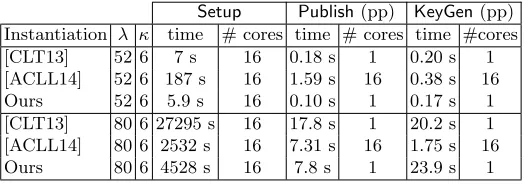
also provide in Table 2 a comparison with the initial CLT implementation [CLT13] and with the implementation of GGHLite recently described in [ACLL14]; GGHLite is an improvement of GGH proposed by Langlois, Stehl´e and Steinfeld [LSS14].
Instantiation λ κ n η ∆ ρ γ=n·η pksize Small 52 6 540 1679 23 52 0.9·106 27 MB
Medium 62 6 2085 1989 45 62 4.14·106 175 MB Large 72 6 8250 2306 90 72 19.0·106 1.2 GB
Extra 80 6 25305 2619 159 85 66.3·106 6.1 GB
Setup Publish KeyGen
5.9 s 0.10 s 0.17 s 36 s 0.33 s 1.06 s 583 s 2.05 s 6.17 s 4528 s 7.8 s 23.9 s
Table 1.Parameters and timings to instantiate aone-round7-way Diffie-Hellman key exchange protocol withκ= 6, `= 2λandα, β, ν=λon a 16-core computer (Intel Xeon E7-8837 at 2.67GHz).Setupwas run in parallel on the 16 cores, while the other steps ran on a single core.PublishandKeyGentimings are per party.
Setup Publish(pp) KeyGen(pp) Instantiation λ κ time # cores time # cores time #cores
[CLT13] 52 6 7 s 16 0.18 s 1 0.20 s 1
[ACLL14] 52 6 187 s 16 1.59 s 16 0.38 s 16
Ours 52 6 5.9 s 16 0.10 s 1 0.17 s 1
[CLT13] 80 6 27295 s 16 17.8 s 1 20.2 s 1
[ACLL14] 80 6 2532 s 16 7.31 s 16 1.75 s 16
Ours 80 6 4528 s 16 7.8 s 1 23.9 s 1
Table 2.Comparison with timings reported in [CLT13] and [ACLL14]. Both [CLT13] experiments and ours were run on Intel Xeon E7-8837 2.67Ghz and [ACLL14] experiments were run on Intel Xeon E5-2667 v2 3.30Ghz.
References
[ACLL14] Martin R. Albrecht, Catalin Cocis, Fabien Laguillaumie, and Adeline Langlois. The whole alphabet (and then some) agree on a key in one round: making multilinear maps practical. IACR Cryptology ePrint Archive, 2014:928, 2014.
[ACPS] M. Albrecht, D. Cad´e, X. Pujol, and D. Stehl´e. fplll-4.0, a floating-point LLL implementation. Available athttp://perso.ens-lyon.fr/damien.stehle.
[BS03] Dan Boneh and Alice Silverberg. Applications of multilinear forms to cryptography. Contemporary Mathematics, 324:71–90, 2003.
[BWZ14] Dan Boneh, David J. Wu, and Joe Zimmerman. Immunizing multilinear maps against zeroizing attacks. Cryptology ePrint Archive, Report 2014/930, 2014. http://eprint.iacr.org/.
[CHL+14] Jung Hee Cheon, Kyoohyung Han, Changmin Lee, Hansol Ryu, and Damien Stehl´e. Cryptanalysis of the multilinear map over the integers. Cryptology ePrint Archive, Report 2014/906, 2014. http: //eprint.iacr.org/. To appear at EUROCRYPT 2015.
[CLT13] Jean-S´ebastien Coron, Tancr`ede Lepoint, and Mehdi Tibouchi. Practical multilinear maps over the integers. In Ran Canetti and Juan A. Garay, editors,CRYPTO, volume 8042 ofLNCS, pages 476–493. Springer, 2013.
[CLT14] Jean-S´ebastien Coron, Tancr`ede Lepoint, and Mehdi Tibouchi. Cryptanalysis of two candidate fixes of multilinear maps over the integers. Cryptology ePrint Archive, Report 2014/975, 2014. http: //eprint.iacr.org/.
[CMNT11] Jean-S´ebastien Coron, Avradip Mandal, David Naccache, and Mehdi Tibouchi. Fully homomorphic encryption over the integers with shorter public keys. In Phillip Rogaway, editor,CRYPTO, volume 6841 ofLNCS, pages 487–504. Springer, 2011.
[CN12] Yuanmi Chen and Phong Nguyen. Faster algorithms for approximate common divisors: Breaking fully-homomorphic-encryption challenges over the integers. In David Pointcheval and Thomas Johansson, editors,EUROCRYPT, volume 7237 ofLNCS, pages 502–519. Springer, 2012.
[Cop97] Don Coppersmith. Small solutions to polynomial equations, and low exponent RSA vulnerabilities.J. Cryptology, 10(4):233–260, 1997.
[GGH13a] Sanjam Garg, Craig Gentry, and Shai Halevi. Candidate multilinear maps from ideal lattices. In Thomas Johansson and Phong Q. Nguyen, editors,EUROCRYPT, volume 7881 ofLNCS, pages 1–17. Springer, 2013.
[GGH+13b] Sanjam Garg, Craig Gentry, Shai Halevi, Mariana Raykova, Amit Sahai, and Brent Waters. Candidate indistinguishability obfuscation and functional encryption for all circuits. InFOCS, pages 40–49. IEEE Computer Society, 2013.
[GGH14] Craig Gentry, Sergey Gorbunov, and Shai Halevi. Graph-induced multilinear maps from lattices. IACR Cryptology ePrint Archive, 2014:645, 2014. To appear at TCC 2015.
[GGHZ14] Sanjam Garg, Craig Gentry, Shai Halevi, and Mark Zhandry. Fully secure functional encryption without obfuscation. Cryptology ePrint Archive, Report 2014/666, 2014.http://eprint.iacr.org/.
[GH11] Craig Gentry and Shai Halevi. Implementing Gentry’s fully-homomorphic encryption scheme. In Kenneth Paterson, editor,EUROCRYPT, volume 6632 ofLNCS, pages 129–148. Springer, 2011.
[Gt14] Torbj¨orn Granlund and the GMP development team.GNU MP: The GNU Multiple Precision Arithmetic Library, 6.0.0 edition, 2014. http://gmplib.org/.
[HSW13] Susan Hohenberger, Amit Sahai, and Brent Waters. Full domain hash from (leveled) multilinear maps and identity-based aggregate signatures. In Ran Canetti and Juan A. Garay, editors,CRYPTO, pages 494–512. Springer, 2013.
[Lep15] Tancr`ede Lepoint. Proof-of-concept implementation of the “new” multilinear maps over the integers, 2015. https://github.com/tlepoint/new-multilinear-maps.
[LS14] Hyung Tae Lee and Jae Hong Seo. Security analysis of multilinear maps over the integers. In Juan A. Garay and Rosario Gennaro, editors,CRYPTO, volume 8616 ofLNCS, pages 224–240. Springer, 2014. [LSS14] Adeline Langlois, Damien Stehl´e, and Ron Steinfeld. GGHLite: More efficient multilinear maps from
ideal lattices. In Phong Q. Nguyen and Elisabeth Oswald, editors,EUROCRYPT, volume 8441 ofLNCS, pages 239–256. Springer, 2014.
[NS99] Phong Q. Nguyen and Jacques Stern. The hardness of the hidden subset sum problem and its cryptographic implications. In Michael J. Wiener, editor,CRYPTO ’99, volume 1666 ofLNCS, pages 31–46. Springer, 1999.
[Pri51] G. Baley Price. Bounds for determinants with dominant principal diagonal.Proceedings of the American Mathematical Society, 2(3):497–502, 1951.
[PS14] David Pointcheval and Olivier Sanders. Forward secure non-interactive key exchange. In Michel Abdalla and Roberto De Prisco, editors,SCN, volume 8642 ofLNCS, pages 21–39. Springer, 2014.
[Var75] James M. Varah. A lower bound for the smallest singular value of a matrix. Linear Algebra and its Applications, 11(1):3–5, 1975.
A Graded Encoding Schemes
In [BS03], Boneh and Silverberg proposed a generalization of pairings calledcryptographic multilinear maps. A (symmetric) κ-multilinear map is a non-degenerate map e:Gκ →GT (where GandGT
are groups of prime order p, denoted additively, and g is a generator of G) such that, for all a1, . . . , aκ∈Zp,e(a1·g, . . . , aκ·g) = (a1· · ·aκ)·e(g, . . . , g). In [GGH13a], Garg, Gentry and Halevi
introduced a richer structure than cryptographic multilinear maps – as in [HSW13], we denote it leveled multilinear maps – and proposed an approximation of these maps called graded encoding schemes.
Definition 1 (Leveled Multilinear Map). A κ-leveled multilinear map is a set of bilinear maps {ei,j: Gi ×Gj → Gi+j | i, j ∈ [κ], i+j 6 κ} where each Gi is a group of prime order p, denoted additively and generated by gi for all i ∈ [κ], and such that each map ei,j satisfies ei,j(a·gi, b·gj) = (a·b)·gi+j for a, b∈Zp and i, j∈[κ] andi+j6κ.
Definition 2 (Graded Encoding System [GGH13a]). Aκ-graded encoding system for a ring
R is a system of sets S ={Sv(α) ∈ {0,1}∗ :v∈N, α∈R}, with the following properties:
1. For everyv∈N, the sets {Sv(α):α∈R} are disjoint.
2. There are binary operations + and −(on {0,1}∗) such that for every α
1, α2 ∈R, every v∈N,
and every u1 ∈ S(va1) and u2 ∈Sv(a2), it holds that u1+u2 ∈Sv(α1+α2) and u1−u2 ∈ S(α1
−α2) v
where α1+α2 andα1−α2 are addition and subtraction in R.
3. There is an associative binary operation ×(on {0,1}∗) such that for everyα
1, α2∈R, every v1, v2 with 06v1+v2 6κ, and every u1 ∈S(vα11) and u2 ∈S
(α2)
v2 , it holds that u1×u2 ∈S (α1·α2) v1+v2
where α1·α2 is multiplication in R.
Definition 3 (Graded Encoding Schemes). A symmetric κ-graded encoding scheme G with rerandomization and public sampling consists of the following (polynomial time) procedures G =
{instGen,samp, enc,reRand,neg,add,mult,isZero,ext}:
instGen(1λ,1κ) : The randomized instance generation procedures takes as input the security parameter
λ, the multilinearity levelκ, and outputs the public parameters(pp,pzt)whereppis a description
of a κ-graded encoding system as above, and pzt is a zero-test parameter;
samp(pp) : The randomized sampling procedure takes as input the public parameterspp and outputs a “level-0” encoding u∈S0(α) for a nearly uniform α∈R;
enc(pp, i, u) : The (possibly randomized) encoding procedure takes as inputs the parameters pp, an index i∈[κ] and a “level-0” encoding u∈S0(α) for some α∈R and outputs a “level-i” encoding
u0 ∈Si(α);
reRand(pp, i, u) : The randomized rerandomization procedures takes as inputs the parameterspp, an index i∈[κ] and a “level-i” encoding u∈Si(α) for some α∈R, and outputs another u0 ∈Si(α)
such that, for anyu1, u2 ∈Si(α), the output distributions ofreRand(pp, i, u1) and reRand(pp, i, u2)
are nearly the same;
neg(pp, u) The arithmetic negation is deterministic, takes as input the public parameterspp and a “level-i” encoding u∈Si(α) for some α in R and outputs a “level-i” encoding u0 ∈Si(−α);
add(pp, u1, u2) The arithmetic addition is deterministic, takes as input the public parameters pp
and “level-i” encodings u1∈Si(α1) and u2 ∈Si(α2) for some α1, α2 in R and outputs a “level-i”
encoding u0 ∈S(iα1+α2);
mult(pp, u1, u2) The arithmetic multiplication is deterministic, takes as input the public parameters
pp, a “level-i” encodingu1∈Si(α1) and a level-j encoding u2 ∈Sj(α2) for someα1, α2 in R such
that i+j6κ and outputs a “level-(i+j)” encoding u0∈S(α1·α2) i+j ;
isZero(pp, u) The zero-testing procedure is deterministic, takes as input the public parameters pp
and a “level-κ” encoding u∈Sκ(α) and outputs1 if α= 0 and 0 otherwise;
ext(pp,pzt, u) The extraction procedure is deterministic, takes as input the public parameterspp, the
zero-test parameterpzt and a “level-κ” encodingu∈Sκ(α) and outputs a λ-bit string ssuch that:
1. For any α∈R andu1, u2∈Sκ(α), ext(pp,pzt, u1) =ext(pp,pzt, u2);
2. The distribution {ext(pp,pzt, v)|α←R, v∈Sκ(α)} is nearly uniform over{0,1}λ.
Hardness assumption. In [GGH13a] is introduced an analogue of the multilinear decisional Diffie-Hellman assumption (see [BS03]) for graded encoding schemes: the Graded Decisional Diffie-Diffie-Hellman assumption (GDDH).
Definition 4 (κ-GDDH). Let G denote a GES. For any security parameter λ ∈ N, the κ
-Graded Decisional Diffie-Hellman assumption is to distinguish between the following distributions
D0[(pp,pzt)] and D1[(pp,pzt)], where (pp,pzt)← G.instGen(1λ,1κ):
D0[(pp,pzt)] =
{u0j}j∈[κ+1], γ
∀j∈[κ+ 1], aj ← G.samp(pp), uj ← G.enc(pp,1, aj) u0j ← G.reRand(pp,1, uj) γ ← G.ext(pp,pzt, aκ+1·Qj∈[κ]u0j)
and
D1[(pp,pzt)] =
{u0j}j∈[κ+1], γ
∀j∈[κ+ 1], aj ← G.samp(pp), uj ← G.enc(pp,1, aj) u0j ← G.reRand(pp,1, uj) γ ← {0,1}λ
B Proof of Lemma 2
We have by definition ofc01:
c01 = ˆc1+
τ
X
j=1
bj ·xj+ n+1
X
j=1
b0j·Πj (25)
where ˆc1 is given as input of the reRand algorithm. We have:
ˆ
c1 =
n
X
i=1
(ˆri·gi+mi)·ui+ ˆrn+1·x0 (26)
where we write ˆc1/zmodpi = ˆri ·gi +mi, where |rˆi·gi +mi| 6 ρenc for all 1 6 i 6 n, where ρenc = 2`·22ρ+2α; since 06ˆc1 < x0, we must also have |rˆn+1|61 +n·ρenc. We obtain from (25):
c01/z≡rˆi·gi+mi+ τ
X
j=1
bj ·rij ·gi+ n+1
X
j=1
b0j ·$ij ·gi (modpi)
Since the column vectors of the matrix X are randomly generated in the half-open parallelepiped spanned by the columns ofΠ, we have|rij·gi|63n·2ρ+α for alli, j. Therefore the right-hand side
of the previous equation is upper bounded in absolute value by:
1 +n·ρenc+τ·3n·2ρ+α+ 2n2·2µ+α+ρ64n2·2µ+α+ρ using µ=ρ+α+λ. Therefore under the condition:
µ+α+ρ+λ6η
We define the function g:Zp1× · · · ×Zpn×Z→Zwith:
g(a1, . . . , an, an+1) = n
X
i=1
ai·ui+an+1·x0
where the CRT coefficients ui are defined by (9). We have that g a bijection; namely its inversef is
defined as:
f(a) =[a·z]p1, . . . ,[a·z]pn, a− n
X
i=1
[a·z]pi·ui
/x0
.
Leta, b∈Z; if for all 16i6n, the i-th coefficient ai of f(a) and the i-th coefficient bi off(b) are
such that|ai+bi|< pi/2, we have:
f(a+b) =f(a) +f(b).
Sincef is a bijection, we can work with the (n+ 1)-vector f(a) instead ofa∈Z; moreover if the CRT components are small enough, we can work with these vectors additively.
We can write from (26):
f(ˆc1) = (ˆr1·g1+m1, . . . ,ˆrn·gn+mn,ˆrn+1) =diag(g1, . . . , gn,1)·rˆ+m
where ˆr= (ˆri)16i6n and m= (m1, . . . , mn,0). Since the CRT components do not wrap modulopi,
Equation (25) can be rewritten
f(c01) =fˆc1+ τ
X
j=1
bj ·xj+ n+1
X
j=1 b0j ·Πj
=m+diag(g1, . . . , gn,1)·
ˆ
r+X ·b+Π·b0,
where b= (bi)i and b0= (b0i)i. Now, using the notations introduced in Lemma 2 we can also write:
f(c01) =m+diag(g1, . . . , gn,1)·r,
which gives:
r= ˆr+X·b+Π·b0.
The latter equation is the same equation as in [CLT13, Sec. 4.3], except thatrhasn+ 1 components instead ofn, because of the additional multiple ofx0; the rest of the proof is therefore similar; it is based on the Leftover-Hash-Lemma over lattices and some facts on diagonally dominant matrices [CLT13, Sec. 4].
We first recall the Leftover-Hash-Lemma over lattices. Let L⊂Zn be a lattice of ranknof basis
B = (b1, . . . ,bn). We denote by DB the distribution obtained by generating a random element in the quotientZn/L and taking its unique representative in the half-open parallelepiped generated by
the basisB. For any µ∈Z∗, we denote by µB the basis (µb1, . . . , µbn).
Lemma 4 (Leftover-Hash-Lemma over Lattices [CLT13]). Let L⊂Zn be a lattice of rank n of basis B = (b1, . . . ,bn). Let xi for 1 6 i 6 m be generated independently according to the
distributionDB. Set s1, . . . , sm← {0,1}and t1, . . . , tn←Z∩[0,2µ). Let y=Pmi=1sixi+Pni=1tibi
and y0 ← D2µB. Then the distributions (x1, . . . ,xm,y) and(x1, . . . ,xm,y0) areε-statistically close,
Since at instance generation the columns of X are generated uniformly and independently in the parallelepiped spanned by the columns of Π, Lemma 4 shows that the distribution of (pp,r) is
ε1-close to the distribution of (pp,ˆr+D2µΠ), with ε1=τ(n+ 1)2−µ+ 1/2
p
|detΠ|/2τ.
Moreover it is proved in [CLT13] thatD2µB is not significantly modified when a small vector
z∈Zn is added, if the operator norm of the corresponding matrixB−1 is upper-bounded.
Lemma 5 ([CLT13]).LetL⊂Znbe a full-rank lattice of basisB = (b1, . . . ,b
n), and letB ∈Zn×n
be the matrix whose column vectors are the bi’s. For any z ∈Zn, the distribution ofz+D2µB is ε-statistically close to that ofD2µB, where ε= 2−µ·(kzk∞· kB−1k∞+ 1).
Using Lemma 5, we obtain that the distribution of (pp,r) is (ε1+ε2)-close to that of (pp,D2µΠ) for ε2= 2−µ·(krˆk∞· kΠ−1k∞+ 1).
We recall the following facts for diagonally dominant matrices [Var75,Pri51]. Given a matrix
B = (bij) ∈Rn×n, we let Λi(B) =Pk6=i|bik|. A matrix B = (bij)∈Rn
×n is said to be diagonally
dominant if|bii|> Λi(B) for all i.
Fact 1 Let B = (bij) ∈Rn×n be a diagonally dominant matrix. Then the matrix B is invertible
and kB−1k
∞ 6maxi=1,...,n(|bii| −Λi(B))−1 where k · k∞ is the operator norm onn×n matrices with respect to the `∞ norm on Rn.
Fact 2 Let B = (bij)∈Rn×n be a diagonally dominant matrix. Then
n
Y
i=1
(|bii| −Λi(B))6|detB|6 n
Y
i=1
(|bii|+Λi(B)).
Using Fact 2 we obtain using|$ii|6(n+ 2)·2ρ and ∆i(Π)6n·2ρ for all i:
ε1 6τ(n+ 1)2−µ+ 2((n+1)(ρ+log2(3n))−τ)/2.
Given the constraint τ >(n+ 2)·ρ+ 2λ, we obtainε1 =negl(λ). Moreover using Fact 1, we obtain
kΠ−1k∞62−ρ and therefore:
ε2 62−µ·((1 +n·ρenc)·2−α+1·2−ρ+ 1)62−µ·n·3`·22ρ+2α·2−ρ−α+1 66`n·2ρ+α−µ.
Withµ=ρ+α+λ, we obtainε2 =negl(λ). This proves Lemma 2.
C Generation of the Zero-Testing Matrix
For the construction of zero-testing parameters, it is necessary to generate, with sufficient entropy, an invertible matrixH ∈Zn×n such that the operator norm of both H and its inverse is suitably
bounded:kHk∞62β andkH−1k∞62β. The following approach to do so was described in [CLT13]: simply chooseH as a product of random matrices of the form:
HA=
Ibn/2c A 0 Idn/2e