A preliminary version of this paper appears inAdvances in Cryptology - EUROCRYPT ’12 Proceedings. Lecture Notes in Computer Science, Vol. 7237, pp. 682–699, Pointcheval, D.; Johansson T. eds., Springer, 2012. This is the full version.
Security of Symmetric Encryption
in the Presence of Ciphertext Fragmentation
∗ALEXANDRABOLDYREVA† JEAN PAULDEGABRIELE‡ KENNETHG. PATERSON§
MARTIJN STAM¶
February 17, 2015
Abstract
In recent years, a number of standardized symmetric encryption schemes have fallen foul of attacks exploiting the fact that in some real world scenarios ciphertexts can be delivered in a fragmented fash-ion. We initiate the first general and formal study of the security of symmetric encryption against such attacks. We extend the SSH-specific work of Paterson and Watson (Eurocrypt 2010) to develop security models for the fragmented setting. We also develop security models to formalize the additional desir-able properties of ciphertext boundary hiding and robustness against Denial-of-Service (DoS) attacks for schemes in this setting. We illustrate the utility of each of our models via efficient constructions for schemes using only standard cryptographic components, including constructions that simultaneously achieve confidentiality, ciphertext boundary hiding and DoS robustness.
∗
This work was supported in part by the European Commission through the ICT programme under contract ICT-2007-216676 ECRYPT II.
†
Georgia Institute of Technology, USA. E-mail:[email protected]. This author supported by NSF awards CNS-0831184 and TWC-1318511.
‡
Royal Holloway, University of London, UK. E-mail:[email protected]. This author supported in part by EPSRC Leadership Fellowship EP/H005455/1, and in part by Vodafone Group Services Limited, a Thomas Holloway Research Studentship, and the Strategic Educational Pathways Scholarship Scheme (Malta), part-financed by the European Union European Social Fund.
§
Royal Holloway, University of London, UK. E-mail:[email protected]. This author supported by EPSRC Leadership Fellowship EP/H005455/1.
¶
Contents
1 Introduction 3
1.1 Overview of Contributions . . . 3 1.2 Further Related Work . . . 7 1.3 Differences From the Proceedings Version . . . 8
2 Notation 8
3 Symmetric Encryption Supporting Fragmentation 8
3.1 Unified Syntax . . . 8 3.2 Degrees of Statefulness . . . 11
4 Message Privacy of Schemes Supporting Fragmentation 13
4.1 The Stateful Notion . . . 13 4.2 A Notion for SBB Schemes . . . 14
5 Boundary Hiding 16
5.1 Security Definitions . . . 16
6 Denial of Service 20
6.1 Security Definitions . . . 20
7 Constructions 23
7.1 Applying Instantaneously Decodable Postprocessing (IDP) . . . 23 7.2 The InterMAC Construction . . . 28 7.3 A SBB Variant of InterMAC . . . 33
A The Paterson–Watson Model 39
B Unsatisfiability of SBB Boundary Hiding 40
C Auxiliary Security Definitions 40
1
Introduction
The provable security approach, which has become a de facto standard in modern cryptography, allows us to build cryptographic schemes with security guarantees. Many widely deployed protocols have been proven secure under reasonable assumptions and the standards bodies, such as NIST, require proofs to accompany new submissions. However, there is still a disconnect between theory and practice. Deployed schemes do get compromised sometimes, despite the existence of proofs guaranteeing security. There is no contradiction here. One of the reasons for this situation is as follows. Security proofs guarantee securityonlyaccording to the specified security definition, which in turn may not include some adversarial capabilities possible in practice.
As one of the many examples of a kind consider SSH, one of the most widely used secure protocols. Bellare et al. [4] have formally analysed variants of SSH’s Binary Packet Protocol (BPP) and showed that these variants are secure under reasonable assumptions on the protocol’s building blocks. Yet a few years later, Albrecht et al. [1] presented plaintext recovery attacks against these provably secure SSH BPP variants. These attacks exploited the fact that encrypted data can be delivered to the receiver in a fragmented, byte-by-byte manner, and that the attacker can observe the receiver’s behaviour at each point (in particular how long it takes to reject certain carefully crafted faulty ciphertexts). On the other hand, formal security definitions, including the one used to prove SSH secure, traditionally treat plaintexts and ciphertexts asatomic, meaning that the entire ciphertext is offered for decryption and a plaintext (or error symbol) is instantly returned.
To bridge this gap between theory and practice and to have schemes with security guarantees that hold not only on paper but also in reality, one has to design security definitions which are integrated better with the environments in which the protocols are deployed. Paterson and Watson [16] recently took a first step in this direction by showing that certain SSH BPP variants meet a newly introduced security notion that takes the aforementioned attacks into account. However, their security notion is heavily intertwined with the SSH BPP specification and too complex to be extended easily to apply to different schemes. We provide a more detailed critique of this precursor [16] in AppendixA.
1.1 Overview of Contributions
In this work we seek to strike the right balance between two conflicting aims: keeping the generality and simplicity of traditional security definitions for symmetric encryption; and developing a framework that can be used to providemeaningfulprovable security analyses of practical schemes when deployed in environ-ments that permit ciphertext fragmentation attacks.
To this end, we initiate a general study of security of symmetric encryption schemes against fragmen-tation attacks, not only in terms of message privacy, but also in terms of length-hiding and prevention of fragmentation-enabled Denial-of-Service (DoS) attack against the receiver. To the best of our knowledge, the latter two goals for encryption, i.e. length-hiding (or, more precisely, hiding ciphertext boundaries in a ciphertext stream) and DoS prevention have not been previously studied, partly because the correspond-ing threats are not present if encryption is treated as becorrespond-ing atomic. The adversarial capabilities we define are general enough to model a wide class of fragmentation attacks, including but not limited to the ones considered by Paterson and Watson [16].
(the observation carries over to the scheme proved confidential against fragmentation attacks by Paterson and Watson [16]).
Let us now describe our focus and results in a little more detail.
Data fragmentation. Data sent over networks is often fragmented, meaning that it is broken up into smaller pieces, or packets. If the data is encrypted, the receiver first has to determine what constitutes a complete ciphertext in order to decrypt it and obtain the underlying message. (Unless the protocol requires on-the-fly decryption. This, however, is known to reduce security [14].) Reconstruction of the original ciphertext by the receiver can be accomplished by various methods. For example, SSH uses a length field that tells the receiver how many bytes are needed before the complete ciphertext has arrived; this length field is encrypted, ostensibly to increase the security of the protocol against traffic analysis. As another example, IPsec handles fragmentation of packets using fields in the IP header: the MF flag (indicating that more fragments follow), the fragment offset field (used to reorder the fragments), and the identification field (to identify which fragments belong to which packets).
During normal transmission, application-layer messages may be fragmented as required by the lower-layer protocols and the specifics of the physical networks over which they are routed. In general this cannot be known a priori and one needs to support arbitrary fragmentation patterns. Interestingly, the mechanisms in place for supporting fragmentation may be subverted by an adversary to mount specialised attacks on secure protocols. Most surprisingly, tampering with fragmentation can undermine message privacy, but it can also result in Denial of Service and aid traffic analysis. We already mentioned an attack of this kind on SSH [1]. Another example is an attack by Degabriele and Paterson [8] on the IPsec protocol.1
Syntax for encryption supporting fragmentation. We start our analysis with defining encryption in the presence of fragmentation. Asymmetric encryption scheme supporting fragmentation is defined similarly to a regular atomic (fragmentation devoid) encryption scheme, except the decryption algorithm is always stateful, mainly to model decryption algorithms that may, for example, combine data coming from multiple ciphertext fragments before outputting any plaintext. In addition to state, decryption takes input fragments, one-by-one. Depending on the scheme, the minimal fragment length can be one bit, a byte or a block (of some fixed length). The correctness requirement is defined more intricately than that for atomic encryption. It requires that regardless of how one fragments the ciphertexts, upon decryption, the original messages are returned, in correct order, with correct message boundaries indicated.
When considering ciphertext fragmentation, a stateful encryption scheme becomes a more natural choice. Intuitively, the decryption algorithm will need to maintain some form of buffer in which it gathers cipher-text fragments prior to decrypting the reconstructed ciphercipher-text. Accordingly, in this work we will by default consider encryption schemes that have a stateful decryption algorithm. If no further constraints are imposed, we will generally simply refer to such schemes asstateful. In the atomic setting it is well known that stateful schemes can meet stronger security notions than stateless ones. In particular stateful schemes can protect against replay and reordering attacks [4]. To translate this distinction to our setting, we define a subclass of schemes that have a ‘minimal’ state, serving as an analogue of stateless schemes in the atomic setting. Namely, the decryption algorithm is still stateful, but the state is restricted to behave as a buffer and hence 1While similar security issues arise for IPsec, its details are much more intricate and so it does not serve as such a good
only serves to support ciphertext fragmentation. We call such schemesstateless beyond buffering (SBB). See Sections3.1and3.2for the definitions.
Message privacy in the presence of fragmentation. We observe that fragmentation becomes relevant for security only in the case of chosen-ciphertext attacks (CCA). We extend the existingIND-CCAsecurity notion and its stateful variant IND-sfCCA[4] to the case of ciphertext fragmentation which we denote as
IND-sbbCFAandIND-sfCFArespectively.
Recall that forIND-sfCCAthere is no restriction on the decryption queries, but if the adversary forwards the challenge ciphertexts returned by the left-or-right encryption oracle to the decryption oracle in order, this is considered in-sync, and the decryption output is suppressed. Otherwise, it is declared out-of-sync, and the decryptions are returned to the adversary. This allows the adversary to advance the state of both encryption and decryption algorithms to potentially favourable values. When dealing with fragments, the challenge is to decide when to enter the out-of-sync state. We opted to delineate the mark where the queries become out-of-sync to coincide with a ciphertext boundary rather than a fragment boundary. This conservative choice results in a stronger security notion. We provide ourIND-sfCFAdefinition and more discussion in Section4.1.
When considering a weaker privacy notion, one that does not protect against replay and reordering attacks, more difficulties emerge. Specifically, parsing the fragment stream for challenge ciphertexts be-comes particularly daunting. To enable effective parsing, we resort to certain properties of SBB schemes, and accordingly our weaker privacy notion (IND-sbbCFA) is only meaningful for SBB schemes. A formal definition and more discussion can be found in Section4.2.
Ciphertext boundary hiding. It is conventional wisdom in cryptographic security definitions that an en-cryption scheme is allowed to leak the length of the ciphertext; it is often regarded as inevitable. However, real schemes do try to hide the lengths of encrypted messages, with a view to frustrating traffic analysis based on these lengths. This is generally achieved in practice by two distinct mechanisms.
Firstly, an encryption scheme for which the ciphertext length doesnotdeterministically depend on the message length may be used (e.g. by using variable-length padding). The SSH Binary Packet Protocol and the TLS Record Protocol both adopt this approach. This mechanism has recently received attention from differing perspectives [15,18]. Secondly, an encryption scheme may be designed in such a way that it is hard to distinguish where the boundaries between ciphertexts lie in astreamof ciphertexts. TLS, with its explicit length field in the header of each TLS Record Protocol message, does not achieve this. But SSH’s Binary Packet Protocol (BPP) does attempt to achieve boundary hiding. This necessitated the introduction of an encrypted length field in SSH, which is used by the receiver to determine how many bytes are required before a complete ciphertext has arrived and a MAC on the plaintext can be checked. However, this design decision, coupled with the use of CBC mode encryption, is precisely what enabled recent fragmentation attacks against SSH [1]. Thus having boundary hiding as a security goal can act in opposition to achieving other, more standard security goals.
ciphertext boundaries, the adversary no longer has access to fine-grained ciphertext lengths (our solution of course does not help to hide the total volume being sent). We also define boundary hiding in the active case and find out that it is much more challenging to achieve.
Denial-of-Service. Next, we shift attention to preventing fragmentation-related Denial-of-Service (DoS) attacks against the receiver. This is, to the best of our knowledge, the first formal treatment of DoS prevention as a property of encryption. For an example of such an attack, consider the SSH-CTR scheme (see [16] for a description) and the adversary who changes the length field that occupies the first 32 bits of plaintext by bit flipping in the ciphertext. If the length is maliciously increased to a very large value (say,232−1, the maximum possible value for a 32-bit field), then the receiver will continue listening for ciphertext fragments awaiting message completion, until232bytes of data have been received. Only then will SSH-CTR’s MAC verification be conducted and the message rejected. The application (or user) receiving data from the SSH connection experiences this as an SSH connection hang, a form of Denial-of-Service.
We provide security definitions for the stateful and SBB settings,DOS-sfCFAandDOS-sbbCFAresp., for DoS attacks in Section6that are sufficiently flexible to capture the SSH attack and others like it. Essen-tially, we measure the attacker’s ability to create a sequence of ciphertext fragments for which the decryption algorithm of a scheme does not output any message or failure symbol within a reasonable timeframe, mea-sured in terms of the number of bits submitted to a decryption oracle by the adversary. Accordingly we parametrise our security notions with an integernindicating the maximum sequence of bits which do not yield any output that a reasonable adversary may produce. The DoS mitigation techniques employed by SSH and TLS require limiting the maximum supported message size to a comparable value in order to be
n-DOS-sfCFAsecure. We manage to surpass this limitation.
Constructions and their security. So far, our emphasis has been on developing security models and notions. However, as we proceed, we demonstrate how each of the security notions we introduce can be met in practice by efficient schemes using only standard symmetric components. These constructions are illustrative rather than definitive.
First we give a simple transformation that converts any secure atomic scheme into a secure scheme sup-porting fragmentation. One of the challenges that has to be overcome is ensuring correct decryption of the fragmented scheme. We solve this by applyinginstantaneously decodable postprocessingto the ciphertexts, where in the simplest of cases this can be instantiated with a prefix-free encoding scheme. This allows the decrypting algorithm to correctly parse a concatenation of ciphertexts into discrete ciphertexts which it can then decrypt in an atomic fashion. In addition, allowing the instantaneously decodable postprocessing to be keyed permits the ciphertext boundaries to be hidden from a passive adversary, i.e. it achievesBH-CPA
security. Achieving BH-sfCFArequires more work. We show that this can be done at the same time as achieving DoS security we discuss next. In the SBB setting, however, we will only achieveBH-CPA se-curity. This appears to be an inherent limitation of the SBB setting: in fact, in Section B, we show that no practically relevant SBB scheme can simultaneously meet our BH-sbbCFAandDOS-sbbCFAsecurity notions.
IND-sfCFA BH-CPA BH-sfCFA n-DOS-sfCFA
n < max
m∈M(|m|)
SSH-CBC 7 3 7 7
SSH-CTR 3 3 7 7
IDP (Sec.7.1) 3 3 7 7
IM (Sec.7.2) 3 3 3 3
IND-sbbCFA BH-CPA BH-sbbCFA n-DOS-sbbCFA
n < max
m∈M(|m|)
IM∗ (Sec.7.3) 3 3 7 3
Table 1: Security comparison of encryption schemes supporting fragmentation.
In the SBB setting we also use the idea of authenticating the ciphertext segments. However, the solution becomes more complex, as we cannot keep message and segment numbers as state and it is not efficient to keep them as part of the segments. To prevent re-ordering attacks we need to authenticate the previous segments as well. To improve efficiency we chain the tags instead, i.e. we compute tags over the concatena-tion of the segment and the previous tag value. In contrast to the stateful case, the scheme is onlyBH-CPA
secure.
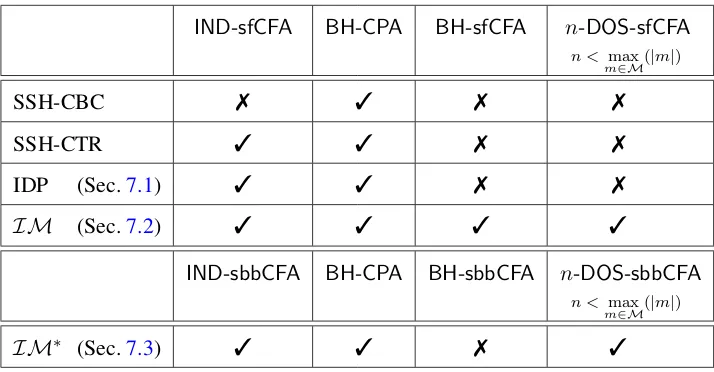
Table1summarizes the security properties achieved by our main constructions for the stateful and SBB settings. For comparison we also cast prior work on the SSH-CBC and SSH-CTR schemes [4,16] into our framework. For construction definitions and further discussions, see the referenced sections. We note that the scheme InterMAC is able to simultaneously achieve all three of our active security notionsIND-sfCFA,
BH-sfCFA, andn-DOS-sfCFAwithout limiting the maximum message size.
1.2 Further Related Work
1.3 Differences From the Proceedings Version
This is a revised and augmented version of a paper with the same title that appeared in the EUROCRYPT 2012 proceedings. We warn the reader that some of the naming and notation has been altered. In particular the prefix-free postprocessing construction has been renamed to instantaneously decodable postprocess-ing. The Indistinguishability and Boundary-Hiding security definitions are essentially unchanged, only the presentation is different. The same holds for the InterMAC construction. On the other hand, the Denial-of-Service security definition has been strengthened. Specifically, we previously required the adversary to produce the winning sequence of ciphertext fragments (ann-bit long sequence of ciphertext fragments that produce no output upon decryption, see Section6) as soon as his decryption queries became out-of-sync. We no longer make this restriction: we allow the winning fragment sequence to appear at any point after the decryption queries become out-of-sync.
2
Notation
Unless otherwise stated, an algorithm may be randomised. An adversary is an algorithm. For any algorithm
Awe usey← A(x1, x2, . . .)to denote executingAwith fresh coins on inputsx1, x2, . . . and assigning its
output toy. IfSis a set then|S|denotes its size, andy ←$Sdenotes the process of selecting an element
fromSuniformly at random and assigning it toy.
The set of all finite binary strings is denoted by{0,1}∗. For any positive integernand bitb, we denote by bnthe string of nconsecutiveb’s and{0,1}n represents the set of all binary strings of lengthn. The empty string is represented byε. For any two stringswandzand positive integersiandj,wk zdenotes their concatenation,w⊕zdenotes their bitwiseXOR,wzdenotes the greatest common prefix ofwandz,
w%zdenotes the remainder string ofwwith respect towz(i.e. w=wzkw%z), and|w|denotes the length ofw. Accordingly, we can express thatwis a prefix ofzaswz=w. A setS ⊂ {0,1}∗ is called prefix-free if for all distinctw, z ∈Sit holds thatwis not a prefix ofz. Unless stated otherwise,w[i]denotes theithbit ofw, andw[i, j]denotes the substringw[i]kw[i+ 1]k. . .kw[j]. For anyn∈N, and any vector of strings w = [w1, w2, . . . , wn], we define the concatenation operator as||(w) = w1 k w2 k . . . k wn. Ifjis a non-negative integer, thenhji` denotes the unsigned`-bit binary representation ofj. Accordingly
h·i−1 represents the inverse mapping which maps strings of any length toN. Ifwis an`-bit string andiis
an integer we usew+ias shorthand forhhwi−1+imod 2`i
`. Finally, a listLis a totally ordered set. We use()to denote the empty list, and useLito denote theithelement of the list.
3
Symmetric Encryption Supporting Fragmentation
3.1 Unified Syntax
Morphology. We extend the standard definition of symmetric encryption for the case of fragmented ci-phertexts. For fragmentation to make sense, we will restrict our attention to ciphertexts that are strings, so
C = {0,1}∗. We assume that the message space consists of strings, soM= {0,1}∗. In addition we will allow schemes to have multiple errors (cf. [5]). The move to fragmentation results in some complications. For instance, a single ciphertext can be split up in multiple fragments (Fig.1, requiring recombination of the decryptions of the various fragments) or a single fragment can contain multiple ciphertexts (Fig.2, where one might like to decrypt to a list of messages).
1 2 3 4 5
Figure 1: A single ciphertextc1 = (12)cut up in multiple fragmentsf1 = (1)andf2= (2).
1 2 3 4 5
Figure 2: A single fragmentf1 = (12345)spanning multiple ciphertextsc1 = (12)andc2 = (345).
A symmetric encryption scheme supporting fragmentation SE = (K,E,D) with associated message spaceM ⊆ {0,1}∗,ciphertext spaceC ⊆ {0,1}∗anderror messagesS⊥is defined by three algorithms:
• The randomisedkey generationalgorithmKreturns a secret keyKand initial statesσ0and%0.
• The randomised and statefulencryptionalgorithm
E :K × M ×Σ→ C ×Σ
takes as input the secret key K ∈ K, a plaintext m ∈ M, and the current encryption state σ ∈
Σ, and returns a ciphertext in C together with an updated state. For any ` ∈ N and any m = [m1, . . . , m`] ∈ M`, we write (c, σ) ← EK(m, σ0) as shorthand for (c1, σ1) ← EK(m1, σ0),
(c2, σ2)← EK(m2, σ1), . . .(c`, σ`)← EK(m`, σ`−1)wherec= [c1, . . . , c`]andσ=σ`.
• The deterministic and statefuldecryptionalgorithm
D:K × {0,1}∗×Σ→({0,1} ∪ {¶} ∪ S⊥)∗×Σ
takes the secret key K, a ciphertext fragment f ∈ {0,1}∗, and the current decryption state % to return the corresponding plaintext fragmentm ∈ ({0,1} ∪ {¶} ∪ S⊥)∗ together with the updated state %. For any ` ∈ N and any f = [f1, . . . , f`] ∈ ({0,1}∗)`, we write (m, %) ← DK(f, %0)
as shorthand for (m1, %1) ← DK(f1, %0), (m2, %2) ← DK(f2, %1), . . . (m`, %`) ← DK(f`, %`−1),
wherem=m1k. . .km`and%=%`.
This definition requires a little unpacking. Firstly, and in contrast to the usual definitions, our syntax de-fines both encryption and decryption to be stateful algorithms. This does not result in any loss of generality: both encryption and decryption can be made stateless by havingKto always return the empty string for the corresponding initial state, and let the algorithm ignore (i.e. never update) the state. We adopt this syntax because supporting ciphertext fragmentation inherently requires the decryption algorithm to be stateful. We will elaborate more on this later on in this section and in Section3.2. Furthermore, our primary motivation for studying ciphertext fragmentation are secure protocols such as TLS, SSH, IPsec, and DTLS. These pro-tocols include mechanisms (other than for the purpose of supporting ciphertext fragmentation) that render their decryption stateful, and generally support ciphersuites with stateful encryption algorithms.
1 2 3 4 5
Figure 3: Fragmentsf1 = (12)andf2 = (345)coincide exactly with the two ciphertextsc1 = (12)and
c2 = (345).
a significant difference from the atomic setting where decryption always outputs something). We use¶ 6∈ {0,1} ∪ S⊥to denote the end of plaintext messages, enabling an application making use of the decryption algorithm to parse the output uniquely into a sequence of elements of {0,1}∗ and errors from S⊥. Our introduction of an explicit symbol¶to help delineate messages during decryption seems novel. This is not because our solution is in any way innovative, but rather because the problem does not arise in earlier works. Thirdly, note that, when failing, the decryption algorithm can output one of possibly many error mes-sages from the setS⊥. This reflects the fact that real schemes may fail in more than one way, with the different failure modes being visible to both legitimate users and adversaries. Boldyreva et al. [5] provide a more in-depth examination of dealing with multiple error messages in the context of symmetric encryption. While we enforce that from a decryption of a sequence of ciphertext fragments, the corresponding message boundaries are easy to distinguish, we make no such requirement for ciphertexts. Indeed, given a sequence of ciphertext fragments, it will not be a priori clear what the constituent ciphertexts are (and in fact, in Section5, we want to model schemes which hide these boundaries as a security goal). Looking ahead, the absence of clear ciphertext boundaries (in a sequence of fragments) will cause challenging parsing problems for our CCA definitions: in order to ‘forbid’ decryption of the challenge ciphertext, a prerequisite is that this challenge ciphertext can be located accurately in the sequence of ciphertext fragments!
For simplicity’s sake we did not to incorporate the nonce-based approach from [17] in our syntax, yet it should be possible to extend most of our work to that setting.
Correctness. If a single message is encrypted and the corresponding ciphertext is subsequently decrypted, we expect that the message is returned. When multiple messages are encrypted and the fragments correspond exactlyto the ciphertext (Fig.3), again we expect to retrieve the original messages.
However, we expect something stronger, namely that regardless of how we fragment the ciphertext(s), the original message(s) are returned. For instance in the situation depicted in Fig.1two ciphertextsc1 =
(12)andc2 = (345)are produced by the encryption oracle, and the adversary subsequently submits
frag-mentsf1= (1)andf2= (2)to its decryption oracle. We require that after reception of the second fragment
(or earlier), the ciphertextc1 gets decrypted (formalised by the correct message being output). Similarly,
in Fig.2, after reception of the single fragment spanning two ciphertexts, we expect both messages to be returned (with correct message boundaries indicated).
Finally, we require correct decryption, even when an extra string is added to the original (string of) ciphertexts. This forces correct decryption once a complete valid ciphertext has been received, even if it is followed by an invalid ciphertext fragment. For instance, in the situation depicted in Fig.5two ciphertexts
c1 = (12) andc2 = (345) are produced by the encryption oracle, the adversary subsequently submits
fragmentsf1 = (1)andf2 = (234050) to its decryption oracle, and we still want to see the first ciphertext
decrypted properly.
With this intuition in mind, we are almost ready to give our definition of correctness for a symmetric encryption scheme supporting fragmentation. We first define a map¶: ({0,1}∗∪ S
⊥)∗→({0,1} ∪ {¶} ∪
1 2 3 4 5
Figure 4: Correct decryption for overly long fragments: Given valid ciphertextsc1 = (12)andc2 = (345)
and fragmentf1 = (123), what should the decryption off1be?
1 2 3 40 50
Figure 5: Two consecutive fragmentsf1 = (1)andf2 = (234050). The second fragment completes the first
ciphertextc1 = (12), so we expect that to be decrypted at this point, even though ciphertextc2 = (345)in
the second fragment has been modified to produce a possibly invalid ciphertext.
Definition 3.2. [Correctness Requirement] For all(K, σ0, %0)that can be output byKand for allm∈ M∗
andf ∈({0,1}∗)∗, it holds (with probability 1) that if(c, σ)← EK(m, σ0)and||(c)prefixes||(f), and if
(m0, %)← DK(f, %0)thenm0 is prefixed by¶(m).
Alternatives. Our choice for correctness (Definition3.2) might seem natural, but it is not the only way to define it. Certainly, if a single, honestly generated ciphertext is cut up into multiple fragments, then decrypting all those fragments ought to result in the original message. This extends to a situation where (the concatenation of) multiple ciphertexts is split up into fragments in such a way thateveryciphertext boundary coincides with a fragment boundary (this implies that every fragment is a substring of a single ciphertext). However, when allowing a single fragment to extend over multiple ciphertexts (see Fig.4for an example), it is not immediately clear what ‘correct’ entails. Let us briefly consider three possible interpretations. Fault: The ciphertext is deemed invalid, and⊥is returned.
Flush: The message is returned, and any surplus ciphertext is ignored.
Buffer: The message is returned, and any surplus ciphertext is considered as starting a new ciphertext (buffering).
We have opted for a strict version of the final interpretation in our correctness definition, which intu-itively requires some sort of buffering to take place in the decryption algorithm. Thus our choice of definition for correctness inherently requires any scheme that supports fragmentation to have a stateful decryption al-gorithm. SSH is a prime example of a stateful scheme that buffers (although it keeps more state than just the buffer). Next we classify two different degrees of statefulness that a scheme may have.
3.2 Degrees of Statefulness
outputting a failure symbol once the flag is set. When appropriately incorporated in (atomic) symmetric encryption schemes, these stateful techniques permit the scheme to meet stronger security notions such as the INT-sfCTXT andIND-sfCCA notions of [4]. When considering ciphertext fragmentation, in light of our correctness requirement, some form of buffering is generally required on the decryption side. Albeit intended for a different purpose, such a buffer is technically a state that is maintained by the decryption algorithm across calls. Thus all schemes that we will consider will be stateful, and as a special case we will consider schemes that employ only a ‘minimal’ form of state necessary to support fragmentation. For each notion of security we will first present a ‘strong’ variant following similar ideas to the security notions in [4]. These notions will generally be met only by schemes which maintain a non-minimal state. Then we will present weakened variants of these notions which can be met by schemes within the special subclass having minimal state.
Stateful schemes. This includes all schemes supporting ciphertext fragmentation, and no restriction is imposed on the nature of the state that is maintained by the decryption algorithm. The encryption algorithm may or may not be stateful. This covers most practical encryption schemes, which, in the non-fragmented scenario, would normally be considered stateful. For instance, this can be used to model the situation where encryption and decryption are both based on a counter that increases depending on the number of messages or ciphertexts processed.
Stateless Beyond Buffering (SBB) schemes. This is a subclass of the above category, which is intuitively an extension of standard (atomic), stateless encryption schemes that makes handling fragmented ciphertexts possible. Namely, we specify three properties which intuitively capture the behaviour of a buffer, and require that the decryption state satisfy these properties. Our formulation allows us to identify states that essentially act as buffers, without imposing any restrictions on the state’s internals or format. Again the encryption algorithm may or may not be stateful. This is in line with [4] where the statefulness of a scheme is determined solely by the statefulness of the decryption algorithm. More formally, we have:
Definition 3.3. [Stateless Beyond Buffering (SBB)] A symmetric encryption scheme supporting fragmenta-tion is calledstateless beyond bufferingif it is correct (Definition3.2) and satisfies the following additional conditions
1. The initial decryption state is empty, that is for all(K, σ0, %0)that can be output byK,%0 =ε; for
simplicity’s sake, we will often simply write(K, σ)← Kfor SBB schemes.
2. The decryption state is empty after decryption of each ciphertext obtained from encryption, i.e. for all K that can be output by K, for allσ ∈ Σ, for allm ∈ M, it holds (with probability 1) that if (c, σ)← EK(m, σ)and if(m0, %)← DK(c, ε), then%=ε.
3. The scheme satisfiesliteral decryption: for allK ∈ Kand for allf = (f1, . . . , f`), whenf0 =f1 k
. . .kf`, thenDK(f, ε) =DK(f0, ε).
sequence of ciphertext fragments, depending on the scheme at hand, a number of outcomes are possible. After a few ciphertext fragments the decryption algorithm may detect the end of a ciphertext and return¶, possibly following⊥∈ S⊥if the ciphertext was deemed invalid, or after some plaintext if the ciphertext was understood to be valid. Alternatively the decryption may never recover, in the sense that it will never return
¶but possibly it may return a sequence of outputs in({0,1} ∪ S⊥)∗. From the second property it follows that state can only be maintained across fragments belonging to the same ciphertext. The literal decryption property then says that the decryption state will not (or does not need to) keep track of how the ciphertext was fragmented, since it will not affect the output of the decryption algorithm.
4
Message Privacy of Schemes Supporting Fragmentation
4.1 The Stateful Notion
When considering the security of a scheme supporting fragmentation, the first thing to note is that frag-mentation matters only in the CCA setting: if there is no decryption oracle, then whether decryption is fragmented or atomic is immaterial to the security of the scheme. In the context of fragmentation, we will replace the usual notion of chosen-ciphertext attacks by chosen-fragment attacks (CFA). Our first notion,
IND-sfCFAis tailored for stateful schemes and it is inspired by Bellare et al.’s notion of IND-sfCCA(for atomic schemes) [4]. Recall that forIND-sfCCA, an adversary has unlimited access to the decryption oracle; there are no ‘prohibited’ queries. Instead, to avoid trivial attacks (by the adversary simply relaying its chal-lenge ciphertext for decryption) a syncing mechanism is used. Initially the decryption oracle is in-sync and its output (to the adversary) will be suppressed. Only when the adversary causes the decryption oracle to be out-of-sync (by deviating from the ciphertext stream output by the encryption oracle) will the purported plaintexts (or error messages) be returned.
For atomic schemes, this is relatively straightforward to define, but for schemes supporting fragmenta-tion, some ambiguity arises. Consider again the scenario sketched in Fig.5. The first fragment is in-sync and any plaintext output corresponding to it will be suppressed. In the second fragment a deviation from the challenge ciphertext stream occurs. However,partof the fragment is still in-sync and certainly outputting the full decryption would—mindful of the correctness requirement—reveal (part of) the plaintext(12). We will need to formalise this by officially declaring part of the fragment in-sync, and part of it out-of-sync. The ambiguity arises with regards to the boundary we should use: is sync lost already at ‘3’ (being the first symbol of a ciphertext that is not completed properly) or only at ‘4’ (being the first symbol of the fragment that actually deviates)?
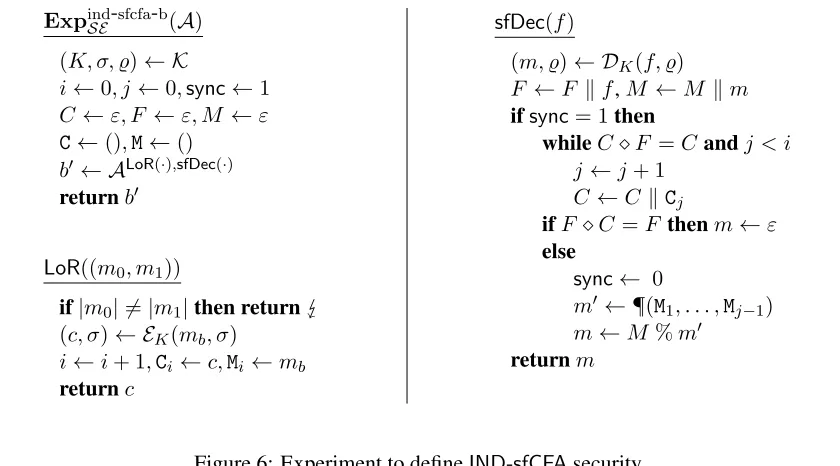
In our definition ofIND-sfCFA(Definition4.1) we opted for the strongest interpretation, namely where synchronisation is lost at the ciphertext boundary. Since this results in synchronization potentially being lost earlier, the decryption oracle consequently suppresseslessof its output, making it the stronger option. Definition 4.1. [IND-sfCFA] LetSE = (K,E,D)be an encryption scheme supporting fragmentation. For an adversaryAand a bitb, define experimentExpSEind-sfcfa-b(A)as depicted in Fig.6. The experiment starts by callingKto generate a keyK and initialise the states. The adversaryAis given access to a left-or-right encryption oracle LoR(·) and a stateful decryption oraclesfDec(·). The stateful decryption oracle can be queried on any sequence of ciphertext fragments, but as long as the decryption queries are in sync the output will be artificially suppressed.
ExpindSE-sfcfa-b(A)
(K, σ, %)← K
i←0, j←0,sync←1
C ←ε, F ←ε, M ←ε
C←(),M←()
b0 ← ALoR(·),sfDec(·)
returnb0
LoR((m0, m1))
if|m0| 6=|m1|then return
(c, σ)← EK(mb, σ)
i←i+ 1,Ci ←c,Mi←mb
returnc
sfDec(f)
(m, %)← DK(f, %)
F ←F kf,M ←M km
ifsync= 1then
whileCF =Candj < i
j←j+ 1
C ←C kCj
ifFC=F thenm←ε
else
sync← 0
m0 ← ¶(M1, . . . ,Mj−1)
m←M%m0
returnm
Figure 6: Experiment to defineIND-sfCFAsecurity.
as well. The corresponding advantage of an adversaryAis given by:
AdvindSE-sfcfa(A) = PrhExpindSE-sfcfa-1(A) = 1i−PrhExpSEind-sfcfa-0(A) = 1i.
The scheme SE is said to be IND-sfCFA secure, if for every adversaryA with reasonable resources its advantageAdvindSE-sfcfa(A)is small.
A few words of explanation about the workings ofsfDec(·)are in order. Recall thatCF denotes the greatest common prefix ofCandF. Thus the test conditionCF = Cchecks whetherC is a prefix of
F. The while loop starts by gathering the sequence of complete ciphertexts that have been relayed from the left-or-right oracle to the decryption oracle, concatenates them into one string, appends the subsequent ciphertext output byLoR(·)(if this exists), and stores the output inC. Then ifF (the concatenation of all ciphertext fragments submitted for decryption) is a prefix ofC, the queries are deemed to be in sync and the output is suppressed. Otherwise thesyncflag is set to0and the output string corresponding to the first out-of-sync ciphertext and onwards is returned.
4.2 A Notion for SBB Schemes
ExpindSE-sbbcfa-b(A)
(K, σ, %)← K
i←0, F ←ε,C←()
b0← ALoR(·),Dec(·)
returnb0
LoR((m0, m1))
if|m0| 6=|m1|then return
(c, σ)← EK(mb, σ)
i←i+ 1,Ci ←c
returnc
Dec(f)
M ←ε,prefix←0 len← |f|
fork= 1tolen
(m, %)← DK(f[k], %)
m0 ←m0 km
F ←F kf[k]
if%=εandm0[|m0|] =¶then ifF ∈Cthenm0 ←ε
M ←M km0
F ←ε, m0←ε
for allc∈C
ifFc=F thenprefix←1 ifprefix= 0then
M ←M km0, m0 ←ε
returnM
Figure 7: Experiment to defineIND-sbbCFAsecurity.
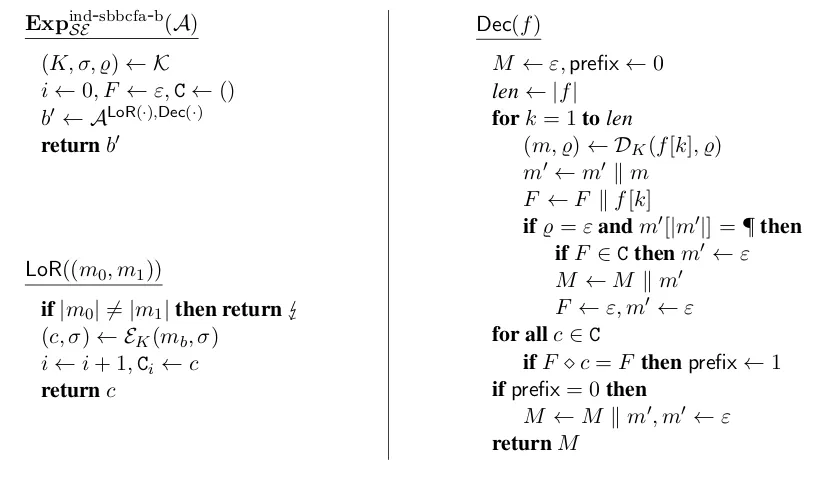
we exploit the literal decryption property to decrypt ciphertext fragments incrementally, i.e. bit by bit. Then we can detect ciphertext boundaries by looking for a condition where the last output symbol is¶and the decryption state is empty. Since Definition 4.2 makes use of properties specific to SBB schemes, it only guarantees a meaningful notion of security for this subclass of schemes, and not schemes supporting fragmentation in general.
Definition 4.2. [IND-sbbCFA] Let SE = (K,E,D) be an encryption scheme supporting fragmentation that is stateless-beyond-buffering. For an adversaryAand a bitb, define experiment ExpindSE-sbbcfa-b(A) as depicted in Fig. 7. The experiment starts by calling K to generate a key K and initialise the states. The adversary A is then given access to a left-or-right encryption oracle LoR(·) and a decryption oracle
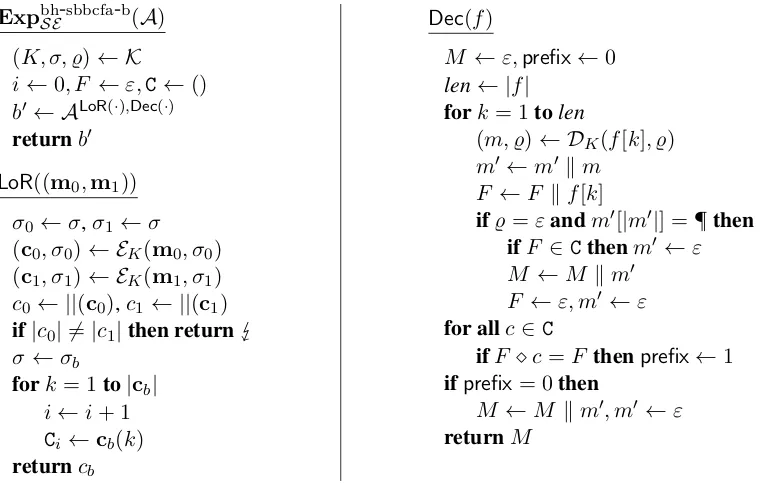
Dec(·). The decryption oracle can be queried on any sequence of ciphertext fragments, except that the output corresponding to a ciphertext previously output by the left-or-right oracle will be artificially suppressed.
The adversary’s goal is to output a bitb0as its guess of the challenge bitb, and the experiment returnsb0
as well. The corresponding advantage of an adversaryAis given by:
AdvindSE-sbbcfa(A) = PrhExpindSE-sbbcfa-1(A) = 1i−PrhExpSEind-sbbcfa-0(A) = 1i.
The schemeSE is said to beIND-sbbCFAsecure, if for every adversaryA with reasonable resources its advantageAdvindSE-sbbcfa(A)is small.
ciphertext boundary is encountered. Similarly,m0 accumulates the plaintext bits corresponding to a single message. If after processingf,F does not yet contain a complete ciphertext, but it contains a prefix of a ciphertext that was previously output by the encryption oracle, the corresponding plaintext is not output but is stored inm0 instead.
5
Boundary Hiding
It is conventional wisdom that an encryption scheme cannot hide entirely the message length from an ad-versary. In practice however, the message length can convey information about the nature of the message. For instance the IPsec attacks from [7, 8] identify ICMP error messages from their length and use this to recover the full plaintext of encrypted messages. As another example, traffic analysis has been used to derive approximate transcripts of encrypted Voice over IP (VoIP) conversations [19]. Traffic analysis is a real concern, and in practice heuristic countermeasures are commonly employed to mitigate such attacks. Practical protocols like TLS, SSH, and IPsec use variable-length padding, while IPsec additionally provides the ability to insert dummy messages/packets. A recent study by Dyer et al. [9] shows that none of the afore-mentioned countermeasures, together with others that have been proposed in the literature, are effective in preventing HTTP fingerprinting. However their attacks do not rely solely on ciphertext lengths.
The ability to fragment ciphertexts without affecting correct decryption may be exploited as an alterna-tive (heuristic) means to frustrate traffic analysis. Ciphertext lengths may no longer be evident from a stream of randomly-fragmented ciphertexts flowing across a channel. However this requires the encryption scheme to not reveal ciphertext boundaries. We therefore formalise the goal of hiding ciphertext boundaries within a concatenation of ciphertexts as an intermediate security goal towards this heuristic strategy and preventing traffic analysis in general.
We give definitions for both the passive and the active adversary cases. The passive case is the one that is commonly assumed in the traffic analysis literature [9,19]. Here the adversary merely monitors encrypted traffic and tries to infer information from ciphertext lengths and other information such as network packet timings, but without risking of giving away its presence by actively modifying network traffic. If ciphertext boundaries are not discernible to the adversary, then it can no longer determine individual ciphertext lengths, except of course, for the total volume being sent. As we will see, achieving security in the passive case is relatively straightforward. Much more challenging is achieving security in the active case. For example, it was already pointed out by Albrecht et al. [1] that SSH, while attempting to hide ciphertext boundaries, fails to do so against active, fragmented attacks (there is a simple bit-flipping attack which works irrespective of whether CBC or CTR mode encryption is used in the SSH construction).
5.1 Security Definitions
ExpbhSE-cpa-b(A) ExpbhSE-sfcfa-b(A)
(K, σ, %)← K
i←0, j←0,sync←1
C ←ε, F ←ε, M ←ε
C←(),M←()
b0 ← ALoR(·) b0 ← ALoR(·),sfDec(·)
returnb0
LoR((m0,m1))
σ0←σ,σ1←σ
(c0, σ0)← EK(m0, σ0)
(c1, σ1)← EK(m1, σ1)
c0 ← ||(c0),c1← ||(c1)
if|c0| 6=|c1|then return
σ ←σb
fork= 1tok=|cb|
i←i+ 1
Ci←cb(k),Mi ←mb(k) returncb
sfDec(f)
(m, %)← DK(f, %)
F ←F kf,M ←M km
ifsync= 1then
whileCF =Candj < i
j←j+ 1
C ←C kCj
ifFC=Fthenm←ε
else
sync← 0
m0 ← ¶(M1, . . . ,Mj−1)
m←M%m0
returnm
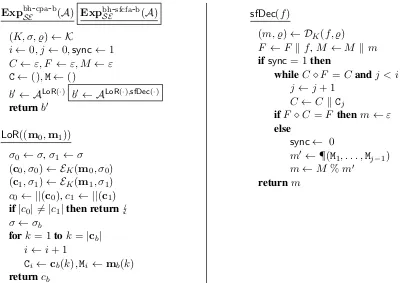
Figure 8: Experiments to defineBH-CPAandBH-sfCFAsecurity. ForBH-CPAthe boxed code is excluded, whereas forBH-sfCFAthe boxed code replaces the code adjacent to it.
in sync the output is artificially suppressed.
In both experiments, the adversary’s goal is to output a bitb0 as its guess of the challenge bitb, and the experiment returnsb0as well. The corresponding advantages of an adversaryAare given by:
AdvbhSE-cpa(A) = PrhExpbhSE-cpa-1(A) = 1i−PrhExpSEbh-cpa-0(A) = 1i,
AdvbhSE-sfcfa(A) = PrhExpbhSE-sfcfa-1(A) = 1i−PrhExpSEbh-sfcfa-0(A) = 1i.
The schemeSE is said to beBH-CPA(orBH-sfCFA) secure, if for every adversaryAwith reasonable resources its advantageAdvbhSE-cpa(A)(respectivelyAdvbhSE-sfcfa(A)) is small.
Analogously to the case of confidentiality, we can define a natural SBB variant of this notion by replacing the stateful decryption oraclesfDec(·)in Fig.8with the decryption oracleDec(·)from Fig.7. As before the resulting experiment, displayed in Fig.9, assumes properties that are specific to SBB schemes, and hence this security notion is only meaningful for SBB schemes.
ExpbhSE-sbbcfa-b(A)
(K, σ, %)← K
i←0, F ←ε,C←()
b0 ← ALoR(·),Dec(·)
returnb0
LoR((m0,m1))
σ0 ←σ,σ1 ←σ
(c0, σ0)← EK(m0, σ0)
(c1, σ1)← EK(m1, σ1)
c0 ← ||(c0),c1 ← ||(c1)
if|c0| 6=|c1|then return
σ←σb
fork= 1to|cb|
i←i+ 1
Ci ←cb(k) returncb
Dec(f)
M ←ε,prefix←0 len← |f|
fork= 1tolen
(m, %)← DK(f[k], %)
m0←m0km
F ←F kf[k]
if%=εandm0[|m0|] =¶then ifF ∈Cthenm0 ←ε
M ←M km0
F ←ε, m0 ←ε
for allc∈C
ifF c=Fthenprefix←1 ifprefix= 0then
M ←M km0, m0←ε
returnM
Figure 9: Experiment to defineBH-sbbCFAsecurity.
of messages, either the left or the right result is returned, but with the caveat that the concatenation of ciphertexts is returnedonlyif it has the same length in both worlds (but note that we do not insist that the two vectors of messages contain the same number of components). The adversary is additionally given a decryption oracleDec(·). It can query the decryption oracle on any sequence of ciphertext fragments, except that the output corresponding to a ciphertext previously output by the left-or-right oracle will be artificially suppressed.
The adversary’s goal is to output a bitb0, as its guess of the challenge bitb, and the experiment returns
b0as well. We define the advantage of an adversaryAas: AdvindSE-sbbcfa(A) = Pr
h
ExpindSE-sbbcfa-1(A) = 1
i
−Pr h
ExpindSE-sbbcfa-0(A) = 1
i
.
The schemeSE is said to beIND-sbbCFAsecure, if for every adversaryA with reasonable resources its advantageAdvindSE-sbbcfa(A)is small.
It turns out that the above definition, which we argue is the natural analogue of the boundary-hiding definition in the stateful setting, is unsatisfiable by any ‘reasonable’ SBB encryption scheme, see the note at the end of this section. As such our coverage of boundary hiding in the SBB setting will be somewhat limited.
Relating Boundary Hiding to Indistinguishability. We now establish a few relations between notions of boundary hiding and notions of indistinguishability which we will use in later Sections. Theorem5.3states that for length-regular2 schemes boundary hiding implies left-or-right indistinguishability. Intuitively this
2
An encryption scheme is said to belength-regularif for allm1, m2 ∈ Mwhere|m1|=|m2|it holds (with probability 1) that
follows because the special left-or-right oracle in theBH-ATKnotions can be used to simulate the left-or-right oracle in theIND-ATKnotions. The requirement on length-regularity ensures that a valid query to the
IND-ATKoracle results in a valid query to theBH-ATKoracle. Other than that the proof is straightforward and we omit it. Moreover, it is not too hard to show thatBH-ATKis strictly stronger thanIND-ATK: take anyIND-ATKsecure scheme and append each ciphertext with a special marker string, e.g.,1128.
Theorem 5.3. [BH-ATK −→ IND-ATK] LetSE = (K,E,D)be a length-regular symmetric encryption scheme supporting fragmentation. For anyATK ∈ {CPA,sbbCFA,sfCFA} and anyIND-ATK adversary
Aindthere exists aBH-ATKadversaryAbhconsuming similar resources toAindsuch that:
AdvindSE-atk(Aind)≤AdvbhSE-atk(Abh).
Intuitively the concatenation of multiple random strings is indistinguishable from a single random string of the same length. It then follows that schemes having ciphertexts indistinguishable from random strings should also hide ciphertext boundaries. This is stated more formally, for the passive setting3, in the following theorem. Again it is not hard to show that this implication is strict: take anyBH-CPA secure scheme and re-encode its ciphertexts by doubling every bit, i.e.,0→00and1→11.
Theorem 5.4. [IND$-CPA−→BH-CPA] LetSE = (K,E,D)be a symmetric encryption scheme support-ing fragmentation. For anyBH-CPAadversaryAbh there exists anIND$-CPAadversaryAind$ consuming
similar resources toAbhsuch that:
AdvbhSE-cpa(Abh)≤2·Advind$SE -cpa(Aind$).
Proof. For any adversary Abh we construct adversary Aind$ as follows. Adversary Aind$ picks a bit d
uniformly at random and then runsAbh. ThenAind$ uses this bit and its own encryption oracle to simulate
the special left-or-right encryption oracle toAbh. That is, it usesdto pick the message vector, it encrypts
each message in the vector componentwise, and returns their concatenation. IfAbh’s output is equal tod,
thenAind$ outputs 1 else it outputs 0. Now whenAind$ is run in the IND$-CPA experiment withb = 1it
providesAbhwith a perfect simulation of theBH-CPAexperiment with random bitd. Otherwise ifb= 0
the responses toAbh’s queries are completely independent to the bitdbecause they are random strings of
appropriate length. We thus have that:
Advind$SE -cpa(Aind$) = PrhExpind$SE -cpa-1(Aind$) = 1i−PrhExpSEind$-cpa-0(Aind$) = 1i
= Prhd← {0,1}:ExpSEbh-cpa-d(Abh) =d
i
−1
2
= 1 2 +
1 2·Adv
bh-cpa
SE (Abh)−
1 2
= 1 2 ·Adv
bh-cpa
SE (Abh).
3It can be shown that this implication does not hold in the stateful setting, in fact the stateful InterMAC construction of
6
Denial of Service
In this section we study fragmentation-related Denial-of-Service (DoS) attacks. This is, to the best of our knowledge, the first formal treatment of DoS prevention as a property of a symmetric encryption scheme. In Section1.1we outlined such a DoS attack for the case of SSH. In that example, by carefully tampering with only a few bits in one of the transmitted ciphertexts, the adversary manages to ‘confuse’ the decryption algorithm so that it will produce no output until a huge amount of ciphertext is received. Informally this kind of attack is what our security notions will attempt to capture. We stress that such attacks are not specific to SSH, but relate more generally to schemes supporting fragmentation. We will equip the adversary with an encryption oracle and a decryption oracle. Its goal will be to produce a sequence of ciphertext fragments whose concatenation is at least nbits long, where each of these fragments decrypts to the empty string. We will then quantify the DoS security of a scheme via the minimum value ofn such that no ‘efficient’ adversary is successful in producing such a sequence of fragments.
The countermeasure adopted by SSH to mitigate against such attacks cf. [20, Section 6.1] is to limit the maximum ciphertext length tonbits; thereby ensuring that the decryption algorithm will produce an output after at most n bits of ciphertext. In the case of OpenSSH n is set to 221. We consider this to be a serious limitation since it affects the usability of the scheme. If two parties wish to exchange large files, it is understood that this may require waiting for large amounts of ciphertext before recovering it at the receiver side, and this should be allowed. What we wish to avoid is cases where the communicating parties are exchanging short messages, but the adversary is able to tamper with the ciphertexts in such a way that the receiver has to wait for a large amount of ciphertext before producing an output. Thus we aim to formulate DoS security in a way that allows loweringnwithout necessarily restricting the maximum message size in the message space. To accommodate this we exclude trivial win conditions of the type where a passive adversary forwards ciphertexts (or fragmentations thereof) of lengthnor higher from the encryption oracle to the decryption oracle. In essence we will insist that the sequence of fragments by which the adversary wins be generated by an active adversary. In the stateful setting this means that we will require the ‘winning’ sequence of fragments to occur after the adversary has become active. In the SBB setting, trivial win conditions will be trickier to catch. We now formulate the two definitions more precisely.
6.1 Security Definitions
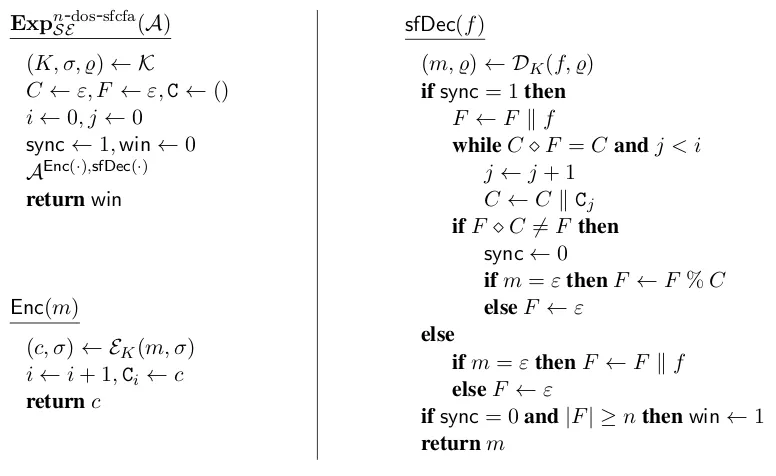
Definition 6.1. [n-DOS-sfCFA] LetSE = (K,E,D) be an encryption scheme supporting fragmentation. For an adversaryAand a positive integern, define the experimentExpSEn-dos-sfcfa(A)as depicted in Fig.10. The experiment starts by callingK to generate a keyK and initialise the states. The adversaryAis then given access to an encryption oracle Enc(·), and a stateful decryption oracle sfDec(·). The adversary’s goal is to submit to the stateful decryption oracle sfDec(·) an out-of-sync sequence of fragments whose combined length is at leastnbits, such that all fragments return no output upon decryption. In the event that the adversary succeeds, the experiment returns1, and0otherwise. The output of the stateful decryption oracle is never suppressed.
We define the advantage of an adversaryAas: Advn-SEdos-sfcfa(A) = Pr
h
Expn-SEdos-sfcfa(A) = 1
i
.
Expn-SEdos-sfcfa(A)
(K, σ, %)← K
C←ε, F ←ε,C←()
i←0, j←0
sync←1,win←0
AEnc(·),sfDec(·)
returnwin
Enc(m)
(c, σ)← EK(m, σ)
i←i+ 1,Ci ←c
returnc
sfDec(f)
(m, %)← DK(f, %) ifsync= 1then
F ←F kf
whileCF =Candj < i
j ←j+ 1
C ←CkCj
ifFC6=F then
sync←0
ifm=εthenF ←F%C
elseF ←ε
else
ifm=εthenF ←F kf
elseF ←ε
ifsync= 0and|F| ≥nthenwin←1 returnm
Figure 10: Experiment to definen-DOS-sfCFAsecurity.
The initial lines of code in the decryption oracle work as before: their purpose is to detect when the queries become out of sync, i.e. when the adversary becomes active. Once the queries have become out of sync, the variableF is used to store the last concatenation of out-of-sync fragments that did not return any output upon decryption. If at any point the size ofF exceedsn, thewinflag is set. In the case where the first out-of-sync fragment returns no output upon decryption, only the out-of-sync portion of that fragment is stored inF. That is, we measure the ciphertext from the point at which the tampering has occurred. This excludes trivial win conditions, resulting say from a legitimately-produced long ciphertext (longer thann
bits) where thelastbit is flipped by the adversary. Permitting such win cases would also require limiting a scheme’s maximum message size for it to be secure.
We now define an analogous DoS security notion in the SBB setting. As before we want to exclude win conditions where the adversary merely forwards (possibly fragmented) ciphertexts from the encryption ora-cle to the decryption oraora-cle. While in the stateful setting the adversary is considered active if he reorders or replays ciphertext, in the SBB setting we will consider this behaviour to be passive. Thus adversarial strate-gies that exploit reorderings and replays are deemed invalid in the SBB setting. This distinction between the stateful and SBB settings is present in all security notions considered thus far. Adapting this ideology to DoS security, if the winning sequence of fragments coincides with the start of a new ciphertext, we do not want it to correspond to a fragmentation of a long ciphertext that was previously output by the encryption oracle. Moreover, it should not be prefixed by a previously-output ciphertext, or by a prefix of a previously-output ciphertext. A sequence of fragments that satisfies these requirements is said to benon-trivial.
Expn-SEdos-sbbcfa(A)
(K, σ, %)← K
F ←ε,C←()
i←0, q←0
tmp←0,win←0
AEnc(·),Dec(·)
returnwin
Enc(m)
(c, σ)← EK(m, σ)
i←i+ 1,Ci←c
returnc
Dec(f)
M ←ε, m0 ←ε
len← |f|
fork= 1tolen
(m, %)← DK(f[k], %)
m0 ←m0 km
F ←F kf[k]
if%=εandm0[|m0|] =¶then
M ←M km0
F ←ε, m0←ε
ifM km0 6=εthenq← |F|
if|F| −q≥nthen
tmp←1 for allc∈C
if|F%c|< nthentmp←0
win←tmp
returnM km0
Figure 11: Experiment to definen-DOS-sbbCFAsecurity.
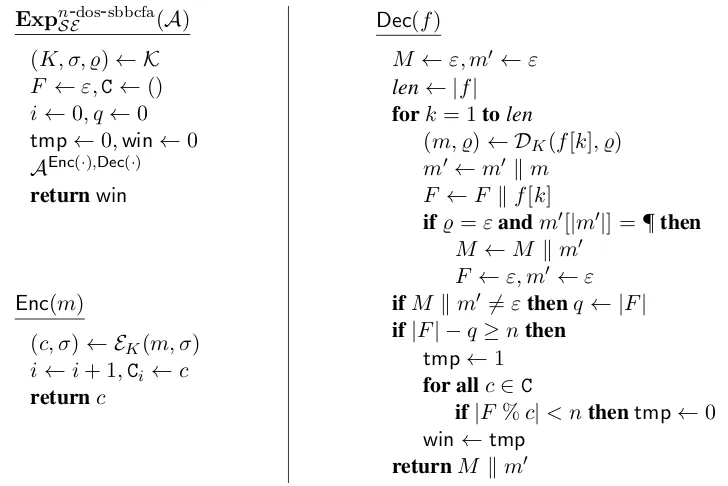
submit to the decryption oracleDec(·)a non-trivial sequence of fragments whose combined length is at least
nbits, such that all fragments return no output upon decryption. In the event that the adversary succeeds, the experiment returns1, and0otherwise. The output of the decryption oracle is never suppressed.
We define the advantage of an adversaryAin this experiment as: Advn-SEdos-sbbcfa(A) = Pr
h
Expn-SEdos-sbbcfa(A) = 1
i
.
The schemeSE is said to ben-DOS-sbbCFAsecure if, for every adversaryAwith reasonable resources, its advantageAdvnSE-dos-sbbcfa(A)is small.
Once again we exploit literal decryption to decrypt ciphertext fragments incrementally. This allows the decryption oracle to detect ciphertext boundaries in order to filter out trivial win conditions. The variable
F stores the concatenation of all ciphertext bits belonging to the current ciphertext. If the end of ciphertext is detected (by checking for the condition where% = εand m0[|m0|] = ¶), thenF is reset. The variable
q points to the end of the last received fragment withinF that produced an output. Each time a fragment is received the decryption oracle checks whether the concatenation of fragments that did not produce an output, i.e. F[q + 1,|F|], is at least n bits long. If so it further verifies that after all possible replayed ciphertext prefixes are removed, it still is at leastnbits long.
once the (possibly very large) ciphertext has been received in full. On the other hand, if a scheme isn-DOS
-sfCFAsecure it does not guarantee that adversarially generated ciphertexts will be rejected. We purposefully chose to maintain this separation between the two notions, as we feel that the two security goals are rather different. This said, a combination of the two security notions has practical significance, since it guarantees that any tampering in the communication would be detected withinnbits. Intuitively it is easy to see that the InterMAC constructions, presented in the next section, achieve this combined security goal.
7
Constructions
7.1 Applying Instantaneously Decodable Postprocessing (IDP)
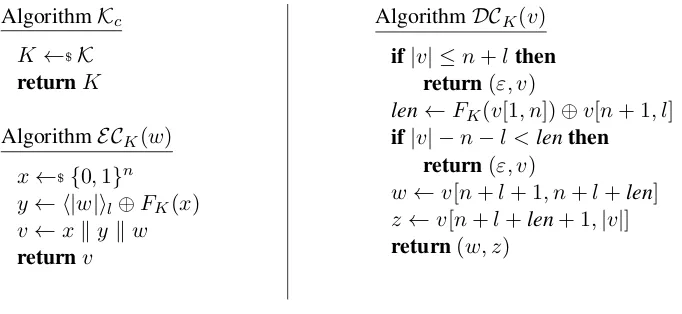
We now present a simple transformation for converting a symmetric encryption scheme to an encryption scheme that supports ciphertext fragmentation. In addition we will see that if the scheme that we start with isIND-sfCCAsecure, then the constructed scheme will be IND-sfCFAsecure. Similarly if we start with a scheme that is IND-CCA secure, the constructed scheme will satisfy IND-sbbCFA security. The construction will make use of an instantaneously decodable encoding scheme. Later we will see that if we allow the encoding scheme to be keyed and probabilistic, the construction can in addition achieve boundary hiding against passive adversaries. Towards this goal, we extend the syntax of encoding schemes as follows. Generalised Encoding Schemes. An encoding schemeES = (Kc,EC,DC)is a triple of algorithms with an associated word spaceW ⊆ {0,1}∗. The randomisedkey-generationalgorithmKctakes no input and returns a secret keyK. TheencodingalgorithmECwhich may be stateful, probabilistic, or both, takes as input a secret keyK and a string (word) w ∈ W to return a codeword v ∈ {0,1}∗. The deterministic decodingalgorithmDC takes as input a secret keyK and a codeword v ∈ {0,1}∗ to return a wordw ∈ W ∪ {ε}, possibly followed by other outputs. For any keyK, we denote the range of the encoding algorithm byECK(W).
Definition 7.1. [Instantaneous Decodability] An encoding scheme ES = (Kc,EC,DC) with associated wordspaceW ⊆ {0,1}∗, is said to be instantaneously decodable if for all keysKthat can be output byK
c, it holds that:
1. For allw∈ W, and alls∈ {0,1}∗, ifv← EC
K(w)then(w, s)← DCK(vks). 2. For alls∈ {0,1}∗, if nov∈ ECK(W)is a prefix ofsthen(ε, s)← DCK(s).
Note that instantaneous decodability does not require the encoding scheme to be keyed. In fact any keyless encoding scheme that is prefix-free is also instantaneously decodable. Later in this section we will give an example of a keyed encoding scheme that is instantaneously decodable. Throughout we assume that
Kc,EC, andDCare efficiently computable algorithms.
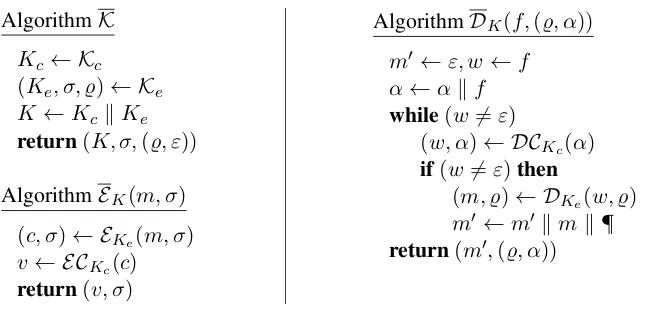
Construction 7.2. [The IDP Construction] LetSE = (Ke,E,D)be a symmetric encryption scheme with associated message spaceMand ciphertext spaceC. LetES = (Kc,EC,DC)be an instantaneously de-codable encoding scheme with an associated word space that containsC. Then the construction specified in Figure 12 yields an encryption scheme supporting fragmentation SE = (K,E,D) with an associated message spaceM. Furthermore ifSEis stateless, thenSEis stateless beyond buffering.
AlgorithmK
Kc← Kc
(Ke, σ, %)← Ke
K ←KckKe
return(K, σ,(%, ε))
AlgorithmEK(m, σ) (c, σ)← EKe(m, σ)
v← ECKc(c) return(v, σ)
AlgorithmDK(f,(%, α))
m0←ε, w←f
α←αkf
while(w6=ε)
(w, α)← DCKc(α) if(w6=ε)then
(m, %)← DKe(w, %)
m0 ←m0 kmk ¶
return(m0,(%, α))
Figure 12: The constructed schemeSEusing instantaneously decodable postpocessing.
maintains is the bufferα. Now the buffer is always initialised toε, and it is easy to see that after decrypt-ing any complete ciphertext, the buffer will always be empty. Finally, because all submitted fragments are appended to the buffer from which ciphertexts are then extracted and submitted toD, decryption is inde-pendent of the fragmentation pattern. Hence the scheme also satisfies literal decryption, and consequently is stateless beyond buffering.
Note that by instantiating the encoding scheme with a prefix-free encoding, we get a very efficient trans-formation for converting a ‘standard’ symmetric encryption scheme to an encryption scheme that supports fragmentation. We next show the nice property that if we start from a scheme that isIND-sfCCAsecure, the transformation yields a scheme that isIND-sfCFAsecure.
Theorem 7.3. [IDP isIND-sfCFAsecure] LetSE = (K,E,D)be the scheme from Construction7.2, com-posed from a symmetric encryption schemeSE = (Ke,E,D)and an instantaneously decodable encoding schemeES = (Kc,EC,DC). Then for anyIND-sfCFAadversaryAsfcfa againstSE, there exists anIND
-sfCCAadversaryAsfccaagainstSE such that:
AdvindSE-sfcfa(Asfcfa)≤AdvindSE-sfcca(Asfcca), (1)
whereAsfccaconsumes similar resources toAsfcfa.
Proof. For any adversary Asfcfa we construct adversary Asfcca as follows. Adversary Asfcca runs Kc to generate an encoding key and then runsAsfcfa. It then uses the encoding key together with its left-or-right
oracle to simulateAsfcfa’s left-or-right oracle as per Construction7.2, keeping record of the ciphertexts it
returns. Asfcfa’s decryption queries are handled by maintaining a buffer to which the queried fragments are
appended. Then Asfcca repeatedly applies the decoding algorithm to the buffer until no codeword can be
extracted, and submits the codewords, in the same order, to its own stateful decryption oracle. When the queries become out of sync, the returned messages are appended with ¶, concatenated together, and the resulting string is returned toAsfcfa.Asfccauses its records to keep track of whenAsfcfa’s queries become out
of sync. This is necessary since the first out of sync query might correspond to an encryption ofε, andAsfcfa
would not be able to distinguish this case from a message being suppressed because it is in sync. Finally
ExprpeES-b(A)
K← Kc
b0← AEoR(·)
returnb0
EoR(`)
w←${0,1}`
v← ECK(w)
ifb= 0then
v←${0,1}|v|
returnv
Figure 13: Experiment to define randomness preserving encodings.
From the instantaneous decodability ofESit follows thatAsfcca’s decryption queries will be in sync if
and only ifAsfcfa’s decryption queries are in sync. ThereforeAsfccaprovidesAsfcfawith a perfect simulation
of its environment. Thus:
Prhd←${0,1} : Expind-sfcfa-d
SE (Asfcfa) =d
i
≤
Prhb←${0,1} : ExpindSE-sfcca-b(Asfcca) =b
i
,
and equation (1) follows.
The following analogous theorem is implied by a similar proof which we omit to avoid repetition. Theorem 7.4. [IDP is IND-sbbCFAsecure] Let SE = (K,E,D) be the scheme from Construction 7.2, composed from a symmetric encryption schemeSE = (Ke,E,D)with stateless decryption, and an instan-taneously decodable encoding scheme ES = (Kc,EC,DC). Then for anyIND-sbbCFAadversary Asbbcfa
againstSE, there exists anIND-CCAadversaryAccaagainstSEsuch that:
AdvindSE-sbbcfa(Asbbcfa)≤AdvindSE-cca(Acca),
whereAccaconsumes similar resources toAsbbcfa.
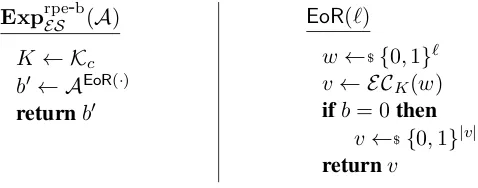
Construction7.2shows thatIND-sfCFAandIND-sbbCFAsecurity are not hard to attain. However when we instantiate the encoding scheme with a prefix free encoding, ciphertext boundaries will inevitably be revealed. While this is what allows the constructed scheme to support ciphertext fragmentation, it obviously conflicts with the goal of boundary hiding. We partly solve this conflict by employing a keyed encoding scheme, which reveals ciphertext boundaries solely to the holder of the encoding key. We now formulate a security property for encoding schemes that will allow Construction7.2to achieveIND$-CPAsecurity, and by Theorem5.4hide ciphertext boundaries from passive adversaries.
The adversary’s goal is to output a bitb0, as its guess of the challenge bitb, and the experiment returnsb0as well. We define the adversary’s rpe-advantage as:
AdvrpeES(A) = Pr h
ExprpeES-1(A) = 1 i
−Pr h
ExprpeES-0(A) = 1 i
.
The encoding schemeESis said to be arandomness preserving encoding(RPE) scheme, if for every adver-saryAwith reasonable resources its advantageAdvrpeES(A)is small.
Theorem 7.6. [IDP isIND$-CPAsecure] Let SE = (Ke,E,D) be a symmetric encryption scheme with associated message space M and ciphertext space C. Let ES = (Kc,EC,DC) be an encoding scheme with an associated word space that contains C. Define the encryption scheme supporting fragmentation
SE = (K,E,D)according to Construction7.2. For anyIND$-CPAadversaryAind$againstSE, there exist
adversariesA0ind$andArpesuch that:
Advind$SE -cpa(Aind$)≤AdvSEind$-cpa(A0ind$) +AdvrpeES(Arpe), (2)
whereA0ind$andArpeconsume similar resources toAind$.
Proof. To prove Theorem7.6 we introduce we introduce a hybrid experimentExpH, similar in spirit to the twoIND$-CPAexperiments corresponding to each bit value. The hybrid experiment proceeds exactly as Expind$-cpa-1
SE , except that the encryption oracle returns encodings of random strings instead. More specifically, after computing an encryption underSEof the queried message, it picks uniformly at random a string of the same length as the ciphertext, and returns an encoding underES of this string instead. We then have that:
Advind$SE -cpa(Aind$) =
Pr
h
Expind$SE -cpa-1(Aind$) = 1
i
−Pr [ExpH(Aind$) = 1 ]
+
Pr [ExpH(Aind$) = 1 ]−Pr
h
Expind$SE -cpa-0(Aind$) = 1
i
. (3)
Now we consider each of the above terms in the braces separately. For any adversaryAind$distinguishing
between the two experiments in the first term, we construct anIND$-CPAadversaryA0ind$againstSE. Ad-versaryA0
ind$runsKcto obtain an encoding key and then runsAind$. It then simulatesAind$’s encryption
oracle in accordance with the IDP construction, except that it uses its own oracle to compute encryptions underSE. It then outputs whatever Aind$ outputs. Note that whenA0ind$’s oracle returns real ciphertexts,
it providesAind$ with a perfect simulation of the IND$-CPA experiment with a bit value of one. Alterna-tively whenA0ind$’s oracle returns random strings, it providesAind$with a perfect simulation of the hybrid
experiment. Hence:
PrhExpind$SE -cpa-1(Aind$) = 1i−Pr [ExpH(Aind$) = 1 ]≤Advind$SE -cpa(A0ind$) (4) Similarly, for any adversaryAind$ distinguishing between the two experiments in the second term, we
con-struct an RPE adversaryArpeagainstES. AdversaryArperunsKeto obtain an encryption key and then runs
Aind$. It simulatesAind$’s encryption oracle by computing an encryption of the queried message underSE,
it then queries its own oracle with the length of this ciphertext and forwards the response toAind$. It then
outputs whateverA0