Web Spam Detection Using Improved Decision
Tree Classification Method
Rashmi R. Tundalwar Computer Engineering Department
Modern College of Engineering Pune, India
Prof. Manasi Kulkarni Computer Engineering Department
Modern College of Engineering Pune, India
Abstract - While Web document quality gets decreases by the presence of Web spam, as a effect of this high commercial value of top-ranked search-engine results. Web spamming refers to the introduction of some ranking algorithm by which some web pages gets higher rank than they actually deserve. To get over of this we present first new approaches like Language Model Disagreement and Qualified link analysis and also introduced new classification methods. There are variety of classification algorithm are available but Decision tree is the simplest one because it’s having uncomplicated hierarchical structure. Here we are utilizing C5.0 as a modified decision tree classification algorithm of C4.5. In this paper we are comparing the accuracy of various classification algorithm and finds C5.0 gives highest accuracy. For this we are using publicly available dataset of WEBSPAM-UK2006 and WEBSPAM-UK2007.
Index Terms - Classification, Data mining, Web spam detection, Language Model, Feature selection, Decision tree.
I.INTRODUCTION
A.PURPOSE
Currently, web spam is being serious concern for search engine spiders. Therefore search engine optimization techniques are necessary to identify spam in order to maintain the truthfulness of the online revivers and to detect possible spam activities also for improving the accuracy of search engine result
.
Web spamming, or spam indexing, includes all techniques used for the goal of getting an undeservedly high rank.Publicly three types of Web spam’s are there:• Link Spam: - link spam can be defined as “links between different pages that present for reasons rather than merit.” It consists of the formation of a link structure to take advantage of link-based ranking algorithms, such as PageRank, which gives a higher ranking to a website the more other highly ranked websites link to it.
• Content Spam: - It includes all techniques that involve altering the logical view that a search engine has over the page contents [10], for instance, by inserting keywords that are more related to popular query terms than to the actual content of the page.
• Cloaking: - A technique in which the content presented to the search engine spider is different to that presented to the browser of the user.
In this work, we also adopt this scheme and propose new features to characterize Web spam pages. However, while most previous works using content and link-based features to detect spam are focused on quantitative features, in this work, we propose several new qualitative features [12] to improve Web spam detection grouped in two sets: 1) a group of link-based features which check the reliability of links, and 2) a group of content-based features extracted with the help of a language-model (LM) approach. Finally, we build an automatic classifier that combines both types of features, reaching a precision that improves the results of each type separately and those obtained by other proposals. What web spammers do?
Web spammers target the last page as shown in following fig
B. QUALIFIED LINK ANALYSIS
of quality as defined in [12]. This qualitative analysis has been designed to study neither the network topology, nor link characteristics in a graph. With this sort of analysis, we mainly try to find nepotistic links [10], [3] that are present for reasons other than merit. For that, we have studied different quality parameters from a website. It includes the analysis of web links i.e. Internal-external links, incoming- outgoing links and broken links.
C. FEATURES
1) Language Models: One of the most successful methods based on term distribution analysis uses the concept of KL divergence [8] to compute the divergence between the probability distributions of terms of two particular documents considered. We have applied KL divergence to measure the differences between two text units of the source and target pages. Specifically, we look at the differences in the term distribution between two text units by computing the KL divergence
2) Lm-Based Features: To improve web spam detection, we proposed a technique that checks the coherence between a page and one pointed by any of its links. Two pages linked by a hyperlink should be semantically related, by at least a weak contextual relation. They make a Language Model from each source of information and ask how different these two language models are from each other. These sources of information are: i) anchor text, surrounding anchor text and URL terms from the source page, and ii) title and content from the target page.
They apply Kullback-Leibler divergence on the language models to characterize the relationship between two linked pages
Anchor Text: When a page links to another, this page has only a way to convince a user to visit this link by showing relevant and summarized information of the target page. This is the function of the anchor text. Therefore, it is a great divergence evidence of spam. In addition, Mishne et al. [14] and Benczúr et al. [3] proved that disagreement between anchor text and the target content is a very useful measure to detect spam.
Surrounding Anchor Text: Sometimes anchor terms provide little or no descriptive value. Let us imagine a link whose anchor text is - click here. For this reason, text surrounding a link can provide contextual information about the pointed page. Moreover, in [3], a better behavior is observed when the anchor text is extended with neighboring words. In our experiments, we are going to use several words around the anchor text (seven per side) to extend it, though we took into account HTML block-level elements and punctuation marks.
URL Terms: Besides the anchor text, the only information available of a link is its URL. A URL is mainly composed of a protocol, a domain, a path, and a file. These elements are composed of terms that can provide rich information
from the target page. During recent years, because of the increasing use of search engines, search engine optimization (SEO) techniques exist that try to exploit the importance of URL terms in a request. Thus, if we have a URL such as www.domain.com/viagra- youtube-free-download-poker-online.html‖, and after visiting this page, a pornographic site, it could be said that this page uses spam techniques. Therefore, we are going too retrieved the most relevant terms from a URL in order to calculate the divergence with the content of the target page. To extract these most relevant terms, first of all, we are building an LM with terms from URLs in the Open Directory Project (ODP) public list. Afterwards, with help of this collection of URLs, we are applying the KL divergence in order to know the most relevant terms in a certain URL. Finally, we use the top 60% of these terms because this value has provided the best results in some preliminary experiments. We also get the following three sources of information from the target page:
Title: Jin et al. [13] observed that document titles bear a close resemblance to queries, and that they are produced by a similar mental process. Eiron et al. [11] studied the similarity of title and anchor text and they concluded that both titles and anchor text capture some notion of what a document is about, though these sources of information are linguistically dissimilar. In addition, it is well-known that anchor text, terms of a URL, and terms of the Web page title, have a great impact when search engines decide whether a page is relevant to a query. In other words, spammers perform engineering tasks in order to set key terms in these sources of information. Therefore, divergence between these sources of information, from source and target pages, reports a great usefulness in the detection of Web spam.
Page content: The page content is the main source of information that is usually available. Although in many cases, the title and Meta tags from the target page are not available, most Web pages have at least a certain amount of text. Previous works that have studied the relationship between two linked Web pages, have usually considered the content of the target page in order to extract any data and/or measure. Qi et al. [12] used the TF-IDF content similarity of two Web pages by measuring the term-based similarity among their 1) textual content, 2) anchor text, and 3) nonanchor text. In addition, Mishne et al. [14] compared two LMs between blog posts and pages linked by comments, and Benczúr [3] et al. proved that
Disagreement between anchor text and the target content is a very useful measure to detect spam.
source page, such as anchor text and surrounding anchor text, and from the target page such as page content and URL terms. Although Meta tags are only found at between 30%–40% of the sites, when they are located in a Web page, their usefulness is very high. Many combinations of these sources of information could be used to measure the divergence between two Web pages. However, considering the issue of computational complexity, he has chosen a set of features that are easy to compute and that are useful in Web spam detection.
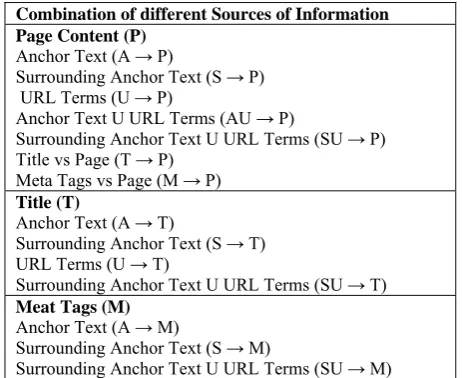
3) Combination of Sources of Information: In addition to using these sources of information individually, we have combined some of them from the source page with the goal of creating virtual documents which provide richer information. As we have seen above, we have used Anchor Text (A), Surrounding Anchor Text (S), and URL terms (U) as sources of information. We also propose to create two new sources of information: 1) combining Anchor Text and URL terms (AU) and 2) combining Surrounding Anchor Text and URL terms (SU). In addition, we have considered other sources of information from the target page: Content Page (P), Title (T), and Meta Tags (M). We have also ruled out the use of any combination due to the limited relationship between these sources of information. Table I summarizes all 14 features used in this work. The group on the top corresponds to divergences between different data (or combinations of them) in the source page and the pointed page (P). The group in the middle corresponds to divergences between data in the source page and the title of the pointed page. And the last group corresponds to divergence between data in the source page and meta tags associated to the pointed page.
TABLE I COMBINATION OF DIFFERENT SOURCES OF INFORMATION USED TO CALCULATE THE KL DIVERGENCE
Combination of different Sources of Information Page Content (P)
Anchor Text (A → P)
Surrounding Anchor Text (S → P) URL Terms (U → P)
Anchor Text U URL Terms (AU → P)
Surrounding Anchor Text U URL Terms (SU → P) Title vs Page (T → P)
Meta Tags vs Page (M → P) Title (T)
Anchor Text (A → T)
Surrounding Anchor Text (S → T) URL Terms (U → T)
Surrounding Anchor Text U URL Terms (SU → T) Meat Tags (M)
Anchor Text (A → M)
Surrounding Anchor Text (S → M)
Surrounding Anchor Text U URL Terms (SU → M)
4) Internal and External Links: SEO Websites and Blogs have published some articles which assert that the relationship between internal and external links, i.e., a ratio between the number of such links, is important to obtain a higher PageRank. Thus, internal and external links in a page would have impact on the ranking provided by a search engine. This suggests that spammers may be using algorithms that take into account this information to
promote their pages. For these reasons, we have decided to distinguish internal and external links in order to carry out the divergence analysis. Therefore, for each Web page we have triple-features: 14 features for internal links, 14 features for external links, and 14 features for both internal and external links [2].
II.RELATED WORK
This paper [1] introduces the techniques Naive Bayes, Support Vector Machine and C4.5 Decision Tree Classifier. The result is a system that significantly improves the detection of Web spam using fewer features. Using this techniques it has been proven that QL features have obtained better results than precompiled content and link-based features, even with many fewer features. In addition, when we combine the four sets of features and we apply them to datasets, the system detects 89.4 % and 54.2 % of the spam domains.
In this paper [2] we have presented a novel algorithm, witch, for the task of detecting Web spam. We have compared witch to several proposed algorithms by using the techniques learning with Graph Regularization, Additional Slack Variables, and Optimization. We observe that the greatest boost appears to be due to the addition of slack variables. This is likely the result of under fitting: there may not be a single linear predictor w on the available feature space that can accurately detect spam, thus the slack introduces an additional level of freedom to the model for accurately classifying spam. We have found that it outperforms all such techniques. Finally, witch obtains the highest AUC performance score on an independent Web spam detection challenge.
Closest to our research are the works by Mishne et al. [14], which apply LMs to Blog spam detection. Here, the authors estimate LMs from the original post and each comment in a Blog and then they compare these models using a variation on the Interpolated Aggregate Smoothing. In particular, this measure calculates the smoothed KL divergence between the LM of a short fragment of text (original post) and a combined LM of knowledge preceding this text (previous comments). They collected 50 random blog posts, along with the 1024 comments posted to them and although they did not get very good results, they propose a model expansion that should improve the performance.
Qi et al. [12] distinguished between QLs and advertising or spam, using six similarity measures considering the issue of computational complexity: Host, URL, Topic Vector, TF-IDF content, Anchor Text, and Nonanchor Text. To calculate these measures they used methods such as Cosine, Dice, or Naive Bayes over the URL terms, anchor texts, or content. They also compared this method with Hits and PageRank ranking approaches, introducing two measures: Qualified HITS and Qualified PageRank. Through experiments on 53 query specific datasets, they showed that their approach improved precision by 9% compared to the Bharat and Henzinger [16] HITS variation proposal.
are based on a group of link based features which checks reliability of links and a group of content based features extracted with the help of Language Model approach. Finally we build an automatic classifier that combines both these of features, reaching a precision that improves the results of each type separately and those obtained by other proposals. Some of the considered features are related to the quality of the links in the page, behavior of standard search Engines, applied to the queries thus increasing the spam detection rate.
As a naive baseline [13], we use the maximum likelihood probabilities for the comment type in our model; as noted earlier, 68% of the comments were spam, so we assume an ad-hoc fixed probability of 0.68 for a comment to contain link spam. We achieve reasonable performance with our model, and can clearly see the trade-off between misclassifying spam and misclassifying non-spam, resulting from different modifications to the language model threshold.
This Paper [15] used Truncated PageRank and probabilistic estimation of the number of neighbors to build an automatic classifier for link spam using several link based features. In this paper, we are more focused on investigating which (combinations of) features are good for spam detection, and we try to build classifiers that can achieve high precision by using a small set of features. Using this approach we are able to detect 80.4 % of the Web spam in our sample, with only 1.1 % of false positives.
III.EXPERIMENTS
CLASSIFICATION METHOD
A. Classification Algorithm
The first step to obtain the best results in the classification task is to select the most appropriate classifier. We selected different classification algorithms to evaluate the introduced features. In particular, we have chosen the following classification algorithms: Naive Bayes, a statistical classifier based on the Bayes theorem using the joint probabilities of sample observations to estimate the conditional probabilities of classes given an observation; SVMs which aim at searching for a hyper plane that separates two classes of data with the largest margin. In this paper the modified decision tree algorithm of C4.5 i.e. C5.0 is used. This gives more accuracy than C4.5.
We used implementation of decision tree, Naïve Bayes and the sequential minimal optimization (SMO) implementation of an SVM RBF kernel.
The evaluation of the learning schemes used in all the predication of this paper was performed by ten-fold cross-validation. For each evaluation, the dataset is split into ten equal partitions and is train ten times. Every time, the classifier trains with nine out of ten partitions and uses the tenth partition as test data. We have adopted the well known performance measure in Web spam Research: true positive (TP or recall), false positive (FP) rate, and F-measure. F-measure combines precision P and recall R by F=2(PR) /(P+R). For evaluating the classification
algorithms, we focus on the F- measure as it is a standard measure to summarize both precision P and Recall R.
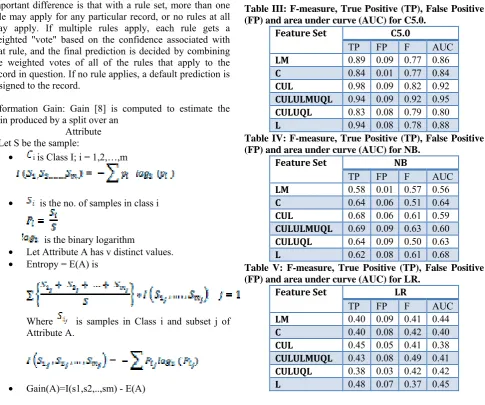
Table II, Table III, Table IV and Table V shows the F-measure, True Positive (TP), False Positive (FP) and area under curve (AUC) for SVM, NB, LR and C5.0 algorithms, based on the features we introduced in previous section. The best classifier in most of the feature set is the decision tree followed by SVM classifier.
B. The C5.0 Classifier
The C5.0 algorithm is a new generation of Machine Learning Algorithms (MLAs) based on decision trees [5]. It means that the decision trees are built from list of possible attributes and set of training cases, and then the trees can be used to classify subsequent sets of test cases. C5.0 was developed as an improved version of well-known and widely used C4.5 classifier and it has several important advantages over its ancestor [6]. The generated rules are more accurate and the time used to generate them is lower (even around 360 times on some data sets). In C5.0 several new techniques were introduced:
1. Boosting: several decision trees are generated and combined to improve the predictions.
2. Variable misclassification costs: it makes it possible to avoid errors which can result in harm. 3. New attributes: dates, times, timestamps, ordered
discrete attributes.
4. Values can be marked as missing or not applicable for particular cases.
5. Supports sampling and cross-validation.
The C5.0 classifier contains a simple command-line interface, which was used by us to generate the decision trees, rules and finally test the classifier. In addition a free C source code for including C5.0 classifier in external applications is available on the C5.0 website. Detailed description of C5.0 and all its options and abilities is published in the tutorial [7].
C5.0 offers a number of improvements on C4.5. Some of these are Speed - C5.0 is significantly faster than C4.5
• Memory usage - C5.0 is more memory efficient than C4.5
• Smaller decision trees - C5.0 gets similar results to C4.5 with considerably smaller decision trees.
• Support for boosting - Boosting improves the trees and gives them more accuracy.
• Weighting - C5.0 allows you to weight different cases and misclassification types.
• Winnowing - a C5.0 option automatically winnows the attributes to remove those that may be unhelpful.
Decision Tree Based C5.0 Classification Algorithm 1. This node uses the C5.0 algorithm to build either
2. A C5.0 model works by splitting the sample based on the field that provides the maximum information gain.
3. Each subsample defined by the first split is then split again, usually based on a different field, and the process repeats until the subsamples cannot be split any further.
4. Finally, the lowest-level splits are reexamined, and those that do not contribute significantly to the value of the model are removed.
C5.0 can produce two kinds of models. A decision tree is a straightforward description of the splits found by the algorithm. Each terminal (or "leaf") node describes a particular subset of the training data, and each case in the training data belongs to exactly one terminal node in the tree. In other words, exactly one prediction is possible for any particular data record presented to a decision tree. In contrast, a rule set is a set of rules that tries to make predictions for individual records. Rule sets are derived from decision trees and, in a way, represent a simplified or distilled version of the information found in the decision tree. Rule sets can often retain most of the important information from a full decision tree but with a less complex model. Because of the way rule sets work, they do not have the same properties as decision trees. The most important difference is that with a rule set, more than one rule may apply for any particular record, or no rules at all may apply. If multiple rules apply, each rule gets a weighted "vote" based on the confidence associated with that rule, and the final prediction is decidedby combining the weighted votes of all of the rules that apply to the record in question. If no rule applies, a default prediction is assigned to the record.
Information Gain: Gain [8] is computed to estimate the gain produced by a split over an
Attribute Let S be the sample:
• is Class I; i = 1,2,…,m
• is the no. of samples in class i
is the binary logarithm
• Let Attribute A has v distinct values.
• Entropy = E(A) is
Where is samples in Class i and subset j of Attribute A.
• Gain(A)=I(s1,s2,..,sm) - E(A)
C. Results
In order to check if the proposed features improve the precision of spam detection, we decided to use precompiled features available for the public dataset. Specifically, we have used the content-based features and the transformed link-based features. In addition, we have combined different feature sets in order to obtain a classifier which has been able to detect both content-spam and link-spam cases. Finally, we have combined content, link, LM, and QL features, achieving a more accurate classifier. As a baseline for our experiments, we selected the pre-Computed content and link features in a combined way to detect different types of Web spam pages.
Table II: F-measure, True Positive (TP), False Positive (FP) and area under curve (AUC) for SVM.
Feature Set SVM
TP FP F AUC
LM 0.76 0.04 0.75 0.81
C 0.85 0.08 0.76 0.84
CUL 0.85 0.03 0.83 0.81
CULULMUQL 0.83 0.02 0.85 0.85
CULUQL 0.84 0.06 0.70 0.73
L 0.82 0.08 0.81 0.83
Table III: F-measure, True Positive (TP), False Positive (FP) and area under curve (AUC) for C5.0.
Feature Set C5.0
TP FP F AUC
LM 0.89 0.09 0.77 0.86
C 0.84 0.01 0.77 0.84
CUL 0.98 0.09 0.82 0.92
CULULMUQL 0.94 0.09 0.92 0.95
CULUQL 0.83 0.08 0.79 0.80
L 0.94 0.08 0.78 0.88
Table IV: F-measure, True Positive (TP), False Positive (FP) and area under curve (AUC) for NB.
Feature Set NB
TP FP F AUC
LM 0.58 0.01 0.57 0.56
C 0.64 0.06 0.51 0.64
CUL 0.68 0.06 0.61 0.59
CULULMUQL 0.69 0.09 0.63 0.60
CULUQL 0.64 0.09 0.50 0.63
L 0.62 0.08 0.61 0.68
Table V: F-measure, True Positive (TP), False Positive (FP) and area under curve (AUC) for LR.
Feature Set LR
TP FP F AUC
LM 0.40 0.09 0.41 0.44
C 0.40 0.08 0.42 0.40
CUL 0.45 0.05 0.41 0.38
CULULMUQL 0.43 0.08 0.49 0.41
CULUQL 0.38 0.03 0.42 0.42
The results of our experiments for web spam datatset are shown in above tables. As it can be seen, if we only use the precompiled features from dataset, we obtain the best results combining content and link-based features (CUL). For this reason, we have chosen the union of these two sets of feature as a baseline for our experiment.
We can conclude from the values shown in Table II, Table III, Table IV and Table V that noteworthy improvements are obtained by combining LM and QL features. The four sets of features produce best result because each set focuses on a different type of spam and they have complementary characteristics. Thus this combination manages to detect content spam, link spam, Nepotistic links and QLs. Moreover if we consider the sets separately, each one of them has a different impact on the F –Measure parameters. While QL gets the best Precision, it also gets the worst Recall. LM gets the worst Precision, but it gets the best Recall. Finally, the combination of the four sets gets a very high Precision, without affecting the Recall.
From the above four tables we can conclude that decision tree C5.0 gives us higher F-measure and TP measure than others.
Results In terms of Graph
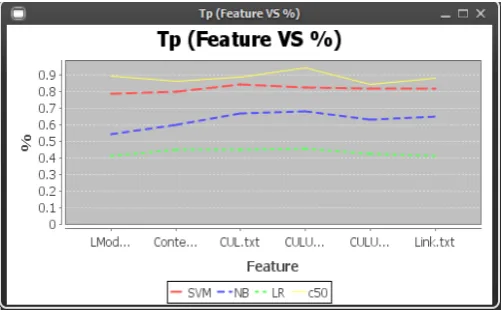
The comparison of all features for all algorithms is shown in following Figures i.e. Fig. 1, Fig. 2, Fig. 3 and Fig. 4 in the form of graph. This graph is shown for all measures i.e. TP, FP, AUC and F - measure.
Fig. 1 Comparison graph of Area under Curve (AUC)
Fig. 2 Comparison graph of True Positive (TP)
Fig. 3 Comparison graph of False Positive (FP)
Fig. 4Comparison graph of Frequency (F) graph
IV.CONCLUSION
In this we have used a new methodology to detect spam in the Web, based on an analysis of QLs and a study of the divergence between linked pages.
In this we have learned various features that we can consider for extraction of information from the dataset. To use QLs and the LM features effectively, we proposed a robust classifier based on a cost-sensitive algorithm as C5.0 classification algorithm used for generating the Decision Tree which describes the classification. We are using here C5.0 because it gives us higher accuracy than C4.5 which gives the higher accuracy in previous works. Here C5.0 gets similar results to C4.5 with considerably smaller decision trees. It also supports boosting which considerably smaller decision trees. The C5.0 automatically winnows the attributes to remove those that may be unhelpful. We have compared the various classifier results like SVM and C5.0 Decision Tree and founded C5.0 Decision tree classifier gives the higher accuracy.
ACKNOWLEDGMENT
We would like to thank Z. Gyöngyi and H. Garcia-Molina for understanding us web spam taxonomy and N. Eiron and K. S. McCurley for analyzing the anchor text for web search. We would also like to express our gratitude to a collaborative effort by a team of volunteers who made available for us the WEBSPAM-UK2007 dataset to run experiments efficiently.
REFERENCES
[1] Lourdes Araujo and Juan Martinez-Romo: Web Spam Detection: New Classification Features Based on Qualified Link Analysis and Language Models, IEEE TRANSACTIONS ON INFORMATION FORENSICS AND SECURITY, VOL. 5, NO. 3, SEPTEMBER 2010.
[2] J. Abernethy, O. Chapelle, and C. Castillo: Web spam Identification through content and hyperlinks, in Proc. Fourth Int. Workshop on Adversarial Information Retrieval on the Web (AIR Web), Beijing, China, 2008, pp. 41–44.
[3] A. A. Benczúr, I. Bíró, K. Csalogány, and M. Uher: Detecting Nepotistic links by language model disagreement, in Proc. 15th Int. Conf. World Wide Web (WWW’06), New York, 2006, pp. 939–940, ACM.
[4] Ping Wang : Web Spam Detection for Heritrix, last Edited by siznax on Nov 13, 2008
[5] Information on See5/C5.0 - Rule Quest Research Data Mining Tools, 2011 [Online].Available: http://www.rulequest.com/see5-info.htm
[6] Is See5/C5.0 Better Than C4.5? 2009. [Online]. Available:http://www.rulequest.com/see5-comparison.html
[7] Is See5/C5.0 Better Than C4.5?, 2009. [Online]. Available:http://www.rulequest.com/see5-comparison.html
[8] Zhu Xiaoliang, Wang Jian, Wu Shangzhuo, Yan Hongcan Research and Application of the improved Algorithm C4.5 on Decision Tree, Hebei Polytechnic University, International Conference on Test and Measurement 2009.
[9] B. Davison, Recognizing Nepotistic Links on the Web 2000[Online]. Available:citeseer.ist.psu.edu/davison00recognizing.html
[10] Z. Gyöngyi and H. Garcia-Molina: Web spam taxonomy, in Proc. First Int. Workshop on Adversarial Information Retrieval On the Web (AIR Web), 2005 [Online].Available: citeseer.ist.psu.edu/gyongyi05web.html
[11] N. Eiron and K. S. McCurley: Analysis of anchor text for web Search, in Proc. 26th Annu Int. ACM SIGIR Conf. Research And Development in Information Retrieval (SIGIR’03), New York, 2003, pp. 459–460, ACM.
[12] X. Qi, L. Nie, and B. D. Davison: Measuring similarity to Detect qualified links, in Proc. 3rd Int. Workshop on Adversarial Information Retrieval on the Web (AIRWeb’07), New York, 2007, pp. 49–56, ACM.
[13] R. Jin, A. G. Hauptmann, and C. X. Zhai: Title language Model for information retrieval, in Proc. 25th Annu. Int. ACM SIGIR Conf. Research and Development in Information Retrieval, New York, 2002, pp. 42–48, ACM
[14] G. Mishne, D. Carmel, and R. Lempel: Blocking blog spam With language model disagreement, in Proc. First Int. Workshop on Adversarial Information Retrieval on the Web (AIR Web), Chiba, Japan, 2005, pp. 1–6.
[15] Jian Pei, Bin Zho, Zhaohui Tang, Dylan Huang: Data Mining Techniques for Web Spam Detection, Simon Fras University Microsoft Ad Center .
[16] K. Bharat and M. R. Henzinger, “Improved algorithms for topic Distillation in a hyperlinked environment,” in Proc. 21st Annul. Int. ACM SIGIR Conf. Research and Development in Information Retrieval, New York, 1998, pp. 104–111, ACM