Forward Secure Signatures on Smart Cards
Full version
Andreas H¨ulsing?, Christoph Busold, and Johannes Buchmann
Cryptography and Computeralgebra Department of Computer Science
TU Darmstadt, Germany
{huelsing, buchmann}@cdc.informatik.tu-darmstadt.de,
Abstract. We introduce the forward secure signature scheme XMSS+ and present an implementation for smart cards. It is based on the hash-based signature scheme XMSS. In contrast to the only previous imple-mentation of a hash-based signature scheme on smart cards by Rohde et al., we solve the problem of on-card key generation. Compared to XMSS, we reduce the key generation time fromO(n) toO(√n), wherenis the number of signatures that can be created with one key pair. To the best of our knowledge this is the first implementation of a forward secure sig-nature scheme and the first full implementation of a hash-based sigsig-nature scheme on smart cards. The resulting runtimes are comparable to those of RSA and ECDSA on the same device. This shows the practicality of forward secure signature schemes, even on constrained devices.
Keywords forward secure signatures, smart cards, implementation, hash-based signatures
1 Introduction
In 1997 Anderson introduced the idea of forward secure signature schemes (FSS) [And97]. The idea behind FSS is the following: Even in the case of a key compromise, all signatures issued before the compromise should remain valid. This is an important property for all use cases where sig-natures have to stay valid for more than a short time period, including use cases like document signing or certificates. If for example a contract is signed, it is important that the signature stays valid for at least as long as the contract has some relevance. The solutions used today require the use of time stamps [ETS10,ETS12]. This introduces the requirement for a trusted third party and the overhead of requesting a time stamp for each
?
signature. FSS in turn already provide this property and thereby aban-don the need for time stamps. To fulfill the forward security property, a signature scheme has to bekey evolving, meaning, the private key changes over time. The lifetime of a key pair is divided into time periods. While the public key stays the same, the secret key is updated at the end of each time period. So far, it was shown that FSS can be efficiently implemented on PCs [BDH11, CJMM03]. As for common signature schemes, to be us-able in practice, FSS must be efficiently implementus-able on smart cards. This is even more important in the case of FSS, as it has to be ensured that the secret key is updated and the former secret key is deleted. So far there exists no implementation of FSS on smart cards.
A candidate FSS is the hash-based FSS XMSS [BDH11] because of its strong security guarantees (see Section 2). Moreover, XMSS benefits from hardware acceleration for block ciphers, which is provided by many smart cards. A severe problem of most FSS, including XMSS, is the costly key generation. XMSS key generation requires time linear in the number of signatures that can be generated using the same key pair. While this might be tolerable on PCs, it makes key generation on smart cards im-practical. The only existing implementation of a hash-based signature scheme on smart cards [RED+08] does not include on-card key genera-tion for this reason. But on-card key generagenera-tion is necessary for most use cases that benefit from the forward security property. I.e. to guarantee non-repudiation in the case of document signing, a signature key pair has to be generated on the smart card and must never leave this secure environment.
pair, signature generation took less than 106ms, verification took no more than 44ms. These timings are of the same order of magnitude than the runtimes for RSA and ECDSA on the same card using the asymmetric crypto co-processor.
Organization. We start with a description of XMSS in Section 2. XMSS+, that enables key generation, is presented and analyzed in Section 3. We describe our implementation and present parameters and runtimes in Sec-tion 4. Finally, we give a conclusion in SecSec-tion 5.
2 The eXtended Merkle Signature Scheme XMSS
In this section we describe the FSS XMSS [BDH11]. While there exist many proposals for FSS, including [BM99, AMN01, AR00, CK06, IR01, KR03, Kra00, MMM02, Son01], XMSS is the only FSS where the forward security is based on minimal security assumptions. XMSS uses a function familyF and a hash function familyH. It is provably forward secure in the standard model, ifF is pseudorandom andH second preimage resis-tant. As current research suggests that these properties are not threat-ened by the existence of quantum computers, XMSS+ is assumed to be resistant against quantum computer based attacks. We first give a high level overview. XMSS is build on a one-time signature scheme (OTS), a signature scheme where a key pair can only be used once. To obtain a many-time signature scheme, many OTS key pairs are used and their public keys are authenticated using a Merkle Tree. A Merkle Tree is a binary hash tree. The leaves of the tree are the hash values of the OTS public keys. The root of the Merkle Tree is the XMSS public key. To overcome the need of storing all OTS key pairs, they are generated using a pseudorandom generator (PRG). We start the detailed description with the parameters used by XMSS, afterwards we give a description of the building blocks, namely, the Winternitz-OTS, the XMSS Tree, the leaf construction, and the PRG. Then we describe the algorithms for key gen-eration, signature generation and verification. In the following we write log for log2 and x ←−$ X if the value x is chosen uniformly at random from the set X.
Parameters. For security parameter n∈N, XMSS uses a pseudorandom
function familyFn={FK :{0,1}n→ {0,1}n|K ∈ {0,1}n}, and a second
by the message lengthm∈N, the tree height h∈N, the BDS parameter k∈N, k < h, k−h is even, and the Winternitz parameterw∈N, w >1.
XMSS can be used to sign 2h message digests of mbits. The Winternitz parameterwallows for a trade off between signature generation time and signature size. The BDS parameter kallows for a time-memory trade-off for the signature generation. Those parameters are publicly known.
Winternitz OTS. XMSS uses a variant of the Winternitz-OTS (W-OTS) introduced in [BDE+11]. W-OTS uses the function familyFnand a value
X ∈ {0,1}n that is chosen during XMSS key generation. For K, X ∈
{0,1}n,e∈
N, andFK ∈ Fnwe defineFeK(X) as follows. We setF0K(X) =
K and for e > 0 we define K0 = FKe−1(X) and FeK(X) =FK0(X). Also, define
`1 =
m log(w)
, `2=
log(`1(w−1)) log(w)
+ 1, `=`1+`2.
The secret signature key of W-OTS consists of` n-bit stringsski, 1≤i≤ `. The generation of theskiwill be explained later. The public verification key is computed as
pk= (pk1, . . . ,pk`) = (Fwsk−11(X), . . . ,F w−1
sk` (X)),
withFw−1 as defined above. W-OTS signs messages of binary length m. They are processed in base w representation. They are of the formM = (M1. . . M`1),Mi ∈ {0, . . . , w−1}. The checksumC=P`1i=1(w−1−Mi)
in base wrepresentation is appended to M. It is of length `2. The result is a sequence of`basewnumbers, denoted by (T1, . . . , T`). The signature
of M is
σ= (σ1, . . . , σ`) = (FT1sk1(X), . . . ,F T`
sk`(X)).
It is verified by constructing (T1. . . , T`) and checking
(Fwσ1−1−T1(X), . . . ,Fσw`−1−T`(X)) ?
= (pk1, . . . ,pk`).
The sizes of signature, public, and secret key are`nbits. For more detailed information see [BDE+11].
XMSS Tree. The XMSS tree utilizes the hash functionH. The XMSS tree is a binary tree of height h. It has h+ 1 levels. The leaves are on level 0. The root is on level h. The nodes on level j, 0 ≤j ≤h, are denoted by Ni,j, 0≤i <2h−j. To construct the tree, h bit masks Bj ∈ {0,1}2n,
0< j≤h, are used.Ni,j, for 0< j≤h, is computed as
Leaf Construction. The leaves of the XMSS tree are the hash values of the W-OTS public keys. To avoid the need of a collision resistant hash function, another XMSS tree is used to construct the leaves. It is called L-tree. The ` leaves of an L-tree are the `bit strings (pk0, . . . ,pk`) from the corresponding verification key. As ` is not necessarily a power of 2, there might not be sufficiently many leaves to get a complete binary tree. Therefore the construction is modified. A left node that has no right sibling is lifted to a higher level of the L-tree until it becomes the right sibling of another node. In this construction, the same hash function as above but new bitmasks are used. The bitmasks are the same for all L-trees. As L-trees have height dlog`e, additional dlog`e bitmasks are required.
Pseudorandom Generator. The W-OTS key pairs are generated using two pseudorandom generators (PRG). The stateful forward secure PRG FsGen:{0,1}n→ {0,1}n×{0,1}nis used to generate one seed value per W-OTS keypair, using the function familyFn. Then the seed is expanded to the ` W-OTS secret key bit strings using Fn. FsGen starts from a
uniformly random state S0 ←− {$ 0,1}n. On input of a state Si, FsGen generates a new stateSi+1 and a pseudorandom output Ri:
FsGen(Si) = (Si+1||Ri) = (FSi(0)||FSi(1)).
The outputRiis used to generate theith W-OTS secret key (sk1, . . . ,sk`):
skj =FRi(j−1),1≤j≤`.
Key Generation. The key generation algorithm takes as input all of the above parameters. Then the whole XMSS Tree has to be constructed to obtain the value of the root node. We now detail this procedure. First, the bitmasks (B1, . . . , Bh+dlog`e) and the value X are chosen uniformly
at random. Then, the initial state of FsGen, S0 is chosen uniformly at random and a copy of it is stored as part of the secret key SK. The tree is constructed using the TreeHash algorithm, listed as Algorithm 1 below. Starting with an empty stack Stack and S0, all 2h leaves are successively generated and used as input to theTreeHashalgorithm to updateStack. This is done by evaluatingFsGen on the current stateSi,
obtainingRi and replacingSi withSi+1. ThenRi is used to compute the
W-OTS key pair and Ri are deleted. After all 2h leaves were processed
by TreeHash, the only value on Stack is the root of the tree, which is stored in the public key PK. The XMSS signature generation algorithm
Algorithm 1 TreeHash
Input:StackStack, nodeN1 Output:Updated stackStack
1. Whiletop node onStackhas same height asN1do
(a) t←N1.height() + 1
(b) N1←H((Stack.pop()||N1)⊕Bt)
2. Stack.push(N1)
3. ReturnStack
uses as subroutine the BDS algorithm [BDS08] that is explained there. The BDS algorithm uses a state StateBDS which is initialized during the above computation of the root. For details see [BDS08]. The initial XMSS secret keySK= (S0,StateBDS) contains the initial states ofFsGen and the BDS algorithm. The XMSS public key consists of the bitmasks (B1, . . . , Bh+dlog`e), the value X, and the root of the tree. As shown in
[BDH11], key generation requires 2h(`+ 1) evaluations of H and 2h(2 + `(w+ 1)) evaluations of functions from Fn.
Signature Generation The signature generation algorithm takes as input a message M, the secret key SK and the index i. It outputs an updated secret keySK0 and a signatureΣon the messageM. To sign theith mes-sage (we start counting from 0), the ith W-OTS key pair is used. The signature Σ= (i, σ,Auth) contains the index i, the W-OTS signatureσ, and the authentication path for the leaf N0,i. The authentication path is
the sequence Auth= (Auth0, . . . ,Authh−1) of the siblings of all nodes on the path fromN0,ito the root. Figure 1 shows the authentication path for
leaf i. We now explain how a signature is generated. On input of the ith message,SK contains theith stateSi ofFsGen. So, FsGenis evaluated
on Si to obtainSi+1, which becomes the updated secret key, and Ri.Ri
is used to generate the ith W-OTS secret key, which in turn is used to generate the one-time signature σ on M. Then the authentication path is computed using theBDS tree traversal algorithm from [BDS08] which we explain next. The BDS algorithm uses TreeHash to compute the nodes of the authentication path. The computation of a node on level i takes 2i leaf computations and 2i evaluations of
Fig. 1.The authentication path for leafi
j = h
j = 0
i
computation is done when the authentication path is needed, the com-putation of an authentication path requires 2h−1 leaf computations and evaluations ofTreeHashin the worst case. TheBDSalgorithm reduces the worst case signing time to (h−k)/2 leaf computations and evaluations of TreeHash. More specifically, the BDS algorithm does three things. First, it uses the fact that a node that is a left child can be computed from values that occurred in an authentication path before, spending only one evaluation of H. Second, it stores the right nodes from the topklevels of the tree during key generation. So these nodes, that are most expensive to compute, do not have to be computed again during signature generation. Third, it distributes the computations for right child nodes among previ-ous signature generations. This is done, using one instance ofTreeHash per tree level. The computation of the next right node on a level starts, when the last computed right node becomes part of the authentication path. The BDS algorithm uses a state StateBDS of 2(h−k) states of FsGenand at most 3h+h2−3k−2 + 2ktree nodes.StateBDS is ini-tialized during key generation. After initialization, it contains the right nodes on the ktop levels, the first authentication path (forN0,0) and the second right node on each level. To compute the authentication paths, the BDSalgorithm spends only (h−k)/2 leaf computations and evaluations ofTreeHashto update its state per signature. This update is done such that at the end of theith signature generation,StateBDSalready contains the authentication path for leaf i+ 1. For more details see [BDS08].
Signature Verification The signature verification algorithm takes as input a signatureΣ= (i, σ,Auth), the messageM and the XMSS public keyPK. To verify the signature, the values (T0, . . . , T`) are computed as described
in the W-OTS signature generation, using M. Then the ith verification key is computed using the formula
(pk1, . . . ,pk`) = (Fσ1w−1−T1(X), . . . ,Fw
−1−T`
The corresponding leaf N0,i of the XMSS tree is constructed using an
L-tree. This leaf and the authentication path are used to compute the path (P0, . . . , Ph) to the root of the XMSS tree, where P0 =N0,i and
Pj =
H((Pj−1||Authj−1)⊕Bj), if
i/2j
≡0 mod 2 H((Authj−1||Pj−1)⊕Bj), if
i/2j≡1 mod 2
for 0 ≤j ≤ h. If Ph is equal to the root of the XMSS tree given in the
public key, the signature is accepted. Otherwise, it is rejected.
3 XMSS+: On-card Key Generation
In [RED+08], a hash-based signature scheme similar to XMSS is imple-mented on smart cards. But they did not implement on-card key gener-ation, because of the heavy computations required. In this section we introduce XMSS+, which allows for fast on-card key generation. The techniques used are based on the tree chaining technique introduced in [BGD+06] and distributed signature generation from [BDK+07]. The basic idea is the following. To obtain an instance of XMSS+ that can be used to make 2h signatures, we use two levels of XMSS key pairs with height h/2 instead of one key pair with height h: One key pair on the upper level (U) of height h/2 is used to sign the roots of 2h/2 key pairs on the lower level (Ls) of height h/2. The root of U becomes the public key and the Ls are used to sign the messages. During key generation, U and the first L are generated. The generation of the remaining Ls is distributed among signature generations. As a result, the time to generate a key pair, that can be used to sign 2h messages, goes down fromO(2h) toO(2h/2).
Key generation. The XMSS+ key generation algorithm takes as inputs the security parameter n, the message length m, the hash function H, the function family F, and the overall height h, h is even. We set the internal tree height h0 =h/2. In contrast to the last section, it takes two Winternitz parameters wu, wl and twoBDS parameters ku, kl such that
h0−ki is even for i∈ {l, u}and (h0−ku)/2 + 1≤2h
0−kl+1
. As for XMSS, the bitmasks and the X are chosen uniformly at random, but this time h0+ max{log`u,log`l} bitmasks are chosen. Both, the bitmasks and the
X are used for both levels. Then the two XMSS key pairs L and U are generated. This is done as described in the last section. ForL,wl,kl, and
the message length mare used. For U,wu and ku are used. The message
length for U is n, because this is the size of the root nodes of the Ls. Next, the root ofL is signed using the first W-OTS keypair of U. Then, a FsGenstate for the next L is chosen uniformly at random, and a new TreeHashstack Stacknext is initialized.
The XMSS+ secret key SK consists of the two FsGen states Sl and
Su and the BDS states StateBDS,l and StateBDS,u for U and L and the
signature on the root ofL. Additionally, it contains aFsGen stateSn, a
TreeHash stack Stacknext and a BDS state StateBDS,n for the next L.
The public key PK consists of the h0+ max{log`1,log`2} bitmasks, the valueX and the root ofU.
Signature generation. The signature generation algorithm takes as input a message M, the secret key SK, and the index i. First, M is signed. This is done as described in the last section, using Sl and StateBDS,l as secret key for L and i mod 2h0 as index. During this signature gen-eration, BDS receives (h0 −kl)/2 updates. If not all of these updates
are used to update StateBDS,l, the remaining updates are used to
up-date StateBDS,u. Then one leaf of the next lower tree is computed and
used as input for TreeHash to update Stacknext. The signature Σ =
(σu,Authu, σl,Authl, i) contains the one-time signatures from U and L
and the two authentication paths, as well as the index i.
Ifi mod 2h0 = 2h0−1 the last W-OTS key pair of the currentL was used. In this case, Stacknext now contains the root of the next L. Now, U is used to sign this root. The key pair consists of Su and StateBDS,u. The used index is di/2h0e. In contrast to the signing algorithm from the last section, BDS receives no updates at this time. The updates needed to compute the next authentication path are received during the next 2h0 message signatures. InSK StateBDS,l,Sl, and the signature of the root of
respectively. Afterwards, the data structures for the nextLare initialized and used to replace the ones in SK.
Signature verification. The signature verification algorithm takes as input a signature Σ = (σu,Authu, σl,Authl, i), the message M and the public
key PK. To verify the signature, M and σl are used to construct the
corresponding W-OTS public key, and then the corresponding leaf node. This leaf node, Authl and the index j =i mod 2h
0
are used to compute the root of L. This root in turn, is used together with σu to compute
the W-OTS public key and the corresponding leaf node of U. This leaf node, Authu and the index j = bi/2h
0
c are used to compute a root for U. The root computations are done as described in the last section. If the resulting root equals the root node included in the public key, the signature is accepted and rejected otherwise.
3.1 Analysis
In the following we provide an analysis of XMSS+. We show that the dis-tributed authentication path computation works and revisit the security of the scheme. We start with key and signature sizes and the runtimes of the algorithms. A theoretical comparison with XMSS can be found in Appendix A.
Sizes and Runtimes. First we look at the sizes. The signature size grows by the size of one W-OTS signature and is (h+`u+`l)nbits. The public
key size slightly decreases, as the number of bitmasks decreases and is (h+ 2 max{log`u,log`l}+ 2)nbits. The secret key stays about the same
size, depending on the parameter choices, and is at most (7.5h−7kl−
5ku+ 2kl+ 2ku+`u)n bits. For the runtimes we only look at the worst
case times and get the following. The key generation time is reduced to 2h/2(`u+`l+ 2)tH+ 2h/2(4 +`u(wu+ 1) +`l(wl+ 1))tF, wheretHand tF denote the runtimes of one evaluation ofHandF, respectively. The worst case signing time also decreases because the trees are smaller and requires less than maxi∈{l,u}{(((h0−kl+2)/2)·(h0−ki+`i)+h0)tH+(((h0−kl+4)/2)·
(`i(wi + 1)) +h0−kl)tF} (Recall that h
0 = h/2). Signature verification
increases by the costs of verifying one W-OTS signature and computing the corresponding leaf. It requires (`u+`l+h)tH+ (`uwu+`lwl)tF.
signature on the (i+1)th root, all unused updates from the (i−1)thLcan be used. The signature algorithm spends (h0−kl)/2 updates per signature.
Hence, theBDS algorithm receives (h0−kl)2h
0−1
updates while the (i− 1)thLis used. For all authentication paths ofL, theBDSalgorithm has to compute all right nodes of the tree, that are on a height< h0−kl, besides
the two first right nodes on every height as these nodes are already stored during initialization. The number of required updates for 2≤kl≤h0 is
h0−kl−1 X
i=0
(2h0−i−1−2)2i = (h0−kl)2h
0−1
−2h0−kl+1
so there are (h0−kl)2h
0−1
−(h0−kl)2h
0−1
+ 2h0−kl+1 = 2h0−kl+1 unused updates. As (h0 −ku)/2 + 1 ≤ 2h
0−k
l+1, the BDS algorithm for the U
receives all (h0−ku)/2 updates to computeAuthi before it is needed and
one update is left for the signature on the next root. Doing the same computation for kl = 0 there are even more (3·2h
0−1
) unused updates. For kl =h0, it follows from (h0−ku)/2 + 1≤ 2h
0−kl+1
that ku =h0 and
therefore all nodes of both trees are stored.
Security. In [BDH11], an exact proof is given which shows that XMSS is forward secure, if F is a pseudorandom function family and H a sec-ond preimage resistant hash function family. The tree chaining technique corresponds to the product composition from [MMM02]. In [MMM02] the authors give an exact proof for the forward security of the product composition if the underlying signature schemes are forward secure. It is straight forward to combine both security proofs to obtain an exact proof for the forward security of XMSS+.
4 Implementation
In this section we present our smart card implementation. First we give a description of our implementation. Then we present our results and give a comparison with XMSS, RSA and ECDSA. At the end of the section we discuss an issue regarding the non-volatile memory (NVM).
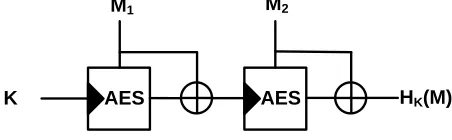
implementation of the card to implement the function families F and H. As proposed in [BDH11], we use plain AES for F. To implement H we build a compression function using the Matyas-Meyer-Oseas con-struction [MMO85] and iterate it using the Merkle-Darmgard construc-tion [Mer90,Dam90]. As the input size ofHis fixed, we do not require M-D strengthening. Figure 2 shows the whole construction. As shown there, the construction requires two AES evaluations per evaluation ofHK ∈ H.
All random inputs of the scheme are generated using the TRNG. Besides XMSS+, we also implemented XMSS for comparison.
Fig. 2. Construction of H using AES with the Matyas-Meyer-Oseas construction in M-D Mode.
AES AES
M1 M2
K HK(M)
Results. Tables 1 and 2 show the runtimes of our implementation with different parameter sets. We use the samekandwfor both trees. The last column shows the security level for the given parameter sets. Following the updated heuristic of Lenstra and Verheul [Len04] the configurations with a security level of 81 (85, 86) bits are secure until the year 2019 (2025, 2026). In Appendix B we explain how the security level is computed. Please note that these numbers represent a lower bound on the provable security level. A successful attack would still require an adversary to either find a second preimage in a 128 bit hash function or to launch a successful key retrieval attack on AES 128. This would result in 128 bit security for all parameter sets. In Table 1, the signature time is the worst case time over all signatures of one key pair. The secret key size in the table differs from the values we would obtain using the theoretical formulas from the last section. This is because it includes all data that has to be stored on the card to generate signatures, including the bitmasks and X.
Table 1.Results for XMSS and XMSS+for message lengthm= 256 on an Infineon
SLE78. We use the samek and wfor both trees. bdenotes the security level in bits. The signature times are worst case times.
Timings (ms) Sizes (byte)
Scheme h k w KeyGen Sign Verify Secret key Public key Signature b
XMSS+ 16 2 4 5,600 106 25 3,760 544 3,476 85
XMSS+ 16 2 8 5,800 105 21 3,376 512 2,436 81
XMSS+ 16 2 16 6,700 118 22 3,200 512 1,892 71
XMSS+ 16 2 32 10,500 173 28 3,056 480 1,588 54
XMSS+ 20 4 4 22,200 106 25 4,303 608 3,540 81
XMSS+ 20 4 8 22,800 105 21 3,920 576 2,500 77
XMSS+ 20 4 16 28,300 124 22 3,744 576 1,956 67
XMSS+ 20 4 32 41,500 176 28 3,600 544 1,652 50
XMSS 10 4 4 14,600 86 22 1,680 608 2,292 92
XMSS 10 4 16 18,800 100 17 1,648 576 1,236 78
XMSS 16 4 4 925,400 134 23 2,448 800 2,388 86
XMSS 16 4 16 1,199,100 159 18 2,416 768 1,332 72
on the smart card in practical time. For all but one used parameter set, the key generation time is below 30 seconds. The times for signature gen-eration and verification are all below 200 ms and 30 ms, respectively. The size of the secret key is around four kilo byte and signatures are around two kilo byte, while the public keys are around 500 bytes. Increasing the tree height for XMSS almost doubles key generation time. For XMSS+ the key generation time is almost doubled if one increases the height by two, as this means that the height of each internal tree is increased by one.
The results show that we can reduce the signature size by increasing the Winternitz parameterw. The behavior of the implementation reflects the theory. The factor for the reduction of the W-OTS signature size is only logarithmic inw. The increase of the runtime is negligible for small w. This can be explained by the following. While the length of the single function chains increases, the number of chains decreases. Forw >16 the increase of the runtime becomes almost linear. So from this point,w= 16 seems to be a good choice. On the other hand, the provable security level also decreases almost linearly in w. While this only reflects a provable lower bound on the security of the scheme, it is still another reason to keepw small.
Table 2. Results for XMSS+ for message lengthm = 256 on an Infineon SLE78 for
different values of k. We use the same k and w for both trees. The table shows the worst case signing times, as well as the average case times
Timings (ms) Size (byte)
Scheme h k w KeyGen Sign (w.c.) Sign (avg.c.) Secret key
XMSS+ 16 0 16 6,700 133 96 3,312
XMSS+ 16 2 16 6,700 118 96 3,200
XMSS+ 16 4 16 6,700 97 83 3,232
XMSS+ 16 6 16 7,000 95 67 4,352
XMSS+ 16 8 16 8,000 94 53 10,112
the other hand, the worst case signing time can only be reduced up to a certain limit. For the given parameters this limit is 94ms, the worst case signing time, when both trees are completely stored. These 94ms are mainly caused by the write operations, when one key pair on the lower level is finished. While all the computations are done in previous rounds, the data structures for the next lower level key pair have to be copied to the data structure for the current lower level key pair. Further the new data structures for the next lower level key pair must be initialized. Choosing k= 4 seems to be the most reasonable choice for h= 16.
Comparison. The last rows of Table 1 show the results for classical XMSS. The results show that XMSS key generation can be done on the smart card, but is impractical as it already takes more than 15 minutes for h = 16. Increasing the height by one almost doubles the runtime of key generation. Generating a key with XMSS+ is already for h = 16 almost 200 times faster than with XMSS. While XMSS+ signature generation is slightly faster for comparable parameters, verification is faster for XMSS. The faster key generation is paid by slightly bigger secret keys and sig-natures, while the XMSS+public keys are smaller, because of the reused bitmasks.
above, the security level of XMSS+ is 128 bit, when we only assume the best known attacks.
NVM. The changing key presents a challenge for the implementation of XMSS+ and XMSS on smart cards. NVM is organized in sectors and pages. Due to physical limitations only complete pages can be written (erased and reprogrammed) at once. Furthermore they wear out and can-not be programmed anymore after a certain number of write cycles, de-pending on the technology (about 500,000 in our case). However, as write operations are distributed over all 33 physical pages of a sector, the com-plete available cycles are around 16.5 million per sector.
Generating a key takes only a few hundred write cycles, but its state has to be updated after each signature step. Overall, one million available signatures require one million write cycles for the modification of the state. Using careful memory management, layout and optimization, we managed to keep the number of write cycles below five million for a key pair withh= 20, which is far below the 16.5 million available per sector. This includes key generation and all 220 signatures. It should be noted, that this affects only one NVM sector of the card. To use multiple keys, they can be placed in different sectors in order to preserve NVM quality.
5 Conclusion
We presented the first smart card implementation of a forward secure signature scheme. The results presented in Section 4 show that the im-plementation is practical and that key generation can be done on the card in less than a minute. This is in contrast to previous implemen-tations of similar schemes, that did not achieve on-card key generation. To achieve this, we introduced XMSS+, an improved version of XMSS. Besides the improved key generation, the worst case signing time is also reduced. While the presented improvement is necessary for an implemen-tation on smart cards, it might also show to be useful for implemenimplemen-tations on other hardware (At least in cases, where key generation time or worst case signing time are critical).
level of 128 bit. This leads to interesting directions for future work. One would be to either tighten the security proofs or find better reductions from different security assumptions. Another one would be to implement XMSS+with co-processors for block ciphers with a bigger block size than AES. Alternatively, it would be possible to use hash functions with a digest length of more than 128 bit, using the constructions from [BDH11] to construct the PRF.
One topic we did not address in this work is the side channel re-sistance. But the forward security property already protects against the most common attack vector for side channel attacks. If a user looses her smart card and revokes her key pair, an attacker can not gain any ad-vantage of a successful side channel attack. The secret key the adversary learns is revoked from this time on and it is not possible to learn the keys of prior time periods. Nevertheless, as there exist other attack vec-tors, it would be interesting to analyze the side channel resistance of our implementation.
References
[AMN01] Michel Abdalla, Sara Miner, and Chanathip Namprempre. Forward-secure threshold signature schemes. In David Naccache, editor,Topics in Cryptol-ogy — CT-RSA 2001, volume 2020 ofLecture Notes in Computer Science, pages 441–456. Springer Berlin / Heidelberg, 2001.
[And97] Ross Anderson. Two remarks on public key cryptology. In Manuscript. Relevant material presented by the author in an invited lecture at the 4th ACM Conference on Computer and Communications Security, CCS, pages 1–4. Citeseer, 1997.
[AR00] Michel Abdalla and Leonid Reyzin. A new forward-secure digital signature scheme. In Tatsuaki Okamoto, editor, Advances in Cryptology — ASI-ACRYPT 2000, volume 1976 ofLecture Notes in Computer Science, pages 116–129. Springer Berlin / Heidelberg, 2000.
[BDE+11] Johannes Buchmann, Erik Dahmen, Sarah Ereth, Andreas H¨ulsing, and Markus R¨uckert. On the security of the Winternitz one-time signature scheme. In A. Nitaj and D. Pointcheval, editors,Africacrypt 2011, volume 6737 ofLecture Notes in Computer Science, pages 363–378. Springer Berlin / Heidelberg, 2011.
[BDH11] Johannes Buchmann, Erik Dahmen, and Andreas H¨ulsing. XMSS - a prac-tical forward secure signature scheme based on minimal security assump-tions. In Bo-Yin Yang, editor, Post-Quantum Cryptography, volume 7071 of Lecture Notes in Computer Science, pages 117–129. Springer Berlin / Heidelberg, 2011.
[BDS08] Johannes Buchmann, Erik Dahmen, and Michael Schneider. Merkle tree traversal revisited. In Johannes Buchmann and Jintai Ding, editors, Post-Quantum Cryptography, volume 5299 ofLecture Notes in Computer Science, pages 63–78. Springer Berlin / Heidelberg, 2008.
[BGD+06] Johannes Buchmann, L. C. Coronado Garc´ıa, Erik Dahmen, Martin D¨oring, and Elena Klintsevich. CMSS - an improved Merkle signature scheme. In INDOCRYPT, volume 4329 of Lecture Notes in Computer Science, pages 349–363. Springer, 2006.
[BM99] Mihir Bellare and Sara Miner. A forward-secure digital signature scheme. In Michael Wiener, editor,Advances in Cryptology — CRYPTO’ 99, volume 1666 ofLecture Notes in Computer Science, pages 786–786. Springer Berlin / Heidelberg, 1999.
[CJMM03] Eric Cronin, Sugih Jamin, Tal Malkin, and Patrick McDaniel. On the per-formance, feasibility, and use of forward-secure signatures. InProceedings of the 10th ACM conference on Computer and communications security, CCS ’03, pages 131–144, New York, NY, USA, 2003. ACM.
[CK06] Jan Camenisch and Maciej Koprowski. Fine-grained forward-secure sig-nature schemes without random oracles. Discrete Applied Mathematics, 154(2):175 – 188, 2006. Coding and Cryptography.
[Dam90] Ivan Damg˚ard. A design principle for hash functions. In Gilles Brassard, editor, Advances in Cryptology — CRYPTO’ 89 Proceedings, volume 435 of Lecture Notes in Computer Science, pages 416–427. Springer Berlin / Heidelberg, 1990.
[ETS10] ETSI. XML advanced electronic signatures (XAdES). Standard TS 101 903, European Telecommunications Standards Institute, December 2010. [ETS12] ETSI. CMS advanced electronic signatures (CAdES). Standard TS 101
733, European Telecommunications Standards Institute, March 2012. [IR01] Gene Itkis and Leonid Reyzin. Forward-secure signatures with optimal
signing and verifying. In Joe Kilian, editor, Advances in Cryptology — CRYPTO 2001, volume 2139 ofLecture Notes in Computer Science, pages 332–354. Springer Berlin / Heidelberg, 2001.
[KR03] Anton Kozlov and Leonid Reyzin. Forward-secure signatures with fast key update. In Stelvio Cimato, Giuseppe Persiano, and Clemente Galdi, edi-tors, Security in Communication Networks, volume 2576 ofLecture Notes in Computer Science, pages 241–256. Springer Berlin / Heidelberg, 2003. [Kra00] Hugo Krawczyk. Simple forward-secure signatures from any signature
scheme. In CCS ’00: Proceedings of the 7th ACM conference on Computer and communications security, pages 108–115, New York, NY, USA, 2000. ACM.
[Len04] Arjen K. Lenstra. Key lengths. Contribution to The Handbook of Infor-mation Security, 2004.
[Mer90] Ralph Merkle. One way hash functions and DES. In Gilles Brassard, editor, Advances in Cryptology — CRYPTO’ 89 Proceedings, volume 435 ofLecture Notes in Computer Science, pages 428–446. Springer Berlin / Heidelberg, 1990.
[MMO85] Stephen Matyas, Carl Meyer, and Jonathan Oseas. Generating strong one-way functions with cryptographic algorithms. InIBM Technical Disclosure Bulletin 27, pages 5658–5659. IBM, 1985.
[RED+08] Sebastian Rohde, Thomas Eisenbarth, Erik Dahmen, Johannes Buchmann, and Christof Paar. Fast hash-based signatures on constrained devices. In Gilles Grimaud and Fran¸cois-Xavier Standaert, editors, Smart Card Re-search and Advanced Applications, volume 5189 ofLecture Notes in Com-puter Science, pages 104–117. Springer Berlin / Heidelberg, 2008.
[Son01] Dawn Xiaodong Song. Practical forward secure group signature schemes. In Proceedings of the 8th ACM conference on Computer and Communications Security, CCS ’01, pages 225–234, New York, NY, USA, 2001. ACM.
A Comparison with XMSS
In the following, we compare sizes and runtimes of XMSS+and XMSS. To get a fair comparison, we assume that the same number of nodes is stored in the BDS states in both schemes. Therefore we set ku = kl = k−1,
where k is the BDS parameter for XMSS. Note that this parameter se-lection can not be compared in practice, as h−kmust be even because otherwise the number of updates is no integer. For the theoretical com-parison this is no problem. Further we assume, that the same Winternitz parameter is chosen for both schemes and for both levels. Last we assume, that messages are the output of a collision resistant hash function and therefore set m= 2n. Given this, `u≈`/2 as the message length ofU is
n. The signature size grows by`unbits, the size of one W-OTS signature,
as both authentication paths together contain only hnodes, which is the same as for the single authentication path of XMSS and the index stays the same. The public key is slightly decreased, as the number of bitmasks decreases fromh+dlog`etoh0+ max{log`u,log`l}, whileXand the root
value stay the same size. The secret key contains two BDS states with 2(h0−ki) states of FsGen and at most 3(h0) +bh0/2c −3ki−2 + 2ki
tree nodes for i∈ {u, l}. Using ku =kl =k−1, the two states together
contain 4(h0−k+ 1) states ofFsGenand 6h0+bh0c −6k+ 2 + 2k tree nodes. So here we save k−2 states of FsGen and 3k−2 tree nodes, or (4k−4)n bits. On the other hand, we have to store 2 additionalFsGen states for the seeds ofU and the nextL, one additional W-OTS signature of `un bits, and StateBDS,n. StateBDS,n requires only h
0 −k+ 1 states
of FsGen and at most (3h0−k+ 1) tree nodes, as some of the space is not needed during initialization and the space for the nodes of the k upper levels can be shared with the space for those nodes in StateBDS,l.
All together this results in an overhead of (`u + 2h −6k+ 8)n which
runtimes we only look at the worst case times and get the following. The key generation time is reduced from 2h(`+ 1)tH+ 2h(2 +`(w+ 1))tF to 2h/2(`u+`l+ 2)tH+ 2h/2(4 +`u(wu+ 1) +`l(wl+ 1))tF, wheretHand tF denote the runtimes of one evaluation ofHandF, respectively. The worst case signing time also decreases. While a signature using XMSS required ((h−k+2)/2·(h−k+`))tH+((h−k+2)/2·(`(w+1))+h−k)tF, a signature for XMSS+ requires less than maxi∈{l,u}{(((h/2−kl+ 2)/2)·(h/2−ki+
`i) +h/2)tH+ ((h/2−kl+ 4)/2·(`i(wi+ 1)) +h/2−kl)tF}. This is the case, because the computation of a node in the trees requires less computation as the trees are smaller. Signature verification increases by the costs of verifying one W-OTS signature and computing the corresponding leaf. This is an increase of`utH+ (`uwu)tF.
B Security Level
We compute the security level in the sense of [Len04]. This allows a com-parison of the security of XMSS+with the security of a symmetric prim-itive like a block cipher for given security parameters. Following [Len04], we say that XMSS+has security levelbif a successful attack on the scheme can be expected to require approximately 2b−1 evaluations of functions fromFnandHn. Following the reasoning in [Len04], we only take into
ac-count generic attacks onHnandFn. A lower bound for the security level
of XMSS was computed in [BDH11]. For XMSS+, we combined the exact security proofs from [BDH11] and [MMM02]. Following the computation in [BDH11], we can lower bound the security level bby
b≥min{n−h/2−4−wu−2log(`uwu), n−h−4−wl−2log(`lwl)}