Weak Zero-Knowledge Beyond the Black-Box Barrier
Nir Bitansky∗ Dakshita Khurana† Omer Paneth‡July 31, 2019
Abstract
The round complexity of zero-knowledge protocols is a long-standing open question, yet to be settled under standard assumptions. So far, the question has appeared equally challenging for relaxations such as weak zero-knowledge and witness hiding. Protocols satisfying these relaxed notions under standard assumptions have at least four messages, just like full-fledged zero knowledge. The difficulty in improving round complexity stems from a fundamental barrier: none of these notions can be achieved in three messages via reductions (or simulators) that treat the verifier as a black box. We introduce a new non-black-box technique and use it to obtain the first protocols that cross this barrier under standard assumptions. Our main results are:
• Weak zero-knowledge for NP in two messages, assuming quasipolynomially-secure fully-homomorphic encryption and other standard primitives (known from quasipolynomial hardness of Learning with Errors), as well as subexponentially-secure one-way functions.
• Weak zero-knowledge forNPin three messages under standard polynomial assumptions (fol-lowing for example from fully-homomorphic encryption and factoring).
We also give, under polynomial assumptions, a two-message witness-hiding protocol for any language L ∈NPthat has a witness encryption scheme. This protocol is also publicly verifiable.
Our technique is based on a new homomorphic trapdoor paradigm, which can be seen as a non-black-box analog of the classic Feige-Lapidot-Shamir trapdoor paradigm.
∗Tel Aviv University,[email protected]. Member of the Check Point Institute of Information Security. Supported by
the Alon Young Faculty Fellowship, by Len Blavatnik and the Blavatnik Family foundation, and an ISF grant 18/484.
†Microsoft Research, New England,[email protected]
‡MIT,[email protected]Supported by NSF Grants CNS-1350619 and CNS-1414119, and the Defense Advanced Research
Contents
1 Introduction 1
1.1 Results. . . 2
1.2 Technical Overview . . . 3
1.2.1 From Explainable to Malicious. . . 7
1.3 More on Related Work . . . 8
2 Preliminaries 10 2.1 Arguments. . . 10
2.1.1 Weak Zero-Knowledge . . . 11
2.1.2 Witness Hiding . . . 11
2.1.3 Explainable Verifiers . . . 11
2.1.4 Witness Indistinguishability . . . 12
2.2 Commitments . . . 13
2.3 Fully-Homomorphic Encryption . . . 14
2.4 Compute and Compare Obfuscation . . . 14
2.5 Random Self-Reducible Public-Key Encryption . . . 15
2.6 Witness Encryption . . . 16
2.7 Conditional Disclosure of Secrets . . . 17
3 Weak Zero-Knowledge against Explainable Verifiers 17 3.1 The Three-Message Protocol . . . 17
3.1.1 Analysis. . . 18
3.2 The Two-Message Protocol . . . 25
4 Witness Hiding against Explainable Verifiers with Public Verification 26 4.1 Analysis . . . 26
5 From Explainable Verifiers to Malicious Ones 29 5.1 The Three-Message Transformation . . . 30
5.2 The Two-Message Transformation . . . 33
5.3 The Two-Message WH Transformation. . . 36
1
Introduction
Zero-knowledge protocols are spectacular. They allow to prove any NP statement without revealing anything but the statement’s validity. That is, whatever a malicious verifier learns from the protocol can be efficiently simulated from the statement alone, without ever interacting with the prover. Since their invention [GMR89] and construction for all ofNP[GMW91], zero-knowledge protocols have had a profound impact on modern cryptography.
A central question in the study of zero knowledge is that of round complexity. Zero-knowledge arguments with a negligible soundness error can be achieved in four messages [FS90], under the minimal assumption of one-way functions [BJY97].1 In terms of lower bounds, zero-knowledge arguments for languages outsideBPP, and without any trusted setup, require at least three messages [GO94].
Zero knowledge protocols with an optimal number of messages (and a negligible soundness error) have been pursued over the last three decades and have proven difficult to construct. Three-message zero-knowledge arguments were only constructed underauxiliary-input knowledge assumptions, which are considered implausible [HT98, BP04b, BCPR14, BP15c, BCC+17], and more recently, under a new, non-standard, assumption on the multi-collision resistance of keyless hash functions [BKP18]. Three-message protocols based on standard cryptographic assumptions remain out of reach.
Relaxing zero knowledge. Given the current state of affairs, it is natural to consider relaxations of the zero-knowledge privacy guarantee. Three main relaxations considered in the literature are:
• Witness indistinguishability [FS90]: Ensures that a malicious verifier cannot distinguish between proofs that are generated using different witnesses. While witness indistinguishability is natural and often useful as a building block in applications, it is still quite limited. For example, in the rather common scenario where statements have a unique witness, witness indistinguishability becomes meaningless.
• Witness hiding [FS90]: Ensures that a malicious verifier cannot learn an entire witness from the proof; that is, unless such a witness can be efficiently computed from the statement alone. In contrast to witness indistinguishability, the witness hiding requirement is also meaningful in the unique witness case.
• Weak zero-knowledge [DNRS03]: Relaxes zero-knowledge by switching the order of quantifiers. Full-fledged zero-knowledge requires that for every verifier there exists a simulator that generates a view, indistinguishable from the verifier’s view in a real interaction, for every distinguisher. In contrast, weak zero-knowledge requires that for every verifier and distinguisher, there exists a simulator that fools this specific distinguisher. We also allow the simulator to depend on the desired distinguishing gap.2
Weak zero-knowledge hides any predicate of the statement and witness (used by the prover) that cannot be computed from the statement alone. It implies both witness hiding and witness indistinguishability.
The above relaxations are not subject to the same lower bounds as full-fledged zero-knowledge. In fact, the only known unconditional lower bound rules out weak zero-knowledge in one message [GO94].
As for constructions, witness indistinguishability has indeed been obtained, under standard assump-tions, in three [GMW91, FS90], two [DN07, BGI+17, JKKR17], and eventually even one message [BOV07, GOS12]. In contrast, weak zero-knowledge and witness hiding have proven to be just as challenging to construct as full-fledged zero-knowledge. So far, constructions with less than four mes-sages are known only based on non-standard assumptions, which by now are considered implausible
[BP12, BM14, BST16], for restricted classes of adversarial verifiers [BCPR14, JKKR17], or for re-stricted classes of languages [FS90,Pas03]. (See the related work section for more details).
The black-box barrier. The difficulty in obtaining round-optimal zero knowledge and its relaxations stems from a fundamental barrier known as theblack-box barrier— three-message zero-knowledge is impossible as long as the simulator is oblivious of the verifier’s code, treating it as a black box [GK96]. Similar barriers hold for both weak zero-knowledge and witness hiding [HRS09].
Whereas classical zero-knowledge protocols all have black-box simulators, starting from the break-through work of Barak [Bar01], non-black-box techniques that exploit the verifier’s code have been introduced (c.f., [DGS09, CLP13, Goy13, BP15a, BBK+16, CPS16]). However, existing techniques seem to require at least four messages (except for [BKP18], based on a non-standard assumption). In conclusion, as in the case of zero knowledge, weak-zero-knowledge and witness-hiding protocols in three-message or less, based on standard cryptographic assumptions, remain out of reach.
1.1 Results
We devise a new non-black-box technique and apply it to obtain, under standard assumptions, weak zero-knowledge and witness hiding beyond the black-box barrier.
Our main result is a two-message weak zero-knowledge argument forNP.
Theorem 1.1(informal). There exists a two-message weak zero-knowledge argument forNPassuming:
subexponentially-secure one-way functions and quasi-polynomially-secure fully-homomorphic encryp-tion, random-self-reducible encrypencryp-tion, two-message witness-indistinguishable arguments and oblivious transfer, non-interactive commitments, and compute-and-compare obfuscation.
All of the above primitives (but subexponentially-secure one-way functions) are known under quasipolynomial hardness of LWE, with the exception of fully-homomorphic encryption that also requires a circular security assumption [Gen09b,BV14,BGI+17,GHKW17,GKW17,JKKR17,WZ17,BD18]. We can also replace compute-and-compare obfuscation with fully-homomorphic encryption scheme with some additional natural properties that are satisfied by known constructions (see the technical overview for more details).
It is interesting to note that the result gives an example of anaturalweak-zero-knowledge protocol that is provably not zero knowledge. Previously, a contrived separation was known assuming exponentially-hard injective one-way functions [CLP15].
Our second result is a three-message protocol that is based only on polynomial hardness assumptions.
Theorem 1.2 (informal). Assuming polynomial hardness of the primitives in Theorem1.1, as well as
dense commitments, there exists a three-message weak zero-knowledge argument forNP.
The polynomially-hard version of the required primitives (including dense commitments) can be based on (polynomially-hard) fully-homomorphic encryption, LWE, and either Factoring or standard Bilinear-Group assumptions.
Our third result, also from polynomial hardness assumptions, is a two-message witness-hiding protocol for any languageL ∈NPthat has awitness encryption scheme[GGSW13].
Theorem 1.3(informal). There exists a two-message witness-hiding argument for any languageL ∈NP
under the same (polynomial) assumptions as in Theorem1.2and witness encryption forL.
The protocol we obtain is publicly verifiable, meaning that the proof can be verified given the transcript alone, without secret verifier randomness. We observe that the [GO94] lower bound for two-message zero-knowledge extends also to two-two-message publicly-verifiable weak zero-knowledge, and thus we cannot expect to get a similar result for weak zero-knowledge.
From explainable to malicious security. The main component in all of the above results is a weak-zero-knowledge argument forNPagainst a new class of verifiers that we callexplainable. Such verifiers may not follow the honest verifier strategy, but they do choose their messages from the support of the honest verifier message distribution; namely, there exist honest verifier coins that explain their behavior. The notion resembles that ofsemi-maliciousanddefensibleadversaries [HIK+11,BGJ+13], but differs in the fact that the verifier does not explicitly choose a random tape for the honest verifier (and it may not be possible to efficiently extract such a tape from the verifier).
Theorem 1.4(informal). Under the same assumptions as in Theorem1.1(respectively,1.2), there exists
a two-message (respectively, three-message) weak zero-knowledge argument forNPagainst explainable
verifiers.
We then give general compilers to boost explainable security to malicious security. These compilers may be of independent interest. For instance, they imply that to obtain full-fledged zero knowledge in three messages, it suffices to consider explainable verifiers.
1.2 Technical Overview
We now give an overview of our techniques. We focus on two-message protocols against explainable verifiers, which is the technical core behind our results. We also explain how to avoid super-polynomial hardness assumptions, at the account of adding one message to this protocol. We then describe the main ideas behind our compilers to malicious security.
Warm up: a witness-hiding protocol. Toward constructing a two-message weak-zero-knowledge protocol against explainable verifiers, let us first consider the easier goal of witness hiding. Recall that a protocol is witness hiding if there exists a reduction that given as input anNPstatementx, and the code of a witness-finding verifier, outputs a witness. By a witness-finding verifier, we mean a verifier that given a proof thatxis true, finds a witness forxwith noticeable probability.
Our protocol follows a classic paradigm by Feige, Lapidot, and Shamir [FLS99]. The first verifier message fixes a so-called trapdoor statement τ. In parallel, the prover and verifier execute a two-message witness-indistinguishable argument that either the statementxor the trapdoor statementτ hold. (Throughout the rest of the introduction we ignore the first message of the witness-indistinguishable argument.)
The trapdoor statementτ is meant to have two properties:
• To a malicious prover, trying to convince the verifier of a false statement x, τ should be com-putationally indistinguishable from a false statement. Thus, by the soundness of the witness-indistinguishable argument, the prover should fail.
• A reductionthat has the code of an explainable witness-finding verifiershould be able to obtain a witnessρfor the trapdoor statementτ. Once such a witness is found, the reduction can use it to generate the witness-indistinguishable argument. By witness indistinguishability, the reduction’s proof is indistinguishable from the honestly generated proof and, therefore, the verifier will output a valid witnesswfor the statementxwith noticeable probability.
In our protocol, on top of the trapdoor statement τ, the verifier will send an encryptionct of the
witnessρ attesting thatτ holds, using a fully-homomorphic encryption scheme. On one hand, by the security of the encryption scheme, this does not compromise soundness. On the other hand, a reduction that has the code of the witness-finding verifier can obtain a witnesswforxunder the encryption. To do so, the reduction homomorphically invokes the strategy described before — under the encryptionct, it
usesρto compute the witness-indistinguishable argument, and obtain the witnesswfrom the verifier. The above step does not find a witnesswin the clear (nor does it extract the trapdoorρ). We observe, however, that an encryption of a witnesswis already a non-trivial piece of information that could only be obtained whenxis a true statement; in fact, we can use it as another trapdoor witness. Concretely, we extend our protocol to include yet another, so-called homomorphic, trapdoor statementτh where a
witnessρhforτhcould be any encryption of a witnesswforx. That is,τhis true if and only ifxis true,
and a witnessρhforτhis an encryption of a witnesswforx.
In the extended protocol, the prover gives a witness-indistinguishable argument that either the statementx, the trapdoor statementτ, or the homomorphic trapdoor statementτh hold. The reduction
first uses the encrypted trapdoorρhomomorphically to obtain a trapdoorρh(in the clear), and then uses
ρh to generate the witness-indistinguishable argument. By witness indistinguishability, the verifier will
output a witnessw, this time in the clear. Note that we crucially rely on the fact that a fully homomorphic encryption scheme satisfiescompactnessin the sense that the size of the encrypted witness (and hence the trapdoor τh) is fixed and independent of the size of the homomorphic computation performed to
obtain this encryption. Indeed, this computation grows with the size of the malicious verifier, which is not apriori bounded.
One difficulty in realizing the above strategy is to prove the homomorphic trapdoor statement τh;
that is, to prove that there exists an encryptionρh of a valid witnesswforx, when the reduction lacks
the homomorphic decryption key. We discuss how to resolve this difficulty below when describing the more general weak-zero-knowledge protocol.
Toward weak zero-knowledge. Recall that in weak zero-knowledge, we require that there exists a simulator that given the code of a verifier and a distinguisherD, simulates the verifier’s output so that it
foolsD. That is,Dcannotε-distinguish between the simulated output and the verifier’s output in a real interaction with the prover, for any accuracy parameterε, where the simulator is allowed to run in time polynomial in1/ε.
In this setting, the verifier’s output is arbitrary and may not include a witness. Thus, we cannot employ the same strategy as before. Nevertheless, our protocol still builds on the homomorphic trapdoor paradigm, but with additional ideas. In a nutshell, instead of extracting a witnesswfrom the verifier under the encryption, we extract a different trapdoor witness from the distinguisherD, under the encryption.
Then, as before, we use the encryption of this trapdoor as the homomorphic trapdoor.
Random self-reducible encryption. To enable extraction from the distinguisher, we rely on a public-key encryption scheme that is random self-reducible[BM84]. In such a scheme, any distinguisherDthat
can tell encryptions of zero from encryptions of one with advantageε, under some specific public key pk, can be used to decrypt arbitrary ciphertexts under the key pk, in time polynomial in |D|/ε. Such schemes are known based on various standard assumptions (see Section2.5).
The protocol. We now describe the protocol, and then go on to analyze it.
• The verifier’s message, as before, includes a trapdoor statementτand a fully-homomorphic encryp-tionct=FHE.Encsk(ρ)of the corresponding witnessρ. In addition, it includes another trapdoor
statementτ0, and a random self-reducible encryptionct0 =RSR.Encpk(ρ0)of the corresponding
witnessρ0. The trapdoor statements τ, τ0 are both indistinguishable from false statements. The statementsτ, τ0also fix a homomorphic trapdoor statementτh, asserting that “there exists a
fully-homomorphic encryptionρh of a valid witnessρ0 forτ0.” That is,τh is true if and only ifτ0 is
• The prover, as before, gives a witness-indistinguishable argument, but now, in addition, it also sends a random-self-reducible encryption of onectP = RSR.Encpk(1). The witness-indistinguishable
argument attests that either one of the statementsx, τ, τhhold, orctPis an encryption of zero (and
not one). Note that the trapdoor statementτ0is not directly involved in the witness-indistinguishable argument, but only defines the homomorphic trapdoor statementτh.
• The verifier checks that the witness-indistinguishable argument is valid and thatctP decrypts to
one.
Soundness.Relying on the security of both encryption schemes, we would like to argue that the verifier’s encryptions ofρandρ0can be changed to encryptions of garbage. Then, the trapdoor statementsτ andτ0 can be changed to false statements, in which case the homomorphic trapdoor statementτhalso becomes
false. Also,ctP must not be an encryption of zero or the verifier rejects. Soundness then follows from
that of the witness-indistinguishable argument.
One subtlety in the above argument is that the verifier’s decision depends on the secret key of the the random-self-reducible encryption, and thus changing the encryption ofρ0 to garbage may affect the bit underlying the prover’s encryptionctPand accordingly also the verifier’s decision bit. To get around
this, we require that the prover exhibits that it “knows” the contents of the encryptionctP(and therefore
does not maul the encryption ofρ0 ). In this case, we can argue that the verifier continues to accept, even if we change the encryption ofρ0. To facilitate such a proof of knowledge in two messages we resort to complexity leveraging, which is the cause of reliance on super-polynomial assumptions in our two-message protocol. In the three-message setting, we rely instead on extractable commitments based on polynomial hardness assumptions.
Weak zero-knowledge. To argue weak zero-knowledge, we follow a similar approach to that taken in previous works that constructed weak zero-knowledge [BP12,JKKR17]. The simulation strategy will have two modes: asecret modeand apublic mode, with two corresponding distributions on proofs,Πs
andΠp. The secret distributionΠsis always indistinguishable from the real distributionΠgenerated by
the honest prover, but sampling from this distribution requires a secrets. The public distributionΠpcan
be publicly sampled without knowings. WhileΠpis not indistinguishable fromΠ, to tell them apart,
the distinguisher must “know” the secrets. That is, given any distinguisherDthatε-distinguishesΠp
fromΠ, it is possible to extract the secretsin time polynomial in|D|/ε.
This gives rise to a simple simulation strategy that treats separately two types of distinguishers: those that know the secrets, and those that do not. Specifically, given the code of the distinguisherDand the
required simulation accuracyε, first try to extract the secretsfromD, and if successful, sample fromΠs
to simulate the proof. Otherwise, deduce thatDcannotε-distinguishΠpfromΠ, and sample the proof
fromΠp. As before, the main challenge in realizing this strategy is to extract the secretsfromD. Our
solution again relies on the homomorphic trapdoor paradigm.
Going back to our protocol, let us define the corresponding secret and public distributionsΠs,Πp:
• The secret distributionΠsis associated with the homomorphic trapdoor τh, and can be sampled
using any witnessρh for τh. Like the real proof distributionΠ, it consists of an encryption of
one ctP = RSR.Encpk(1). However, differently from the real proof distribution, the
witness-indistinguishable argument is computed using the homomorphic trapdoor witnessρh.
• The public distributionΠpconsists of an encryption of zeroctP=RSR.Encpk(0), and the
witness-indistinguishable argument is computed using the randomness of the encryptionctPas a witness.
We argue thatΠs andΠp have the required properties. The fact thatΠs is indistinguishable from the
real proof distributionΠfollows from witness indistinguishability. We now show that any distinguisher DbetweenΠpandΠcan be used to extract a witnessρh(namely, an encryption of a witnessρ0forτ0),
1. We show that given a distinguisherDbetweenΠpandΠ,as well as the trapdoorρ, we can obtain
a distinguisherD0 that can tell apart encryptions of one from encryptions of zero (with about the
same advantage). By random self-reducibility, such a distinguisher D0 can be used to decrypt
arbitrary ciphertexts under the random self-reducible scheme. In particular, suchD0can be used
to decrypt the encryptionct0of the trapdoorρ0(given in the first verifier message).
The distinguisher D0 is defined in the natural way: given a bit encryption, it samples on its
own a witness-indistinguishable argument, using ρ as the witness, and then applies D. By
witness indistinguishability, the induced distributionΠ0, corresponding to encryptions of zero, is indistinguishable from the real proof distributionΠ. Similarly, the distributionΠ1, corresponding to encryptions of one, is indistinguishable from the public distributionΠp. Accordingly,D0 has
roughly the same advantage asD.
2. In the second step, we extract the required trapdoorρhallowing us to sample fromΠs. Analogously
to the witness-hiding reduction we have already seen, this is done by homomorphically applying the first step — under the encryptionctsent by the verifier, we useρto obtain the distinguisherD0
and decryptct0. This results in the required trapdoorρh, a fully-homomorphic encryption of the
trapdoorρ0.
How to prove homomorphic trapdoor statements. To conclude our sketch of the weak zero-knowledge analysis, we explain how to prove the homomorphic trapdoor statementτh. As already mentioned, the
difficulty in proving that there exists an encryptionρhof a valid witness forτ0is that the simulator does
not have the corresponding secret key. Next, we discuss two possible solutions.
The first approach (which we follow in the body of the paper) is based on obfuscation forcompute and compare programs. A compute and compare programCC[f, u]is given by a functionf (represented as a circuit) and a target output stringuin its range; it accepts every input xsuch thatf(x) = u, and rejects all other inputs. A corresponding obfuscator compiles any such program into a programCCgwith the same functionality. In terms of security, provided that the targetuhas high entropy , the obfuscated program is computationally indistinguishable from a simulated program that rejects all inputs. Such obfuscators are defined and constructed under LWE in [GKW17,WZ17].3
Using compute-and-compare obfuscation, we modify our protocol as follows. We no longer sample a trapdoor statementτ0, but instead, setρ0to be a random string. The homomorphic trapdoor statement τhis still defined so that a witnessρhis a fully-homomorphic encryption ofρ0. Specifically,τhis given
by an obfuscationCCg of the programCC[FHE.Decsk, ρ0]that accepts fully-homomorphic ciphertexts that decrypt to ρ0. Accordingly, a ciphertext ρh is a valid witness for τh if and only if CCg(ρh) = 1. The obfuscationCCg will now be specified as part of the verifier’s first message, which also includes as before the trapdoor statementτ, a fully-homomorphic encryption of the trapdoor witnessρ, and a random self-reducible encryption of the random stringρ0.
The simulator can obtain a fully-homomorphic encryption of ρ0 and use it as a trapdoor witness ρh. Furthermore, as required for soundness,τhis indistinguishable from a false statement, sinceCCg is indistinguishable from a program that rejects all inputs.
Another approach, without compute-and-compare obfuscation. We now describe an alternative approach for proving the trapdoor statement, which does not rely on compute-and-compare obfuscation, but requires the homomorphic encryption to satisfy additional properties.
Here, given the fully-homomorphic encryptionρhofρ0, the simulator homomorphically evaluates the
NPwitness verification procedure for the statementτ0and sends the encrypted output bit. It then proves that this bit encryption was indeed obtained by homomorphically evaluating the verification procedure
3The known construction have a one-sided negligible correctness error. This error will not obstruct our protocol and is
forτ0 using the encryptionρh as a witness. The verifier checks the proof and in addition decrypts the
output bit and checks that it is accepting.
There are some subtleties to take care of: a) to preserve witness indistinguishability, the homomorphic evaluation must befunction hidingand b) to preserve soundness, the prover must convince the verifier that the homomorphic computation was performed over a valid ciphertextρh. To this end, we require a
validationoperation mapping arbitrary (possibly invalid) ciphertexts into valid ones, while preserving the plaintext underlying valid ciphertexts. Both properties can be achieved in existing fully-homomorphic encryption constructions (without additional assumptions) [Gen09a,OPP14,HW15]. (Also, a similar malleability problem as described before also occurs here and is dealt with using a proof of knowledge.) Another issue is that the simulator cannot tell whether the encryption ρh it obtained is indeed an
encryption of a valid trapdoor witnessρ0 or not (in which case, it should deduce that Dcannot tellΠ fromΠp and useΠpto simulate). To deal with this, we again use the distinguisher D0 to decryptct0,
except that we do so in the clear. Since now we do not have the trapdoor witnessρ, we useρh instead.
By witness indistinguishability, if we fail to decrypt ct0 and obtain the witness ρ0 in the clear, we can deduce thatDcannot tellΠfromΠp.
1.2.1 From Explainable to Malicious
Observe that in the protocols described above, it was crucial that the verifier behaves in an explainable fashion. In particular, the simulation strongly relies on the fact that the verifier’s fully-homomorphic encryptionctis indeed an encryption of trapdoor witnessρfor the statementτ. To deal with malicious adversaries, we design compilers that take protocols secure against explainable verifiers and turn them into protocols secure against malicious verifiers. We provide three different compilers for different settings. We now explain the main ideas behind each of these compilers.
A two-message compiler based on super-polynomial assumptions. Our first compiler is based on two-message conditional disclosure of secrets schemes forNP, which is known under standard assumptions [AIR01,BP12,AJ17]. In such a scheme, the verifier first sends an instancex0for someNPlanguageL0 together with an encrypted witness. The prover responds with an encryption of a message, which the honest verifier can then decrypt. In contrast, if a cheating verifier sendsx0∈ L/ 0, the prover’s message is completely hidden.
The compiler works as follows. The parties emulate the original two-message protocol for explainable verifiers. The verifier also sends the first message of a conditional disclosure protocol for the statement x0asserting that its message is explainable (namely, it is in the support of the honest verifier’s messages). The prover then responds with an encryption, relative to x0, of its second message in the underlying protocol. The verifier decrypts and verifies the underlying protocol.
Intuitively, if the verifier does not behave in an explainable manner, the statement x0 is false, the prover’s message is hidden, and the verifier learns nothing. If the verifier is explainable, then the weak zero-knowledge guarantee of the underlying protocol kicks in. To argue soundness, we would like to give a reduction that can efficiently extract the prover’s encrypted message, without using the verifier’s randomness. To this end, the prover provides a proof-of-knowledge of its message. To enable such a proof of knowledge in only two messages, we again rely on complexity leveraging.
A three-message compiler based on polynomial assumptions. A natural approach toward a message compiler based on polynomial assumptions is to augment the previous compiler with a three-message proof of knowledge (rather than a two-three-message one based on complexity leveraging). However, we do not know how to prove that this approach works. In a nutshell, the issue is that the explainability of the verifier’s message may now depend on the first prover message, and cannot be efficiently tested. Instead, we take a different approach inspired by [BP15b].
a witness-indistinguishable argument that eitherx /∈ Lor that its message is explainable; namely, there exists randomness for the honest verifier strategy that is consistent with the messages. Note thatx /∈ L is indeed anNPstatement sinceL ∈coNP.
We first argue that the compiler preserves the privacy guarantee of the original protocol. By the soundness of the witness-indistinguishable argument, for everyx ∈ L, if the verifier sends a message that is not explainable, the prover immediately aborts. Thus, the view of a malicious verifier can be simulated from that of an explainable verifier. As for soundness, if x /∈ L, then, since L ∈ coNP, there exists a witness for this fact. Given this witness as a non-uniform advice, the reduction can turn any cheating prover against the compiled scheme into a cheating prover against the original scheme. By witness indistinguishability, the reduction can use the witness for x /∈ Lto compute the witness-indistinguishable arguments without compromising the verifier’s randomness.
To extend the above to all ofNP, we use the first prover message to map the statementxinto a related coNPstatement. For this, we rely on perfectly bindingdense commitmentswhere every string is a valid commitment to some value. The prover, in the first message, commits to the witnesswusing the dense commitment. The verifier proceeds to prove that the prover’s commitment can be opened to a string which is not a valid witness forx(or that its messages can be explained).
To argue soundness when x /∈ L, note that the dense commitment can necessarily be opened to some string, which is not a witness. The reduction then proceeds as in the previous protocol. Weak zero-knowledge follows by a simple extension of the previous argument. If the commitment in the first message indeed contains a valid witness, then by the binding of the commitment and the soundness of the verifier’s proofs, the verifier fails to prove that the commitment is to a non-witness. Thus, the view of a malicious verifier can be simulated given the view of an explainable verifier and a commitment to a witness. Furthermore, by the hiding of the commitment, such simulation is possible even given a commitment to garbage, which the simulator can generate alone.
We note that this compiler actually preserves all natural security notions (like, zero-knowledge, weak zero-knowledge, or witness hiding).
Two-message witness-hiding compilers. We provide another two-message compiler for witness hiding protocol that is based on polynomial assumptions and is also publicly verifiable. The compiler works for any languageL ∈ NPprovided a witness encryption scheme forL. moved this here: In a witness encryption scheme forL, it is possible to encrypt messages using statementsxas a public-key. Decryption can be done by anyone in possession of a corresponding witnessw. In contrast, forx /∈ L, the encryption completely hides the message.
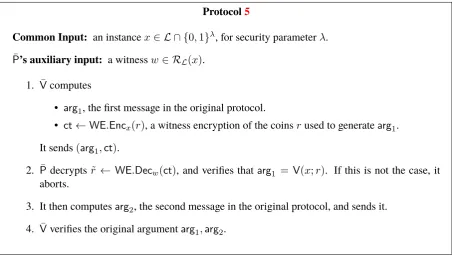
The compiler is as follows. Given the statementx, the verifier sends, together with its message, an encryption of its randomness under witness encryption, using the instancexas the public-key. The honest prover, holding a witness, can decrypt and abort in case of malicious behavior. The compiler guarantees that if the verifier is not explainable, the prover aborts. Therefore, intuitively, such a verifier does not obtain any information. However, this intuition is misleading — a malicious verifier may generate messages without knowing whether they are explainable, and use the prover’s abort decision to learn this bit of information.4 Nonetheless, the compiler does preserve witness hiding — the witness-finding reduction can simply guess if the verifier’s message is explainable and simulate the prover’s message accordingly. This only decreases its success probability by a factor of two.
1.3 More on Related Work
We next address related work in more detail.
Weak zero-knowledge and witness hiding. The notion of weak zero-knowledge is introduced in [DNRS03] who study the connection between 3-message public-coin weak zero-knowledge and
calledmagic functions. (They also consider several variants of the definition.) The notion of witness hiding is introduced in [FS90] who prove that any witness-indistinguishable protocol is witness hiding for distributions on statements with at least two “independent” witnesses. In [BP12], three-message weak zero-knowledge and witness-hiding protocols are constructed based on non-standard assumptions, which by now are considered implausible [BM14,BST16]. Specifically, these constructions are based on the notion of recognizable auxiliary-input point obfuscation that was shown in [BST16] to be impossible assuming virtual-grey-box obfuscation exists.
Upgrading weak zero-knowledge. The work of [CLP15] considers two relaxed notions of zero knowl-edge and proves that they are equivalent to their weak variants (where the simulator can depend on the distinguisher). The first notion they consider is distributional zero-knowledge where instances are sampled from some known distribution (and the simulator can depend on this distribution). The second notion is zero knowledge against uniform distinguishers (these distinguishers can still get an auxiliary input, but the same input is given to the simulator). In both settings, the equivalence is shown for (t, )-zero-knowledge, where the distinguisher’s running time and distinguishing gap are bounded byt and, respectively, and the simulator’s running time can depend ontand1/.
Combining our weak-zero-knowledge protocols with the equivalence theorems of [CLP15] yields distributional(t, )-zero-knowledge and(t, )-zero-knowledge against uniform distinguishers. Note that the two-message lower bound of [GO94] does not apply for these notions.
Distributional security against non-adaptive verifiers. The work of [JKKR17] constructs
distribu-tionalweak-zero-knowledge and witness-hiding protocols for a restricted class ofnon-adaptive verifiers
who choose their messages obliviously of the proven statement. They give protocols in three messages under standard assumptions, and in two messages under standard, but super-polynomial, assumptions. Their simulators and (witness-finding) reductions access the verifier as a black box.
Bounded description adversaries. Another type of relaxation considered in the literature is restrict-ing the (adversarial) verifier or prover to a-priori bounded description (and arbitrary polynomial run-ning time). Here (full-fledged) zero-knowledge can be constructed in two messages against bounded-description verifiers under standard, but super-polynomial, assumptions [BCPR14], and in three messages against bounded-description provers assuming also keyless hash functions that are collision-resistant against bounded-description adversaries [BBK+16].
Super-polynomial simulation. Zero knowledge with simulators that run in super-polynomial time can be constructed in two messages from standard, but super-polynomial, assumptions [Pas03, BGI+17]. One-message zero-knowledge with super-polynomial simulation can be constructed against uniform provers, assuming uniform collision-resistant keyless hash functions [BP04a], or against non-uniform verifiers, but with weak soundness, assuming multi-collision-resistant keyless hash functions [BL18]. Such zero-knowledge implies a weak notion of witness hiding for distributions on instances where it is hard to find a witness, even for algorithms that run in the same super-polynomial time as the simulator. Zero-knowledge proofs. So far, we have focused on the notion of arguments (which are only computa-tionally sound). The round complexity of zero-knowledge proofs (which are statistically sound) has also been studied extensively. Four-message proofs are impossible to achieve via black-box simulation, except for languages inNP∩coMA [Kat12]. Four message proofs with non-black-box simulation are only known assuming multi-collision-resistance keyless hash functions [BKP18]. Recent evidence [FGJ18] suggests that, differently from zero-knowledge arguments, zero-knowledge proofs may be impossible to achieve in three messages (even with non-black-box simulation).
Honest-verifier zero knowledge.For languages in the classSZK, there exist two-message proofs with an inefficient prover (known as Arthur-Merlin proofs) that are zero knowledge only against honest verifiers [AH91,SV97]. Two-message honest-verifier zero-knowledge is implied by any NIZK with a common
2
Preliminaries
We rely on the standard notions of Turing machines and Boolean circuits.
• We say that a Turing machine is PPT if it is probabilistic and runs in polynomial time.
• For a PPT algorithmM, we denote byM(x;r)the output ofM on inputxand random coinsr. For such an algorithm, and any inputx, we may writem ∈M(x)to denote the fact thatmis in the support ofM(x;·).
• A polynomial-size circuit familyCis a sequence of circuitsC ={Cλ}λ∈N, such that each circuit
Cλis of polynomial sizeλO(1)and hasλO(1)input and output bits. We also consider probabilistic
circuits that may toss random coins.
• We follow the standard habit of modeling any efficient adversary as a family of polynomial-size circuits. For an adversaryAcorresponding to a family of polynomial-size circuits {Aλ}λ∈N, we
sometimes omit the subscriptλ, when it is clear from the context.
• We also consider quasisize adversaries, which are defined analogously to polynomial-size adversaries, but are of polynomial-size2(logλ)O(1) instead ofλO(1). By default we define the security of primitives against polynomial-size adversaries. Security against quasipolynomial-size adversaries is always defined analogously.
• A functionf :N→Ris negligible iff(λ) =λ−ω(1)and is noticeable iff(λ) =λ−O(1).
• For random variablesXandY, distinguisherD, and0< µ <1, we writeX ≈D,µY if
|Pr[D(X) = 1]−Pr[D(Y) = 1]| ≤µ.
2.1 Arguments
In what follows, we denote byhP,Via protocol between two partiesPandV. For inputwfor P, and
common inputx, we denote byOUTVhP(w),Vi(x)the output ofVin the protocol. For honest verifiers,
this output will be a single bit indicating acceptance (or rejection), malicious verifiers may have arbitrary output. Throughout, we assume that honest parties in all protocols are uniform PPT algorithms.
Definition 2.1(Argument). A protocolhP,Vifor anNPrelationRL(x, w)is an argument if it satisfies:
1. Completeness: For anyλ∈N, x∈ L ∩ {0,1}λ,w∈ RL(x):
Pr [OUTVhP(w),Vi(x) = 1] = 1 .
2. Computational soundness:For any polynomial-size proverP∗ ={P∗λ}λ, there exists a negligible µsuch that for any security parameterλ∈N, and anyx∈ {0,1}λ\ L,
Pr [OUTVhP∗λ,Vi(x) = 1]≤µ(λ) .
The argument issound against quasipolynomial provers, if the above holds also for
quasipolynomial-sizeP∗.
Remark2.1 (Public verification). We say that the protocol ispublicly verifiableif the verifier’s decision bit can be computed from the protocol’s messages (without verifier private state).
Remark 2.2 (Proofs). We say that the protocol is aproofif the soundness condition also holds against unbounded proversP∗.
2.1.1 Weak Zero-Knowledge
Definition 2.2(WZK). A protocolhP,Vi is WZK if there exists a PPT simulatorS, such that for any
polynomial-size verifier V∗ = {Vλ∗}λ, distinguisherD = {Dλ}λ, and noticeable ε(λ), there exists a
negligibleµ(λ), such that for anyλ∈N,x∈ L ∩ {0,1}λ, andw∈ RL(x),
OUTV∗
λhP(w),V
∗
λi(x)≈Dλ,ε+µS(x,V
∗
λ,Dλ,11/ε) .
Remark2.4 (w.l.o.g). When convenient we assume w.l.o.g thatV∗is deterministic. This is as in the case
of (standard) zero knowledge with a universal simulator [GO94]. We do not assume that the distinguisher is deterministic. This is in contrast to standard zero-knowledge where we often fix the best random coins for the distinguisher. In weak zero-knowledge this is not possible, as the simulated distribution can depend on the distinguisher.
Also, when convenient we assume w.l.o.g that verifiers always output their entire view consisting of the prover message and, if they are probabilistic, their randomness.
2.1.2 Witness Hiding
Definition 2.3 (WH). A protocol hP,Vi is WH if there exists a PPT reduction R, such that for any
polynomial-size verifierV∗ ={V∗λ}λ and noticeableε(λ), there exists a negligibleµ(λ), such that for
anyλ∈Nandx∈ L ∩ {0,1}λ,
PrhOUTV∗
λhP(w),V
∗
λi(x)∈ RL(x)
i
≤PrhR(x,Vλ∗,11/ε)∈ RL(x)i+ε(λ) +µ(λ) .
Remark 2.5 (Randomized verifiers). As in Remark2.4, and for the same reasons, the above definition considers w.l.o.g only deterministic verifiersV∗.
It is well-known that WZK implies WH (by considering the specific distinguishers that checks if the verifier’s output is a valid witness).
Lemma 2.1. Any WZK protocol is WH.
2.1.3 Explainable Verifiers
Roughly speaking, explainable verifiers are verifiers whose messages are (almost) always in the support of the honest verifier’s messages, regardless of how the prover’s messages are generated. We also allow such verifiers to abort at any stage.
Definition 2.4(Explainable transcript). LethP,Vibe a protocol,P∗be an arbitrary prover, andV∗ an
arbitrary verifier. We say that a transcriptT of an executionhP∗,V∗i(x)is explainable if there exists
honest verifier coinsr such that T is consistent with the transcript of an execution hP∗,Vri until the
point inTthatV∗aborts. (HereVris the honest verifier using coinsr).
Definition 2.5 (Explainable verifier). Let hP,Vi be a protocol. A (possibly probabilistic) verifier V∗ = {Vλ∗}λ is explainable if there exists a negligible µ(λ) such that for any proverP∗, λ ∈ N, and x∈ {0,1}λ,
Pr
V∗λ[T is explainable|T ← hP
∗
,V∗λi(x)]≥1−µ(λ) .
In the two-message setting, We will also consider a simpler notion ofalways explainable verifiers, which are deterministic verifiers that always output a message in the support of the honest verifier.
Definition 2.6(Always-explainable verifier). A deterministic verifierV∗={V∗λ}λis always explainable
Explainable WZK and WH. WZK and WH against explainable verifiers are defined exactly as WZK and WH only that the (respective) definition only holds against explainable verifiers rather than all
verifiers. We also note that Lemma2.1saying that WZK implies WH also holds for explainable verifiers.
Remark2.6 (w.l.o.g). We note that in the two-message setting, we can assume w.l.o.g that explainable verifiers arealwaysexplainable. This is because aborts can be easily simulated and malicious verifier messages (that are not abort) occur with negligible probability.
2.1.4 Witness Indistinguishability
We consider two-message witness-indistinguishable (WI) arguments with delayed input, where the prover obtains the input statement and witness after the first round of the protocol. In some of our protocols, we will also require a weak argument of knowledge property that says that there exists a quasipolynomial-time witness extractor.
Definition 2.7(Two-message argument with delayed input). A two-message protocolhP,Viis a delayed
input WI argument ifVconsists of two PPT algorithms(V1,V2)that satisfy:
1. Completeness: For anyλ∈N, x∈ L ∩ {0,1}λ,w∈ RL(x):
Pr
V2(x,wi2;τ) = 1
(wi1, τ)←V1(1λ) wi2 ←P(x, w,wi1)
= 1 .
2. Computational soundness:For any polynomial-size proverP∗ ={P∗λ}λ, there exists a negligible µsuch that for any security parameterλ∈N,
Pr
V2(x,wi2;τ) = 1 x∈ {0,1}λ\ L
(wi1, τ)←V1(1λ) (x,wi2)←P∗(wi1)
≤µ(λ) .
3. Witness indistinguishability: For any polynomial-size verifier V∗ = {V∗λ}λ, there exists a
negligibleµsuch that for any security parameterλ∈N,
Pr
V∗λ(wi2) =b x∈ L ∩ {0,1}λ
w0, w1∈ RL(x)
(wi1, x, w0, w1)←V∗λ b← {0,1}
wi2←P(x, wb,wi1)
≤ 1
2+µ(λ) .
The argument has a quasipolynomial witness extractorif there exists a quasipolynomial time
extractorEsuch that for any polynomial-size proverP∗ ={P∗λ}λ, there exists a negligibleµsuch
that for any security parameterλ∈N,
Pr
V2(x,wi2;τ) = 1 w /∈ RL(x)
(wi1, τ)←V1(1λ) (x,wi2)←P∗(wi1) w←E(x,wi1,wi2)
≤µ(λ) .
Instantiations. Two-message WI arguments with delayed input that are also publicly verifiable (and in fact also proofs) can be based either on trapdoor permutations [DN07], standard assumptions on bilinear groups [GOS12], or indistinguishability obfuscation [BP15b]. Such privately-verifiable arguments can be constructed from any 2-message oblivious transfer against malicious receivers and super-polynomial semi-honest senders [BGI+17,JKKR17]. In particular, they can be constructed from (super-polynomial) LWE [BD18].
2.2 Commitments
Non-interactive bit commitments. We define bit commitments.
Definition 2.8(Bit commitment). A polynomial-time computable function
Com:{0,1} × {0,1}λ→ {0,1}`(λ)
is a bit commitment if it satisfies:
1. Binding: For anyr, r0 ∈ {0,1}λ, b, b0 ∈ {0,1}, ifCom(b;r) =Com(b0;r0)thenb=b0.
2. Computational hiding: For any polynomial-size distinguisher D = {Dλ}λ∈N, there exists a
negligibleµsuch that for any security parameterλ∈N, Com(0)≈Dλ,µ Com(1) ,
whereCom(b)is the distribution of commitments tobwith randomnessr ← {0,1}λ.
The commitment isdenseif for any strings∈ {0,1}`(λ)there exist(b, r)such thats=Com(b;r).
Instantiations. (Non-interactive) bit commitments are known based on various standard assumptions, including LWE [GHKW17].
Extractable commitments. We define 3-message extractable commitment schemes.
Definition 2.9. A 3-message extractable commitment scheme(EC.S,EC.R,EC.V)satisfies
1. Indistinguishability: For any polynomial-size receiverR∗ ={R∗λ}λ∈
N, there exists a negligible
µsuch that for any security parameterλ∈N, and any two equal-lengths0, s1,
Pr
R∗λ(c1,c2,c3) =b
b← {0,1} (c1, τ)←EC.S(sb)
c2←R∗(c1) c3 ←EC.S(c1,c2;τ)
≤ 1
2 +µ(λ) .
2. Extraction: There exists a PPT extractorE, such that for any deterministic senderS∗ ={S∗λ}λ
and any security parameterλ∈N,
if Pr
EC.V(c1,c2,c3) = 1
c1←S∗ c2 ←EC.R(c1,1λ) c3 ←S∗(c1,c2)
≥ε , then Pr
EC.V(c1,c2,c3) = 1 ∃s: (c1,c2,c3)∈EC.S(s) s0←ES∗(1λ,11/ε) s06=s
c1←S∗ c2←EC.R(c1,1λ) c3←S∗(c1,c2)
≤2−λ ,
where(c1,c2,c3) ∈EC.S(s)denotes the fact that the transcript(c1,c2,c3)is consistent with an
honest commitment to a strings.
The scheme is 2-message with a quasipolynomial extractor if c1 is always empty, and E runs in
quasipolynomial time.
Remark 2.7 (2-Message extractable commitments). In the two message case, the extraction guarantee can be simplified to require that whenever(c2,c3)∈EC.S(s), the extractor outputss. This, in particular, implies the above definition, which will be sufficient for us.
2.3 Fully-Homomorphic Encryption
We recall the definition of fully-homomorphic encryption (FHE).
Definition 2.10. A fully-homomorphic encryption scheme(FHE.Enc,FHE.Dec,FHE.Eval)satisfies
1. Correctness: for anyλ∈N,sk∈ {0,1}λ, messagem∈ {0,1}∗, and circuitC,
FHE.Decsk(FHE.Eval(C,FHE.Encsk(m))) =C(m) .
2. Indistinguishability: For any polynomial-size distinguisherD={Dλ}λ∈N, there exists a
negli-gibleµsuch that for any security parameterλ∈N, and any two equal-length messagesm0, m1,
FHE.Encsk(m0)≈Dλ,µ FHE.Encsk(m1) ,
where FHE.Encsk(mb) is the distribution of encryptions of mb with random secret key sk ←
{0,1}λ.
3. Compactness: There exists a fixed polynomial poly, such that for any λ ∈ N,sk ∈ {0,1}λ,
messagem∈ {0,1}∗, and circuitC,
|FHE.Eval(C,FHE.Encsk(m))| ≤poly(|C(m)|, λ) .
Instantiations. Starting from the work of Gentry [Gen09a], there have been several constructions of FHE schemes, including ones based on LWE and a corresponding circular security assumptions, starting from [BV14].5
2.4 Compute and Compare Obfuscation
We start by defining the class ofcompute and compare programs.
Definition 2.11(Compute and compare). Letf :{0,1}n→ {0,1}λbe a circuit, and letu∈ {0,1}λbe
a string. ThenCC[f, u](x)is a circuit that returns1iff(x) =y, and0otherwise.
We now define compute and compare (CC) obfuscators. In what followsOis a PPT algorithm that takes as input a CC circuit CC[f, u]and outputs a new circuitCCg. (We assume that the CC circuit CC[f, u]is given in some canonical description from whichf anducan be read.)
Definition 2.12(CC obfuscator). A PPTOis a compute and compare obfuscator if it satisfies:
1. One-sided correctness: for any circuit f : {0,1}n → {0,1}λ and u ∈ {0,1}λ, and any
x∈ {0,1}nsuch thatf(x) =u,
PrhCCg(x) = 1
CCg ← O(CC[f, u]) i
= 1 .
2. Simulation: there exists a PPT simulatorSimsuch that
• For any polynomially-bounded function `(λ) and any polynomial-size distinguisher D = {Dλ}λ∈N, there exists a negligible µ such that for any λ ∈ N and `(λ)-size circuit f :
{0,1}n→ {0,1}λ,
O(CC[f, u])≈Dλ,µSim(1
λ,1`) ,
whereu← {0,1}λ is chosen uniformly at random.
• Simulated circuits are rejecting:
Prh∃x:CCg(x) = 1
CCg ←Sim(1
λ,1`)i≤2−λ .
Instantiations.Compute and compare obfuscators are constructed in [GKW17,WZ17] based on LWE. The correctness considered there is two-sided — they prove perfect correctness for inputsxsuch that f(x) =uand almost perfect correctness for inputsxsuch thatf(x)6=u. We will only rely on the first of the two (and perfect correctness will play a role).
In addition, they do not state explicitly the fact that simulated circuits are rejecting. However, this is satisfied by their construction, and follows readily from their simulator definition and correctness analysis (see e.g., [WZ17, Claim 4.11]).
2.5 Random Self-Reducible Public-Key Encryption
Intuitively speaking, a random self reducible (RSR) encryption scheme admits the classic notion of random self-reduction [BM84] — it is possible to rerandomize an arbitrary ciphertext into a random ciphertexts of the same message under the same public key. More generally, given access to an average-case distinguisher, it is possible to decrypt in the worst average-case.
Syntax. An RSR encryption schemeRSRconsists of PPT algorithms(RSR.Gen,RSR.Enc,RSR.Dec, RSR.Decg). The first three algorithms have the standard syntax of a public-key (bit) encryption scheme.
The fourth algorithm RSR.gDecD(ct,pk,11/ε) is an oracle-aided alternative decryption algorithm, which given as input a ciphertextct, public keypk and (distinguishing) parameter11/ε, and a oracle access to a distinguisherD, outputs a plaintext bitb.
Definition 2.13. A public-key encryption scheme(RSR.Gen,RSR.Enc,RSR.Dec,RSR.Decg)is random
self-reducible if it satisfies
1. Correctness: for anyb∈ {0,1}, λ∈N,
Pr
RSR.Decsk(ct) =b
(sk,pk)←RSR.Gen(1λ) ct←RSR.Encpk(b)
= 1
2. Indistinguishability: For any polynomial-size distinguisherD={Dλ}λ∈N, there exists a
negli-gibleµsuch that for any security parameterλ∈N,
pk,RSR.Encpk(0)≈Dλ,µ pk,RSR.Encpk(1) ,
where RSR.Encpk(b) is the distribution of encryptions of b with random public key pk ← RSR.Gen(1λ).
3. Random self-reduction: for any public key pk ∈ RSR.Gen(1λ) it holds that for any (possibly
probabilistic) distinguisherDandε,
• if
E D(RSR.Encpk(0))
−E D(RSR.Encpk(1))
≥ε ,
• then for anyb∈ {0,1}andct∈RSR.Encpk(b),
PrhRSR.gDecD(ct,pk,11/ε) =bi= 1−2−λ ,
Remark 2.8 (Self reducibility against unbounded distinguishers). In the above definitions of random self-reduction, the distinguisherDis allowed to be unbounded. This is not essential in our constructions,
but does make our proof cleaner, and is satisfied by all considered instantiations.
Relaxed RSR.We may consider a relaxed version of RSR encryption, where ciphertextsct∈RSR.Encpk(b)
can be reduced to ciphertexts relative to a different encryption algorithmRSR.Encg. Such a relaxation is simpler to construct for instance under LWE.
Formally, there exists an additional PPT algorithmRSR.gEnc, that satisfies:
1. Correctness: similarly toRSR.Enc.
2. Relaxed random self-reduction: for any public key pk ∈ RSR.Gen(1λ) it holds that for any (possibly probabilistic) distinguisherDandε,
• if
ED(RSR.gEncpk(0))−ED(RSR.gEncpk(1)) ≥ε , • then for anyb∈ {0,1}andct∈RSR.Encpk(b),
Pr h
RSR.Decg
D
(ct,pk,11/ε) =b i
= 1−2−λ ,
where the probability is over the coins ofRSR.gDec.
We do not explicitly define (nor use) semantic security for the alternative encryption algorithm (although it actually follows from the semantic security of the original encryption together with relaxed RSR). Instantiations. There are various public-key encryption schemes [GM84, Gam85, Pai99] based on standard algebraic assumptions, that are known to be perfectlyrerandomizableand are hence random self reducible. Assuming quasipolynomial hardness of the underlying problems they are also quasipoly-nomially secure.
Statistically rerandomizable schemes are also known based on LWE [Reg09]. However, in such schemes rerandomization is guaranteed for a random public key, whereas as we require that it holds for an arbitrary public key in the support of the generation algorithm. LWE does give relaxed RSR schemes using the standard noise flooding technique [Gen09a] (see AppendixA).
2.6 Witness Encryption
We recall the definition of witness encryption (WE).
Definition 2.14. A witness encryption scheme(WE.Enc,WE.Dec)for anNPlanguageLsatisfies
1. Correctness: for any(x, w)∈ RL, and messagem∈ {0,1}∗, WE.Decw(WE.Encx(m))) =m .
2. Indistinguishability: For any polynomial-size distinguisherD={Dλ}λ∈N, there exists a
negli-gibleµsuch that for any security parameterλ∈ N, anyx ∈ {0,1}λ\ L, and two equal-length
messagesm0, m1,
WE.Encx(m0)≈Dλ,µ WE.Encx(m1) ,
whereWE.Encx(mb)is the distribution of encryptions ofmbunderx.
2.7 Conditional Disclosure of Secrets
Conditional disclosure of secrets for anNPlanguageL[AIR01,BP12,AJ17] can be viewed as a two-message analog of witness encryption. That is, the sender holds an instancexand message mand the receiver holdsx and a corresponding witness w. If the witness is valid, then the receiver obtainsm, whereas ifx /∈ L,mremains hidden. We further require that the protocol hides the witnesswfrom the sender.
Definition 2.15. A conditional disclosure of secrets scheme(CDS.R,CDS.S,CDS.D) for a language L ∈NPsatisfies:
1. Correctness: for any(x, w)∈ RL, and messagem∈ {0,1}∗,
Pr
CDS.Dk(ctS) =m
(ctR,k)←CDS.R(x, w) ctS←CDS.S(x, m,ctR)
= 1 .
2. Message indistinguishability: For any polynomial-size distinguisherD={Dλ}λ∈N, there exists
a negligible µsuch that for any security parameter λ ∈ N, any x ∈ {0,1}λ\ L, ct∗R, and two
equal-length messagesm0, m1,
CDS.S(x, m0,ct∗R)≈Dλ,µ CDS.S(x, m1,ct
∗
R) .
3. Receiver simulation: There exists a simulator CDS.Sim, such that for any polynomial-size
distinguisher D = {Dλ}λ∈N, there exists a negligible µ such that for any security parameter
λ∈N, anyx∈ L, andw∈ RL(x),
ctR≈Dλ,µ CDS.Sim(x) ,
wherectR←CDS.R(x, w).
Instantiations.CDS schemes can be instantiated assuming any two-message oblivious transfer protocol where the receiver message is computationally hidden from any semi-honest sender, and with (un-bounded) simulation security against malicious receivers. Such oblivious transfer schemes are known based on DDH [NP01], Quadratic (orNth) Residuosity [HK12], and LWE [BD18].
3
Weak Zero-Knowledge against Explainable Verifiers
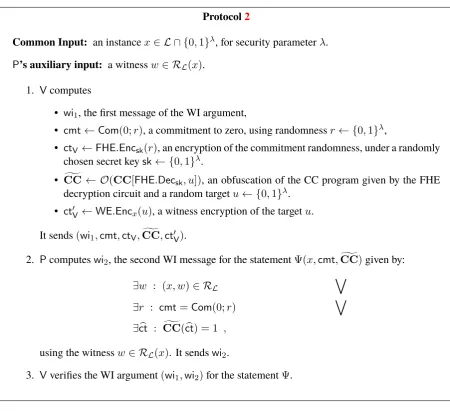
In this section, we construct WZK protocols against explainable verifiers. We start with the three-message protocol and then move to the 2-message protocol, which will be a special case of the 3-message protocol.
3.1 The Three-Message Protocol
In this section, we construct a three-message WZK argument against explainable verifiers. Ingredients and notation:
• A 3-message extractable commitment(EC.S,EC.R,EC.V). We denote its messages by(c1,c2,c3). • a 2-message WI argument(WI.P,WI.V)with delayed input. We denote its messages by(wi1,wi2). • A non-interactive perfectly-binding commitment schemeCom.
• A compute-and-compare obfuscatorO.
• A random self-reducible public-key encryption(RSR.Gen,RSR.Enc,RSR.Dec,RSR.Decg). (In fact, relaxed RSR suffices. To simplify the description of the protocol, we rely on standard RSR, and later remark why relaxed RSR suffices.)
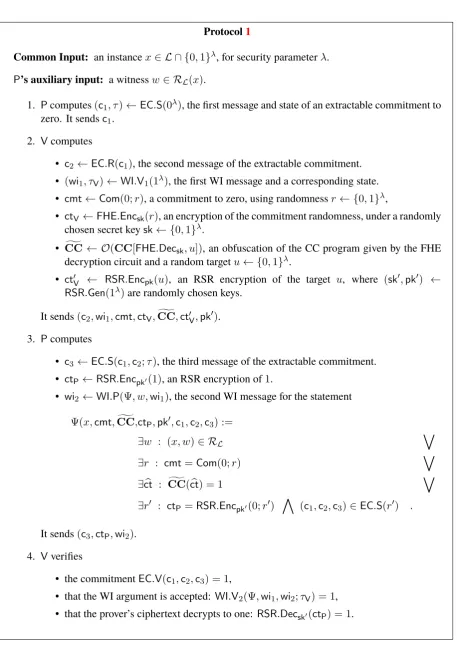
We describe the protocol in Figure1.
Remark3.1 (FHE Compactness). In the protocol the decryption circuitFHE.Decskis meant to decrypt
encryptions of messages of size |u| = λ. Such encryptions could be the result of homomorphic evaluation, and according to the compactness property of the FHE will have fixed polynomial size in the security parameter.
3.1.1 Analysis
We now analyze the protocol. We first show that it is sound, and then that it is WZK against explainable verifiers.
Proposition 3.1. Protocol1is sound.
Proof. Assume toward contradiction that there exists a polynomial-size (w.l.o.g deterministic) prover
P∗ ={P∗λ}that (for infinitely manyλ∈N) breaks soundness with noticeable probabilityε(λ) =λ−O(1).
Fixλ∈Nandx∈ {0,1}λ\ Lsuch thatP∗
λconvinces the verifier of accepting with probabilityε.
Augmenting the interaction with extraction. We parse any verifier message(c2,wi1,cmt,ctV,CCg,ct0V,pk0), as two parts(c2, z). For anyz, we consider a senderSz∗whose first message is the samec1output byP∗λ, and given a messagec2from the receiverEC.R, computes the third messagec3by runningP∗λon(c2, z), emulating a message formV. For any transcriptT = (c1,(c2, z),(c3,ctP,wi2))of an execution between P∗λ andV, we consider the resultsT of running the witness extractorsT ←ES
∗
z(1λ,14/ε). (Note thatsT
is a random variable that may depend onT and the extractor’s coins.) LetF be the event, over a transcriptT and coins of the extractorE, that:
1. Vsuccessfully verifies the commitment transcript(c1,c2,c3), 2. Vaccepts the WI argument(wi1,wi2),
3. the the extracted stringsT doesnotattest thatctPis a zero encryption; that is,sT isnotrandomness
r0such thatctP=RSR.Enc(0;r0).
We next consider several hybrid experiments and show that the probability thatF occurs is preserved through these experiments, upto a negligible difference. To reach a contradiction, we show thatFoccurs in the first hybrid with probability at leastεand with probability at mostε/2in the last hybrid. This is a contradiction since the gapε/2is noticeable. In what follows, in each hybridi, we will denote bypithe
probability thatFoccurs in that hybrid.
H0: This is the real protocol.
Claim 3.1. p0 ≥ε.
Proof. By definition, whenever V accepts, it decrypts ctP to1; thus, by the correctness of RSR, the
ciphertext ctP cannot be opened to an encryption of 0. The claim now follows from the fact thatP∗λ
convincesVwith probabilityε.
H1: In this hybrid,ct0Vis an encryption of0λ instead of the targetu.
Protocol1
Common Input: an instancex∈ L ∩ {0,1}λ, for security parameterλ.
P’s auxiliary input: a witnessw∈ RL(x).
1. Pcomputes(c1, τ)←EC.S(0λ), the first message and state of an extractable commitment to zero. It sendsc1.
2. Vcomputes
• c2 ←EC.R(c1), the second message of the extractable commitment. • (wi1, τV)←WI.V1(1λ), the first WI message and a corresponding state.
• cmt←Com(0;r), a commitment to zero, using randomnessr← {0,1}λ,
• ctV ←FHE.Encsk(r), an encryption of the commitment randomness, under a randomly
chosen secret keysk← {0,1}λ.
• CCg ← O(CC[FHE.Decsk, u]), an obfuscation of the CC program given by the FHE decryption circuit and a random targetu← {0,1}λ.
• ct0V ← RSR.Encpk(u), an RSR encryption of the target u, where (sk0,pk0) ← RSR.Gen(1λ)are randomly chosen keys.
It sends(c2,wi1,cmt,ctV,CCg,ct0V,pk0). 3. Pcomputes
• c3 ←EC.S(c1,c2;τ), the third message of the extractable commitment. • ctP ←RSR.Encpk0(1), an RSR encryption of1.
• wi2 ←WI.P(Ψ, w,wi1), the second WI message for the statement
Ψ(x,cmt,CCg,ctP,pk0,c1,c2,c3) :=
∃w : (x, w)∈ RL
_
∃r : cmt=Com(0;r) _
∃ctb : CCg(ctb) = 1
_
∃r0 : ctP=RSR.Encpk0(0;r0)
^
(c1,c2,c3)∈EC.S(r0) .
It sends(c3,ctP,wi2).
4. Vverifies
• the commitmentEC.V(c1,c2,c3) = 1,
• that the WI argument is accepted: WI.V2(Ψ,wi1,wi2;τV) = 1,
• that the prover’s ciphertext decrypts to one: RSR.Decsk0(ctP) = 1.
Proof. The claim follows by the semantic security of the scheme RSR. Indeed, given a noticeable
difference betweenp0 andp1, we can distinguish an RSR encryption of a randomufrom one of0λ, by emulating an interaction betweenP∗λandV, running the extractor, and testing whetherFoccurs.
H2: In this hybrid, the obfuscation CCg ← Sim(1λ,1`) is simulated rather than an obfuscation of CC[FHE.Decsk, u], where`is the size of the decryption circuitFHE.Decsk.
Claim 3.3. |p1−p2| ≤λ−ω(1).
Proof. The claim follows by the CC simulation guarantee. Indeed, given a noticeable difference between p1 andp2, we can distinguish, givensk, an obfuscation ofCC[FHE.Decsk, u]for a randomu, from a
simulated obfuscation contradicting the CC guarantee. Using the fact that nowct0V is an encryption of 0λ, we can again emulate an interaction betweenP∗λ andV.
H3: In this hybrid,ctVis an encryption of0λ instead of the commitment randomnessr.
Claim 3.4. |p2−p3| ≤λ−ω(1).
Proof. The claim follows by the semantic security of the FHE schemeFHE. Indeed, given a noticeable
difference betweenp2 andp3, we can distinguish, an encryption of a randomr from an encryption of 0λ. Since now the FHE keyskis not needed to compute the obfuscationCCg, we can again emulate an interaction betweenP∗λandV.
H4: In this hybrid,cmtis a commitment to1instead of0.
Claim 3.5. |p3−p4| ≤λ−ω(1).
Proof. The claim follows by hiding of the commitment. Given a noticeable difference betweenp3and p4, we can distinguish, a commitment to zero from a commitment to one. In this hybrid,ctV no longer
depends on the commitment randomness, so we can again emulate an interaction betweenP∗λandV.
.
It is left to show that inH4,F occurs with probability at mostε/2. Claim 3.6. p4 ≤ε/2.
Proof. Assume toward contradiction thatp4> ε/2. First, observe that in hybridH4: • x /∈ L.
• cmt∈Com(1), and by perfect binding there does not existrsuch thatcmt=Com(0;r).
• By the CC simulation guarantee, except with negligible probability 2−λ, there does not existctb such thatCCg(ctb) = 1.
In particular, we can fix the second part zof the verifier’s message such that with probability at least ε/2−2−λ, overc2:
1. The above three conditions hold (forcmt,CCgfixed byz). 2. The WI verifierWI.Vaccepts the argument (for the statementΨ). 3. The commitment verifierEC.Vaccepts the transcript(c1,c2,c3).