Educational Structure Of The Workforce And Its
Impact On The Economic Development In Macedonia
Nikolche Jankulovski, Blagoj Gjorgievski
Abstract
The subject of this paper is an analysis of the educational structure of the efficient population in the Republic of Macedonia, analysis of the educational structure of the employed and the unemployed according to their totality and gender, as well as according to their educational level. After determination of the current conditions and the changes during the observed period (2002-2012) the relation between the education of the workforce and the economic development of the country is presented.
The goal of this paper is to give comprehensive analysis of the current situation and the changes in the educational structure of the workforce in the Republic of Macedonia, and to percieve its importance for the economic development.
A questionnaire for the workforce for the period of 2002, 2006 and 2012 form the State Statistical Office of the Republic of Macedonia as well as home and foreign literature are used as sources of information.
Keywords: Educational structure, workforce, economic development
INTRODUCTION
In the Republic of Macedonia, in conditions of limited finances, the capital and the stuff, the role of the workforce and the educational level playan important role for ecouragement of the economic, socialand cultural development.
The determination of the current conditions related to the educational level of the workforce is a basic assumption for identification of the education as a kind of human capital. From economic aspect of view, the educational structure is important because higher educational level allows engagement and productivity of the efficient population.
In this context, the investments in education are especially important and they are activities that have an influence on the improvement of the individual’s skills and abilities, that is on the increase of their productivity. The increased productivity leads to economic growth, which is an instigator of the economic development of a country.
Educational structure of the efficient population in the Republic of Macedonia
The efficient population is composed of employed people and people that want to be employed, but cannot find employment. For that purpose data from the questionnaire for the workforce1 which is a research of the economic activity of the population is used and it gives information about the number, structure and the characteristics of the active population. Having in mind the great importance of the utilization of the human resources as an important factor for development, the attention has to be directed not only to the
number of the active and inactive part of the efficient population, but also to their structure according to the educational level.
The data from the questionnaire for the workforce in the Republic of Macedonia between the age of 15 and 64 show that during the observed period there have been positive changes (Table 1).
That is, the percent of people with low educational level has decreased from 47.3% in 2002 to 40.4% in 2012, the percent of people with secondary educational level has increased from 42.1% in 2002 to 44.3% in 2012, and there has also been a mild increase, in the same observed period, of the number of people with high educational level (from 10.6 to 15.3%).
In relation to the structure of the active population, from 2002 to 2012, the changes refer to a decrease of the number of people with low educational level and an increase of the number of people with secondary and high educational level.
Analyzing the data about the inactive population we can see that the participation of the people with low educational level has decreased from 65.9% in 2002 to 61% in 2012. The percent of inactive people with secondary educational level has increased from 29.9% in 2009 to 31.9% in 2012, and the number of those with high education has increased for 2.9% in the observed period.
Table 1 Structure of the efficient population in the Republic of Macedonia (15-64 years), according to the educational level and economic activity, for 2002, 2006 and
2012
Source: Calculations based on data from questionnaires for workforce 2002, 2006 and 2012, State Statistical Office
The given calculations point to quite unfavorable conditions from the aspect of developmental potential and utilization of the available human resources, especially from the inactive efficient population.
In relation to the decrease of the birth-rate in the Republic of Macedonia, a gradual decrease of the workforce is expected. That is, in future, every increase of the demand of workforce will include economic activation of the inactive part of the efficient population or better utilization of the unutilized part of the workforce.
Uneducated people, unfinished primary school and people with primary education
People with 3 or 4 years of secondary education People with high education master’s and doctoral
2002 2006 2012
Efficient population
Active Efficient population
Active Efficient population
Active Efficient population
Active Inactive
% % % % % % %
Characteristics of the educational structure of the employed people in the Republic of Macedonia
Analysing the educational structure of the efficient population we come to the part where the educational structure of the employed people is especially important creator of the current and the future economic development, and at the same time, of the development of the country. In this direction, information are given about the current condition and the changes in the education of the employed people, total and according to gender, according to the age and the educational level.
Employed people according to the educational level, total and gender
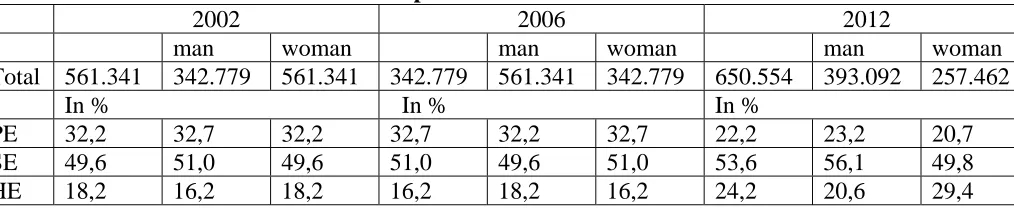
The structure of the employed people in the Republic of Macedonia in the period from 2002 to 2012 is marked by positive trend. This trend is manifested through a decrease of the participation of people with low educational level from 32.2% in 2002 to 22.2% in 2012, and an increase of the participation of the employed people with secondary education from 49.6% to 53.6% as well as of those with high education from 18.2% to 24.2% (Table 2).
Table 2 Structure of the employed people in the Republic of Macedonia, according to gender and educational level, for 2002, 2006 and 2012
Source: Calculations based on data from questionnaires for workforce 2002, 2006 and 2012, State Statistical Office
During the analyzed period, an increase of the employed women is noticed in the structure of employed people according to gender. In the period from 2002 to 2012 there is an improvement of the educational structure in men as well as in women that is changes that overlap with those of the employed. That is, the participation of men with low educational level has decreased from 32.7% in 2002 to 23.2% in 2012, and of women from 31.2% to 20.7%. The prevalence of employed men with secondary education, on the other hand, has increased from 51% to 56.1% during the observed period and from 47.4% to 49.8% of employed women. Biggest deviations are present in the participation of employed people with high education. That implicates significant improvement of the educational structure of women and deepening of the differences in relation to the employed men with high education. Although there have been changes in the structure of the employed women, the bigger prevalence of people with low and secondary educational level was and remained in comparison to those with high educational level.
We can conclude that during the period from 2002 to 2012 there have been positive changes in men as well as in women. From the aspect of quality of the engaged
2002 2006 2012
man woman man woman man woman
Total 561.341 342.779 561.341 342.779 561.341 342.779 650.554 393.092 257.462
In % In % In %
PE 32,2 32,7 32,2 32,7 32,2 32,7 22,2 23,2 20,7
SE 49,6 51,0 49,6 51,0 49,6 51,0 53,6 56,1 49,8
workforce they are more expressed in women as a result of the bigger increase of employed women, from that of employed men with high educational level. These tendencies can be qualified as very significant for the economic development of the country.
Employed people according to the age and the educational level
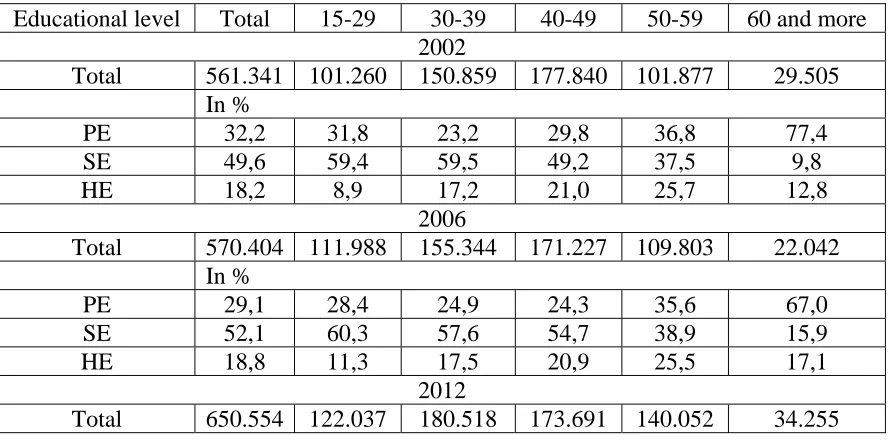
The structure of the employed people according to the age is significant demographic mark because it shows the vitality of the engaged workforce. From the presented data in Table 3 particular movements can be noticed in the absolute volume and the relative participation of the employed in the Republic of Macedonia according to the age and the level of education (Table 3).
During the observed period there is a tendency of a decrease of the number of employed people with low educational level from all age groups. Biggest decrease is noticed in the employed people that are 60 years old or older.
The number of the employed young people with secondary educational level between the age of 15-29 years and 30-39 years is bigger, around 60% . Only in the cases of the employed young people (30-39 years old) there is a decrease of the participation of those with secondary educational level and that is from 59.5% to 53%, whereas in all other groups the percent is increased. The age group of 60 and older has less participation in this educational level, whereupon according to the situation in 2012 it is lower from those employed with high level of education.
The prevalence of employed with high education has a tendency of increase in all age structures, not including the younger, middle-aged population (30-39 years old). In 2002, it moves from 18.2% (15-29 years old) to 25.7% (50-59 years old), and in 2012, these indicators are 28.5 and 25%.
Table 3 Structure of the employed people in the Republic of Macedonia, according to age and educational level, for 2002, 2006 and 2012
Educational level Total 15-29 30-39 40-49 50-59 60 and more
2002
Total 561.341 101.260 150.859 177.840 101.877 29.505
In %
PE 32,2 31,8 23,2 29,8 36,8 77,4
SE 49,6 59,4 59,5 49,2 37,5 9,8
HE 18,2 8,9 17,2 21,0 25,7 12,8
2006
Total 570.404 111.988 155.344 171.227 109.803 22.042
In %
PE 29,1 28,4 24,9 24,3 35,6 67,0
SE 52,1 60,3 57,6 54,7 38,9 15,9
HE 18,8 11,3 17,5 20,9 25,5 17,1
2012
In %
PE 22,2 11,7 21,7 21,9 27,1 44,4
SE 53,6 59,9 53 59,9 47,9 27,1
HE 24,1 28,5 25,3 18,2 25 28,5
Source: Calculations based on data from questionnaires for workforce 2002, 2006 and 2012, State Statistical Office
The analysis of the age structure of the employed people in the Republic of Macedonia, in the period from 2002 to 2012, undoubtedly leads us to a conclusion that apart from the positive changes, expressed in an increase of the number of employed people with secondary and high educational level, yet, from developmental point of view cannot be evaluated as significant improvement of the quality of the engaged workforce because the same are more expressed in older people at the age of 50. And this leads to changes conditioned by the aging of the employed and their generation movement. That is, the quality of the significance of the older generations whose participation notes an increase of the total number of employed with high educational level leaves a mark, as well as the possibility for them to be involved in the process of permanent education and to follow the modern technical and technological changes that have great importance in the economic development of the country.
2. Characteristics of the educational structure of the unemployed people in the Republic of Macedonia
Analyzing the dependence between the human resources as an important factor for economic development of a country, and the economic development as an important condition for greater engagement of the efficient population on the other hand, in conditions of huge unemployment it is very important to perceive the educational structure of the unemployed people. According to the obtained data from the conducted analysis, it is necessary to create and implement appropriate programs for improvement of the educational level and qualification, as an assumption for stimulation of the possibility for their employment.
In addition, there is an analysis of the unemployed people in the Republic of Macedonia, their total number and gender, according to their educational level and age, as well as according to the period of their unemployment.
2.1.Unemployed people according to the educational level, total number and gender
The educational structure of the unemployed people in the Republic of Macedonia in the period from 1999 to 2006 has significant changes (Table 4).
Source: Calculations based on data from questionnaires for workforce 2002, 2006 and 2012, State Statistical Office
That is, during this period there has been a decrease of the participation of the unemployed people with low educational level from 42.9% in 2002 to 30% in 2012, and an increase of the participation of those with secondary education from 49.7% to 54.5% and of those with high education from 7.4% to 15.5%. From these trends, it can be noted that during the observed period the participation of the unemployed with secondary education is biggest and of those with high educational is lowest.
In relation to the absolute and relative increase of people with secondary and high education from one side, and the increase of the unemployment from another, it can be concluded that the composition of the unemployed people according to the educational level is unfavorable.
From the presented data in Table 4 we can conclude that during the period from 2002 to 2012 the number of unemployed men with low educational level has decreased for 11.2% that is, 15.9% of women. The number of unemployed men with secondary education has increased for 7.3 %, and the number of women has increased for 1.2% whereas these indices in the unemployed with high education are +4.1%, that is +14.8%.
According to these tendencies there have been significant movements in the structure of the unemployed people according to their age and their educational level. The participation of people with low educational level in the total number of men has decreased from 45.8% to 34.6%, and the total number of women has decreased from 38.5% to 22.6% in the period from 2002 to 2012. From the aspect of quality of the workforce there is a positive trend of decrease of the less educated unemployed men and women.
That is, we can conclude that irrespective of the changes in direction of a decrease of the differences in the educational level between men and women, in the observed period, the unfavorable educational structure existed and it still exists.
Unemployed people according to age and the educational level
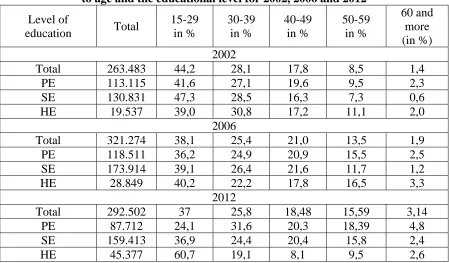
The structure of the unemployed people shows that in the period from 2002 to 2012 there have been significant changes that are related to the absolute volume and participation of the unemployed people and the relative participation (Table 5).
Analyzing the data for absolute volume and participation of the unemployed people, observed according to the high, secondary and low educational level we come with several findings. In the structure of people with secondary education those of 29 years are most present, no matter of their totality and participation in the total unemployment. Independent of the changes the condition of men can be evaluated as quite unfavorable
2002 2006 2012
men women men women men women
Total 263.483 159.145 104.338 321.274 191.856 129.418 292.502 180.406 112.096
In % In % In %
PE 42,9 45,8 38,5 36,9 38,7 34,2 30 34,6 22,6
SE 49,7 47,8 52,4 54,1 54,0 54,3 54,5 55,1 53,6
from the aspect of quality of the available unengaged workforce because their number is 43 000 young people that after finishing their primary education have continued the education.
Tabel 5. Structure of the uemployed people in the Republic of Macedonia, according to age and the educational level for 2002, 2006 and 2012
Level of
education Total
15-29 in %
30-39 in %
40-49 in %
50-59 in %
60 and more (in %) 2002
Total 263.483 44,2 28,1 17,8 8,5 1,4
PE 113.115 41,6 27,1 19,6 9,5 2,3
SE 130.831 47,3 28,5 16,3 7,3 0,6
HE 19.537 39,0 30,8 17,2 11,1 2,0
2006
Total 321.274 38,1 25,4 21,0 13,5 1,9
PE 118.511 36,2 24,9 20,9 15,5 2,5
SE 173.914 39,1 26,4 21,6 11,7 1,2
HE 28.849 40,2 22,2 17,8 16,5 3,3
2012
Total 292.502 37 25,8 18,48 15,59 3,14
PE 87.712 24,1 31,6 20,3 18,39 4,8
SE 159.413 36,9 24,4 20,4 15,8 2,4
HE 45.377 60,7 19,1 8,1 9,5 2,6
Source: Calculations based on data from questionnaires for workforce 2002, 2006 and 2012, State Statistical Office
In relation to the other age groups their participation in the unemployed people with low educational level has positive trend in all age groups, especially in those at the age of 50 to 59 years.
In relation to the structure of the unemployed people with secondary education the dominant participation of the 29 year olds has remained, independent of the decrease from 47.3% to 36.9% in the period from 2002 to 2012. In the age group of 30-39 years old there is a decrease in the participation from 28.5% in 2002 to 24.4% in 2012, and an increase in all other groups. This increase should not be neglected because it is more as a result of the great number of discharge during the observed period, an less as a result of the generation movement. That means that one third of the unemployed people at the age of 40 are with secondary education.
The reason for unemployment of a large number of young people is the fact that the country lacks a strategy for encouragement of opening new work posts. And, in the group of the older people, the reason for unemployment is in the fact that they hardly answer to the demand for workforce due to their qualifications and their age.
Unemployed people according to the period of unemployment and education
From aspect of utilization of the available workforce, especially in conditions when a significant part of the total workforce is out of economic activity, the period of unemployment is an important indicator. In the Republic of Macedonia, there is a long-term unemployment which is composed mainly by people who are waiting for employment more than one year (Table 6).
Apart from the period of waiting for employment, there have been changes in the period from 2002 to 2012 in relation to the educational level of the unemployed people. In addition, an increase of the long-term unemployment is characteristic for the unemployed people with low educational level from 67.4% to 73.1%. These data point to the fact that there is an expressive limitation of the possibilities for their future engagement on the market for workforce.
The trend of increased number of those waiting for employment more than 4 years is worrying and that implies that their knowledge lapses and the possibilities for their employment are lowered.
Table 6. Structure of the unemployed people in the Republic of Macedonia, according to the period of unemployment and to the age for 2002, 2006 and 2012
Educationa l level
Total To 11
months (in %) 12-17 months (in %) 18-23 months (in %) To 2 years (in %) To 3 years (in %)
4 and more years (in %) unknow n (in %) 2002
Total 263.48
3
15,5 4,1 6,0 1,2 10,5 62,8 0,0
PE 113.11 5
13,1 3,5 4,9 1,3 9,7 67,4 0,0
SE 130.83 1
16,7 4,3 6,3 0,9 11,1 60,6 0,0
HE 19.537 20,5 5,9 9,9 2,4 11,2 50,0 0,0
Other 263.48
3
15,5 4,1 6,0 1,2 10,5 62,8 0,0
2006
Total 321.27
4
13,7 5,4 3,9 0,9 9,8 66,4 0,0
PE 118.51 1
9,9 4,8 3,3 0,6 7,6 73,7 0,0
4
HE 28.849 26,6 6,7 7,0 1,6 11,6 46,5 0,0
Other
2012
Total 292.50
2
17,9 6,4 4,8 0,7 9,3 60,9 0,0
PE 87.712 12 3,5 3 0,3 8 73,1 0,0
SE 159.41 3
8,3 6,8 4,7 0,8 8,6 61 0,0
HE 45.377 16,3 10,6 8,7 1,5 14,3 37,2 0,0
Other
Source: Calculations based on data from questionnaires for workforce 2002, 2006 and 2012, State Statistical Office
In relation to the duration of unemployment of people with high education we can conclude that the number of those waiting for employment more than one year has decreased from 20.5% in 2002 to 16.3% in 2012, which means that there has been a significant decrease of the long-term unemployment. At the same time, the number of people waiting for employment more than 4 years has also decresed. But, this change does not mean significant improvement of the condition of the highly educated unemployed people. These considerations come from the fact that the total number of unemployed people from these educational levels, around 37.2%, can not find employment longer period of time (4 and more years).
That is, although there has been a relative decrease in the unemployed people with secondary and high education, the absolute number of the long-term unemployment shows an increase. This means that very small number of the unemployed with secondary and high education can find employment after graduation. But, this implies that a large number of the available workfore in the Republic of Macedonia remains unutilized for a long time and cannot give contribution to the economic contribution of the country.
Investment in the human’s capital
The unfavorable conditions in relation to the educational structure of the efficient population in the Republic of Macedonia, undoubtedly call for taking activities in relation to the intensifying the investments whose goal is to enlarge the quality of the workforce.
In this context, the investments in education are especially important, and by definition these investments are activities that have an impact on the improvement of the individual’s skills and the abilities, that is on the improvement of their productivity.2
The education can be analysed as an expenditure, but it can be analysed as an investment as well. The expenditures are related to the expenses for education, and the investments are related to the individual’s profit. But, analyzing both we come to the fact that everything comes to measuring the effects and the profit of the education on the
2
improvement of the future national and individual profit, that is the impact that education has on the economic and human’s development.
The effects from the investment in education are the following:3
Improvement of the knowledge and skills, which results in improvement of the individual and social productivity of labor;
Decrease of the working risk of the companies and enlargement of their productivity;
Increase of the Gross domestic product which is directly related to the employment, the quality of life and the general welfare of the population;
Increase of the inventive and innovative activity in the country which results in technical progress etc.
That is, if we treat all the resources used in education as investments, based on the behavior of people who look for possibility for investment, these estimations will not be opposite to the opinions for large attractiveness of the profit rate of the population. The profit in this case is bigger than in the profit gained by the physical capital.
Impact between the educational structure of the workforce on the economic development of the Republic of Macedonia
Having in mind the influence that people have on the economic developmet, the changes that happen in the active and inactive part of the efficient population especially in relation to the educational level, have impact on the economic development.
The relation between the education and the economic development can be shown as following:
Picture 1. Relation between education and economic development
Source: Eftimovski, Dimitar. Economy of the development: Economic institute, 2003 pg. 35
That is, the education increases the productivity of the labour, which results in a possibility for adaptation of the worker to the new technologies, which are the main instigator of the economic development. But, as we can see from Picture 1 there is a direct relation between the education and the economic development and the relation is in direction from the economic development towards the education. That comes from the
3
Ibid , r. 34
Greater productivity of
labor
Economic development Higher
educational level
Greater possibility for use of modern
fact that education, that is its quality, depends on the economic development of the country4.
From the aspect of the quality of the workforce in the Republic of Macedonia, the current situation of the active population at the age from 15 to 64 according to the education can be evaluated as unfavorable because of the number of people with low educational level. Because of this fact they cannot contribute to the economic development of the country.
The current situation in the Republic of Macedonia points to the fact that a significant part of the available human resources of efficient population is out of the whole of active population. That are people who participate in the total efficient population with secondary, that is high education whose number is 29.9%, that is 31.9%. That means that around 13% from the total efficient population is a human capital that is not part of the workforce, that it is out of the economic activity and because of that it cannot have an impact on the economic development of the country. However, it is a potential human capital that in other conditions, under presumption of its economic activation will be a factor for development.
The analysis of data, in the period 2002-2012 showed that although there have been significant positive changes, the number of employed people with secondary education has remained huge. The participation of the employed people with low education implies the need for additional trainings and qualifications in order to improve their productivity that has direct impact on the economic development of the country.
In relation to the age structure of the employed people with secondary and high education in 2012 is characterised with smaller participation of the middle-aged population (15-29 and 30-39) which points to the small number of new employments in the observed period. Also, the participation of people at the age of 40 from the total number of employees with these levels of education is significantly larger, that is 41.7% and 62.9%. This situation estimates a certain lapse of the kowledge and smaller contribution to the economic development of the country. In these circumstances a need appears for implementation of the concept of learning at the work post, as well as for lifelong learning.
The situation of the unemployed is even more unfavorable because in the last decade there was a decrease of the participation of the unemployed people with low educational level and an increase of the participation of those with secondary and high education. Because of this, from the aspect of economic development, the current educational structure of the unemployed can be evaluated as unfavorable because of two reasons5:
Big part and absolute volume of the unengaged workforce with low educational level – where the unemployment of the young people to 29 years who are with low educational level is the most worrying
The educational structure of the unemployed shows that in 2006, the biggest part of them is with secondary education, and this means that out of the economic activity the quality part of the workforce is significant.
4
Eftimovski D.: “Economy of the development”, Economic institute - Skopje, 2003, pg.35
5
From the stand point of the economic development, it is interesting to point to the mutual participation of the efficient population and the unegaged workforce, that is the unemployed with secondary and high education. According to the conditions in 2006, around 348.800 people with secondary education and 44.900 people with high education are inactive or unemployed, and their participation in the total number of the work force is 54.0% and 29.2%. That means that in the Republic of Macedonia there is a significant number of human potential that is out of economic activity.
Conclusion
The structure of the educational level in the Republic of Macedonia, from the aspect of quality, can be estimated as unfavorable because of the large number of people with low education. That implies the fact that their contribution to the economic development of the country is very low. At the same time, this condition entails bigger expences by the country for training of the employees and for encouragement of the employment of the unemployed.
As a result of the inactive efficient population with secondary and high education, the Republic of Macedonia faces a significant amount of unutilized human capacity in which financial assets have been invested and which will be irreversable if those people don’t find employment.
Irrespective of the positive changes in relation to the education of the employed people, the participation of people with low educational level still remains enormous. From another point of view, the participation of people with secondary and high education who are older than 40 is still high. This means that one part of the employees faces with insufficient education, and another with bigger or lower lapse of their knowledge which lowers their contribution to the economic development of the country. In these conditions the need for learning at the work post and longlife learning appears.
There is also unfavorable situation in the educational level of the unemployed people, especially of those at the age to 29 who during the transition left their education and remained with low level of education. Because of that, in order to overcome this situation, these people must be included in some other forms of education by which they will acquire particular qualifications. Also, the unemployed people with secondary and high education, as potential workforce, do not create new values but spend the national budget because of the compulsory insurence.
REFERENCES
1. Eftimoski D. (2003). Development Economy, Institute of Economics, Skopje.
2. Ghazi M. F., Yaw O. (2002): Population, Labour Force and Employment:
Concepts, Trends and policy issues, World Employment Programme, International Labor Office, Geneva.
3. Hart R. A. and Moutos T., (1995): Human Capital, Employment and Bargaining, Cambridge University Press.
4. International Labour Office (2003), Key Indicators of the Labour Market, Third Edition, Geneva.
5. Jankulovski N. (2009). Financing the local governments units through loans and pre-accession funds.Institute of Economics – Skopje.
6. Jankulovski N. (2012). Financing local governments units in context of balanced regional development. Institute of Economics – Skopje.
7. Michael T., Frederick N., Andy S., (2010), Economics and Development Studies, Routledge, USA.